1
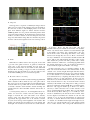
and carpets as the obstacles. We wanted to use segmented
image rather than edge detected image because we believed
that segmented image just would work better. But we were
not successful in finding decent Java segmentation code
and was not really able to connect Java with c++ based
segmentation due to image file type support of Java.
C. Experiment with SURF Navigation
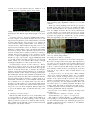
We did an experiment to find the best threshold to determine whether two pictures are of the same area. We first
tried a ratio threshold which considers two images to be the
same if the number of matched points divided by the number
of interested points is above the threshold. However, this did
not work well for pictures with too few interested points. So
we tried an absolute threshold and used 5 matched points
which gives the best result according to our experiment. The
absolute threshold still also causes some problems, so we add
another mechanism to allow Rovio to localize itself in both
backward in forward direction on the waypoint and estimated
its current position by the most matched picture based on the
number of matched points, the number of interested points,
and the ratio. When tested on Rovio, this method seems to
give better localization and Rovio lost track of waypoint in
less than 10
D. Experiment with Obstacles
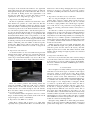
As described earlier, we were successful in doing obstacle
learning and avoidance of many types of obstacles just based
on image processing. The only problem was such objects
such as leg of chair which actually is very close to Rovio but
seems to be located very far to single camera based Rovio.
between two AP’s. It keeps changing the access points and
therefore is frozen for a long time. To prevent it, a laptop
was made as a WIFI point itself, and someone follows Rovio
with it.
F. Experiment with Obstacle Size Calibration
Two very long and straight rods were used to measure the
viewing angle of Rovio’s camera. They located in front of
Rovio and were adjusted so that they are just out of bounds
from Rovio’s sight, parallel to the vertical edges of pictures.
As a result, the two rods positioned as a big V-shape with
angle of 52, and any point inside could be seen by Rovio’s
camera.
To relate the coordinate of a pixel from the camera and its
actual location, an object was placed in 11 different distances
straightly in front of Rovio (the middle x-coordinate in picture). Pictures were taken independently for 1each datapoint,
and the plot of y-coordinate of picture vs actual distance were
drawn. It was found out that they have quadratic relation with
y-coordinate, and linear relation with x-coordinate. The error
bound was about 3mm.
Similar approach was used for height measurement. Objects with different heights were placed at different points
(and those points were the same for all objects), and their
heights in pixel were recorded. The relation between actual
distance and the change in height in picture was measured
and recorded.
G. Experiment with Battery Life
Rovio has a very short bettery life, and is often not charged
very well. It was common for a Rovio (dramatically different
from each Rovio) to run out of battery and stop in the middle.
We tried to minimize the number of HTTP requests to Rovio
to use less battery.
V. C ONCLUSION
There was another problem with learning which was
caused by instability of IR sensor. IR sensor sometimes
wouldn’t detect one-inch tall obstacles. In that case, Rovio
would just run over it. Even though it was real obstacle,
Rovio was able to climb over and pass-by the obstacle which
is not a big of problem.
And as described earlier, though there were lots of challenges, obstacle learning and avoidance works well on both
carpet and glossy surface of the hallway.
E. Experiment with WIFI Access Points
When Rovio changes AP, it freezes for a while. This
especially causes a problem when Rovio is around the border
Rovio navigates reasonably well based on vision waypoint
and is able to avoid various types of obstacles on both carpets
and glossy surface as shown in the video. Rovio barely
ever hits an obstacle as long as Rovio is fully charged and
IR sensor returns correct value. When Rovio is not fully
charged, they tend to make smaller turn which makes Rovio
to sometimes hit obstacles by the side-wheel slightly. But
even though it is not charged fully, it navigates without
too much of a problem. Best part was that it was able to
distinguish between real obstacles and tiles on the floor.
It was able to navigate anywhere in Upson Hallway even
though it had lots different colors and sets of tiles. One of
the longest drive without hitting we were able to see was
from Robot Lab to another Robot Lab (Prof. Saxena’s Lab)
and almost all the way back to the location where we started.
Unfortunately, we were not able to take video due to problem
where WIFI Access Point caused problem or Rovio’s battery
would die out before traveling farther.
Navigation using SURF also worked well given that the
images on the waypoint have sufficient number of interested
points. If the image has too few features, Rovio sometimes