1
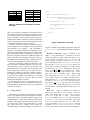
Annotations type
May throw
NodeResource held
NodeMutex not held
NODEA Resource held
NODEA Resource release all
OUT parameter modified
Parameter flag set
Total
# of inferred annot
914
107
674
360
210
271
331
2867
Figure 9. Distribution of inferred annotations.
3. NodeMutex not held: This infers a set of procedures
where the NodeMutex field of the global NODE is not
held at entry. Since most procedures acquire and release this lock locally inside a procedure, this annotation is useful for proving that locks are not acquired
twice.
4. NODEA Resource held: This infers that the
Resource field for an NODEA parameter or the
Resource field for the parent of an NODEB or
NODEC object is held at entry to a set of procedures.
This along with NodeResource ensures absence of
data races.
5. NODEA Resource release all: This infers the set of
procedures that could release the Resource field of
any NODEA object by a transitive call to the procedure
CompReleaseAllNodeAResources.
6. OUT parameter modified: This adds a modifies
(x) annotation for an out parameter x that is modified
inside a procedure.
7. Parameter flag set: This infers a set of procedures
where a certain field of a parameter is set on entry
to the procedures. The parameter captures the state
of computations that span multiple procedures and is
threaded through the nested procedure calls. The parameter Context in Figures 7 and Figure 8 is an example of such a parameter.
5.4
Assumptions
H AVOC provides a set of options that allows the user to
introduce a class of explicit assumptions into the verification, which can be enumerated and discharged later with
more annotations or a separate analysis. This allows the
user of the tool to control the degree of unsoundness in the
verification, and to recover from them using more annotations. This is in contrast to most other static analysis tools
that bake these assumptions into the analysis and there is no
way to recover from them. There are three main sources of
such assumptions in our current analysis: (1) field safety,
(2) type invariants and (3) free modifies.
Field safety. We assume that the addresses of two different word-type fields (fields that are not nested structures
or unions) can never alias, i.e. a write to x->f does not
affect any constraint involving y->g, when f and g are
distinct fields. This assumption is mostly maintained with
the exception of cases where the program exploits structural subtyping whereby two structures with identical layout of types are considered equivalent, even though the field
names might differ.
Type invariants. The type invariants are currently assumed at user-specified control locations, and help to reduce
false positives significantly when dealing with unbounded
set of objects. Although such assertions can be proved in
H AVOC [18], it requires reasoning with quantifiers and the
annotation overhead is fairly high.
Free modifies. Specifying sound modifies clauses can
be challenging for large code bases such as C OMP. Currently, our analysis provides sound modifies clauses for the
fields that are present in the property description (e.g. the
state of the locks in different objects, reference count fields),
but is unsound with respect to most other fields.
Of the three options, we believe that both field safety
and the type invariants hold for the module with very few
exceptions and separate the proof of the high-level properties from the proofs of type-safety and type/shape invariants. However, the free modifies option has the potential to
suppress some real errors, and we are working on removing
this option.
6 Related Work
There is a rich literature on static analysis tools for finding various defects in software programs. We categorize
these tools into the following broad categories:
Annotation-based checkers. Our tool is closely based
on the principles of ESC-JAVA [15] tool for JAVA programs and SPEC# [5] tool for C# programs. The main difference lies in our focus on systems program written in C
with support for low-level operations in both the source and
the annotation language. Although these tools have been
applied to real programs, we believe that they have not been
applied successfully to a module of comparable size or complexity as C OMP.
Dedicated property checkers. A majority of the numerous static analysis tools developed for systems software in the last decade fall in this category — we highlight
only a representative sample for the different properties that
scale to several thousand lines of code. Examples of data
race checkers include RELAY [20], LOCKSMITH [19],
RacerX [12]. CALYSTO [2] finds null dereference bugs
in C programs by using SAT solvers. The ASTRE É an-