1
assign ((resid 5 and name HA)) ((resid 67 and name HN)) 3.555 3.555 0.876 !
The program requires that the interacting proton names conform with the latest PDB naming
convention. A line comment in the file noe.txt starts with // as shown above.
rdc medium1.txt
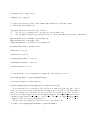
This file contains the RDCs in xplor format, e.g.,
assign ( resid 500 and name OO)
( resid 500 and name Z)
( resid 500 and name X)
( resid 500 and name Y)
( resid 15 and name N)
( resid 15 and name HN) -10.5000 0.0000 0.0000
The RDCs are read from this file.
seq.txt
This file specifies the amino acid sequence of the protein in the format
residueNumber threeLetterIUPACAminoAcidName.
talos+ Dihedral Restraints in talos.txt
We use talos + dihedral restraint format to specify dihedral restraints predicted from the analysis
of the chemical shift information.
5.3
Output Format
The output directory, is automatically created when pool executes, and the ensemble of loop
conformations are written into solutionFragments.pdb, the file specified in dirArch.txt against
the tag bestFragmentPdbFile.
In addition, a directory is created to keep the log files for the execution of pool. The log
file solutionLog.txt and mostRecentLeaf.pdb respectively hold the progress of the execution of
pool, and the fragment corresponding to the most recently evaluated leaf node of a solution tree.
6
Examples
This distribution comes with seven examples of how to prepare the input files and run pool on
proteins. For ubiquitin (two examples), experimental NMR data is used. For the rest five proteins,
since no NMR data is available, simulated RDCs are used. These loops vary in size (i.e., the number
of residues in the loop) from 6 to 12. Specifically, the lengths of the seven loops are 6, 7, 8, 12, 12,
12 and 12.
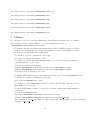
To invoke pool for each of these loops, the following commands can be issued (in parallel
without any problem) in any order:
java analytic/Pool -masterdir EXPERIMENTS/1d3z_17_23/
10