1
through the condenser for a standard microscope slide. Depressing the
left side switch turns on the supra-stage light for macro and opaque
objects.
Built-in Illuminator(s)
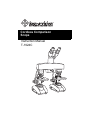
T-1924C - There are two illuminators built into to each of the microscope
bases, one is sub-stage and one is supra-stage. The supra-stage
illuminator is necessary for macro or opaque specimens where light
from the sub-stage illuminator can not come through. Only one of
these illuminators can be on at a time (not both), but both will change
their intensity by using the rheostat.
Focus
Be sure the X-axis (in the middle of the Bridge Assembly) control
knob lever is in the "unlock" position, and while looking through the
eyepieces make sure the X-axis control knob is in the middle. Each
microscope works independently and must be focused independently.
Note - In the T-1924C, be sure that the floating stage is centered directly
over the sub-stage illuminator, so light comes through. - The floating
stage can actually cover up the sub-stage illuminator so no light comes
through.
Place a specimen slide on the stage of the microscope, and move the
specimen into place for viewing. First, put the 4x objective in position of
use. Using the coarse adjust knob (larger of two) raise the stage until it
will go no higher. Now looking through the eyepieces, lower the stage
(again using the coarse adjust), bringing the specimen into focus. Use
the fine adjust knob (smaller of two) to now sharpen the focus and attain
maximum resolution. Now rotate the 10x objective into place, and you
should only have to use the fine adjust to achieve a crisp focus (The
microscope is Parfocal). Now the 40x objective can be similarly utilized if
needed.
Note - on the T-1924C you may start with the 2x objective if you choose
to.
With coaxial focusing, both the coarse focus (large knob) and fine
focus (small knob) are on the same axis. Having both sets of knobs on
the same axis makes it easier to switch from one focus knob to the other
without moving eyes away from the eyepieces. Repeat this procedure
with each of the two microscope bases.
5