1
CircuLex
Human ISG15 ELISA Kit
User’s Manual
For Research Use Only, Not for use in diagnostic procedures
On
ly!
TM
Calculations
rp
os
e
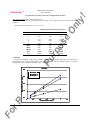
Average the duplicate readings for each Standard Solution, control, and sample and subtract the
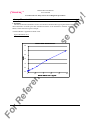
average zero standard optical density. Plot the optical density for the standards versus the concentration
of the standards and draw the best curve. The data can be linearized by using log/log paper and
regression analysis may be applied to the log transformation. To determine the human ISG15
concentration of each sample, first find the absorbance value on the y-axis and extend a horizontal line
to the standard curve. At the point of intersection, extend a vertical line to the x-axis and read the
corresponding human ISG15 concentration. If the samples have been diluted, the concentration read
from the standard curve must be multiplied by the dilution factor.
1. The dose-response curve of this assay fits best to a sigmoidal four-parameter logistic equation. The
results of unknown samples can be calculated with any computer program having a four-parameter
logistic function. It is important to make an appropriate mathematical adjustment to accommodate for
the dilution factor.
2. Most microtiter plate readers perform automatic calculations of analyte concentration. The calibration
curve is constructed by plotting the absorbance (Y) of calibrators versus log of the known
concentration (X) of calibrators, using the four-parameter function. Alternatively, the logit log
function can be used to linearize the calibration curve (i.e. logit of absorbance (Y) is plotted versus
log of the known concentration (X) of calibrators).
Pu
Measurement Range
The measurement range is 0.188 ng/mL to 12 ng/mL. Any sample reading higher than the highest
standard should be diluted with Dilution Buffer in higher dilution and re-assayed. Dilution factors need
to be taken into consideration in calculating the human ISG15 concentration.
ce
Troubleshooting
en
1. The Standard Solutions should be run in duplicate, using the protocol described in the Detailed
Protocol. Incubation times or temperatures significantly different from those specified may give
erroneous results.
2. Poor duplicates, accompanied by elevated values for wells containing no sample, indicate insufficient
washing. If all instructions in the Detailed Protocol were followed accurately, such results indicate a
need for washer maintenance.
er
3. Overall low signal may indicate that desiccation of the plate has occurred between the final wash and
addition of Substrate Reagent. Do not allow the plate to dry out. Add Substrate Reagent immediately
after wash.
ef
Reagent Stability
rR
All of the reagents included in the CycLex Research Product CircuLex Human ISG15 ELISA Kit
have been tested for stability. Reagents should not be used beyond the stated expiration date. Upon
receipt, kit reagents should be stored at 4°C, except the reconstituted ISG15 Standard must be stored at
below -70°C. The Microplate should be stored in the original foil bag sealed by the zip lock and
containing a desiccant pack.
Fo
Cat#: CY-8085
9
Version#: 120710