1
1 INTRODUCTION
5
1 Introduction
Galois Field arithmetic forms the backbone of erasure-coded storage systems, most famously the Reed-Solomon
erasure code. A Galois Field is defined over w-bit words and is termed GF (2w ). As such, the elements of a Galois
Field are the integers 0, 1, . . ., 2w − 1. Galois Field arithmetic defines addition and multiplication over these closed
sets of integers in such a way that they work as you would hope they would work. Specifically, every number has a
unique multiplicative inverse. Moreover, there is a value, typically the value 2, which has the property that you can
enumerate all of the non-zero elements of the field by taking that value to successively higher powers.
Addition in a Galois Field is equal to the bitwise exclusive-or operation. That’s nice and convenient. Multiplication
is a little more complex, and there are many, many ways to implement it. The Paper describes them all, and the
following references provide more supporting material: [Anv09, GMS08, LHy08, LD00, LBOX12, Pla97]. The intent
of this library is to implement all of the techniques. That way, their performance may be compared, and their tradeoffs
may be analyzed.
When used for erasure codes, there are typically five important operations:
1. Adding two numbers in GF (2w ). That’s bitwise exclusive-or.
2. Multiplying two numbers in GF (2w ). Erasure codes are usually based on matrices in GF (2w ), and constructing these matrices requires both addition and multiplication.
3. Dividing two numbers in GF (2w ). Sometimes you need to divide to construct matrices (for example, Cauchy
Reed-Solomon codes [BKK+ 95, Rab89]). More often, though, you use division to invert matrices for decoding.
Sometimes it is easier to find a number’s inverse than it is to divide. In that case, you can divide by multiplying
by an inverse.
4. Adding two regions of numbers in GF (2w ), which will be explained along with...
5. Mutiplying a region of numbers in GF (2w ) by a constant in GF (2w ). Erasure coding typically boils down
to performing dot products in GF (2w ). For example, you may define a coding disk using the equation:
c0 = d0 + 2d1 + 4d2 + 8d3 .
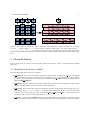
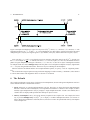
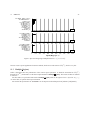
That looks like three multiplications and three additions However, the way that’s implemented in a disk system
looks as in Figure 1. Large regions of disks are partitioned into w-bit words in GF (2w ). In the example, let us
suppose that w = 8, and therefore that words are bytes. Then the regions pictured are 1 KB from each disk.
The bytes on disk Di are labeled di,0 , di,1 , . . . , di,1023 , and the equation above is replicated 1024 times. For
0 ≤ j < 1024:
c0,j = d0,j + 2d1,j + 4d2,j + 8d3,j .
While it’s possible to implement each of these 1024 equations independently, using the single multiplication
and addition operations above, it is often much more efficient to aggregate. For example, most computer architectures support bitwise exclusive-or of 64 and 128 bit words. Thus, it makes much more sense to add regions
of numbers in 64 or 128 bit chunks rather than as words in GF (2w ). Multiplying a region by a constant can
leverage similar optimizations.
GF-Complete supports multiplication and division of single values for all values of w ≤ 32, plus w = 64 and w =
128. It also supports adding two regions of memory (for any value of w, since addition equals XOR), and multiplying
a region by a constant in GF (24 ), GF (28 ), GF (216 ), GF (232 ), GF (264 ) and GF (2128 ). These values are chosen
because words in GF (2w ) fit into machine words with these values of w. Other values of w don’t lend themselves
to efficient multiplication of regions by constants (although see the “CAUCHY” option in section 6.1.5 for a way to
multiply regions for other values of w).