1
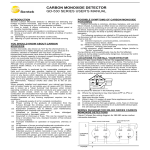
CARBON MONOXIDE DETECTOR
GD-530 SERIES USER’S MANUAL
INTRODUCTION
Sentek’s Carbon Monoxide Detector is effective for detecting any
buildup of carbon monoxide, also known as CO gas, in your home
or office . The features of your CO gas detector includes:
(1) Easy to install. It allows connecting to fire control panel or
security monitoring system.
(2) Monitoring for carbon monoxide in a continuous manner.
(3) Giving a loud alarm (85 dB) when it detects a buildup of carbon
monoxide.
(4) Self-testing its operative functions continuously.
(5) Offering a 5-year warranty for the carbon monoxide sensing
unit.
YOU SHOULD KNOW ABOUT CARBON MONOXIDE
Carbon monoxide, also known as "CO" by the chemical form, is
considered to be a highly dangerous poisonous gas, because it is
colorless, odorless or tasteless and very toxic. In general,
biochemistry phenomena have shown that the presence of CO gas
inhibits the blood's capacity to transport oxygen throughout the body,
which can eventually lead to brain damage.
In any enclosed space (home, office, recreational vehicle or boat)
even a small accumulation of CO gas can be quite dangerous.
Although many products of combustion can cause discomfort and
adverse health effects, it is CO gas which presents the greatest
threat to life.
Carbon monoxide is produced by the incomplete combustion of
fuels such as natural gas, propane, heating oil, kerosene, coal,
charcoal, gasoline, or wood. The incomplete combustion of fuel can
occur in any device which depends on burning for energy or heat
such as furnaces, boilers, room heaters, hot water heaters, stoves,
grills, and in any gasoline powered vehicle or engine (e.g. generator
set, lawnmower). Tobacco smoke also adds CO to the air you
breathe.
When properly installed and maintained, your natural gas furnace
and hot water heater do not pollute your air space with CO. Natural
gas is known as a "clean burning" fuel because under correct
operating conditions, the combustion products are water vapor and
carbon dioxide (CO2), which is not toxic. The products of
combustion are exhausted from furnaces and water heaters to the
outside by means of a fuel duct or chimney.
Correct operation of any burning equipment requires two key
conditions:
(a) An adequate supply of air for complete combustion.
(b) Proper venting of the products of combustion from the
furnace through the chimney, vent or duct to the outside.
Typical carbon monoxide gas problems are summarized here:
(a) Equipment problems, due to defects, poor maintenance,
damaged and cracked heat exchangers
(b) Collapsed or blocked chimneys or flues, dislodged,
disconnected or damaged vents
(c) Downdraft in chimneys or flues. This can be caused by very
long or circuitous flue runs, improper location of flue exhaust
or wind conditions
(d) Improper installation or operation of equipment, chimney or
vents
(e) Air tightness of house envelop/inadequate combustion of air
(f) Inadequate exhaust of space heaters or appliances
(g) Exhaust ventilation/fireplace competing for air supply
Potential sources of carbon monoxide in your home or office
include clogged chimney, wood stove, wood or gas fireplace,
automobile and garage, gas water heater, gas appliance, gas
or kerosene heater, gas or oil furnace, and cigarette smoke.
POSSIBLE SYMPTOMS OF CARBON MONOXIDE
POISONING
Carbon monoxide is colorless, odorless, tasteless, and very toxic.
When inhaled, it produces an effect known as chemical asphyxiation.
Injury is due to the combining of CO with the available hemoglobin in
1
the blood, lowering the oxygen-carrying capacity of the blood. In the
presence of CO gas, the body is quickly affected by oxygen
starvation.
The following symptoms are related to CO poisoning and should
be discussed with all members of the household so that you know
what to look for:
(a) Extreme exposure: unconsciousness, convulsions,
cardiorespiratory failure, death
(b) Medium exposure: severe throbbing headache, drowsiness,
confusion, vomiting, fast heart rate
(c) Mild exposure: slight headache, nausea, fatigue (similar to
"flu-like" symptoms)
Young children and household pets may be the first affected.
Exposure during sleep is particularly dangerous, because the victim
usually does not awaken.
LOCATIONS TO INSTALL YOUR ETECTOR
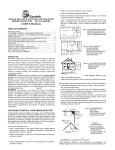
Since CO gas moves freely in the air, the suggested location is in or
as near as possible to sleeping areas of the home. The human body
is most vulnerable to the effects of CO gas during sleeping hours.
For maximum protection, a CO detector should be located outside
primary sleeping areas or on each level of your home. In the figure
below, are suggested locations in the home. The electronic sensor
detects carbon monoxide, measures the concentration and sounds a
loud alarm before a potentially harmful level is reached.
Do not place the detector in the following areas:
(a) Where the temperature may drop below 40°F (4.4°C) or
exceed 122°F (50°C)
(b) Near paint thinner fumes
(c) Within 5 feet (1.5 meter) of open flame appliances such as
furnaces, stoves and fireplaces
(d) In exhaust streams from gas engines, vents, flues or chimneys
(e) Do not place in close proximity to an automobile exhaust pipe;
this will damage the detector
Wiring Diagram for CO-530 Series CARBON
MONOXIDE DETECTORS
Figure 2 shows the wiring diagram for CO-530 series carbon
monoxide detectors.
3
INSTALLING THE BASE OF DETECTOR
(1)
(2)
All the wires in the base compartment should be flattened and
are not touched to any connectors to ensure that the detector
head be smoothly fastened to the base.
When using the jump wires to check the connectivity for each
gas detector in the circuit loop (e.g. connecting point 2 and
point 3 with a jump wire as shown in Figure 3), be sure to
remove all the jump wires before attaching the detector head
onto the base.
2
(3)
(4)
Be sure that the components used in the circuit loop as shown
in Figure 3 should be coupled up with those components used
in the transceiver circuitry of the control panel.
The base is allowed to be installed within an available wiring
box including octagon box (3”, 3.5”, or 4”), circular box (3”) and
rectangular box (4” long), without using any other additional
mechanical adapters.
INSTALLING THE DETECTOR HEAD
(1)
(2)
Align up the position of head to the base, see Figure 4.
Screw the detector head into the base in clockwise direction.
immediately. Do a head count to check that everybody is
accounted for.
(b)
Do not re-enter the premises until the problem has been
corrected and the CO gas has been dispersed out and a safe
level is reached.
(c)
If no symptoms exist, Immediately ventilate the home by
opening windows and doors. Turn off fuel burning appliances
and call a qualified technician or your utility company to
inspect and repair your problem before restarting appliances.
WARNING: Normally an activation of the detector indicates the
presence of CO gas. However, the CO gas can be extremely fatal, if
it is not detected. The source of the CO gas may come from several
possible situations, please refer to the list of sources of carbon
monoxide in page 1.
CAUTION: This detector will only indicate the presence of CO gas
at the sensor. However, you have to be aware that the CO gas may
be present in other areas in the premises.
ACTIONS TO TAKE AFTER THE PROBLEM BEING
CORRECTED
Figure 3 Alignment of detector head and its base
MAINTENANCE OF CARBON MONOXIDE
DETECTORS
A CO detector constantly monitors any carbon monoxide under its
normal operational conditions. The following maintenance
procedures for the detectors will assure its desired performance:
(1) Use a vacuum cleaner to clean the dust around the vent holes
of gas detector cover.
(2) Carry out a regular or weekly test of gas detectors.
Once the problem about the CO gas presence in the premises has
been corrected, the alarm of the detector should be off. After waiting
for 10 minutes, push the Test button to test the detector so that you
can make sure that the detector is working properly again
SPECIFICATION:
Gas Monitored
Operating Voltage
Sensitivity(EN)
Alarm Sounds
Operating Temp
Power Consumption
Output
2/4
Wire
Voltage DC
min/max
CO530
2
12/24
CO530R
4
12/24
CO530I
4
12/24
Mode
Figure 4 Front cover of detector head
CO
12Vdc ~ 24Vdc
50ppm within 70 minutes
100ppm within 30 minutes
300ppm within 1 minutes
75dB
0℃~50℃
3W
CO530R: Buzzer
CO530R: Buzzer and Relay Output (NO or NC)
CO530I: Buzzer and Interconnection
Standby Current
12V /24V
17 mA (12V)
10 mA (24V)
17 mA (12V)
10 mA (24V)
17 mA (12V)
10 mA (24V)
Alarm Current
12V/24V
25 mA(12V)
18 mA(24V)
30 mA(12V)
20 mA(24V)
28 mA(12V)
19 mA(24V)
Humidity
Base Mode
30%~90%
P/N852001
30%~90%
P/N854001
30%~90%
P/N854001
TYPES FOR DETECTOR SIGNALING
WARNING AND LIMITATION
The carbon monoxide detector has to be warmed up for at least 10
minutes with green LED flashing after being energized, then the test
procedure can be followed. There are three types of detector
signaling:
(1) Green LED lighting indicates that the detector is in the normal
monitoring condition.
(2) When the carbon monoxide is detected, the green light will
change to flashing of red LED light, accompanying the alarm
sounds (3 beeps).
(3) If the detector is not in normal operation, the buzzer will chirp
once every 15 seconds to indicate that the malfunction is detected
by the built-in self-monitoring circuitry.
(4) When interconnected, the red LED flashing as companying alarm
sound (2 beeps) when other detector alarm.
Note that CO530 series carbon monoxide detector is not supposed
to be used as smoke detector or fire alarm. In addition, this detector
should not be installed in a “danger area” as defined by National
Electrical Code. A gas detector will operate normally under regular
power supply, therefore, it will not perform at any situation when
power outage occurs.
WARRANTY INFORMATION
Under the normal operation conditions, the manufacturer provides
five-year warranty for the sensor head of gas detector and one-year
warranty for other parts for repairing without charge. Part and labor
charge will be required after the warranty is expired.
ACTIONS TO TAKE WHEN ALARM SOUNDING
In case of harmful levels of CO gas being detected, your detector will
go into a continuous full alarm. Try to take the following necessary
actions immediately:
(a)
If there is anyone experiencing the effects of carbon monoxide
poisoning such as headache, dizziness, nausea or other flulike symptoms, call your fire department right away or 911.
You should evacuate all the people in the premises
3
Sentek Electronics Co., Ltd.
#28 Zhongtang Road, Wangchun, Ningbo City 315016,
Zhejiang Province, China
4