1
©PPVMEDIEN 2011
Stage test
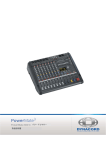
DynacOrD POwermate 1000-3
the new Power
Generation
Data
PRICE �2,430 £
INPUTS 6 Mono, 4 Stereo
TONE CONTROLS Mono:
3-band EQ, Low-Cut,
Voice Filter Stereo:
3-band EQ
AUXILIARY BUSSES 6
EFFECTS 2 x 100 + 20
User
POWER 2 x 1,000 W into
4 ohms
DIMENSIONS 51 x 16 x
57 cm (table-top)
48 x 13 x 44 cm (rackmount)
WEIGHT 14 kg
INFO www.dynacord.de
80
tastenwelt 6/2010
©PPVMEDIEN 2011
test Stage
G
eneration change on stage: Dynacord ‘s developers have been busy; and, yet again,
they’ve come up with the goods – in the shape of the brand-new, and truly astonishing, PowerMate3 family of powered mixers. Aware that its
predecessors, PowerMate Generations I and II, had
themselves set new standards for this breed of device, we were more than interested to see how this
latest generation would shape up in practice. In our
first test, we put the smallest model in the series,
the PowerMate 1000-3, through its paces
channels
The test model is, as we have noted, the smallest
model in the new series, offering six mono and four
stereo input channels. The integrated digital power
amplifier delivers 2 x 1,000 watts, in each case into
four ohms. The family is completed by two larger
models: the PowerMate 1600-3 with twelve, and
the PowerMate 2200-3 with eighteen, mono channels; and since models numbers do generally mean
something, you’ll have deduced that they, too, offer
four stereo channels.
The mono channels will accept both microphone
and line level signals, in each case using balanced
connections. Each of the mono channels is equipped with a three-band equalizer with a sweepable
Mid; this is followed by a typical Dynacord feature,
a Voice filter as well as a Low-Cut filter with a turnover frequency of 80 Hz. This type of tone control
section proved its effectiveness in the earlier models and has therefore been retained.
The spec has, however, been expanded with the
introduction of new auxiliary busses: in the third
PowerMate generation, there are not four but six of
these, each of which can be used independently.
Two of these busses, as is typically the case, are
switched pre-fader and therefore recommended for
monitoring duties; two others are linked internally
with the PowerMate’s two multi-effects processors.
The remaining pair can be switched, according to
choice, pre- or post-fader; the choice is made for
each bus separately but for all channels globally
using a switch in the master section.
These additional aux busses can be used for a
wide variety of applications: whether as additional
monitor or effects sends, to provide an independent
recording mix, or as separate sound reinforcement
www.tastenwelt.de
tecHnIK
If Prince still had his old backing group, “The New Power
Generation”, that would be the ideal slogan for the launch of
the new PowerMate series. The Prince band has, of course,
been consigned to history. Not so the PowerMate3, now
leading the entire breed of powered mixers towards a bright
new future
USB Deluxe
The new PowerMates boast a
powerful four-channel USB
interface. Thanks to modern
driver technology, the PowerMate, when combined with a
desk- or laptop computer,
can function as a digital
home studio with four inputs
and outputs. The requisite
software, in this case Cubase LE, is even included in the
delivery, so you can get started at once. A big plus in
this context is the fact that
the ASIO drivers supplied are
virtually latency-free in their
operation. The USB interface
is also unusually flexible
thanks to the choice of routing options: using the
PowerMate’s menu, you can
elect swiftly, which of the
desk’s output busses you
wish to route to the recording
device. But not only in the
home studio but also in live
performance, the USB interface represents a invaluable
addition to the spec: and
when the band takes a
break, a DJ armed with the
usual software can take over
the rig and transform the
PowerMate into a control
centre for his or her own
performance.
81
©PPVMEDIEN 2011
Stage test
PFL buttons, pan pots and channel faders – round
off both the mono and the stereo channel strips.
Effects
The new PowerMates have two digital effects processors on board. In the current firmware versions,
both processors offer you 100 effects programs as
well as the possibility of creating and saving 20 programs of your own. In other words, anyone who
finds their needs are not fully catered for by the
factory presets – which, it has to be said, are very
well programmed – is in the happy position of being
able to do something about it.
The possibilities for intervention are comprehensive and of great practical value, making it possible
to work not only very intuitively but also creatively
with the two processors. A graphic display, four buttons and an encoder comprise the programming
interface.
Outputs
Features
Among other things, the provision of auxiliary busses (previously four, now six) has been
expanded
82
Speaker
protection
The “Speaker Protection”
alluded to in the spec turns
out to be a dynamic circuit
that serves to protect the
connected loudspeakers.
From the menu, you would
suppose all that’s involved
here is a stepped reduction
of the maximum output of
the power amplifiers, but in
fact the processor-controlled protective circuitry is
considerably more sophisticated in its operation than
that, having no influence
whatever upon those impulses that are important
to the dynamic range but
preventing – and preventing very effectively – the
power handling capabilities
of the speaker being overtaxed for any length of
time. In this way, it prevents the voice coils overheating and therefore protects the drivers reliably
against overload.
busses, they have all bases covered. The two auxiliary busses are particularly interesting in the light of
the USB interface on board the new PowerMate,
but more of this later.
A glance at the stereo channels reveals only minor differences: one is that the centre frequency of
the Mid (band-pass) filter in the stereo channel
equalizers is fixed; another, that the stereo channels lack the low-cut and voicing filters offered by
the mono channels. These are hardly shortcomings,
however, as stereo channels are usually reserved for
line level signals from devices like keyboards, samplers and the like that seldom call for drastic intervention. The essential control elements – mute and
On the output side, the PowerMate 1000-3 offers a
wealth of options. In addition to the signal sum and
an additional B output with level control, all the
auxiliary busses are available – the two explicitly
defined as monitor busses are even present on balanced XLRs as well as the more common jack sockets. The two monitor channels are equipped with
notch filters in the Master section for feedback suppression. These sweepable filters have very sleep
slopes (hence the name ‘notch’) and are therefore
capable of eliminating feedback without otherwise
making much impact upon the audio signal. Hardly
the most filigree of solutions to the problem of feedback, but nonetheless a very helpful one at times.
Far more subtly differentiated, of course, is the
sound texturing provided by the 11-band graphic
equalizer, which can be introduced, according to
choice, into the sum (the Master L/R channel) or
else either or both of the PowerMate’s monitor
sends. With this, you can fine-tune the frequency
response until just the right sound is achieved.
The MIDI connectors provide a PC-MIDI interface, allowing the integrated effects devices to be
controlled remotely (program change) via the MIDI In port
tastenwelt 6/2010
©PPVMEDIEN 2011
test Stage
For keyboard soloists to
trios, even the PowerMate
1000-3 offers enough channels (6 mono, 4 stereo).
Larger bands or ensembles
will find their needs catered to by either the 12- or
the 18-channel model.
.
Amplifiers
The power amplifiers of the new PowerMate deliver
2 x 1,000 watts into 4 ohms, making the device
suitable also for medium-sized venues. The power
amplifiers can actually support impedances as low
as 2.6 ohms, so up to three 8-ohm loudspeakers
can therefore be driven from the same output.
Thanks to the use of digital Class D technology,
the new generation of PowerMates are considerably
lighter than their predecessors. The smallest model
in the series, for example, used to weigh around 20
kg, whilst the new PowerMate 1000-3 (including
the lid) tips the scales at a mere 14 kg – in other
words, around 30 per cent less.
As an alternative to use with passive sound reinforcement boxes, the amps of the PowerMate can
be redeployed to the monitor sends, allowing active
systems to be driven from the line output of the
sum. Even mixed configurations, such as passive
tops and active subwoofers, can be implemented
without any problems. The PowerMate offers a wide
variety of options in this area.
footswitch – all these are done using the four function keys below, and the encoder alongside, the display.
In terms of sound, the new PowerMate is flawless. The tone controls are musical and unobtrusive
in their operation, though at times one might wish
for a second band-pass in the microphone channels
to provide a more sophisticated means of licking
into shape sensitive or complex signals. The Voice
filter in the mono channels, on the other hand,
turns out not only to be an invaluable aid to the
shaping of vocal signals but also of great service
when acoustic instruments are involved.
The third PowerMate generation begins where
mixing amplifiers once left off. With its modern digital power amplifiers and two powerful effects processors, its capabilities are scarcely more limited
than those of solutions involving separate power
amplifiers and mixers. The smallest PowerMate
boasts enough inputs for solo performers and even
trios, whilst larger bands or ensembles will find
their needs catered for by either the 12- or the
18-channel model.
Uli Hoppert tw
Practice
The new PowerMate is highly intuitive in its operation, making the task of mixing uncomplicated and
easy to perform well. Thanks to the integrated
handle and removable lid, it is also very easy to
carry. This has much to do also with the drastic reduction in weight, which has turned the third generation PowerMates into most agreeable travelling
companions. It is also possible to work with the PowerMate without constantly having to consult the
user manual. It is only for unusual tasks that the
more detailed information in the manual is required.
The display of the new PowerMate is itself a helpful source of information as well as a functional
control centre. It offers access to all the core functions of the device: the selection and editing of effects, the configuration of recording and playback
channels via USB, the activation of the power manager, definition of the functions of the optional
www.tastenwelt.de
assessment
Dynacord Powermate 1000-3
Powered mixer
numerous features
intuitive operation
effects flawlessly programmed
high power amp output
flexible bus structure
83