1
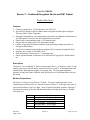
A similar procedure to that used for the Frame Block was used. A test bench once again
read input and output values from files to ascertain correct operation. Once again a C
program was used to produce these input and output files. Listed below are the cases that
were tested:
•
•
•
•
•
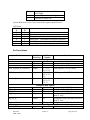
Base Case #1: Data is all zeros except for frame bits. The output data should be all
zeros.
Base Case #2: Data is all ones except for frame bits. The output data should be all
ones.
Random Case: Data will be produced using the rand function. This will simulate the
average case.
Worst Case: Data will be picked so as all bits follow the T1 format for a relatively
large amount of time. This is the most difficult for the deframe block to detect.
Error Case: Data that does not include an accurate frame bit will be produced. The
deframe block should detect the error and produce an error message before resetting.
Frame synchronization should again be found once the correct data is again passed
These cases should prove sufficient to satisfy in terms of correct deframe block operation.
Testing Strategy for Encryption/Decryption
As there are standard C programs available that perform the encryption and decryption
algorithms these programs were used on pseudo random data to generate a data stream
that can be compared to the output of the Encryption and Decryption blocks. The tests
were performed on various key combinations. Any deviations from expected results
were flagged with a test bench. Given the length of the simulation time, waveform
simulation is not particularly informative. Instead, the VHDL for the test bench has been
included as well as the C code for generating the data. A sample page from the test
bench output can be found in the Appendices.
The basic 3 way cipher block was tested independently as well to ensure that this
implementation is correct since it is critical to the operation of all the other blocks. This
can only be done on a select few cases as it was found that the test bench conversion
procedures are not capable of handling 96 bit vectors. Thus, this is done manually in
Mentor Graphics.
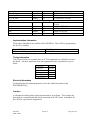
Testing Strategy for Entire Secure-T Design
A test bench will be used to ensure the correct operation of the entire chip. The data from
the chip will be compared to the expected data which will be taken from standard or
custom C programs. The chip will be tested in the following modes
• No encryption - verifies correct operation of the frame/deframe circuitry
• Encryption with Framing - verifies correct operation of the frame and encrypt
Ian Kuon
Mark Calder
Secure-T
Page 21 of 54