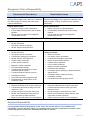
1
Workplace Safety Guide In the event of a work-related injury immediately contact the CAPS Risk Management department: Telephone: 310-280-0755, ext. 2259, 2297 or 2310 E-mail: [email protected] Fax: 310-733-1802 Revised September 23, 2015 Table of Contents Introduction: CAPS Statement on Workplace Safety ......................................................... 5 Purpose of This Guide ............................................................................................. 5 Forms and Instructions for Reporting Injuries ................................................................ 5 Reporting an Injury ................................................................................................ 5 What to Do If… ................................................................................................... 6 An employee is injured on the job ........................................................................... 6 Injured employee refuses medical attention ............................................................... 6 After the accident has been reported ....................................................................... 6 CAPS First Report of Injury Form .............................................................................. 7 Right of Refusal of Medical Aid .............................................................................. 10 Workers' Compensation Claim Form (DWC 1) – California Only .......................................... 11 Injury and Illness Prevention Program (IIPP) ................................................................ 14 Management Commitment and Responsibility ............................................................... 14 Management Chain of Responsibility ........................................................................ 15 Employee Responsibility ...................................................................................... 15 Hazard Reporting ..............................................................................................16 When an Injury Occurs ........................................................................................16 Close Calls ......................................................................................................16 Safety Communications with Employees ..................................................................... 16 Emergency Procedures ........................................................................................ 17 Safety and Emergency Notice Area .........................................................................17 Emergency Contacts Poster ..................................................................................17 Safety Notice Boards ..........................................................................................17 Industry-Wide Labor-Management Safety Committee Bulletins ........................................17 Emergency Action Plan .......................................................................................18 Production Safety Guide ...................................................................................... 18 Safety Training ................................................................................................. 18 Sample Training Outline ......................................................................................18 Safety Meetings ................................................................................................ 18 On-Production..................................................................................................19 Off Production .................................................................................................19 Compliance with Safety Guidelines ......................................................................... 19 Safety Inspections and Reporting .............................................................................. 20 Identified Hazards ............................................................................................. 20 Corrective Action .............................................................................................. 20 Accident Reporting and Investigation ......................................................................... 20 Recordkeeping .................................................................................................... 20 Production Safety Guide......................................................................................... 21 General Safety Rules ............................................................................................ 21 Revised September 23, 2015 Pre- Production and Off Production ......................................................................... 21 Record Keeping ................................................................................................. 21 Injury/Illness and Corrective Action Reports .............................................................. 22 Code of Safe Practice ........................................................................................... 22 Supervisor’s Ten Commandments of Safety .................................................................. 23 Fire Emergencies ................................................................................................. 24 Whether or Not to Fight a Fire ............................................................................... 24 About Fire Extinguishers ...................................................................................... 25 Types of Extinguishers ........................................................................................25 Remember P-A-S-S – Pull, Aim, Squeeze, Sweep..........................................................26 Electricity Safety................................................................................................. 27 Electrical Outlets .............................................................................................. 27 Three-Pronged Outlets ........................................................................................ 27 Portable Power Tools .......................................................................................... 27 Best Practices ..................................................................................................27 Guards ........................................................................................................... 28 Safety Switches................................................................................................. 28 Fall Protection.................................................................................................... Scaffolds......................................................................................................... Ladders .......................................................................................................... Aerial Lifts and Scissor Lifts .................................................................................. 29 29 30 30 Hand Tool Safety ................................................................................................. 31 Best Practices .................................................................................................. 31 Electrical Shock .................................................................................................. 31 What to Do ...................................................................................................... 32 Temperature Extremes .......................................................................................... 33 Hot Weather Effects, First Aid and Best Practices ........................................................ 33 Heat Index Free Mobile App .................................................................................33 Heat Exhaustion ...............................................................................................33 Heat Stroke .....................................................................................................33 Heat Cramps ...................................................................................................33 Heat Fainting ...................................................................................................34 Heat Rash .......................................................................................................34 Good Hot Weather Practices .................................................................................34 Cold Weather Effects, First Aid and Best Practices ....................................................... 34 Hypothermia ...................................................................................................34 Frostbite ........................................................................................................35 Good Cold Weather Practices................................................................................36 Protect Your Back ................................................................................................ 36 Back Safety Tips ................................................................................................ 37 Appendix ........................................................................................................... 38 Revised September 23, 2015 Injury and Illness Prevention Program ........................................................................ 38 Responsibility ..................................................................................................38 Compliance .....................................................................................................38 Communication ................................................................................................38 Hazard Assessment ............................................................................................38 Accident/Exposure Investigations ...........................................................................39 Hazard Correction .............................................................................................39 Training and Instruction ......................................................................................39 Recordkeeping .................................................................................................40 List of Training Subjects......................................................................................41 Hazard Assessment Checklists ...............................................................................41 Emergency Contacts Poster .................................................................................... 44 Emergency Action Plan Overview .............................................................................. 45 Minimum Plan Requirements ................................................................................. 45 Stay or Go? ...................................................................................................... 46 Types of Emergency Events ................................................................................... 46 Fire ..............................................................................................................46 Power Failure ..................................................................................................46 Earthquake .....................................................................................................47 Extreme Weather ..............................................................................................47 After Action Safety Checklist ................................................................................. 47 Emergency Action Plan .......................................................................................... 48 Employee Safety Training Sign-In Sheet ...................................................................... 49 Acknowledgement of Safety Training ....................................................................... 50 Line Producer Safety Checklist................................................................................. 51 First Assistant Director/Technical Lead Safety Checklist .................................................. 52 Location Shoot Safety Checklist ............................................................................... 53 Daily Production Safety Report ................................................................................ 56 Safety Suggestion Form ......................................................................................... 58 Sample Safety Inspection ....................................................................................... 59 Corrective Action Guide ........................................................................................ Investigating an Accident ..................................................................................... Analyzing Risk Factors ......................................................................................... Developing Corrective Action ................................................................................ 60 60 60 61 Corrective Action Form ......................................................................................... 63 No Smoking Sign .................................................................................................. 64 OSHA Reporting Requirements: Work-Connected Fatalities and Injuries ................................ 65 A summary of the OSHA Fatality and Severe Injury and Illness Reporting Requirements ........... 65 California Occupational Safety and Health Regulations (CAL/OSHA) ..................................... 66 Cal/OSHA Regional and District Offices ...................................................................... 67 Revised September 23, 2015 Introduction: CAPS Statement on Workplace Safety Your production company has not only the opportunity but the legal responsibility to provide a safe workplace. This includes identifying and eliminating potential hazards, ensuring that injured workers receive efficient and effective care, investigating accidents and implementing corrective action, and employee safety training. To carry out this purpose, a member of your company will have overall responsibility for workplace safety during each production. Commonly this is the First Assistant Director for film and commercial, the Technical Lead in theatrical venues, or the Safety Director if your company has one. Purpose of This Guide This guide is intended to provide our clients, their Assistant Directors, Team Leaders and Safety Directors with tools and information to minimize the incidence of injuries by understanding and preventing the most common workplace hazards. This guide covers federal Occupational Health and Safety Administration (OSHA) requirements (which are the standard in many states including New York) as well as Cal/OSHA standards for California. Your safety program should be in compliance with the applicable state safety regulations. Please make sure that a health and safety program is implemented on each job you produce as locations, content and personnel can change. If your company has a safety program your team should familiarize itself with that guide. If one is not in place please use this guide. Forms and Instructions for Reporting Injuries Here you will find the injury reporting forms and instructions you will need if an injury occurs. In addition to being included in this guide, these forms are available on the CAPS website: http://capspayroll.com/. Browse to the Resources page, click on Forms and Info and select the Workers’ Compensation Forms section. If a workplace injury occurs you must immediately contact the CAPS Risk Management Department to assist you in completing the required forms and processing the claim: CAPS Risk Management Telephone: 310-280-0755, ext. 2259, 2297 or 2310 / Facsimile: 310-733-1802 Click here for the CAPS Risk Management contact list. E-mail: [email protected] Reporting an Injury The following forms and information must be submitted to CAPS as soon as possible but in no case later than 24 hours after the injury occurs: 1. The First Report of Injury Form must be completed and signed by a company representative such as the First AD or Production Manager. All sections must be completed in full. Use the First Report of Injury Form to describe the circumstances surrounding the injury. If possible take still or moving pictures of the accident scene and submit them along with the paperwork. Revised September 23, 2015 Page 5 of 67 For injuries occurring in California, the injured employee must fill-out the Employee section of the Workers’ Compensation Claim Form (DWC 1). The DWC1 form is also available from the State of California here: http://www.dir.ca.gov/dwc/dwcform1.pdf 2. If the injured employee refuses medical aid, he or she must fill-out the Right of Refusal of Medical Aid Form. This form should be submitted along with the completed First Report of Injury. 3. A copy of the injured employee’s time card should be submitted along with the other documents. What to Do If… An employee is injured on the job Ensure that the individual receives immediate medical care appropriate to the injury Contact the CAPS Risk Management Department immediately by phone or e-mail and inform the representative that an accident has occurred Fill out a First Report of Injury Form. Describe the accident and contributing factors as completely as possible. If in California, have the injured employee fill-out the Employee section of the Workers’ Compensation Claim Form (DWC 1). E-mail, fax or deliver to CAPS the above forms, a copy of the employee’s time card, and any supporting information such as photographs, witness statements, within 24 hours. Injured employee refuses medical attention If the injured employee refuses medical aid, he/she must fill-out the Right of Refusal of Medical Aid form Submit the Right of Refusal of Medical Aid form with the completed First Report of Injury Form. The First Report of Injury Form should be completed even if the person refuses medical treatment. After the accident has been reported Perform an investigation and complete the corrective action form to document appropriate control methods to prevent future injuries. Analyze risk factors created the hazard and implement appropriate management controls to eliminate the hazard. Use the attached Corrective Action Guide for assistance. Retain for your use and send a copy as soon as possible to CAPS via fax. Revised September 23, 2015 Page 6 of 67 Incident Investigation/First Report of Injury INSTRUCTIONS 1. This form should be completed by a Supervisor, not the Employee. 2. This form should be completed as soon as possible, and no later than 24 hours after the incident. 3. Once completed, this form can be faxed to 310-733-1802 or e-mailed to [email protected] INJURED WORKER INFORMATION Name: Social Security No.: Address: City/State/Zip: Phone number: Date of birth: E-mail address: Male Marital Status: Married Female Divorced Separated Date of Injury: Single Wage Rate: Widowed Time of Injury: Date and time reported by employee: : Injury reported to whom (name): If reporting more than 24 hours after date of injury, please note reason: Start Time: Occupation: Date Hired: State of hire: Employee’s last scheduled date to work: Client Company: Job/Project Name: Client Address: Client Phone: Assistant Director/Supervisor/Lead Name: Contact Number: MEDICAL PROVIDER INFORMATION Name of Treating Clinic or Hospital: Address: Was an ambulance called? Phone: YES NO Does employee require additional treatment? YES Is employee missing time from work? YES Revised: September 22, 2015 AM NO NO 10600 Virginia Avenue Culver City, CA 90232 Phone: 310-280-0755 capspayroll.com PM Incident Investigation/First Report of Injury ACCIDENT LOCATION Incident’s exact location and address (include location name, city, state and zip code): Weather conditions: Witness names and phone numbers: Onsite Medic Name: Was this a vehicle accident: Onsite Medic Phone number: YES NO Name of Other Driver: 3rd Party’s Insurance Company and Policy # (if applicable): Was a police report filed? YES NO If yes, please indicate police report number INJURY INVESTIGATION Describe in detail how the injury/illness occurred: Nature of Injury/Illness (e.g. strain, laceration, contusion): Part(s) of body affected (include left or right side of body): List direct cause(s). (e.g. Improper lifting technique, Poor housekeeping): Is surveillance or video available?: YES NO ATTACHED Are photos of the accident location available?: YES NO ATTACHED Are photos of the equipment related to the incident available?: YES NO ATTACHED PERSON COMPLETING FORM Name/Title (Please print) Phone Signature Date Revised: September 22, 2015 10600 Virginia Avenue Culver City, CA 90232 Phone: 310-280-0755 capspayroll.com Incident Investigation/First Report of Injury Voluntary Statement Name: Phone number: Injured Employee Name: Date of Loss: Relationship to Injured Employee: Self Witness Onsite Medic Supervisor Describe the details of the incident (attach additional sheets if necessary): I have reviewed this statement of _____ page(s) and believe it to be true and accurate to the best of my recollection. I understand this voluntary statement may be used as legal documentation. Signature Revised: September 22, 2015 Today’s Date 10600 Virginia Avenue Culver City, CA 90232 Phone: 310-280-0755 capspayroll.com Right of Refusal of Medical Aid CLIENT COMPANY ___________________________ PROJECT TITLE _______________________________ This form has been given to you because you have refused or declined an initial offer of treatment by a set medic or other trained medical personnel or transportation for medical treatment by a health provider. I, _______________________________________, hereby refuse the first aid treatment by the First Aid Person employed on this project or transportation for medical treatment by a health provider for the illness or injury incurred by me on this date _____________________. In signing this waiver, I relieve the production company and CAPS, LLC ("CAPS") from any all liability or damages resulting from this refusal to accept such first aid treatment. Employee Name (Print or Type) Job Title or Position Employee Signature Date Supervisor Signature Supervisor Name (printed) Set Medic Signature Set Medic Name (printed) Please return this form to: New CAPS, LLC 10600 Virginia Avenue Culver City, CA 90232 FAX: 310-733-1802 You may also e-mail a scan of the completed and signed form to [email protected]. 10600 VIRGINIA AVENUE CULVER CITY, CA 90232 310-280-0755 FAX: 310-733-1802 capspayroll.com Workers’ Compensation Claim Form (DWC 1) & Notice of Potential Eligibility Formulario de Reclamo de Compensación de Trabajadores (DWC 1) y Notificación de Posible Elegibilidad If you are injured or become ill, either physically or mentally, because of your job, including injuries resulting from a workplace crime, you may be entitled to workers’ compensation benefits. Attached is the form for filing a workers’ compensation claim with your employer. You should read all of the information below. Keep this sheet and all other papers for your records. You may be eligible for some or all of the benefits listed depending on the nature of your claim. If required you will be notified by the claims administrator, who is responsible for handling your claim, about your eligibility for benefits. To file a claim, complete the “Employee” section of the form, keep one copy and give the rest to your employer. Your employer will then complete the “Employer” section, give you a dated copy, keep one copy and send one to the claims administrator. Benefits can’t start until the claims administrator knows of the injury, so complete the form as soon as possible. Medical Care: Your claims administrator will pay all reasonable and necessary medical care for your work injury or illness. Medical benefits may include treatment by a doctor, hospital services, physical therapy, lab tests, x-rays, and medicines. Your claims administrator will pay the costs directly so you should never see a bill. There is a limit on some medical services. The Primary Treating Physician (PTP) is the doctor with the overall responsibility for treatment of your injury or illness. Generally your employer selects the PTP you will see for the first 30 days, however, in specified conditions, you may be treated by your predesignated doctor or medical group. If a doctor says you still need treatment after 30 days, you may be able to switch to the doctor of your choice. Different rules apply if your employer is using a Health Care Organization (HCO) or a Medical Provider Network (MPN). A MPN is a selected network of health care providers to provide treatment to workers injured on the job. You should receive information from your employer if you are covered by an HCO or a MPN. Contact your employer for more information. If your employer has not put up a poster describing your rights to workers’ compensation, you may choose your own doctor immediately. Within one working day after you file a claim form, your employer shall authorize the provision of all treatment, consistent with the applicable treating guidelines, for the alleged injury and shall continue to be liable for up to $10,000 in treatment until the claim is accepted or rejected. Disclosure of Medical Records: After you make a claim for workers' compensation benefits, your medical records will not have the same level of privacy that you usually expect. If you don’t agree to voluntarily release medical records, a workers’ compensation judge may decide what records will be released. If you request privacy, the judge may "seal" (keep private) certain medical records. Payment for Temporary Disability (Lost Wages): If you can't work while you are recovering from a job injury or illness, for most injuries you will receive temporary disability payments for a limited period of time. These payments may change or stop when your doctor says you are able to return to work. These benefits are tax-free. Temporary disability payments are two-thirds of your average weekly pay, within minimums and maximums set by state law. Payments are not made for the first three days you are off the job unless you are hospitalized overnight or cannot work for more than 14 days. Return to Work: To help you to return to work as soon as possible, you should actively communicate with your treating doctor, claims administrator, and employer about the kinds of work you can do while recovering. They may coordinate efforts to return you to modified duty or other work that is medically appropriate. This modified or other duty may Rev. 6/10 Si Ud. se lesiona o se enferma, ya sea físicamente o mentalmente, debido a su trabajo, incluyendo lesiones que resulten de un crimen en el lugar de trabajo, es posible que Ud. tenga derecho a beneficios de compensación de trabajadores. Se adjunta el formulario para presentar un reclamo de compensación de trabajadores con su empleador. Ud. debe leer toda la información a continuación. Guarde esta hoja y todos los demás documentos para sus archivos. Es posible que usted reúna los requisitos para todos los beneficios, o parte de éstos, que se enumeran, dependiendo de la índole de su reclamo. Si se requiere, el administrador de reclamos, quien es responsable por el manejo de su reclamo, le notificará sobre su elegibilidad para beneficios. Para presentar un reclamo, llene la sección del formulario designada para el “Empleado,” guarde una copia, y déle el resto a su empleador. Entonces, su empleador completará la sección designada para el “Empleador,” le dará a Ud. una copia fechada, guardará una copia, y enviará una al administrador de reclamos. Los beneficios no pueden comenzar hasta, que el administrador de reclamos se entere de la lesión, así que complete el formulario lo antes posible. Atención Médica: Su administrador de reclamos pagará toda la atención médica razonable y necesaria, para su lesión o enfermedad relacionada con el trabajo. Es posible que los beneficios médicos incluyan el tratamiento por parte de un médico, los servicios de hospital, la terapia física, los análisis de laboratorio y las medicinas. Su administrador de reclamos pagará directamente los costos, de manera que usted nunca verá un cobro. Hay un límite para ciertos servicios médicos. El Médico Primario que le Atiende-Primary Treating Physician PTP es el médico con la responsabilidad total para tratar su lesión o enfermedad. Generalmente, su empleador selecciona al PTP que Ud. verá durante los primeros 30 días. Sin embargo, en condiciones específicas, es posible que usted pueda ser tratado por su médico o grupo médico previamente designado. Si el doctor dice que usted aún necesita tratamiento después de 30 días, es posible que Ud. pueda cambiar al médico de su preferencia. Hay reglas differentes que se aplican cuando su empleador usa una Organización de Cuidado Médico (HCO) o una Red de Proveedores Médicos (MPN). Una MPN es una red de proveedores de asistencia médica seleccionados para dar tratamiento a los trabajadores lesionados en el trabajo. Usted debe recibir información de su empleador si su tratamiento es cubierto por una HCO o una MPN. Hable con su empleador para más información. Si su empleador no ha colocado un cartel describiendo sus derechos para la compensación de trabajadores, Ud. puede seleccionar a su propio médico inmediatamente. Dentro de un día después de que Ud. Presente un formulario de reclamo, su empleador autorizará todo tratamiento médico de acuerdo con las pautas de tratamiento aplicables a la presunta lesión y será responsable por $10,000 en tratamiento hasta que el reclamo sea aceptado o rechazado. Divulgación de Expedientes Médicos: Después de que Ud. presente un reclamo para beneficios de compensación de trabajadores, sus expedientes médicos no tendrán el mismo nivel de privacidad que usted normalmente espera. Si Ud. no está de acuerdo en divulgar voluntariamente los expedientes médicos, un juez de compensación de trabajadores posiblemente decida qué expedientes se revelarán. Si Ud. solicita privacidad, es posible que el juez “selle” (mantenga privados) ciertos expedientes médicos. Pago por Incapacidad Temporal (Sueldos Perdidos): Si Ud. no puede trabajar, mientras se está recuperando de una lesión o enfermedad relacionada con el trabajo, Ud. recibirá pagos por incapacidad temporal para la mayoría de las lesions por un period limitado. Es posible que estos pagos cambien o paren, cuando su médico diga que Ud. está en condiciones de regresar a trabajar. Estos beneficios son libres de impuestos. Los pagos Workers’ Compensation Claim Form (DWC 1) & Notice of Potential Eligibility Formulario de Reclamo de Compensación de Trabajadores (DWC 1) y Notificación de Posible Elegibilidad be temporary or may be extended depending on the nature of your injury or illness. Payment for Permanent Disability: If a doctor says your injury or illness results in a permanent disability, you may receive additional payments. The amount will depend on the type of injury, your age, occupation, and date of injury. Supplemental Job Displacement Benefit (SJDB): If you were injured after 1/1/04 and you have a permanent disability that prevents you from returning to work within 60 days after your temporary disability ends, and your employer does not offer modified or alternative work, you may qualify for a nontransferable voucher payable to a school for retraining and/or skill enhancement. If you qualify, the claims administrator will pay the costs up to the maximum set by state law based on your percentage of permanent disability. Death Benefits: If the injury or illness causes death, payments may be made to relatives or household members who were financially dependent on the deceased worker. It is illegal for your employer to punish or fire you for having a job injury or illness, for filing a claim, or testifying in another person's workers' compensation case (Labor Code 132a). If proven, you may receive lost wages, job reinstatement, increased benefits, and costs and expenses up to limits set by the state. You have the right to disagree with decisions affecting your claim. If you have a disagreement, contact your claims administrator first to see if you can resolve it. If you are not receiving benefits, you may be able to get State Disability Insurance (SDI) benefits. Call State Employment Development Department at (800) 480-3287. You can obtain free information from an information and assistance officer of the State Division of Workers' Compensation (DWC), or you can hear recorded information and a list of local offices by calling (800) 736-7401. You may also go to the DWC website at www.dwc.ca.gov. You can consult with an attorney. Most attorneys offer one free consultation. If you decide to hire an attorney, his or her fee will be taken out of some of your benefits. For names of workers' compensation attorneys, call the State Bar of California at (415) 538-2120 or go to their web site at www.californiaspecialist.org. por incapacidad temporal son dos tercios de su pago semanal promedio, con cantidades mínimas y máximas establecidas por las leyes estatales. Los pagos no se hacen durante los primeros tres días en que Ud. no trabaje, a menos que Ud. sea hospitalizado una noche o no pueda trabajar durante más de 14 días. Regreso al Trabajo: Para ayudarle a regresar a trabajar lo antes posible, Ud. debe comunicarse de manera activa con el médico que le atienda, el administrador de reclamos y el empleador, con respecto a las clases de trabajo que Ud. puede hacer mientras se recupera. Es posible que ellos coordinen esfuerzos para regresarle a un trabajo modificado, o a otro trabajo, que sea apropiado desde el punto de vista médico. Este trabajo modificado u otro trabajo podría ser temporal o podría extenderse dependiendo de la índole de su lesión o enfermedad. Pago por Incapacidad Permanente: Si el doctor dice que su lesión o enfermedad resulta en una incapacidad permanente, es posible que Ud. reciba pagos adicionales. La cantidad dependerá de la clase de lesión, su edad, su ocupación y la fecha de la lesión. Beneficio Suplementario por Desplazamiento de Trabajo: Si Ud. Se lesionó después del 1/1/04 y tiene una incapacidad permanente que le impide regresar al trabajo dentro de 60 días después de que los pagos por incapacidad temporal terminen, y su empleador no ofrece un trabajo modificado o alternativo, es posible que usted reúna los requisitos para recibir un vale no-transferible pagadero a una escuela para recibir un nuevo entrenamiento y/o mejorar su habilidad. Si Ud. reúne los requisitios, el administrador de reclamos pagará los gastos hasta un máximo establecido por las leyes estatales basado en su porcentaje de incapacidad permanente. Beneficios por Muerte: Si la lesión o enfermedad causa la muerte, es posible que los pagos se hagan a los parientes o a las personas que viven en el hogar y que dependían económicamente del trabajador difunto. Es ilegal que su empleador le castigue o despida, por sufrir una lesión o enfermedad en el trabajo, por presentar un reclamo o por testificar en el caso de compensación de trabajadores de otra persona. (El Codigo Laboral sección 132a.) De ser probado, usted puede recibir pagos por pérdida de sueldos, reposición del trabajo, aumento de beneficios y gastos hasta los límites establecidos por el estado. Ud. tiene derecho a no estar de acuerdo con las decisiones que afecten su reclamo. Si Ud. tiene un desacuerdo, primero comuníquese con su administrador de reclamos para ver si usted puede resolverlo. Si usted no está recibiendo beneficios, es posible que Ud. pueda obtener beneficios del Seguro Estatal de Incapacidad (SDI). Llame al Departamento Estatal del Desarrollo del Empleo (EDD) al (800) 480-3287. Ud. puede obtener información gratis, de un oficial de información y asistencia, de la División Estatal de Compensación de Trabajadores (Division of Workers’ Compensation – DWC) o puede escuchar información grabada, así como una lista de oficinas locales llamando al (800) 736-7401. Ud. también puede consultar con la pagína Web de la DWC en www.dwc.ca.gov. Ud. puede consultar con un abogado. La mayoría de los abogados ofrecen una consulta gratis. Si Ud. decide contratar a un abogado, los honorarios serán tomados de algunos de sus beneficios. Para obtener nombres de abogados de compensación de trabajadores, llame a la Asociación Estatal de Abogados de California (State Bar) al (415) 5382120, ó consulte con la pagína Web en www.californiaspecialist.org. Rev. 6/10 State of California Department of Industrial Relations DIVISION OF WORKERS’ COMPENSATION Estado de California Departamento de Relaciones Industriales DIVISION DE COMPENSACIÓN AL TRABAJADOR WORKERS’ COMPENSATION CLAIM FORM (DWC 1) Employee: Complete the “Employee” section and give the form to your employer. Keep a copy and mark it “Employee’s Temporary Receipt” until you receive the signed and dated copy from your em ployer. You may call the Division of Workers’ Compensation and hear recorded information at (800) 736-7401. An explanation of workers' compensation benefits is included as the cover sheet of this form. You should also have received a pamphlet from your employer describing workers’ compensation benefits and the procedures to obtain them. Any person who makes or causes to be made any knowingly false or fraudulent material statement or material representation for the purpose of obtaining or denying workers’ compensation benefits or payments is guilty of a felony. Employee—complete this section and see note above PETITION DEL EMPLEADO PARA DE COMPENSACIÓN DEL TRABAJADOR (DWC 1) Empleado: Complete la sección “Empleado” y entregue la forma a su empleador. Quédese con la copia designada “Recibo Temporal del Empleado” hasta que Ud. reciba la copia firmada y fechada de su empleador. Ud. puede llamar a la Division de Compensación al Trabajador al (800) 7367401 para oir información gravada. En la hoja cubierta de esta forma esta la explicatión de los beneficios de compensación al trabajador. Ud. también debería haber recibido de su empleador un folleto describiendo los benficios de compensación al trabajador lesionado y los procedimientos para obtenerlos. Toda aquella persona que a propósito haga o cause que se produzca cualquier declaración o representación material falsa o fraudulenta con el fin de obtener o negar beneficios o pagos de compensación a trabajadores lesionados es culpable de un crimen mayor “felonia”. Empleado—complete esta sección y note la notación arriba. 1. Name. Nombre. _____________________________________________Today’s Date. Fecha de Hoy. 2. Home Address. Dirección Residencial. _______________________________________________________________________________________ 3. City. Ciudad. _______________________________________ State. Estado. __________________ 4. Date of Injury. Fecha de la lesión (accidente). ________________________ Time of Injury. Hora en que ocurrió. _________a.m. ________p.m. 5. Address and description of where injury happened. Dirección/lugar dónde occurió el accidente. _________________________________________ ___________________________________ Zip. Código Postal. ___________________ _______________________________________________________________________________________________________________________ 6. Describe injury and part of body affected. Describa la lesión y parte del cuerpo afectada. _______________________________________________ _______________________________________________________________________________________________________________________ 7. Social Security Number. Número de Seguro Social del Empleado. 8. Signature of employee. Firma del empleado. _______________________________________________________________ _________________________________________________________________________________ Employer—complete this section and see note below. Empleador—complete esta sección y note la notación abajo. 9. Name of employer. Nombre del empleador. ___________________________________________________________________________________ 10. Address. Dirección. _____________________________________________________________________________________________________ 11. Date employer first knew of injury. Fecha en que el empleador supo por primera vez de la lesión o accidente. _____________________________ 12. Date claim form was provided to employee. Fecha en que se le entregó al empleado la petición. _________________________________________ 13. Date employer received claim form. Fecha en que el empleado devolvió la petición al empleador. _______________________________________ 14. Name and address of insurance carrier or adjusting agency. Nombre y dirección de la compañía de seguros o agencia adminstradora de seguros. _______________________________________________________________________________________________________________________ 15. Insurance Policy Number. El número de la póliza de Seguro. _____________________________________________________________________ 16. Signature of employer representative. Firma del representante del empleador. _______________________________________________________ 17. Title. Título. _____________________________________ 18. Telephone. Teléfono. _______________________________________________ Employer: You are required to date this form and provide copies to your insurer or claims administrator and to the employee, dependent or representative who filed the claim within one working day of receipt of the form from the employee. Empleador: Se requiere que Ud. feche esta forma y que provéa copias a su compañía de seguros, administrador de reclamos, o dependiente/representante de reclamos y al empleado que hayan presentado esta petición dentro del plazo de un día hábil desde el momento de haber sido recibida la forma del empleado. SIGNING THIS FORM IS NOT AN ADMISSION OF LIABILITY EL FIRMAR ESTA FORMA NO SIGNIFICA ADMISION DE RESPONSABILIDAD ❑ Employer copy/Copia del Empleador 6/10 Rev. ❑ Employee copy/ Copia del Empleado ❑ Claims Administrator/Administrador de Reclamos ❑ Temporary Receipt/Recibo del Empleado Injury and Illness Prevention Program (IIPP) An Injury and Illness Prevention Program (IIPP) is required of most California employers to help ensure the safety of its employees. The federal government is in the process of developing a similar requirement as the minimum requirement for employers. Enclosed is a program that we strongly recommend you adopt to safeguard your employees and to ensure compliance with occupational health and safety regulations. The IIPP major requirements are: 1. Management commitment and responsibility 2. Safety communications with employees 3. Compliance with safe work practices 4. A system of safety inspections and reporting 5. Accident Investigation 6. Corrective action to remedy unsafe conditions 7. Safety training 8. Recordkeeping and documentation This safety guide provides information and recommendations on each of these components, and also provides forms and checklists that can be used to document safety-related activities. A basic production safety guide is also provided; however, you may want to supplement the program with additional provisions appropriate to your production needs. Industry-specific safety sheets web links are also provided. Management Commitment and Responsibility As the safety director for the production you need to lead and conduct safety activities, such as inspections and training, to help ensure that hazards have been eliminated and safe work practices are understood and practices. All safety-related activities such as inspections and safety meetings be documented. This is an integral part of good safety management practices. You should also develop written safety policies collected into a safety program. The production leadership is ultimately accountable for running a safe production or event and each level of supervision and management have specific roles. Therefore, you should identify personnel who are ultimately responsible for safety activities and make sure they have taken appropriate actions to prevent injuries. Revised September 23, 2015 Page 14 of 67 Management Chain of Responsibility Television and Film Production Theatrical/Music Venue Program Executive / Executive Producer Identify safety budget costs (resources to develop a site safety program, training, and safety/injury response mechanism) Director of Operations Identify safety budget costs (resources to develop a site safety program, training, and safety/injury response mechanism) Program Administrator Report any injury to CAPS immediately Provide safety documentation such as safety bulletins File all inspection reports and equipment maintenance records Venue Administration Report any injury to CAPS immediately Provide safety documentation such as safety bulletins File all inspection reports and equipment maintenance records Production Chain of Responsibility Line Producer Review Call Sheets Post safety contact Information Review and post safety bulletins N/A First Assistant Director Review Call Sheets Post safety contact information Communicate emergency procedures Review and post safety bulletins Conduct safety inspections Correct unsafe conditions Respond to safety complaints Facilitate safety meetings Coordinate special meetings to discuss hazardous special effects Coordinate medical response services Investigate accidents Post-production safety program review Documentation of safety issues on the production report Venue Technical Coordinator /Director of Operations /Safety Coordinator Review Call Sheets Post safety contact information Communicate emergency procedures Review and post safety bulletins Conduct safety inspections Correct unsafe conditions Respond to safety complaints Facilitate safety meetings Coordinate special meetings to discuss hazardous special effects Coordinate medical response services Investigate accidents Post production safety program review Technical Lead Dep. Head Read and understand the location safety plan Communicate and enforce safety rules with respective crews Discuss emergency action plan with crews Review and communicate safety material that crews have not been trained on Report injuries and assist in the investigation Technical Lead Dep. Head Read and understand the location safety plan Communicate and enforce safety rules with respective crews Discuss emergency action plan with crews Review and communicate safety material that crews have not been trained on Report injuries and assist in the investigation Employee Responsibility Every employee should understand his or her role in the overall safety of the workplace and, accordingly, practice safe work habits. By remaining safety-conscious, employees can prevent workrelated injuries and illnesses for themselves and their co-workers. Revised September 23, 2015 Page 15 of 67 Every employee is responsible for being informed of and following all safety rules. Employees directly assist in maintaining workplace safety by constant alertness and their own safe work practices. Employees should report actual or potential workplace hazards to their supervisors. Any supervisory employee (for example, a foreman or gang boss) who observes or has knowledge of unsafe work practices, dangerous equipment or untrained personnel must take action to correct the situation. Hazard Reporting Anyone on or off the set who observes an unsafe situation or hazard should inform the First AD or Construction Coordinator immediately. If anyone desires to report a safety hazard anonymously, a Safety Report Form should be completed. The forms should be located in a central location at the worksite; typically they are available where the safety notice board and emergency contact poster are located. There will be no reprisal against anyone for reporting safety hazards or concerns. We encourage anyone to report safety concerns or hazards. You can also send in your observations to the CAPS Risk Management team by email ([email protected]) or fax (310-733-1802). The CSATF maintains a list of studio safety hotlines. The Studio Safety Hotlines list is available via this direct link: http://www.csatf.org/studio_safety_hotlines.pdf When an Injury Occurs When an injury occurs, stay with the person and have the set medic or nurse summoned immediately. If it is apparent that the injury is severe, also phone 911 and stay on the line as instructed. Any personnel instructed in first aid practices should assist at the direction of the set medic or 911 operator. All workplace injuries must be investigated, so in addition, you can contribute to effective investigation and corrective action if you will: Make mental or written notes about the accident in addition to taking smart device videos or photos Avoid talking to others before talking to the investigator, since this may confuse the facts Answer all investigator questions about the incident as accurately as possible Take the investigation seriously – give it your best. Close Calls Close calls should be reported. The study of close calls can help prevent incidents in which someone is actually injured. Such investigations needn't be extensive, but records of close calls often indicate trends or hazardous conditions that can be corrected. Safety Communications with Employees Well-designed emergency procedures and safety guidelines that are clearly understood by all personnel are essential to injury prevention and to efficient response and care when an injury does occur. It is your responsibility to communicate to your cast and crew the production emergency procedures, emergency contact information and where it is located, to whom to report a hazard or injury and safe workplace practices. Revised September 23, 2015 Page 16 of 67 Emergency Procedures Emergency plans should encompass what to do in case of fire or evacuation, a clear understanding of the closest emergency contacts and facilities (fire, ambulance, hospital emergency room, urgent care), and general emergency procedures. This is even more important if the production is in a remote location. The Appendix contains an Emergency Action Plan form which you are required to fill out, communicate to your cast and crew and keep on file, and the Production Safety Guide contains information on the most common workplace hazards. Safety and Emergency Notice Area A central and conspicuous location should be set up that includes the emergency contacts poster, OSHA-required safety notice boards, a first aid kit, a fire extinguisher and safety report forms. For a production on location this could be a small table against a motorhome wall, with the notices taped to the side of the motorhome. In any event, pick an obvious and accessible location, and in your safety meetings point it out to the cast and crew. Emergency Contacts Poster A basic emergency contact poster is included in the Appendix. A poster should be filled out and posted for each production location. Safety Notice Boards At every California workplace a Cal/OSHA Health and Safety Board must be displayed along with the address and telephone number of the nearest hospital. You can rent Cal/OSHA Safety boards for a nominal fee at Line 204, Anytime Rentals or Heavy Artillery Rentals, to name a few. The Cal/OSHA Safety and Health Protection on the Job poster is also available here: www.dir.ca.gov/dosh/dosh_publications/shpstreng012000.pdf The OSHA Safety and Health Protection on the Job poster is here: www.osha.gov/Publications/poster.html The OSHA poster must be reproduced on at least 8.5” X 14” paper (legal size). Industry-Wide Labor-Management Safety Committee Bulletins You should regularly review any applicable industry-specific Safety Bulletins issued by the AMPTP Industry-Wide Labor-Management Safety Committee. The Safety Bulletins cover many productionrelated activities and cover very specific production activities that are beyond the scope of this guide. The Safety Bulletins may be reproduced and attached to Call Sheets or otherwise distributed to employees. They are available as follows: Film / Television: Management Safety Committee for the Motion Picture and Television Industry. Safety Bulletins are guidelines recommended by the Safety Committee. You may contact CSATF at (818) 565-1656 or http://www.csatf.org/bulletintro.shtml for the most recent Safety Bulletins. Theatrical/Venue: International Alliance of Theatrical Stage Employees, Moving Picture Technicians, Artists, and Allied Crafts (IATSE). You may contact IATSE at (212) 730-1770 or view bulletins at http://70.47.17.77/services/bulletins.html. The Ontario (Canada) Ministry of Labour has a similar set of safety guidelines for the film and television industry. The bulletins are located here: http://www.labour.gov.on.ca/english/hs/pubs/filmguide/ Revised September 23, 2015 Page 17 of 67 Emergency Action Plan An emergency action plan addresses what should be done during and after a localized environmental emergencies (fire, earthquake, gas leak, etc.) or a widespread emergency. A general emergency action plan form for you to complete is included in the Appendix. Production Safety Guide Every member of the production company should be given a copy of the Production Safety Guide, and should sign an Acknowledgement of Receipt of Production Safety Guidelines. Keep the acknowledgement forms with the safety program records. A sample Production Safety Guide is provided in the next section of this document for your use. Safety Training General safety training should be held at the start of production, as soon as possible after arriving at the location when the majority of employees can attend. Also include provisions to train employees who cannot attend the official session. Whenever the production moves to a new location, when there are significant changes in the cast or crew, when stunts are scheduled, when extreme conditions exist, or when there are significant changes to the scheduled activities the training should be repeated to include location-relevant updates. Each employee attending safety training should be recorded on a sign-in sheet, and on training completion should sign and return an Employee Safety Training Acknowledgement form. Samples of both these forms are in the Appendix. Sample Training Outline The safety training should include: All attendees sign the training sign-in sheet Introduction to safety team members (e.g. Safety Director, 1st AD, Team Leader, Set Medic) Orientation to the specifics and challenges of the location (e.g. busy streets, abandoned building, desert dry brush, snow, indigenous animals, reptiles, insects, weather conditions, drinking water, sanitation facilities), Location of emergency contact info, first aid/set medic, fire extinguishers and hydrants Emergency action plan review (e.g. fire procedure, evacuation routes, where to meet if evacuated), how to report a hazard Access routes and exits, vehicle routing, smoking areas, flammable or combustible substances locations Personal protective equipment recommendations and best practices specific to the location and activities (e.g. for smoke, dust, temperature extremes, special tool or chemical handling) Safety Meetings Safety meetings should be held at the beginning of the shoot, and when there are changes to the location, personnel or schedule. For off-production, tailgate or toolbox meetings should be held, and construction safety meetings are required every ten days. Revised September 23, 2015 Page 18 of 67 On-Production A safety meeting should be held at the beginning of every on or off-production day, particularly when the production moves to a new location, when there are significant changes in the cast or crew, when stunts are scheduled, when extreme conditions exist, or when there are significant changes to the scheduled activities. The First Assistant Director or Stage Manager should conduct daily safety meetings. Use the call sheet and any attached safety bulletins to state any potential safety issues on the set. The points discussed should be outlined on the call sheet and initialed by the AD or Safety Director. Notify all crew and talent not in attendance of topics discussed during the safety meeting. Special hazards may require specific safe work practices to be developed. For example, specific safety practices pertain to activities such as: Stunts (including air bags), use of high speed vehicles, helicopters, animals, scuba diving, camera cars, artificially created smoke or fog, pyrotechnics, fixed wing-aircraft usage, gimbals or venomous reptiles; parachuting or skydiving, bodies of water or boating, railroads, hot air balloons, and climate extremes. Official safety meeting attendance should be documented in the daily production report. It may be helpful to use a sign-in sheet in order to track who has been briefed. NOTE: The CAPS Risk Management Department must be contacted if workers are exposed to pyrotechnics (fire/explosion), non-scheduled aircraft including helicopters, or stunts. Off Production The Construction Coordinator or Department Head should conduct informal “toolbox” or “tailgate” meetings to make the crew aware of pertinent safety issues including the use of specialized equipment and construction or rigging operations. In addition, the Construction Department is required to have a safety meeting every ten days, or when there are significant changes to the activity. The safety meetings should cover emergency and evacuation plans, emergency contact information, and should identify any potentially hazardous situations. Meetings should occur at the earliest point in the day when the majority of the personnel are able to attend. Compliance with Safety Guidelines Just as OSHA or Cal/OSHA can cite and fine employers for workplace safety hazards, so should a discipline system be in place for employees who disregard safety practices. Supervisors are required to enforce safety guidelines and regulations and so should counsel, train or discipline those neglect safe work practices. Written and consistent procedures should be in place which acknowledge the safe habits of employees (such as announcing consecutive accident-free days on a production) and which provide for an increasing degree of discipline and/or retraining for employees who violate safety rules, cause hazardous or dangerous situations or who allow such conditions to occur. Records of corrective or disciplinary action should be maintained. Revised September 23, 2015 Page 19 of 67 Safety Inspections and Reporting Safety inspections should be completed daily to assure that there are no obvious physical hazards and that production safety preparations are in order. A number of safety checklists are provided in the Appendix. Identified Hazards Hazards are identified during inspections, from verbal notifications from cast and crew, or from safety reports they submit. When potentially unsafe conditions or work practices are discovered or reported, they must be corrected as quickly as possible, correcting the most hazardous condition first. Corrective Action When a safety hazard is identified or an accident occurs, employers are required to take corrective action to: Analyze why the hazard or injury occurred Take effective action to prevent the hazardous situation from recurring The corrective action must be documented and kept as part of the production record. The Appendix contains a Corrective Action Guide and Corrective Action Form for your use. Accident Reporting and Investigation When an injury occurs in the workplace, you are required to fill out the injury reporting forms in the Forms and Instructions for Reporting Injuries section of this guide. As part of accident reporting you must investigate the details of the accident and document the corrective action taken using the Corrective Action Form. Recordkeeping All records pertaining to the Injury and Illness Prevention Program should be maintained with the production records. These would include: 1. An overall document that outlines your IIPP (see Appendix for document template) 2. Safety training records or documentation (e.g. sign-in sheets or other meeting records, completion attestations, Production Safety Guidelines employee receipts) 3. Completed safety inspection checklists 4. Safety bulletins used during the production 5. Safety meeting minutes or records 6. Employee suggestion/report forms 7. Injury reports investigation records and communications 8. Corrective action reports 9. Disciplinary reports and warnings 10. A copy of this guide or your company’s Workplace Safety Program guide Revised September 23, 2015 Page 20 of 67 Production Safety Guide This guide is intended for production companies to provide a code of safe practice and advice on dealing with potential hazards such as fire, electricity, extreme temperature and above the ground structures, as well as local and widespread emergencies. The appropriate production company personnel should review this guide, and may wish to incorporate pertinent portions into employee health and safety training sessions. General Safety Rules All safety rules, codes of safe practices and safety directions must be followed. These rules include but are not limited to the following: Always familiarize yourself with emergency procedures for the location Maintain clear walkways and exits and a clear 4 foot wide perimeter around the stage exterior Practice good housekeeping at all times Use safety belts when operating above ground and in elevated work platforms Keep Material Safety Data Sheets (MSDS) for all hazardous chemicals and substances Machinery and equipment shall not be serviced, adjusted or repaired while in operation Temporary guardrails are to be used for elevated areas, pits and holes Eye, ear and respiratory protection will be provided and must be used where appropriate Anyone on the set who observes an unprotected hazard or who is uncertain about the safety of the shot should inform the First AD immediately. Any stunt or special effects shot must be preceded by a meeting of key personnel and a walkthrough rehearsal. Any cast or crew observing an unsafe situation in the workplace (carbon monoxide hazards, unsafe trailer or truck steps, electrical or cabling hazards, etc.) shall notify the First AD, who shall follow with immediate investigation and corrective action. Pre- Production and Off Production Every foreman, gang boss and supervisor is responsible for providing a safe workplace for his or her employees; each employee is responsible for complying with safety rules. Each employee MUST be trained in the safe operation of the tools he or she will be using. Safety meetings must be held when new employees begin work and any time there is a new process, location, procedure, new equipment or a new work location. In addition, construction is required to hold a safety meeting every ten days to reinforce safe work practices, the use of safety equipment, proper work clothing and emergency procedures, and to identify any unusual safety issues at the worksite. Record Keeping The First AD is responsible for recording all safety meetings, stunt rehearsals, regulatory agency inspections, accidents or injuries on the Production Report. Revised September 23, 2015 Page 21 of 67 The Assistant Director should also ensure that the copies of appropriate "Industry Wide Labor Management Safety Bulletins" are attached to the Call Sheet when relevant work situations or equipment are scheduled. Injury/Illness and Corrective Action Reports All work-related injuries, illnesses, OSHA citations or other safety violations must be thoroughly documented and reported to the First AD or the Production Manager who will follow up to assure corrective action has been taken. Code of Safe Practice Film and Video Production It is our policy to protect employees and visitors from accidents. Safety is a cooperative undertaking requiring everyone’s participation. Department heads will ensure that employees observe all applicable company, studio, state or federal safety rules and practices. To achieve this, employees shall: 1. Report all unsafe conditions or equipment to their department head or the responsible safety person on set. 2. Be aware of and comply with all production safety guidelines adopted by the production company. 3. Maintain clear walkways, exits, and 4' perimeters around stages and sets. 4. Use safety belts when working above ground or on elevating work platforms. 5. Use personal protective equipment whenever necessary. 6. Not attempt to use any equipment, tools or substances for which they have not been trained or authorized to use. 7. Attend all safety meetings, especially if involving a stunt or special effect, which will be held to reinforce safe work practices, the use of safety equipment, proper work clothing, emergency procedures, or any unusual safety hazards. 8. Report all accidents, injuries and illness to their department head of the responsible safety person immediately. 9. Not attempt to work while under the influence of intoxicating liquor or drugs. 10. Not engage in horseplay, scuffling, or other acts which have the potential to cause bodily injury or property damage. 11. Be aware of emergency evacuation routes and procedures at each location where filming occurs. 12. Store all equipment and materials in a proper manner and place. 13. Maintain work areas in a neat, clean, and orderly fashion. 14. Always use proper lifting techniques and request help if the object is too heavy or unstable. 15. Continually be aware of their surroundings and its conditions. 16. Maintain sufficient access and working space around electrical equipment. 17. Shut off the engine, set the brakes and lock the wheels prior to loading or unloading vehicles. 18. Not eat or drink in areas where hazardous substances are present. Revised September 23, 2015 Page 22 of 67 19. Use electrical tools and equipment properly. All AC electrical equipment must be grounded. Plugs, connectors, outlet boxes or lines cannot be altered. 20. Not use gasoline for cleaning purposes at any time. 21. Not disconnect air hoses at compressors until the line has been bled. 22. Wear appropriate work clothing and shoes. Supervisor’s Ten Commandments of Safety Excerpted from Handbook of OSHA Construction Safety and Health, Second Edition. 1. Care for people at work as you would care for your family. Be sure each employee understands and accepts his or her personal responsibility for safety 2. Know the rules for safety that apply to the work you supervise. Never let it be said that one of the workers you supervise was injured because you were not aware of the precautions required on his or her job. 3. Anticipate the risks that may arise from changes in equipment or methods. Make use of the expert safety advice that is available to help you guard against such new hazards. 4. Encourage workers to discuss with you the hazards of their work. When you are receptive to the ideas of workers, you tap a resource of firsthand knowledge that will help you prevent needless loss and suffering. 5. Instruct workers to work safely, as you would guide and counsel your own family – with persistence and patience. 6. Follow up your instructions consistently. See to it that workers make use of safeguards provided to them. If necessary, enforce safety rules by disciplinary action. 7. Set a good example. Demonstrate safety in your own work habits and personal conduct. 8. Investigate and analyze every incident – however slight – that befalls any of the workers that you supervise. Where minor injuries go unheeded, crippling accidents may strike later. 9. Cooperate fully with those in the organization who are actively concerned with worker safety. 10. Remember: Not only does accident prevention reduce human suffering and loss; from the practical viewpoint it is no more than good business. Safety, therefore, is one of your prime obligations to the company, to your fellow supervisors, and to your fellow workers. Revised September 23, 2015 Page 23 of 67 Fire Emergencies If a fire breaks out, take the following actions: Rescue anyone in immediate danger if it is safe to do so Alert others; sound the fire alarm and call the local fire department Contain the spread of the fire by closing doors and window before leaving the building. Evacuate to a safe outside area (this should be a pre-arranged place per your Emergency Action Plan Follow your company's procedures on responding to fires. Whether or Not to Fight a Fire Attempt to fight the fire only if: You know the type of material that is burning You have been trained to use the fire extinguisher correctly and have the correct one for the type of fire If the fire is still in the beginning stage Here are risk assessment questions from OSHA regarding whether to attempt to extinguish a fire with a fire extinguisher or whether to evacuate without attempting to extinguish the fire: Risk Assessment Question May be able to be extinguished using a fire extinguisher Do not fight – evacuate immediately How big is the fire? Is it limited to the original material ignited, is contained (such as in a waste basket), has not spread, flames are no higher than the firefighter’s head The fire involve flammable solvents, has it spread over 60 square feet, is it partially hidden behind a wall or ceiling, or cannot be reached in a standing position Is the air safe to breathe? The fire has not depleted the oxygen in the room, is producing only small quantities of toxic gases. No respiration equipment required Smoke, fumes and other products of combustion require respiratory protection to fight the fire Is the environment too hot or smoky? Heat is being generated but the room temperature is only slightly increased. Smoke may be accumulating on the ceiling but visibility is good. No special protective equipment required Radiant heat easily felt on exposed skin making it difficult to approach within 10-15 feet of the fire (the effective range of a fire extinguisher). One must crawl on the floor due to heat or smoke, smoke is filling the room and decreasing visibility Is there a safe evacuation path? There is a clear evacuation path behind you as you fight the fire The fire is not contained, and fire, heat or smoke may block the evacuation path Revised September 23, 2015 Page 24 of 67 About Fire Extinguishers Portable fire extinguishers can be used on fires that have just started and can mean the difference between a minor loss or a major one. However, the time to learn to use an extinguisher is not when you see flames. The key points to know about using portable fire extinguishers: What type of extinguisher should be used for which kind of fire Basic fire extinguisher operation Safety guidelines when suppressing a beginning fire Your company and crew should know the basic facts about portable extinguishers before you need to use one. Types of Extinguishers Class A--For ordinary combustibles such as paper, wood, cloth, rubber or plastics. Common extinguishing media is water or dry chemical. Class B--Flammable liquids or grease or gases. Common extinguishing media are foam, carbon dioxide or dry chemical. Class C--Live electrical fires are Class C fires. CO2 or dry chemical extinguishers should be used. However, the actual burning product may be class A items. Class D –Combustible metals such as magnesium and sodium. The extinguishing material is generally a powder that sprays in a large and gentle volume to avoid spreading the burning material. Multi-class extinguisher – symbols indicate for which classes of fires extinguisher can be used. Limited Class – symbols show which types of fires are unsafe for the type of extinguisher Revised September 23, 2015 Page 25 of 67 Remember P-A-S-S – Pull, Aim, Squeeze, Sweep P – PULL the fire extinguisher locking pin to break the seal. This may be a button instead. A – AIM low, spraying the base of the fire, not at the flames or smoke. The extinguishing agent should hit the base of the fire. Most fire extinguishers must be used from a distance of 6 to 10 feet from the fire to be effective. S - SQUEEZE the lever of the fire extinguisher to operate and discharge. S – SWEEP the fire extinguisher from side to side at the base of the fire. As the fire diminishes, move slowly forward, keeping the extinguisher aimed at the base of the fire, until the fire appears to be out. If the fire does not immediately die down, evacuate. If the smoke is becoming a problem, evacuate. Never turn your back on a fire, even if it seems to be out. Most extinguishers will only expel extinguishing media for about 10-seconds. Revised September 23, 2015 Page 26 of 67 Electricity Safety Electrical setup and supply is an integral part of film, television and venue productions. When setting up a show or on location, Resources: Safety Bulletin 23: Guidelines for Working with Portable Power Distribution Systems and Other Electrical Equipment: http://www.csatf.org/pdf/23ELECTRICAL.pdf Safety Bulletin 23A: Addendum "A" - Power Line Distance Requirements: http://www.csatf.org/pdf/23ADDENDUM_A.pdf Safety Bulletin 23B: Addendum "B" - Basic Electric Safety Precautions for Motion Picture and Television Off Studio Lot Location Productions for the City of Los Angeles: http://www.csatf.org/pdf/23ADDENDUM_B.pdf Safety Bulletin 23C: Addendum "C" - Working With 480 Volt Systems: http://www.csatf.org/pdf/23ADDENDUM_C.pdf Safety Bulletin 23D: Addendum "D" - Common Motion-Picture and Television Tasks and Associated Personal Protective Equipment: http://www.csatf.org/pdf/23ADDENDUM_D.pdf Electrical Outlets Before using an outlet check for loose cable connections, bare wires, cracked outlets, and missing or damage face plates. When using an outlet, be sure the plug fits firmly and check for any signs of heating caused by faulty connections. Never yank a cord from an outlet because the action can break cord insulation and wires, pull wire connections loose, bend plug prongs, and spread clips inside the outlet. Three-Pronged Outlets Always guard three-pronged plugs. They are your shock lifeguard. Never cut off the third prong to fit an older, two-hole outlet. Never use a two-wire extension cord with a three-pronged plug. If you use an adapter at a two-hole outlet, be sure the pigtail is attached to the faceplate screw. Portable Power Tools Employees should be trained in the use of all tools, not just power tools. They should understand the proper operation and use, potential hazards as well as the safety precautions to prevent those hazards from occurring. Five basic power tool safety rules: 1. Keep all tools in good condition with regular maintenance. 2. Use the right tool for the job. 3. Examine each tool for damage before use. 4. Operate according to the manufacturer's instructions and within its design limitations. 5. Provide and use the proper protective equipment. Best Practices Never carry a tool by the cord or hose. Revised September 23, 2015 Page 27 of 67 Never yank the cord or the hose to disconnect it from the receptacle. Keep cords and hoses away from heat, oil, sharp edges and where they can be run over by vehicles. When not in use, store tools in a dry place. Do not use in damp or wet locations. Make sure work areas are well lit. Disconnect tools when not in use, before servicing, and when changing accessories such as blades, bits and cutters. All observers should be kept at a safe distance away from the work area. Secure work with clamps or a vise, freeing both hands to operate the tool. Avoid accidental starting. The worker should not hold a finger on the switch button while carrying a plugged-in tool. Tools should be maintained with care. They should be kept sharp and clean for the best performance. Follow instructions in the user's manual for lubricating and changing accessories. Be sure to keep good footing and maintain good balance when operating a tool. Wear proper apparel. Avoid loose clothing, ties, jewelry and untied long hair which can become caught in moving parts. All portable electric tools that are damaged shall be removed from use and tagged "Do Not Use." Guards Hazardous moving parts of a power tool should have guards. As an example for a portable circular saw an upper guard must cover the entire blade of the saw and a retractable lower guard must cover the teeth of the saw, except when it makes contact with the work material. The lower guard must automatically return to the covering position when the tool is withdrawn from the work. Examples of tools requiring guards are belts, gears, shafts, pulleys, sprockets, spindles, drums, fly wheels, chains, or other reciprocating, rotating, or moving parts of equipment must be guarded if such parts are exposed to contact by employees. Guards, as necessary, should be provided to protect the operator and others from the point of operation, in-running nip points, rotating parts, and flying chips and sparks. Safety guards must never be removed when a tool is being used. Safety Switches The following hand-held powered tools must be equipped with a momentary contact "on-off" control switch: drills, tappers, fastener drivers, horizontal, vertical and angle grinders with wheels larger than 2 inches in diameter, disc and belt sanders, reciprocating saws, saber saws, and other similar tools. These tools also may be equipped with a lock-on control provided that turnoff can be accomplished by a single motion of the same finger or fingers that turn it on. The following hand-held powered tools may be equipped with only a positive "on-off" control switch: platen sanders, disc sanders with discs 2 inches or less in diameter; grinders with wheels 2 inches or less in diameter; routers, planers, laminate trimmers, nibblers, shears, scroll saws and jigsaws with blade shanks one-fourth of an inch wide or less. Revised September 23, 2015 Page 28 of 67 Other hand-held powered tools such as circular saws having a blade diameter greater than 2 inches, chain saws, and percussion tools without positive accessory holding means must be equipped with a constant pressure switch that will shut off the power when the pressure is released. Fall Protection Falls and falling objects can result from unstable working surfaces, ladders that are not safely positioned, and misuse of fall protection. Workers are also subject to falls or to the dangers of falling objects if sides and edges, floor holes, and wall openings are not protected. Any time a worker is at a height of six feet or more (construction industry) or four feet or more (general industry), the worker must be protected. Unprotected work areas such as platforms, sets, walkways, cliffs, floor openings, shafts and rooftops (when approaching within 6 feet of the roof's edge) require the use of approved fall protection measures. These measures include but are not limited to guardrails, barriers, safety net systems, a written fall protection plan, and/or the use of personal fall arrest, fall restraint, or work positioning systems. Fall arrest equipment is always required when working in the permanent grid and truss system (perms) outside the catwalks and handrails. Do not use fall protection equipment without proper training and instruction. Only use appropriate anchorage points. Temporary stair railings and guardrails are required around elevated surfaces, pits, holes or other unprotected openings. Ensure proper lighting in such areas and post signs as necessary. Generally it is better to fall prevention systems such as guardrails than fall protection systems such as harnesses or fall arrest devices. OSHA general fall protection requirements: Guard every floor hole into which a worker can accidentally walk (using a railing and toe-board or a floor hole cover). Construct all floor hole covers so they will support two times the weight of employees, equipment, and materials that may be imposed on the cover at any one time. Provide a guard rail and toe-board around every elevated open sided platform, floor or runway. Regardless of height, if a worker can fall into or onto dangerous machines or equipment employers must provide guardrails and toe-boards to prevent workers from falling and getting injured. Other means of fall protection that may be required on certain jobs include safety and harness and line, safety nets, stair railings and hand rails. Scaffolds Ensure that scaffolding is properly assembled and staged by properly trained personnel in order to prevent collapse in whole or in part, falls due to lack of railings and edge guards or items falling from the scaffold. Ensure that scaffolds are: Safely secured and supported Rated for the load they will carry Level Provided with safe and appropriate access (e.g. ladders) Revised September 23, 2015 Page 29 of 67 Adequately decked; they have a uniform work surface and platform The decking materials are straight, sufficient for the load and free from defect (such as lumber) Provided with guard rails When using scaffolds: Fall protection is required at 10 feet. Only use scaffolds with the appropriate guardrails, mid rails and toe boards. Do not remove guardrails; contact the scaffold "competent person" if they need to be removed to perform special work. Report any missing guardrails at once. Do not climb across braces. Ladders Position portable ladders so the side rails extend at least 3 feet above the landing Secure side rails at the top to a rigid support and use a grab device when 3 foot extension is not possible Make sure that the weight on the ladder will not cause it to slip off its support Before each use, inspect ladders for cracked, broken, or defective parts Do not apply more weight on the ladder than it is designed to support Use only ladders that comply with OSHA standards If using a fixed ladder (one that cannot be moved because it is an integral part of a building or structure), fall protection must be used if the length of climb equals or exceeds 24 feet Aerial Lifts and Scissor Lifts ONLY authorized personnel may operate the lift. Do not move the lift with the boom telescoped or the lift extended. The ground under the scissor lift must be within 3 degrees of level. Do not drive over debris, uneven ground, or loose soil while extended. Setting the brakes and chocking the wheels of an aerial lift is a best practice. Travel speed should be governed by workplace conditions (surfaces and people present) Avoid overhead power lines and overhead objects. Inspect the lift for cracks or other mechanical defects. Do not exceed the load limit; load distribution on the platform must be in accordance with manufacturer's specifications. Wear appropriate fall protection specified by the site safety plan and in accordance to the equipment manufacturer’s recommendations. If working over or near water, a personal floatation device should be worn. Related Safety Bulletin: Guidelines for the Use of Elevating Work Platforms (Scissor Lifts) and Aerial Extensible Boom Platforms: http://www.csatf.org/pdf/22PLATFORMS.pdf Revised September 23, 2015 Page 30 of 67 Hand Tool Safety Hammers, wrenches, chisels, pliers, screwdrivers, and other handheld tools are often underrated as a safety concern, but hand tools accidents can cause substantial injuries. Injuries caused by hand tools include: Cuts, abrasions, amputations, and punctures: If hand tools are designed to cut or move metal and wood, remember what a single slip can do to fragile human flesh. Repetitive motion injuries: Using the same tool in the same way all day long, day-after-day, can stress human muscles and ligaments. Carpal tunnel syndrome (inflammation of the nerve sheath in the wrist) and injuries to muscles, joints and ligaments are increasingly common if the wrong tool is used, or the right tool is used improperly. Injury from continuous vibration can also cause numbness or poor circulation in hands and arms. Eye injuries: Flying chips of wood or metal are a common hazard. Broken bones and bruises: Tools can slip, fall from heights, or even be thrown by inattentive employees, causing severe injuries. A hammer that falls from a ladder can be extremely dangerous. Best Practices Use the right tool for the job. Don't use your wrench as a hammer. Don't use a screwdriver as a chisel. Always keep your tools in top condition. Don't use broken or damaged tools, dull cutting tools, or screwdrivers with worn tips. Worn tools are harder to use, and a dull blade or blunt point can lead to injury. Cut in a direction away from your body. Make sure your grip and footing are secure when using large tools. Carry tools securely in a tool belt or box. Don't carry tools up ladders. Use a hoist or rope. Keep close track of tools and co-workers when working at heights. Pass a tool to another person by the handle; never toss it to them. Use the right personal protective equipment for the job. Follow company instructions for selecting and using safety eyewear, steel toed shoes, gloves, hard hats, etc. Never carry sharp or pointed tools such as a screwdriver in your pocket. Select ergonomic tools for your work task when movements are repetitive and forceful. Be on the lookout for signs of repetitive stress. Early detection might prevent a serious injury. Avoid using your hands as a fixture. Use clamps when possible. Store tools properly when you stop work. Electrical Shock Electrical shock occurs when: You come in contact with two exposed wires in a live electrical circuit You come in contact with one wire of an energized circuit and the ground A metallic part in contact with you comes in contact with an live electrical source and you are in contact with the ground Revised September 23, 2015 Page 31 of 67 When live electrical boxes are not properly shielded and marked, when power tools have worn cords or other worn parts, when power lines are down, or when electrical equipment is not properly grounded electrical current can travel through the body and cause serious injury. The severity of the shock depends on the amount of current flowing through the body, the path of the current through the body, the length of time the body is connected to the electrical source, the phase of the heart cycle when the shock occurs and the general health of the individual. The scale of increasing intensity of shock sensation and injury: A slight tingling sensation A slight shock feeling, not painful but disturbing (note that involuntary reactions to the shock can cause a person can be thrown) A painful shock with loss of muscular control Extreme pain with severe muscular contractions (which can damage muscles and tendons, and can break bones), respiratory arrest and the person unable to let go of the electrical source, Heart fibrillation with muscular contraction and nerve damage Cardiac arrest with internal organ damage and severe burns Wet skin can amplify what would be a barely perceptible tingling sensation into a shock that can cause heart fibrillation. High voltage electrical energy greatly reduces the body's resistance by quickly breaking down human skin. Once the skin is punctured, the lowered resistance results in massive current flow. What to Do 1. Before touching the individual, look to see if he or she is still connected to the electrical source. Do not touch the person if still in contact with the electrical source. 2. Call emergency response immediately if the injured worker has any of these signs or symptoms: Cardiac arrest Heart rhythm problems (arrhythmias) Respiratory failure Muscle pain and contractions Burns Seizures Numbness and tingling Unconsciousness 3. If necessary, turn off the electrical source, or move the source away from the person using a dry object that does not conduct electricity, such as cardboard, plastic or wood. Do not use a metal object. 4. Check for breathing, coughing or movement. If these are absent, begin CPR immediately. 5. Do not move a shock victim unless he or she is in immediate danger 6. To prevent shock, lay the person down and if possible position the head slightly lower than the trunk with the legs elevated. 7. Even if the person has no obvious signs or symptoms of injury, he or she should be transported to urgent care to be checked. Revised September 23, 2015 Page 32 of 67 Temperature Extremes Hot Weather Effects, First Aid and Best Practices It is possible to become accustomed to very hot climates over five to seven days, but if you have to work in very hot temperatures (such as in the desert) without a period of acclimatization, or if you are acclimatized but leave for a week or longer and come back, you must be alert to heat-related ailments. Acclimatizing is the process of gradual exposure to work in hot conditions. The body adjusts with changes to the blood vessels and sweating ability. OSHA recommends this acclimatization schedule. Begin with 50% of the normal workload and time spent in the hot environment and gradually build up to 100% by the 5th day. Acclimatization may continue to occur over a longer period, and keep in mind that the ability to acclimatize can vary greatly between individuals. OSHA has heat-illness guides and posters here: http://www.osha.gov/SLTC/heatstress/heat_illnesses.html Heat Index Free Mobile App The US Department of Labor has developed a free smart device app for Android, Blackberry and iPhone which calculates the heat index (the combined effect of temperature and humidity) and gives a risk level with reminders about protective measures. The download links are here: http://www.osha.gov/SLTC/heatillness/heat_index/heat_app.html Heat Exhaustion Loss of fluids from sweating and inadequate intake of appropriate fluids can cause heat exhaustion, which is dehydration with the following symptoms: sweating, cool or clammy skin, weakness, fatigue, confusion, nausea, headache, low blood pressure and fast or slow pulse and breathing. The difference between heat exhaustion and heat stroke is that in heat exhaustion the body temperature is normal. Place the individual in a cool, shaded location and replace fluids. Seek medical attention for someone severely ill. Heat Stroke Heat stroke is the most severe heat ailment and is life-threatening. The sweating mechanism of the body fails, resulting in a sharp rise in body temperature (up to 106 degrees Fahrenheit). The person can exhibit confusion, anger or delusion and may convulse or become unconscious. The skin is hot, dry and red, and later turns gray. Heat stroke can cause brain damage and untreated can be fatal. Remove the person to a cool environment and then transport immediately to a hospital. Heat Cramps Heat cramps are painful muscle cramps in the major muscle groups (legs, arms, abdomen, back) that may be accompanied by profuse sweating and dizziness. Remedy by resting, replenishing fluids; cool the body down with cool compresses, wrapping in a wet sheet, immersing in a tub of cool water or by putting into a cool shower or trickle with water from a garden hose. Massage or stretch out cramped muscles. Heat cramps can be an early warning sign of heat related illness such as heat exhaustion or heat stroke. Revised September 23, 2015 Page 33 of 67 Heat Fainting Heat fainting occurs when there is insufficient blood flow to the head, and may be preceded by dizziness, lightheadedness and a flushed sensation. The individual should recover fairly quickly if laid down in a cool, shade environment and given liquids. Heat Rash Excessive sweating due to hot weather may cause sweat glands to clog which cause a skin inflammation known as heat rash or prickly heat. While the rash is not a serious condition, an individual unable to sweat properly may be more susceptible to heat stroke. Good Hot Weather Practices General hot weather practices include: Acclimatize - Adjust yourself to the heat through short exposure periods followed by longer exposure until your body is accustomed to the heat. It may take 5-7 days of hot weather exposure for acclimatization to occur. Hydrate - Drinking small amounts of water very frequently – a cup of water every fifteen to twenty minutes Cool-down breaks - Regular cool-off periods in a shaded or temperature-controlled location Proper clothing - Wear loose, light clothing including a wide-brimmed hat if possible Eat properly - Eat regular meals and snacks that provide salt and electrolytes. Avoid consuming alcohol. Buddy system - Employ a buddy system if practicable; otherwise regularly check on coworkers or the employees you supervise Education - Know the signs and symptoms of heat stress disorders and act quickly. Related Safety Bulletin: Safety Considerations for the Prevention of Heat Illness: http://www.csatf.org/pdf/35HOT_TEMPS.pdf Cold Weather Effects, First Aid and Best Practices Prolonged exposure to very cold temperatures, especially combined with wind, snow, rain, or while in the water even at warmer temperatures, can cause the cold-related conditions of frostbite or hypothermia. When the outside temperature falls below 50 degrees Fahrenheit and there is wind, the combination of factors cause an effective drop in the air temperature, called wind chill. For example, a 40 degree air temperature with a 10 mile per hour wind will cause body heat loss as would a 34 degree air temperature. Bright sunshine can lessen the effects of wind chill. Hypothermia Hypothermia can occur when exposed to land temperatures are above freezing or to water temperatures below 98.6 degrees Fahrenheit. Hypothermia is the condition of the body temperature dropping below 95 degrees Fahrenheit. Danger signs include uncontrolled shivering, muscle tenseness, slurred speech, clumsy movements, fatigue and confused behavior. Do not dismiss these as the usual effects of the cold. If these signs are observed do the following: What to Do: Hypothermia on Land Call for emergency help Move the person to a warm, dry area. Revised September 23, 2015 Page 34 of 67 Don’t leave the person alone. Remove any wet clothing and replace with warm, dry clothing or wrap the person in blankets. Have the person drink warm, sweet drinks (sugar water or sports-type drinks) if they are alert. Avoid drinks with caffeine (coffee, tea, or hot chocolate) or alcohol. Have the person move their arms and legs to create muscle heat. If unable to do so, place warm bottles or hot packs in the arm pits, groin, neck, and head areas. Do not rub the person’s body or place them in a warm water bath. This may stop the heart. What to Do: Hypothermia in the Water: Call for emergency help Do not remove any clothing. Button, buckle, zip, and tighten any collars, cuffs, shoes, and hoods. The trapped water against the body provides a layer of insulation that slows the loss of heat. Keep the head out of the water and put on a hat or hood. Get out of the water as quickly as possible or climb on anything floating. Do not attempt to swim unless a floating object or another person can be reached. Swimming or and physical activity uses the body’s heat and reduces survival time by about 50 percent. If unable to get out of the water, wait quietly and conserve body heat by folding arms across the chest, thighs together, bending the knees and crossing the ankles. If another person is in the water, huddle together with chests held together closely. Body heat is lost up to 25 times faster in water. Frostbite Frostbite occurs when body tissue freezes due to cold exposure. Frostbite is more common than hypothermia. The air temperature (without wind chill factor) must be below freezing for frostbite to develop on exposed skin, and in freezing conditions bare-handed contact with very cold metal can cause frostbite. The body extremities (fingers, toes, nose, and ear lobes) are most often affected. The skin loses its color, looks white and waxen, and will lose sensation. Other indicators are itching, swelling, burning and deep pain. Degrees of Frostbite There are increasing degrees of frostbite: First degree: Ice crystals forming on the skin Second degree: Skin begins to feel warm, even though it is not yet defrosted. Third degree: Skin turns red, pale, or white. Fourth degree: Pain lasts for more than a few hours; dark blue or black and blue areas develop under skin. See a doctor immediately if these symptoms arise as gangrene is a threat. What to Do for Frostbite Seek immediate medical attention for any symptom of frostbite and do the following: Move the person to a warm dry area. Don’t leave the person alone. Remove any wet or tight clothing that may cut off blood flow to the affected area. Do not rub the affected area, because rubbing causes damage to the skin and tissue. Revised September 23, 2015 Page 35 of 67 Gently place the affected area in a warm (105°F) water bath and monitor the water temperature to slowly warm the tissue. Don’t pour warm water directly on the affected area because it will warm the tissue too quickly which can cause tissue damage. Warming takes about 25-40 minutes. Note: After the affected area has been warmed, it may become puffy and blister. The affected area may have a burning feeling or numbness. When normal feeling, movement, and skin color have returned, the affected area should be dried and wrapped to keep it warm. Important: If there is a chance the affected area may get cold again, do not warm the skin. Warmed frostbitten skin that becomes cold again can suffer severe tissue damage. Good Cold Weather Practices Some important safety tips for dealing with cold weather include: Understand the environmental conditions and prepare accordingly Learn the signs and symptoms of cold-induced illnesses Wear proper insulating clothing for cold, wet and/or windy conditions, including layers that can be adjusted to changing conditions. Multiple layers trap more warmth than single garments. Wool retains its insulating abilities when wet. Wool gives off heat as it absorbs water and can feel dry when it is wet. Silk is an excellent insulator, is slow to absorb moisture and absorbs up to 30% of its weight before feeling wet. Polypropylene and synthetics tend to repel water and dry quickly and make a good outermost layer. Synthetic pile and fleece are good insulators Cover your head. As much as half of body heat can be lost through the head Be sure to take frequent short breaks in warm dry shelters to allow your body to warm up If you cannot take a break inside a warm shelter, keep moving: jog in place, shake your arms, etc., to increase your circulation Try to schedule outside activities for the warmest part of the day Avoid exhaustion or fatigue Eat regular hot meals, snacks and warm beverages to keep the body properly fueled Related Safety Bulletin: Guidelines for Working in Extreme Cold Temperature Conditions: http://www.csatf.org/pdf/34COLD_TEMPS.pdf Protect Your Back Improperly moving or lifting loads can cause back injuries. The following factors can contribute to back disorders and injuries: Reaching while lifting, poor posture, stressful living and working activities, staying in one position for too long, bad body mechanics - how one lifts, pushes, pulls, or carries objects, poor physical condition, repetitive lifting of awkward items or equipment, twisting while lifting, bending while Revised September 23, 2015 Page 36 of 67 lifting, heavy lifting, fatigue, poor footing such as slippery floors or awkward position or posture, lifting with great force, and vibration, such as from machinery one is operating. Back injuries can be hard to repair and are painful. Adopt sensible work habits and be kind to your back. Back Safety Tips If the size, shape or weight of an item is too great for one person to move, get help from other or employ a tool: Use a forklift, cart, dolly, pallet jack or packing blanket under the item so it slides easily. Change the position of the object or your position in relation to the object to avoid repetitive strain, twisting, stretching or leaning. Where practicable, minimize the distance between you and the work object. High-strength push-pull motions should be avoided, but pushing is better than pulling. Check your intended path for obstructions Where possible, make adjustments to remain in a relaxed upright stance or a fully supported, seated position. Every few hours, rotate employees into a completely different job that uses different muscle groups and action. If standing for long periods, use a footrest or rail, floor padding or adjustable height stool. Store heavy objects at waist level. Get sufficient food and rest, as well as regular exercise. Revised September 23, 2015 Page 37 of 67 Appendix Injury and Illness Prevention Program Responsibility The Injury and Illness Prevention Program (IIP Program) administrator, ___________________________________________________ (Program Administrator) has the authority and responsibility for implementing and maintaining this IIP Program for ____________________________________________________ (Company Name). Managers and supervisors are responsible for implementing and maintaining the IIP Program in their work areas and for answering worker questions about the IIP Program. A copy of this IIP Program is available from each manager and supervisor. Compliance All permanent and intermittent workers, including managers and supervisors, are responsible for complying with safe and healthful work practices. Our system of ensuring that all workers comply with these practices include one or more of the following checked practices: Informing employees of the provisions of our IIP Program; Evaluating the safety performance of all employees; Recognizing employees who perform safe and healthful work practices; Providing training to employees whose safety performance is deficient; Disciplining employees for failure to comply with safe and healthful work practices; and Communication All managers and supervisors are responsible for communicating with all permanent and intermittent workers about occupational safety and health in a form readily understandable by all workers. Our communication system encourages all workers to inform their managers and supervisors about workplace hazards without fear of reprisal. Our communication system includes one or more of the following checked items: New employee orientation including a discussion of safety and health policies and procedures. Review of our IIP Program. Workplace safety and health training programs. Regularly scheduled safety meetings. Effective communication of safety and health concerns between employees and supervisors, including translation where appropriate. Posted or distributed safety information. A system for employees to anonymously inform management about workplace hazards. Our establishment has less than ten employees and communicates with and instructs employees orally about general safe work practices and with respect to hazards unique to each employee's job assignment. Hazard Assessment Periodic inspections to identify and evaluate workplace hazards shall be performed by the following competent observer(s) in the following areas of our workplace: Revised September 23, 2015 Page 38 of 67 Periodic inspections are performed according to the following schedule: When we initially established our IIP Program; When new substances, processes, procedures or equipment which present potential new hazards are introduced into our workplace; When new, previously unidentified hazards are recognized; When occupational injuries and illnesses occur; When we hire and/or reassign permanent or intermittent workers to processes, operations, or tasks for which a hazard evaluation has not been previously conducted; and Whenever workplace conditions warrant an inspection. Periodic inspections consist of identification and evaluation of workplace hazards utilizing applicable sections of the attached Hazard Assessment Checklist and any other effective methods to identify and evaluate workplace hazards. Accident/Exposure Investigations Procedures for investigating workplace accidents and hazardous substance exposures include: Interviewing injured workers and witnesses; Examining the workplace for factors associated with the accident/exposure; Determining the cause of the accident/exposure; Taking corrective action to prevent the accident/exposure from reoccurring; and Recording the findings and corrective actions taken. Hazard Correction Unsafe or unhealthy work conditions, practices or procedures shall be corrected in a timely manner based on the severity of the hazards. Hazards shall be corrected according to the following procedures: When observed or discovered; When an imminent hazard exists which cannot be immediately abated without endangering employee(s) and/or property, we will remove all exposed workers from the area except those necessary to correct the existing condition. Workers necessary to correct the hazardous condition shall be provided with the necessary protection Training and Instruction All permanent and intermittent workers, including managers and supervisors, shall have training and instruction on general and job-specific safety and health practices. Training and instruction can be provided through a brief on-site safety meeting. Any training and instruction shall be provided as follows: When the IIP Program is first established; To all new employees, except for those in construction who are provided training through a Cal/OSHA approved construction industry occupational safety and health training program; To all employees given new job assignments for which training has not been previously provided; Whenever new substances, processes, procedures or equipment are introduced to the workplace and represent a new hazard; Whenever the employer is made aware of a new or previously unrecognized hazard; To supervisors to familiarize them with the safety and health hazards to which workers under their immediate direction and control may be exposed; and To all employees with respect to hazards specific to each employee's job assignment. Revised September 23, 2015 Page 39 of 67 Workplace safety and health training practices for all industries include, but are not limited to, the following: Explanation of the employer's IIP Program, emergency action plan and fire prevention plan, and measures for reporting any unsafe conditions, work practices, and injuries. Use of appropriate clothing, including gloves, footwear, and personal protective equipment. Information about chemical hazards to which employees could be exposed and other hazard communication program information. Availability of toilet, hand-washing and drinking water facilities. Provisions for medical services and first aid including emergency procedures. Prevention of musculoskeletal disorders, including proper lifting techniques. In addition, we train all workers about the checked applicable items found in the attached List of Training Subjects. Recordkeeping We have selected one of the following categories as our recordkeeping policy. Category 1. Our establishment is on a designated high hazard industry list. We have taken the following steps to implement and maintain our IIP Program: a. Records of hazard assessment inspections, including the person(s) conducting the inspection, the unsafe conditions and work practices that have been identified and the action taken to correct the identified unsafe conditions and work practices, are recorded on a hazard assessment and correction form; and b. Documentation of safety and health training for each employee, including the employee's name or other identifier, training dates, type(s) of training, and training providers are recorded on an employee training and instruction form. We also include the records relating to employee training provided by a construction industry occupational safety and health training program approved by Cal/OSHA. Inspection records and training documentation will be maintained according to the following checked schedule: For one year, except for training records of employees who have worked for less than one year which are provided to the employee upon termination of employment; or Since we have less than ten workers, including managers and supervisors, we maintain inspection records only until the hazard is corrected and only maintain a log of instructions to employees with respect to employee job assignments when they are first hired or assigned new duties. Category 2. Our establishment has fewer than twenty workers and is not on a designated high hazard industry list. We are also on a designated low hazard industry list or have a workers' compensation experience modification rate of 1.1 or less, and have taken the following steps to implement and maintain our IIP Program: a. Records of hazard assessment inspections; and b. Documentation of safety and health training for each worker. Inspection records and training documentation will be maintained according to the following checked schedule: For one year, except for training records of employees who have worked for less than one year which are provided to the employee upon termination of employment; or Since we have less than ten workers, including managers and supervisors, we maintain inspection records only until the hazard is corrected and only maintain a log of instructions to workers with respect to worker job assignments when they are first hired or assigned new duties. Revised September 23, 2015 Page 40 of 67 Category 3. We are a local governmental entity (any county, city, or district, and any public or quasipublic corporation or public agency therein) and therefore are not required to keep written records of the steps taken to implement and maintain our IIP Program. List of Training Subjects We train our workers about the following checked training subjects for Motion Picture Production and Services and Theatrical Producers: Fall protection from elevated locations. Use of elevated platforms, including condors and scissor lifts. Electrical safety. Safe use of explosives. Slips, falls, and back injuries. Noise. Ergonomic hazards, including proper lifting techniques. Other job-specific hazards, such as _______________________________________________________ ________________________________________________________________________________________ _______________________________________________________________________________ Hazard Assessment Checklists The following checklists contain safety and health hazard assessment items commonly found in the workplace. It is the employer's responsibility to identify, evaluate and control job-specific safety and health hazards in the workplace, and to meet all applicable Cal/OSHA requirements. The following checklists are to be used as guides in identifying safety and health hazards in your workplace. Answer the questions contained in the General Workplace checklist and then identify and answer the questions contained in the checklist that applies to your specific industry. General Workplace Is the Cal/OSHA poster Safety and Health Protection on the Job displayed in a prominent location where all employees are likely to see it? Do you have a written, effective Injury and Illness Prevention Program? Are all work areas properly illuminated? Are employees instructed in proper first aid and other emergency procedures? Do you have a fire prevention plan? Are all worksites clean and orderly? Are all spilled materials or liquids cleaned up immediately? Do you have eye wash facilities and a quick drench shower within the work area where employees are exposed to injurious corrosive materials? When lunches are eaten on the premises, are they eaten in areas where there is no exposure to toxic materials or other health hazards? Are aisles and passageways kept clear? Are the directions to exits, when not immediately apparent, marked with visible signs? Are hazardous substances identified which may cause harm by inhalation, ingestion, skin absorption or contact? Are employees aware of the hazards involved with the various chemicals they may be exposed to in their work environment, such as ammonia, chlorine, epoxies or caustics? Revised September 23, 2015 Page 41 of 67 Is personal protective equipment provided, used and maintained wherever required? Are there written standard operating procedures for the selection and use of respirators where needed? Are restrooms and washrooms kept clean and sanitary? Are employees instructed in the proper manner of lifting heavy objects? Is there a list of hazardous substances used in your workplace? Is there a written hazard communication program dealing with Material Safety Data Sheets (MSDS) labeling, and employee training? Is each container for a hazardous substance (i.e. vats, bottles, storage tanks,) labeled with product identity and a hazard warning (communication of the specific health hazards and physical hazards)? Is there a Material Safety Data Sheet readily available for each hazardous substance used? Is there an employee training program for hazardous substances? Can the work be performed without eye strain or glare to the employees? Does the task require prolonged raising of the arms and does the neck and shoulders have to be stooped to view the task? Are there pressure points on any parts of the body (wrists, forearms, back of thighs)? Are there sufficient rest breaks, in addition to the regular rest breaks, to relieve stress from repetitive-motion tasks? Are tools, instruments and machinery shaped, positioned and handled so that tasks can be performed comfortably? Are you keeping the required records and documentation? Have arrangements been made to maintain required records for the legal period of time? Motion Picture Production and Services and Theatrical Producers Are workers protected against accidental falls from elevated locations? Is the use of elevated platforms, including condors and scissors lifts, in accordance with safety regulations? Is the use of pyrotechnics in accordance with safe work practices? Are only authorized personnel allowed to handle pyrotechnic devices and material? Are work areas free from slipping, tripping, and falling hazards? Are your workplace electricians familiar with the Cal/OSHA Electrical Safety Orders? Do extension cords have a grounding conductor? Are all temporary circuits protected by suitable disconnecting switches or plug connectors at the junction with permanent wiring? Are exposed wiring and cords with frayed or deteriorated insulation repaired or replaced promptly? Is sufficient access and working space provided and maintained about all electrical equipment to permit ready and safe operations and maintenance? Are workers trained in proper lifting techniques? Are work surfaces kept dry or appropriate means taken to assure the surfaces are slip-resistant? Is there safe clearance for equipment through aisles and doorways? Are employees trained in the use of fire extinguisher? Are there areas in the workplace where noise levels may exceed the permissible exposure limits? Revised September 23, 2015 Page 42 of 67 Is approved hearing protective equipment available to employees exposed to excessive noise levels? Are combustible scrap, debris and waste materials (i.e. oily rags) stored in covered metal receptacles and removed from the worksite promptly? If internal combustion engines are used, is carbon monoxide kept within acceptable levels? Revised September 23, 2015 Page 43 of 67 EMERGENCY CONTACTS POSTER FILMING LOCATION ___________________________________ NEAREST EMERGENCY ROOM ___________________________ NEAREST URGENT CARE _______________________________ HOSPITAL ___________________________________________ AMBULANCE _________________________________________ POLICE _____________________________________________ FIRE _______________________________________________ NOTIFICATION TELEPHONE NUMBERS SAFETY PROGRAM ADMINISTRATOR ______________________ OSHA ______________________________________________ INSURANCE CARRIER _________________________________ LOCATION OF EMERGENCY EQUIPMENT FIRST AID KIT ________________________________________ FIRE EXTINGUISHER ___________________________________ Revised September 23, 2015 Page 44 of 67 Emergency Action Plan Overview An Emergency Action Plan (EAP) is a written document to organize the actions of the employer and employees in the event of a workplace emergency. A well-designed emergency action plan will facilitate efficient emergency response such as evacuation, avoid injury and property damage and minimize confusion. For a production company, certain details of an emergency action plan would necessarily change as the production moves from location to location. If shooting at a stage, lot or other established facility, an emergency action plan should already be in place. You and your designated crew members should familiarize yourselves with the plan and follow the facility manager’s instructions. Minimum Plan Requirements The minimum requirements for an emergency action plan are: 1. Means of reporting fires and other emergencies 2. Evacuation procedures and emergency escape routes 3. Procedures to be followed by employees who remain behind for essential functions If any employees will stay behind, the plan must describe in detail the procedures to be followed by these employees. All employees remaining behind must be capable of recognizing when to abandon the operation or task and evacuate themselves before their exit path is blocked. Employees designated with action plan roles must be trained on their duties prior to implementing the action plan 4. Procedures to account for all employees after an emergency evacuation is complete Designate an areas or areas, both inside and outside your workplace, where employees should gather after evacuating. Assembly locations within the building are often referred to as "areas of refuge." Make sure your assembly area has sufficient space to accommodate all of your employees. Exterior assembly areas, used when the building must be partially or completely evacuated, are typically located in parking lots or other open areas away from busy streets. Try to designate assembly areas so that you will be upwind of the most common or prevailing wind direction, and where your group will minimize interference with rescue operations. Take a head count after the evacuation. Identify the names and last known locations of anyone not accounted for and pass them to the official in charge. Accounting for all employees following an evacuation is critical. Confusion can lead to delays in rescuing anyone trapped in the building, or unnecessary and dangerous search-and-rescue operations. Establish a method for accounting for non-employees such as suppliers and customers; and Establish procedures for further evacuation in case the incident expands. This may consist of sending employees home by normal means or providing them with transportation to an offsite location. 5. Rescue and medical duties for individuals trained to perform them 6. Names and contact information of people who can be contacted for further information or duties under the plan 7. The plan would also optimally include: The site of an alternative communications center to be used in the event of a fire or explosion A secure off-site location to store key documents such as accounting, legal documents, permits, employee emergency contact lists, etc. 8. The plan must be communicated to employees with roles in the action plan when: Revised September 23, 2015 Page 45 of 67 The plan is developed When an employee is initially assigned a responsibility in the action plan When the employee’s responsibility changes When the plan changes. For companies with ten or fewer employees, the plan may be communicated orally and need not be written. Stay or Go? Depending on your circumstances and the type of emergency, the first important decision is whether you stay put or get away. You should understand and plan for both possibilities. Use common sense and available information to assess the situation. In general, there are two kinds of crisis response situations: Isolated Events: Those affecting only a certain area, floor, building, site etc. Widespread Events: Those affecting large sections of the community or state. Unless there is an imminent threat, ask employees, customers, clients, and visitors to call their emergency contact to let them know where they are and that they are safe. Be aware that cellular telephone equipment may be overwhelmed or damaged during an emergency. Types of Emergency Events A variety of emergencies may require emergency response action, including evacuation. These can include fire, explosion, flood, earthquake, hurricanes, tornadoes, toxic material releases, radiological and biological accidents, civil disturbances and workplace violence. In general: If on location in a remote or low traffic area (such as an abandoned building), contact local authorities and give them your exact location. Although you should have had contact with local officials during your location setup activities, some emergency response agencies may not know that your production is on location unless you tell them. Fire Whenever you suspect or detect a fire, a fire response should take place. Notify the appropriate fire response agency as established in your Emergency Notification Poster. Then assess whether to evacuate employees from the affected area. If you have placed a call for assistance and have been trained in the use of available fire equipment, you are may choose to attempt to suppress a small fire in its initial, controlled stage. Also see the section on fire in the Production Safety Guidelines. IF YOU HAVE THE SLIGHTEST DOUBT ABOUT WHETHER OR NOT TO FIGHT THE FIRE…DON'T! Instead move to safety. If inside a building, leave the building, closing the door behind you. Power Failure In the event of a partial blackout or a total power failure, the Safety Coordinator or the first person aware of the situation should call for assistance. If a significant disruption is anticipated, whether to evacuate the location. In the event of a lengthy power outage: As a precaution, electrical equipment including computers, television/audio equipment and other sensitive electronic should be unplugged if safe to do so. This should be done to avoid a possible electrical surge that may damage equipment when power is restored. Revised September 23, 2015 Page 46 of 67 Earthquake If inside, take shelter if possible under a solid desk or door frame. If outside, stay clear of buildings, trees and wires. After shaking stops, evacuate the building (if you are in one), assemble in a safe location Account for all employees and visitors or vendors who were present when the emergency began. Contact emergency response/fire department if anyone is missing. Assess whether it is safe enough to undertake a search while awaiting emergency response personnel. Extreme Weather Blizzard, hurricane and tornado warning systems are active in regions of the United States prone to this type of activity. Continuous monitoring of local weather conditions should take place whenever adverse conditions are anticipated or weather worsens. Because most weather-related disasters can be predicted, pre-planning must take place. Contingency weather plans should include provisions for evacuation, transportation, first-aid and shelter. Related Safety Bulletin – Guidelines for Inclement or Severe Weather: http://www.csatf.org/pdf/38Inclement_or_Severe_Weather.pdf After Action Safety Checklist If in a location with buildings, check for the following potential risks after any significant disruption: 1. Fire or fire hazards 2. Gas leaks. Shut off the main gas valve if a leak is suspected or identified by the odor of natural gas. Wait for the gas company to check it and turn it back on. 3. Damaged electrical wiring. Shut off power at the source if there is any damage noted. 4. Downed or damaged chimneys - approach chimneys with caution. After an earthquake or tornado they may be weakened and could topple. 5. Fallen items in storage units, cupboards and closets - be aware of objects falling from shelves when doors are opened. 6. Communications – if any landline phones, check that each telephone is on its receiver. Off the hook phones tie up the telephone network. 7. Account for all employees and visitors or vendors who were present when the emergency began. Contact emergency response/fire department if anyone is missing. Assess whether it is safe enough to undertake a search while awaiting emergency response personnel. As antiquated as it may seem, the local telephone white or yellow pages are an excellent source of emergency information specific to the region of the country you are located. In addition, specific emergency first-aid information can also be found in most phone directories. Revised September 23, 2015 Page 47 of 67 Emergency Action Plan Location _______________________________________________________Date________________________ Production Title: Company Name/Address: Contact Name/Title: Telephone/Cell: E-mail: Alerts In the event of an emergency, employees are alerted by (check all that apply): Sounding of an alarm Public Address system Verbal Announcement announcement Other (describe notification system): Routes (check one) In the event of an emergency employees will evacuate via the nearest marked exit In the event of emergency employees will evacuate (describe means and route): Extinguishers (check one) Portable fire extinguishers are provided in the workplace for employee use. In the event of fire, any employee may use extinguishers to attempt to extinguish the fire before evacuating. Employees are not authorized to use any portable fire extinguisher that may be present to fight fires. In the event of fire, employees are to evacuate immediately. In the event of a fire, the following individuals are authorized to use portable fire extinguishers to attempt to extinguish fires before evacuating (describe): Operations (check one) Critical operations shutdown procedures are not required, because no employees are authorized to delay evacuation for this purpose. In the event of an emergency, the following employees are to remain in the workplace to shut down or monitor critical operations before they evacuate (describe employees by name or job): Assembly After an emergency evacuation employees are to gather in the following location(s) (describe): Accounting for Employees After an emergency evacuation the procedure for accounting for all employees is (describe): Additional Evacuation Plan and Procedures (describe): Revised September 23, 2015 Page 48 of 67 Employee Safety Training Sign-In Sheet Production Title: Date: Production Location: Training Delivered by: Training Subject(s): Employee Name (Print) Revised September 23, 2015 Employee Signature Date Page 49 of 67 Acknowledgement of Safety Training Production Title: __________________________________________________ On ________________ (date) I received general safety training relating to this production. I also understand that I must attend safety meetings whenever they are appropriate for my work. Employee Signature Date Employee Name Printed Title This form should be signed, dated and returned to your Safety Program administrator. Acknowledgement of Safety Training Production Title: __________________________________________________ On ________________ (date) I received general safety training relating to this production. I also understand that I must attend safety meetings whenever they are appropriate for my work. Employee Signature Date Employee Name Printed Title This form should be signed, dated and returned to your Safety Program administrator. Acknowledgement of Safety Training Production Title: __________________________________________________ On ________________ (date) I received general safety training relating to this production. I also understand that I must attend safety meetings whenever they are appropriate for my work. Employee Signature Date Employee Name Printed Title This form should be signed, dated and returned to your Safety Program administrator. Revised September 23, 2015 Page 50 of 67 Line Producer Safety Checklist 1 General Safety Guide received Safety Guide reviewed and understood Health & Safety Bulletin Board set up Legal responsibility reviewed 2 Pre-Production Storyboards Tech Scout Potentially hazardous situations Health and safety bulletins Outside facility personnel Crew experience verified Rehearsals and run-throughs Location inspection Proper casting procedures Safety meeting with Director and 1st AD 3 Shoot Shoot day meeting with Director and 1st AD AM safety meeting with all personnel Health & Safety bulletins Rehearsals / run-throughs Bystander safety 4 Wrap Wrap crew qualified Final site inspected Paperwork completed Safety suggestion sheets Record of Safety Meetings Hazard reports Accident /illness reports Reports to outside suppliers All other pertinent health and safety paperwork Please give original to program administrator, and keep a copy in the wrap file. Line Producer Signature Revised September 23, 2015 Date Page 51 of 67 First Assistant Director/Technical Lead Safety Checklist Safety Guide received Safety Guide reviewed and understood Legal responsibility reviewed Chain of responsibility reviewed Pre-production meeting with Director and Line Producer Emergency responders contact information identified Health and Safety Bulletin Board posted with Emergency Contacts and Safety Rules Location of safety facilities identified and listed on crew safety awareness poster Crew safety awareness orientation/meeting Shoot day location hazards identified and reviewed Shoot day meeting with Director and Line Producer AM safety meeting Rehearsals/run-throughs Location inspections/safety check list completed Health and safety paperwork/reports completed Condition check of special equipment Bystander safety controlled Potentially hazardous situations identified and controlled Please give original to (________________________) and keep a copy in the wrap file. First Assistant Director /Technical Lead Signature: _____________________ __________________ Date_____________________ Revised September 23, 2015 Page 52 of 67 Location Shoot Safety Checklist Job# & Name: Your Name: Date: Location: Yes No N/A Requirement General Required permits obtained (including special fire/stunt/SFX) Police and/or fire personnel on the location adequately briefed on the shoot Cast and crew safety training complete Applicable safety bulletins attached to Call Sheet Daily safety briefing for all personnel (crew, cast, clients, visitors, bystanders) General housekeeping (lights, exits and access) Building equipped with emergency lighting Building equipped with fire suppression system Safety information and emergency contact poster displayed in central location Fire extinguishers or charged hose line available, in working order, extinguisher inspection tags current; extinguisher(s) within 75 feet of reach Telephone service must be available for emergencies (e.g. cell or satellite phone) Sanitation facilities available and in working order Medical staff and first aid equipment adequate and available Special safety equipment and/or clothing required is available and in use Dressing rooms check Access Vehicle traffic routes well marked Fire lanes clear Fire hydrants not blocked, minimum 3 feet clearance, no parked vehicles within 15 feet Standpipe connections clear Flats, sets, props secured and braced Interior sets have 4 feet of clear space around the stage perimeter Pits and floor openings covered and/or guarded Weather conditions accounted for Safety check of any confined space associated with the location Flammables Flammable liquids in closed containers no greater than 5 gallons in size Pressurized vessels (e.g. propane) contents identified, stored outside away from vehicle traffic and marked with No Smoking signs Refuelers parked in designated areas Revised September 23, 2015 Page 53 of 67 Yes No N/A Requirement No refueling of equipment while in operation Refueling performed in designated, remote areas Combustible waste materials (rags, wood chips, sawdust) properly contained in closed containers and removed frequently Painting/solvent fumes/set construction off gassing properly ventilated No Smoking signs posted by all combustibles and pyrotechnic material areas No flammables, combustibles or pyrotechnics placed in exit hallways, stairways or passages Smoking areas marked and equipped with butt cans Dry brush or other growth properly cleared Electrical Cords, cables, wiring free of frays or compromised insulation Cords, cables, wiring routed safely and neatly, secured in trays or covered by trunking Extension cords not used as a substitute for permanent wiring Lighting properly set up and secured Electrical sources and live parts secure, covered and labeled If lockout/tagout in process, proper labeling and locks Appropriate crew members informed of lockout/tagout Generators in approved locations, grounded and insulated Generator exhaust directed away from cast and crew areas Generators inspected for no leaky hoses, no frayed cables, insulated from earth, extinguisher present Lighting and heated surfaces adequately separated from combustible materials Survey of power line proximity Catering trucks/cooking areas have fire extinguishers Aerial Platforms, Lifts, Ladders, Scaffolds Only trained personnel set up and operate aerial equipment Fall prevention/protection equipment in use Ladders inspected and in good condition Aerial equipment on level surfaces, braked and wheels chocked Ladder extends at least three feet above the working surface Handrails, guardrails, toe guards and fall prevention/protection in place for platforms, risers, roofs, cliffs No ladders blocking doorways, exits, thoroughfares Stunts Stunt briefing conducted Cast and crew briefed on day’s stunts Smoke/fog ingredients listed on call sheet All stunt/SFX technicians possess current cards of proper classification (cards must be on their person) Revised September 23, 2015 Page 54 of 67 Yes No N/A Requirement Pyrotechnicians provide fire extinguishers Fires have safety spotter with retardant equipment Pyrotechnic and ammunition storage marked with No Smoking signs Appropriate protective equipment for camera and crew in shot (Plexiglas, protective shields, eye/ear protection Area inspected by stunt personnel Helicopter briefing Stunt noise levels assessed and protective equipment issued to cast/crew as required Animal handling reviewed Scuba equipment, instructor, certified diver at underwater locations Safety check of camera cars/cranes Smoke/fog/dust properly ventilated Stunt rehearsal with risk assessment Key Stunt/Special Effects Personnel Roster (Name/Cell Phone) Stunt Coordinator: Special FX Coordinator: Assistant Director: Medic/Nurse: Police Dept. Rep.: Fire Dept. Rep.: Revised September 23, 2015 Page 55 of 67 Daily Production Safety Report (Daily: To be completed by the 1st AD or 2nd AD and turned in to the Production Coordinator) Production Title: Date: Production Location: For each question, please circle a response and note the applicable information: 1. Was today's filming / work site inspected? Yes No Comments: By whom (name and title): Note what, if anything was found, and any changes/corrections made: 2. Were the cast and/or crew notified of any potential safety concerns? Yes No By whom (name and title): Notified of: 3. Were individual cast/crew safety meetings held? Yes No Briefly note what was discussed for each area: Special FX: Stunts: 2nd Unit: Rig Crew: Cast: Other: 4. Were safety bulletins distributed? Yes No Which bulletins: To whom: Revised September 23, 2015 Page 56 of 67 Daily Production Safety Report (Page 2) Date: 5. Safety training for cast and/or crew held? Yes No (If yes, attach completed sign-in sheet) What type: 6. Were there any accidents? Yes No (If yes, attach investigation report) 7. Additional Comments Your Name (Print): Signature: Revised September 23, 2015 Page 57 of 67 Safety Suggestion Form Use this form to make a suggestion or to report an unsafe condition or practice. A system should be in place for you to submit a form anonymously if you so choose. However, state law requires that you be able to inform your employer of workplace hazards without fear of reprisal. Description of Unsafe Condition Causes or Contributing Factors Suggestion for Improvement Has this been reported to a supervisor? Yes No Name (Optional): Department: Date: Revised September 23, 2015 Page 58 of 67 Sample Safety Inspection Production/Venue Name: __________________________________________ Date: ___________________ Completed by: _______________________________________________ General Safety and emergency information is posted and visible? Is there a backup method to report emergencies if main communication is down? Call sheets and applicable safety bulletins have been reviewed for special hazards? General housekeeping in good order? Medical staff and first aid equipment is adequate and acceptable for event? Fall hazards are controlled? Exits are clear of obstructions? Warning signs are visible? Vehicle traffic areas are well marked (including forklifts)? Vehicles are not allowed near tents, shelters, and blind corners? Environmental conditions (weather, heat, etc…) have been prepared for? Chemicals Solvents, cleaners, paints are properly stored? Eye wash is available? Proper waste containers are provided? Containers are labeled to warn of contents and hazards? Ladders and Aerial Lifts Only trained personnel are allowed to use ladders and lifts? Approved safety harnesses worn when using lifts? All ladders are in good condition and used properly? Aerial lifts are not moved with basket extended? Lifts are not used in winds over 25 miles per hour? Vehicles Vehicle traffic areas are well marked (including forklifts)? Vehicles are not allowed near tents, shelters, and blind corners? Vehicles are not allowed to idle near crews? Only trained and authorized persons are allowed to operate carts? Carts are not allowed to carry excessive passengers or loads? Fire Safety Propane and flammable liquids are stored properly and at proper distance from set? Fire extinguishers marked and accessible? Fire truck and ambulance access is maintained at 20’ wide? Fire hydrants are clear of all vehicles? Flammable material and heat sources are at least 25 feet apart? No smoking signs are visible and smoking restrictions are in place near flammable material? Revised September 23, 2015 Page 59 of 67 Corrective Action Guide Purpose: To help develop corrective action after an injury or to prevent recurrence of an identified hazard. Investigating an Accident A good accident investigation should answer these questions: What happened? When did it happen? Where did it happen? Who was involved? Why did it happen? What events and factors led up the incident? What could have prevented it, and what steps can be taken to prevent a like incident in the future? When these questions are answered, patterns often emerge and preventable causes can be discovered. But the patterns may not be true unless information acquired during the investigation is complete and accurate. The observations of coworkers and from employees that were directly involved can be critical. The first thing to do when an accident happens is to make sure the worker's injuries are treated. The next step is to carefully investigate the events surrounding the accident. The reason for investigations is not to place blame but to determine what happened so that similar incidents can be prevented in the future. An accident that results in hospitalization or death must be immediately followed by a thorough investigation. Multiple injuries and fatalities are also investigated by OSHA and insurance personnel, so accurate facts must be gathered carefully. Photographs, samples and measurements are often necessary. The actual investigation is generally carried out by supervisors or trained personnel. Nevertheless, all employees play an important role in the accident prevention process and in preventing future mishaps. Once employees understand why it's important for them to report all accidents and close calls, and to cooperate fully with investigations, management can benefit from their experience and input. Analyzing Risk Factors When analyzing an injury or risk factor you will be breaking the analysis into three categories. Understand how each of the three elements are involved and ask yourself how these factors could have created an unsafe condition. 1. People Factors – These are factors related to the injured employee, including the employee’s condition, as well as other individuals in the organization. You may find that more than one person that contributed to the injury or hazard. Ask yourself: Was there proper training for the task? Was the person experienced? Did they follow proper procedures? 2. Process/Machine Factors – These are factors that related to the machine, tool, workstation design or the task that is being done at the time of the injury or hazard. Ask yourself: Was this the right tool for the job? Was the part maintained correctly? Was it used properly? Were there other related conditions or factors? Revised September 23, 2015 Page 60 of 67 3. Environmental Factors – These are factors that relate to the physical environment, such as noise, light, weather, etc., and which can also influence people. Production demands, short staffing situations and seasonal fluctuations can create a predisposition to injury or hazard. Ask yourself: Did we plan ahead and predict these factors? How could this have been avoided? Developing Corrective Action Identify the key risk factors and hazards and consider the following actions to prevent recurrence. Potential Hazard Possible Safe Procedure Burn Personal Protective Equipment (PPE) Segregate hot areas away from normal traffic Adequate protection around hazard to prevent contact Use tools/protection to handle hot materials Cut / Puncture Personal Protective Equipment (PPE) Proper handling and use of knives, case cutters and sharp objects Housekeeping Keep tools sharp Proper disposal of sharp objects Use safety razor versus an open knife Maintain guarding on power tools Contact with Electricity Lockout -Tagout procedures (cut the electricity to the item, lock the item with a padlock and key, tag the item as Do Not Use, test that it won’t start) Electrical equipment installed and maintained to code Electrical tools and equipment properly grounded Do not allow cords to be damaged by foot or vehicle traffic Maintain clearance from overhead power lines Assume that a line is live until a qualified operator confirms otherwise Avoid electrical work in confined spaces Foreign Body in Eye Personal Protective Equipment (PPE) such as face shields, safety glasses Do not blow particles with an air hose; instead use a vacuum to remove materials Fall from Elevation Proper housekeeping Slip resistant footwear, footwear in good condition Avoid climbing on equipment Revised September 23, 2015 Page 61 of 67 Potential Hazard Possible Safe Procedure No “Hands-free” climbing / descending stairs and ladders Three point contact when climbing in and out of vehicles Ladder and equipment inspection Reposition ladder or equipment rather than reaching Use fall protection equipment Proximity to eaves, walls or roofs Fall Same Level Slip resistant footwear, keep soles of shoes in good condition Floor condition and housekeeping Eliminate tripping hazards by running cords and hoses overhead Do not leave low carts, pallets in positions where people may trip over the object Fork Truck Collision Operator training Sound horns and stop at intersections and blind turns Reduce speed Maintain vehicle clearance spaces Heat/Cold Exhaustion Maintain hydration Recognize signs of overexposure Plan for weather and provide appropriate shelter Exposure to noise, smoke, fumes and chemicals Personal Protective Equipment (PPE) Exhaust ventilation Dust collection systems Only trained personnel use chemicals Daily stunt meetings and run-through rehearsals Proper chemical storage Use safer materials if possible Struck by / Against Lockout -Tagout procedures Traffic control procedures in pedestrian areas Suspended loads are braced so they cannot fall Stable positioning to avoid falling into hazard Do not position your body between the load and another object Revised September 23, 2015 Page 62 of 67 Corrective Action Form List all actions recommended to prevent an accident that occurred or a hazard that has been identified. When this form is used as part of an accident investigation, please fax or e-mail as soon as possible to the CAPS Risk Management Department. Also discuss with location/production management to assure that the identified action items have been completed. Action Item Revised September 23, 2015 Person(s) Responsible Page 63 of 67 No Smoking Sign OSHA Reporting Requirements: Work-Connected Fatalities and Injuries As of January 1, 2015, the federal Occupational Safety and Health Administration’s (OSHA) recordkeeping rule requires that employers must report the following events to OSHA: All work-related fatalities All work-related in-patient hospitalizations of one or more employees All work-related amputations All work-related losses of an eye Employers must report work-related fatalities within 8 hours of finding out about it. For any in-patient hospitalization, amputation, or eye loss employers must report the incident within 24 hours of learning about it. Only fatalities occurring within 30 days of the work-related incident must be reported to OSHA. Further, for an inpatient hospitalization, amputation or loss of an eye, the incident must be reported to OSHA only if it occurs within 24 hours of the work-related incident. A summary of the OSHA Fatality and Severe Injury and Illness Reporting Requirements Type Required Employer Action Fatalities Employers are required to report each fatality within 8 hours of the death, for all fatalities occurring within 30 days of the incident. Hospitalizations Employers are required to report each in-patient hospitalization within 24 hours of the hospitalization, for all hospitalizations occurring within 24 hours of the workrelated incident. In-patient hospitalization defined as a formal admission to the in-patient service of a hospital or clinic for care or treatment. Amputations Employers are required to report each amputation within 24 hours of the amputation, for all amputations occurring within 24 hours of the work-related incident. Definition comes from BLS OIICS Manual 2010. Losses of an eye Employers are required to report each loss of an eye within 24 hours of the loss of an eye, for all losses of an eye occurring within 24 hours of the work-related incident. Knowledge of event Employer is required to report if event (fatality, in-patient hospitalization, amputation, loss of an eye) is reported to employer or employer’s agent(s). Employers have three options for reporting the event: By telephone to the nearest OSHA Area Office during normal business hours. By telephone to the 24-hour OSHA hotline (1-800-321-OSHA or 1-800-321-6742). OSHA is developing a new means of reporting events electronically, which will be released soon and accessible on OSHA's website. These reporting requirements will apply to all employers under OSHA jurisdiction, including those who are exempt from routinely keeping OSHA records due to company size or industry. Revised September 23, 2015 Page 65 of 67 More information on this recordkeeping requirement can be found here: https://www.osha.gov/recordkeeping2014/faqs.html#reporting California Occupational Safety and Health Regulations (CAL/OSHA) Regulations of the Division of Occupational Safety and Health §330. Definitions. (h) "Serious injury or illness" means any injury or illness occurring in a place of employment or in connection with any employment which requires inpatient hospitalization for a period in excess of 24 hours for other than medical observation or in which an employee suffers a loss of any member of the body or suffers any serious degree of permanent disfigurement, but does not include any injury or illness or death caused by the commission of a Penal Code violation, except the violation of Section 385 of the Penal Code, or an accident on a public street or highway. §342. Reporting Work-Connected Fatalities and Serious Injuries. (a) Every employer shall report immediately by telephone or telegraph to the nearest District Office of the Division of Occupational Safety and Health any serious injury or illness, or death, of an employee occurring in a place of employment or in connection with any employment. Immediately means as soon as practically possible but not longer than 8 hours after the employer knows or with diligent inquiry would have known of the death or serious injury or illness. If the employer can demonstrate that exigent circumstances exist, the time frame for the report may be made no longer than 24 hours after the incident. Serious injury or illness is defined in section 330(h), Title 8, California Administrative Code. (b) Whenever a state, county, or local fire or police agency is called to an accident involving an employee covered by this part in which a serious injury, or illness, or death occurs, the nearest office of the Division of Occupational Safety and Health shall be notified by telephone immediately by the responding agency. (c) When making such report, whether by telephone or telegraph, the reporting party shall include the following information, if available: (1) Time and date of accident. (2) Employer's name, address and telephone number. (3) Name and job title or badge number of person reporting the accident. (4) Address of site of accident or event. (5) Name of person to contact at site of accident. (6) Name and address of injured employee(s). (7) Nature of injury. (8) Location where injured employee(s) was (were) moved to. (9) List and identity of other law enforcement agencies present at the site of accident. (10) Description of accident and whether the accident scene or instrumentality has been altered. (d) The reporting in (a) and (b) above, is in addition to any other reports required by law and may be made by any person authorized by the employers, state, county, or local agencies to make such reports. Revised September 23, 2015 Page 66 of 67 Cal/OSHA Regional and District Offices