1
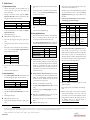
C. Quick Protocol I. Template Preparation Step 1. 2. Add 10 µL of DNA sample to each well of a PCR plate or tube. If necessary, include NTC negative control buffer sample(s) and positive control samples. Depending on the number of reactions, prepare the Template Preparation Master Mix as described in the table below. Mix thoroughly with a pipette. Keep on ice until used. Template Preparation Master Mix Component Cap Color Volume/Reaction Template Preparation Buffer Red 2 µL Template Preparation Enzyme Red 1 µL 3. 4. 5. 6. 7. To each 10 µL sample from step 1 above, add 3 µL of the Template Preparation Master Mix. Mix thoroughly with a pipette. Note: Final volume at this stage will be 13 µL. Seal the PCR plate using proper sealing film or tightly cap the tube(s). Centrifuge briefly to collect contents to the bottom of each well or tube. Place the plate or tube(s) in a thermal cycler with a heated lid set to 101C – 105C. Perform the Template Preparation Reaction using the conditions in the table below. Template Preparation Reaction Temperature Time 22°C 25 min 55°C 20 min 4°C Hold ≤ 2 hours 8. 9. 4. 5. Remove the seal on the plate or open the tube(s). Add 2 µL of the Library Synthesis Master Mix to each well or tube. Mix thoroughly with a pipette. Note: Final volume at this stage is 15 µL. Seal the PCR plate using proper sealing film or tightly cap the tube(s). Centrifuge briefly to collect contents to the bottom of each well or tube. Return the plate or tube(s) to the thermal cycler with a heated lid set to 101C – 105C. Perform Library Synthesis Reaction using the conditions in the table below. Library Synthesis Reaction Temperature Time 22°C 40 min 4°C Hold ≤30 min 8. 9. 7. 8. 1. 2. Remove the DIP from the freezer and thaw for 10 min on bench top. Prior to use, centrifuge the DIP to collect the contents at the bottom. Wipe foil seal with 70% ethanol and allow to dry. Prepare Library Amplification Master Mix as described in the table below. Mix thoroughly with a pipette. Keep on ice until used. Library Amplification Master Mix Component Cap Color Volume/Reaction Library Amplification Buffer Green 25.0 µL Library Amplification Enzyme Green 1.0 µL Nuclease Free Water Clear 4.0 µL (plus fluorescent dyes*) 3. 4. 5. 6. *Fluorescence dyes (for detection and optical calibration) are added when monitoring amplification in real time during cycling. Please refer to the Real Time PCR Instrument's user manual for calibration dye recommendations. The volume of detection and calibration dyes plus nuclease free water should not exceed 4 µL. If a regular thermal cycler is used, there is no need to add the dyes; use 4 µL of nuclease free water. Example: EvaGreen®/Fluorescein dye mix. Prepare by mixing 9:1 v/v ratio of EvaGreen Dye, 20X in water (Biotium, CAT. NO. 31000-T) and 1:500 diluted Fluorescein Calibration Dye (Bio-Rad Laboratories, CAT. NO. 170-8780); add 2.5 µL of this mix and 1.5 µL of nuclease free water per reaction. Remove the seal on the PCR plate or open the tube(s). Add 30 µL of Library Amplification Master Mix to each well or tube. Add 5 µL of the appropriate Indexing Reagent from the DIP to each well or tube. Note: Follow the DIP handling instructions (section B.7 of this quick protocol) to avoid index cross contamination. Mix thoroughly with a pipette. Avoid introducing excessive air bubbles. Note: Final volume at this stage is 50 µL. Seal the plate or tube(s) tightly and centrifuge briefly to collect contents to the bottom of each well or tube. Return plate or tube(s) to the real time PCR thermal cycler/thermal cycler with a heated lid set to 101C – 105C. Perform Library Amplification Reaction using the cycling conditions from the tables below. Caution: Ensure that the thermal cycler does not have a denaturing step programmed until Stage 3. Library Amplification Reaction Stage Temperature Time Number of Cycles 1 72°C 3 min 1 Extension & Cleavage 2 85°C 2 min 1 Denaturation 3 98°C 2 min 1 98°C 20 s Addition of 4 67°C 20 s 4 Indexes 72°C 40 s 5 to16 98°C 20 s Library 5 see table Amplification *72°C 50 s below 6 4°C Hold 1 *Acquire fluorescence data at this step, if monitoring in real-time. Remove the plate or tube(s) from the thermal cycler and centrifuge briefly. Continue to the Library Amplification Step. III. Library Amplification Step Prepare Library Synthesis Master Mix as described in the table below. Mix thoroughly with a pipette. Keep on ice until used. Library Synthesis Master Mix Component Cap Color Volume/Reaction Library Synthesis Buffer Yellow 1 µL Library Synthesis Enzyme Yellow 1 µL 2. 3. 7. Remove the plate or tube(s) from the thermal cycler and centrifuge briefly. Continue to the Library Synthesis Step. II. Library Synthesis Step 1. 6. Selecting the optimal number of amplification cycles: The number of PCR cycles required at Stage 5 of the Library Amplification Reaction is dependent upon the amount of input DNA and the thermal cycler used. We recommend performing an optimization experiment to identify the appropriate number of PCR cycles needed. The table below provides the suggested number of PCR cycles at Stage 5 for different input amounts. Stage 5 Amplification Guide DNA Input (ng) Number of Cycles 50 5 20 6 10 7 5 8 2 10 1 11 0.2 14 0.05 16 9. Note: Over amplification could result in a higher rate of PCR duplicates in the library. Remove the plate or tube(s) from the thermal cycler and centrifuge briefly. Note: At this stage, samples can be processed for next generation sequencing (NGS) immediately or stored frozen at -20°C and processed later. For instructions and recommendations on library pooling, purification, quantification, and sequencing, please refer to the ThruPLEX DNA-seq Kit Instruction Manual at www.rubicongenomics.com/resources/manuals/. For technical support contact [email protected] or call +1.734.677.4845 (9 AM – 5:30 PM EST). ThruPLEX® DNA-seq Kit is for research use only. It may not be used for any other purposes including, but not limited to, use in diagnostics, forensics, therapeutics, or in humans. ThruPLEX DNA-seq may not be transferred to third parties, resold, modified for resale or used to manufacture commercial products without prior written approval of Rubicon Genomics, Inc. ThruPLEX DNA-seq is protected by U.S. Patents 7,803,550; 8,071,312; 8,399,199; 8,728,737 and corresponding foreign patents. Additional patents are pending. Trademarks: ThruPLEX®; Illumina®, TruSeq® (Illumina Inc.); EvaGreen® (Biotium Inc.); Agencourt®, AMPure® (Beckman Coulter, Inc.). QAM-136-003