1
Page 2
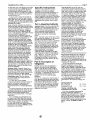
Form 8038-GC (Rev. 11-2000)
• More than 10% of the payment of principal
or interest of the issue is either (a) secured
by an interest in property to be used for a
private business use (or payments for such
property) or (b) to be derived from payments
for property (or borrowed money) used for a
private business use.
It also includes a bond, the proceeds of
which (a) are to be used to make or finance
loans (other than loans described in section
141(c)(2)) to persons other than governmental
units and (b) exceeds the lesser of 5% of the
proceeds or $5 million.
Issue. Generally, obligations are treated as
part of the same issue only if they are issued
by the same issuer, on the same date, and as
part of a single transaction, or a series of
related transactions. However, obligations
issued during the same calendar year (a)
under a loan agreement under which amounts
are to be advanced periodically (a
"draw-down loan") or (b) with a term not
exceeding 270 days, may be treated as part
of the same issue if the obligations are
equally and ratably secured under a single
indenture or loan agreement and are issued
under a common financing arrangement (e.g.,
under the same official statement periodically
updated to reflect changing factual
circumstances). Also, for obligations issued
under a draw-down loan that meets the
requirements of the preceding sentence,
obligations issued during different calendar
years may be treated as part of the same
issue if all of the amounts to be advanced
under the draw-down loan are reasonably
expected to be advanced within 3 years of
the date of issue of the first obligation.
Likewise, obligations (other than private
activity bonds) issued under a single
agreement that is in the form of a lease or
installment sale may be treated as part of the
same issue if all of the property covered by
that agreement is reasonably expected to be
delivered within 3 years of the date of issue
of the first obligation.
Arbitrage rebate. Generally, interest on a
state or local bond is not tax exempt unless
the issuer of the bond rebates to the United
States arbitrage profits earned from investing
proceeds of the bond in higher yielding
nonpurpose investments. See section 148(f).
Construction issue. This is an issue of
tax-exempt bonds that meets both of the
following conditions:
1. At least 75% of the available
construction proceeds of the issue are to be
used for construction expenditures with
respect to property to be owned by a
governmental unit or a 501(c)(3) organization,
and
2. All of the bonds that are part of the issue
are qualified 501 (c)(3) bonds, bonds that are
not private activity bonds, or private activity
bonds issued to finance property to be
owned by a governmental unit or a 5O1(c)(3)
organization.
In lieu of rebating any arbitrage that may
be owed to the United States, the issuer of a
construction issue may make an irrevocable
election to pay a penalty. The penalty is equal
to 1 V2% of the amount of construction
proceeds that do not meet certain spending
requirements. See section 148(f)(4)(C) and the
Instructions for Form 8038-T.
Specific Instructions
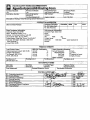
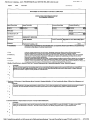
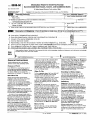
In general, a Form 8038-GC must be
completed on the basis of available
information and reasonable expectations as
of the date the issue is issued. However,
forms that are filed on a consolidated basis
may be completed on the basis of information
readily available to the issuer at the close of
the calendar year to which the form relates,
supplemented by estimates made in good
faith.
Part I—Reporting Authority
Amended return. If this is an amended Form
8038-GC, check the amended return box.
Complete Part I and only those lines of Form
8038-GC that are being amended. Do not
amend estimated amounts previously
reported once the actual amounts are
determined. (See the Part II instructions
below.)
Line 1. The issuer's name is the name of the
entity issuing the obligations, not the name of
the entity receiving the benefit of the
financing. In the case of a lease or installment
sale, the issuer is the lessee or purchaser.
Line 2. An issuer that does not have an
employer identification number (EIN) should
apply for one on Form SS-4, Application for
Employer Identification Number. This form
may be obtained at Social Security
Administration offices or by calling
1-800-TAX-FORM. If the EIN has not been
received by the due date for Form 8038-GC,
write "Applied for" in the space for the EIN.
Line 5. After the preprinted 5, enter two
self-designated numbers. Number reports
consecutively during any calendar year (e.g.,
534, 535, etc.).
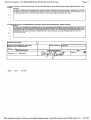
Part II—Description of
Obligations
Line 8a. The issue price of obligations is
generally determined under Regulations
section 1.148-1 (b). Thus, when issued for
cash, the issue price is the price at which a
substantial amount of the obligations are sold
to the public. To determine the issue price of
an obligation issued for property, see
sections 1273 and 1274 and the related
regulations.
Line 8b. For a single issue, enter the date of
issue, generally the date on which the issuer
physically exchanges the bonds that are part
of the issue for the underwriter's (or other
purchaser's) funds; for a lease or installment
sale, enter the date interest starts to accrue.
For issues reported on a consolidated basis,
enter the calendar year during which the
obligations were issued.
Lines 9a and 9b. For line 9a, enter the
amount of the proceeds that will be used to
pay principal, interest, or call premium on any
other issue of bonds, including proceeds that
will be used to fund an escrow account for
this purpose. Both line 9a and 9b may apply
to a particular obligation. For example, report
on line 9a and 9b obligations used to refund
prior issues which represent loans from the
proceeds of another tax-exempt obligation.
Line 11. Check this box if property other than
cash is exchanged for the obligation, e.g.,
acquiring a police car, a fire truck, or
telephone equipment through a series of
monthly payments. (This type of obligation is
sometimes referred to as a "municipal lease.")
Also check this box if real property is directly
acquired in exchange for an obligation to
make periodic payments of interest and
principal. Do not check this box if the
proceeds of the obligation are received in the
form of cash, even if the term "lease" is used
in the title of the issue.
Line 12. Check this box if the issue is a
construction issue and an irrevocable election
to pay a penalty in lieu of arbitrage rebate
has been made on or before the date the
bonds were issued. The penalty is payable
with a Form 8038-T for each 6-month period
after the date the bonds are issued. Do not
make any payment of penalty in lieu of rebate
with Form 8038-GC. See Rev. Proc. 92-22,
1992-1 C.B. 736, for rules regarding the
"election document."
Paperwork Reduction Act Notice
We ask for the information on this form to
carry out the Internal Revenue laws of the
United States. You are required to give us the
information. We need it to ensure that you are
complying with these laws.
You are not required to provide the
information requested on a form that is
subject to the Paperwork Reduction Act
unless the form displays a valid OMB control
number. Books or records relating to a form
or its instructions must be retained as long as
their contents may become material in the
administration of any Internal Revenue law.
Generally, tax returns and return information
are confidential, as required by section 6103.
The time needed to complete and file this
form varies depending on individual
circumstances. The estimated average time
is:
Learning about the
law or the form
Preparing the form
1 hr., 58 min.
.
.
.
. 3 hr., 3 min.
Copying, assembling, and
sending the form to the IRS
16 min.
If you have comments concerning the
accuracy of these time estimates or
suggestions for making this form simpler, we
would be happy to hear from you. You can
write to the Tax Forms Committee, Western
Area Distribution Center, Rancho Cordova,
CA 95743-0001. Do not send the form to this
address. Instead, see Where To File on
page 1.