1
<3. Parameter Setting>
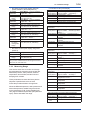
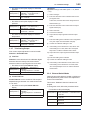
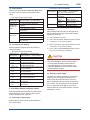
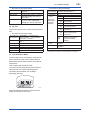
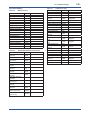
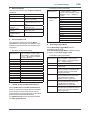
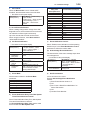
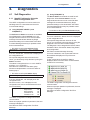
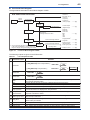
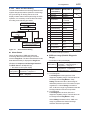
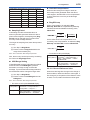
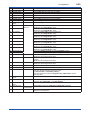
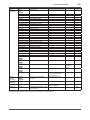
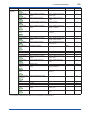
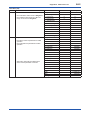
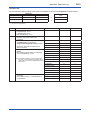
Typical Unit Conversion Factor
3.3.6 Sensor Trim
Use “kg” in case of mass flow
Use “m3” in case of volume flow
Use “Nm3” in case of normal or standard volume flow
Set Base Unit
kg
m3
Nm3
User Unit
g
kg
t
lb
STon
LTon
oz
gal
L
Impgal
m3
bbl
bushel
yd3
ft3
in3
bbl
hl
Nm3
NL
SCF
3-20
Convert val
1.0000E+03
1.0000E+00
1.0000E-03
2.2046E+00
1.1023E-03
9.8421E-04
3.5274E+01
2.6417E+02
1.0000E+03
2.1997E+02
1.0000E+00
6.2898E+00
2.8378E+01
1.3080E+00
3.5315E+01
6.1024E+04
6.2898E+00
1.0000E+01
1.0000E+00
1.0000E+03
3.5315E+01
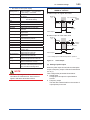
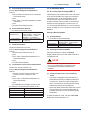
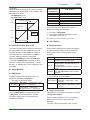
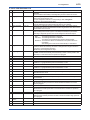
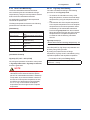
<Example>
Set the special total flow unit as g (=0.001kg) based
kg.
(1kg=1.0000E+03g)
1) Select “kg” for Set base unit (or Conf User Unit Set
Base Unit).
2) Set “g” for Modify Unit (or Conf User Unit Modify
Unit).
3) Enter 1.0000E+03 for Cvt Val (or Conf User Unit Cvt
Val).
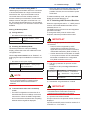
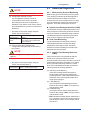
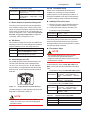
NOTE
Up to eight alphanumeric characters, spaces or
slash(/) can be input for Modify Unit (or Conf
User Unit Modify Unit).
EJX multivariable transmitter is factory
characterized. Factory characterization is the
process of comparing a known pressure input with
the output of each transmitter sensor module over
the entire pressure and temperature operating
range. During the characterization process, this
comparison information is stored in the transmitter
EEPROM. In operation, the transmitter uses this
factory-stored curve to produce a process variable
output (PV), in engineering units, dependent on the
pressure input.
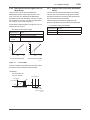
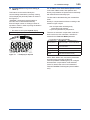
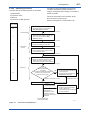
The sensor trim procedure allows you to adjust
for local conditions, changing how the transmitter
calculates process variables. There are two ways
to trim the sensor: a zero trim and a full sensor trim.
A zero trim is a one-point adjustment typically used
to compensate for mounting position effects or
zero shifts caused by static pressure. A full sensor
trim is a two-point process, in which two accurate
end-point pressures are applied (equal to or greater
than the range values), and all output is linearized
between them.
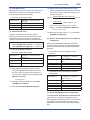
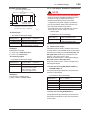
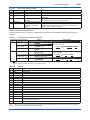
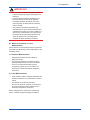
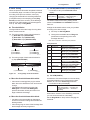
Full Sensor Trim—Auto Trim and Manual Trim Full sensor trim is carried out by performing Auto,
Lower Pt followed by Auto, Upper Pt.
Also, you can manually perform the trimming
procedure with Manual, Lower Pt and Manual,
Upper Pt.
The full sensor trim is a two-point adjustment,
and the lower point adjustment should always be
performed before the upper point adjustment in
order to maintain the pitch between the zero and
100% points within the calibration range.
In the manual method, the reference pressure
should also be applied to the transmitter at both
the lower and upper points. Without the reference
pressure, Manual, Lower Pt and Manual, Upper
Pt may not represent the correct value for each
adjustment point.
IM 01C25R02-01E