1
2.2 The Considered Properties
First of all, the properties we intend to check include basic consistency of pointer manipulations, i.e. absence of null and undefined pointer dereferences and references to
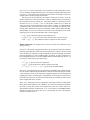
already deleted nodes. Further, we would like to check various shape invariance properties (such as absence of sharing, acyclicity, or, e.g., the fact that if x->next == y
(and y is not null) in a DLL, then also y->prev == x, etc.). To define such properties
we propose two approaches described below.
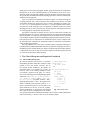
Shape Testers. First, we use the so-called shape
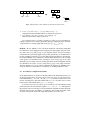
x = aDLLHead;
testers written in the C language. They can be seen
while (x != NULL && random())
as instrumentation code trying to detect violations
x = x->next;
of the memory shape properties at selected con- if (x != NULL
trol locations of the original program. We extend
&& x->next->prev != x)
slightly the C language used by the possibility of
error();
following next pointers backwards and by nondeterministic branching. For our verification tool, Fig. 2. Checking the consistency
the testers are just a part of the code being verified. of the next and previous pointers
An error is announced when a line denoted by an
error label is reached. This way, we can check a whole range of properties (including
acyclicity, absence of sharing and other shape invariants as the relation of next and
previous pointers in DLLs—cf. Fig 2).
A Logic of Bad Memory Patterns. Second, in order to allow the undesired violations
of the memory shape properties to be specified more easily, we propose a logic-based
specification language—namely, a logic of bad memory patterns (LBMP)—that is a
fragment of the existential first order logic on graphs with (regular) reachability predicates (and an implicit existential quantification over paths). When defining the logic,
our primary concern is not to obtain a decidable logic but rather to obtain a logic whose
formulae may be automatically translated to the above mentioned C testers allowing us
to efficiently test whether some bad shapes may arise from the given program by testing
reachability of a designated error control line of a tester.
Let V be a finite set of program variables and S a finite set of selectors. The formu/
lae of LBMP have the form Φ ::= ∃w1 , ...wn .ϕ where W = {w1 , ..., wn }, V ∩ W = 0,
is a set of formulae variables, ϕ ::= ϕ ∨ ϕ | ψ, ψ ::= ψ ∧ ψ | xρy, x, y ∈ V ∪ W , and ρ
is a reachability formula defined below. To simplify the formulae, we allow y in xρy to
be skipped if it is not referred to anywhere else. We suppose such a missing variable to
be implicitly added and existentially quantified. Given a ψ formula, we define its associated graph to be the graph Gψ = (V ∪ W , E) where (x, y) ∈ E iff xρy is a conjunct in
ψ. To avoid guessing in the tester corresponding to a formula, we require G ψ of every
top level ψ formula to have all nodes reachable from elements of V .
s s
An LBMP reachability formula has the form ρ ::=→|←| ρ + ρ | ρ.ρ | ρ∗ | [σ] where
s ∈ S and σ is a local neighbourhood formula. Finally, an LBMP local neighbours
hood formula has the form ∃u1 , ..., um .BC(x → y, x = y) where U = {u1 , ..., um } is
/ p 6∈ V ∪ W , s ∈ S , x ∈
a set of local formula variables, U ∩ (V ∪ W ∪ {p}) = 0,
V ∪ W ∪ U ∪ {p}, y ∈ V ∪ W ∪ U ∪ {p, ⊥, >}, and BC is the Boolean closure. Here, ⊥