1
248
Hand-held Analyzers Types 2250 and 2270 – User Manual
Frequency weighting
(cont.):
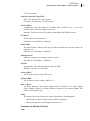
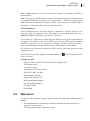
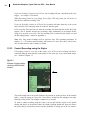
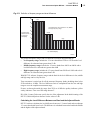
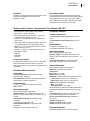
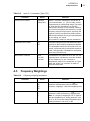
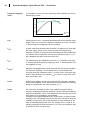
A ‘C-weighting’ curve is also used, particularly when evaluating very loud or
low-frequency sounds.
Lp (dB)
0
A
C
–20
–40
–60
10
20
50
100 200 500
1k
2k
5k
10k 20k
Frequency
(Hz)
000055
LAE:
Sound Exposure Level – sometimes abbreviated SEL and sometimes called
Single Event Level, is the Sound Exposure expressed as a level. The letter
‘A’ denotes that the A-weighting has been included.
LAeq:
A widely used noise parameter that calculates a constant level of noise with
the same energy content as the varying acoustic noise signal being
measured. The letter ‘A’ denotes that the A-weighting has been included and
‘eq’ indicates that an equivalent level has been calculated. Hence, LAeq is
the A-weighted equivalent continuous noise level.
LAF:
The instantaneous time-weighted sound level, Lp, is available at any time.
‘A’ denotes that the A-frequency weighting is used. ‘F’ denotes that the Fast
time-weighting is used.
LAFmax:
Maximum time-weighted sound level measured with A-frequency weighting
and Fast time weighting. It is the highest level of environmental noise
occurring during the measurement time. It is often used in conjunction with
another noise parameter (for example LAeq) to ensure a single noise event
does not exceed a limit.
LAFmin:
Minimum time-weighted sound level measured with A-frequency weighting
and Fast time weighting. It is the lowest level of environmental noise occurring
during the measurement time (time resolution is 1 s).
LAF90.0:
The noise level exceeded for 90% of the measurement period with Afrequency weighting and Fast time weighting. The level is based on statistical
analysis of a parameter (LAF or LAS) sampled at 10 ms intervals into 0.2 dB
wide classes. The percentage is user-definable.
An analysis of the statistical distributions of sound levels is a useful tool when
assessing noise. The analysis not only provides useful information about the
variability of noise levels, but is also prominent in many standards as the
basis for assessing background noise. For example, LAF90 is used as an
indicator of background noise levels while LAF10 or LAF5 are sometimes used
to indicate the level of noise events.