1
1.1 LED Display
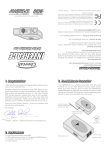
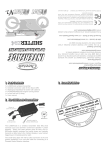
The mounting location for the LED display is a matter of personal choice. It can
be held securely in place by your helmet’s cheek padding, so that it does not
move during use. To begin with, we recommend fitting it as far towards the front
of the view port as possible (Fig 1 - position A), but please note that it must never
be mounted where it interferes with your forward vision. As you become more
used to the display, you may prefer to move it more towards the side of your
helmet, in your peripheral vision (Fig 1 - position B).
The beam from the LED display is directional, so care must be taken when
mounting to ensure that the raised “bubbles” are kept pointing towards your eye,
otherwise you may miss some alerts. TIP - Use a mirror and press the test button
on the RADARnode transmitter to see where the beams are pointing.
A
B
1.2 Receiver
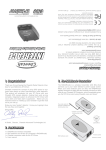
The receiver can be easily tucked behind the comfort liner or even slipped
underneath the base gasket, and secured with Velcro, if required.
1.3 Battery Pack
Secure the battery pack with Velcro, in a convenient location for access to the
ON/OFF switch. The battery pack is not waterproof so must be positioned
inside the helmet.
Fig. 1
6 color display
Battery pack with
ON / OFF switch
2 x CR2032 installed
1.4 Cruiser / Open Face / Shorty Helmets
The VizAlert V2 is designed for installing inside full-face helmets. However a
boom arm, to support the VizAlert LED display in your forward vision, is available
as an optional extra on our website. You may also like to consider purchasing
the VizAlert Classic display, as its receiver / battery compartment is waterproof
and mounts on the outside of an open face helmet.
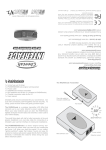
2.1 Switching ON your system
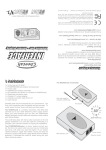
The radar detector and the helmet display operate independently.The VizAlert’s
battery pack has a sliding ON/OFF switch. All 6 LEDs will flash once, at the
same time, to confirm it is switched on.
Your radar detector will power up when you start the engine. The RADARnode
transmitter will then begin transmitting to the VizAlert and all the LED's will flash
in a circular sequence to confirm that the wireless link is established.
2.2 Switching off your system
When you switch off your engine, power to the RADARnode transmitter and your
radar detector is automatically cut off, so you won’t get a flat battery.
The VizAlert’s battery pack has a sliding ON/OFF switch.
2.3 Automatic shut-down
If you forget to switch the VizAlert display off, it will automatically shut itself down
10 minutes after the RADARnode stops transmitting, to conserve battery power.
All 6 LEDs will flash twice to confirm it is switching off. When you next use the
system after an automatic shut down, you must first move the battery
switch to the OFF position, then turn it back ON again as normal.
Wireless
receiver
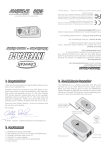
2.4 Light sensitive
The automatic dimming feature will reduce the LED intensity at night time. If
required, the display may be temporarily rotated away to further protect your
night vision.
Green = KA
Yellow = X
Blue = Future Use
Red = Laser
Orange = KU
White = K
Daylight
Sensor
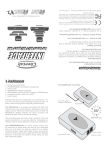
Different colors represent different radar / laser bands. There are three flash rates
to indicate signal strength - slow, medium and fast.
LED
Green
White
Yellow
Orange
Red (medium flashing)
Red (rapid flashing)
Blue
All 6 LEDs flash once
All 6 LEDs flash twice
All 6 LEDs flash in sequence
Green, Blue then Orange
Yellow and Orange alternately
MEANING
KA band radar
K band radar
X band radar
KU band radar
Laser alert from your radar detector
Laser alert from your laser jammer
not currently used - reserved for future
Power ON
Power OFF
Wireless link established
Low battery - replace the batteries soon
No wireless link
(6 flashes ever 30 seconds until the wireless connection is re-established)