1
1
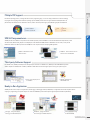
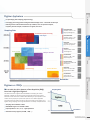
Digitizer Applications
PXI/PXIe
For quantifying and analyzing physical energy
Leveraging processing power and high-resolution display of PC – PC-based oscilloscope
Defining custom measurement functions by software, such as spectrum analysis,
frequency domain analysis, rise/fall time of signals, and more
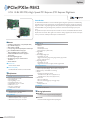
PCIe/PXIe-9852
Sampling Rate
200 MS/s 14-Bit 2-CH
High Speed Digitizers
Distributed Temperature Sensing
P 2-11
PCIe/PXIe-9842
Video Signal
200 MS/s 14-Bit 1-CH
High Speed Digitizers
P 2-15
100 MS/s 14-Bit 8-CH
High Density Digitizers
P 2-9
PXI-98x6
Power Supply Unit Testing
10/20/40 MS/s 16-Bit
4-CH Digitizers
Radar & LiDAR
P 2-13
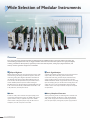
Modular Instruments
PXIe-9848
2
Military & Education
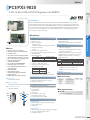
PCI/PXI-9820
P 2-16
65 MS/s 14-Bit 2-CH
PCI/PXI Digitizers
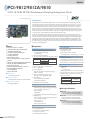
20 MS/s 10/12-Bit 4-CH
PCI Digitizers
Power & Energy
P 2-17
3
DAQ
PCI-9812/9810
PXIe-9529
Sound & Vibration
24-Bit 192 kS/s 8-CH
High-Resolution DSA
P 2-18
PCI/PXI-9527
24-Bit 432 kS/s
High-Resolution DSA
12-Bit
14-Bit
16-Bit
24-Bit
P 2-19
4
Resolution
GPIB & Bus Expansion
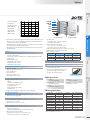
Digitizers v.s. DAQs
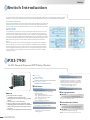
How to make the choice between a Data Acquisition (DAQ)
board and a High-Speed Digitizer?
Sampling Rate
The difference between a digitizer and standard DAQ is the sampling rate and the
bandwidth. A digitizer can extend its sampling rate from MS/s to GS/s grade, and the
bandwidth can also extend from 10 MHz to GHz. Additionally, the input impedance or the
module’s memory capacity can provide more options for use in different application
environments. Given the features of what are referred to as high accuracy signals, only a
digitizer with high sampling rate and high bandwidth can successfully accomplish the task.
Sampling rate from MS/s to GS/s
Bandwidth ranges from 10 MHz to GHz
Input impedance : 50 Ω, 75 Ω,…high impedance
Onboard memory support (512 MB, 1 GB, …)
Resolution
8-Bit
14-Bit
24-Bit
www.adlinktech.com 2-6