1
HP Integrity Superdome Servers: 16-way, 32-way,
and 64-way
QuickSpecs
Configuration
I/O Subsystem
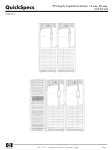
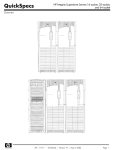
Each I/O chassis provides twelve PCI X slots; eight standard and four high bandwidth PCI X slots. There are two I/O chassis
in an I/O Chassis Enclosure (ICE). Each I/O chassis connects to one cell board and the number of I/O chassis supported is
dependent on the number of cells present in the system. If a PCI card is inserted into a PCI X slot, the card cannot take
advantage of the faster slot.
Each Superdome cabinet supports a maximum of four I/O chassis. The optional I/O expansion cabinet can support up to
six I/O chassis.
A 4 cell Superdome (16-way) supports up to four I/O chassis for a maximum of 48 PCI X slots.
An 8 cell Superdome supports up to eight I/O chassis for a maximum of 96 PCI X slots. Four of these I/O chassis will reside
in an I/O expansion cabinet.
A 16-cell Superdome supports up to sixteen I/O chassis for a maximum of 192 PCI X slots. Eight of these I/O chassis will
reside in two I/O expansion cabinets (either six chassis in one I/O expansion cabinet and two chassis in the other, or four
chassis in each).
Core I/O
The core I/O in Superdome provides the base set of I/O functions required by every Superdome partition. Each partition
must have at least one core I/O card in order to boot. Multiple core I/O cards may be present within a partition (one core
I/O card is supported per I/O backplane); however, only one may be active at a time. Core I/O will utilize the standard
long card PCI X form factor but will add a second card cage connection to the I/O backplane for additional non PCI X
signals (USB and utilities). This secondary connector will not impede the ability to support standard PCI X cards in the core
slot when a core I/O card is not installed.
Any I/O chassis can support a Core I/O card that is required for each independent partition. A system configured with 16
cells, each with its own I/O chassis and core I/O card could support up to 16 independent partitions. Note that cells can
be configured without I/O chassis attached, but I/O chassis cannot be configured in the system unless attached to a cell.
HP-UX Core I/O
(A6865A)
The core I/O card's primary functions are:
Partitions (console support) including USB and RS 232 connections
10/100Base T LAN (general purpose)
Other common functions, such as Ultra/Ultra2 SCSI, Fibre Channel, and Gigabit Ethernet, are not included on the core I/O
card. These functions are, of course, supported as normal PCI X add in cards.
The unified 100Base T Core LAN driver code searches to verify whether there is a cable connection on an RJ 45 port or on an
AUI port. If no cable connection is found on the RJ 45 port, there is a busy wait pause of 150 ms when checking for an AUI
connection. By installing the loopback connector (description below) in the RJ 45 port, the driver would think an RJ 45 cable
was connected and would not continue to search for an AUI connection, hence eliminate the 150 ms busy wait state:
Product/
Option Number
Description
A7108A
RJ 45 Loopback Connector
0D1
Factory integration RJ 45 Loopback Connector
Windows Core I/O
For Windows Server 2003, two core I/O cards are required: the Superdome core I/O card (A6865A) and a 1000Base T LAN
(A6865A and A7061A and card (A7061A). The use of Graphics/USB card (A6869A) is optional and not required.
optional VGA/USB
A6869A)
DA - 11717
Worldwide — Version 1 — June 30, 2003
Page 6