1
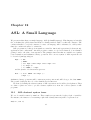
15.1. THE TYPE SYSTEM
101
2
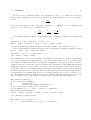
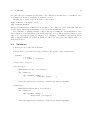
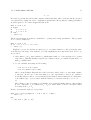
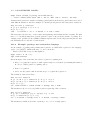
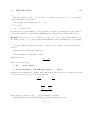
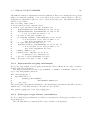
The type scheme σ 0 = ∀β1 . . . βm .τ 0 is said to be a generic instance of σ = ∀α1 . . . αn .τ if there
exists a substitution S such that:
• the domain of S is included in {α1 , . . . , αn };
• τ 0 = S(τ );
• no βi occurs free in σ.
In other words, a generic instance of a type scheme is obtained by giving more precise values to
some generic variables, and (possibly) quantifying some of the new type variables introduced.
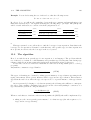
Example If σ = ∀β.(β → α) → α, then σ 0 = ∀γ.((γ → γ) → α) → α is a generic instance of σ.
We changed β into (γ → γ), and we universally quantified on the newly introduced type variable
γ.
2
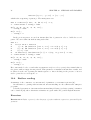
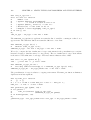
We express this type system by means of inference rules. An inference rule is written as a
fraction:
• the numerator is called the premisses;
• the denominator is called the conclusion.
An inference rule:
P1 . . . Pn
C
may be read in two ways:
• “If P1 , . . . and Pn , then C”.
• “In order to prove C, it is sufficient to prove P1 , . . . and Pn ”.
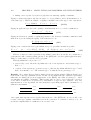
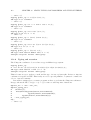
An inference rule may have no premise: such a rule will be called an axiom. A complete proof will
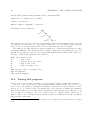
be represented by a proof tree of the following form:
P1m . . .
. . . Plk
..
.
...
P11 . . . Pn1
C
where the leaves of the tree (P1m , . . . , Plk ) are instances of axioms.
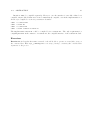
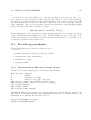
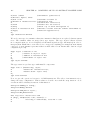
In the premisses and the conclusions appear judgements having the form:
Γ`e:σ