1
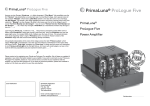
PRIMAlUNA PROLOGUE PREMIUM INTEGRATED AMPLIFIER
a tube type not installed does no harm; in fact, the user manual
suggests that you experiment with the switch position for personal taste. I explored matching/mismatching the tubes and bias
switch positions, and preferred the matched positions.
TI1e rear panel sports five pairs of RCA jacks for inputs,
one pair labeled HT (for Home Theater). This is not just unity
gain, but actually bypasses the preamp section, and allows
volume to be controlled by a surround processor/receiver.
The ProLogue Premium normally comes with EL34 output
tubes, but can also accommodate KT88s, a set of which was
included with the review sample. Except as noted, I did my
listening with the EL34s. There are connections for speakers
with nominal impedances of 4 and 8 ohms. The ProLogue
Premium is available with an internal moving-magnet phono
stage ($199), but the review sample didn't include this option.
The ProLogue Premium was designed in Holland by a team
headed by H erman van den Dungen, and, like most audio
products these days, it's manufactured in China. According to
Kevin Deal of Upscale Audio and PrimaLuna USA, PrimaLuna's
North American distributor, the engineering of the Premium
began with a circuit design in which nothing was taken for
granted, and the components selected are of a quality not
normally seen in cost-conscious designs. These include:
• Nichicon and Solen polystyrene and tin-foil capacitors
• Alps motorized potentiometer (said to be 10 times the
cost oflesser parts)
• toroidal power transformer, manufactured in-house
• capacitor-plus-choke power supply, designed to eliminate
both low-frequency ripples and high-frequency hash
• custom-designed output transformers, manufactured in-house
• heavy-gauge, ventilated chassis with a five-coat flnish
• construction by hand and point-to-point wiring
The tubes supplied with the ProLogue Premium are SilverLabel, according to Upscale Audio's classilication, and are said to
T
o take these measurements, I
used Stereophile's loan sample
of the top-of-the-line Audio
Precision SYS2722 system (see
t he January 2008 "As We See It," www.
stereophile.com/asweseeit/108awsi/
index.html, and www.ap.com). The unit
shipped to me for measurement-serial
no.10115729, a different sample from the
one auditioned by Robert Deutsch-was
f itted with EL34 output tubes; I made
sure t he bias switch on the amplifier's
left side panel was set to the appropriate
bias position for that tube.
M aximum voltage gain into 8 ohms was
on the low side for an integrated amplifier,
at 36d B from the 8 ohm output transformer tap and 34dB from the 4 ohm tap,
but this shouldn't be an issue with modern
line-level source components. The ProLogue Premium preserved absolute polarity and the input impedance was 35k ohms
across the audioband, dropping to 30k
ohms at 20kHz. Though these figures are
around half the specified 68k ohms, they
s:e·eophile.com • June 2012
be already "special" compared to standard tubes on the market.
Other tubes, including cryogenically treated ones, are available
from Upscale.
The ProLogue Premium has a number of specific, trademarked circuits designed to optimize performance and prevent
damage to the amplifier in the event of a malfunction:
• Adaptive AutoBias (AAB) monitors and adjusts bias constantly. AAB was present in previous PrimaLuna amplifiers,
but the latest version is said to include more extended outputstage protection circuitry, to safeguard the output transformers,
resistors, and high-voltage power supply in case a tube fails.
• Bad Tube Indicator (BTl) is what PrimaLuna calls the red
LED next to each output tube, though BTl is not quite what
its name implies. A lit BTl LED indicates that the tube is
drawing m ore power than it should; however, this condition may
be only temporary, and not necessarily indicate a bad tube. If
the BTl comes on, you're advised to turn off the ProLogue
Premium, wait a few minutes, and turn it on again. If no BTl
LEDs light up, you're fine. It's only when the indicator stays
on that the cause is likely a bad tube, which must then be replaced. During the review period, there were a few instances
of a BTl coming on, but each time, turning the amplifier off
and then on again fixed the problem.
• Power Transformer Protection (PTP) is a thermal switch
built into the AC transformer. If the internal temperature
gets too high, the AC is switched off autom atically, coming
back on again when the problem is resolved. This never
happened during the review period.
• Output Transformer Protection (OTP) protects the output
transformers from high-voltage transients. Power in my system
is supplied by a PS Audio PerfectWave Power Plant 5, which is
designed to protect against transients of this sort; in any case, there
were no problems in this area.
• SoftStart is yet another protection circuit, designed to
will result in no practical consequences.
I assess an amplifier's output impedance by comparing the output voltages
when it is loaded down with 8 and 4
ohms with the voltage when it is loaded
only by the Audio Precision's 100k ohms.
Things went smoothly with the 4 ohm
tap, which measured 1.7 ohms across the
audioband. However, when I tried to measure the impedance of the 8 ohm tap, the
:~~ .
·•
- ~n
10 20
50 100200 500 11<. 21<.
5k 101<.201<. 50k. 2001<.
"'
Fig.l Prima luna Prologue Premium, 8 ohm tap,
frequency res ponse at 2.83V into: simulated loudspeaker load (gray), 8 ohms (left channel blue,
right red), 4 ohms (left cyan, right magenta),
2 ohms (green) (1dB/vertical div.).
amplifier went into runaway ultrasonic
oscillation when not loaded down, causing the Prologue to mute its output and
illuminate one or more of the Bad Tube
Indicator (BTl) LEOs. Normal service was
restored when I left the amplifier turned
off for a few minutes, then turned it back
on, but Prologue Premium owners must
take care never to disconnect their speakers
when the amplifier is powered up.
-10
10 20
50 100200 500 1k 2k
'
~
Sk 101<.201<. 50k 2001<.
"'
Fig.2 Prima luna Prologue Premium, 4 ohm tap,
frequency response at 2.83V into: simulated loudspeaker load (gray), 8 ohms (left channel blue,
right red), 4 ohms (left cyan, right magenta),
2 ohms (green) (ldB/vertical div.).
77
~ !.