1
relevant to later generations. Start Lifetime & Reliability
Demo during P2, so this is completed before the end of P3.
For a project that develops subunits in parallel, test each
subunit as early as it is available (P1) rather than waiting for
final system test (P3) when it is painfully late.
Start test as soon as subunits are ready for integration.
Don’t wait for SW or diagnostics to be complete. Just make
sure you have a way to functionally test unit. Worst case is
inability for functional test of two subunits. Once subunits are
ready for physical integration, we can test these nonoperationally. This less desirable than full-functional test
Nevertheless we still can perform vibration tests to find
resonant frequencies. This may point out many things,
including component interference issues, mounting issues, and
board layout issues.
3.5.1 Case Study for Overcoming Parallel Development
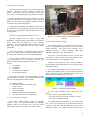
We tested a Neutrino Telescope for the National Science
Foundation (NSF). This product could be tested with full
functions only if all the pieces were working. Rather than
waiting for that, we elected to start with some non-operational
testing on some fixtures we custom-designed.
Figure 14: Reliability Testing during product development
3.4.1 Case Study for Overcoming Immature Designs
For an electro-mechanical medical device during P0, we
knew that life test was premature. Instead during P1, we
tested margin and characterization to prove design
repeatability. During P1, this was more feasible and valuable
than testing until manifest failure.
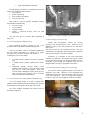
We set up a high-speed camera on the mechanical
assembly and tested during hundreds of runs on several
products.
Thus we measured the repeatability of the
mechanical design.
Figure 16: Neutrino Telescope Unit. Picture on left is final
assembly and picture on right is the subassembly.
4.
CONCLUSION
Reliability test plans are often generic or blindly following
industry standards. Test plans must be tailored to fit customer
use profiles. FMEA is a development tactic that can help
solve the problem of testing too little by uncovering failure
modes that require tailored test methods rather than only
cookbook methods from industry standards.
Also, reliability testing often occurs too late in the process.
There are many methods we can use to start the testing
process earlier in order to get better results faster. ERT is a
development tactic that can enable earlier feedback, smarter
engineering, less total cost, and lower risk for reliability. Thus
ERT offers better final product and better reliability.
\\
Figure 15: High Speed Camera Equipment used to Overcome
Immature Designs
3.5 Overcoming Parallel Development
Parallel or concurrent design & development requires
mating two or more subunits as prerequisite for meaningful
test data. This impedes test prior to integration. Nevertheless,
we still can test earlier, although not as less early as serial
development of subunits.
6