1
OMNeT++ Manual – Simple Modules
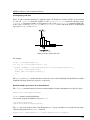
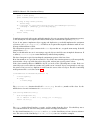
Example:
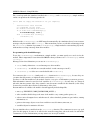
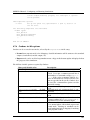
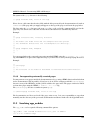
void Sink::activity()
{
while(true)
{
msg = receive();
delete msg;
}
}
should rather be programmed as:
void Sink::handleMessage(cMessage *msg)
{
delete msg;
}
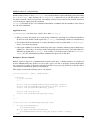
Activity() is run as a coroutine
activity() is run in a coroutine. Coroutines are a sort of threads which are scheduled non-preemptively
(this is also called cooperative multitasking). From one coroutine you can switch to another coroutine by
a transferTo(otherCoroutine) call. Then this coroutine is suspended and otherCoroutine will run.
Later, when otherCoroutine does a transferTo(firstCoroutine) call, execution of the first coroutine
will resume from the point of the transferTo(otherCoroutine) call. The full state of the coroutine,
including local variables are preserved while the thread of execution is in other coroutines. This implies
that each coroutine must have its own processor stack, and transferTo() involves a switch from one
processor stack to another.
Coroutines are at the heart of OMNeT++, and the simulation programmer doesn’t ever need to call transferTo() or other functions in the coroutine library, nor does he need to care about the coroutine library
implementation. It is important to understand, however, how the event loop found in discrete event
simulators works with coroutines.
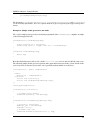
When using coroutines, the event loop looks like this (simplified):
while (FES not empty and simulation not yet complete)
{
retrieve first event from FES
t:= timestamp of this event
transferTo(module containing the event)
}
That is, when the module has an event, the simulation kernel transfers the control to the module’s coroutine. It is expected that when the module “decides it has finished the processing of the event”, it will
transfer the control back to the simulation kernel by a transferTo(main) call. Initially, simple modules
using activity() are “booted” by events (”starter messages”) inserted into the FES by the simulation
kernel before the start of the simulation.
How does the coroutine know it has “finished processing the event”? The answer: when it requests another
event. The functions which request events from the simulation kernel are the receive() and wait(),
so their implementations contain a transferTo(main) call somewhere.
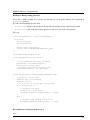
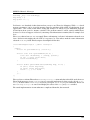
Their pseudocode, as implemented in OMNeT++:
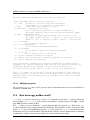
receive()
{
54