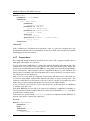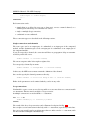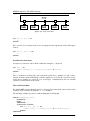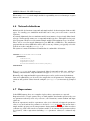
1
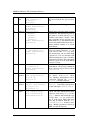
OMNeT++
Discrete Event Simulation System
Version 2.3
User Manual
by András Varga
Last updated: June 15, 2003
OMNeT++ Manual –
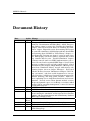
Document History
Date
2003/06
2003/04-06
2003/03
2003/02
2003/01
Summer 2002
2002/03/18
2002/01/24
2001/10/23
Author Change
AV
OMNeT++ 2.3 released
AV
"Design of OMNeT++" chapter revised, extended, and renamed to "Customization and Embedding". Added "Interpreting Cmdenv output" section to the "Running the Simulation"
chapter. Added section about Akaroa in "Running the Simulation" chapter. Expanded section about writing shell scripts
to control the simulation. Added background info about RNGs
and warning about old RNG in "Class Library" chapter; revised/extended "Deriving new classes" section in same chapter. Bibliography converted to Bibtex, expanded and cleaned
up; citations added to text. "Parallel Simulation" chapter:
contents removed until new PDES implementation gets released. Revised and reorganized NED chapter. Section about
message sending/receiving and other simple module related
functions moved to chapter "Simple Modules"; cMessage treatment from "Simulation Library" merged with message subclassing chapter into new chapter "Messages". Deprecated
cPacket. Removed sections "Simulation techniques" and "Coding conventions", and their useful fragments were incorporated elsewhere. Added/created sections about message transmission modeling, and using global variables. Added sections explaining how to implement broadcasts and retransmissions. Revised section about dynamic module creation.
Deprecated putaside-queue, receiveNew(), receiveOn(). Added
section "Object ownership management"; removed section on
"Using shared objects".
AV
OMNeT++ 2.3b2 released
AV
OMNeT++ 2.3b1 released
AV
Added chapter about message subclassing; revised chapter
about running the simulation and incorporated new Cmdenv
options; added new distributions and clarified many details in
NED expr. handling section
Ulrich Converted from Word to LaTeX
Kaage
AV
Documented new ini file options about Envir plugins
AV
Refinements on the Parsec chapter
AV
Updated to reflect changes since 2.1 release (see include/ChangeLog)
iii
OMNeT++ Manual –
iv
OMNeT++ Manual – CONTENTS
Contents
Contents
v
1 Introduction
1
1.1 What is OMNeT++? . . . . . . . . . . . . . . . . . . . . . . . . . . . . . . . . . . .
1
1.2 Where is OMNeT++ in the world of simulation tools?
. . . . . . . . . . . . . . .
2
1.3 Organization of this manual . . . . . . . . . . . . . . . . . . . . . . . . . . . . . .
3
1.4 History . . . . . . . . . . . . . . . . . . . . . . . . . . . . . . . . . . . . . . . . . .
4
1.5 Authors . . . . . . . . . . . . . . . . . . . . . . . . . . . . . . . . . . . . . . . . . .
5
2 Overview
7
2.1 Modeling concepts . . . . . . . . . . . . . . . . . . . . . . . . . . . . . . . . . . . .
7
2.1.1 Hierarchical modules . . . . . . . . . . . . . . . . . . . . . . . . . . . . . .
7
2.1.2 Module types . . . . . . . . . . . . . . . . . . . . . . . . . . . . . . . . . . .
8
2.1.3 Messages, gates, links . . . . . . . . . . . . . . . . . . . . . . . . . . . . .
8
2.1.4 Modeling of packet transmissions . . . . . . . . . . . . . . . . . . . . . . .
9
2.1.5 Parameters . . . . . . . . . . . . . . . . . . . . . . . . . . . . . . . . . . . .
9
2.1.6 Topology description method . . . . . . . . . . . . . . . . . . . . . . . . . .
9
2.2 Programming the algorithms . . . . . . . . . . . . . . . . . . . . . . . . . . . . .
10
2.2.1 Creating simple modules . . . . . . . . . . . . . . . . . . . . . . . . . . . .
10
2.2.2 Object mechanisms . . . . . . . . . . . . . . . . . . . . . . . . . . . . . . .
10
2.2.3 Derive new classes . . . . . . . . . . . . . . . . . . . . . . . . . . . . . . .
11
2.2.4 Self-describing objects to ease debugging . . . . . . . . . . . . . . . . . .
11
2.3 Using OMNeT++ . . . . . . . . . . . . . . . . . . . . . . . . . . . . . . . . . . . . .
11
2.3.1 Building and running simulations . . . . . . . . . . . . . . . . . . . . . .
11
2.3.2 What is what in the directories . . . . . . . . . . . . . . . . . . . . . . . .
13
3 An Example: The Nim Game
15
3.1 Topology . . . . . . . . . . . . . . . . . . . . . . . . . . . . . . . . . . . . . . . . .
15
3.2 Simple modules . . . . . . . . . . . . . . . . . . . . . . . . . . . . . . . . . . . . .
17
3.3 Running the simulation . . . . . . . . . . . . . . . . . . . . . . . . . . . . . . . .
20
3.4 Other examples . . . . . . . . . . . . . . . . . . . . . . . . . . . . . . . . . . . . .
22
v
OMNeT++ Manual – CONTENTS
4 The NED Language
23
4.1 NED overview . . . . . . . . . . . . . . . . . . . . . . . . . . . . . . . . . . . . . .
23
4.1.1 Components of a NED description . . . . . . . . . . . . . . . . . . . . . .
23
4.1.2 Reserved words . . . . . . . . . . . . . . . . . . . . . . . . . . . . . . . . .
23
4.1.3 Identifiers . . . . . . . . . . . . . . . . . . . . . . . . . . . . . . . . . . . .
24
4.1.4 Case sensitivity . . . . . . . . . . . . . . . . . . . . . . . . . . . . . . . . .
24
4.1.5 Comments . . . . . . . . . . . . . . . . . . . . . . . . . . . . . . . . . . . .
24
4.2 The import directive . . . . . . . . . . . . . . . . . . . . . . . . . . . . . . . . . .
24
4.3 Channel definitions . . . . . . . . . . . . . . . . . . . . . . . . . . . . . . . . . . .
24
4.4 Simple module definitions . . . . . . . . . . . . . . . . . . . . . . . . . . . . . . .
25
4.4.1 Simple module parameters . . . . . . . . . . . . . . . . . . . . . . . . . .
25
4.4.2 Simple module gates . . . . . . . . . . . . . . . . . . . . . . . . . . . . . .
26
4.5 Compound module definitions . . . . . . . . . . . . . . . . . . . . . . . . . . . . .
27
4.5.1 Compound module parameters and gates . . . . . . . . . . . . . . . . . .
27
4.5.2 Submodules . . . . . . . . . . . . . . . . . . . . . . . . . . . . . . . . . . .
28
4.5.3 Submodule type as parameter . . . . . . . . . . . . . . . . . . . . . . . . .
29
4.5.4 Assigning values to submodule parameters . . . . . . . . . . . . . . . . .
30
4.5.5 Defining sizes of submodule gate vectors
. . . . . . . . . . . . . . . . . .
31
4.5.6 Conditional parameters and gatesizes sections . . . . . . . . . . . . . . .
31
4.5.7 Connections . . . . . . . . . . . . . . . . . . . . . . . . . . . . . . . . . . .
32
4.6 Network definitions . . . . . . . . . . . . . . . . . . . . . . . . . . . . . . . . . . .
35
4.7 Expressions . . . . . . . . . . . . . . . . . . . . . . . . . . . . . . . . . . . . . . .
35
4.7.1 Constants . . . . . . . . . . . . . . . . . . . . . . . . . . . . . . . . . . . .
36
4.7.2 Referencing parameters . . . . . . . . . . . . . . . . . . . . . . . . . . . .
36
4.7.3 Operators . . . . . . . . . . . . . . . . . . . . . . . . . . . . . . . . . . . . .
37
4.7.4 The sizeof() and index operators . . . . . . . . . . . . . . . . . . . . .
38
4.7.5 Functions . . . . . . . . . . . . . . . . . . . . . . . . . . . . . . . . . . . . .
38
4.7.6 Random values . . . . . . . . . . . . . . . . . . . . . . . . . . . . . . . . .
38
4.7.7 Defining new functions . . . . . . . . . . . . . . . . . . . . . . . . . . . . .
39
4.8 Display strings . . . . . . . . . . . . . . . . . . . . . . . . . . . . . . . . . . . . . .
40
4.8.1 Submodule display strings . . . . . . . . . . . . . . . . . . . . . . . . . . .
41
4.8.2 Compound module display strings . . . . . . . . . . . . . . . . . . . . . .
42
4.8.3 Connection display strings . . . . . . . . . . . . . . . . . . . . . . . . . . .
42
4.9 Parameterized compound modules . . . . . . . . . . . . . . . . . . . . . . . . . .
43
4.9.1 Examples . . . . . . . . . . . . . . . . . . . . . . . . . . . . . . . . . . . . .
43
4.9.2 Design patterns for compound modules . . . . . . . . . . . . . . . . . . .
46
4.9.3 Topology templates . . . . . . . . . . . . . . . . . . . . . . . . . . . . . . .
47
4.10 Large networks . . . . . . . . . . . . . . . . . . . . . . . . . . . . . . . . . . . . .
48
4.10.1 Generating NED files . . . . . . . . . . . . . . . . . . . . . . . . . . . . . .
48
4.10.2 Building the network from C++ code . . . . . . . . . . . . . . . . . . . . .
49
vi
OMNeT++ Manual – CONTENTS
4.11 XML support . . . . . . . . . . . . . . . . . . . . . . . . . . . . . . . . . . . . . . .
49
4.12 GNED – Graphical NED Editor . . . . . . . . . . . . . . . . . . . . . . . . . . . .
50
4.12.1 Comment parsing . . . . . . . . . . . . . . . . . . . . . . . . . . . . . . . .
50
4.12.2 Keyboard and mouse bindings . . . . . . . . . . . . . . . . . . . . . . . . .
51
5 Simple Modules
53
5.1 Simulation concepts . . . . . . . . . . . . . . . . . . . . . . . . . . . . . . . . . . .
53
5.1.1 Discrete Event Simulation . . . . . . . . . . . . . . . . . . . . . . . . . . .
53
5.1.2 The event loop . . . . . . . . . . . . . . . . . . . . . . . . . . . . . . . . . .
54
5.1.3 Simple modules in OMNeT++ . . . . . . . . . . . . . . . . . . . . . . . . .
54
5.1.4 Events in OMNeT++ . . . . . . . . . . . . . . . . . . . . . . . . . . . . . .
55
5.1.5 FES implementation . . . . . . . . . . . . . . . . . . . . . . . . . . . . . .
56
5.2 Packet transmission modeling . . . . . . . . . . . . . . . . . . . . . . . . . . . . .
56
5.2.1 Delay, bit error rate, data rate . . . . . . . . . . . . . . . . . . . . . . . . .
56
5.2.2 Multiple transmissions on links . . . . . . . . . . . . . . . . . . . . . . . .
57
5.3 Defining simple module types . . . . . . . . . . . . . . . . . . . . . . . . . . . . .
59
5.3.1 Overview . . . . . . . . . . . . . . . . . . . . . . . . . . . . . . . . . . . . .
59
5.3.2 The module declaration . . . . . . . . . . . . . . . . . . . . . . . . . . . .
60
5.3.3 Several modules, single NED interface . . . . . . . . . . . . . . . . . . . .
61
5.3.4 The class declaration . . . . . . . . . . . . . . . . . . . . . . . . . . . . . .
62
5.3.5 Decomposing activity()/handleMessage() . . . . . . . . . . . . . . . . . . .
63
5.3.6 Using inheritance . . . . . . . . . . . . . . . . . . . . . . . . . . . . . . . .
64
5.3.7 Global variables . . . . . . . . . . . . . . . . . . . . . . . . . . . . . . . . .
65
5.4 Adding functionality to cSimpleModule . . . . . . . . . . . . . . . . . . . . . . .
65
5.4.1 activity() . . . . . . . . . . . . . . . . . . . . . . . . . . . . . . . . . . . . .
65
5.4.2 handleMessage()
. . . . . . . . . . . . . . . . . . . . . . . . . . . . . . . .
69
5.4.3 initialize() and finish() . . . . . . . . . . . . . . . . . . . . . . . . . . . . .
74
5.5 Finite State Machines in OMNeT++ . . . . . . . . . . . . . . . . . . . . . . . . .
76
5.6 Sending and receiving messages . . . . . . . . . . . . . . . . . . . . . . . . . . .
80
5.6.1 Sending messages . . . . . . . . . . . . . . . . . . . . . . . . . . . . . . . .
81
5.6.2 Broadcasts and retransmissions . . . . . . . . . . . . . . . . . . . . . . .
81
5.6.3 Delayed sending . . . . . . . . . . . . . . . . . . . . . . . . . . . . . . . . .
83
5.6.4 Direct message sending . . . . . . . . . . . . . . . . . . . . . . . . . . . .
83
5.6.5 Receiving messages . . . . . . . . . . . . . . . . . . . . . . . . . . . . . . .
83
5.6.6 The wait() function . . . . . . . . . . . . . . . . . . . . . . . . . . . . . . .
84
5.6.7 Modeling events using self-messages . . . . . . . . . . . . . . . . . . . . .
85
5.6.8 Stopping the simulation . . . . . . . . . . . . . . . . . . . . . . . . . . . .
86
5.7 Accessing module parameters . . . . . . . . . . . . . . . . . . . . . . . . . . . . .
87
5.8 Accessing gates and connections . . . . . . . . . . . . . . . . . . . . . . . . . . .
88
5.8.1 Gate objects . . . . . . . . . . . . . . . . . . . . . . . . . . . . . . . . . . .
88
vii
OMNeT++ Manual – CONTENTS
5.8.2 Link parameters . . . . . . . . . . . . . . . . . . . . . . . . . . . . . . . . .
89
5.8.3 Transmission state . . . . . . . . . . . . . . . . . . . . . . . . . . . . . . .
89
5.8.4 Connectivity . . . . . . . . . . . . . . . . . . . . . . . . . . . . . . . . . . .
89
5.9 Walking the module hierarchy . . . . . . . . . . . . . . . . . . . . . . . . . . . . .
90
5.10 Dynamic module creation . . . . . . . . . . . . . . . . . . . . . . . . . . . . . . .
92
5.10.1 When do you need dynamic module creation . . . . . . . . . . . . . . . .
92
5.10.2 Overview . . . . . . . . . . . . . . . . . . . . . . . . . . . . . . . . . . . . .
92
5.10.3 Creating modules . . . . . . . . . . . . . . . . . . . . . . . . . . . . . . . .
93
5.10.4 Deleting modules . . . . . . . . . . . . . . . . . . . . . . . . . . . . . . . .
94
5.10.5 Creating connections . . . . . . . . . . . . . . . . . . . . . . . . . . . . . .
94
6 Messages
97
6.1 Messages and packets . . . . . . . . . . . . . . . . . . . . . . . . . . . . . . . . .
97
6.1.1 The cMessage class . . . . . . . . . . . . . . . . . . . . . . . . . . . . . . .
97
6.1.2 Message encapsulation . . . . . . . . . . . . . . . . . . . . . . . . . . . . .
99
6.1.3 Information about the last sending . . . . . . . . . . . . . . . . . . . . . .
99
6.1.4 Context pointer . . . . . . . . . . . . . . . . . . . . . . . . . . . . . . . . . 100
6.1.5 Modeling packets and frames . . . . . . . . . . . . . . . . . . . . . . . . . 100
6.1.6 Attaching parameters and objects . . . . . . . . . . . . . . . . . . . . . . 101
6.2 Message definitions . . . . . . . . . . . . . . . . . . . . . . . . . . . . . . . . . . . 102
6.2.1 Introduction . . . . . . . . . . . . . . . . . . . . . . . . . . . . . . . . . . . 102
6.2.2 Declaring enums . . . . . . . . . . . . . . . . . . . . . . . . . . . . . . . . 104
6.2.3 Message declarations . . . . . . . . . . . . . . . . . . . . . . . . . . . . . . 104
6.2.4 Inheritance, composition . . . . . . . . . . . . . . . . . . . . . . . . . . . . 107
6.2.5 Using existing C++ types . . . . . . . . . . . . . . . . . . . . . . . . . . . . 110
6.2.6 Customizing the generated class . . . . . . . . . . . . . . . . . . . . . . . 111
6.2.7 Summary . . . . . . . . . . . . . . . . . . . . . . . . . . . . . . . . . . . . . 113
6.2.8 What else is there in the generated code? . . . . . . . . . . . . . . . . . . 115
7 The Simulation Library
117
7.1 Class library conventions . . . . . . . . . . . . . . . . . . . . . . . . . . . . . . . . 118
7.2 Utilities . . . . . . . . . . . . . . . . . . . . . . . . . . . . . . . . . . . . . . . . . . 120
7.3 Generating random numbers . . . . . . . . . . . . . . . . . . . . . . . . . . . . . 121
7.3.1 Random number generators . . . . . . . . . . . . . . . . . . . . . . . . . . 122
7.3.2 Random variates . . . . . . . . . . . . . . . . . . . . . . . . . . . . . . . . 123
7.3.3 Random numbers from histograms . . . . . . . . . . . . . . . . . . . . . . 124
7.4 Container classes . . . . . . . . . . . . . . . . . . . . . . . . . . . . . . . . . . . . 125
7.4.1 Queue class: cQueue . . . . . . . . . . . . . . . . . . . . . . . . . . . . . . 125
7.4.2 Expandable array: cArray . . . . . . . . . . . . . . . . . . . . . . . . . . . 126
7.5 Non-object container classes . . . . . . . . . . . . . . . . . . . . . . . . . . . . . . 127
viii
OMNeT++ Manual – CONTENTS
7.6 The parameter class: cPar . . . . . . . . . . . . . . . . . . . . . . . . . . . . . . . 128
7.6.1 Basic usage . . . . . . . . . . . . . . . . . . . . . . . . . . . . . . . . . . . . 128
7.6.2 Random number generation through cPar . . . . . . . . . . . . . . . . . . 129
7.6.3 Storing object and non-object pointers in cPar . . . . . . . . . . . . . . . 129
7.6.4 Reverse Polish expressions . . . . . . . . . . . . . . . . . . . . . . . . . . . 130
7.6.5 Using redirection . . . . . . . . . . . . . . . . . . . . . . . . . . . . . . . . 131
7.6.6 Type characters . . . . . . . . . . . . . . . . . . . . . . . . . . . . . . . . . 132
7.6.7 Summary . . . . . . . . . . . . . . . . . . . . . . . . . . . . . . . . . . . . . 132
7.7 Routing support: cTopology . . . . . . . . . . . . . . . . . . . . . . . . . . . . . . 134
7.7.1 Overview . . . . . . . . . . . . . . . . . . . . . . . . . . . . . . . . . . . . . 134
7.7.2 Basic usage . . . . . . . . . . . . . . . . . . . . . . . . . . . . . . . . . . . . 134
7.7.3 Shortest paths . . . . . . . . . . . . . . . . . . . . . . . . . . . . . . . . . . 136
7.8 Statistics and distribution estimation . . . . . . . . . . . . . . . . . . . . . . . . 137
7.8.1 cStatistic and descendants . . . . . . . . . . . . . . . . . . . . . . . . . . . 137
7.8.2 Distribution estimation . . . . . . . . . . . . . . . . . . . . . . . . . . . . . 138
7.8.3 The k-split algorithm . . . . . . . . . . . . . . . . . . . . . . . . . . . . . . 141
7.8.4 Transient detection and result accuracy . . . . . . . . . . . . . . . . . . . 143
7.9 Recording simulation results . . . . . . . . . . . . . . . . . . . . . . . . . . . . . 145
7.9.1 Output vectors: cOutVector . . . . . . . . . . . . . . . . . . . . . . . . . . 145
7.9.2 Output scalars . . . . . . . . . . . . . . . . . . . . . . . . . . . . . . . . . . 145
7.10 Tracing and debugging aids . . . . . . . . . . . . . . . . . . . . . . . . . . . . . . 146
7.10.1 Displaying information about module activity . . . . . . . . . . . . . . . 146
7.10.2 Watches . . . . . . . . . . . . . . . . . . . . . . . . . . . . . . . . . . . . . . 146
7.10.3 Snapshots . . . . . . . . . . . . . . . . . . . . . . . . . . . . . . . . . . . . 147
7.10.4 Breakpoints . . . . . . . . . . . . . . . . . . . . . . . . . . . . . . . . . . . 151
7.10.5 Disabling warnings . . . . . . . . . . . . . . . . . . . . . . . . . . . . . . . 151
7.10.6 Getting coroutine stack usage . . . . . . . . . . . . . . . . . . . . . . . . . 152
7.11 Changing the network graphics at run-time . . . . . . . . . . . . . . . . . . . . . 152
7.11.1 Setting display strings . . . . . . . . . . . . . . . . . . . . . . . . . . . . . 152
7.11.2 The cDisplayStringParser class . . . . . . . . . . . . . . . . . . . . . . . . 153
7.12 Deriving new classes . . . . . . . . . . . . . . . . . . . . . . . . . . . . . . . . . . 153
7.12.1 cObject or not? . . . . . . . . . . . . . . . . . . . . . . . . . . . . . . . . . . 153
7.12.2 cObject virtual methods . . . . . . . . . . . . . . . . . . . . . . . . . . . . 154
7.12.3 Class registration . . . . . . . . . . . . . . . . . . . . . . . . . . . . . . . . 155
7.12.4 Details . . . . . . . . . . . . . . . . . . . . . . . . . . . . . . . . . . . . . . 155
7.13 Object ownership management . . . . . . . . . . . . . . . . . . . . . . . . . . . . 158
7.13.1 Ownership tree . . . . . . . . . . . . . . . . . . . . . . . . . . . . . . . . . 158
7.13.2 Purpose . . . . . . . . . . . . . . . . . . . . . . . . . . . . . . . . . . . . . . 159
7.13.3 Objects are deleted by their owners . . . . . . . . . . . . . . . . . . . . . . 159
7.13.4 Ownership is managed transparently . . . . . . . . . . . . . . . . . . . . 159
ix
OMNeT++ Manual – CONTENTS
7.13.5 Garbage collection . . . . . . . . . . . . . . . . . . . . . . . . . . . . . . . . 161
7.13.6 What cQueue and cArray do . . . . . . . . . . . . . . . . . . . . . . . . . . 163
7.13.7 Change of implementation . . . . . . . . . . . . . . . . . . . . . . . . . . . 164
7.14 Tips for speeding up the simulation . . . . . . . . . . . . . . . . . . . . . . . . . . 165
8 Building Simulation Programs
167
8.1 Overview . . . . . . . . . . . . . . . . . . . . . . . . . . . . . . . . . . . . . . . . . 167
8.2 Using Unix and gcc . . . . . . . . . . . . . . . . . . . . . . . . . . . . . . . . . . . 169
8.2.1 Installation . . . . . . . . . . . . . . . . . . . . . . . . . . . . . . . . . . . . 169
8.2.2 Building simulation models . . . . . . . . . . . . . . . . . . . . . . . . . . 169
8.2.3 Multi-directory models . . . . . . . . . . . . . . . . . . . . . . . . . . . . . 170
8.2.4 Static vs shared OMNeT++ system libraries . . . . . . . . . . . . . . . . . 171
8.3 Using Windows and Microsoft Visual C++ . . . . . . . . . . . . . . . . . . . . . . 171
8.3.1 Installation . . . . . . . . . . . . . . . . . . . . . . . . . . . . . . . . . . . . 171
8.3.2 Building simulation models on the command line . . . . . . . . . . . . . 172
8.3.3 Building simulation models from the MSVC IDE . . . . . . . . . . . . . . 172
9 Running The Simulation
175
9.1 User interfaces . . . . . . . . . . . . . . . . . . . . . . . . . . . . . . . . . . . . . . 175
9.2 The configuration file: omnetpp.ini . . . . . . . . . . . . . . . . . . . . . . . . . . 175
9.2.1 An example . . . . . . . . . . . . . . . . . . . . . . . . . . . . . . . . . . . 175
9.2.2 The concept of simulation runs . . . . . . . . . . . . . . . . . . . . . . . . 177
9.2.3 File syntax . . . . . . . . . . . . . . . . . . . . . . . . . . . . . . . . . . . . 177
9.2.4 File inclusion
. . . . . . . . . . . . . . . . . . . . . . . . . . . . . . . . . . 177
9.2.5 Sections . . . . . . . . . . . . . . . . . . . . . . . . . . . . . . . . . . . . . . 178
9.2.6 The [General] section . . . . . . . . . . . . . . . . . . . . . . . . . . . . . . 178
9.3 Cmdenv: the command-line interface . . . . . . . . . . . . . . . . . . . . . . . . . 179
9.3.1 Command-line switches . . . . . . . . . . . . . . . . . . . . . . . . . . . . 179
9.3.2 Cmdenv ini file options . . . . . . . . . . . . . . . . . . . . . . . . . . . . . 181
9.3.3 Interpreting Cmdenv output . . . . . . . . . . . . . . . . . . . . . . . . . . 182
9.4 Tkenv: the graphical user interface . . . . . . . . . . . . . . . . . . . . . . . . . . 183
9.4.1 Command-line switches . . . . . . . . . . . . . . . . . . . . . . . . . . . . 184
9.4.2 Tkenv ini file settings . . . . . . . . . . . . . . . . . . . . . . . . . . . . . . 184
9.4.3 Using the graphical environment . . . . . . . . . . . . . . . . . . . . . . . 185
9.4.4 In Memoriam. . . . . . . . . . . . . . . . . . . . . . . . . . . . . . . . . . . . 186
9.5 More about omnetpp.ini . . . . . . . . . . . . . . . . . . . . . . . . . . . . . . . . 186
9.5.1 Module parameters in the configuration file . . . . . . . . . . . . . . . . . 186
9.5.2 Configuring output vectors . . . . . . . . . . . . . . . . . . . . . . . . . . . 187
9.5.3 Display strings
. . . . . . . . . . . . . . . . . . . . . . . . . . . . . . . . . 187
9.5.4 Specifying seed values . . . . . . . . . . . . . . . . . . . . . . . . . . . . . 188
x
OMNeT++ Manual – CONTENTS
9.6 Choosing good seed values: the seedtool utility . . . . . . . . . . . . . . . . . . . 189
9.7 Repeating or iterating simulation runs . . . . . . . . . . . . . . . . . . . . . . . . 189
9.7.1 Executing several runs . . . . . . . . . . . . . . . . . . . . . . . . . . . . . 190
9.7.2 Variations over parameter values . . . . . . . . . . . . . . . . . . . . . . . 191
9.7.3 Variations over seed value (multiple independent runs) . . . . . . . . . . 192
9.8 Akaroa support: Multiple Replications in Parallel . . . . . . . . . . . . . . . . . 192
9.8.1 Introduction . . . . . . . . . . . . . . . . . . . . . . . . . . . . . . . . . . . 192
9.8.2 What is Akaroa . . . . . . . . . . . . . . . . . . . . . . . . . . . . . . . . . 193
9.8.3 Using Akaroa with OMNeT++ . . . . . . . . . . . . . . . . . . . . . . . . . 193
9.9 Typical problems . . . . . . . . . . . . . . . . . . . . . . . . . . . . . . . . . . . . 195
9.9.1 Stack problems . . . . . . . . . . . . . . . . . . . . . . . . . . . . . . . . . 195
9.9.2 Memory leaks and crashes . . . . . . . . . . . . . . . . . . . . . . . . . . . 197
10 Analyzing Simulation Results
199
10.1 Output vectors . . . . . . . . . . . . . . . . . . . . . . . . . . . . . . . . . . . . . . 199
10.2 Plotting output vectors with Plove . . . . . . . . . . . . . . . . . . . . . . . . . . 199
10.2.1 Plove features . . . . . . . . . . . . . . . . . . . . . . . . . . . . . . . . . . 199
10.2.2 Usage . . . . . . . . . . . . . . . . . . . . . . . . . . . . . . . . . . . . . . . 200
10.2.3 Writing filters . . . . . . . . . . . . . . . . . . . . . . . . . . . . . . . . . . 200
10.3 Format of output vector files . . . . . . . . . . . . . . . . . . . . . . . . . . . . . . 201
10.4 Working without Plove . . . . . . . . . . . . . . . . . . . . . . . . . . . . . . . . . 201
10.4.1 Extracting vectors from the file . . . . . . . . . . . . . . . . . . . . . . . . 201
10.4.2 Using splitvec . . . . . . . . . . . . . . . . . . . . . . . . . . . . . . . . . . 202
10.4.3 Visualization under Unix . . . . . . . . . . . . . . . . . . . . . . . . . . . 202
11 Parallel Execution
205
11.1 OMNeT++ support for parallel execution . . . . . . . . . . . . . . . . . . . . . . . 205
11.1.1 Introduction to Parallel Discrete Event Simulation . . . . . . . . . . . . 205
11.1.2 In work . . . . . . . . . . . . . . . . . . . . . . . . . . . . . . . . . . . . . . 206
12 Customization and Embedding
207
12.1 Architecture . . . . . . . . . . . . . . . . . . . . . . . . . . . . . . . . . . . . . . . 207
12.2 Embedding OMNeT++ . . . . . . . . . . . . . . . . . . . . . . . . . . . . . . . . . 209
12.3 Sim: the simulation kernel and class library . . . . . . . . . . . . . . . . . . . . 209
12.3.1 The global simulation object . . . . . . . . . . . . . . . . . . . . . . . . . . 209
12.3.2 The coroutine package . . . . . . . . . . . . . . . . . . . . . . . . . . . . . 209
12.4 The Model Component Library . . . . . . . . . . . . . . . . . . . . . . . . . . . . 210
12.5 Envir, Tkenv and Cmdenv . . . . . . . . . . . . . . . . . . . . . . . . . . . . . . . 211
12.5.1 The main() function . . . . . . . . . . . . . . . . . . . . . . . . . . . . . . . 211
12.5.2 The cEnvir interface . . . . . . . . . . . . . . . . . . . . . . . . . . . . . . 211
12.5.3 Customizing Envir . . . . . . . . . . . . . . . . . . . . . . . . . . . . . . . 212
xi
OMNeT++ Manual – CONTENTS
12.5.4 Implementation of the user interface: simulation applications . . . . . . 212
A NED Language Grammar
215
References
219
Index
221
xii
OMNeT++ Manual – Introduction
Chapter 1
Introduction
1.1
What is OMNeT++?
OMNeT++ is an object-oriented modular discrete event simulator. The name itself stands for
Objective Modular Network Testbed in C++. OMNeT++ has its distant roots in OMNeT, a
simulator written in Object Pascal by dr. György Pongor.
The simulator can be used for:
• traffic modeling of telecommunication networks
• protocol modeling
• modeling queueing networks
• modeling multiprocessors and other distributed hardware systems
• validating hardware architectures
• evaluating performance aspects of complex software systems
• . . . modeling any other system where the discrete event approach is suitable.
An OMNeT++ model consists of hierarchically nested modules. The depth of module nesting
is not limited, which allows the user to reflect the logical structure of the actual system in
the model structure. Modules communicate with message passing. Messages can contain
arbitrarily complex data structures. Modules can send messages either directly to their
destination or along a predefined path, through gates and connections.
Modules can have parameters which are used for three main purposes: to customize module
behaviour; to create flexible model topologies (where parameters can specify the number of
modules, connection structure etc); and for module communication, as shared variables.
Modules at the lowest level of the module hierarchy are to be provided by the user, and they
contain the algorithms in the model. During simulation execution, simple modules appear
to run in parallel, since they are implemented as coroutines (sometimes termed lightweight
processes). To write simple modules, the user does not need to learn a new programming
language, but he/she is assumed to have some knowledge of C++ programming.
OMNeT++ simulations can feature different user interfaces for different purposes: debugging, demonstration and batch execution. Advanced user interfaces make the inside of
1
OMNeT++ Manual – Introduction
the model visible to the user, allow him/her to start/stop simulation execution and to intervene by changing variables/objects inside the model. This is very important in the development/debugging phase of the simulation project. User interfaces also facilitate demonstration of how a model works.
The simulator as well as user interfaces and tools are portable: they are known to work on
Windows and on several Unix flavours, using various C++ compilers.
OMNeT++ also supports parallel simulation (as of OMNeT++ 2.3, currently this feature is
currently being redesigned.)
1.2
Where is OMNeT++ in the world of simulation tools?
There are numerous network simulation tools on the market today, both commercial and
non-commercial. In this section I will try to give an overview by picking some of the most
important or most representative ones in both categories and comparing them to OMNeT++:
PARSEC, SMURPH, NS, Ptolemy, NetSim++, C++SIM, CLASS as non-commercial, and OPNET, COMNET III as commercial tools. (The OMNeT++ Home Page contains a list of Web
sites with collections of references to network simulation tools where the reader can get a
more complete list.) In the commercial category, OPNET is widely held to be the state of the
art in network simulation. OMNeT++ is targeted at roughly the same segment of network
simulation as OPNET.
Seven issues are examined to get an overview about the network simulation tools:
Detail Level. Does the simulation tool have the necessary power to express details in the
model? In other words, can the user implement arbitrary new building blocks like in OMNeT++ or he is confined to the predefined blocks implemented by the supplier? Some tools
like COMNET III are not programmable by the user to this extent therefore they cannot be
compared to OMNeT++. Specialized network simulation tools like NS (for IP) and CLASS
(for ATM) also rather fall into this category.
Available Models. What protocol models are readily available for the simulation tool? On
this point, non-commercial simulation tools cannot compete with some commercial ones (especially OPNET) which have a large selection of ready-made protocol models. OMNeT++ is
no exception.
Defining Network Topology. How does the simulation tool support defining the network
topology? Is it possible to create some form of hierarchy (nesting) or only “flat” topologies are
supported? Network simulation tools naturally share the property that a model (network)
consists of “nodes” (blocks, entities, modules, etc.) connected by “links” (channels, connections, etc.). Many commercial simulators have graphical editors to define the network; however, this is only a good solution if there is an alternative form of topology description (e.g.
text file) which allows one to generate the topology by program. OPNET follows a unique
way: the network topology is stored in a proprietary binary file format which can be generated (and read) by the graphical editor and C programs linked against a special library.
On the other hand, most non-commercial simulation tools do not provide explicit support
for topology description: one must program a “driver entity” which will boot the model by
creating the necessary nodes and interconnecting them (PARSEC, SMURPH, NS). Finally, a
large part of the tools that do support explicit topology description supports only flat topologies (CLASS). OMNeT++ probably uses the most flexible method: it has a human-readable
textual topology description format (the NED language) which is easy to create with any
text-processing tool (perl, awk, etc.), and the same format is used by the graphical editor.
It is also possible to create a “driver entity” to build a network at run-time by program.
OMNeT++ also supports submodule nesting.
Programming Model. What is the programming model supported by the simulation en2
OMNeT++ Manual – Introduction
vironment? Network simulators typically use either thread/coroutine-based programming
(such as activity() in OMNeT++), or FSMs built upon a handleMessage()-like function. For example, OPNET, SMURPH and NetSim++ use FSMs (with underlying handleMessage()), PARSEC and C++SIM use threads. OMNeT++ supports both programming models;
the author does not know of another simulation tool that does so.
Debugging and Tracing Support. What debugging or tracing facilities does the simulation tool offer? Simulation programs are infamous for long debugging periods. C++-based
simulation tools rarely offer much more than printf()-style debugging; often the simulation kernel is also capable of dumping selected debug information on the standard output.
Animation is also often supported, either off-line (record&playback) or in some client-server
architecture, where the simulation program is the “server” and it can be viewed using the
“client”. Off-line animation naturally lacks interactivity and is therefore little use in debugging. The client-server solution typically has limited power because the simulation and
the viewer run as independent operating system processes, and the viewer has limited access to the simulation program’s internals and/or it does not have enough control over the
course of simulation execution. OPNET has a very good support for command-line debugging
and provides both off-line and client-server style animation. NetSim++ and Ptolemy use the
client-server method of animation. OMNeT++ goes a different way by linking the GUI library
with the debugging/tracing capability into the simulation executable. This architecture enables the GUI to be very powerful: every user-created object is visible (and modifiable) in the
GUI via inspector windows and the user has tight control over the execution. To the author’s
best knowledge, the tracing feature OMNeT++ provides is unique among the C++-based simulation tools.
Performance. What performance can be expected from the simulation? Simulation programs
typically run for several hours. Probably the most important factor is the programming language; almost all network simulation tools are C/C++-based. Performance is a particularly
interesting issue with OMNeT++ since the GUI debugging/tracing support involves some extra overhead in the simulation library. However, in a reported case, an OMNeT++ simulation
was only 1.3 slower than its counterpart implemented in plain C (i.e. one containing very
little administration overhead), which is a very good showing. A similar result was reported
in a performance comparison with a PARSEC simulation.
Source Availability. Is the simulation library available in source? This is a trivial question
but it immediately becomes important if one wants to examine or teach the internal workings
of a simulation kernel, or one runs into trouble because some function in the simulation
library has a bug and/or it is not documented well enough. In general it can be said that noncommercial tools (like OMNeT++) are open-source and commercial ones are not. This is also
true for OPNET: the source for simulation kernel is not available (although the ready-made
protocol models come with sources).
In conclusion, it can be said that OMNeT++ has enough features to make it a good alternative
to most network simulation tools, and it has a strong potential to become one of the most
widely used network simulation packages in academic and research environments. The most
serious shortcoming is the lack of available protocol models, but since this is mostly due to the
fact that it is a relatively new simulation tool, with the help of the OMNeT++ user community
the situation is likely to become much better in the future.
1.3
Organization of this manual
The manual is organized around the following topics:
• The Chapters 1, 2 and 3 contain introductory material: some overview and an example
simulation.
3
OMNeT++ Manual – Introduction
• The second group of Chapters, 4, 5 and 7 are the programming guide. They present
the NED language, the simulation concepts and their implementation in OMNeT++,
explain how to write simple modules and describe the class library.
• The following chapters, 8, 9 and 10 deal with practical issues like building and running
simulations and analyzing results, and present the tools OMNeT++ has to support these
tasks.
• Chapter 11 is devoted to the support for distributed execution.
• Finally, Chapter 12 explains the architecture and the internals of OMNeT++. This
chapter will be useful to those who want to extend the capabilities of the simulator or
want to embed it into a larger application.
• Appendice A provides a reference of the NED language.
1.4 History
The development of OMNeT++ started as a semester’s programming assignment at the Technical University of Budapest (BME) in 1992. The assignment (“creation of an object-oriented
discrete event simulation system in C++”) was handed out by Prof. Dr György Pongor, and
two students signed up: Ákos Kun and András Varga. The basis for the design was Mr.
Pongor’s existing simulation software written in Pascal, named OMNeT.
We started developing the code in Borland C++ 3.1. The idea of multiple runtime environments, a significant addition to the original OMNeT design, was there from the very beginning. We used Turbo Vision (Borland’s then successful character-based GUI) for the first
‘graphical’ user interface.
In 1992, we submitted a paper about OMNeT++ to the student’s annual university conference
(named “TDK”) and won first prize in the “Software” section. Later we also won 1st prize
in the national “TDK”. Then the idea came to port OMNeT++ to Unix (first for AIX on an
RS/6000 with only 16MB RAM, later Linux), until all development was done in Linux and
BC3.1 could no longer be supported.
Well, here’s a brief list of events since then – maybe one time I’ll make up my mind to enhance
them to a whole story. . .
1994: XEnv (a GUI in pure MOTIF, superceded by Tkenv by now) was written as diploma
work
1994: used OPNET for several simulation projects. OPNET features (and flaws) gave lots of
ideas how to continue with OMNeT++.
1995: initial version of nedc was written by a group of exchange students from Delft
1996: initial version of PVM support was programmed by Zoltan Vass as diploma work
1997: started working on Tkenv
1997 Dec: added GNED
1997 Sept: web site set up, first public release
1997 Feb-1998 Sept: simulation projects for a small company in Hungary. We used a version
of OMNeT++.
1998 March: added Plove
1998 June: animation implemented in Tkenv
1998 Sept-1999 May: work at MeTechnology (later Brokat) in Leipzig
4
OMNeT++ Manual – Introduction
2000 Jan: MSVC porting
2000 Sept: contributed model repository set up
2000: IP-suite created in Karlsruhe
2001 June: the CVS is hosted in Karlsruhe
...
1.5
Authors
OMNeT++ has been developed mostly by András Varga at the Technical University of Budapest, Department of Telecommunications (BME-HIT).
András Varga
BME-HIT, [email protected]
Since leaving the university in 1998, I’ve been doing the development in my free time.
Several people have worked for shorter periods (1..3 months) on different topics within OMNeT++. Credit for organizing this goes to Dr. György Pongor (BME-HIT, [email protected]),
my advisor at the University. Here is a more-or-less complete list of people:
Old NED compiler, 1992-93:
Ákos Kun
BME
JAR compiler (now called NEDC), sample simulations; summer 1995:
Jan Heijmans
TU Delft
Alex Paalvast
TU Delft
Robert van der Leij TU Delft
New feaures, testing, new examples; fall 1995:
Maurits André
TU Delft, [email protected]
George van Montfort TU Delft, [email protected]
Gerard van de Weerd TU Delft, [email protected]
JAR (NEDC) support for distributed execution:
Gábor Lencse
BME-HIT, [email protected]
PVM support (as final project), spring 1996:
Zoltán Vass
BME-HIT
P2 , k-split algorithms and more, from fall 1996:
Babak Fakhamzadeh TU Delft
We have to mention Dr. Leon Rothkranz from the Technical University of Delft whose work
made it possible for the Delft students to come to Budapest in 1995.
Several bugfixes and valuable suggestions for improvements came from the user community
of OMNeT++. It would be impossible to mention everyone here, and the list is constantly
growing – instead, the README file contains acknowledgements to those I can remember.
Since the summer of 2001, the OMNeT++ sources are kept in the CVS server at the University of Karlsruhe. Credit for setting up and maintaining the CVS server goes to Ulrich
Kaage.
The starting point of this manual was the 1995 report of Jan Heijmans, Alex Paalvast and
Robert van der Leij.
5
OMNeT++ Manual – Introduction
6
OMNeT++ Manual – Overview
Chapter 2
Overview
2.1
Modeling concepts
OMNeT++ provides efficient tools for the user to describe the structure of the actual system.
Some of the main features are:
• hierarchically nested modules
• modules are instances of module types
• modules communicate with messages through channels
• flexible module parameters
• topology description language
2.1.1
Hierarchical modules
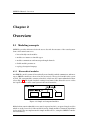
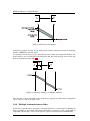
An OMNeT++ model consists of hierarchically nested modules which communicate with messages. OMNeT++ models are often referred to as networks. The top level module is the system
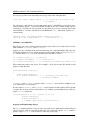
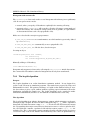
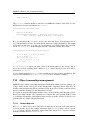
module. The system module contains submodules, which can also contain submodules themselves (Fig. 2.1). The depth of module nesting is not limited; this allows the user to reflect
the logical structure of the actual system in the model structure.
Figure 2.1: Simple and compound modules
Modules that contain submodules are termed compound modules, as opposed simple modules
which are at the lowest level of the module hierarchy. Simple modules contain the algorithms
in the model. The user implements the simple modules in C++, using the OMNeT++ simulation class library.
7
OMNeT++ Manual – Overview
2.1.2
Module types
Both simple and compound modules are instances of module types. While describing the
model, the user defines module types; instances of these module types serve as components
for more complex module types. Finally, the user creates the system module as an instance of
a previously defined module type; all modules of the network are instantiated as submodules
and sub-submodules of the system module.
When a module type is used as a building block, there is no distinction whether it is a simple
or a compound module. This allows the user to split a simple module into several simple
modules embedded into a compound module, or vica versa, aggregate the functionality of a
compound module into a single simple module, without affecting existing users of the module
type.
Module types can be stored in files separately from the place of their actual usage. This
means that the user can group existing module types and create component libraries. This
feature will be discussed later, in Chapter 9.
2.1.3
Messages, gates, links
Modules communicate by exchanging messages. In an actual simulation, messages can represent frames or packets in a computer network, jobs or customers in a queuing network
or other types of mobile entities. Messages can contain arbitrarily complex data structures.
Simple modules can send messages either directly to their destination or along a predefined
path, through gates and connections.
The “local simulation time” of a module advances when the module receives a message. The
message can arrive from another module or from the same module (self-messages are used to
implement timers).
Gates are the input and output interfaces of modules; messages are sent out through output
gates and arrive through input gates.
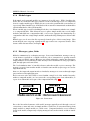
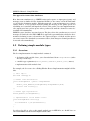
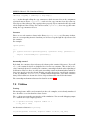
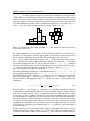
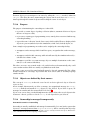
Each connection (also called link) is created within a single level of the module hierarchy:
within a compound module, one can connect the corresponding gates of two submodules, or
a gate of one submodule and a gate of the compound module (Fig. 2.2).
Figure 2.2: Connections
Due to the hierarchical structure of the model, messages typically travel through a series of
connections, to start and arrive in simple modules. Such series of connections that go from
simple module to simple module are called routes. Compound modules act as ‘cardboard
boxes’ in the model, transparently relaying messages between their inside and their outside
world.
8
OMNeT++ Manual – Overview
2.1.4
Modeling of packet transmissions
Connections can be assigned three parameters which facilitate the modeling of communication networks, but can be useful for other models too: propagation delay, bit error rate and
data rate, all three being optional. One can specify link parameters individually for each
connection, or define link types and use them throughout the whole model.
Propagation delay is the amount of time the arrival of the message is delayed by when it
travels through the channel.
Bit error rate speficifies the probability that a bit is incorrectly transmitted, and allows for
simple noisy channel modelling.
Data rate is specified in bits/second, and it is used for calculating transmission time of a
packet.
When data rates are in use, the sending of the message in the model corresponds to the
transmission of the first bit, and the arrival of the message corresponds to the reception
of the last bit. This model is not always applicable, for example protocols like Token Ring
and FDDI do not wait for the frame to arrive in its entirety, but rather start repeating its
first bits soon after they arrive – in other words, frames “flow through” the stations, being
delayed only a few bits. If you want to model such networks, the data rate modeling feature
of OMNeT++ cannot be used.
2.1.5
Parameters
Modules can have parameters. Parameters are used for three purposes:
1. to parameterize module topology
2. to customize simple module behaviour
3. for module communication, as shared variables
Parameters can take string, numeric or pointer values; numeric values include expressions
using other parameters and calling C functions, random variables from different distributions, and values input interactively by the user.
Numeric-valued parameters can be used to construct topologies in a flexible way. Within a
compound module, parameters can define the number of submodules, number of gates, and
the way the internal connections are made.
Compound modules can pass parameters or expressions of parameters to their submodules.
Parameter passing can be done by value or by reference.
During simulation execution, if a module changes the value of a parameter taken by reference, the changed value propagates to other modules. This effect can be used to tune the
model or as a second means of module communication.
2.1.6
Topology description method
The user defines the structure of the model in NED language descriptions (Network Description).The NED language will be discussed in detail in Chapter 4.
9
OMNeT++ Manual – Overview
2.2
Programming the algorithms
The simple modules of a model contain the algorithms as C++ functions. The full flexibility
and power of the programming language can be used, supported by the OMNeT++ simulation
class library.
OMNeT++ supports a process-style description method for describing activities. During simulation execution, simple module functions appear to run in parallel, because they are implemented as coroutines (also termed lightweight processes). Coroutines were chosen because
they allow an intuitive description of the algorithm and they can also serve as a good basis
for implementing other description methods like state-transition diagrams or Petri nets.
OMNeT++ has a consistent object-oriented design. One can freely use OOP concepts (inheritance, polymorphism etc) to extend the functionality of the simulator.
Elements of the simulation (messages, modules, queues etc.) are represented as objects.
These classes are part of the simulation class library:
• modules, gates, connections etc.
• parameters
• messages
• container classes (e.g. queue, array)
• data collection classes
• statistic and distribution estimation classes (histograms, P 2 algorithm for calculating
quantiles etc.)
• transient detection and result accuracy detection classes
The objects are designed so that they can efficiently work together, creating a powerful framework for simulation programming.
2.2.1
Creating simple modules
Each simple module type is implemented with a C++ class. Simple module classes are derived from a simple module base class, by redefining the virtual function that contains the
algorithm. The user can add other member functions to the class to split up a complex algorithm; he can also add data members to the class.
It is also possible to derive new simple module classes from existing ones. For example,
if one wants to experiment with retransmission timeout schemes in a transport protocol,
he can implement the protocol in one class, create a virtual function for the retransmission
algorithm and then derive a family of classes that implement concrete schemes. This concept
is further supported by the fact that in the network description, actual module types can be
parameters.
2.2.2
Object mechanisms
The use of smart container classes allows the user to build aggregate data structures. For
example, one can add any number of objects to a message object as parameters. Since the
added objects can contain further objects, complex data structures can be built.
There is an efficient ownership mechanism built in. The user can specify an owner for each
object; then, the owner object will have the responsibility of destroying that object. Most
10
OMNeT++ Manual – Overview
of the time, the ownership mechanism works transparently; ownership only needs to be
explicitly managed when the user wants to do something non-typical.
The foreach mechanism allows one to enumerate the objects inside a container object in a
uniform way and do some operation on them. This feature which makes it possible to handle
many objects together. (The foreach feature is extensively used by the user interfaces with
debugging capability and the snapshot mechanism; see later.)
2.2.3
Derive new classes
It most cases, the functionality offered by the OMNeT++ classes is enough for the user. But if
it is needed, one can derive new classes from the existing ones or create entirely new classes.
For flexibility, several member functions are declared virtual. When the user creates new
classes, certain rules need to be kept so that the object can fully work together with other
objects.
2.2.4
Self-describing objects to ease debugging
The class library is designed so that objects can give textual information about themselves.
This makes it possible to peek into a running simulation program: through an appropriate
user interface, one can examine (and modify) the internal data structures of a running simulation. This feature helps the user to get some insight what is happening inside the model
and get hands-on experience.
A unique feature called snapshot allows the user to dump the contents of the simulation
model or a part of it into a text file. The file will contain textual reports about every object;
this can be of invaluable help at times of debugging. Ordinary variables can also be made to
appear in the snapshot file. Snapshot creations can be scheduled from within the simulation
program or done from the user interface.
2.3
2.3.1
Using OMNeT++
Building and running simulations
This section gives some idea how to work with OMNeT++ in practice: issues like model files,
compiling and running simulations are discussed.
An OMNeT++ model consists of the following parts:
• NED language topology description(s) which describe the module structure with parameters, gates etc. They are files with .ned suffix. NED files can be written with any
text editor or using the GNED graphical editor.
• Simple modules sources. They are C++ files, with .h/.cc suffix.
The simulation system provides the following components:
• Simulation kernel. This contains the code that manages the simulation and the simulation class library. It is written in C++, compiled and put together to form a library (a
file with .a or .lib extension)
• User interfaces. OMNeT++ user interfaces are used with simulation execution, to facilitate debugging, demonstration, or batch execution of simulations. There are several
11
OMNeT++ Manual – Overview
user interfaces, written in C++, compiled and put together into libraries (.a or .lib
files).
Simulation programs are built from the above components. First, the NED files are compiled
into C++ source code, using the NEDC compiler which is part of OMNeT++. Then all C++
sources are compiled and linked with the simulation kernel and a user interface to form a
simulation executable.
Running the simulation and analyzing the results
The simulation executable is a standalone program, thus it can be run on other machines
without OMNeT++ or the model files being present. When the program is started, it reads
in a configuration file (usually called omnetpp.ini); it contains settings that control how
the simulation is run, values for model parameters, etc. The configuration file can also prescribe several simulation runs; in the simplest case, they will be executed by the simulation
program one after another.
The output of the simulation is written into data files: output vector files, output scalar files ,
and possibly the user’s own output files. OMNeT++ provides a GUI tool named Plove to view
and plot the contents of output vector files. But it is not expected that someone will process
the result files using OMNeT++ alone: output files are text files in a format which (maybe after some preprocessing using sed, awk or perl) can be read into math packages like Matlab
or its free equivalent Octave, or imported into spreadsheets like Excel. All these external programs have rich functionality for statistical analysis and visualization, and OMNeT++ does
not try to duplicate their efforts. This manual briefly describes some data plotting programs
and how to use them with OMNeT++.
User interfaces
The primary purpose of user interfaces is to make the inside of the model visible to the
user, to start/stop simulation execution, and possibly allow the user intervene by changing
variables/objects inside the model. This is very important in the development/debugging
phase of the simulation project. Just as important, a hands-on experience allows the user to
get a ‘feel’ about the model’s behaviour. A nice graphical user interface can also be used to
demonstrate how the model works internally.
The same simulation model can be executed with different user interfaces, without any
change in the model files themselves. The user would test and debug the simulation with
a powerful graphical user interface, and finally run it with a simple and fast user interface
that supports batch execution.
Component libraries
Module types can be stored in files separately from the place of their actual usage. This
means that the user can group existing module types and create component libraries.
Universal standalone simulation programs
A simulation executable can store several independent models that use the same set of simple modules. The user can specify in the configuration file which model he/she wants to
run. This allows one to build one large executable that contains several simulation models,
and distribute it as a standalone simulation tool. The flexibility of the topology description
language also supports this approach.
12
OMNeT++ Manual – Overview
2.3.2
What is what in the directories
To help you navigate among files in the OMNeT++ distribution, here’s a list what you can
find in the different directories.
The omnetpp directory contains the following subdirectories.
The simulation system itself:
omnetpp/
bin/
include/
lib/
bitmaps/
doc/
html/
api/
nedxml-api/
src/
nedc/
sim/
std/
pvm/
mpi/
envir/
cmdenv/
tkenv/
gned/
plove/
nedxml/
utils/
test/
distrib/
OMNeT++ root directory
OMNeT++ executables (GNED, nedc, etc.)
header files for simulation models
library files
icons that can be used in network graphics
manual (PDF), readme, license, etc.
manual in HTML
API reference in HTML
API reference for the NEDXML library
OMNeT++ sources
NED compiler
simulation kernel
files for non-distributed execution
files for distributed execution over PVM
files for distributed execution using MPI
common code for user interfaces
command-line user interface
Tcl/Tk-based user interface
graphical NED editor
output vector analyzer and plotting tool
NEDXML library (experimental)
makefile-autocreator etc
regression test suite
regression test suite for built-in distributions
There is a tutorial, contributed by Nick van Foreest
tutorial/
queues/
doc_src/
the tutorial document
sample simulation that supports the tutorial
the Latex sources for the tutorial doc
Sample simulations are within the samples directory. Each of the sample directories contain a network description (.ned file) and corresponding simple module code (.h, .cc files).
Makefiles are included.
samples/
nim/
hcube/
token/
fddi/
hist/
dyna/
dyna2/
fifo1/
fifo2/
topo/
demo/
directories for sample simulations
a simple two-player game
hypercube network with deflection routing
simple model of a Token Ring LAN
an accurate FDDI MAC simulation
demo of the histogram classes
model of a client-server network
a version of dyna, using message subclassing
single-server queue
another version of fifo, with handleMessage() and FSM
NED demo, shows how to create various topologies
several sim. models in a single executable
13
OMNeT++ Manual – Overview
The contrib directory contains material from the OMNeT++ community.
contrib/
octave/
emacs/
directory for contributed material
Octave scripts for result processing
NED syntax highlight for Emacs
You may also find additional directories like msvc/, which contain integration components
for Microsoft Visual C++, etc.
14
OMNeT++ Manual – An Example: The Nim Game
Chapter 3
An Example: The Nim Game
This chapter contains a full example program that can give you some basic idea of using
the simulator. An enhanced version of the Nim example can be found among the sample
programs.
Nim is an ancient game with two players and a bunch of sticks. The players take turns,
removing 1, 2, 3 or 4 sticks from the heap of sticks at each turn. The one who takes the last
stick is the loser.
Of course, building a model of the Nim game is not much of a simulation project, but it nicely
demonstrates the modeling approach used by OMNeT++.
Describing the model consists of two phases:
• topology description
• defining the operation of components
3.1 Topology
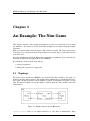
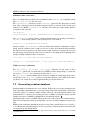
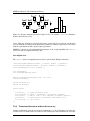
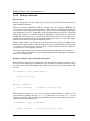
The game can be modelled in OMNeT++ as a network with three modules: the “game” (a
manager module) and two players. The modules will communicate by exchanging messages.
The “game” module keeps the current number of tokens and organizes the game; in each
turn, the player modules receives the number of tokens from the Game module and sends
back its move.
Figure 3.1: Module structure for the Nim game.
Player1, Player2 and Game are simple modules (e.g. they have no submodules.) Each
15
OMNeT++ Manual – An Example: The Nim Game
module is an instance of a module type. We’ll need a module type to represent the Game
module; let’s call it Game too.
We can implement two kinds of players: SmartPlayer, which knows the winning algorithm, and SimplePlayer, which simply takes a random number of sticks. In our example,
Player1 will be a SmartPlayer and Player2 will be a SimplePlayer.
The enclosing module, Nim is a compound module (it has submodules). It is also defined as a
module type of which one instance is created, the system module.
Modules have input and output gates (the tiny boxes labeled in, out, fromPlayer1, etc.
in the figure). An input and an output gate can be connected: connections (or links) are
shown as in the figure as arrows. During the simulation, modules communicate by sending
messages through the connections.
The user defines the topology of the network in NED files.
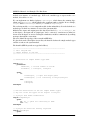
We placed the model description in two files; the first file defines the simple module types
and the second one the system module.
The first file (NED keywords are typed in boldface):
//--------------------------------------------------------// file: nim_mod.ned
// Simple modules in nim.ned
//---------------------------------------------------------
// Declaration of simple module type Game.
simple Game
parameters:
numSticks, // initial number of sticks
firstMove; // 1=Player1, 2=Player2
gates:
in:
fromPlayer1, // input and output gates
fromPlayer2; // for connecting to Player1/Player2
out:
toPlayer1,
toPlayer2;
endsimple
// Now the declarations of the two simple module types.
// Any one of the two types can be Player1 or Player2.
// A player that makes random moves
simple SimplePlayer
gates:
in: in; // gates for connecting to Game
out: out;
endsimple
// A player who knows the winning algorithm
simple SmartPlayer
gates:
16
OMNeT++ Manual – An Example: The Nim Game
in: in; // gates for connecting to Game
out: out;
endsimple
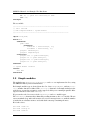
The second file:
//------------------------------------------------------------// file: nim.ned
// Nim compound module + system module
//------------------------------------------------------------import "nim_mod";
module Nim
submodules:
game: Game
parameters:
numSticks = intuniform(21, 31),
firstMove = intuniform(1, 2);
player1: SmartPlayer;
player2: SimplePlayer;
connections:
player1.out --> game.fromPlayer1,
player1.in <-- game.toPlayer1,
player2.out --> game.fromPlayer2,
player2.in <-- game.toPlayer2;
endmodule
// system module creation
network
nim: Nim
endnetwork
3.2
Simple modules
The module types SmartPlayer, SimplePlayer and Game are implemented in C++, using
the OMNeT++ library classes and functions.
Each simple module type is derived from the C++ class cSimpleModule, with its activity() member function redefined. The activity() functions of all simple modules in the
network are executed as coroutines, so they appear as if they were running in parallel. Messages are instances of the class cMessage.
We present here the C++ sources of the SmartPlayer and Game module types.
The SmartPlayer first introduces himself by sending its name to the Game module. Then it
enters an infinite loop; with each iteration, it receives a message from Game with the number
of sticks left, it calculates its move and sends back a message containing the move.
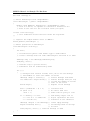
Here’s the source:
#include <stdio.h>
#include <string.h>
#include <time.h>
17
OMNeT++ Manual – An Example: The Nim Game
#include <omnetpp.h>
// derive SmartPlayer from cSimpleModule
class SmartPlayer : public cSimpleModule
{
Module_Class_Members( SmartPlayer, cSimpleModule, 8192)
// this is a macro; it expands to constructor definition etc.
// 8192 is the size for the coroutine stack (in bytes)
virtual void activity();
// this redefined virtual function holds the algorithm
};
// register the simple module class to OMNeT++
Define_Module( SmartPlayer );
// define operations of SmartPlayer
void SmartPlayer::activity()
{
int move;
// initialization phase: send module type to Game module
// create a message with the name "SmartPlayer" and send it to Game
cMessage *msg = new cMessage("SmartPlayer");
send(msg, "out");
// infinite loop to process moves;
// simulation will be terminated by Game
for (;;)
{
// messages have several fields; here, we’ll use the message
// kind member to store the number of sticks
cMessage *msgin = receive();
// receive message from Game
int numSticks = msgin->kind(); // extract message kind (an int)
// it hold the number of sticks
// still on the stack
delete msgin;
// dispose of the message
move = (numSticks + 4) % 5;
if (move == 0)
move = 1;
// calculate move
// we cannot take zero
// seems like we going to lose
ev << "Taking " << move
<< " out of " << numSticks
<< " sticks.\n";
// some debug output. The ev
// object represents the user
// interface of the simulator
cMessage *msgout = new cMessage;// create empty message
msgout->setKind( move );
// use message kind as storage
// for move
send( msgout, "out"); // send the message to Game
}
}
18
OMNeT++ Manual – An Example: The Nim Game
The Game module first waits for a message from both players and extracts the message names
that are also the players’ names. Then it enters a loop, with the playerToMove variable
alternating between 1 and 2. With each iteration, it sends out a message with the current
number of sticks to the corresponding player and gets back the number of sticks taken by that
player. When the sticks are out, the module announces the winner and ends the simulation.
The source:
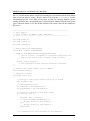
//------------------------------------------------------------// file: game.cc
// (part of NIM - an OMNeT++ demo simulation)
//------------------------------------------------------------#include <stdio.h>
#include <string.h>
#include <omnetpp.h>
// derive Game from cSimpleModule
class Game : public cSimpleModule
{
Module_Class_Members(Game,cSimpleModule,8192)
// this is a macro; it expands to constructor definition etc.
// 8192 is the size for the coroutine stack (in bytes)
virtual void activity();
// this redefined virtual function holds the algorithm
};
// register the simple module class to OMNeT++
Define_Module( Game );
// operation of Game:
void Game::activity()
{
// strings to store player names; player[0] is unused
char player[3][32];
// read parameter values
int numSticks = par("numSticks");
int playerToMove = par("firstMove");
// waiting for players to tell their names
for (int i=0; i<2; i++)
{
cMessage *msg = receive();
if (msg->arrivedOn("fromPlayer1"))
strcpy( player[1], msg->name());
else
strcpy( player[2], msg->name());
delete msg;
}
// ev represents the user interface of the simulator
19
OMNeT++ Manual – An Example: The Nim Game
ev << "Let the game begin!\n";
ev << "Player 1: " << player[1] << "
<< "\n\n";
Player 2: " << player[2]
do
{
ev << "Sticks left: " << numSticks << "\n";
ev << "Player " << playerToMove << " ("
<< player[playerToMove] << ") to move.\n";
cMessage *msg = new cMessage("", numSticks);
// numSticks will be the msg kind
if (playerToMove == 1)
send(msg, "toPlayer1");
else
send(msg, "toPlayer2");
msg = receive();
int sticksTaken = msg->kind();
delete msg;
numSticks -= sticksTaken;
ev << "Player " << playerToMove << " ("
<< player[playerToMove] << ") took "
<< sticksTaken << " stick(s).\n";
playerToMove = 3 - playerToMove;
}
while (numSticks>0);
ev << "\nPlayer " << playerToMove << " ("
<< player[playerToMove] << ") won!\n";
endSimulation();
}
3.3
Running the simulation
Once the source files are ready, one needs to compile and link them into a simulation executable. One can specify the user interface to be linked.
Before running the simulation, one can put parameter values and all sorts of other settings
into an initialization file that will be read when the simulation program starts:
#
# file: omnetpp.ini
#
[General]
network = nim
random-seed = 3
20
OMNeT++ Manual – An Example: The Nim Game
ini-warnings = false
[Cmdenv]
express-mode = no
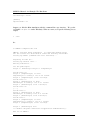
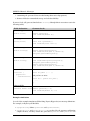
Suppose we link the Nim simulation with the command line user interface. We get the
executable nim (nim.exe under Windows). When we run it, we’ll get the following screen
output:
% ./nim
Or:
C:\OMNeT++\samples\nim> nim
OMNeT++ Discrete Event Simulation (C) 1992-2003 Andras Varga
See the license for distribution terms and warranty disclaimer
Setting up Cmdenv (command-line user interface)...
Preparing for Run #1...
Setting up network ‘nim’...
Running simulation...
Let the game begin!
Player 1: SmartPlayer Player 2: SimplePlayer
Sticks left: 29
Player 2 (SimplePlayer) to move.
SimplePlayer is taking 2 out of 29 sticks.
Player 2 (SimplePlayer) took 2 stick(s).
Sticks left: 27
Player 1 (SmartPlayer) to move.
SmartPlayer is taking 1 out of 27 sticks.
Player 1 (SmartPlayer) took 1 stick(s).
Sticks left: 26
[...]
Sticks left: 5
Player 1 (SmartPlayer) to move.
SmartPlayer is taking 4 out of 5 sticks.
Player 1 (SmartPlayer) took 4 stick(s).
Sticks left: 1
Player 2 (SimplePlayer) to move.
SimplePlayer is taking 1 out of 1 sticks.
Player 2 (SimplePlayer) took 1 stick(s).
Player 1 (SmartPlayer) won!
<!> Module nim.game: Simulation stopped with endSimulation().
End run of OMNeT++
21
OMNeT++ Manual – An Example: The Nim Game
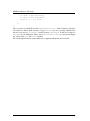
3.4
Other examples
An enhanced version of the Nim example can be found among the sample programs. It adds
a third, interactive player and derives specific player types from a Player abstract class. It
also adds the possibility that actual types for player1 and player2 can be specified in the
ini file or interactively entered by the user at the beginning of the simulation.
Nim does not show very much of how complex algorithms like communication protocols can
be implemented in OMNeT++. To have an idea about that, look at the Token Ring example.
It is also extensively commented, though you may need to peep into the user manual to fully
understand it. The Dyna simulation models a simple client-server network and demonstrates
dynamic module creation. The FDDI example is an accurate FDDI MAC simulation which
was written on the basis of the ANSI standard.
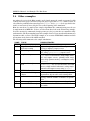
The following table summarizes the sample simulations:
NAME
nim
hcube
token
TOPIC
a simple two-player game
hypercube network with
deflection routing
Token Ring network
fifo1
single-server queue
fifo2
another fifo implementation
fddi
hist
dyna
FDDI MAC simulation
demo of the histogram
classes
a client-server network
topo
demo
various topologies
tour of OMNeT++ samples
DEMONSTRATES
module inheritance; module type as parameter
hypercube topology with dimension as parameter;
topology templates; output vectors
ring topology with the number of nodes as parameter; using cQueue; wait(); output vectors
simple module inheritance; decomposing activity() into several functions; using simple statistics and output vectors; printing stack usage
info to help optimize memory consumption; using
finish()
using handleMessage(); decomposing handleMessage() into several functions; the FSM
macros; simple module inheritance; using simple
statistics and output vectors; using finish()
using statistics classes; and many other features
collecting observations into statistics objects; saving statistics objects to file and restoring them
dynamic module creation; using WATCH(); star
topology with the number of modules as parameters
using NED for creating parametrized topologies
shows how to link several sim. models into one
executable
22
OMNeT++ Manual – The NED Language
Chapter 4
The NED Language
4.1
NED overview
The topology of a model is specified using the NED language. The NED language supports
modular description of a network. This means that a network description consists of a number of component descriptions (channels, simple/compound module types). The channels,
simple modules and compound modules of one network description can be reused in another
network description. As a consequence, the NED language makes it possible for users to
build their own module libraries.
Files containing network descriptions generally have a .ned suffix. NED files are not used
directly: they are translated into C++ code by the NEDC compiler, then compiled by the C++
compiler and linked into the simulation executable.
The EBNF description of the language can be found in Appendix A.
4.1.1
Components of a NED description
A NED description can contain the following components, in arbitrary number or order:
• import directives
• channel definitions
• simple and compound module definitions
• network definitions
4.1.2
Reserved words
The writer of the network description has to take care that no reserved words are used for
names. The reserved words of the NED language are:
import include channel endchannel simple endsimple module endmodule
error delay datarate const parameters gates submodules connections
gatesizes on if machines for do endfor network endnetwork nocheck
ref ancestor true false like input numeric string bool char
23
OMNeT++ Manual – The NED Language
4.1.3
Identifiers
Identifiers are the names of modules, channels, networks, submodules, parameters, gates,
channel attributes and functions.
Identifiers must be composed of letters of the English alphabet (a-z, A-Z), numbers (0-9) and
the underscore “_”. Identifiers may only begin with a letter or the underscore. If you want to
begin an identifier with a digit, prefix the name you’d like to have with an underscore, e.g.
_3Com.
If you have identifiers that are composed of several words, the convention is to capitalize the
beginning of every word. Also, it is recommended that you begin the names of modules, channels and networks with a capital letter, and the names of parameters, gates and submodules
with a lower-case letter. Underscores are rarely used.
4.1.4
Case sensitivity
The network description and all identifiers in it are case sensitive. For example, TCP and
Tcp are two different names.
4.1.5
Comments
Comments can be placed anywhere in the NED file, with the usual C++ syntax: comments
begin with a double slash ‘//’, and last until the end of the line. Comments are ignored by the
NED compiler.
It is planned that future OMNeT++ versions will use comments for documentation generation, much like JavaDoc or Doxygen.
4.2
The import directive
The import directive is used to import declarations from another network description file.
After importing a network description, one can use the components (channels, simple/compound
module types) defined in it.
When a file is imported, only the declaration information is used. Also, importing a .ned file
does not cause that file to be compiled with the NED compiler when the parent file is NEDC
compiled, i.e., one must compile and link all network description files – not only the top-level
ones.
You can specify the name of the files with or without the .ned extension. You can also include
a path in the filenames, or better, use the NEDC compiler’s -I <path> command-line option
to name the directories where the imported files reside.
Example:
import "ethernet";
4.3
// imports ethernet.ned
Channel definitions
A channel definition specifies a connection type of given characteristics. The channel name
can be used later in the NED description to create connections with these parameters.
The syntax:
24
OMNeT++ Manual – The NED Language
channel ChannelName
//...
endchannel
Three attributes can be assigned values in the body of the channel declaration, all of them optional: delay, error and datarate. delay is the propagation delay in (simulated) seconds;
error is the bit error rate that speficifies the probability that a bit is incorrectly transmitted;
and datarate is the channel bandwidth in bits/second, used for calculating transmission
time of a packet. The attributes can appear in any order.
The values must be constants, or expressions that do not contain external references (e.g.
names of module parameters). If you assign a random-valued expression (e.g. truncnormal(0.005,0.001)), it will be evaluated and a new random number generated for each
packet transmission.
Example:
channel DialUpConnection
delay normal (0.004, 0.0018)
error 0.00001
datarate 14400
endchannel
4.4
Simple module definitions
Simple modules are the basic building blocks for other (compound) modules. Simple module
types are identified by names. By convention, module names begin with upper-case letters.
A simple module is defined by declaring its parameters and gates.
Simple modules are declared with the following syntax:
simple SimpleModuleName
parameters:
//...
gates:
//...
endsimple
4.4.1
Simple module parameters
Parameters are variables that belong to a module. Simple module parameters can be queried
and used by simple module algorithms. For example, a module called TrafficGen may have
a parameter called numOfMessages that determines how many messages it should generate.
Parameters are identified by names. By convention, parameter names begin with lower-case
letters.
Parameters are declared by listing their names in the parameters: section of a module description. The parameter type can optionally be specified as numeric, numeric const (or
simply const), bool, string, or anytype.
Example:
simple TrafficGen
parameters:
25
OMNeT++ Manual – The NED Language
interArrivalTime,
numOfMessages : const,
address : string;
gates: //...
endsimple
If the parameter type is omitted, numeric is assumed. Practically, this means that you only
need to explicitly specify the type for string, bool or char-valued parameters.
Note that the actual parameter values are given later, when the module is used as a building
block of a compound module type or as a system module.
Const parameters
When you declare a parameter to be const, it will be evaluated and replaced by the resulting
constant value at the beginning of the simulation. This can be important when the original
value was a random number or an expression. One is advised to write out the const keyword
for each parameter that should be constant.
Beware when using const and by-reference parameter passing (ref modifier, see later) at
the same time. Converting the parameter to constant can affect other modules and cause
errors that are difficult to discover.
4.4.2
Simple module gates
Gates are the connection points of modules. The starting and ending points of the connections
between modules are gates. OMNeT++ supports simplex (one-directional) connections, so
there are two kinds of gates: input and output. Messages are sent through output gates and
received through input gates.
Gates are identified with their names. By convention, gate names begin with lower-case
letters.
Gate vectors are supported: a gate vector contains a number of single gates.
Gates are declared by listing their names in the gates: section of a module description. An
empty bracket pair [] denotes a gate vector. Elements of the vector are numbered starting
with zero.
Examples:
simple DataLink
parameters: //...
gates:
in: fromPort, fromHigherLayer;
out: toPort, toHigherLayer;
endsimple
simple RoutingModule
parameters: //...
gates:
in: output[];
out: input[];
endsimple
The sizes of gate vectors are given later, when the module is used as a building block of a
26
OMNeT++ Manual – The NED Language
compound module type. Thus, every instance of the module can have gate vectors of different
sizes.
4.5
Compound module definitions
Compound modules are modules composed of one or more submodules. Any module type
(simple or compound module) can be used as a submodule. Like simple modules, compound
modules can also have gates and parameters, and they can be used wherever simple modules
can be used.
It is useful to think about compound modules as “cardboard boxes” that help you organize
your simulation model and bring structure into it. No active behaviour is associated with
compound modules – they are simply for grouping modules into larger components that can
can be used either as a model (see section 4.6) or as a building block for other compound
modules.
By convention, module type names (and so compound module type names, too) begin with
upper-case letters.
Submodules may use parameters of the compound module. They may be connected with each
other and/or with the compound module itself.
A compound module definition looks similar to a simple module definition: it has gates and
parameters sections. There are two additional sections, submodules and connections.
The syntax for compound modules is the following:
module CompoundModule
parameters:
//...
gates:
//...
submodules:
//...
connections:
//...
endmodule
All sections (parameters, gates, submodules, connections) are optional.
4.5.1
Compound module parameters and gates
Parameters and gates for compound modules are declared and work in the same way as with
simple modules, described in sections 4.4.1 and 4.4.2.
Typically, compound module parameters are passed to submodules and used for initializing
their parameters.
Parameters can also be used in defining the internal structure of the compound module:
the number of submodules, gate vector sizes can be define with the help of parameters, and
parameters can also be used in defining the connections inside the compound module. As
a practical example, you can create a Router compound module with a variable number of
ports, specified in a numOfPorts parameter.
Parameters affecting the internal structure should always be declared const, so that accessing them always yields the same value. (Otherwise, if the parameter was assigned a random
27
OMNeT++ Manual – The NED Language
value, one could get a different value each time the parameter is accessed during building
the internals of the compound module, which is surely not what was meant.)
Example:
module Router
parameters:
packetsPerSecond : numeric,
bufferSize : numeric,
numOfPorts : const;
gates:
in: inputPort[];
out: outputPort[];
submodules: //...
connections: //...
endmodule
4.5.2
Submodules
Submodules are defined in the submodules: section of a compound module declaration.
Submodules are identified by names. By convention, submodule names begin with lowercase letters.
Submodules are instances of a module type, either simple or compound – there is no distinction. The module type must be known to the NED compiler, that is, it must have appeared
earlier in the same NED file or have been imported from another NED file.
It is possible to define vectors of submodules, and the size of the vector may come from a
parameter value.
When defining submodules, you can assign values to their parameters, and if the corresponding module type has gate vectors, you have to specify their sizes.
Example:
module CompoundModuleName
//...
submodules:
submodule1: ModuleType1
parameters:
//...
gatesizes:
//...
submodule2: ModuleType2
parameters:
//...
gatesizes:
//...
endmodule
Module vectors
It is possible to create an array of submodules (a module vector). This is done with an
expression between brackets right behind the module type name. The expression can refer
to module parameters. A zero value as module count is also allowed.
Example:
28
OMNeT++ Manual – The NED Language
module BigCompoundModule
parameters:
size: const;
submodules:
submod1: Node[3]
//...
submod2: Node[size]
//...
submod3: Node[2*size+1]
//...
endmodule
4.5.3
Submodule type as parameter
Sometimes it is convenient to make the name of a submodule type a parameter, so that one
can easily ‘plug in’ any module there.
For example, assume the purpose of your simulation study is to compare different routing
algorithms. Suppose you programmed the needed routing algorithms as simple modules:
DistVecRoutingNode, AntNetRouting1Node, AntNetRouting2Node, etc. You have also
created the network topology as a compound module called RoutingTestNetwork, which
will serve as a testbed for your routing algorithms. Currently, RoutingTestNetwork has
DistVecRoutingNode hardcoded (all submodules are of this type), but you want to be able
to switch to other routing algorithms easily.
NED gives you the possibility to add a string-valued parameter, say routingNodeType to
the RoutingTestNetwork compound module. Then you can tell NED that types of the submodules inside RoutingTestNetwork are not of any fixed module type, but contained in the
routingNodeType parameter. That’s all – now you are free to assign any of the "DistVecRoutingNode", "AntNetRouting1Node" or "AntNetRouting2Node" string constants to
this parameter (you can do that in NED, in the config file (omnetpp.ini), or even enter it
interactively), and your network will use the routing algorithm you chose.
If you specify a wrong value, say "FooBarRoutingNode" whereas you have no FooBarRoutingNode module implemented, you’ll get a runtime error at the beginning of the simulation: module type definition not found.
Inside the RoutingTestNetwork module you assign parameter values and connect the
gates of the routing modules. To provide some degree of type safety, NED wants to make
sure you didn’t misspell parameter or gate names and you used them correctly. To be able
to do such checks, NED requires some help from you: you have to name an existing module type (say RoutingNode) and promise NED that all modules you’re going you specify in
the routingNodeType parameter will have (at least) the same parameters and gates as the
RoutingNode module. 1
All the above is achieved via the like keyword. The syntax is the following:
module RoutingTestNetwork
parameters:
routingNodeType: string; // should hold the name
// of an existing module type
gates: //...
submodules:
1 If
you like, the above solution somewhat similar to polymorphism in object-oriented languages – RoutingNode is like a “base class”, DistVecRoutingNode and AntNetRouting1Node are like “derived classes”, and the
routingNodeType parameter is like a “pointer to a base class” which may be downcast to specific types.
29
OMNeT++ Manual – The NED Language
node1: routingNodeType like RoutingNode;
node2: routingNodeType like RoutingNode;
//...
connections nocheck:
node1.out0 --> node2.in0;
//...
endmodule
The RoutingNode module type does not need to be implemented in C++, because no instance
of it is created; it is merely used to check the correctness of the NED file.
On the other hand, the actual module types that will be substituted (e.g. DistVecRoutingNode, AntNetRouting1Node,etc.) do not need to be declared in the NED files.
The like phrase lets you create families of modules that serve similar purposes and implement the same interface (they have the same gates and parameters) and to use them
interchangeably in NED files.
4.5.4
Assigning values to submodule parameters
If the module type used as submodule has parameters, you can assign values to them in
the parameters section of the submodule declaration. As a value you can use a constant
(such as 42 or "www.foo.org"), various parameters (most commonly, parameters of the
compound module), or write an arbitrary expression containing the above.
It is not mandatory to mention and assign all parameters. Unassigned parameters can get
their values at runtime: either from the configuration file (omnetpp.ini), or if the value isn’t
there either, the simulator will prompt you to enter it interactively. Indeed, for flexibility
reasons it is often very useful not to “hardcode” parameter values in the NED file, but to
leave them to omnetpp.ini where they can be changed more easily.
Example:
module CompoundModule
parameters:
param1: numeric,
param2: numeric,
useParam1: bool;
submodules:
submodule1: Node
parameters:
p1 = 10,
p2 = param1+param2,
p3 = useParam1==true ? param1 : param2;
//...
endmodule
The expression syntax is very similar to C. Expressions may contain constants (literals) and
parameters of the compound module being defined. Parameters can be passed by value or
by reference. The latter means that the expression is evaluated at runtime each time its
value is accessed (e.g. from simple module code), opening up interesting possibilities for the
modeler. You can also refer to parameters of the already defined submodules, with the syntax
submodule.parametername (or submodule[index].parametername).
Expressions are described in detail in section 4.7.
30
OMNeT++ Manual – The NED Language
The input keyword
When a parameter does not receive a value inside NED files or in the configuration file
(omnetpp.ini), the user will be prompted to enter its value at the beginning of the simulation. If you plan to make use of interactive prompting, you can specify a prompt text and a
default value.
The syntax is the following:
<paramname> = input(<default-value>, <prompt>)
<paramname> = input(<default-value>)
<paramname> = input
The third version is actually equivalent to simply and quietly leaving out the parameter from
the list of assignments, but you can use it to make it explicit that you do not want to assign
a value from within the NED file.
Examples:
parameters:
numProc = input(10, "Number of processors?"),
processingTime = input(10ms);
4.5.5
Defining sizes of submodule gate vectors
The sizes of gate vectors are defined with the gatesizes keyword. Gate vector sizes can be
given as constants, parameters or expressions.
An example:
simple Node
gates:
in: inputs[];
out: outputs[];
endsimple
module CompoundModule
parameters:
numPorts: const;
submodules:
node1: Node
gatesizes:
inputs[2], outputs[2];
node2: Node
gatesizes:
inputs[numPorts], outputs[numPorts];
//...
endmodule
4.5.6
Conditional parameters and gatesizes sections
Multiple parameters and gatesizes sections can exist in a submodule definition and each
of them can be tagged with conditions.
Example:
31
OMNeT++ Manual – The NED Language
module Tandem
parameters: count: const;
submodules:
node : Node [count]
parameters:
position = "middle";
parameters if index==0:
position = "beginning";
parameters if index==count-1:
position = "end";
gatesizes:
in[2], out[2];
gatesizes if index==0 || index==count-1:
in[1], in[1];
connections:
//...
endmodule
If the conditions are not disjoint and a parameter value or a gate size is defined twice, the
last definition will take effect, overwriting the former ones. Thus, values intended as defaults
should appear in the first sections.
4.5.7
Connections
The compound module definition specifies how the gates of the compound module and its
immediate sub-modules are connected.
You can connect two submodules or a submodule with its enclosing compound module. (For
completeness, you can also connect two gates of the compound module on the inside, but
this is rarely needed). This means that NED does not permit connections that span multiple
levels of hieararchy – this restriction enforces compound modules to be self-contained, and
thus promotes reusability. Gate directions must also be observed, that is, you cannot connect
two output gates or two input gates.
Only one-to-one connections are supported. One-to-many and many-to-one connections can
be achieved using simple modules that duplicate messages or merge message flows. The
rationale is that wherever such fan-in or fan-out occurs in a model, it is usually associated
with some processing anyway that makes it necessary to use simple modules.
A gate can only be connected once: if two connections refer to the same gate, a compilation
or runtime error will occur.
By default, NED expects every gate to be connected, resulting in a compilation or runtime error if an unconnected gate is found. This check can be turned off with the nocheck modifier,
described later in this section.
Connections are specified in the connections: section of a compound module definition. It
lists the connections, separated by semicolons.
Example:
module CompoundModule
parameters: //...
gates: //...
submodules: //...
connections:
node1.output --> node2.input;
32
OMNeT++ Manual – The NED Language
node1.input <-- node2.output;
//...
endmodule
Each connection can be:
• simple (that is, no delay, bit error rate or data rate), can use a named channel, or a
channel given with delay, error and data rate values;
• single or multiple (loop) connection;
• conditional or non-conditional.
These connection types are described in the following sections.
Single connections and channels
The source gate can be an output gate of a submodule or an input gate of the compound
module, and the destination gate can be an input gate of a submodule or an output gate of
the compound module.
If you do not specify a channel, the connection will have no propagation delay, no transmission delay and no bit errors:
sender.outGate --> receiver.inGate;
The arrow can point either left-to-right or right-to-left.
You can specify a channel by its name:
sender.outGate --> Dialup14400 --> receiver.inGate;
In this case, the NED sources must contain the definition of the channel.
One can also specify the channel parameters directly:
sender.outGate --> error 1e-5 delay 0.001 --> receiver.inGate;
Either of the parameters can be omitted and they can be in any order.
Loop connections
If submodule or gate vectors are used, it is possible to create more than one connection with
one statement. This is termed a multiple or loop connection.
A multiple connection is created with the for statement:
for i=0..4 do
sender.outGate[i] --> receiver[i].inGate
endfor;
The result of the above loop connection can be illustrated as depicted in Fig. 4.1.
One can place several connections in the body of the for statement, separated by semicolons.
One can create nested loops by specifying more than one indices in the for statement, with
the first variable forming the outermost loop.
33
OMNeT++ Manual – The NED Language
Figure 4.1: Loop connection
for i=0..4, j=0..4 do
//...
endfor;
One can also use an index in the lower and upper bound expressions of the subsequent
indices:
for i=0..3, j=i+1..4 do
//...
endfor;
Conditional connections
Creation of a connection can be made conditional, using the if keyword:
for i=0..n do
sender.outGate[i] --> receiver[i].inGate if i%2==0;
endfor;
The if condition is evaluated for each connection (in the above example, for each i value),
and the decision is made individually each time whether to create the the connection or not.
In the above example we connected every second gate. Conditions may also use random
variables, as shown in the next section.
The nocheck modifier
By default, NED requires that all gates be connected. Since this check can be inconvenient
at times, it can be turned off using the nocheck modifier.
The following example generates a random subgraph of a full graph.
module RandomConnections
parameters: //..
gates: //..
submodules: //..
connections nocheck:
for i=0..n-1, j=0..n-1 do
node[i].out[j] --> node[j].in[i] if uniform(0,1)<0.3;
endfor;
endmodule
34
OMNeT++ Manual – The NED Language
When using nocheck, it is the simple modules’ responsibility not to send messages on gates
that are not connected.
4.6
Network definitions
Module module declarations (compound and simple module declarations) just define module
types. To actually get a simulation model that can be run, you need to write a network
definition.
A network definition declares a simulation model as an instance of a previously defined module type. You’ll typically want to use a compound module type here, although it is also possible to program a model as a self-contained simple module and instantiate it as a “network”.
There can be several network definitions in your NED file or NED files. The simulation
program that uses those NED files will be able to run any of them; you typically select the
desired one in the config file (omnetpp.ini).
The syntax of a network definition is similar that of a submodule declaration:
network wirelessLAN: WirelessLAN
parameters:
numUsers=10,
httpTraffic=true,
ftpTraffic=true,
distanceFromHub=truncnormal(100,60);
endnetwork
Here, WirelessLAN is the name of previously defined compound module type, which presumably contains further compound modules of types WirelessHost, WirelessHub, etc.
Naturally, only compound module types without gates can be used in network definitions.
Just as for submodules, you do not need to assign values to all parameters. Unassigned parameters will get their values from the config file (omnetpp.ini) or interactively prompted
for.
4.7
Expressions
In the NED language there are a number of places where expressions are expected.
Expressions have a C-style syntax. They are built with the usual math operators; they can
use parameters taken by value or by reference; call C functions; contain random and input
values etc.
When an expression is used for a parameter value, it is evaluated each time the parameter
value is accessed (unless the parameter is declared const, see 4.4.1). This means that a
simple module querying a non-const parameter during simulation may get different values
each time (e.g. if the value involves a random variable, or it contains other parameters taken
by reference). Other expressions (including const parameter values) are evaluated only
once.
35
OMNeT++ Manual – The NED Language
4.7.1
Constants
Numeric and string constants
Numeric constants are accepted in their usual decimal or scientific notations.
String constants
String constants use double quotes.
Time constants
Anywhere you would put numeric constants (integer or real) to mean time in seconds, you
can also specify the time in units like milliseconds, minutes or hours:
...
parameters:
propagationDelay = 560ms, // 0.560s
connectionTimeout = 6m 30s 500ms, // 390.5s
recoveryIntvl = 0.5h; // 30 min
The following units can be used:
Unit
ns
us
ms
s
m
h
d
4.7.2
Meaning
nanoseconds
microseconds
milliseconds
seconds
minutes
hours
days
Seconds
∗10−9
∗10−6
∗10−3
∗1
∗60
∗3600
∗24 ∗ 3600
Referencing parameters
Expressions can use the parameters of the enclosing compound module (the one being defined) and of submodules defined earlier in NED file. The syntax for the latter is submod.param or submod[index].param.
You can refer to a compound module parameter called param in several ways: as param, ref
param, ancestor param, or ref ancestor param. They all have different semantics.
The first two variations, param and ref param lets you access the parameters of the compound module being defined. In the third and fourth versions, the keyword ancestor means
that the parameter will be searched for upwards, in the module nesting hierarchy. Naturally,
this kind of reference can only be resolved at runtime, when the whole network has been built
up. The parameter which is found first is used. If no such parameter can be found in any of
the enclosing modules, it is a runtime error.
The ref and ref-less versions differ in how the parameter is taken: by value or by reference. If you take a parameter by reference, then runtime changes to that parameter will be
reflected in the assigned parameter: each time a simple module reads the parameter value,
the expression is evaluated, and you may get a different value. In contrast, if you take the
36
OMNeT++ Manual – The NED Language
parameter by value, then runtime changes do not affect the assigned parameter.
2
Reference parameters open up interesting possibilities for the modeler. For example, you
can define a parameter that at the highest level of the model, and let other modules take
it by reference – then if you change the parameter value at runtime (manually or from a
simple module), it will affect the whole model. You can use this arrangement to “tune” model
parameters at runtime, in search for an optimal setting.
In another setup, reference parameters can be used by to propagate status values to neighbouring modules.
4.7.3
Operators
The set of operators supported in NED is similar to C/C++, with the following differences:
• ^ is used for power-of (and not bitwise XOR as in C)
• # is used for logical XOR (same as != between logical values), and ## is used for bitwise
XOR
• the precedence of bitwise operators (&, |, #) have been raised to bind stronger than
relational operations. This precedence is usually more convenient than the C/C++ one.
All values are represented as doubles. For the bitwise operators, doubles are converted to
unsigned long 3 using the C/C++ builtin conversion (type cast), the operation is performed,
then the result is converted back to double. Similarly, for the logical operators &&, || and
##, the operands are converted to bool using the C/C++ builtin conversion (type cast), the
operation is performed, then the result is converted back to double. For modulus (%), the
operands are converted to long.
Here’s the complete list of operators, in order of decreasing precendence:
Operator
-, !, ∼
^
∗, /, %
+, «, »
&, |, #
==
!=
>, >=
<, <=
&&, ||, ##
?:
Meaning
unary minus, negation, bitwise complement
power-of
multiply, divide, modulus
add, subtract
bitwise shifting
bitwise and, or, xor
equal
not equal
greater, greater or equal
less, less or equal
logical operators and, or, xor
the C/C++ “inline if”
2 This also means that if an expression doesn’t contain any parameter taken by reference, the NED compiler may
have the possibility to evaluate the expression only once, at compile time. If an expression refers to parameters
taken by reference, only runtime evaluation can be used.
3 In case you are worried about long values being not accurately represented in doubles, this is not the case.
IEEE-754 doubles have 52 bit mantissas, and integer numbers in that range are represented without rounding
errors.
37
OMNeT++ Manual – The NED Language
4.7.4
The sizeof() and index operators
A useful operator is sizeof(), which gives the size of a vector gate. The index operator
gives the index of the current submodule in its module vector.
An example for both:
module Compound
gates: in: fromgens[];
submodules:
proc: Processor[ sizeof(fromgens) ];
parameters: address = 10*(1+index);
connections:
for i = 0.. sizeof(fromgens)-1 do
in[i] --> proc[i].input;
endfor;
endmodule
Here, we create as many processors as there are input gates for this compound module in
the network. The address parameters of the processors are 10, 20, 30 etc.
4.7.5
Functions
In NED expressions, you can use the following mathematical functions:
• many of the C language’s <math.h> library functions: exp(), log(), sin(), cos(),
floor(), ceil(), etc.
• functions that generate random variables: uniform, exponential, normal and others were already discussed.
It is possible to add new ones, see 4.7.7.
4.7.6
Random values
Expressions may contain random variates from different distributions. This has the effect
that unless the parameter was declared const, it returns a different value each time it is
evaluated.
If the parameter was declared const, it is only evaluated once at the beginning of the simulation, and subsequent queries on the parameter will always return the same value.
Random variate functions use one of the random number generators (RNGs) provided by
OMNeT++. By default this is generator 0, but you can specify which one to be used.
OMNeT++ has the following predefined distributions:
Function
Description
Continuous distributions
uniform(a, b, rng=0)
uniform distribution in the range [a,b)
exponential(mean, rng=0)
exponential distribution with the given mean
normal(mean, stddev, rng=0)
normal distribution with the given mean and
standard deviation
truncnormal(mean, stddev,
normal distribution truncated to nonnegative
rng=0)
values
38
OMNeT++ Manual – The NED Language
gamma distribution with parameters alpha>0,
beta>0
beta(alpha1, alpha2, rng=0)
beta distribution with parameters alpha1>0,
alpha2>0
erlang_k(k, mean, rng=0)
Erlang distribution with k>0 phases and the
given mean
chi_square(k, rng=0)
chi-square distribution with k>0 degrees of
freedom
student_t(i, rng=0)
student-t distribution with i>0 degrees of freedom
cauchy(a, b, rng=0)
Cauchy distribution with parameters a,b
where b>0
triang(a, b, c, rng=0)
triangular distribution with parameters
a<=b<=c, a!=c
lognormal(m, s, rng=0)
lognormal distribution with mean m and variance s>0
weibull(a, b, rng=0)
Weibull distribution with parameters a>0, b>0
pareto_shifted(a, b, c, rng=0)
generalized Pareto distribution with parameters a, b and shift c
Discrete distributions
intuniform(a, b, rng=0)
uniform integer from a..b
bernoulli(p, rng=0)
result of a Bernoulli trial with probability
0<=p<=1 (1 with probability p and 0 with probability (1-p))
binomial(n, p, rng=0)
binomial distribution with parameters n>=0
and 0<=p<=1
geometric(p, rng=0)
geometric distribution with parameter
0<=p<=1
negbinomial(n, p, rng=0)
binomial distribution with parameters n>0
and 0<=p<=1
poisson(lambda, rng=0)
Poisson distribution with parameter lambda
gamma_d(alpha, beta, rng=0)
If you do not specify the optional rng argument, the functions will use random number
generator 0.
Examples:
intuniform(0,10)/10
exponential(5)
2+truncnormal(5,3)
// one of: 0, 0.1, 0.2, ..., 0.9, 1
// exponential with mean=5 (thus parameter=0.2)
// normal distr with mean 7 truncated to >=2 values
The above distributions are implemented with C functions, and you can easily add new ones
(see section 4.7.7). Your distributions will be treated in the same way as the built-in ones.
4.7.7
Defining new functions
To use user-defined functions, one has to code the function in C++. The C++ function must
take 0, 1, 2, 3, or 4 arguments of type double and return a double. The function must be
registered in one of the C++ files with the Define_Function() macro.
An example function (the following code must appear in one of the C++ sources):
#include <omnetpp.h>
39
OMNeT++ Manual – The NED Language
double average(double a, double b)
{
return (a+b)/2;
}
Define_Function(average, 2);
The number 2 means that the average() function has 2 arguments. After this, the average() function can be used in NED files:
module Compound
parameter: a,b;
submodules:
proc: Processor
parameters: av = average(a,b);
endmodule
If your function takes parameters that are int or long or some other type which is not
double, you can create wrapper function that takes all doubles and does the conversion. In
this case you have to register the wrapper function with the Define_Function2() macro
which allows a function to be registered with a name different from the name of the function
that implements it. You can do the same if the return value differs from double.
#include <omnetpp.h>
long factorial(int k)
{
...
}
static double _wrap_factorial(double k)
{
return factorial((int)k);
}
Define_Function2(factorial, _wrap_factorial, 1);
4.8
Display strings
Display strings specify the arrangement and appearance of modules in graphical user interfaces (currently only Tkenv): they control how the objects (compound modules, their submodules and connections) are displayed. Display strings occur in NED description’s display:
phrases.
The display string format is a semicolon-separated list of tags. Each tag consists of a key
(usually one letter), an equal sign and a comma-separated list of parameters, like:
"p=100,100;b=60,10,rect;o=blue,black,2"
Parameters may be omitted also at the end and also inside the parameter list, like:
"p=100,100;b=,,rect;o=blue,black"
40
OMNeT++ Manual – The NED Language
Module/submodule parameters can be included with the $name notation:
"p=$xpos,$ypos;b=rect,60,10;o=$fillcolor,black,2"
Objects that may have display strings are:
• compound modules (as the enclosing module in the drawing),
• submodules
• connections
4.8.1
Submodule display strings
The following table lists the tags used in submodule display strings:
Tag
p=xpos,ypos
p=xpos,ypos,row,deltax
p=xpos,ypos,column,deltay
p=xpos,ypos,matrix,
row,deltax,deltay
itemsper-
p=xpos,ypos,ring,width,height
Meaning
Place submodule at (xpos,ypos) pixel position,
with the origin being the top-left corner of the
enclosing module.
Defaults: an appropriate automatic layout is
where submodules do not overlap.
If applied to a submodule vector, ring or row layout is selected automatically.
Used for module vectors. Arranges submodules
in a row starting at (xpos,ypos), keeping deltax
distances.
Defaults: deltax is chosen so that submodules do
not overlap.
row may be abbreviated as r.
Used for module vectors. Arranges submodules
in a column starting at (xpos,ypos), keeping
deltay distances.
Defaults: deltay is chosen so that submodules do
not overlap.
column may be abbreviated as col or c.
Used for module vectors. Arranges submodules
in a matrix starting at (xpos,ypos), at most
itemsperrow submodules in a row, keeping deltax
and deltay distances.
Defaults: itemsperrow=5, deltax,deltay are
chosen so that submodules do not overlap.
matrix may be abbreviated as m.
Used for module vectors. Arranges submodules
in an ellipse, with the top-left corner of its
bounding boxes at (xpos,ypos), with the width
and height.
Defaults: width=40, height=24
ring may be abbreviated as ri.
41
OMNeT++ Manual – The NED Language
p=xpos,ypos,exact,deltax,deltay
b=width,height,rect
b=width,height,oval
o=fillcolor,outlinecolor,borderwidth
i=iconname
Used for module vectors. Each submodule is
placed at (xpos+deltax, ypos+deltay). This is
useful if deltax and deltay are parameters
(e.g.:”p=100,100,exact,$x,$y”) which take
different values for each module in the vector.
Defaults: none
exact may be abbreviated as e or x.
Rectangle with the given height and width.
Defaults: width=40, height=24
Ellipse with the given height and width.
Defaults: width=40, height=24
Specifies options for the rectangle or oval. Any
valid Tk color specification is accepted: English
color names or #rgb, #rrggbb format (where r,g,b
are hex digits).
Defaults: fillcolor=#8080ff (a lightblue), outlinecolor=black, borderwidth=2
Use the named icon.
No default. If no icon name is present, box is used.
Examples:
"p=100,60;i=workstation"
"p=100,60;b=30,30,rect;o=4"
4.8.2
Compound module display strings
The tags that can be used in enclosing module display strings are:
Tag
p=xpos,ypos
b=width,height,rect
b=width,height,oval
o=fillcolor,outlinecolor,borderwidth
4.8.3
Meaning
Place enclosing module at (xpos,ypos) pixel position, with (0,0) being the top-left corner of the
window.
Display enclosing module as a rectangle with the
given height and width.
Defaults: width, height are chosen automatically
Display enclosing module as an ellipse with the
given height and width.
Defaults: width, height are chosen automatically
Specifies options for the rectangle or oval. Any
valid Tk color specification is accepted: English
color names or #rgb, #rrggbb format (where r,g,b
are hex digits).
Defaults: fillcolor=#8080ff (a lightblue), outlinecolor=black, borderwidth=2
Connection display strings
Tags that can be used in connection display strings:
42
OMNeT++ Manual – The NED Language
Tag
m=auto
m=north
m=west
m=east
m=south
m=manual,srcpx,srcpy,destpx,destpy
Meaning
Drawing mode. Specifies the exact placement of
the connection arrow. The arguments can be abbreviated as a,e,w,n,s.
The manual mode takes four parameters that
explicitly specify anchoring of the ends of the
arrow: srcpx, srcpy, destpx, destpy. Each value is
a percentage of the width/height of the
source/destination module’s enclosing rectangle,
with the upper-left corner being the origin. Thus,
m=m,50,50,50,50
o=color,width
would connect the centers of the two module rectangles.
Specifies the appearance of the arrow. Any valid
Tk color specification is accepted: English color
names or #rgb, #rrggbb specification (where r,g,b
are hex digits).
Defaults: color=black, width=2
Examples:
"m=a;o=blue,3"
4.9 Parameterized compound modules
With the help of conditional parameter and gatesize blocks and conditional connections, one
can create complex topologies.
4.9.1
Examples
Example 1: Router
The following example contains a router module with the number of ports taken as parameter. The compound module is built using three module types: Application, RoutingModule,
DataLink. We assume that their definition is in a separate NED file which we will import.
import "modules";
module Router
parameters:
rteProcessingDelay, rteBuffersize,
numOfPorts: const;
gates:
in: inputPorts[];
out: outputPorts[];
submodules:
localUser: Application;
routing: RoutingModule
43
OMNeT++ Manual – The NED Language
parameters:
processingDelay = rteProcessingDelay,
buffersize = rteBuffersize;
gatesizes:
input[numOfPorts+1],
output[numOfPorts+1];
portIf: DataLink[numOfPorts]
parameters:
retryCount = 5,
windowSize = 2;
connections:
for i=0..numOfPorts-1 do
routing.output[i] --> portIf[i].fromHigherLayer;
routing.input[i] <-- portIf[i].toHigherLayer;
portIf[i].toPort --> outputPorts[i];
portIf[i].fromPort <-- inputPorts[i];
endfor;
routing.output[numOfPorts] --> localUser.input;
routing.input[numOfPorts] <-- localUser.output;
endmodule
Example 2: Chain
For example, one can create a chain of modules like this:
module Chain
parameters: count: const;
submodules:
node : Node [count]
gatesizes:
in[2], out[2];
gatesizes if index==0 || index==count-1:
in[1], out[1];
connections:
for i = 0..count-2 do
node[i].out[i!=0 ? 1 : 0] --> node[i+1].in[0];
node[i].in[i!=0 ? 1 : 0] <-- node[i+1].out[0];
endfor;
endmodule
Example 3: Binary Tree
One can use conditional connections to build a binary tree. The following NED code loops
through all possible node pairs, and creates the connections needed for a binary tree.
simple BinaryTreeNode
gates:
in: fromupper;
out: downleft;
out: downright;
endsimple
44
OMNeT++ Manual – The NED Language
module BinaryTree
parameters:
height: const;
submodules:
node: BinaryTreeNode [ 2^height-1 ];
connections nocheck:
for i = 0..2^height-2, j = 0..2^height-2 do
node[i].downleft --> node[j].fromupper if j==2*i+1;
node[i].downright --> node[j].fromupper if j==2*i+2;
endfor;
endmodule
Note that not every gate of the modules will be connected. By default, an unconnected gate
produces a run-time error message when the simulation is started, but this error message is
turned off here with the nocheck modifier. Consequently, it is the simple modules’ responsibility not to send on a gate which is not leading anywhere.
An alert reader might notice that there is a better alternative to the above code. Each node
except the ones at the lowest level of the tree has to be connected to exactly two nodes, so we
can use a single loop to create the connections.
module BinaryTree2
parameters:
height: const;
submodules:
node: BinaryTreeNode [ 2^height-1 ];
connections nocheck:
for i=0..2^(height-1)-2 do
node[i].downleft --> node[2*i+1].fromupper;
node[i].downright --> node[2*i+2].fromupper;
endfor;
endmodule
Example 4: Random graph
Conditional connections can also be used to generate random topologies. The following code
generates a random subgraph of a full graph:
module RandomGraph
parameters:
count: const,
connectedness; // 0.0<x<1.0
submodules:
node: Node [count];
gatesizes: in[count], out[count];
connections nocheck:
for i=0..count-1, j=0..count-1 do
node[i].out[j] --> node[j].in[i]
if i!=j && uniform(0,1)<connectedness;
endfor;
endmodule
Note the use of the nocheck modifier here too, to turn off error messages given by the network setup code for unconnected gates.
45
OMNeT++ Manual – The NED Language
4.9.2
Design patterns for compound modules
Several approaches can be used when you want to create complex topologies which have a
regular structure; three of them are described below.
‘Subgraph of a Full Graph’
This pattern takes a subset of the connections of a full graph. A condition is used to “carve
out” the necessary interconnection from the full graph:
for i=0..N-1, j=0..N-1 do
node[i].out[...] --> node[j].in[...] if condition(i,j);
endfor;
The RandomGraph compound module (presented earlier) is an example of this pattern, but
the pattern can generate any graph where an appropriate condition(i,j) can be formulated.
For example, when generating a tree structure, the condition would return whether node j is
a child of node i or vica versa.
Though this pattern is very general, its usage can be prohibitive if the N number of nodes
is high and the graph is sparse (it has much fewer connections that N 2 ). The following two
patterns do not suffer from this drawback.
‘Connections of Each Node’
The pattern loops through all nodes and creates the necessary connections for each one. It
can be generalized like this:
for i=0..Nnodes, j=0..Nconns(i)-1 do
node[i].out[j] --> node[rightNodeIndex(i,j)].in[j];
endfor;
The Hypercube compound module (to be presented later) is a clear example of this approach.
BinaryTree can also be regarded as an example of this pattern where the inner j loop is
unrolled.
The applicability of this pattern depends on how easily the rightNodeIndex(i,j) function can
be formulated.
‘Enumerate All Connections’
A third pattern is to list all connections within a loop:
for i=0..Nconnections-1 do
node[leftNodeIndex(i)].out[...] --> node[rightNodeIndex(i)].in[...];
endfor;
The pattern can be used if leftNodeIndex(i) and rightNodeIndex(i) mapping functions can be
sufficiently formulated.
The Serial module is an example of this approach where the mapping functions are extremely
simple: leftNodeIndex(i)=i and rightNodeIndex(i)=i+1. The pattern can also be used to create
a random subset of a full graph with a fixed number of connections.
46
OMNeT++ Manual – The NED Language
In the case of irregular structures where none of the above patterns can be employed, you
can resort to specifying constant submodule/gate vector sizes and explicitly listing all connections, like you would do it in most existing simulators.
4.9.3
Topology templates
Overview
Topology templates are nothing more than compound modules where one or more submodule
types are left as parameters (using the like phrase of the NED language). You can write
such modules which implement mesh, hypercube, butterfly, perfect shuffle or other topologies, and you can use them wherever needed in you simulations. With topology templates,
you can reuse interconnection structure.
An example: hypercube
The concept is demonstrated on a network with hypercube interconnection. When building
an N-dimension hypercube, we can exploit the fact that each node is connected to N others
which differ from it only in one bit of the binary representations of the node indices (see Fig.
4.2).
Figure 4.2: Hypercube topology
The hypercube topology template is the following (it can be placed into a separate file, e.g
hypercube.ned):
simple Node
gates:
out: out[];
in: in[];
endsimple
module Hypercube
parameters:
dim, nodetype;
submodules:
node: nodetype[2^dim] like Node
gatesizes:
out[dim], in[dim];
connections:
for i=0..2^dim-1, j=0..dim-1 do
node[i].out[j] --> node[i # 2^j].in[j]; // # is bitwise XOR
47
OMNeT++ Manual – The NED Language
endfor;
endmodule
When you create an actual hypercube, you substitute the name of an existing module type
(e.g. "Hypercube_PE") for the nodetype parameter. The module type implements the algorithm the user wants to simulate and it must have the same gates that the Node type has.
The topology template code can be used through importing the file:
import "hypercube.ned";
simple Hypercube_PE
gates: out: out[]; in: in[];
endsimple
network hypercube: Hypercube
parameters:
dim = 4,
nodetype = "Hypercube_PE";
endnetwork
If you put the nodetype parameter to the ini file, you can use the same simulation model
to test e.g. several routing algorithms in a hypercube, each algorithm implemented with a
different simple module type – you just have to supply different values to nodetype, such as
"WormholeRoutingNode", "DeflectionRoutingNode", etc.
4.10
Large networks
There are situations when using hand-written NED files to describe network topology is
inconvenient, for example when the topology information comes from an external source like
a network management program.
In such case, you have two possibilities:
1. generating NED files from data files
2. building the network from C++ code
The two solutions have different advantages and disadvantages. The first is more useful in
the model development phase, while the second one is better for writing larger scale, more
productized simulation programs. In the next sections we examine both methods.
4.10.1 Generating NED files
Text processing programs like awk or perl are excellent tools to read in textual data files
and generate NED files from them. Perl also has extensions to access SQL databases, so it
can also be used if the network topology is stored in a database.
The advantage is that the necessary awk or perl program can be written in a releatively
short time, and it is inexpensive to maintain afterwards: if the structure of the data files
change, the NED-creating program can be easily modified. The disadvantage is that the
resulting NED files are often quite big and the C++ compilation of the *_n.cc files may take
long.
This method is best suited in the first phase of a simulation project when the topology, the
format of the data files, etc. have not yet stabilized.
48
OMNeT++ Manual – The NED Language
4.10.2 Building the network from C++ code
Another alternative is to write C++ code which becomes part of the simulation executable.
The code would read the topology data from data files or a database, and build the network
directly, using dynamic module creation (to be described later, in section 5.10). The code
which builds the network would be similar to the *_n.cc files output by nedc.
Since writing such code is more complex than letting perl generate NED files, this method
is recommended when the simulation program has to be somewhat more productized, for
example when OMNeT++ and the simulation model is embedded into a larger program, e.g.
a network design tool.
4.11
XML support
Future OMNeT++ versions will contain strong XML support. NED files will have XML representations, and the two forms can be freely converted to each other. XML is much more
suited for machine processing, e.g. XSLT can be used to produce NED via XML, extract
information from NED files, generating HTML documentation from NED, etc.
The current version (2.3) contains an alpha version of these tools. nedtool is going to replace
nedc, and it offers much more functionality.
Converting a NED file to XML:
nedtool -x wireless.ned
It generates wireless_n.xml. Several switches control the exact content and details of the
resulting XML as well as the amount of checks made on the input.
Converting the XML representation back to NED:
nedtool -n wireless.xml
The result is wireless_n.ned.
Using nedtool as nedc to generate C++ code:
nedtool wireless.ned
The resulting code is more compact and less redundant than the one created by nedc. As a
result, nedtool-created _n.cc C++ files compile much faster.
You can generate C++ code from the XML format, too:
nedtool wireless.xml
The opp_nedtool command uses XSLT to produce HTML documentation from the given NED
files, much like Javadoc or Doxygen. 4
opp_neddoc *.ned
The output file is called neddoc.html. opp_nedtool can be very useful in discovering and
understanding the structure of large models like the IP-Suite. On Unix, you’d use it like this:
4 You’re going to need xsltproc (part of libxml/libxslt) installed on your system. Since Gnome and KDE also heavily
rely on these components, there’s a good chance it is already present on your system.
49
OMNeT++ Manual – The NED Language
cd IPSuite
opp_neddoc ‘find . -name *.ned‘
The HTML output is currently rather plain, but it is going to be improved.
4.12
GNED – Graphical NED Editor
The GNED editor allows you to design compound modules graphically. GNED works with
NED files – it doesn’t use any nasty internal file format. You can load any of your existing
NED files, edit the compound modules in it graphically and then save the file back. The
rest of the stuff in the NED file (simple modules, channels, networks etc.) will survive the
operation. GNED puts all graphics-related data into display strings.
GNED works by parsing your NED file into an internal data structure, and regenerating
the NED text when you save the file. One consequence of this is that indentation will be
“canonized” – hopefully you consider this fact as a plus and not as a minus. Comments in
the original NED are preserved – the parser associates them with the NED elements they
belong to, so comments won’t be messed up even if you edit the graphical representation to
death by removing/adding submodules, gates, parameters, connections, etc.
GNED is now a fully two-way visual tool. While editing the graphics, you can always switch
to NED source view, edit in there and switch back to graphics. Your changes in the NED
source will be immediately backparsed to graphics; in fact, the graphics will be totally reconstructed from the NED source and the display strings in it.
GNED is still under development. There are some missing functions and bugs, but overall it
should be fairly reliable. See the TODO file in the GNED source directory for problems and
missing features.
4.12.1
Comment parsing
It is useful to know how exactly GNED identifies the comments in the NED file. The following
(maybe a bit long) NED code should explain it:
//
//
//
//
//
//
//
--------------------------------------------------------------File: sample.ned
This is a file comment. File comments reach from the top of
the file till the last blank line above the first code line.
---------------------------------------------------------------
// The file comment can also contain blank lines, so this is
// still part of the above file comment.
//
// Module1 -//
// This is a banner comment for the Module1 declaration below.
// Banner comments can be multi-line, but they are not supposed
// to contain blank lines. (Otherwise the lines above the blank
// one will be taken as part of a file comment or trailing comment.)
//
module Module1
50
OMNeT++ Manual – The NED Language
submodules: // and this is right-comment
// This is another banner comment, for the submodule
submod1: Module;
display: "p=120,108;b=96,72,rect";
connections:
out --> submod1.in; // Right-comments can also be
// multi-line.
endmodule
// Finally, this is a trailing comment, belonging to the above
// module. It may contain blank lines. Trailing comments are
// mostly used to put separator lines into the file, like this:
// -------------------------------------------------------------// Module2 -//
// an empty module
//
module Module2
endmodule
4.12.2
Keyboard and mouse bindings
In graphics view, there are two editing modes: draw and select/mode. The mouse bindings
are the following:
Mouse
Effect
In draw mode:
Drag out a rectangle in empty area:
create new submodule
Drag from one submodule to another:
create new connection
Click in empty area:
switch to select/move mode
In select/move mode:
Click submodule/connection:
select it
Ctrl-click submodule/conn.:
add to selection
Click in empty area:
clear selection
Drag a selected object:
move selected objects
Drag submodule or connection:
move it
Drag either end of connection:
move that end
Drag corner of (sub)module:
resize module
Drag starting in empty area:
select enclosed submodules/connections
Del key
delete selected objects
Both editing modes:
Right-click on module/submodule/connec- popup menu
tion:
Double-click on submodule:
go into submodule
Click name label
edit name
Drag&drop module type from the tree view create a submodule of that type
to the canvas
51
OMNeT++ Manual – The NED Language
52
OMNeT++ Manual – Simple Modules
Chapter 5
Simple Modules
The activities of simple modules are implemented by the user. The algorithms are programmed in C++, using the OMNeT++ class library. The following sections contain a short
introduction to discrete event simulation in general, how its concepts are implemented in
OMNeT++, and gives an overview and practical advice on how to design and code simple
modules.
5.1
Simulation concepts
This section contains a very brief introduction into how Discrete Event Simulation (DES)
works, in order to introduce terms we’ll use when explaining OMNeT++ concepts and implementation. If you’re familiar with DES, you can skip the next few sections.
5.1.1
Discrete Event Simulation
A Discrete Event System is a system where state changes (events) happen at discrete points
of time, and events take zero time to happen. It is assumed that nothing (i.e. nothing interesting) happens between two consecutive events, that is, no state change takes place in the
system between the events (in contrast to continuous systems where state changes are continuous). Those systems that can be viewed as Discrete Event Systems can be modeled using
Discrete Event Simulation. (Continuous systems are modelled using differential equations
and suchlike.)
For example, computer networks are usually viewed as discrete event systems. Some of the
events are:
• start of a packet transmission
• end of a packet transmission
• expiry of a retransmission timeout
This implies that between two events such as start of a packet transmission and end of a
packet transmission, nothing interesting happens. That is, the packet’s state remains being
transmitted. Note that the definition of “interesting” events and states always depends on
the intent and purposes of the person doing the modeling. If we were interested in the transmission of individual bits, we would have included something like start of bit transmission
and end of bit transmission among our events.
53
OMNeT++ Manual – Simple Modules
The time when events occur is often called event timestamp ; with OMNeT++ we’ll say arrival time (because in the class library, the word “timestamp” is reserved for a user-settable
attribute in the event class). Time within the model is often called simulation time, model
time or virtual time as opposed to real time or CPU time or which refers to how long the
simulation program has been running or how much CPU time it has consumed.
5.1.2
The event loop
Discrete event simulations maintain the set of future events in a data structure often called
FES (Future Event Set) or FEL (Future Event List). Such simulators usually work according
to the following pseudocode:
initialize -- this includes building the model and
inserting initial events to FES
while (FES not empty and simulation not yet complete)
{
retrieve first event from FES
t:= timestamp of this event
process event
(processing may insert new events in FES or delete existing ones)
}
finish simulation (write statistical results, etc.)
The first, initialization step usually builds the data structures representing the simulation
model, calls any user-defined initialization code, and inserts initial events into the FES to
ensure that the simulation can start. Initialization strategy can be quite different from one
simulator to another.
The subsequent loop consumes events from the FES and processes them. Events are processed in strict timestamp order in order to maintain causality, that is, to ensure that no
event may have an effect on earlier events.
Processing an event involves calls to user-supplied code. For example, using the computer
network simulation example, processing a “timeout expired” event may consist of re-sending
a copy of the network packet, updating the retry count, scheduling another “timeout” event,
and so on. The user code may also remove events from the FES, for example when cancelling
timeouts.
Simulation stops when there are no more events left (this happens rarely in practice), or
when it isn’t necessary for the simulation to run further because the model time or the CPU
time has reached a given limit, or because the statistics have reached the desired accuracy.
At this time, before the program exits, the simulation programmer will typically want to
record statistics into output files.
5.1.3
Simple modules in OMNeT++
In OMNeT++, events occur inside simple modules. Simple modules encapsulate C++ code
that generate and react to events, in other words, implement the behaviour of the model.
The user creates simple module types by subclassing the cSimpleModule class, which is
part of the OMNeT++ class library. cSimpleModule, just as cCompoundModule, is derived
from a common base class, cModule.
cSimpleModule, although stuffed with simulation-related functionality, doesn’t do anything
54
OMNeT++ Manual – Simple Modules
useful by itself – you have to redefine some virtual member functions to make it do useful
work.
These member functions are the following:
• void initialize()
• void activity()
• void handleMessage(cMessage *msg)
• void finish()
In the initialization step, OMNeT++ builds the network: it creates the necessary simple and
compound modules and connects them according to the NED definitions. OMNeT++ also calls
the initialize() functions of all modules.
The activity() and handleMessage() functions are called during event processing. This
means that the user will implement the model’s behavior in these functions. activity()
and handleMessage() implement different event processing strategies: for each simple
module, the user has to redefine exactly one of these functions. activity() is a coroutinebased solution which implements the process interaction approach (coroutines are non-preemptive [cooperative] threads). handleMessage() is a method that is called by the simulation kernel when the module receives a message. Modules written with activity() and
handleMessage() can be freely mixed within a simulation model.
The finish() functions are called when the simulation terminates successfully. The most
typical use of finish() is the recording of statistics collected during simulation.
All these functions will be discussed later in detail.
5.1.4
Events in OMNeT++
OMNeT++ uses messages to represent events. Each event is represented by an instance of
the cMessage class or one its subclasses; there is no separate event class. Messages are sent
from one module to another – this means that the place where the “event will occur” is the
message’s destination module, and the model time when the event occurs is the arrival time
of the message. Events like “timeout expired” are implemented with the module sending a
message to itself.
Simulation time in OMNeT++ is stored in the C++ type simtime_t, which is a typedef for
double.
Events are consumed from the FES in arrival time order, to maintain causality. More precisely, given two messages, the following rules apply:
1. the message with earlier arrival time is executed first. If arrival times are equal,
2. the one with smaller priority value is executed first. If priorities are the same,
3. the one scheduled or sent earlier is executed first.
Priority is a user-assigned integer attribute of messages.
Storing simulation time in doubles may sometimes cause inconveniences. Due to finite machine precision, two doubles calculated in two different ways do not always compare equal
even if they mathematically should be. For example, addition is not an associative operation
when it comes to floating point calculations: (x + y) + z! = x + (y + z)! (See [Gol91]). This
means that if you want to explicitly rely on the arrival times of two events being the same,
55
OMNeT++ Manual – Simple Modules
you should take care that they are calculated in exactly the same way. Another possible
approach is to avoid equal arrival times, for example by adding/subtracting small values to
schedule times to ensure specific execution order (inorder_epsilon).
One may suggest introducing a small simtime_precision parameter in the simulation kernel
that would force t1 and t2 to be regarded equal if they are “very close” (if they differ less than
simtime_precision). However, in addition to the problem determining the correct value for
simtime_precision, this approach is likely to cause confusion in many cases.
5.1.5
FES implementation
The implementation of the FES is a crucial factor in the performance of a discrete event
simulator. In OMNeT++, the FES is implemented with binary heap, the most widely used
data structure for this purpose. Heap is also the best algorithm we know, although exotic
data structures like skiplist may perform better than heap in some cases. In case you’re
interested, the FES implementation is in the cMessageHeap class, but as a simulation programmer you won’t ever need to care about it.
5.2
5.2.1
Packet transmission modeling
Delay, bit error rate, data rate
Connections can be assigned three parameters which facilitate the modeling of communication networks, but can be useful for other models too:
• propagation delay (sec)
• bit error rate (errors/bit)
• data rate (bits/sec)
Each of these parameters is optional. One can specify link parameters individually for each
connection, or define link types (also called channel types) once and use them throughout the
whole model.
The propagation delay is the amount of time the arrival of the message is delayed by when
it travels through the channel. Propagation delay is specified in seconds.
The bit error rate has influence on the transmission of messages through the channel. The
bit error rate is the probability that a bit is incorrectly transmitted. Thus, the probability
that a message of n bits length is transferred correctly is:
P (sent message received properly) = (1 − ber)n
where ber = bit error rate and n = number of bits in message.
The message has an error flag which is set in case of transmission errors.
The data rate is specified in bits/second, and it is used for transmission delay calculation.
The sending time of the message normally corresponds to the transmission of the first bit,
and the arrival time of the message corresponds to the reception of the last bit (Fig. 5.1).
The above model is not applicable for modeling some protocols like Token Ring and FDDI
where the stations repeat the bits of a frame that arrives on the ring immediately, without
waiting for the whole frame to arrive; in other words, frames “flow through” the stations,
56
OMNeT++ Manual – Simple Modules
Figure 5.1: Message transmission
being delayed only a few bits. If you want to model such networks, the data rate modeling
feature of OMNeT++ cannot be used.
If a message travels along a route, through successive links and compound modules, the
model behaves as if each module waited until the last bit of the message arrives and only
start its transmission then (Fig. 5.2).
Figure 5.2: Message sending over multiple channels
Since the above effect is usually not the desired one, typically you will want to assign data
rate to only one connection in the route.
5.2.2
Multiple transmissions on links
If data rate is specified for a connection, a message will have a certain nonzero transmission
time, depending on its length. This means that when a message is sent out through an
output gate, the message “reserves” the gate for a given period (“it is being transmitted”).
57
OMNeT++ Manual – Simple Modules
Figure 5.3: Connection with a data rate
While a message is under transmission, other messages have to wait until the transmission
finishes. You can still send messages while the gate is busy, but the beginning of the modelled message transmission will be delayed, just like the gate had an internal queue for the
messages waiting to be transmitted.
The OMNeT++ class library provides you with functions to check whether a certain output
gate is transmitting or to learn when it finishes transmission.
If the connection with a data rate is not the immediate one connected to the simple module’s output gate but the second one in the route, you have to check the second gate’s busy
condition.
Implementation of message sending
Message sending is implemented in the following way: the arrival time and the bit error
flag of a message are calculated at once, when the send() (or similar) function is invoked.
That is, if the message travels through several links until it reaches its destination, it is not
scheduled individually for each link, but rather, every calculation is done once, within the
send() call. This implementation was chosen because of its run-time efficiency.
In the actual implementation of queuing the messages at busy gates and modeling the transmission delay, messages do not actually queue up in gates; gates do not have internal queues.
Instead, as the time when each gate will finish transmission is known at the time of sending
the message, the arrival time of the message can be calculated in advance. Then the message
will be stored in the event queue (FES) until the simulation time advances to its arrival time
and it is retrieved by its destination module.
Consequence
The implementation has the following consequence. If you change the delay (or the bit error rate, or the data rate) of a link during simulation, the modeling of messages sent “just
before” the parameter change will not be accurate. Namely, if link parameters change while
a message is “under way” in the model, that message will not be affected by the parameter
change, although it should. However, all subsequent messages will be modelled correctly.
Similar for data rate: if a data rate changes during the simulation, the change will affect
only the messages that are sent after the change.
If it is important to model gates and channels with changing properties, you can go two ways:
• write sender module such that they schedule events for when the gate finishes its current transmission and send then;
• alternatively, you can implement channels with simple modules (“active channels”).
58
OMNeT++ Manual – Simple Modules
The approach of some other simulators
Note that some simulators (e.g. OPNET) assign packet queues to input gates (ports), and
messages sent are buffered at the destination module (or the remote end of the link) until
received by the destination module. With that approach, events and messages are separate
entities, that is, a send operation includes placing the message in the packet queue and
scheduling an event which will signal the arrival of the packet. In some implementations,
also output gates have packet queues where packets wait until the channel becomes free
(available for transmission).
OMNeT++ gates don’t have associated queues. The place where the sent but not yet received
messages are buffered is the FES. OMNeT++’s approach is potentially faster than the above
mentioned solution because it doesn’t have the enqueue/dequeue overhead and also spares
an event creation. The drawback is, as mentioned above, that changes to channel parameters
do not take effect immediately.
5.3
5.3.1
Defining simple module types
Overview
The C++ implementation of a simple module consists of:
• declaration of the module class: your class subclassed from cSimpleModule (either
directly or indirectly)
• a module type registration (Define_Module() or Define_Module_Like() macro)
• implementation of the module class
For example, the C++ source for a Sliding Window Protocol implementation might look like
this:
// file: swp.cc
#include <omnetpp.h>
// module class declaration:
class SlidingWindow : public cSimpleModule
{
Module_Class_Members(SlidingWindow,cSimpleModule,8192)
virtual void activity();
};
// module type registration:
Define_Module( SlidingWindow );
// implementation of the module class:
void SlidingWindow::activity()
{
int windowSize = par("windowSize");
...
}
In order to be able to refer to this simple module type in NED files, we should have an
associated NED declaration which might look like this:
59
OMNeT++ Manual – Simple Modules
// file: swp.ned
simple SlidingWindow
parameters:
windowSize: numeric const;
gates:
in: fromNet, fromUser;
out: toNet, toUser;
endsimple
5.3.2
The module declaration
The module declaration
• announces that you’re going to use the class as a simple module type
• associates the module class with an interface declared in NED
Forms of module declaration
Module declarations can take two forms:
Define_Module(classname);
Define_Module_Like(classname, neddeclname);
The first form associates the class (subclassed from cSimpleModule) with the NED simple
module declaration of the same name. For example, the
Define_Module(SlidingWindow);
line would ensure that when you create an instance of SlidingWindow in your NED files, the
module has the parameters and gates given in the simple SlidingWindow NED declaration,
and the implementation will be an instance of the SlidingWindow C++ class.
The second form associates the class with a NED simple module declaration of a different
name. You can use this form when you have several modules which share the same interface.
This feature will be discussed in detail in the next section.
Header files
Module declarations should not be put into header files, because they are macros expanding
to lines for which the compiler generates code.
Compound modules
All module types (including compound modules) need to have module declarations. For all
compound modules, the NEDC compiler generates the Define_Module(..) lines automatically. However, it is your responsibility to put Define_Module(..) lines into one of the C++
sources for all your simple module types.
60
OMNeT++ Manual – Simple Modules
Implementation
Unless you are dying to learn about the dirty internals, you may just as well skip this section.
But if you’re interested, here it is: Define_Module() (and also Define_Module_Like())
is a macro which expands to a function definition plus the definition of a global object, something like this ugly code (luckily, you won’t ever need to be interested in it):
static cModule *MyClass__create(const char *name, cModule *parentmod)
return (cModule *) new MyClass(name, parentmod);
cModuleType MyClass__type("MyClass","MyClass",
(ModuleCreateFunc)MyClass__create);
The cModuleType object can act as a factory: it is able to create an instance of the given
module type. This, together with the fact that all cModuleType objects are available in a
single linked list, allows OMNeT++ to instantiate module types given only their class names
as strings, without having to include the class declaration into any other C++ source.
The global object also stores the name of the NED interface associated with the module class.
The interface description object (another object, generated by nedc) is looked up automatically at network construction time. Whenever a module of the given type is created, it will
automatically have the parameters and gates specified in the associated interface description.
5.3.3
Several modules, single NED interface
To support submodule types defined as parameters in NED files (see section 4.5.3), you can
reuse an existing NED simple module definition for several simple module types.
Suppose you have three different C++ module classes (TokenRingMAC, EthernetMAC, FDDIMAC) which have identical gates and parameters. Then you can create a single NED declaration, GenericMAC for them and write the following module declarations in the C++ code:
Define_Module_Like(TokenRingMAC, GenericMAC);
Define_Module_Like(EthernetMAC, GenericMAC);
Define_Module_Like(FDDIMAC, GenericMAC);
You won’t be able to directly refer to the TokenRingMAC, EthernetMAC, FDDIMAC module
types in your NED files, because NED doesn’t know about them (their names don’t appear
in any NED file you could import), but you can use them wherever a submodule type was
defined as a parameter to the compound module:
module Host
parameters:
macType: string;
submodules:
mac: macType like GenericMAC;
// if macType=="EthernetMAC" --> OK!
...
endmodule
The macType parameter should take the value "TokenRingMAC", "EthernetMAC" or
"FDDIMAC", and a submodule of the appropriate type will be created. The value for the
parameter can even be given in the ini file. This gives you a powerful tool to customize
simulation models (see also Topology templates, Section 4.9.3).
61
OMNeT++ Manual – Simple Modules
5.3.4
The class declaration
As mentioned before, simple module classes have to be derived from cSimpleModule (either
directly or indirectly). In addition to overwriting some of the previously mentioned four
member functions (initialize(), activity(), handleMessage(),finish()), you have
to write a constructor and some more functions. Some of this task can be automated, so when
writing the C++ class declaration, you have two choices:
1. either use a macro which expands to the “stock” version of the functions
2. or write them yourself.
Using macro to declare the constructor
If you choose the first solution, you use the Module_Class_Members() macro:
Module_Class_Members(classname, baseclass, stacksize);
The first two arguments are obvious (baseclass is usually cSimpleModule), but stacksize
needs some explanation. If you use activity(), the module code runs as a coroutine, so it
will need a separate stack. (This will be discussed in detail later.)
As an example, the class declaration
class SlidingWindow : public cSimpleModule
{
Module_Class_Members(SlidingWindow,cSimpleModule,8192)
...
};
expands to something like this:
class SlidingWindow : public cSimpleModule
{
public:
SlidingWindow(const char *name, cModule *parentmodule,
unsigned stacksize = 8192) :
cSimpleModule(name, parentmodule, stacksize) {}
...
};
Expanded form of the constructor
If you have data members in the class that you want to initialize in the constructor, you
cannot use the Module_Class_Members() macro. Then you have to write the constructor
yourself.
The constructor should take the following arguments (which you also have to pass further to
the base class):
• const char *name, which is the name of the module
• cModule *parentmodule, pointer to the parent module
62
OMNeT++ Manual – Simple Modules
• unsigned stacksize=stacksize, the coroutine stack size
You should not change the number or types of the arguments taken by the constructor, because it will be called by OMNeT++-generated code.
An example:
class TokenRingMAC : public cSimpleModule
{
public:
cQueue queue; // a data member
TokenRingMAC(const char *name, cModule *parentmodule,
unsigned stacksize = 8192);
...
};
TokenRingMAC(const char *name, cModule *parentmodule,
unsigned stacksize) :
cSimpleModule(name, parentmodule, stacksize), queue("queue")
{
// initialize data members
}
Stack size decides between activity() and handleMessage()
• if the specified stack size is zero, handleMessage() will be used;
• if it is greater than zero, activity() will be used.
If you make a mistake (e.g. you forget to set zero stack size for a handleMessage() simple
module): the default versions of the functions issue error messages telling you what is the
problem.
5.3.5
Decomposing activity()/handleMessage()
It is usually a good idea to decompose a activity() or handleMessage() function when it
grows too large. “Too large” is a matter of taste of course, but you should definitely consider
splitting up the function if it is more that a few screens (say 50-100 lines) long. This will
have a couple of advantages:
• will help future readers of the code understand your program;
• will help you understand what it is you’re really programming and bring some structure
into it;
• will enable you to customize the class by inheriting from it and overwriting member
functions
If you have variables which you want to access from all member functions (typically state
variables are like that), you’ll need to add those variables to the class as data members.
Let’s see an example:
63
OMNeT++ Manual – Simple Modules
class TransportProtocol : public cSimpleModule
{
public:
Module_Class_Members(TransportProtocol, cSimpleModule, 8192)
int windowSize;
int n_s; // N(s)
int n_r; // N(r)
cOutVector eedVector;
cStdDev eedStats;
//...
virtual
virtual
virtual
virtual
//...
void
void
void
void
activity();
recalculateTimeout();
insertPacketIntoBuffer(cMessage *packet);
resendPacket(cMessage *packet);
};
Define_Module( TransportProtocol );
void TransportProtocol::activity()
{
windowSize = par("windowSize");
n_s = n_r = 0;
eedVector.setName("End-to-End Delay");
eedStats.setName("eedStats");
//...
}
//...
Note that you may have to use the expanded form of the constructor (instead of Module_Class_Members()) to pass arguments to the constructors of member objects like eedVector and eedStats. But most often you don’t need to go as far as that; for example, you can
set parameters later from activity(), as shown in the example above.
5.3.6
Using inheritance
It is often needed to have several variants of a simple module. A good design strategy is to
create a simple module class with the common functionality, then subclass from it to create
the specific simple module types.
An example:
class AdvancedTransportProtocol : public TransportProtocol
{
public:
Module_Class_Members(AdvancedTransportProtocol, TransportProtocol,
8192)
virtual void recalculateTimeout();
};
Define_Module( AdvancedTransportProtocol );
64
OMNeT++ Manual – Simple Modules
void AdvancedTransportProtocol::recalculateTimeout()
{
//...
}
5.3.7
Global variables
If possible, avoid them. Do not use global variables, including static class members. There
are several problems with them.
First, they are not reset to their initial values (to zero) when you rebuild the simulation in
Tkenv, or start another run in Cmdenv. This may produce surprising results.
Second, they prevent you from running your simulation in parallel. When using parallel
simulation, each partition of your model (may) run in a separate process, having its own
copy of the global variables. This is usually not what you want.
5.4
Adding functionality to cSimpleModule
This section discusses cSimpleModule’s four previously mentioned member functions, intended to be redefined by the user: initialize(), activity(), handleMessage() and
finish().
5.4.1
activity()
Process-style description
With activity(), you can code the simple module much like you would code an operating
system process or a thread. You can wait for an incoming message (event) at any point of the
code, you can suspend the execution for some time (model time!), etc. When the activity()
function exits, the module is terminated. (The simulation can continue if there are other
modules which can run.)
The most important functions you can use in activity() are (they will be discussed in
detail later):
• receive() – to receive messages (events)
• wait() – to suspend execution for some time (model time)
• send() family of functions – to send messages to other modules
• scheduleAt() – to schedule an event (the module “sends a message to itself ”)
• cancelEvent() – to delete an event scheduled with scheduleAt()
• end() – to finish execution of this module (same as exiting the activity() function)
The activity() function normally contains an infinite loop, with at least a wait() or
receive() call in its body.
65
OMNeT++ Manual – Simple Modules
Application area
One area where the process-style description is especially convenient is when the process has
many states but transitions are very limited, ie. from any state the process can only go to one
or two other states. For example, this is the case when programming a network application
which uses a single network connection. The pseudocode of the application which talks to a
transport layer protocol might look like this:
activity()
{
while(true)
{
open connection by sending OPEN command to transport layer
receive reply from transport layer
if (open not successful)
{
wait(some time)
continue // loop back to while()
}
while(there’s more to do)
{
send data on network connection
if (connection broken)
{
continue outer loop // loop back to outer while()
}
wait(some time)
receive data on network connection
if (connection broken)
{
continue outer loop // loop back to outer while()
}
wait(some time)
}
close connection by sending CLOSE command to transport layer
if (close not successful)
{
// handle error
}
wait(some time)
}
}
If you want to handle several connections simultaneously, you may dynamically create as
instances of the simple module above as needed. Dynamic module creation will be discussed
later.
Activity() is run as a coroutine
Activity() is run in a coroutine. Coroutines are a sort of threads which are scheduled
non-preemptively (this is also called cooperative multitasking). From one coroutine you can
switch to another coroutine by a transferTo(otherCoroutine) call. Then this corou66
OMNeT++ Manual – Simple Modules
tine is suspended and otherCoroutine will run. Later, when otherCoroutine does a transferTo(firstCoroutine) call, execution of the first coroutine will resume from the point
of the transferTo(otherCoroutine) call. The full state of the coroutine, including local
variables are preserved while the thread of execution is in another coroutines. This implies
that each coroutine must have an own processor stack, and transferTo() involves a switch
from one processor stack to another.
Coroutines are at the heart of OMNeT++, and the simulation programmer doesn’t ever need
to call transferTo() or other functions in the coroutine library, nor does he need to care
about the coroutine library implementation. But it is important to understand how the event
loop found in discrete event simulators works with coroutines.
When using coroutines, the event loop looks like this (simplified):
while (FES not empty and simulation not yet complete)
{
retrieve first event from FES
t:= timestamp of this event
transferTo(module containing the event)
}
That is, when the module has an event, the simulation kernel transfers the control to the
module’s coroutine. It is expected that when the module “decides it has finished the processing of the event”, it will transfer the control back to the simulation kernel by a transferTo(main) call. Initially, simple modules using activity() are “booted” by events
(”starter messages”) inserted into the FES by the simulation kernel before the start of the
simulation.
How does the coroutine know it has “finished processing the event”? The answer: when it
requests another event. The functions which request events from the simulation kernel are
the receive() and wait(), so their implementations contain a transferTo(main) call
somewhere.
Their pseudocode, as implemented in OMNeT++:
receive()
{
transferTo(main)
retrieve current event
return the event // remember: events = messages
}
wait()
{
create event e
schedule it at (current sim. time + wait interval)
transferTo(main)
retrieve current event
if (current event is not e) {
error
}
delete e // note: actual impl. reuses events
return
}
Thus, the receive() and wait() calls are special points in the activity() function, because that’s where:
67
OMNeT++ Manual – Simple Modules
• simulation time elapses in the module, and
• other modules get a chance to execute.
Starter messages
Modules written with activity() need starter messages to “boot”. These starter messages
are inserted into the FES automatically by OMNeT++ at the beginning of the simulation,
even before the initialize() functions are called.
Coroutine stack size
All the simulation programmer needs to care about coroutines is to choose the processor stack
size for them. This cannot be automated (Eerrr... at least not without hardware support,
some trick with virtual memory handling).
16 kbytes is usually a good choice, but you may need more if the module uses recursive
functions or has local variables which occupy a lot of stack space. OMNeT++ has a builtmechanism that will usually detect if the module stack is too small and overflows. OMNeT++
can also tell you how much stack space a module actually uses, so you can find it out if you
overestimated the stack needs.
initialize() and finish() with activity()
Because local variables of activity() are preserved across events, you can store everything
(state information, packet buffers, etc.) in them. Local variables can be initialized at the top
of the activity() function, so there isn’t much need to use initialize().
However, you need finish() if you want to write statistics at the end of the simulation.
And because finish() cannot access the local variables of activity(), you have to put the
variables and objects that contain the statistics into the module class. You still don’t need
initialize() because class members can also be initialized at the top of activity().
Thus, a typical setup looks like this pseudocode:
class MySimpleModule...
{
...
variables for statistics collection
activity();
finish();
};
MySimpleModule::activity()
{
declare local vars and initialize them
initialize statistics collection variables
while(true)
{
...
}
}
68
OMNeT++ Manual – Simple Modules
MySimpleModule::finish()
{
record statistics into file
}
Advantages and drawbacks of activity() vs handleMessage()
Advantages:
• initialize() not needed, state can be stored in local variables of activity()
• process-style description is a natural programming model in many cases
Drawbacks:
• memory overhead: stack allocation may unacceptably increase the memory requirements of the simulation program if you have several thousands or ten thousands of
simple modules;
• run-time overhead: switching between coroutines is somewhat slower than a simple
function call
Other simulators
Coroutines are used by a number of other simulation packages:
• All simulation software which inherit from SIMULA (e.g. C++SIM) are based on coroutines, although all in all the programming model is quite different.
• The simulation/parallel programming language Maisie and its successor PARSEC (from
UCLA) also use coroutines (although implemented on with “normal” preemptive threads).
The philosophy is quite similar to OMNeT++. PARSEC, being “just” a programming
language, has a more elegant syntax but much less features than OMNeT++.
• Many Java-based simulation libraries are based on Java threads.
5.4.2
handleMessage()
Function called for each event
The idea is that at each event we simply call a user-defined function instead of switching
to a coroutine that has activity() running in it. The “user-defined function” is the handleMessage(cMessage *msg) virtual member function of cSimpleModule; the user has
to redefine the function to make it do useful work. Calls to handleMessage() occur in the
main stack of the program – no coroutine stack is needed and no context switch is done.
The handleMessage() function will be called for every message that arrives at the module.
The function should process the message and return immediately after that. The simulation time is potentially different in each call. No simulation time elapses within a call to
handleMessage().
The pseudocode of the event loop which is able to handle both activity() and handleMessage() simple modules:
69
OMNeT++ Manual – Simple Modules
while (FES not empty and simulation not yet complete)
{
retrieve first event from FES
t:= timestamp of this event
m:= module containing this event
if (m works with handleMessage())
m->handleMessage( event )
else // m works with activity()
transferTo( m )
}
Modules with handleMessage() are NOT started automatically: the simulation kernel creates starter messages only for modules with activity(). This means that you have to
schedule self-messages from the initialize() function if you want a handleMessage()
simple module to start working “by itself ”, without first receiving a message from other modules.
Programming with handleMessage()
To use the handleMessage() mechanism in a simple module, you must specify zero stack
size for the module. This is important, because this tells OMNeT++ that you want to use
handleMessage() and not activity().
Message/event related functions you can use in handleMessage():
• send() family of functions – to send messages to other modules
• scheduleAt() – to schedule an event (the module “sends a message to itself ”)
• cancelEvent() – to delete an event scheduled with scheduleAt()
You cannot use the receive() family and wait() functions in handleMessage(), because
they are coroutine-based by nature, as explained in the section about activity().
You have to add data members to the module class for every piece of information you want to
preserve. This information cannot be stored in local variables of handleMessage() because
they are destroyed when the function returns. Also, they cannot be stored in static variables
in the function (or the class), because they would be shared between all instances of the class.
Data members to be added to the module class will typically include things like:
• state (e.g. IDLE/BUSY, CONN_DOWN/CONN_ALIVE/...)
• other variables which belong to the state of the module: retry counts, packet queues,
etc.
• values retrieved/computed once and then stored: values of module parameters, gate
indices, routing information, etc.
• pointers of message objects created once and then reused for timers, timeouts, etc.
• variables/objects for statistics collection
You can initialize these variables from the initialize() function. The constructor is not
a very good place for this purpose, because it is called in the network setup phase when
the model is still under construction, so a lot of information you may want to use is not yet
available then.
70
OMNeT++ Manual – Simple Modules
Another task you have to do in initialize() is to schedule initial event(s) which trigger
the first call(s) to handleMessage(). After the first call, handleMessage() must take care
to schedule further events for itself so that the “chain” is not broken. Scheduling events is
not necessary if your module only has to react to messages coming from other modules.
finish() is used in the normal way: to record statistics information accumulated in data
members of the class at the end of the simulation.
Application area
handleMessage() is definately a better choice than activity() in many cases:
1. When you expect the module to be used in large simulations, involving several thousand modules. In such cases, the module stacks required by activity() would simply
consume too much memory.
2. For modules which maintain little or no state information, such as packet sinks, handleMessage() is more convenient to program.
3. Other good candidates are modules with a large state space and many arbitrary state
transition possibilities (i.e. where there are many possible subsequent states for any
state). Such algorithms are difficult to program with activity(), or the result is
code which is better suited for handleMessage() (see rule of thumb below). Most
communication protocols are like this.
In general, if your activity() function contains no wait() and it has only one receive()
call at the top of an infinite loop (while(true) or for(;;)), you can trivially convert it to
handleMessage(). The body of the infinite loop becomes the body to handleMessage(),
state variables inside activity() become data members in the module class, and you initialize them in initialize().
That is, the following code:
activity()
{
initialization code
while(true)
{
msg = receive();
// code which doesn’t contain
// receive() or wait() calls
}
}
becomes like this:
initialize()
{
initialization code
}
handleMessage( msg )
{
// code which doesn’t contain
// receive() or wait() calls
}
71
OMNeT++ Manual – Simple Modules
Example 1: Simple traffic generators and sinks
The code for simple packet generators and sinks programmed with handleMessage() might
be as simple as this:
PacketGenerator::handleMessage(m)
{
create and send out packet
schedule m again to trigger next call to handleMessage
// (self-message)
}
PacketSink::handleMessage(m)
{
delete m
}
Note that PacketGenerator will need to redefine initialize() to create m and schedule the
first event.
The following simple module generates packets with exponential inter-arrival time. (Some
details in the source haven’t been discussed yet, but the code is probably understandable
nevertheless.)
class Generator : public cSimpleModule
{
Module_Class_Members(Generator,cSimpleModule,0)
// note zero stack size!
virtual void initialize();
virtual void handleMessage(cMessage *msg);
};
Define_Module( Generator );
void Generator::initialize()
{
// schedule first sending
scheduleAt(simTime(), new cMessage);
}
void Generator::handleMessage(cMessage *msg)
{
// generate & send packet
cMessage *pkt = new cMessage;
send(pkt, "out");
// schedule next call
scheduleAt(simTime()+exponential(1.0), msg);
}
Example 2: Bursty traffic generator
A bit more realistic example is to rewrite our Generator to create packet bursts, each consisting of burstLength packets.
We add some data members to the class:
72
OMNeT++ Manual – Simple Modules
• burstLength will store the parameter that specifies how many packets a burst must
contain,
• burstCounter will count in how many packets are left to be sent in the current burst.
The code:
class BurstyGenerator : public cSimpleModule
{
Module_Class_Members(Generator,cSimpleModule,0)
// note the zero stack size!
int burstLength;
int burstCounter;
virtual void initialize();
virtual void handleMessage(cMessage *msg);
};
Define_Module( BurstyGenerator );
void BurstyGenerator::initialize()
{
// init parameters and state variables
burstLength = par("burstLength");
burstCounter = burstLength;
// schedule first packet of first burst
scheduleAt(simTime(), new cMessage);
}
void BurstyGenerator::handleMessage(cMessage *msg)
{
// generate & send packet
cMessage *pkt = new cMessage;
send(pkt, "out");
// if this was the last packet of the burst
if (--burstCounter == 0)
{
// schedule next burst
burstCounter = burstLength;
scheduleAt(simTime()+exponential(5.0), msg);
}
else
{
// schedule next sending within burst
scheduleAt(simTime()+exponential(1.0), msg);
}
}
Advantages and drawbacks of handleMessage() vs activity()
Advantages:
• consumes less memory: no separate stack needed for simple modules
• fast: function call is faster than switching between coroutines
73
OMNeT++ Manual – Simple Modules
Drawbacks:
• local variables cannot be used to store state information
• need to redefine initialize()
• programming model is inconvenient in some cases
Other simulators
Many simulation packages use a similar approach, often topped with something like a state
machine (FSM) which hides the underlying function calls. Such systems are:
• OPNET(T M ) (MIL3, Inc.) which uses FSM’s designed using a graphical editor;
• NetSim++ clones OPNET’s approach;
• SMURPH (University of Alberta) defines a (somewhat eclectic) language to describe
FSMs, and uses a precompiler to turn it into C++ code;
• Ptolemy (UC Berkeley) uses a similar method.
OMNeT++’s FSM support is described in the next section.
5.4.3
initialize() and finish()
Purpose
initialize() – to provide place for any user setup code
finish() – to provide place where the user can record statistics after the simulation has
completed
When and how they are called
The initialize() functions of the modules are invoked before the first event is processed,
but after the initial events (starter messages) have been placed into the FES by the simulation kernel.
Both simple and compound modules have initialize() functions. A compound module
has its initialize() function called before all its submodules have.
The finish() functions are called when the event loop has terminated, and only if it terminated normally (i.e. not with a runtime error). The calling order is the reverse as with
initialize(): first submodules, then the containing compound module. (The bottom line is
that in the moment there’s no “official” possibility to redefine initialize() and finish()
for compound modules; the unofficial way is to write into the nedc-generated C++ code. Future versions of OMNeT++ will support adding these functions to compound modules.)
This is summarized in the following pseudocode (although you won’t find this code “as is” in
the simulation kernel sources):
perform simulation run:
build network
(i.e. the system module and its submodules recursively)
insert starter messages for all submodules using activity()
74
OMNeT++ Manual – Simple Modules
do callInitialize() on system module
enter event loop // (described earlier)
if (event loop terminated normally) // i.e. no errors
do callFinish() on system module
clean up
callInitialize()
{
call to user-defined initialize() function
if (module is compound)
for (each submodule)
do callInitialize() on submodule
}
callFinish()
{
if (module is compound)
for (each submodule)
do callFinish() on submodule
call to user-defined finish() function
}
initialize() vs. constructor
Usually you should not put simulation-related code into the simple module constructor. For
example, modules often need to investigate their surroundings (maybe the whole network)
at the beginning of the simulation and save the collected info into internal tables. Code like
that cannot be placed into the constructor since the network is still being set up when the
constructor is called.
finish() vs. destructor
Keep in mind that finish() is not always called, so it isn’t a good place for cleanup code
which should run every time the module is deleted. finish() is only a good place for writing
statistics, result post-processing and other stuff which are to run only on successful completion.
Cleanup code should go into the destructor. But in fact, you almost never need to write a
destructor because OMNeT++ keeps track of objects you create and disposes of them automatically (sort of automatic garbage collection). However it cannot track objects not derived
from cObject, so they may need to be deleted manually from the destructor. Garbage collection is discussed in more detail in section 7.13.5.
Multi-stage initialization
In simulation models, when one-stage initialization provided by initialize() is not sufficient, one can use multi-stage initialization. Modules have two functions which can be
redefined by the user:
void initialize(int stage);
int numInitStages() const;
75
OMNeT++ Manual – Simple Modules
At the beginning of the simulation, initialize(0) is called for all modules, then initialize(1), initialize(2), etc. You can think of it like initialization takes place in
several “waves”. For each module, numInitStages() must be redefined to return the number of init stages required, e.g. for a two-stage init, numInitStages() should return 2, and
initialize(int stage) must be implemented to handle the stage=0 and stage=1 cases. 1
The callInitialize() function performs the full multi-stage initialization for that module
and all its submodules.
If you do not redefine the multi-stage initialization functions, the default behavior is singlestage initialization: the default numInitStages() returns 1, and the default initialize(int stage) simply calls initialize().
“End-of-Simulation” event
The task of finish() is solved in many simulators (e.g. OPNET) by introducing a special
end-of-simulation event. This is not a very good practice because the simulation programmer
has to code the models (often represented as FSMs) so that they can always properly respond
to end-of-simulation events, in whichever state they are. This often makes program code
unnecessarily complicated.
This fact is also evidenced in the design of the PARSEC simulation language (UCLA). Its predecessor Maisie used end-of-simulation events, but – as documented in the PARSEC manual
– this has led to awkward programming in many cases, so for PARSEC end-of-simulation
events were dropped in favour of finish() (called finalize() in PARSEC).
5.5
Finite State Machines in OMNeT++
Overview
Finite State Machines (FSMs) can make life with handleMessage() easier. OMNeT++ provides a class and a set of macros to build FSMs. OMNeT++’s FSMs work very much like
OPNET’s or SDL’s.
The key points are:
• There are two kinds of states: transient and steady. At each event (that is, at each call
to handleMessage()), the FSM transitions out of the current (steady) state, undergoes
a series of state changes (runs through a number of transient states), and finally arrives
at another steady state. Thus between two events, the system is always in one of the
steady states. Transient states are therefore not really a must – they exist only to group
actions to be taken during a transition in a convenient way.
• You can assign program code to entering and leaving a state (known as entry/exit code).
Staying in the same state is handled as leaving and re-entering the state.
• Entry code should not modify the state (this is verified by OMNeT++). State changes
(transitions) must be put into the exit code.
OMNeT++’s FSMs can be nested. This means that any state (or rather, its entry or exit code)
may contain a further full-fledged FSM_Switch() (see below). This allows you to introduce
sub-states and thereby bring some structure into the state space if it would become too large.
1 Note const in the numInitStages() declaration. If you forget it, by C++ rules you create a different function
instead of redefining the existing one in the base class, thus the existing one will remain if effect and return 1.
76
OMNeT++ Manual – Simple Modules
The FSM API
FSM state is stored in an object of type cFSM. The possible states are defined by an enum;
the enum is also a place to tell which state is transient and which is steady. In the following
example, SLEEP and ACTIVE are steady states and SEND is transient (the numbers in
parens must be unique within the state type and they are used for constructing the numeric
IDs for the states):
enum {
INIT = 0,
SLEEP = FSM_Steady(1),
ACTIVE = FSM_Steady(2),
SEND = FSM_Transient(1),
};
The actual FSM is embedded in a switch-like statement, FSM_Switch(), where you have
cases for entering and leaving each state:
FSM_Switch(fsm)
{
case FSM_Exit(state1):
//...
break;
case FSM_Enter(state1):
//...
break;
case FSM_Exit(state2):
//...
break;
case FSM_Enter(state2):
//...
break;
//...
};
State transitions are done via calls to FSM_Goto(), which simply stores the new state in the
cFSM object:
FSM_Goto(fsm,newState);
The FSM starts from the state with the numeric code 0; this state is conventionally named
INIT.
Debugging FSMs
FSMs can log their state transitions ev, with the output looking like this:
...
FSM GenState: leaving state SLEEP
FSM GenState: entering state ACTIVE
...
FSM GenState: leaving state ACTIVE
77
OMNeT++ Manual – Simple Modules
FSM
FSM
FSM
...
FSM
FSM
...
GenState: entering state SEND
GenState: leaving state SEND
GenState: entering state ACTIVE
GenState: leaving state ACTIVE
GenState: entering state SLEEP
To enable the above output, you have to #define FSM_DEBUG before including omnetpp.h.
#define FSM_DEBUG
// enables debug output from FSMs
#include <omnetpp.h>
The actual logging is done via the FSM_Print() macro. It is currently defined as follows, but
you can change the output format by undefining FSM_Print() after including omnetpp.ini
and providing a new definition instead.
#define FSM_Print(fsm,exiting)
(ev << "FSM " << (fsm).name()
<< ((exiting) ? ": leaving state " : ": entering state ")
<< (fsm).stateName() << endl)
Implementation
The FSM_Switch() is a macro. It expands to a switch() statement embedded in a for()
loop which repeats until the FSM reaches a steady state. (The actual code is rather ugly, but
if you’re dying to see it, it’s in cfsm.h.)
Infinite loops are avoided by counting state transitions: if an FSM goes through 64 transitions without reaching a steady state, the simulation will terminate with an error message.
An example
Let us write another flavour of a bursty generator. It has two states, SLEEP and ACTIVE.
In the SLEEP state, the module does nothing. In the ACTIVE state, it sends messages with
a given inter-arrival time. The code was taken from the Fifo2 sample simulation.
#define FSM_DEBUG
#include <omnetpp.h>
class BurstyGenerator : public cSimpleModule
{
public:
Module_Class_Members(BurstyGenerator,cSimpleModule,0);
// parameters
double sleepTimeMean;
double burstTimeMean;
double sendIATime;
cPar *msgLength;
// FSM and its states
cFSM fsm;
78
OMNeT++ Manual – Simple Modules
enum {
INIT = 0,
SLEEP = FSM_Steady(1),
ACTIVE = FSM_Steady(2),
SEND = FSM_Transient(1),
};
// variables used
int i;
cMessage *startStopBurst;
cMessage *sendMessage;
// the virtual functions
virtual void initialize();
virtual void handleMessage(cMessage *msg);
};
Define_Module( BurstyGenerator );
void BurstyGenerator::initialize()
{
fsm.setName("fsm");
sleepTimeMean = par("sleep_time_mean");
burstTimeMean = par("burst_time_mean");
sendIATime = par("send_ia_time");
msgLength = &par("msg_length");
i = 0;
WATCH(i); // always put watches in initialize()
startStopBurst = new cMessage("startStopBurst");
sendMessage = new cMessage("sendMessage");
scheduleAt(0.0,startStopBurst);
}
void BurstyGenerator::handleMessage(cMessage *msg)
{
FSM_Switch(fsm)
{
case FSM_Exit(INIT):
// transition to SLEEP state
FSM_Goto(fsm,SLEEP);
break;
case FSM_Enter(SLEEP):
// schedule end of sleep period (start of next burst)
scheduleAt(simTime()+exponential(sleepTimeMean),
startStopBurst);
break;
case FSM_Exit(SLEEP):
// schedule end of this burst
scheduleAt(simTime()+exponential(burstTimeMean),
startStopBurst);
// transition to ACTIVE state:
if (msg!=startStopBurst) {
error("invalid event in state ACTIVE");
}
79
OMNeT++ Manual – Simple Modules
FSM_Goto(fsm,ACTIVE);
break;
case FSM_Enter(ACTIVE):
// schedule next sending
scheduleAt(simTime()+exponential(sendIATime), sendMessage);
break;
case FSM_Exit(ACTIVE):
// transition to either SEND or SLEEP
if (msg==sendMessage) {
FSM_Goto(fsm,SEND);
} else if (msg==startStopBurst) {
cancelEvent(sendMessage);
FSM_Goto(fsm,SLEEP);
} else {
error("invalid event in state ACTIVE");
}
break;
case FSM_Exit(SEND):
{
// generate and send out job
char msgname[32];
sprintf( msgname, "job-%d", ++i);
ev << "Generating " << msgname << endl;
cMessage *job = new cMessage(msgname);
job->setLength( (long) *msgLength );
job->setTimestamp();
send( job, "out" );
// return to ACTIVE
FSM_Goto(fsm,ACTIVE);
break;
}
}
}
5.6
Sending and receiving messages
On an abstract level, an OMNeT++ simulation model is a set of simple modules that communicate with each other via message passing. The essence of simple modules is that they
create, send, receive, store, modify, schedule and destroy messages – everything else is supposed to facilitate this task, and collect statistics about what was going on.
Messages in OMNeT++ are instances of the cMessage class or one of its subclasses. Message
objects are created using the C++ new operator and destroyed using the delete operator
when they are no longer needed. During their lifetimes, messages travel between modules
via gates and connections (or are sent directly, bypassing the connections), or they are scheduled by and delivered to modules, representing internal events of that module.
Messages are described in detail in chapter 6. At this point, all we need to know about
them is that they are referred to as cMessage * pointers. Message objects can be given
descriptive names (a const char * string) that often helps in debugging the simulation.
The message name string can be specified in the constructor, so it should not surprise you if
you see something like new cMessage("token") in the examples below.
80
OMNeT++ Manual – Simple Modules
5.6.1
Sending messages
Once created, a message object can be sent through an output gate using one of the following
functions:
send(cMessage *msg, const char *gateName, int index=0);
send(cMessage *msg, int gateId);
In the first function, the argument gateName is the name of the gate the message has to be
sent through. If this gate is a vector gate, index determines though which particular output
gate this has to be done; otherwise, the index argument is not needed.
The second function uses the gate Id, and because it does not have to search through the gate
array, it is faster than the first one.
Examples:
send(msg, "outGate");
send(msg, "outGates", i); // send via outGates[i]
The following code example creates and sends messages every 5 simulated seconds:
int outGateId = findGate("outGate");
while(true)
{
send(new cMessage("packet"), outGateId);
wait(5);
}
Modeling packet transmissions
If you’re sending messages over a link that has (nonzero) data rate, it is modeled in the way
that has been described earlier in this manual, in section 5.2.
If you want to have full control over the transmission process, you’ll probably need the isBusy() and transmissionFinishes() member functions of cGate. They are described in
section 5.8.3.
5.6.2
Broadcasts and retransmissions
When you implement broadcasts or retransmissions, two frequently occurring tasks in protocol simulation, you might feel tempted to use the same message in multiple send() operations. Do not do it – you cannot send the same message object multiple times. The solution
in such cases is duplicating the message.
Broadcasting messages
In your model, you may need to broadcast a message to several destinations. Broadcast can
be implemented in a simple module by sending out copies of the same message, for example
on every gate of a gate vector. As described above, you cannot use the same message pointer
for in all send() calls – what you have to do instead is create copies (duplicates) of the
message object and send them.
Example:
81
OMNeT++ Manual – Simple Modules
for (int i=0; i<n; i++)
{
cMessage *copy = (cMessage *) msg->dup();
send(copy, "out", i);
}
delete msg;
You might have noticed that copying the message for the last gate is redundant (we could
send out the original message), so it can be optimized out like this:
for (int i=0; i<n-1; i++)
// note n-1 instead of n
{
cMessage *copy = (cMessage *) msg->dup();
send(copy, "out", i);
}
send(msg, "out", n-1); // send original on last gate
Retransmissions
Many communication protocols involve retransmissions of packets (frames). When implementing retransmissions, you cannot just hold a pointer to the same message object and
send it again and again – you’d get the not owner of message error on the first resend.
Instead, whenever it comes to (re)transmission, you should create and send copies of message, and retain the original. When you’re sure there won’t be any more retransmission, you
can delete the original message.
Creating and sending a copy:
// (re)transmit packet:
cMessage *copy = (cMessage *) packet->dup();
send(copy, "out");
and finally (when no more retransmissions will occur):
delete packet;
Why?
A message is like any real world object – it cannot be at two places at the same time. Once
you’ve sent it, the message object no longer belongs to the module: it is taken over by the
simulation kernel, and will eventually be delivered to the destination module. The sender
module should not even refer to its pointer any more. Once the message arrived in the
destination module, that module will has full authority over it – it can send it further, destroy
it immediately, or store it for further handling. The same applies to messages that have been
scheduled – they belong to the simulation kernel until they are delivered back to the module.
To enforce the rules above, all message sending functions check that you actually own the
message you are about to send. If the message is with another module, it is currently scheduled or in a queue etc., you’ll get a runtime error: not owner of message. 2
2 The feature does not increase runtime overhead significantly, because it uses the object ownership management
(described in Section 7.13); it merely checks that the owner of the message is the module that wants to send it.
82
OMNeT++ Manual – Simple Modules
5.6.3
Delayed sending
It is often needed to model a delay (processing time, etc.) immediately followed by message
sending. In OMNeT++, it is possible to implement it like this:
wait( some_delay );
send( msg, "outgate" );
If the module needs to react to messages that arrive during the delay, wait() cannot be
used and the timer mechanism described in Section 5.6.7, “Self-messages”, would need to be
employed.
However, there is a more straightforward method than the above two, and this is delayed
sending. Delayed sending can be done with one of these functions:
sendDelayed(cMessage *msg, double delay, const char *gate_name, int index);
sendDelayed(cMessage *msg, double delay, int gate_id);
The arguments are the same as for send(), except for the extra delay parameter. The effect
of the function is the same as if the module had kept the message for the delay interval and
sent it afterwards. That is, the sending time of the message will be the current simulation
time (time at the sendDelayed() call) plus the delay. The delay value must be nonnegative.
Example:
sendDelayed(msg, 0.005, "outGate");
5.6.4
Direct message sending
Sometimes it is necessary or convenient to ignore gates/connections and send a message
directly to a remote destination module. The sendDirect() function does that, and it takes
the pointer of the remote module (cModule *). You can also specify a delay and an input gate
of the destination module.
cModule *destinationmodule =...;
double delay = truncnormal(0.005, 0.0001);
sendDirect( new cMessage, delay, destinationmodule, "in" );
The destination module receives the message as if it was sent “normally”.
5.6.5
Receiving messages
With activity() only! The message receiving functions can only be used in the activity()
function, handleMessage() gets received messages in its argument list.
Messages are received using the receive() function. receive() is a member of cSimpleModule.
cMessage *msg = receive();
The receive() function accepts an optional timeout parameter. (This is a delta, not an absolute simulation time.) If an appropriate message doesn’t arrive within the timeout period,
the function returns a NULL pointer.
83
OMNeT++ Manual – Simple Modules
simtime_t timeout = 3.0;
cMessage *msg = receive( timeout );
if (msg==NULL)
{
...
// handle timeout
}
else
{
... // process message
}
Deprecated functionality: putaside-queue
Earlier versions of OMNeT++ supported something called putaside-queue which stored messages that arrived while the module was waiting for something else. For example, a function
called receiveOn() waited for a message to arrive on a specific gate, and messages that
actually arrived on another gate were inserted in the putaside-queue. receive() returned
messages from the putaside-queue first, and it waited for new messages to arrive only if
putaside-queue was empty.
Practice has shown that putaside-queue and associated functionality bore little usefulness,
and at the same time it was very confusing to people. Therefore putaside-queue, receiveOn(),
receiveNew(), and receiveNewOn() have been deprecated in OMNeT++ 2.3, and will be
entirely removed from further releases.
5.6.6
The wait() function
With activity() only! The wait() function’s implementation contains a receive() call
which cannot be used in handleMessage().
The wait() function suspends the execution of the module for a given amount of simulation
time (a delta).
wait( delay );
In other simulation software, wait() is often called hold. Internally, the wait() function
is implemented by a scheduleAt() followed by a receive(). The wait() function is very
convenient in modules that do not need to be prepared for arriving messages, for example
message generators. An example:
for(;;)
{
// wait for a (potentially random amount of) time, specified
// in the interArrivalTime module parameter
wait( par("interArrivalTime") );
// generate and send message
...
}
If you expect messages to arrive during the wait period, you can use the waitAndEnqueue()
function. It takes a pointer to a queue object (of class cQueue, described in chapter 7) in addition to the wait interval. Messages that arrive during the wait interval will be accumulated
in the queue, so you can process them after the wait() call has returned.
84
OMNeT++ Manual – Simple Modules
cQueue queue("queue");
...
waitAndEnqueue(waitTime, &queue);
if (!queue.empty())
{
// process messages arrived during wait interval
...
}
Change in wait() semantics
The semantics of wait() has slightly changed after OMNeT++ 2.3, due to the deprecation
of the putaside-queue (see section 5.6.5). Up to release 2.3, messages that arrived during the
wait interval were accumulated in the putaside-queue. In later releases, it will be a runtime
error if a message arrives during the wait interval – if you want to allow such messages, you
should use waitAndEnqueue().
5.6.7
Modeling events using self-messages
In most simulation models it is necessary to implement timers, or schedule events that occur
at some point in the future. For example, when a packet is sent by a communications protocol
model, it has to schedule an event that would occur when a timeout expires, because it will
have to resent the packet then. As another example, suppose you want to write a model of
a server which processes jobs from a queue. Whenever it begins processing a job, the server
model will want to schedule an event to occur when the job finishes processing, so that it can
begin processing the next job.
In OMNeT++ you solve such tasks by letting the simple module sending a message to itself;
the message would be delivered to the simple module at a later point of time. Messages
used this way are called self-messages. Self-messages are used to model events which occur
within the module.
Scheduling an event
The module can send a message to itself using the scheduleAt() function. scheduleAt()
accepts an absolute simulation time, usually calculated as simTime()+delta:
scheduleAt(absoluteTime, msg);
scheduleAt(simtime()+delta, msg);
Self-messages are delivered to the module in the same way as other messages (via the usual
receive calls or handleMessage()); the module may call the isSelfMessage() member of
any received message to determine if it is a self-message.
As an example, here’s how you could implement your own wait() function in an activity() simple module, if the simulation kernel didn’t provide it already:
cMessage *msg = new cMessage();
scheduleAt(simtime()+waitTime, msg);
cMessage *recvd = receive();
if (recvd!=msg)
// hmm, some other event occurred meanwhile: error!
...
85
OMNeT++ Manual – Simple Modules
You can determine if a message is currently in the FES by calling its isScheduled() member:
if (msg->isScheduled())
// currently scheduled
else
// not scheduled
Re-scheduling an event
If you want to reschedule an event which is currently scheduled to a different simulation
time, first you have to cancel it using cancelEvent().
Cancelling an event
Scheduled self-messages can be cancelled (removed from the FES). This is particularly useful
because self-messages are often used to model timers.
cancelEvent( msg );
The cancelEvent() function takes a pointer to the message to be cancelled, and also returns the same pointer. After having it cancelled, you may delete the message or reuse it in
the next scheduleAt() calls. cancelEvent() gives an error if the message is not in the
FES.
Implementing timers
The following example shows how to implement timers:
cMessage *timeoutEvent = new cMessage("timeout");
scheduleAt(simTime()+10.0, timeoutEvent);
//...
cMessage *msg = receive();
if (msg == timeoutEvent)
{
// timeout expired
}
else
{
// other message has arrived, timer can be cancelled now:
delete cancelEvent(timeoutEvent);
}
5.6.8
Stopping the simulation
Normal termination
You can finish the simulation with the endSimulation() function:
endSimulation();
86
OMNeT++ Manual – Simple Modules
However, typically you don’t need endSimulation() because you can specify simulation
time and CPU time limits in the ini file (see later).
Stopping on errors
If your simulation detects an error condition and wants to stop the simulation, you can do it
with the error() member function of cModule. It is used like printf():
if (windowSize<1)
error("Invalid window size %d; must be >=1", windowSize);
Do not include a newline (“\n”) or punctuation (period or exclamation mark) in the error text,
as it will be added by OMNeT++.
5.7
Accessing module parameters
Module parameters can be accessed with the par() member function of cModule:
cPar& delay_par = par("delay");
The cPar class is a general value-storing object. It supports type casts to numeric types, so
parameter values can be read like this:
int num_tasks = par("num_tasks");
double proc_delay = par("proc_delay");
If the parameter is a random variable or its value can change during execution, it is best to
store a reference to it and re-read the value each time it is needed:
cPar& wait_time = par("wait_time");
for(;;)
{
//...
wait( (simtime_t)wait_time );
}
If the wait_time parameter was given a random value (e.g. exponential(1.0)) in the NED
source or the ini file, the above code results in a different delay each time.
Parameter values can also be changed from the program, during execution. If the parameter was taken by reference (with a ref modifier in the NED file), other modules will also
see the change. Thus, parameters taken by reference can be used as a means of module
communication.
An example:
par("wait_time") = 0.12;
Or:
cPar& wait_time = par("wait_time");
wait_time = 0.12;
See cPar explanation later in this manual for further information on how to change a cPar’s
value.
87
OMNeT++ Manual – Simple Modules
5.8
5.8.1
Accessing gates and connections
Gate objects
Module gates are cGate objects. Gate objects know whether and to which gate they are
connected, and they can be asked about the parameters of the link (delay, data rate, etc.)
The gate() member function of cModule returns a pointer to a cGate object, and an overloaded form of the function lets you to access elements of a vector gate:
cGate *outgate = gate("out");
cGate *outvec5gate = gate("outvec",5);
For gate vectors, the first form returns the first gate in the vector (at index 0).
The isVector() member function can be used to determine if a gate belongs to a gate vector
or not. But this is almost insignificant, because non-vector gates are treated as vectors with
size 1.
Given a gate pointer, you can use the size() and index() member functions of cGate to
determine the size of the gate vector and the index of the gate within the vector:
int size2 = outvec5gate->size(); // --> size of outvec[]
int index = outvec5gate->index(); // --> 5 (it is gate 5 in the vector)
For non-vector gates, size() returns 1 and index() returns 0.
The type() member function returns a character, ’I’ for input gates and ’O’ for output gates:
char type = outgate->type() // --> ’O’
Gate IDs
Module gates (input and output, single and vector) are stored in an array within their modules. The gate’s position in the array is called the gate ID. The gate ID is returned by the
id() member function:
int id = outgate->id();
For a module with input gates from_app and in[3] and output gates of to_app and status, the
array may look like this:
ID
0
1
2
3
4
5
6
dir
input
output
name[index]
from_app
to_app
empty
input
in[0]
input
in[1]
input
in[2]
output
status
The array may have empty slots. Gate vectors are guaranteed to occupy contiguous IDs, thus
it is legal to calculate the ID of gate[k] as gate("gate",0).id()+k.
88
OMNeT++ Manual – Simple Modules
Message sending and receiving functions accept both gate names and gate IDs; the functions
using gate IDs are a bit faster. Gate IDs do not change during execution, so it is often worth
retrieving them in advance and using them instead of gate names.
You can also obtain gate IDs with the findGate() member of cModule:
int id1 = findGate("out");
int id2 = findGate("outvect",5);
5.8.2
Link parameters
The following member functions return the link attributes:
cLinkType
cPar *d =
cPar *e =
cPar *r =
5.8.3
*link = outgate->link();
outgate->delay();
outgate->error();
outgate->datarate();
Transmission state
The isBusy() member function returns whether the gate is currently transmitting, and if
so, the transmissionFinishes() member function returns the simulation time when the
gate is going to finish transmitting. (If the gate in not currently transmitting, transmissionFinishes() returns the simulation time when it finished its last transmission.)
The semantics has been described in section 5.2.
An example:
cMessage *packet = new cMessage("DATA");
packet->setLength( 1000 );
if (gate("TxGate")->isBusy()) // if gate is busy, wait until it
{
// becomes free
wait( gate("TxGate")->transmissionFinishes() - simTime());
}
send( packet, "TxGate");
If the connection with a data rate is not immediately the one connected to the simple module’s output gate but the second one in the route, you have to check the second gate’s busy
condition. You would use the following code:
if (gate("mygate")->toGate()->isBusy())
//...
Note that if data rates change during the simulation, the changes will affect only the messages that are sent after the change.
5.8.4
Connectivity
The isConnected() member function returns whether the gate is connected. If the gate
is an output gate, the gate to which it is connected is obtained by the toGate() member
function. For input gates, the function is fromGate().
89
OMNeT++ Manual – Simple Modules
cGate *gate = gate("somegate");
if (gate->isConnected())
{
cGate *othergate = (gate->type()==’O’) ?
gate->toGate() : gate->fromGate();
ev << "gate is connected to: " << othergate->fullPath() << endl;
}
else
{
ev << "gate not connected" << endl;
}
An alternative to isConnected() is to check the return value of toGate() or fromGate().
The following code is fully equivalent to the one above:
cGate *gate = gate("somegate");
cGate *othergate = (gate->type()==’O’) ?
gate->toGate() : gate->fromGate();
if (othergate)
ev << "gate is connected to: " << othergate->fullPath() << endl;
else
ev << "gate not connected" << endl;
To find out to which simple module a given output gate leads finally, you would have to walk
along the path like this (the ownerModule() member function returns the module to which
the gate belongs):
cGate *gate = gate("out");
while (gate->toGate()!=NULL)
{
gate = gate->toGate();
}
cModule *destmod = gate->ownerModule();
but luckily, there are two convenience functions which do that: sourceGate() and destinationGate().
5.9
Walking the module hierarchy
Module vectors
If a module is part of a module vector, the index() and size() member functions can be
used to query its index and the vector size:
ev << "This is module [" << module->index() <<
"] in a vector of size [" << module->size() << "].\n";
Module IDs
Each module in the network has a unique ID that is returned by the id() member function.
The module ID is used internally by the simulation kernel to identify modules.
90
OMNeT++ Manual – Simple Modules
int myModuleId = id();
If you know the module ID, you can ask the simulation object (a global variable) to get back
the module pointer:
int id = 100;
cModule *mod = simulation.module( id );
Module IDs are guaranteed to be unique, even when modules are created and destroyed
dynamically. That is, an ID which once belonged to a module which was deleted is never
issued to another module later.
Walking up and down the module hierarchy
The surrounding compound module can be accessed by the parentModule() member function:
cModule *parent = parentModule();
For example, the parameters of the parent module are accessed like this:
double timeout = parentModule()->par( "timeout" );
cModule’s findSubmodule() and submodule() member functions make it possible to look
up the module’s submodules by name (or name+index if the submodule is in a module vector).
The first one returns the numeric module ID of the submodule, and the latter returns the
module pointer. If the submodule is not found, they return -1 or NULL, respectively.
int submodID = compoundmod->findSubmodule("child",5);
cModule *submod = compoundmod->submodule("child",5);
The moduleByRelativePath() member function can be used to find a submodule nested
deeper than one level below. For example,
compoundmod->moduleByRelativePath("child[5].grandchild");
would give the same results as
compoundmod->submodule("child",5)->submodule("grandchild");
(Provided that child[5] does exist, because otherwise the second version will crash with an
access violation because of the NULL pointer.)
The cSimulation::moduleByPath() function is similar to cModule’s moduleByRelativePath() function, and it starts the search at the top-level module.
Iterating over submodules
To access all modules within a compound module, use cSubModIterator.
For example:
91
OMNeT++ Manual – Simple Modules
for (cSubModIterator iter(*parentModule()); !iter.end(); iter++)
{
ev << iter()->fullName();
}
(iter() is pointer to the current module the iterator is at.)
The above method can also be used to iterate along a module vector, since the name() function returns the same for all modules:
for (cSubModIterator iter(*parentModule()); !iter.end(); iter++)
{
if (iter()->isName(name())) // if iter() is in the same
// vector as this module
{
int its_index = iter()->index();
// do something to it
}
}
Walking along links
To determine the module at the other end of a connection, use cGate’s fromGate(), toGate() and ownerModule() functions. For example:
cModule *neighbour = gate( "outputgate" )->toGate()->ownerModule();
For input gates, you would use fromGate() instead of toGate().
5.10
Dynamic module creation
5.10.1
When do you need dynamic module creation
In some situations you need to dynamically create and maybe destroy modules. For example,
when simulating a mobile network, you may create a new module whenever a new user
enters the simulated area, and dispose of them when they leave the area.
As another example, when implementing a server or a transport protocol, it might be convenient to dymically create modules to serve new connections, and dispose of them when the
connection is closed. (You would write a manager module that receives connection requests
and creates a module for each connection. The Dyna example simulation does something like
this.)
Both simple and compound modules can be created dynamically. If you create a compound
module, all its submodules will be created recursively.
It is often convenient to use direct message sending with dynamically created modules.
5.10.2
Overview
To understand how dynamic module creation works, you have to know a bit about how normally OMNeT++ instantiates modules. Each module type (class) has a corresponding factory object of the class cModuleType. This object is created under the hood by the De92
OMNeT++ Manual – Simple Modules
fine_Module() macro, and it has a factory function which can instantiate the module class
(this function basically only consists of a return new module-class(...) statement).
The cModuleType object can be looked up by its name string (which is the same as the
module class name). Once you have its pointer, it’s possible to call its factory method and
create an instance of the corresponding module class – without having to include the C++
header file containing module’s class declaration into your source file.
The cModuleType object also knows what gates and parameters the given module type has
to have. (This info comes from compiled NED code.)
Simple modules can be created in one step. For a compound module, the situation is more
complicated, because its internal structure (submodules, connections) may depend on parameter values and gate vector sizes. Thus, for compound modules it is generally required
to first create the module itself, second, set parameter values and gate vector sizes, and then
call the method that creates its submodules and internal connections.
As you know already, simple modules with activity() need a starter message. For statically created modules, this message is created automatically by OMNeT++, but for dynamically created modules, you have to do this explicitly by calling the appropriate functions.
Calling initialize() has to take place after insertion of the starter messages, because
the initializing code may insert new messages into the FES, and these messages should be
processed after the starter message.
5.10.3
Creating modules
The first step, finding the factory object:
cModuleType *moduleType = findModuleType("TCPConnectionHandler");
Simplified form
cModuleType has createScheduleInit(const char *name, cModule *parentmod)
convenience function to get a module up and running in one step.
mod = modtype->createScheduleInit("name",this);
It does create() + buildInside() + callInitialize() + scheduleStart(now).
This method can be used for both simple and compound modules. However, its applicability
is somewhat limited: because it does everything in one step, you do not have the chance to
set parameters or gate sizes, and to connect gates before initialize() is called. (initialize() expects all parameters and gates to be in place and the network fully built when
it is called.) Because of the above limitation, this function is mainly useful for creating basic
simple modules.
Expanded form
If the previous simple form cannot be used. There are 5 steps:
1. find factory object
2. create module
3. set up parameters and gate sizes (if needed)
93
OMNeT++ Manual – Simple Modules
4. call function that builds out submodules and finalizes the module
5. call function that creates activation message(s) for the new simple module(s)
Each step (except for Step 3.) can be done with one line of code.
See the following example, where Step 3 is omitted:
// find factory object
cModuleType *moduleType = findModuleType("TCPConnectionHandler");
// create (possibly compound) module and build its submodules (if any)
cModule *module = moduleType->create( "TCPconn", this );
module->buildInside();
// create activation message
module->scheduleStart( simTime() );
If you want to set up parameter values or gate vector sizes (Step 3.), the code goes between
the create() and buildInside() calls:
cModuleType *moduleType = findModuleType("TCP-conn-handler");
cModule *module = moduleType->create( "TCPconn", this );
// set up parameters and gate sizes before we set up its submodules
module->par("window-size") = 4096;
module->setGateSize("to-apps", 3);
module->buildInside();
module->scheduleStart( simTime() );
5.10.4 Deleting modules
To delete a module dynamically:
module->deleteModule();
If the module was a compound module, this involves recursively destroying all its submodules. A simple module can also delete itself; in this case, if the module was implemented
using activity(), the deleteModule() call does not return to the caller (the reason is
that deleting the module also deletes the CPU stack of the coroutine).
Currently, you cannot safely delete a compound module from a simple module in it; you must
delegate the job to a module outside the compound module.
5.10.5
Creating connections
Connections can be created using cGate’s connectTo() method. 3 connectTo() should be
invoked on the source gate of the connection, and expects the destination gate pointer as an
argument:
srcGate->connectTo(destGate);
3 The earlier connect() global functions that accepted two gates have been deprecated, and may be removed
from further OMNeT++ releases.
94
OMNeT++ Manual – Simple Modules
The source and destination words correspond to the direction of the arrow in NED files and
which is the same, the direction of messages. That is, you connect an output gate to another
submodule’s input gate; you connect a submodule’s output gate to the output gate of its
parent module; and an input gate of a compound module to the input gate of its submodule.
As an example, we create two modules and connect them in both directions:
cModuleType *moduleType = findModuleType("TicToc");
cModule *a = modtype->createScheduleInit("a",this);
cModule *b = modtype->createScheduleInit("b",this);
a->gate("out")->connectTo(b->gate("in"));
b->gate("out")->connectTo(a->gate("in"));
connectTo() also accepts a channel object as an additional, optional argument. Channels
are subclassed from cChannel. Almost always you’ll want use an instance of cSimpleChannel as channel – this is the one that supports delay, bit error rate and data rate. The channel object will be owned by the source gate of the connection, and you cannot reuse the same
channel object with several connections.
cSimpleChannel has setDelay(), setError() and setDatarate() methods to set up
the channel attributes. These functions accept pointer to dynamically allocated cPar objects.
cPar will be covered in detail in chapter 7.
An example that sets up a channel with a delay:
cSimpleChannel *channel = new cSimpleChannel("channel");
cPar *d = new cPar("delay");
d->setDoubleValue(0.001);
channel->setDelay(d);
a->gate("out")->connectTo(b->gate("in"), channel); // a,b are modules
95
OMNeT++ Manual – Simple Modules
96
OMNeT++ Manual – Messages
Chapter 6
Messages
6.1
6.1.1
Messages and packets
The cMessage class
cMessage is a central class in OMNeT++. Objects of cMessage and subclasses may model
a number of things: events; messages; packets, frames, cells, bits or signals travelling in a
network; entities travelling in a system and so on.
Attributes
A cMessage object has number of attributes. Some are used by the simulation kernel, others
are provided just for the convenience of the simulation programmer. A more-or-less complete
list:
• The name attribute is a string (const char *), which can be freely used by the simulation programmer. The message name appears in many places in Tkenv (for example,
in animations), and it is generally very useful to choose a descriptive name. This attribute is inherited from cObject (see section 7.1).
• The message kind attribute is supposed to carry some message type information. Zero
and positive values can be freely used for any purpose. Negative values are reserved
for use by the OMNeT++ simulation library.
• The length attribute (understood in bits) is used to compute transmission delay when
the message travels through a connection that has an assigned data rate.
• The bit error flag attribute is set to true by the simulation kernel with a probability of
1 − (1 − ber)length when the message is sent through a connection that has an assigned
bit error rate (ber).
• The priority attribute is used by the simulation kernel to order messages in the message
queue (FES) that have the same arrival time values.
• The time stamp attribute is not used by the simulation kernel; you can use it for purposes like remembering the time when the message was enqueued or re-sent.
• Other attributes and data members make simulation programming easier, they will be
discussed later: parameter list, encapsulated message, context pointer.
97
OMNeT++ Manual – Messages
• A number of read-only attributes store information about the message’s (last) sending/scheduling: source/destination module and gate, sending (scheduling) and arrival
time. They are mostly used by the simulation kernel while the message is in the FES,
but the information is still in the message object when a module receives the message.
Basic usage
The cMessage constructor accepts several arguments. Most commonly, you would create a
message using an object name (a const char * string) and a message kind (int):
cMessage *msg = new cMessage("MessageName", msgKind);
Both arguments are optional and initialize to the null string ("") and 0, so the following
statements are also valid:
cMessage *msg = new cMessage();
cMessage *msg = new cMessage("MessageName");
It is a good idea to always use message names – they can be extremely useful when debugging
or demonstrating your simulation.
Message kind is usually initialized with a symbolic constant (e.g. an enum value) which
signals what the message object represents in the simulation (i.e. a data packet, a jam
signal, a job, etc.) Please use positive values or zero only as message kind – negative values
are reserved for use by the simulation kernel.
The cMessage constructor accepts further arguments too (length, priority, bit error flag),
but for readability of the code it is best to set them explicitly via the set...() methods
described below. Length and priority are integers, and the bit error flag is boolean.
Once a message has been created, its data members can be changed by the following functions:
msg->setKind( kind );
msg->setLength( length );
msg->setPriority( priority );
msg->setBitError( err );
msg->setTimestamp();
msg->setTimestamp( simtime );
With these functions the user can set the message kind, the message length, the priority, the
error flag and the time stamp. The setTimeStamp() function without any argument sets
the time stamp to the current simulation time.
The values can be obtained by the following functions:
int k
int p
int l
bool b
simtime_t t
=
=
=
=
=
msg->kind();
msg->priority();
msg->length();
msg->hasBitError();
msg->timestamp();
Duplicating messages
It is often needed to duplicate a message (for example, send one and keep a copy). This can
be done in the standard ways as for any other OMNeT++ object:
98
OMNeT++ Manual – Messages
cMessage *copy1 = (cMessage *) msg->dup();
cMessage *copy2 = new cMessage( *msg );
The two are equivalent. The resulting message is an exact copy of the original, including
message parameters (cPar or other object types) and encapsulated messages.
6.1.2
Message encapsulation
It is often necessary to encapsulate a message into another when you’re modeling layered
protocols of computer networks. Although you can encapsulate messages by adding them to
the parameter list, there’s a better way.
The encapsulate() function encapsulates a message into another one. The length of the
message will grow by the length of the encapsulated message. An exception: when the encapsulating (outer) message has zero length, OMNeT++ assumes it is not a real packet but
some out-of-band signal, so its length is left at zero.
cMessage *userdata = new cMessage("userdata");
userdata->setLength(8*2000);
cMessage *tcpseg = new cMessage("tcp");
tcpseg->setLength(8*24);
tcpseg->encapsulate(userdata);
ev << tcpseg->length() << endl; // --> 8*2024 = 16192
A message can only hold one encapsulated message at a time. The second encapsulate()
call will result in an error. It is also an error if the message to be encapsulated isn’t owned
by the module.
You can get back the encapsulated message by decapsulate():
cMessage *userdata = tcpseg->decapsulate();
decapsulate() will decrease the length of the message accordingly, except if it was zero. If
the length would become negative, an error occurs.
The encapsulatedMsg() function returns a pointer to the encapsulated message, or NULL
if no message was encapsulated.
6.1.3
Information about the last sending
There are several variables in cMessage that store information about the last time the message was sent or scheduled. These variables can only be read.
isSelfMessage() returns true if the message has been scheduled (scheduleAt()) as opposed to being sent with one of the send...() methods.
bool isSelfMessage()
The following methods can tell where the message came from and where it arrived (will
arrive).
int
int
int
int
senderModuleId();
senderGateId();
arrivalModuleId();
arrivalGateId();
99
OMNeT++ Manual – Messages
The following two methods are just convenience functions that combine module id and gate
id into a gate object pointer.
cGate *senderGate();
cGate *arrivalGate();
And there are further convenience functions to tell whether the message arrived on a specific
gate given with id or name+index.
bool arrivedOn(int id);
bool arrivedOn(const char *gname, int gindex=0);
The following methods return message creation time and the last sending and arrival times.
simtime_t creationTime()
simtime_t sendingTime();
simtime_t arrivalTime();
6.1.4
Context pointer
cMessage contains a void* pointer which is set/returned by the setContextPointer() and
contextPointer() functions:
void *context =...;
msg->setContextPointer( context );
void *context2 = msg->contextPointer();
It can be used for any purpose by the simulation programmer. It is not used by the simulation
kernel, and it is treated as a mere pointer (no memory management is done on it).
Intended purpose: a module which schedules several self-messages (timers) will need to
identify a self-message when it arrives back to the module, ie. the module will have to
determine which timer went off and what to do then. The context pointer can be made to
point at a data structure kept by the module which can carry enough “context” information
about the event.
6.1.5
Modeling packets and frames
The cPacket class is now deprecated. Please do not use it in new models.
1
In future OMNeT++ models, the protocol should be represented in the message subclass
(i.e. instances of class IPv6Packet represent IPv6 packets, and EthernetFrame represents
Ethernet frames) and/or in the message kind value. PDU is usually represented as a field
inside the message class (a protocol header field).
If the former case, the C++ dynamic_cast operator can be used to determine if a message
object is of a specific protocol:
1 cPacket was a subclass of cMessage, and it was originally intended as a base class for packets or frames in a
telecommunications network. cPacket added two data members: protocol and PDU (Protocol Data Unit, an OSI
term). It was envisioned that procotol and PDU would take their values from globally maintained enums. As it
turned out, this was utopistic. In practice, usage of protocol was inconsistent (protocol and message kind played
similar roles, creating confusion), and models did not use PDU at all. Hence the deprecation of cPacket.
100
OMNeT++ Manual – Messages
cMessage *msg = receive();
if (dynamic_cast<IPv6Packet *>(msg) != NULL)
{
IPv6Packet *ipv6packet = (IPv6Packet *)msg;
...
}
6.1.6
Attaching parameters and objects
If you want to add parameters or objects to a message, the preferred way to do that is via
message definitions, described in chapter 6.2.
Attaching objects
The cMessage class has an internal cArray object which can carry objects. Only objects
that are derived from cObject (most OMNeT++ classes are so) can be attached. The addObject(), getObject(), hasObject(), removeObject() methods use the object name as
the key to the array. An example:
cLongHistogram *pklen_distr = new cLongHistogram("pklen_distr");
msg->addObject( pklen_distr );
...
if (msg->hasObject("pklen_distr"))
{
cLongHistogram *pklen_distr =
(cLongHistogram *) msg->getObject("pklen_distr");
...
}
You should take care that names of the attached objects do not clash with each other or with
cPar parameter names (see next section). If you do not attach anything to the message and
do not call the parList() function, the internal cArray object will not be created. This
saves both storage and execution time.
You can attach non-object types (or non-cObject objects) to the message by using cPar’s
void* pointer ’P’) type (see later in the description of cPar). An example:
struct conn_t *conn = new conn_t; // conn_t is a C struct
msg->addPar("conn") = (void *) conn;
msg->par("conn").configPointer(NULL,NULL,sizeof(struct conn_t));
Attaching parameters
The preferred way of extending messages with new data fields is to use message definitions
(see section 6.2).
The old, deprecated way of adding new fields to messages is via attaching cPar objects. There
are several downsides of this approach, the worst being being large memory and execution
time overhead. cPar’s are heavy-weight and fairly complex objects themselves. It has been
reported that using cPar message parameters might account for a large part of execution
time, sometimes as much as 80%. Using cPars is also error-prone because cPar objects have
to be added dynamically and individually to each message object. In contrast, subclassing
101
OMNeT++ Manual – Messages
benefits from static type checking: if you mistype the name of a field in the C++ code, already
the compiler can detect the mistake.
However, if you still need to use cPars, here’s a short summary how you can do it. You
add a new parameter to the message with the addPar() member function, and get back a
reference to the parameter object with the par() member function. hasPar() tells you if the
message has a given parameter or not. Message parameters can be accessed also by index in
the parameter array. The findPar() function returns the index of a parameter or -1 if the
parameter cannot be found. The parameter can then be accessed using an overloaded par()
function.
Example:
msg->addPar("dest_addr");
msg->par("dest_addr") = 168;
...
long dest_addr = msg->par("dest_addr");
6.2
6.2.1
Message definitions
Introduction
In practice, you’ll need to add various fields to cMessage to make it useful. For example,
if you’re modelling packets in communication networks, you need to have a way to store
protocol header fields in message objects. Since the simulation library is written in C++,
the natural way of extending cMessage is via subclassing it. However, because for each
field you need to write at least three things (a private data member, a getter and a setter
method), and the resulting class has to integrate with the simulation framework, writing the
necessary C++ code can be a tedious and time-consuming task.
OMNeT++ offers a more convenient way called message definitions. Message definitions provide a very compact syntax to describe message contents. C++ code is automatically generated from message definitions, saving you a lot of typing.
A common source of complaint about code generators in general is lost flexibility: if you have
a different idea how the generated code should look like, there’s little you can do about it. In
OMNeT++, however, there’s nothing to worry about: you can customize the generated class
to any extent you like. Even if you decide to heavily customize the generated class, message
definitions still save you a great deal of manual work.
The message subclassing feature in OMNeT++ is still somewhat experimental, meaning that:
• The message description syntax and features may slightly change in the future, based
on feedback from the community;
• The compiler that translates message descriptions into C++ is a perl script opp_msgc.
This is a temporary solution until the C++-based nedtool is finished.
The subclassing approach for adding message parameters was originally suggested by Nimrod Mesika.
The first message class
Let us begin with a simple example. Suppose that you need message objects to carry source
and destination addresses as well as a hop count. You could write a mypacket.msg file with
the following contents:
102
OMNeT++ Manual – Messages
message MyPacket
{
fields:
int srcAddress;
int destAddress;
int hops = 32;
};
The task of the message subclassing compiler is to generate C++ classes you can use from
your models as well as “reflection” classes that allow Tkenv to inspect these data stuctures.
If you process mypacket.msg with the message subclassing compiler, it will create the following files for you: mypacket_m.h and mypacket_m.cc. mypacket_m.h contains the declaration of the MyPacket C++ class, and it should be included into your C++ sources where
you need to handle MyPacket objects.
The generated mypacket_m.h will contain the following class declaration:
class MyPacket : public cMessage {
...
virtual int getSrcAddress() const;
virtual void setSrcAddress(int srcAddress);
...
};
So in your C++ file, you could use the MyPacket class like this:
#include "mypacket_m.h"
...
MyPacket *pkt = new MyPacket("pkt");
pkt->setSrcAddress( localAddr );
...
The mypacket_m.cc file contains implementation of the generated MyPacket class, as well
as “reflection” code that allows you to inspect these data stuctures in the Tkenv GUI. The
mypacket_m.cc file should be compiled and linked into your simulation. (If you use the
opp_makemake tool to generate your makefiles, the latter will be automatically taken care
of.)
What is message subclassing not?
There’s might be some misunderstanding around the purpose and concept of message definitions, so it seems to be a good idea to deal with them right here.
It is not:
• ... an attempt to reproduce the functionality of C++ with another syntax. Do not look for
complex C++ types, templates, conditional compilation, etc. Also, it defines data only
(or rather: an interface to access data) – not any kind of active behaviour.
• ... a generic class generator. This is meant for defining message contents, and data
structure you put in messages. Defining methods is not supported on purpose. Also,
while you can probably (ab)use the syntax to generate classes and structs used internally in simple modules, this is probably not a good idea.
103
OMNeT++ Manual – Messages
The goal is to define the interface (getter/setter methods) of messages rather than their implementations in C++. A simple and straightforward implementation of fields is provided –
if you’d like a different internal representation for some field, you can have it by customizing
the class.
There are questions you might ask:
• Why doesn’t it support std::vector and other STL classes? Well, it does... Message
definitions focus on the interface (getter/setter methods) of the classes, optionally leaving the implementation to you – so you can implement fields (dynamic array fields)
using std::vector. (This aligns with the idea behind STL – it was designed to be
nuts and bolts for C++ programs).
• Why does it support C++ data types and not octets, bytes, bits, etc..? That would restrict
the scope of message definitions to networking, and OMNeT++ wants to support other
application areas as well. Furthermore, the set of necessary concepts to be supported
is probably not bounded, there would always be new data types to be adopted.
• Why no embedded classes? Good question. As it does not conflict with the above principles, it might be added someday.
The following sections describe the message syntax and features in detail.
6.2.2
Declaring enums
An enum {..} generates a normal C++ enum, plus creates an object which stores text representations of the constants. The latter makes it possible to display symbolic names in Tkenv.
An example:
enum ProtocolTypes
{
IP = 1;
TCP = 2;
};
Enum values need to be unique.
6.2.3
Message declarations
Basic use
You can describe messages with the following syntax:
message FooPacket
{
fields:
int sourceAddress;
int destAddress;
bool hasPayload;
};
Processing this description with the message compiler will produce a C++ header file with a
generated class, FooPacket. FooPacket will be a subclass of cMessage.
104
OMNeT++ Manual – Messages
For each field in the above description, the generated class will have a protected data member, a getter and a setter method. The names of the methods will begin with get and set,
followed by the field name with its first letter converted to uppercase. Thus, FooPacket will
contain the following methods:
virtual int getSourceAddress() const;
virtual void setSourceAddress(int sourceAddress);
virtual int getDestAddress() const;
virtual void setDestAddress(int destAddress);
virtual bool getHasPayload() const;
virtual void setHasPayload(bool hasPayload);
Note that the methods are all declared virtual to give you the possibility of overriding them
in subclasses.
Two constructors will be generated: one that optionally accepts object name and (for cMessage subclasses) message kind, and a copy constructor:
FooPacket(const char *name=NULL, int kind=0);
FooPacket(const FooPacket& other);
Appropriate assignment operator (operator=()) and dup() methods will also be generated.
Data types for fields are not limited to int and bool. You can use the following primitive
types (i.e. primitive types as defined in the C++ language):
• bool
• char, unsigned char
• short, unsigned short
• int, unsigned int
• long, unsigned long
• double
Field values are initialized to zero.
Initial values
You can initialize field values with the following syntax:
message FooPacket
{
fields:
int sourceAddress = 0;
int destAddress = 0;
bool hasPayload = false;
};
Initialization code will be placed in the constructor of the generated class.
105
OMNeT++ Manual – Messages
Enum declarations
You can declare that an int (or other integral type) field takes values from an enum. The
message compiler can than generate code that allows Tkenv display the symbolic value of
the field.
Example:
message FooPacket
{
fields:
int payloadType enum(PayloadTypes);
};
The enum has to be declared separately in the message file.
Fixed-size arrays
You can specify fixed size arrays:
message FooPacket
{
fields:
long route[4];
};
The generated getter and setter methods will have an extra k argument, the array index:
virtual long getRoute(unsigned k) const;
virtual void setRoute(unsigned k, long route);
If you call the methods with an index that is out of bounds, an exception will be thrown.
Dynamic arrays
If the array size is not known in advance, you can declare the field to be a dynamic array:
message FooPacket
{
fields:
long route[];
};
In this case, the generated class will have two extra methods in addition to the getter and
setter methods: one for setting the array size, and another one for returning the current
array size.
virtual
virtual
virtual
virtual
long getRoute(unsigned k) const;
void setRoute(unsigned k, long route);
unsigned getRouteArraySize() const;
void setRouteArraySize(unsigned n);
106
OMNeT++ Manual – Messages
The set...ArraySize() method internally allocates a new array. Existing values in the
array will be preserved (copied over to the new array.)
The default array size is zero. This means that you need to call the set...ArraySize()
before you can start filling array elements.
String members
You can declare string-valued fields with the following syntax:
message FooPacket
{
fields:
string hostName;
};
The generated getter and setter methods will return and accept const char* pointers:
virtual const char *getHostName() const;
virtual void setHostName(const char *hostName);
The generated object will have its own copy of the string.
NOTE: a string member is different from a character array, which is treated as an array of
any other type. For example,
message FooPacket
{
fields:
char chars[10];
};
will generate the following methods:
virtual char getChars(unsigned k);
virtual void setChars(unsigned k, char a);
6.2.4
Inheritance, composition
So far we have discussed how to add fields of primitive types (int, double, char, ...) to
cMessage. This might be sufficient for simple models, but if you have more complex models,
you’ll probably need to:
• set up a hierarchy of message (packet) classes, that is, not only subclass from cMessage
but also from your own message classes;
• use not only primitive types as fields, but also structs, classes or typedefs. Sometimes
you’ll want to use a C++ type present in an already existing header file, another time
you’ll want a struct or class to be generated by the message compiler so that you can
benefit from Tkenv inspectors.
The following section describes how to do these tasks.
107
OMNeT++ Manual – Messages
Inheritance among message classes
By default, messages are subclassed from cMessage. However, you can explicitly specify the
base class using the extends keyword:
message FooPacket extends FooBase
{
fields:
...
};
For the above example, the generated C++ code will look like:
class FooPacket : public FooBase { ... };
Inheritance also works for structs and classes (see next sections for details).
Defining classes
Until now we have used the message keyword to define classes, which implies that the base
class is cMessage, either directly or indirectly.
But as part of complex messages, you’ll need structs and other classes (rooted or not rooted in
cObject) as building blocks. Classes can be created with the class class keyword; structs
we’ll cover in the next section.
The syntax for defining classes is almost the same as defining messages, only the class
keyword is used instead of message.
Slightly different code is generated for classes that are rooted in cObject than for those
which are not. If there is no extends, the generated class will not be derived from cObject,
thus it will not have name(), className(), etc. methods. To create a class with those
methods, you have to explicitly write extends cObject.
class MyClass extends cObject
{
fields:
...
};
Defining plain C structs
You can define C-style structs to be used as fields in message classes, “C-style” meaning
“containing only data and no methods”. (Actually, in the C++ language a struct can have
methods, and in general it can do anything a class can.)
The syntax is similar to that of defining messages:
struct MyStruct
{
fields:
char array[10];
short version;
};
108
OMNeT++ Manual – Messages
However, the generated code is different. The generated struct has no getter or setter methods, instead the fields are represented by public data members. For the above definition, the
following code is generated:
// generated C++
struct MyStruct
{
char array[10];
short version;
};
A struct can have primitive types or other structs are fields. It cannot have string or class as
field.
Inheritance is supported for structs:
struct Base
{
...
};
struct MyStruct extends Base
{
...
};
But because a struct has no member functions, there are limitations:
• field initialization is not supported (it would need constructor)
• struct fields are not initialized to zero (it would need constructor)
• dynamic arrays are not supported (no place for the array allocation code)
• “generation gap” or abstract fields (see later) cannot be used, because they would build
upon virtual functions.
Using structs and classes as fields
In addition to primitive types, you can also use other structs or objects as a field. For example,
if you have a struct named IPAddress, you can write the following:
message FooPacket
{
fields:
IPAddress src;
};
The IPAddress structure must be known in advance to the message compiler; that is, it
must either be a struct or class defined earlier in the message description file, or it must be a
C++ type with its header file included via cplusplus {{...}} and its type announced (see
Announcing C++ types).
The generated class will contain an IPAddress data member (that is, not a pointer to an
IPAddress). The following getter and setter methods will be generated:
virtual const IPAddress& getSrc() const;
virtual void setSrc(const IPAddress& src);
109
OMNeT++ Manual – Messages
Pointers
Not supported yet.
6.2.5
Using existing C++ types
Announcing C++ types
If you want to use one of your own types (a class, struct or typedef, declared in a C++ header)
in a message definition, you have to announce those types to the message compiler. You also
have to make sure that your header file gets included into the generated _m.h file so that
the C++ compiler can compile it.
Suppose you have an IPAddress structure, defined in an ipaddress.h file:
// ipaddress.h
struct IPAddress {
int byte0, byte1, byte2, byte3;
};
To be able to use IPAddress in a message definition, the message file (say foopacket.msg)
should contain the following lines:
cplusplus {{
#include "ipaddress.h"
}};
struct IPAddress;
The effect of the first three lines is simply that the #include statement will be copied into
the generated foopacket_m.h file to let the C++ compiler know about the IPAddress class.
The message compiler itself will not try to make sense of the text in the body of the cplusplus {{ ... }} directive.
The next line, struct IPAddress, tells the message compiler that IPAddress is a C++
struct. This information will (among others) affect the generated code.
Classes can be announced using the class keyword:
class cSubQueue;
The above syntax assumes that the class is derived from cObject either directly or indirectly. If it is not, the noncobject keyword should be used:
class noncobject IPAddress;
The distinction between classes derived and not derived from cObject is important because
the generated code differs at places. The generated code is set up so that if you incidentally
forget the noncobject keyword (and so you mislead the message compiler into thinking
that your class is rooted in cObject when in fact it is not), you’ll get a C++ compiler error in
the generated header file.
110
OMNeT++ Manual – Messages
6.2.6
Customizing the generated class
The Generation Gap pattern
Sometimes you need the generated code to something more or do something differently than
the version generated by the message compiler. For example, when setting a integer field
named payloadLength, you might also need to adjust the packet length. That is, the following default (generated) version of the setPayloadLength() method is not suitable:
void FooPacket::setPayloadLength(int payloadLength)
{
this->payloadLength = payloadLength;
}
Instead, it should look something like this:
void FooPacket::setPayloadLength(int payloadLength)
{
int diff = payloadLength - this->payloadLength;
this->payloadLength = payloadLength;
setLength( length() + diff );
}
According to common belief, the largest drawback of generated code is that it is difficult or
impossible to fulfill such wishes. Hand-editing of the generated files is worthless, because
they will be overwritten and changes will be lost in the code generation cycle.
However, object oriented programming offers a solution. A generated class can simply be
customized by subclassing from it and redefining whichever methods need to be different
from their generated versions. This practice is known as the Generation Gap design pattern.
It is enabled with the following syntax:
message FooPacket
{
properties:
customize = true;
fields:
int payloadLength;
};
The properties section within the message declaration contains meta-info that affects how
generated code will look like. The customize property enables the use of the Generation Gap
pattern.
If you process the above code with the message compiler, the generated code will contain a
FooPacket_Base class instead of FooPacket. The idea is that you have to subclass from
FooPacket_Base to produce FooPacket, while doing your customizations by redefining the
necessary methods.
class FooPacket_Base : public cMessage
{
protected:
int src;
// make constructors protected to avoid instantiation
111
OMNeT++ Manual – Messages
FooPacket_Base(const char *name=NULL);
FooPacket_Base(const FooPacket_Base& other);
public:
...
virtual int getSrc() const;
virtual void setSrc(int src);
};
There is a minimum amount of code you have to write for FooPacket, because not everything
can be pre-generated as part of FooPacket_Base, e.g. constructors cannot be inherited. This
minimum code is the following (you’ll find it the generated C++ header too, as a comment):
class FooPacket : public FooPacket_Base
{
public:
FooPacket(const char *name=NULL) : FooPacket_Base(name) {}
FooPacket(const FooPacket& other) : FooPacket_Base(other) {}
FooPacket& operator=(const FooPacket& other)
{FooPacket_Base::operator=(other); return *this;}
virtual cObject *dup() {return new FooPacket(*this);}
};
Register_Class(FooPacket);
So, returning to our original example about payload length affecting packet length, the code
you’d write is the following:
class FooPacket : public FooPacket_Base
{
// here come the mandatory methods: constructor,
// copy contructor, operator=(), dup()
// ...
virtual void setPayloadLength(int newlength);
}
void FooPacket::setPayloadLength(int newlength)
{
// adjust message length
setLength(length()-getPayloadLength()+newlength);
// set the new length
FooPacket_Base::setPayloadLength(newlength);
}
Abstract fields
The purpose of abstract fields is to let you to override the way the value is stored inside the
class, and still benefit from inspectability in Tkenv.
For example, this is the situation when you want to store a bitfield in a single int or short,
and still you want to present bits as individual packet fields. It is also useful for implementing computed fields.
You can declare any field to be abstract with the following syntax:
112
OMNeT++ Manual – Messages
message FooPacket
{
properties:
customize = true;
fields:
abstract bool urgentBit;
};
For an abstract field, the message compiler generates no data member, and generated
getter/setter methods will be pure virtual:
virtual bool getUrgentBit() const = 0;
virtual void setUrgentBit(bool urgentBit) = 0;
Usually you’ll want to use abstract fields together with the Generation Gap pattern, so that
you can immediately redefine the abstract (pure virtual) methods and supply your implementation.
6.2.7
Summary
This section attempts to summarize the possibilities.
You can generate:
• classes rooted in cObject
• messages (default base class is cMessage)
• classes not rooted in cObject
• plain C structs
The following data types are supported for fields:
• primitive types: bool, char, short, int, long, unsigned short, unsigned int,
unsigned long, double
• string, a dynamically allocated string, presented as const char *
• fixed-size arrays of the above types
• structs, classes (both rooted and not rooted in cObject), declared with the message
syntax or externally in C++ code
• variable-sized arrays of the above types (stored as a dynamically allocated array plus
an integer for the array size)
Further features:
• fields initialize to zero (except struct members)
• fields initializers can be specified (except struct members)
• assigning enums to variables of integral types.
• inheritance
113
OMNeT++ Manual – Messages
• customizing the generated class via subclassing (Generation Gap pattern)
• abstract fields (for nonstandard storage and calculated fields)
Generated code (all generated methods are virtual, although this is not written out in the
following table):
Field declaration
primitive types
Generated code
double field;
double getField();
void setField(double d);
string type
string field;
const char *getField();
void setField(const char *);
fixed-size arrays
double field[4];
double getField(unsigned k);
void setField(unsigned k, double d);
unsigned getFieldArraySize();
dynamic arrays
double field[];
void setFieldArraySize(unsigned n);
unsigned getFieldArraySize();
double getField(unsigned k);
void setField(unsigned k, double d);
customized class
class Foo {
properties:
customize=true;
class Foo_Base { ... };
and you have to write:
class Foo : public Foo_Base {
...
};
abstract fields
abstract double field;
double getField() = 0;
void setField(double d) = 0;
Example simulations
Several of the example simulations (Token Ring, Dyna2, Hypercube) use message definitions.
For example, in Dyna2 you’ll find this:
• dynapacket.msg defines DynaPacket and DynaDataPacket;
• dynapacket_m.h and dynapacket_m.cc are produced by the message subclassing
compiler from it, and they contain the generated DynaPacket and DynaDataPacket
114
OMNeT++ Manual – Messages
C++ classes (plus code for Tkenv inspectors);
• other model files (client.cc, server.cc, ...) use the generated message classes
6.2.8
What else is there in the generated code?
In addition to the message class and its implementation, the message compiler also generates
reflection code which makes it possible to inspect message contents in Tkenv. To illustrate
the why this is necessary, suppose you manually subclass cMessage to get a new message
class. You could write the following: 2
class RadioMsg : public cMessage
{
public:
int freq;
double power;
...
};
Now it is possible to use RadioMsg in your simple modules:
RadioMsg *msg = new RadioMsg();
msg->freq = 1;
msg->power = 10.0;
...
You’d notice one drawback of this solution when you try to use Tkenv for debugging. While
cPar-based message parameters can be viewed in message inspector windows, fields added
via subclassing do not appear there. The reason is that Tkenv, being just another C++ library in your simulation program, doesn’t know about your C++ instance variables. The
problem cannot be solved entirely within Tkenv, because the C++ language does not support
“reflection” (extracting class information at runtime) like for example Java does.
There is a solution however: one can supply Tkenv with missing “reflection” information
about the new class. Reflection info might take the form of a separate C++ class whose
methods return information about the RadioMsg fields. This descriptor class might look like
this:
class RadioMsgDescriptor : public Descriptor
{
public:
virtual int getFieldCount() {return 2;}
virtual const char *getFieldName(int k) {
const char *fieldname[] = {"freq", "power";}
if (k<0 || k>=2) return NULL;
return fieldname[k];
}
virtual double getFieldAsDouble(RadioMsg *msg, int k) {
2 Note
that the code is only for illustration. In real code, freq and power should be private members, and
getter/setter methods should exist to access them. Also, the above class definition misses several member functions
(constructor, assignment operator, etc.) that should be written.
115
OMNeT++ Manual – Messages
if (k==0) return msg->freq;
if (k==1) return msg->power;
return 0.0; // not found
}
//...
};
Then you have to inform Tkenv that a RadioMsgDescriptor exists and that it should be
used whenever Tkenv finds messages of type RadioMsg (as it is currently implemented,
whenever the object’s className() method returns "RadioMsg"). So when you inspect a
RadioMsg in your simulation, Tkenv can use RadioMsgDescriptor to extract and display
the values of the freq and power variables.
The actual implementation is somewhat more complicated than this, but not much.
116
OMNeT++ Manual – The Simulation Library
Chapter 7
The Simulation Library
OMNeT++ has an extensive C++ class library which you can use when implementing simple
modules. Some areas of class librar have already been covered in the previous chapters:
• events, messages, network packets: the cMessage and cPacket classes (chapter 6)
• sending and receiving messages, scheduling and cancelling events, terminating the
module or the simulation (section 5.6)
• access to module gates and parameters via cModule member functions (sections 5.7
and 5.8)
• accessing other modules in the network (section 5.9)
• dynamic module creation (section 5.10)
This chapter discusses the rest of the simulation library:
• random number generation: normal(), exponential(), etc.
• module parameters: cPar class
• storing data in containers: cArray, cQueue, cBag and cLinkedList classes
• routing support and discovery of network topology: cTopology class
• recording statistics into file: cOutVector class
• collecting simple statistics: cStdDev and cWeightedStddev classes
• distribution estimation: cLongHistogram, cDoubleHistogram, cVarHistogram, cPSquare, cKSplit classes
• making variables inspectable in the graphical user interface (Tkenv): the WATCH()
macro (cWatch class)
• sending debug output to and prompting for user input in the graphical user interface
(Tkenv): the ev object (cEnvir class)
117
OMNeT++ Manual – The Simulation Library
7.1
Class library conventions
Base class
Classes in the OMNeT++ simulation library are derived from cObject. Functionality and
conventions that come from cObject:
• name attribute
• className() member and other member functions giving textual information about
the object
• conventions for assignment, copying, duplicating the object
• ownership control for containers derived from cObject
• support for traversing the object tree
• support for inspecting the object in graphical user interfaces (Tkenv)
• support for automatic cleanup (garbage collection) at the end of the simulation
Classes inherit and redefine several cObject member functions; in the following we’ll discuss some of the practically important ones.
Setting and getting attributes
Member functions that set and query object attributes follow consistent naming. The setter
member function has the form setSomething(...) and its getter counterpart is named something(), i.e. the “get” verb found in Java and some other libraries is omitted for brevity. For
example, the length attribute of the cMessage class can be set and read like this:
msg->setLength( 1024 );
length = msg->length();
className()
For each class, the className() member function returns the class name as a string:
const char *classname = msg->className(); // returns "cMessage"
Name attribute
An object can be assigned a name (a character string). The name string is the first argument
to the constructor of every class, and it defaults to NULL (no name string). If you supply a
name string, the object will make its own copy (strdup()). As an example, you can create a
message object like this:
cMessage *mymsg = new cMessage("mymsg");
You can also set the name after the object has been created:
mymsg->setName("mymsg");
118
OMNeT++ Manual – The Simulation Library
You can get a pointer to the internally stored copy of the name string like this:
const char *name = mymsg->name(); // --> returns ptr to internal copy
// of "mymsg"
For convenience and efficiency reasons, the empty string “” and NULL are treated as equivalent by library objects: “” is stored as NULL (so that it does not consume heap), but it is
returned as “” (so that it is easier to print out etc). Thus, if you create a message object with
either NULL or “” as name, it will be stored as NULL and name() will return a pointer to “”,
a static string:
cMessage *msg = new cMessage(NULL, <additional args>);
const char *str = msg->name(); // --> returns ptr to ""
fullName() and fullPath()
Objects have two more member functions which return other sort of names based on the
name attribute: fullName() and fullPath().
Suppose we have a module in the network university_lan, compound module fddi_ring, simple module station[10]. If you call the functions on the simple module object (cSimpleModule inherits from cObject, too), the functions will return these values:
ev << module->name(); // --> "station"
ev << module->fullName(); // --> "station[10]"
ev << module->fullPath(); // --> "university_lan.fddi_ring.station[10]"
These functions work for any object. For example, a local object inside the module would
produce results like this:
void FDDIStation::activity()
{
cQueue buffer("buffer");
ev << buffer->fullPath(); // --> "university_lan.fddi_ring.
// station[10].buffer"
}
fullName() and fullPath(), together with className() can be used for example to generate informative error messages.
Be aware that fullName() and fullPath() return pointers to static buffers. Each call will
overwrite the previous content of the buffer, so for example you shouldn’t put two calls in a
single printf() statement:
ev.printf("object1 is ’%s’, object2 is ’%s’\n",
object1->fullPath(),
object2->fullPath()
); // WRONG! Same string is printed twice!!!
Copying and duplicating objects
The dup() member function creates an exact copy of the object, duplicating contained objects
also if necessary. This is especially useful in the case of message objects. dup() returns a
pointer of type cObject*, so it needs to be cast to the proper type:
119
OMNeT++ Manual – The Simulation Library
cMessage *copyMsg = (cMessage *) msg->dup();
dup() works through calling the copy constructor, which in turn relies on the assignment
operator between objects. operator=() can be used to copy contents of an object into another object of the same type. The copying is done properly; object contained in the object will
also be duplicated if necessary. For various reasons, operator=() does not copy the name
string; the copy constructor does it.
Iterators
There are several container classes in the library (cQueue, cArray etc.) For many of them,
there is a corresponding iterator class that you can use to loop through the objects stored in
the container.
For example:
cQueue queue;
//..
for (cQueue::Iterator queueIter(queue); !queueIter.end(); queueIter++)
{
cObject *containedObject = queueIter();
}
Ownership control
By default, if a container object is destroyed, it destroys the contained objects too. If you call
dup(), the contained objects are duplicated too for the new container. This is done so because contained objects are owned by the container; ownership is defined as the right/duty of
deallocation. However, there is a fine-grain ownership control mechanism built in which allows you to specify on per-object basis whether you want objects to be owned by the container
or not; by calling the takeOwnership() member function with false, you tell the container
that you don’t want it to become the owner of objects that will be inserted in the future.
The ownership mechanism is discussed in detail in section 7.13
7.2
Utilities
Tracing
The tracing feature will be used extensively in the code examples, so it is shortly introduced
here. It will be covered in detail in a later section.
The ev object represents the user interface of the simulation. You can send debugging output
to ev with the C++-style output operators:
ev << "packet received, sequence number is "
<< seq_num << endl;
An alternative solution is ev.printf():
ev.printf("packet received, sequence number is %d\n", seq_num);
120
OMNeT++ Manual – The Simulation Library
Simulation time conversion
There are utility functions which convert simulation time (simtime_t) to a printable string
(like "3s 130ms 230us") and vica versa.
The simtimeToStr() function converts a simtime_t (passed in the first arg) to textual
form. The result is placed into the buffer pointed to by the second arg. If the second arg is
omitted or it is NULL, simtimeToStr() will place the result into a static buffer which is
overwritten with each call:
char buf[32];
ev.printf("t1=%s, t2=%s\n", simtimeToStr(t1), simTimeToStr(t2,buf));
The strToSimtime() function parses a time specification passed in a string, and returns a
simtime_t. If the string cannot be entirely interpreted, -1 is returned.
simtime_t t = strToSimtime("30s 152ms");
Another variant, strToSimtime0() can be used if the time string is a substring in a larger
string. Instead of taking a char*, it takes a reference to char* (char*&) as the first argument.
The function sets the pointer to the first character that could not be interpreted as part of
the time string, and returns the value. It never returns -1; if nothing at the beginning of the
string looked like simulation time, it returns 0.
const char *s = "30s 152ms and some rubbish";
simtime_t t = strToSimtime0(s); // now s points to "and some rubbish"
Utility <string.h> functions
The opp_strdup(), opp_strcpy(), opp_strcmp() functions are the same as their
<string.h> equivalents, except that they treat NULL and the empty string ("") as identical, and opp_strdup() uses operator new instead of malloc().
The opp_concat() function might also be useful, for example in constructing object names.
It takes up to four const char * pointers, concatenates them in a static buffer and returns
a pointer to the result. The result’s length shouldn’t exceed 255 characters.
7.3
Generating random numbers
Random numbers in simulation are never random. Rather, they are produced using deteministic algorithms. Algorithms take a seed value and perform some deterministic calculations
on them to produce a “random” number and the next seed. Such algorithms and their implementations are called random number generators or RNGs, or sometimes pseudo random
number generators or PRNGs to highlight their deterministic nature. 1
Starting from the same seed, RNGs always produce the same sequence of random numbers.
This is a useful property and of great importance, because it makes simulation runs repeatable.
RNGs produce uniformly distributed integers in some range, usually between 0 or 1 and 232
or so. Matematical transformations are used to produce random variates from them that
correspond to specific distributions.
1 There exist real random numbers too, see e.g. http://www.random.org/, http://www.comscire.com, or the Linux
/dev/random device.
121
OMNeT++ Manual – The Simulation Library
7.3.1
Random number generators
The current RNG
The currently used random number generator in OMNeT++ is a linear congruential generator (LCG) with a cycle length of 231 − 2. The startup code of OMNeT++ contains code that
checks if the random number generator works OK, so you do not have to worry about this if
you port the simulator to a new architecture or use a different compiler.
The random number generator was taken from [Jai91], pp. 441-444,455. It has the following
properties:
• Range: 1...231 − 2
• Period length: 231 − 2
• Method: x := (x ∗ 75 )mod(231 − 1)
• Verification: if x[0] = 1 then x[10000] = 1, 043, 618, 065
• Required hardware: exactly 32-bit integer arithmetics
The concrete implementation:
long intrand()
{
const long int a=16807, q=127773, r=2836;
seed=a*(seed%q) - r*(seed/q);
if (seed<=0) seed+=INTRAND_MAX;
return seed;
}
Caution!
The above “minimal standard” RNG is only suitable for small-scale simulation studies. As
shown by Karl Entacher et al. in [EHW02], the cycle length of about 231 is too small (on
todays fast computers it is easy to exhaust all random numbers), and the structure of the
generated “random” points is too regular. The [Hel98] paper gives you a broader overview of
issues associated with RNGs used for simulation, and it’s well worth reading. It also gives
you useful links and references to further reading on the topic.
Work is underway to create a flexible and extensible random number architecture in future
versions of OMNeT++, and to integrate modern RNGs such as L’Ecuyer’s CMRG [LSCK02]
with a period of about 2191 and/or Mersenne Twister [MN98].
Multiple RNGs
If a simulation program uses random numbers for more than one purpose, the numbers
should come from different random number generators. OMNeT++ provides several independent random number generators (by default 32; this number is #defined as NUM_RANDOM_GENERATORS in utils.h).
To avoid unwanted correlation, it is also important that different simulation runs and different random number sources within one simulation run use non-overlapping series of random
numbers, so the generators should be started with seeds well apart. For selecting good seeds,
the seedtool program can be used (it is documented later).
122
OMNeT++ Manual – The Simulation Library
Accessing RNGs
Integers can be generated via the intrand() function:
long rnd = intrand();
// in the range 1..INTRAND_MAX-1
The random number seed can be specified in the ini file (random-seed=) or set directly from
within simple modules with the randseed() function:
randseed( 10 );
// set seed to 10
long seed = randseed(); // current seed value
Zero is not allowed as a seed.
The intrand() and randseed() functions use generator 0. They have another variant
which uses a specified generator:
long rnd = genk_intrand(6); // like intrand(), using generator 6
genk_randseed( k, 167 );
// set seed of generator k to 167
The intrand(n) and dblrand() functions are based on intrand():
int dice = 1 + intrand(6); // result of intrand(6) is in the range 0..5
// (it is calculated as intrand()%6)
double prob = dblrand();
// dblrand() produces numbers in [0,1)
// calculated as
// intrand()/(double)INTRAND_MAX
They also have their counterparts that use generator k:
int dice = 1 + genk_intrand(k,6); // uses generator k
double prob = genk_dblrand(k);
// ""
7.3.2
Random variates
The following functions are based on dblrand() and return random variables of different
distributions:
Random variate functions use one of the random number generators (RNGs) provided by
OMNeT++. By default this is generator 0, but you can specify which one to be used.
OMNeT++ has the following predefined distributions:
Function
Description
Continuous distributions
uniform(a, b, rng=0)
uniform distribution in the range [a,b)
exponential(mean, rng=0)
exponential distribution with the given mean
normal(mean, stddev, rng=0)
normal distribution with the given mean and
standard deviation
truncnormal(mean, stddev,
normal distribution truncated to nonnegative
rng=0)
values
gamma_d(alpha, beta, rng=0)
gamma distribution with parameters alpha>0,
beta>0
123
OMNeT++ Manual – The Simulation Library
beta distribution with parameters alpha1>0,
alpha2>0
erlang_k(k, mean, rng=0)
Erlang distribution with k>0 phases and the
given mean
chi_square(k, rng=0)
chi-square distribution with k>0 degrees of
freedom
student_t(i, rng=0)
student-t distribution with i>0 degrees of freedom
cauchy(a, b, rng=0)
Cauchy distribution with parameters a,b
where b>0
triang(a, b, c, rng=0)
triangular distribution with parameters
a<=b<=c, a!=c
lognormal(m, s, rng=0)
lognormal distribution with mean m and variance s>0
weibull(a, b, rng=0)
Weibull distribution with parameters a>0, b>0
pareto_shifted(a, b, c, rng=0)
generalized Pareto distribution with parameters a, b and shift c
Discrete distributions
intuniform(a, b, rng=0)
uniform integer from a..b
bernoulli(p, rng=0)
result of a Bernoulli trial with probability
0<=p<=1 (1 with probability p and 0 with probability (1-p))
binomial(n, p, rng=0)
binomial distribution with parameters n>=0
and 0<=p<=1
geometric(p, rng=0)
geometric distribution with parameter
0<=p<=1
negbinomial(n, p, rng=0)
binomial distribution with parameters n>0
and 0<=p<=1
poisson(lambda, rng=0)
Poisson distribution with parameter lambda
beta(alpha1, alpha2, rng=0)
They are the same functions that can be used in NED files. intuniform() generates integers including both the lower and upper limit, so for example the outcome of tossing a coin
could be written as intuniform(1,2). truncnormal() is the normal distribution truncated to
nonnegative values; its implementation generates a number with normal distribution and if
the result is negative, it keeps generating other numbers until the outcome is nonnegative.
If the above distributions do not suffice, you can write your own functions. If you register
your functions with the Register_Function() macro, you can use them in NED files and
ini files too.
7.3.3
Random numbers from histograms
You can also specify your distribution as a histogram. The cLongHistogram, cDoubleHistogram, cVarHistogram, cKSplit or cPSquare classes are there to generate random
numbers from equidistant-cell or equiprobable-cell histograms. This feature is documented
later, with the statistical classes.
124
OMNeT++ Manual – The Simulation Library
7.4
Container classes
7.4.1
Queue class: cQueue
Basic usage
cQueue is a container class that acts as a queue. cQueue can hold objects of type derived
from cObject (almost all classes from the OMNeT++ library), such as cMessage, cPar, etc.
Internally, cQueue uses a double-linked list to store the elements.
A queue object has a head and a tail. Normally, new elements are inserted at its head and
elements are removed at its tail.
Figure 7.1: What is what with cQueue
The basic cQueue member functions dealing with insertion and removal are insert() and
pop(). They are used like this:
cQueue queue("my-queue");
cMessage *msg;
// insert messages
for (int i=0; i<10; i++)
{
msg = new cMessage;
queue.insert( msg );
}
// remove messages
while( ! queue.empty() )
{
msg = (cMessage *)queue.pop();
delete msg;
}
The length() member function returns the number of items in the queue, and empty()
tells whether there’s anything in the queue.
There are other functions dealing with insertion and removal. The insertBefore() and
insertAfter() functions insert a new item exactly before and after a specified one, regardless of the ordering function.
The tail() and head() functions return pointers to the objects at the tail and head of the
queue, without affecting queue contents.
The pop() function can be used to remove items from the tail of the queue, and the remove() function can be used to remove any item known by its pointer from the queue:
125
OMNeT++ Manual – The Simulation Library
queue.remove( msg );
Priority queue
By default, cQueue implements a FIFO, but it can also act as a priority queue, that is, it
can keep the inserted objects ordered. If you want to use this feature, you have to provide a
function that takes two cObject pointers, compares the two objects and returns -1, 0 or 1 as
the result (see the reference for details). An example of setting up an ordered cQueue:
cQueue sortedqueue("sortedqueue", cObject::cmpbyname, true );
// sorted by object name, ascending
If the queue object is set up as an ordered queue, the insert() function uses the ordering
function: it searches the queue contents from the head until it reaches the position where
the new item needs to be inserted, and inserts it there.
Iterators
Normally, you can only access the objects at the head or tail of the queue. However, if you
use an iterator class, cQueue::Iterator, you can examine each object in the queue.
The cQueue::Iterator constructor takes two arguments, the first is the queue object and
the second one specifies the initial position of the iterator: 0=tail, 1=head. Otherwise it acts
as any other OMNeT++ iterator class: you can use the ++ and – operators to advance it, the
() operator to get a pointer to the current item, and the end() member function to examine
if you’re at the end (or the beginning) of the queue.
An example:
for( cQueue::Iterator iter(queue,1); !iter.end(), iter++)
{
cMessage *msg = (cMessage *) iter();
//...
}
7.4.2
Expandable array: cArray
Basic usage
cArray is a container class that holds objects derived from cObject. cArray stores the
pointers of the objects inserted instead of making copies. cArray works as an array, but
if it gets full, it grows automatically. Internally, cArray is implemented with an array of
pointers; if the array gets full, it is reallocated.
cArray objects are used in OMNeT++ to store parameters attached to messages, and internally, for storing module parameters and gates.
Creating an array:
cArray array("array");
Adding an object at the first free index:
cPar *p = new cPar("par");
int index = array.add( p );
126
OMNeT++ Manual – The Simulation Library
Adding an object at a given index (if the index is occupied, you’ll get an error message):
cPar *p = new cPar("par");
int index = array.addAt(5,p);
Finding an object in the array:
int index = array.find(p);
Getting a pointer to an object at a given index:
cPar *p = (cPar *) array[index];
You can also search the array or get a pointer to an object by the object’s name:
int index = array.find("par");
Par *p = (cPar *) array["par"];
You can remove an object from the array by calling remove() with the object name, the
index position or the object pointer:
array.remove("par");
array.remove(index);
array.remove( p );
The remove() function doesn’t deallocate the object, but it returns the object pointer. If you
also want to deallocate it, you can write:
delete array.remove( index );
Iteration
cArray has no iterator, but it’s easy to loop through all the indices with an integer variable.
The items() member function returns the largest index plus one.
for (int i=0; i<array.items(); i++)
{
if (array[i]) // is this position used?
{
cObject *obj = array[i];
ev << obj->name() << endl;
}
}
7.5
Non-object container classes
There are two container classes to store non-object items: cLinkedList and cBag. The first
one parallels with cQueue, the second one with cArray. They can be useful if you have to
deal with C structs or objects that are not derived from cObject.
See the class library reference for more info about them.
127
OMNeT++ Manual – The Simulation Library
7.6
7.6.1
The parameter class: cPar
Basic usage
cPar is a class that is designed to hold a value. The value is numeric (long or double) in the
first place, but string, pointer and other types are also supported.
cPar is used in OMNeT++ in the following places:
• as module parameters
• as message parameters
There are many ways to set a cPar’s value. One is the set...Value() member functions:
cPar pp("pp");
pp.setDoubleValue(1.0);
or by using overloaded operators:
cPar pp("pp");
pp = 1.0;
For reading its value, it is best to use overloaded type cast operators:
double d1 = (double)pp;
// or simply:
double d2 = pp;
Long integers:
pp = 89363L; // or:
pp.setLongValue( 89363L );
Character string:
pp = "hi there"; // or:
pp.setStringValue( "hi there" );
The cPar object makes its own copy of the string, so the original one does not need to be
preserved. Short strings (less than ∼20 chars) are handled more efficiently because they are
stored in the object’s memory space (and are not dynamically allocated).
There are several other types cPar can store: such as boolean, void* pointer; cObject*
pointer, function with constant args; they will be mentioned in the next section.
For numeric and string types, an input flag can be set. In this case, when the object’s value
is first used, the parameter value will be searched for in the configuration (ini) file; if it is not
found there, the user will be given a chance to enter the value interactively.
Examples:
cPar inp("inp");
inp.setPrompt("Enter my value:");
inp.setInput( true );
// make it an input parameter
double a = (double)inp; // the user will be prompted HERE
128
OMNeT++ Manual – The Simulation Library
7.6.2
Random number generation through cPar
Setting cPar to call a function with constant arguments can be used to make cPar return
random variables of different distributions:
cPar rnd("rnd");
rnd.setDoubleValue(intuniform, -10.0, 10.0);// uniform distr.
rnd.setDoubleValue(normal, 100.0, 5.0); // normal distr. (mean,dev)
rnd.setDoubleValue(exponential, 10.0); // exponential distr. (mean)
intuniform(), normal() etc. are ordinary C functions taking double arguments and returning double. Each time you read the value of a cPar containing a function like above,
the function will be called with the given constant arguments (e.g. normal(100.0,5.0)) and its
return value used.
The above functions use number 0 from the several random number generators. To use
another generator, use the genk_xxx versions of the random functions:
rnd.setDoubleValue(genk\_normal, 3, 100.0, 5.0); // uses generator 3
A cPar object can also be set to return a random variable from a distribution collected by a
statistical data collection object:
cDoubleHistogram hist =....; // the distribution
cPar rnd2("rnd2");
rnd2.setDoubleValue(hist);
7.6.3
Storing object and non-object pointers in cPar
cPar can store pointers to OMNeT++ objects. You can use both assignment and the setObjectValue() member function:
cQueue *queue = new cQueue("queue"); // just an example
cPar par1, par2;
par1 = (cObject *) queue;
par2.setObjectValue( queue );
To get the store pointer back, you can use typecast or the objectValue() member function:
cQueue *q1 = (cQueue *)(cObject *)par1;
cQueue *q2 = (cQueue *)par2.objectValue();
Whether the cPar object will own the other object or not is controlled by the takeOwnership() member function, just as with container classes. This is documented in detail in the
class library reference. By default, cPar will own the object.
cPar can be used to store non-object pointers (for example C structs) or non-OMNeT++ object
types in the parameter object. It works very similarly to the above mechanism. An example:
double *mem = new double[15];
cPar par1, par2;
par1 = (void *) mem;
par2.setPointerValue( (void *)mem );
...
double *m1 = (double *)(void *)par1;
double *m2 = (double *)par2.pointerValue();
129
OMNeT++ Manual – The Simulation Library
Memory management can be specified by cPar’s configPointer() member function. It
takes three arguments: a pointer to a user-supplied deallocation function, a pointer to a
user-supplied duplication function and an item size. If all three are 0 (NULL), no memory
management is done, that is, the pointer is treated as a mere pointer. This is the default
behaviour. If you supply only the item size (and both function pointers are NULL), cPar will
use the delete operator to deallocate the memory area when the cPar object is destructed,
and it will use new char[size] followed by a memcpy() to duplicate the memory area whenever the cPar object is duplicated. If you need more sophisticated memory management, you
can supply your own deallocation and duplication functions.
An example for simple memory management:
double *mem = new double[15];
cPar par;
par.setPointerValue((void *) mem);
par.configPointer(NULL, NULL, 15*sizeof(double));
// -> now if par goes out of scope, it will delete the 15-double array.
The configPointer() setting only affects what happens when the cPar is deleted, duplicated or copied, but does not apply to assigning new pointers. That is, if you assign a new
void* to the cPar, you simply overwrite the pointer – the block denoted by the old pointer
is not deleted. This fact can be used to extract some dynamically allocated block out of the
cPar: carrying on the previous example, you would extract the array of 15 doubles from the
cPar like this:
double *mem2 = (double *)par.pointerValue();
par.setValue( (void *)0 );
// -> now par has nothing to do with the double[15] array
However, if you assign some non-pointer value to the cPar, beware: this will activate the
memory management for the block. If you temporarily use the same cPar object to store
other than void* (’P’) values, the configPointer() setting is lost.
7.6.4
Reverse Polish expressions
This feature is rarely needed by the user, it is more used internally. A cPar object can also
store expressions. In this case, the expression must be given in reversed Polish form. An
example:
cPar::XElem *expression = new cPar::XElem[5];
expression[0] = &par("count"); // pointer to
module parameter
expression[1] = 1;
expression[2] = ’+’;
expression[3] = 2;
expression[4] = ’/’;
cPar expr("expr");
expr.setDoubleValue(expression,5);
The cPar object created above contains the (count + 1)/2 expression where count is a module
parameter. Each time the cPar is evaluated, it recalculates the expression, using the current
value of count. Note the & sign in front of par(”count”) expression: if it was not there, the
130
OMNeT++ Manual – The Simulation Library
parameter would be taken by value, evaluated once and then the resulting constant would
be used.
Another example is a distribution with mean and standard deviation given by module parameters:
cPar::XElem *expression = new cPar::XElem[3];
expression[0] = &par("mean");
expression[1] = &par("stddev");
expression[2] = normal; // pointer to the normal(double,double) func.
cPar expr("expr");
expr.setDoubleValue(expression,3);
For more information, see the reference and the code NEDC generates for parameter expressions.
7.6.5
Using redirection
A cPar object can be set to stand for a value actually stored in another cPar object. This is
called indirect or redirected value. When using redirection, every operation on the value (i.e.
reading or changing it) will be actually done to the other cPar object:
Figure 7.2: cPar redirection
Redirection is how module parameters taken by reference are implemented. The redirection
does not include name strings. That is, if you say A->setName(”newname”) in the above
example, A’s name will be changed as the name member is not redirected. (This is natural
if you consider parameters taken by reference: a parameter should/can have different name
than the value it refers to.)
You create a redirection with the setRedirection() function:
cPar *bb = new cPar("bb"); // background value
bb = 10L;
cPar a("a"); // we’ll redirect this object
a.setRedirection(bb); // create redirection
Now every operation you do on a’s value will be done to bb:
131
OMNeT++ Manual – The Simulation Library
long x = a; // returns bb’s value, 10L
a = 5;
// bb’s value changes to 5
The only way to determine whether a is really holding the value or it is redirected to another
cPar is to use the isRedirected() member function which returns a bool, or redirection() which returns the pointer to the background object, or NULL if there’s no redirection:
cPar *redir = a.redirection(); // returns bb’s pointer
if (redir != NULL)
ev << "a is redirected to " << redir->name() << endl;
To break the link between the two objects, use the cancelRedirection() member function.
(No other method will work, including assigning a the value of another cPar object.) The
cancelRedirection() function gives the (long)0 value to the redirected object (the other
will be unaffected). If you want to cancel the indirection but keep the old value, you can do
something like this:
cPar *value = a.redirection();
a.cancelRedirection();
a = *value;
7.6.6
// bb’s pointer
// break the link; value of a is now 0
// copy the contents of bb into a
Type characters
Internally, cPar objects identify the types of the stored values by type characters. The type
character is returned by the type() member function:
cPar par = 10L;
char typechar = par.type(); // returns ’L’
The full table of type characters is presented in the Summary section below.
The isNumeric() function tells whether the object stores one of the numeric types, so that
e.g. asDoubleValue() can be invoked on it.
7.6.7
Summary
The various cPar types and the member functions used to manipulate them are summarized
in the following table:
Type Type
char name
S
string
B
boolean
Member functions
Description
setStringValue(
const char *);
const char *
stringValue();
op const char *();
op=(const char *);
setBoolValue(bool);
bool boolValue();
op bool();
op=(bool);
string value. Short strings (len<=27)
are stored inside cPar object, without using heap allocation.
boolean value. Can also be retrieved
from the object as long (0 or 1).
132
OMNeT++ Manual – The Simulation Library
L
D
F
long
int
setLongValue(long);
long longValue();
op long();
op=(long);
double
setDoubleValue(double);
double doubleValue();
op double();
op=(double);
function setDoubleValue(
MathFunc,
[double],
[double],
[double]);
double doubleValue();
op double();
X
expr.
setDoubleValue(
cPar::XElem*,int);
double doubleValue();
op double();
T
distrib.
setDoubleValue(
cStatistic*);
double doubleValue();
op double();
P
void*
pointer
setPointerValue(void*);
void *pointerValue();
op void *();
op=(void *);
O
object
pointer
I
indirect
value
setObjectValue(cObject*);
cObject *objectValue();
op cObject *();
op=(cObject *);
setRedirection(cPar*);
bool isRedirected();
cPar *redirection();
cancelRedirection();
signed long integer value. Can also
be retrieved from the object as double.
double-precision floating point value.
Mathematical function with constant
arguments. The function is given by
its pointer; it must take 0,1,2 or 3
doubles and return a double. This
type is mainly used to generate random numbers: e.g. the function takes
mean and standard deviation and returns random variable of a certain
distribution.
Reverse Polish expression. Expression can contain constants, cPar objects, refer to other cPars (e.g. module parameters), can use many math
operators (+-*/^% etc), function calls
(function must take 0,1,2 or 3 doubles
and return a double). The expression
must be given is in an cPar::XElem
array (see later).
random variable generated from a
distribution collected by a statistical
data collection object (derived from
cStatistic).
pointer to a non-cObject item
(C struct,
non-cObject object
etc.) Memory management can be
controlled through the configPointer() member function.
pointer to an object derived from
cObject. Ownership management
is done through takeOwnership().
value is redirected to another cPar
object. All value setting and reading
operates on the other cPar; even the
type() function will return the type
in the other cPar (so you’ll never
get ’I’ as the type). This redirection
can only be broken with the cancelRedirection() member function. Module parameters taken by
REF use this mechanism.
133
OMNeT++ Manual – The Simulation Library
7.7
7.7.1
Routing support: cTopology
Overview
The cTopology class was designed primarily to support routing in telecommunication or
multiprocessor networks.
A cTopology object stores an abstract representation of the network in graph form:
• each cTopology node corresponds to a module (simple or compound), and
• each cTopology edge corresponds to a link or series of connecting links.
You can specify which modules (either simple or compound) you want to include in the graph.
The graph will include all connections among the selected modules. In the graph, all nodes
are at the same level, there’s no submodule nesting. Connections which span across compound module boundaries are also represented as one graph edge. Graph edges are directed,
just as module gates are.
If you’re writing a router or switch model, the cTopology graph can help you determine
what nodes are available through which gate and also to find optimal routes. The cTopology
object can calculate shortest paths between nodes for you.
The mapping between the graph (nodes, edges) and network model (modules, gates, connections) is preserved: you can easily find the corresponding module for a cTopology node and
vica versa.
7.7.2
Basic usage
You can extract the network topology into a cTopology object by a single function call. You
have several ways to select which modules you want to include in the topology:
• by module type
• by a parameter’s presence and its value
• with a user-supplied boolean function
First, you can specify which node types you want to include. The following code extracts all
modules of type Router or User. (Router and User can be both simple and compound module
types.)
cTopology topo;
topo.extractByModuleType( "Router", "User", NULL );
Any number of module types (up to 32) can be supplied; the list must be terminated by
NULL.
Second, you can extract all modules which have a certain parameter:
topo.extractByParameter( "ip_address" );
You can also specify that the parameter must have a certain value for the module to be
included in the graph:
cPar yes = "yes";
topo.extractByParameter( "include_in_topo", &yes );
134
OMNeT++ Manual – The Simulation Library
The third form allows you to pass a function which can determine for each module whether
it should or should not be included. You can have cTopology pass supplemental data to the
function through a void* pointer. An example which selects all top-level modules (and does
not use the void* pointer):
int select_function(cModule *mod, void *)
{
return mod->parentModule() == simulation.systemModule();
}
topo.extractFromNetwork( select_function, NULL );
A cTopology object uses two types: sTopoNode for nodes and sTopoLink for edges. (sTopoLinkIn and sTopoLinkOut are ‘aliases’ for sTopoLink; we’ll talk about them later.)
Once you have the topology extracted, you can start exploring it. Consider the following code
(we’ll explain it shortly):
for (int i=0; i<topo.nodes(); i++)
{
sTopoNode *node = topo.node(i);
ev << "Node i=" << i << " is " << node->module()->fullPath() << endl;
ev << " It has " << node->outLinks() << " conns to other nodes\n";
ev << " and " << node->inLinks() << " conns from other nodes\n";
ev << " Connections to other modules are:\n";
for (int j=0; j<node->outLinks(); j++)
{
sTopoNode *neighbour = node->out(j)->remoteNode();
cGate *gate = node->out(j)->localGate();
ev << " " << neighbour->module()->fullPath()
<< " through gate " << gate->fullName() << endl;
}
}
The nodes() member function (1st line) returns the number of nodes in the graph, and
node(i) returns a pointer to the ith node, an sTopoNode structure.
The correspondence between a graph node and a module can be obtained by:
sTopoNode *node = topo.nodeFor( module );
cModule *module = node->module();
The nodeFor() member function returns a pointer to the graph node for a given module. (If
the module is not in the graph, it returns NULL). nodeFor() uses binary search within the
cTopology object so it is fast enough.
sTopoNode’s other member functions let you determine the connections of this node: inLinks(), outLinks() return the number of connections, in(i) and out(i) return pointers to graph edge objects.
By calling member functions of the graph edge object, you can determine the modules and
gates involved. The remoteNode() function returns the other end of the connection, and localGate(), remoteGate(), localGateId() and remoteGateId() return the gate pointers and ids of the gates involved. (Actually, the implementation is a bit tricky here: the same
graph edge object sTopoLink is returned either as sTopoLinkIn or as sTopoLinkOut so
that “remote” and “local” can be correctly interpreted for edges of both directions.)
135
OMNeT++ Manual – The Simulation Library
7.7.3
Shortest paths
The real power of cTopology is in finding shortest paths in the network to support optimal
routing. cTopology finds shortest paths from all nodes to a target node. The algorithm is
computationally inexpensive. In the simplest case, all edges are assumed to have the same
weight.
A real-life example when we have the target module pointer, finding the shortest path looks
like this:
cModule *targetmodulep =...;
sTopoNode *targetnode = topo.nodeFor( targetmodulep );
topo.unweightedSingleShortestPathsTo( targetnode );
This performs the Dijkstra algorithm and stores the result in the cTopology object. The
result can then be extracted using cTopology and sTopoNode methods. Naturally, each
call to unweightedSingleShortestPathsTo() overwrites the results of the previous call.
Walking along the path from our module to the target node:
sTopoNode *node = topo.nodeFor( this );
if (node == NULL)
{
ev < "We (" << fullPath() << ") are not included in the topology.\n";
}
else if (node->paths()==0)
{
ev << "No path to destination.\n";
}
else
{
while (node != topo.targetNode())
{
ev << "We are in " << node->module()->fullPath() << endl;
ev << node->distanceToTarget() << " hops to go\n";
ev << "There are " << node->paths()
<< " equally good directions, taking the first one\n";
sTopoLinkOut *path = node->path(0);
ev << "Taking gate " << path->localGate()->fullName()
<< " we arrive in " << path->remoteNode()->module()->fullPath()
<< " on its gate " << path->remoteGate()->fullName() << endl;
node = path->remoteNode();
}
}
The purpose of the distanceToTarget() member function of a node is self-explanatory. In
the unweighted case, it returns the number of hops. The paths() member function returns
the number of edges which are part of a shortest path, and path(i) returns the ith edge of
them as sTopoLinkOut. If the shortest paths were created by the ...SingleShortestPaths() function, paths() will always return 1 (or 0 if the target is not reachable), that
is, only one of the several possible shortest paths are found. The ...MultiShortestPathsTo() functions find all paths, at increased run-time cost. The cTopology’s targetNode()
function returns the target node of the last shortest path search.
136
OMNeT++ Manual – The Simulation Library
You can enable/disable nodes or edges in the graph. This is done by calling their enable()
or disable() member functions. Disabled nodes or edges are ignored by the shortest paths
calculation algorithm. The enabled() member function returns the state of a node or edge
in the topology graph.
One usage of disable() is when you want to determine in how many hops the target node
can be reached from our node through a particular output gate. To calculate this, you calculate the shortest paths to the target from the neighbor node, but you must disable the current
node to prevent the shortest paths from going through it:
sTopoNode *thisnode = topo.nodeFor( this );
thisnode->disable();
topo.unweightedSingleShortestPathsTo( targetnode );
thisnode->enable();
for (int j=0; j<thisnode->outLinks(); j++)
{
sTopoLinkOut *link = thisnode->out(i);
ev << "Through gate " << link->localGate()->fullName() << " : "
<< 1 + link->remoteNode()->distanceToTarget() << " hops" << endl;
}
In the future, other shortest path algorithms will also be implemented:
unweightedMultiShortestPathsTo(sTopoNode *target);
weightedSingleShortestPathsTo(sTopoNode *target);
weightedMultiShortestPathsTo(sTopoNode *target);
7.8
7.8.1
Statistics and distribution estimation
cStatistic and descendants
There are several statistic and result collection classes: cStdDev, cWeightedStdDev, LongHistogram, cDoubleHistogram, cVarHistogram, cPSquare and cKSplit. They are all
derived from the abstract base class cStatistic.
• cStdDev keeps number of samples, mean, standard deviation, minimum and maximum value etc.
• cWeightedStdDev is similar to cStdDev, but accepts weighted observations. cWeightedStdDev can be used for example to calculate time average. It is the only weighted
statistics class.
• cLongHistogram and cDoubleHistogram are descendants of cStdDev and also keep
an approximation of the distribution of the observations using equidistant (equal-sized)
cell histograms.
• cVarHistogram implements a histogram where cells do not need to be the same size.
You can manually add the cell (bin) boundaries, or alternatively, automatically have a
partitioning created where each bin has the same number of observations (or as close
to that as possible).
• cPSquare is a class that uses the P 2 algorithm described in [JC85]. The algorithm
calculates quantiles without storing the observations; one can also think of it as a histogram with equiprobable cells.
137
OMNeT++ Manual – The Simulation Library
• cKSplit uses a novel, experimental method, based on an adaptive histogram-like algorithm.
Basic usage
One can insert an observation into a statistic object with the collect() function or the
+= operator (they are equivalent). cStdDev has the following methods for getting statistics
out of the object: samples(), min(), max(), mean(), stddev(), variance(), sum(),
sqrSum() with the obvious meanings. An example usage for cStdDev:
cStdDev stat("stat");
for (int i=0; i<10; i++)
stat.collect( normal(0,1) );
long numSamples = stat.samples();
double smallest = stat.min(),
largest = stat.max();
double mean = stat.mean(),
standardDeviation = stat.stddev(),
variance = stat.variance();
7.8.2
Distribution estimation
Initialization and usage
The distribution estimation classes (the histogram classes, cPSquare and cKSplit) are derived from cDensityEstBase. Distribution estimation classes (except for cPSquare) assume that the observations are within a range. You may specify the range explicitly (based
on some a-priori info about the distribution) or you may let the object collect the first few observations and determine the range from them. Methods which let you specify range settings
are part of cDensityEstBase.
The following member functions exist for setting up the range and to specify how many
observations should be used for automatically determining the range.
setRange(lower,upper);
setRangeAuto(num_firstvals, range_ext_factor);
setRangeAutoLower(upper, num_firstvals, range_ext_factor);
setRangeAutoUpper(lower, num, range_ext_factor);
setNumFirstVals(num_firstvals);
The following example creates a histogram with 20 cells and automatic range estimation:
cDoubleHistogram histogram("histogram", 20);
histogram.setRangeAuto(100,1.5);
Here, 20 is the number of cells (not including the underflow/overflow cells, see later), and
100 is the number of observations to be collected before setting up the cells. 1.5 is the range
extension factor. It means that the actual range of the initial observations will be expanded
1.5 times and this expanded range will be used to lay out the cells. This method increases
138
OMNeT++ Manual – The Simulation Library
Figure 7.3: Setting up a histogram’s range
the chance that further observations fall in one of the cells and not outside the histogram
range.
After the cells have been set up, collecting can go on.
The transformed() function returns true when the cells have already been set up. You can
force range estimation and setting up the cells by calling the transform() function.
The observations that fall outside the histogram range will be counted as underflows and
overflows. The number of underflows and overflows are returned by the underflowCell()
and overflowCell() member functions.
Figure 7.4: Histogram structure after setting up the cells
You create a P 2 object by specifying the number of cells:
cPSquare psquare("interarrival-times", 20);
Afterwards, a cPSquare can be used with the same member functions as a histogram.
Getting histogram data
There are three member functions to explicitly return cell boundaries and the number of
observations is each cell. cells() returns the number of cells, basepoint(int k) returns the kth base point, cell(int k) returns the number of observations in cell k, and
cellPDF(int k) returns the PDF value in the cell (i.e. between basepoint(k) and basepoint(k+1)). These functions work for all histogram types, plus cPSquare and cKSplit.
An example:
long n = histogram.samples();
for (int i=0; i<histogram.cells(); i++)
{
double cellWidth = histogram.basepoint(i+1)-histogram.basepoint(i);
int count = histogram.cell(i);
double pdf = histogram.cellPDF(i);
//...
}
The pdf(x) and cdf(x) member functions return the value of the probability density function and the cumulated density function at a given x, respectively.
139
OMNeT++ Manual – The Simulation Library
Figure 7.5: base points and cells
Random number generation from distributions
The random() member function generates random numbers from the distribution stored by
the object:
double rnd = histogram.random();
cStdDev assumes normal distribution.
You can also wrap the distribution object in a cPar:
cPar rnd_par("rnd_par");
rnd_par.setDoubleValue(&histogram);
The cPar object stores the pointer to the histogram (or P 2 object), and whenever it is asked
for the value, calls the histogram object’s random() function:
double rnd = (double)rnd_par; // random number from the cPSquare
Storing/loading distributions
The statistic classes have loadFromFile() member functions that read the histogram data
from a text file. If you need a custom distribution that cannot be written (or it is inefficient) as
a C function, you can describe it in histogram form stored in a text file, and use a histogram
object with loadFromFile().
You can also use saveToFile()that writes out the distribution collected by the histogram
object:
FILE *f = fopen("histogram.dat","w");
histogram.saveToFile( f ); // save the distribution
fclose( f );
FILE *f2 = fopen("histogram.dat","r");}
cDoubleHistogram hist2("Hist-from-file");
hist2.loadFromFile( f2 ); // load stored distribution
fclose( f2 );
140
OMNeT++ Manual – The Simulation Library
Histogram with custom cells
The cVarHistogram class can be used to create histograms with arbitrary (non-equidistant)
cells. It can operate in two modes:
• manual, where you specify cell boundaries explicitly before starting collecting
• automatic, where transform() will set up the cells after collecting a certain number of
initial observations. The cells will be set up so that as far as possible, an equal number
of observations fall into each cell (equi-probable cells).
Modes are selected with a transform-type parameter:
• HIST_TR_NO_TRANSFORM: no transformation; uses bin boundaries previously defined
by addBinBound()
• HIST_TR_AUTO_EPC_DBL: automatically creates equiprobable cells
• HIST_TR_AUTO_EPC_INT: like the above, but for integers
Creating an object:
cVarHistogram(const char *s=NULL,
int numcells=11,
int transformtype=HIST_TR_AUTO_EPC_DBL);
Manually adding a cell boundary:
void addBinBound(double x);
Rangemin and rangemax is chosen after collecting the num_firstvals initial observations.
One cannot add cell boundaries when the histogram has already been transformed.
7.8.3
The k-split algorithm
Purpose
The k-split algorithm is an on-line distribution estimation method. It was designed for
on-line result collection in simulation programs. The method was proposed by Varga and
Fakhamzadeh in 1997. The primary advantage of k-split is that without having to store
the observations, it gives a good estimate without requiring a-priori information about the
distribution, including the sample size. The k-split algorithm can be extended to multidimensional distributions, but here we deal with the one-dimensional version only.
The algorithm
The k-split algorithm is an adaptive histogram-type estimate which maintains a good partitioning by doing cell splits. We start out with a histogram range [xlo , xhi ) with k equal-sized
histogram cells with observation counts n1 , n2 , · · · nk . Each collected observation increments
the corresponding observation count. When an observation count ni reaches a split threshold,
the cell is split into k smaller, equal-sized cells with observation counts ni,1 , ni,2 , · · · ni,k initialized to zero. The ni observation count is remembered and is called the mother observation
count to the newly created cells. Further observations may cause cells to be split further (e.g.
141
OMNeT++ Manual – The Simulation Library
ni,1,1 , ...ni,1,k etc.), thus creating a k-order tree of observation counts where leaves contain live
counters that are actually incremented by new observations, and intermediate nodes contain
mother observation counts for their children. If an observation falls outside the histogram
range, the range is extended in a natural manner by inserting new level(s) at the top of the
tree. The fundamental parameter to the algorithm is the split factor k. Low values of k, k = 2
and k = 3 are to be considered. In this paper we examine only the k = 2 case.
Figure 7.6: Illustration of the k-split algorithm, k = 2. The numbers in boxes represent the
observation count values
For density estimation, the total number of observations that fell into each cell of the partition has to be determined. For this purpose, mother observations in each internal node of
the tree must be distributed among its child cells and propagated up to the leaves.
Let n...,i be the (mother) observation count for a cell, s...,i be the total observation count in a
cell n...,i plus the observation counts in all its sub-, sub-sub-, etc. cells), and m...,i the mother
observations propagated to the cell. We are interested in the ñ...,i = n...,i + m...,i estimated
amount of observations in the tree nodes, especially in the leaves. In other words, if we have
ñ...,i estimated observation amount in a cell, how to divide it to obtain m...,i,1 , m...,i,2 · · · m...,i,k
that can be propagated to child cells. Naturally, m...,i,1 + m...,i,2 + · · · + m...,i,k = ñ...,i .
Two natural distribution methods are even distribution (when m...,i,1 = m...,i,2 = · · · = m...,i,k )
and proportional distribution (when m...,i,1 : m...,i,2 : · · · : m...,i,k = s...,i,1 : s...,i,2 : · · · : s...,i,k ).
Even distribution is optimal when the s...,i,j values are very small, and proportional distribution is good when the s...,i,j values are large compared to m...,i,j . In practice, a linear combination of them seems appropriate, where λ = 0 means even and λ = 1 means proportional
distribution:
m···,i,j = (1 − λ)
ñ···,i
s...,i,j
+ λñ···,i
, λ ∈ [0, 1]
k
s···,i
(7.1)
Note that while n...,i are integers, m...,i and thus ñ...,i are typically real numbers. The histogram estimate calculated from k-split is not exact, because the frequency counts calculated
in the above manner contain a degree of estimation themselves. This introduces a certain
cell division error; the λ parameter should be selected so that it minimizes that error. It has
been shown that the cell division error can be reduced to a more-than-acceptable small value.
Strictly speaking, the k-split algorithm is semi-online, because its needs some observations
to set up the initial histogram range. However, because of the range extension and cell split
capabilities, the algorithm is not very sensitive to the choice of the initial range, so very few
observations are enough for range estimation (say Npre = 10). Thus we can regard k-split as
an on-line method.
K-split can also be used in semi-online mode, when the algorithm is only used to create an
optimal partition from a larger number of Npre observations. When the partition has been
created, the observation counts are cleared and the Npre observations are fed into k-split once
142
OMNeT++ Manual – The Simulation Library
Figure 7.7: Density estimation from the k-split cell tree. We assume λ = 0, i.e. we distribute
mother observations evenly.
again. This way all mother (non-leaf) observation counts will be zero and the cell division
error is eliminated. It has been shown that the partition created by k-split can be better than
both the equi-distant and the equal-frequency partition.
OMNeT++ contains an experimental implementation of the k-split algorithm, the cKSplit
class. Research on k-split is still under way.
The cKSplit class
The cKSplit class is an implementation of the k-split method. Member functions:
void setCritFunc(KSplitCritFunc _critfunc, double *_critdata);
void setDivFunc(KSplitDivFunc \_divfunc, double *\_divdata);
void rangeExtension( bool enabled );
int treeDepth();
int treeDepth(sGrid& grid);
double realCellValue(sGrid& grid, int cell);
void printGrids();
sGrid& grid(int k);
sGrid& rootGrid();
struct sGrid
{
int parent;
int reldepth;
long total;
int mother;
int cells[K];
};
7.8.4
//
//
//
//
//
index of parent grid
depth = (reldepth - rootgrid’s reldepth)
sum of cells & all subgrids (includes ‘mother’)
observations ‘inherited’ from mother cell
cell values
Transient detection and result accuracy
In many simulations, only the steady state performance (i.e. the performance after the system has reached a stable state) is of interest. The initial part of the simulation is called the
143
OMNeT++ Manual – The Simulation Library
transient period. After the model has entered steady state, simulation must proceed until
enough statistical data have been collected to compute result with the required accuracy.
Detection of the end of the transient period and a certain result accuracy is supported by
OMNeT++. The user can attach transient detection and result accuracy objects to a result
object (cStatistic’s descendants). The transient detection and result accuracy objects will
do the specific algorithms on the data fed into the result object and tell if the transient period
is over or the result accuracy has been reached.
The base classes for classes implementing specific transient detection and result accuracy
detection algorithms are:
• cTransientDetection: base class for transient detection
• cAccuracyDetection: base class for result accuracy detection
Basic usage
Attaching detection objects to a cStatistic and getting pointers to the attached objects:
addTransientDetection(cTransientDetection *object);
addAccuracyDetection(cAccuracyDetection *object);
cTransientDetection *transientDetectionObject();
cAccuracyDetection *accuracyDetectionObject();
Detecting the end of the period:
• polling the detect() function of the object
• installing a post-detect function
Transient detection
Currently one transient detection algorithm is implemented, i.e. there’s one class derived
from cTransientDetection. The cTDExpandingWindows class uses the sliding window
approach with two windows, and checks the difference of the two averages to see if the transient period is over.
void setParameters(int reps=3,
int minw=4,
double wind=1.3,
double acc=0.3);
Accuracy detection
Currently one accuracy detection algorithm is implemented, i.e. there’s one class derived
from cAccuracyDetection. The algorithm implemented in the cADByStddev class is: divide the standard deviation by the square of the number of values and check if this is small
enough.
void setParameters(double acc=0.1,
int reps=3);
144
OMNeT++ Manual – The Simulation Library
7.9
7.9.1
Recording simulation results
Output vectors: cOutVector
Objects of type cOutVector are responsible for writing time series data (referred to as output vectors) to a file. The record() member is used to output a value (or a value pair) with
a timestamp.
It can be used like this:
cOutVector resp_v("response time");
while (...)
{
double response_time;
//...
resp_v.record( response_time );
//...
}
All cOutVector objects write to the same, common file. The file is textual; each record()
call generates a line in the file. The output file can be processed using Plove, but otherwise
its simple format allows it to be easily processed with sed, awk, grep and the like, and it
can be imported by spreadsheet programs. The file format is described later in this manual
(in the section about simulation execution).
You can disable the output vector or specify a simulation time interval for recording either
from the ini file or directly from program code:
cOutVector v("v");
simtime_t t =...;
v.enable();
v.disable();
v.setStartTime( t );
v.setStopTime( t+100.0 );
If the output vector object is disabled or the simulation time is outside the specified interval,
record() doesn’t write anything to the output file. However, if you have a Tkenv inspector
window open for the output vector object, the values will be displayed there, regardless of
the state of the output vector object.
7.9.2
Output scalars
While output vectors are to record time series data and thus they typically record a large
volume of data during a simulation run, output scalars are supposed to record a single value
per simulation run. You can use outputs scalars
• to record summary data at the end of the simulation run
• to do several runs with different parameter settings/random seed and determine the
dependence of some measures on the parameter settings. For example, multiple runs
and output scalars are the way to produce Throughput vs. Offered Load plots.
145
OMNeT++ Manual – The Simulation Library
Output scalars are recorded with the recordScalar() member function. It is overloaded,
you can use it to write doubles and strings (const char *):
double avg_throughput = total_bits / simTime();
recordScalar("Average throughput", avg_throughput);
You can record whole statistics objects by calling recordStats():
cStdDev *eedstats = new cStdDev;
...
recordStats("End-to-end Statistics", eedstats);
Calls to recordScalar() and recordStats() are usually placed in the redefined finish() member function of a simple module.
The above calls write into the (textual) output scalar file. The output scalar file is preserved
across simulation runs (unlike the output vector file is, scalar files are not deleted at the
beginning of each run). Data are always appended at the end of the file, and output from
different simulation runs are separated by special lines.
7.10
Tracing and debugging aids
7.10.1 Displaying information about module activity
You can have simple modules print textual output for debugging purposes.
The global object called ev represents the user interface of the simulation program. You can
send data to ev using the C++-style I/O operator (<<).
ev << "started\n";
ev << "about to send message #" << i << endl;
ev << "queue full, discarding packet\n";
The more traditional-looking but functionally equivalent ev.printf() form also exists.
ev.printf("%d packets dropped out of %d\n", drops, total);
The exact way messages are displayed to the user depends on the user interface. In the
command-line user interface (Cmdenv), it is simply dumped to the standard output. (This
output can also be disabled from the ini file so that it doesn’t slow down simulation when it is
not needed.) In windowing user interfaces (Tkenv), each simple module can have a separate
text output window.
The above means that you should not use printf(), cout « and the like because with
Tkenv, their output would appear in the terminal window behind the graphical window of
the simulation application.
7.10.2 Watches
You may want some of your int, long, double, char, etc. variables to be inspect-able in Tkenv
and to be output into the snapshot file. In this case, you can create cWatch objects for them
with the WATCH() macro:
146
OMNeT++ Manual – The Simulation Library
int i; WATCH(i);
char c; WATCH(c);
When you open an inspector for the simple module in Tkenv and click the Objects/Watches
tab in it, you’ll see your WATCHed variables and their values there. Tkenv also lets you
change the value of a WATCHed variable.
The WATCH() macro expands to a dynamically created cWatch object. The object remembers
the address and type of your variable. The macro expands to something like:
new cWatch("i",i);
You can also make a WATCH for pointers of type char* or cObject*, but this may cause a segmentation fault if the pointer does not point to a valid location when Tkenv or snapshot()
wants to use it.
You can also set watches for variables that are members of the module class or for structure
fields:
WATCH( lapbconfig.timeout );
Placement of WATCHes
Be careful not to execute a WATCH() statement more than once, as each call would create
a new cWatch object! If you use activity(), the best place for WATCHes is the top of
the activity() function. If you use handleMessage(), place the WATCH() statement into
initialize(). WATCH() creates a dynamic cWatch object, and we do not want to create a
new object each time handleMessage() is called.
7.10.3 Snapshots
The snapshot() function outputs textual information about all or selected objects of the
simulation (including the objects created in module functions by the user) into the snapshot
file.
bool snapshot(cObject *obj = &simulation, const char *label = NULL);
The function can be called from module functions, like this:
snapshot();
// dump the whole network
snapshot(this); // dump this simple module and all its objects
snapshot(&simulation.msgQueue); // dump future events
This will append snapshot information to the end of the snapshot file. (The snapshot file
name has an extension of .sna, default is omnetpp.sna. Actual file name can be set in the
config file.)
The snapshot file output is detailed enough to be used for debugging the simulation: by
regularly calling snapshot(), one can trace how the values of variables, objects changed
over the simulation. The arguments: label is a string that will appear in the output file; obj
is the object whose inside is of interest. By default, the whole simulation (all modules etc)
will be written out.
If you run the simulation with Tkenv, you can also create a snapshot from the menu.
An example of a snapshot file:
147
OMNeT++ Manual – The Simulation Library
================================================
|| SNAPSHOT ||
================================================
| Of object:
‘simulation’
| Label:
‘three-station token ring’
| Sim. time:
0.0576872457 ( 57ms)
| Network:
‘token’
| Run no.
1
| Started at:
Mar 13, 1997, 14:23:38
| Time:
Mar 13, 1997, 14:27:10
| Elapsed:
5 sec
| Initiated by: operator
================================================
(cSimulation) ‘simulation’ begin
Modules in the network:
‘token’ #1 (TokenRing)
‘comp[0]’ #2 (Computer)
‘mac’ #3 (TokenRingMAC)
‘gen’ #4 (Generator)
‘sink’ #5 (Sink)
‘comp[1]’ #6 (Computer)
‘mac’ #7 (TokenRingMAC)
‘gen’ #8 (Generator)
‘sink’ #9 (Sink)
‘comp[2]’ #10 (Computer)
‘mac’ #11 (TokenRingMAC)
‘gen’ #12 (Generator)
‘sink’ #13 (Sink)
end
(cCompoundModule) ‘token’ begin
#1 params
(cArray) (n=6)
#1 gates
(cArray) (empty)
comp[0]
(cCompoundModule,#2)
comp[1]
(cCompoundModule,#6)
comp[2]
(cCompoundModule,#10)
end
(cArray) ‘token.parameters’
num_stations (cModulePar)
num_messages (cModulePar)
ia_time
(cModulePar)
THT
(cModulePar)
data_rate
(cModulePar)
cable_delay (cModulePar)
end
begin
3 (L)
10000 (L)
truncnormal(0.005,0.003) (F)
0.01 (D)
4000000 (L)
1e-06 (D)
(cModulePar) ‘token.num_stations’ begin
Type: L
Value: 3
end
148
OMNeT++ Manual – The Simulation Library
[...token.num_messages omitted...]
(cModulePar) ‘token.ia_time’ begin
Type: F
Value: truncnormal(0.005,0.003)
end
[...rest of parameters & gates stuff deleted from here...]
(cCompoundModule) ‘token.comp[0]’ begin
parameters
(cArray) (empty)
gates
(cArray) (n=2)
mac
(TokenRingMAC,#3)
gen
(Generator,#4)
sink
(Sink,#5)
end
(cArray) ‘token.comp[0].parameters’ begin
end
(cArray) ‘token.comp[0].gates’ begin
in
(cGate) <-- comp[2].out
out
(cGate) --> D --> comp[1].in
end
(cGate) ‘token.comp[0].in’ begin
type: input
inside connection: token.comp[0].mac.phy_in
outside connection: token.comp[2].out
delay: error: data rate: end
(cGate) ‘token.comp[0].out’ begin
type: output
inside connection: token.comp[0].mac.phy_out
outside connection: token.comp[1].in
delay: (cPar) 1e-06 (D)
error: data rate: end
(TokenRingMAC) ‘token.comp[0].mac’ begin
parameters
(cArray) (n=2)
gates
(cArray) (n=4)
local-objects (cHead)
class-data-members (cHead)
end
[...comp[0].mac parameters stuff deleted from here...]
(cArray) ‘token.comp[0].mac.gates’ begin
phy_in
(cGate) <-- <parent>.in
149
OMNeT++ Manual – The Simulation Library
from_gen
phy_out
to_sink
end
(cGate)
(cGate)
(cGate)
<-- gen.out
--> <parent>.out
--> sink.in
[...detailed gate list deleted from here...]
(cHead) ‘token.comp[0].mac.local-objects’ begin
sendqueue-length (cOutVector) (single)
send-queue
(cQueue) (n=11)
end
(cOutVector) ‘token.comp[0].mac.local-objects.sendqueue-length’ begin
end
(cQueue) ‘token.comp[0].mac.local-objects.send-queue’ begin
0-->1
(cMessage) Tarr=0.0158105774 ( 15ms) Src=#4
0-->2
(cMessage) Tarr=0.0163553310 ( 16ms) Src=#4
0-->1
(cMessage) Tarr=0.0205628236 ( 20ms) Src=#4
0-->2
(cMessage) Tarr=0.0242203591 ( 24ms) Src=#4
0-->2
(cMessage) Tarr=0.0300994268 ( 30ms) Src=#4
0-->1
(cMessage) Tarr=0.0364005251 ( 36ms) Src=#4
0-->1
(cMessage) Tarr=0.0370745702 ( 37ms) Src=#4
0-->2
(cMessage) Tarr=0.0387984129 ( 38ms) Src=#4
0-->1
(cMessage) Tarr=0.0457462493 ( 45ms) Src=#4
0-->2
(cMessage) Tarr=0.0487308918 ( 48ms) Src=#4
0-->2
(cMessage) Tarr=0.0514466766 ( 51ms) Src=#4
end
Dest=#3
Dest=#3
Dest=#3
Dest=#3
Dest=#3
Dest=#3
Dest=#3
Dest=#3
Dest=#3
Dest=#3
Dest=#3
(cMessage) ‘token.comp[0].mac.local-objects.send-queue.0-->1’ begin
#4 --> #3
sent:
0.0158105774 ( 15ms)
arrived:
0.0158105774 ( 15ms)
length:
33536
kind:
0
priority:
0
error:
FALSE
time stamp:
0.0000000 ( 0.00s)
parameter list:
dest
(cPar) 1 (L)
source
(cPar) 0 (L)
gentime
(cPar) 0.0158106 (D)
end
(cArray) ‘token.comp[0].mac.local-objects.send-queue.0-->1.par-vector’ begin
dest
(cPar) 1 (L)
source
(cPar) 0 (L)
gentime
(cPar) 0.0158106 (D)
end
[...message parameters and the other messages’ stuff deleted...]
(cHead) ‘token.comp[0].mac.class-data-members’ begin
end
150
OMNeT++ Manual – The Simulation Library
[...comp[0].gen and comp[0].sink stuff deleted from here...]
[...whole comp[1] and comp[2] stuff deleted from here...]
(cMessageHeap) ‘simulation.message-queue’ begin
1-->0
(cMessage) Tarr=0.0576872457 ( 57ms)
(cMessage) Tarr=0.0577201630 ( 57ms)
(cMessage) Tarr=0.0585677054 ( 58ms)
(cMessage) Tarr=0.0594939072 ( 59ms)
(cMessage) Tarr=0.0601010000 ( 60ms)
1-->2
(cMessage) Tarr=0.0601020000 ( 60ms)
end
Src=#8 Dest=#7
Mod=#8 (selfmsg)
Mod=#4 (selfmsg)
Mod=#12 (selfmsg)
Mod=#7 (selfmsg)
Src=#11 Dest=#13
[...detailed list of message queue contents deleted from here...]
7.10.4 Breakpoints
With activity() only! In those user interfaces which support debugging, breakpoints stop
execution and the state of the simulation can be examined.
You can set a breakpoint inserting a breakpoint() call into the source:
for(;;)
{
cMessage *msg = receive();
breakpoint("before-processing");
breakpoint("before-send");
send( reply_msg, "out" );
//..
}
In user interfaces that do not support debugging, breakpoint() calls are simply ignored.
7.10.5 Disabling warnings
Some container classes and functions suspend the simulation and issue warning messages in
potentially bogus/dangerous situations, for example when an object is not found and NULL
pointer/reference is about to be returned. Very often this is useful, but sometimes it is more
trouble. You can turn warnings on/off from the ini file (warnings=yes/no).
It is a good practice to leave warnings enabled, and temporarily disable warnings in places
where OMNeT++ would normally issue warnings but you know the code is correct. This is
done in the following way:
bool w = simulation.warnings();
simulation.setWarnings( false );
...
... // critical code
...
simulation.setWarnings( w );
151
OMNeT++ Manual – The Simulation Library
7.10.6 Getting coroutine stack usage
It is important to choose the correct stack size for modules. If the stack is too large, it
unnecessarily consumes memory; if it is too small, stack violation occurs.
From the Feb99 release, OMNeT++ contains a mechanism that detects stack overflows. It
checks the intactness of a predefined byte pattern (0xdeadbeef) at the stack boundary, and
reports “stack violation” if it was overwritten. The mechanism usually works fine, but occasionally it can be fooled by large – and not fully used – local variables (e.g. char buffer[256]):
if the byte pattern happens to fall in the middle of such a local variable, it may be preserved
intact and OMNeT++ does not detect the stack violation.
To be able to make a good guess about stack size, you can use the stackUsage() call which
tells you how much stack the module actually uses. It is most conveniently called from
finish():
void FooModule::finish()
{
ev << stackUsage() << "bytes of stack used\n";
}
The value includes the extra stack added by the user interface library (see extraStackforEnvir in envir/omnetapp.h), which is currently 8K for Cmdenv and at least 16K for Tkenv. 2
stackUsage()also works by checking the existence of predefined byte patterns in the stack
area, so it is also subject to the above effect with local variables.
7.11
Changing the network graphics at run-time
7.11.1 Setting display strings
Sometimes it is useful to change the appearance or position of some components in the network graphics, such as the color of the modules, color/width of connection arrows, position of
a submodule, etc.
The appearance of nodes and connections is determined by the display strings. Display
strings (e.g. "p=100,10;i=pc") are initially taken from the NED description. You can
change the display string of a module or connection arrow at run-time by calling methods
named setDisplayString(). The cDisplayStringParser class (discussed in the following sections) might be useful for manipulating the display string.
Setting the module’s appearance when it is displayed as a component within a compound
module:
setDisplayString("p=100,100;b=60,30,rect;o=red,black,3", true);
Setting appearance of a compound module when it’s displayed as a bounding box for its
submodules:
parentModule()->setDisplayStringAsParent("p=100.....", true);
The display string of a connection arrow is stored in its source gate, so you’ll need to write
something like this:
2 The
actual value is dependent on the operating system, e.g. SUN Solaris needs more space.
152
OMNeT++ Manual – The Simulation Library
gate("out")->setDisplayString("o=yellow,3");
The setDisplayString() methods additionally take a bool argument called immediate.
It specifies whether the display string change should take effect immediately, or only after processing the current event (the default is immediate=true). If several display string
changes are going to be done within one event, then immediate=false is useful because it reduces the number of necessary redraws. Immediate=false also uses less stack. But its drawback is that a setDisplayString() followed by a send() would actually be displayed in
reverse order (message animation first), because message animations are performed immediately (actually within the send() call).
7.11.2
The cDisplayStringParser class
The cDisplayStringParser utility class lets you parse and manipulate display strings.
As far as cDisplayStringParser is concerned, a display string (e.g. "p=100,125;i=cloud")
is a string that consist of several tags separated by semicolons, and each tag has a name and
after an equal sign, zero or more arguments separated by commas.
The class facilitates tasks such as finding out what tags a display string has, adding new
tags, adding arguments to existing tags, removing tags or replacing arguments. The internal
storage method allows very fast operation; it will generally be faster than direct string manipulation. The class doesn’t try to interpret the display string in any way, nor does it know
the meaning of the different tags; it merely parses the string as data elements separated by
semicolons, equal signs and commas.
An example:
cDisplayStringParser dispstr("a=1,2;p=alpha,,3");
dispstr.insertTag("x");
dispstr.setTagArg("x",0,"joe");
dispstr.setTagArg("x",2,"jim");
dispstr.setTagArg("p",0,"beta");
ev << dispstr.getString(); // result: "x=joe,,jim;a=1,2;p=beta,,3"
7.12
Deriving new classes
7.12.1
cObject or not?
If you plan to implement a completely new class (as opposed to subclassing something already present in OMNeT++), you have to ask yourself whether you want the new class to
be based on cObject or not. Note that we’re not saying you should always subclass from
cObject. Both solutions have advantages and disadvantages which you have to consider
individually for each class.
cObject already carries (or provides framework for) significant functionality that are either important for your particular purpose or not. Subclassing cObject generally means
you have more code to write (as you have to redefine certain virtual functions and adopt
to conventions) and your class will be a bit more heavy-weight. In turn, it will integrate
into OMNeT++ better, for example it will be more visible in Tkenv and can be automatically
garbage-collected (this will be discussed later). If you need to store your objects in OMNeT++
objects like cQueue, or you’ll want to store OMNeT++ classes in your object, then you must
153
OMNeT++ Manual – The Simulation Library
subclass from cObject.
3
The most significant features cObject has is the name string (which has to be stored somewhere, so it has its overhead) and ownership management (see section 7.13) which also has
the advantages but also some costs.
As a general rule, small struct-like classes like IPAddress, MACAddress, RoutingTableEntry, TCPConnectionDescriptor, etc. are better not sublassed from cObject. On the
other hand, if you want to store your objects in OMNeT++ objects like cQueue, or you’ll want
to store OMNeT++ classes in your object, then you must subclass from cObject. If your class
fits neither category, you’ll need to see if cObject brings any benefit for you, and decide accordingly.
7.12.2
cObject virtual methods
Most classes in the simulation class library are descendants of cObject. If you want to derive a new class from cObject or a cObject descendant, you must redefine some member
functions so that objects of the new type can fully co-operate with other parts of the simulation system. A more or less complete list of these functions is presented here. Do not be
embarrassed at the length of the list: most functions are not absolutely necessary to implement. For example, you do not need to redefine forEach() unless your class is a container
class.
The following methods must be implemented:
• Constructor. At least two constructors should be provided: one that takes the object
name string as const char * (recommended by convention), and another one with no
arguments (must be present). The two are usually implemented as a single method,
with NULL as default name string.
• Copy constructor, which must have the following signature for a class X: X(const X&).
The copy constructor is used whenever an object is duplicated. The usual implementation of the copy constructor is to initialize the base class with the name (name()) of the
other object it receives, then call the assignment operator (see below).
• Destructor. Any good-tempered class has a destructor.
• Duplication function, cObject *dup() const. It should create and return an exact
duplicate of the object. It is usually a one-line function, implemented with the help of
the new operator and the copy constructor.
• Assigment operator, that is, X& operator=(const X&) for a class X. It should copy
the contents of the other object into this one, except the name string. See later what to
do if the object contains pointers to other objects.
The following function should be implemented if your class contains via pointers or as data
member) other object subclassed from cObject.
• Iteration function, void forEach(ForeachFunc f). The implementation should call
the function passed for each object it contains via pointer or as data member; see the
API Reference on cObject on how to implement foreach(). foreach() is used by
Tkenv and snapshot() to navigate, search or display the object tree.
The following methods are recommended to implement:
3 For simplicity, in the these sections “OMNeT++ object” should be understood as “object of a class subclassed from
cObject”
154
OMNeT++ Manual – The Simulation Library
• Object info, void info(char *). The info() function should print a one-line info
about object contents into the given buffer – usually the class name, the object name,
important state variables, etc. This is used when Tkenv displays list of objects (in the
object tree or in listboxes). The length of the info should not exceed 500 chars.
• Detailed object info, void writeContents(ostream&). It should write a detailed
multi-line report about the object contents into the stream provided. This is currently
only used by snapshot().
7.12.3
Class registration
You should also use the Register_Class() macro to register the new class. It is used by
the createOne() function.
7.12.4
Details
We’ll go through the details using an example. We create a new class NewClass, redefine
all above mentioned cObject member functions, and explain the conventions, rules and
tips associated with them. To demonstrate as much as possible, the class will contain an
int data member, dynamically allocated non-cObject data (an array of doubles), an OMNeT++ object as data member (a cQueue), and a dynamically allocated OMNeT++ object (a
cMessage).
The class declaration is the following. It contains the declarations of all methods discussed
in the previous section.
//
// file: newclass.h
//
#include <omnetpp.h>
class NewClass : public cObject
{
protected:
int data;
double *array;
cQueue queue;
cMessage *msg;
...
public:
NewClass(const char *name=NULL, int d=0);
NewClass(const NewClass& other);
virtual ~NewClass();
virtual cObject *dup() const;
NewClass& operator=(const NewClass& other);
virtual void foreach(ForeachFunc f);
virtual void info(char *buf);
virtual void writeContents(ostream& os);
...
};
We’ll discuss the implementation method by method. Here’s the top of the .cc file:
155
OMNeT++ Manual – The Simulation Library
//
// file:
//
#include
#include
#include
#include
newclass.cc
<stdio.h>
<string.h>
<iostream.h>
"newclass.h"
Register_Class( NewClass );
NewClass::NewClass(const char *name, int d) : cObject(name)
{
data = d;
array = new double[10];
take(&queue);
msg = NULL;
}
The constructor (above) calls the base class constructor with the name of the object, then
initializes its own data members. cObject-based data members should have their owners
explicitly set to NULL.
NewClass::NewClass(const NewClass& other) : cObject(name())
{
array = new double[10];
msg = NULL;
take(&queue);
operator=(other);
}
The copy constructor relies on the assignment operator. Because by convention the assignment operator does not copy the name member, it is passed here to the base class constructor.
(Alternatively, we could have written setName(other.name()) into the function body.)
Note that pointer members have to be initialized (to NULL or to an allocated object/memory)
before calling the assignment operator, to avoid crashes.
cObject-based data members should have their owners explicitly set to NULL.
NewClass::~NewClass()
{
delete [] array;
if (msg->owner()==this)
delete msg;
}
The destructor should delete all data structures the object allocated. cObject-based objects
should only be deleted if they are owned by the object – details will be covered in section 7.13.
cObject *NewClass::dup() const
{
return new NewClass(*this);
}
156
OMNeT++ Manual – The Simulation Library
The dup() functions is usually just one line, like the one above.
NewClass& NewClass::operator=(const NewClass& other)
{
if (&other==this)
return *this;
cObject::operator=(other);
data = other.data;
for (int i=0; i<10; i++)
array[i] = other.array[i];
queue = other.queue;
queue.setName(other.queue.name());
if (msg && msg->owner()==this)
delete msg;
if (other.msg && other.msg->owner()==const_cast<cMessage*>(&other))
take(msg = (cMessage *)other.msg->dup());
else
msg = other.msg;
return *this;
}
Complexity associated with copying and duplicating the object is centralized in the assignment operator, so it is usually the one that requires the most work from you of all methods
required by cObject.
If you do not want to implement object copying and duplication, you should implement the
assigment operator to call copyNotSupported() – it’ll throw an exception that stops the
simulation with an error message if this function is called.
The assignment operator copies contents of the other object to this one, except the name
string. It should always return *this.
First, we should make sure we’re not trying to copy the object to itself, because it might be
disastrous. If so (that is, &other==this), we return immediately without doing anything.
The base class part is copied via invoking the assignment operator of the base class.
New data members are copied in the normal C++ way. If the class contains pointers, you’ll
most probably want to make a deep copy of the data where they point, and not just copy the
pointer values.
If the class contains pointers to OMNeT++ objects, you need to take ownership into account.
If the contained object is not owned then we assume it is a pointer to an “external” object,
consequently we only copy the pointer. If it is owned, we duplicate it and become the owner
of the new object. Details of ownership management will be covered in section 7.13.
void NewClass::forEach(ForeachFunc f)
{
if (f(this,true))
{
queue->forEach(f);
if (msg)
msg->forEach(f);
157
OMNeT++ Manual – The Simulation Library
}
f(this,false);
}
The foreach() function should be called for each OMNeT++ member of the class. See the
API Reference for more information of foreach().
void NewClass::info(char *buf)
{
cObject::info(buf);
sprintf(buf+strlen(buf), " data=%d, array[0]=%g, %s",
data, array[0], (msg ? "has msg" : "no msg"));
}
Here you should produce a concise, one-line info about the object. You should try not to
exceed 40-80 characters, since the string will be shown in tooltips and listboxes. The length
of the buffer is 500 bytes, so in any case you should not exceed that length. You can make
use of cObject’s info() method that produces the class name and the object name.
void NewClass::writeContents(ostream& os)
{
os << " data: " << data << endl;
os << " array: "
for (int i=0; i<10; i++)
os << array[i] << " ";
os << endl;
}
writecontents() is expected to write values of all data members to the stream. You do
not need to include anything about contained cObject-based objects, because they will be
included via foreach().
See the virtual functions of cObject in the class library reference for more information. The
sources of the Sim library (include/, src/sim/) can serve as further examples.
7.13
Object ownership management
OMNeT++ has a built-in ownership management mechanism which is used for garbage collection, sanity checks, and as part of the infrastructure supporting Tkenv inspectors. It
usually works transparently, but it is useful to know what it does exactly so that it doesn’t
interfere with the cleanup code and destructors you write.
If you plan to program small simple modules only, you can probably safely skip this section.
But if your simple module code is getting more complex and you’re getting memory leaks
or seemingly unexplicable segmentation faults because of double deletion of objects, it is
probably time to read the following discussion.
7.13.1 Ownership tree
Any cObject-based object can be both owner of other objects and can at the same time be
owned by another object. For example, a message object (cMessage) may reside in a queue
(cQueue) and be owned by that queue, while it may own attached cPar objects or another
message (added to it via encapsulate()).
158
OMNeT++ Manual – The Simulation Library
From an object you can navigate to its owner by calling the owner() method, defined in
cObject. The other direction, enumerating the objects owned can be done via foreach()
that loops through all contained objects and checking the owner of each object.
7.13.2 Purpose
The purpose of maintaining the ownership tree is threefold:
• to provide a certain degree of garbage collection (that is, automatic deletion of objects
that are no longer needed)
• to prevent a certain types of programming errors, namely, those associated with wrong
ownership handling.
• it provides some “reflection” (in the Java sense), which enables Tkenv to display which
objects are present (and where) in the simulation, to find “lost” (leaked) objects, etc.
Some examples of programming errors that can be caught by the ownership facility:
• attempts to send a message while it’s still in a queue, encapsulated in another message,
etc.
• attempts to send/schedule a message while it’s still owned by the simulation kernel (i.e.
scheduled as a future event)
• attempts to send the very same message object to multiple destinations at the same
time (ie. to all connected modules)
The above errors are easy to make in the code, and if not detected automatically, they could
cause random crashes which are usually very difficult to track down.
Of course, some errors of the same kind still cannot be detected automatically, like calling
member functions of a message object which has been sent to (and so currently kept by)
another module.
7.13.3 Objects are deleted by their owners
The concept of ownership is that the owner has the exclusive right and duty to delete the
objects it owns.
As an example, this means if you delete a message, its encapsulated message (see encapsulate() method) and attached cPar objects are also deleted. If you delete a queue, all
messages it contains and also owns will also be deleted. 4
If you create a new class, you should implement it so that it deletes the owned objects in the
destructor – that is, you have to check owner() of each object before you delete it.
7.13.4
Ownership is managed transparently
Automatic transfer of ownership
Ownership is usually established and managed automatically. It is not hard to guess that
objects (i.e. messages) inserted into a cQueue or a cArray will be owned by that object (by
4 Note that it’s not necessary for a container object like a queue to actually own all inserted objects. This behavior
can be controlled via the takeownership flag, as explained later.
159
OMNeT++ Manual – The Simulation Library
default – this can be changed, as described later). Messages encapsulated into other messages (by cMessages’s encapsulate() method), and cPar’s added to a message will also
become owned by the message object (again, this can be changed), and they are deallocated
automatically when the message object is deleted.
The local objects list
But objects which, not being stored in another object, appear not to have owners usually
have one as well. If you just create a message object inside a simple module (e.g. from
activity(), handleMessage() or any function called from them), it will be owned by
simple module, or more precisely, by its “local objects list” (a member of cSimpleModule).
So the following line:
cMessage *msg = new cMessage("HELLO");
actually creates the message object and automatically adds it to the module’s local objects
list. 5
The local objects list also plays a role when an object is removed from a container object
(e.g. when a message is removed from a queue). In that case, the container object “drops” the
ownership of the object, and the object will “join” its default owner, the local objects list of the
simple module (again, to the currently active simple module’s list). Thus, an innocent-looking
cMessage *msg = queue.pop();
statement actually involves a transfer of ownership of the message object from the queue to
the simple module. The same thing happens when a message is decapsulated from another
message, when cPar’s are removed from a cArray, and in many more cases.
Sanity checks
The send() and scheduleAt() functions make use of the ownership mechanism to do some
sanity check: the message being sent/scheduled must be owned by module’s local objects list.
If it is not, then it’s an error, because then the message is probably with another module (i.e.
already sent), or currently scheduled, or inside a queue, a message or some other object – in
either case, you do not have any authority to send it. When you get this error message ("not
owner of object"), you might feel tempted to forcibly take ownership of the message object by means of setOwner(). Note that it would be entirely wrong, and would probably lead
to crash further on in your program. Do not use setOwner()! Instead, you need to carefully
examine who has the ownership of the message, why’s that, and then probably you’ll need to
fix the logic somewhere in your program.
The class members list
For completeness, it should also be mentioned that class members of a simple module are
collected on a “class members list”. The reason for the existence of this list is not so much
garbage collection or sanity checks, but rather assisting Tkenv in displaying the class members list in simple module inspectors.
5 More precisely: to the currently executing module’s local object list, because that’s the best guess a cMessage
constructor can do.
160
OMNeT++ Manual – The Simulation Library
7.13.5 Garbage collection
How it’s done
The local objects list is also the reason why you rarely need to put delete statements in your
simple module destructors.
When you restart the simulation in Tkenv or begin a new run in Cmdenv, OMNeT++ has
to clean up the previously running simulation. This involves (a) deleting all modules in
the network, and (b) deleting all messages in the Future Events Set. Modules (both simple
and compound) can also be dynamically deleted during simulation (deleting a compound
module just consists of recursively deleting all submodules). At that time, one expects all
dynamically allocated objects to be properly destructed and memory released, which is not
trivial since the simulation kernel does not know what objects have been created by simple
modules. Here’s how it is done in the simulation kernel.
When a simple module gets deleted, the local objects list is also deleted in addition to the
module’s gates and parameters. This means that all objects on the module’s local objects list
(i.e. objects you allocated and need to be garbage collected) will also be deleted, and this is
exactly what we need as garbage collection.
The result is that as long as you only have dynamically allocated memory as (or within) cObject-based objects, you don’t have to worry about writing module destructors: everything is
taken care of automatically.
Garbage collection and your module destructors
Note that this garbage collection can nicely co-exist with module destructors you write. If you
delete an object explicitly, it is redundant but does no harm: its destructor will also remove
it from the owner’s list (which might be the module’s local object list), so double deletion will
not occur.
class MyModule : public cSimpleModule
{
...
cMessage *timeoutmsg;
...
};
MyModule::~MyModule()
{
delete timeoutmsg;
}
// redundant but does no harm
Other allocated memory (e.g. C++ arrays of integers, doubles, structs or pointers) or objects which have nothing to do with cObject (e.g. STL objects or your non-cObject rooted
classes) are invisible to the ownership mechanism discussed here, and must be deleted in the
destructor in the conventional way.
class MyModule : public cSimpleModule
{
...
double *distances; // array allocated via new double []
...
};
161
OMNeT++ Manual – The Simulation Library
MyModule::~MyModule()
{
delete [] distances; // OMNeT++ knows nothing about this vector,
// so we need to clean up it manually
}
It is similar when you have arrays of cMessage pointers (or in general any other non-OMNeT++ data structure which holds pointers to cObject-rooted objects). Then it is enough
if you delete the array or the data structure, the objects will be cleaned up via the garbage
collection mechanism.
class MyModule : public cSimpleModule
{
...
cMessage **events; // array allocated via new cMessage *[]
...
};
MyModule::~MyModule()
{
delete [] events; // we need to delete only the pointer array itself,
// deleting the message objects can be left to
// the garbage collection mechanism
}
In any case, remember not to put any destructor-like code inside the module’s finish()
function. The main reason is that whenever your simulation stops with an error (or you just
stop it within Tkenv), the finish() functions will not be called and thus, memory will be
leaked.
Can it crash?
A potential crash scenario is when the object ownership mechanism deletes objects before
your code does, and your code, not aware of the ownership mechanism and not knowing that
the objects have already been deleted, tries to delete them again. Note that this cannot happen as long as objects stay within the module, because the garbage collection mechanism is
embedded deeply in the base class of your simple module, thus it is guaranteed by C++ language rules to take place after all your destructor-related code (your simple module class’s
destructor and the destructors of data members you added to the simple module class) have
executed.
However, if some of your objects have been sent to other modules (e.g. inside a message) while
their ownership stayed with the original module (which is a situation one should not allow to
happen), the above order of destruction is not guaranteed and crash is possible. To produce
the above crash, however, one must work hard to add a nonstandard way of storing objects
in a message. This situation will be discussed later in more detail, after we’ve discussed how
containers like cQueue and cArray work.
Garbage collection of activity() simple modules
Another interesting aspect is what happens when an activity() simple module is deleted.
Objects that were local variables of activity() are just left on the coroutine stack. They
162
OMNeT++ Manual – The Simulation Library
themselves need not (and must not) be deleted using the delete operator, but they need
to be properly destructed (their destructors called) so that the memory they allocated can be
released. As of OMNeT++ version 2.3, this is done by actually calling the method named discard() in the cObject destructor instead of the directly the delete operator. discard()
invokes either the delete operator (if the object was allocated dynamically) or directly the
object’s destructor (if the object was a local variable in activity() or a function called
from activity()). In future releases, the implementation might be changed to rely on C++
exceptions (stack unwinding) for proper cleanup.
7.13.6
What cQueue and cArray do
How can the ownership mechanism operate transparently? It is useful to look inside cQueue
and cArray, because they might give you a hint what behavior you need to implement when
you want to use non-OMNeT++ container classes to store messages or other cObject-based
objects.
Insertion
cArray and cQueue have internal data structures (array and linked list) to store the objects
which are inserted into them. However, they do not necessarily own all of these objects.
(Whether they own an object or not can be determined from that object’s owner() pointer.)
The default behaviour of cQueue and cArray is to take ownership of the objects inserted.
This behavior can be changed via the takeOwnership flag. The flag is part of cObject so that
every container object can make use of it, and can be get/set via the takeOwnership() and
setTakeOwnership() methods.
Here’s what the insert operation of cQueue (or cArray) does:
• insert the object into the internal array/list data structure
• if the takeOwnership flag is true, take ownership of the object, otherwise just leave it
with its original owner
The corresponding source code:
void cQueue::insert(cObject *obj)
{
// insert into queue data structure (linked list)
...
// take ownership if needed
if (takeOwnership())
take(obj);
}
Removal
Here’s what the remove family of operations in cQueue (or cArray) does:
• remove the object from the internal array/list data structure
163
OMNeT++ Manual – The Simulation Library
• if the object is actually owned by this cQueue/cArray, release ownership of the object,
otherwise just leave it with its current owner
After the object was removed from a cQueue/cArray, you may further use it, or if it’s not
needed any more, you can delete it.
The release ownership phrase requires further explanation. When you remove and object
from a queue or array, the ownership is expected to be transferred to the simple module’s
local objects list. This is acomplished by the drop() function, which transfers the ownership
to the object’s default owner. defaultOwner() is a virtual method returning cObject*
defined in cObject, and its implementation returns the currently executing simple module’s
local object list.
As an example, the remove() method of cQueue is implemented like this:
6
cObject *cQueue::remove(cObject *obj)
{
// remove object from queue data structure (linked list)
...
// release ownership if needed
if (obj->owner()==this)
drop(obj);
return obj;
}
Destructor
The destructor should delete all data structures the object allocated. From the contained
objects, only the owned ones are deleted – that is, where obj->owner()==this.
Object copying
The ownership mechanism also has to be taken into consideration when a cArray or cQueue
object is duplicated. The duplicate is supposed to have the same content as the original,
however the question is whether the contained objects should also be duplicated or just their
pointers taken over to the duplicate cArray or cQueue.
The convention followed by cArray/cQueue is that only owned objects are copied, and the
contained but not owned ones will have their pointers taken over and their original owners
left unchanged.
In fact, the same question arises at three places: the assignment operator operator=(),
the copy constructor and the dup() method. In OMNeT++, the convention is that copying is
implemented in the assignment operator, and the other two just rely on it. (The copy constructor just constructs an empty object and invokes assigment, while dup() is implemented
as new cArray(*this)).
7.13.7
Change of implementation
In the current release (version 2.3), the data structure used to maintain the ownership tree
is in cObject. The ownership principle is also enforced in cObject, so it is the cObject
6 Actual
code in src/sim is structured somewhat differently, but the meaning is the same.
164
OMNeT++ Manual – The Simulation Library
destructor that deletes all owned objects.
7
This behaviour will probably be changed in the next major release, and every class will be
made responsible for deleting its own owned objects. This will be closer to the usual C++
practice and will make the OMNeT++ simulation library easier to understand. Also, it will be
more efficient with both memory and execution time, without losing significant functionality.
The change will be transparent to simulations, unless you implemented a container class
which relies on cObject’s destructor to destroy owned objects.
As of the 2.3 release, cObject contains 4 pointers. ownerp points to the owner, firstchildp
points to the first owned object, while prevp, nextp are used to build a doubly linked list of
objects held by the same owner. These pointers are private data members, they cannot be
accessed directly, only via certain member functions. Changing the owner of an object (setOwner() method in cObject) involves about 8-9 pointer assignments (i.e., ownerp, prevp,
nextp and firstchildp in the object, in its owner and siblings).
This data structure is likely to change: firstchildp, prevp and nextp will be removed from
cObject, and only ownerp will remain. The setOwner() method will probably be removed
entirely.
7.14
Tips for speeding up the simulation
Here are a few tips that can help you make the simulation faster:
• Use message subclassing instead of adding cPar’s to messages.
• Try to minimize message creations and deletions. Reuse messages if possible.
• Turn off the display of screen messages when you run the simulation. You can do this
in the ini file. Alternatively, you can place #ifdefs around your ev« and calls and turn
off the define when compiling the simulation for speed.
• Store the module parameters in local variables to avoid calling cPar member functions
every time.
7 This is also the reason why there are currently so few delete calls in the simulation kernel sources: container
classes like cArray or cQueue leave the task of deleting the contained objects they own to the cObject destructor.
165
OMNeT++ Manual – The Simulation Library
166
OMNeT++ Manual – Building Simulation Programs
Chapter 8
Building Simulation Programs
8.1
Overview
As it was already mentioned, an OMNeT++ model physically consists of the following parts:
• NED language topology description(s). These are files with the .ned suffix.
• Messsage definitions, in files with .msg suffix.
• Simple modules implementations and other C++ code, in .cc files (or .cpp, on Windows)
To build an executable simulation program, first you need to translate the NED files and the
message files into C++, using the NED compiler (nedc) and the message compiler (opp_msgc).
After this step, the process is the same as building any C/C++ program from source: all C++
sources need to be compiled into object files (.o files on Unix/Linux, and .obj on Windows),
and all object files need to be linked with the necessary libraries to get an executable.
File names for libraries differ for Unix/Linux and for Windows, and it’s also different for
static and shared libraries. Suppose you have a library called Tkenv. On a Unix/Linux system, the file name for the static library would be something like libtkenv.a (or libtkenv.a.<version>),
and the shared library would be called libtkenv.so (or libtkenv.so.<version>). The
Windows version of the static library would be tkenv.lib, and the DLL (which is the Windows equivalent of shared libraries) would be a file named tkenv.dll.
You’ll need to link with the following libraries:
• The simulation kernel and class library, called sim_std (file libsim_std.a, sim_std.lib,
etc).
• User interfaces. The common part of all user interfaces is the envir library (file libenvir.a, etc), and the specific user interfaces are tkenv and cmdenv (libtkenv.a, libcmdenv.a, etc). You have to link with envir, plus either tkenv or cmdenv.
Luckily, you do not have to worry about the above details, because automatic tools like
opp_makemake will take care of the hard part for you.
The following figure gives an overview of the process of building and running simulation
programs.
This section discusses how to use the simulation system on the following platforms:
167
OMNeT++ Manual – Building Simulation Programs
Figure 8.1: Building and running simulation
168
OMNeT++ Manual – Building Simulation Programs
• Unix with gcc (also Windows with Cygwin or MinGW)
• MSVC 6.0 on Windows
8.2 Using Unix and gcc
This section applies to using OMNeT++ on Linux, Solaris, FreeBSD and other Unix derivatives, and also more or less to Cygwin and MinGW on Windows.
Here in the manual we can give you a rough overview only. The doc/ directory of your OMNeT++ installation contains Readme.<platform> files that provide up-to-date, more detailed
and more precise instructions.
8.2.1
Installation
The installation process depends on what distribution you take (source, precompiled RPM,
etc.) and it may change from release to release, so it is better to refer to the readme files. If
you compile from source, you can expect the usual GNU procedure: ./configure followed
by make.
8.2.2
Building simulation models
The opp_makemake script can automatically generate the Makefile for your simulation
program, based on the source files in the current directory. (It can also handle large models
which are spread across several directories; this is covered later in this section.)
opp_makemake has several options, with the -h option it displays a summary.
% opp_makemake -h
Once you have the source files (*.ned, *.msg, *.cc, *.h) in a directory, cd there then type:
% opp_makemake
This will create a file named Makefile. Thus if you simply type make, your simulation
program should build. The name of the executable will be the same as the name of the
directory containing the files.
The freshly generated Makefile doesn’t contain dependencies, it is advisable to add them
by typing make depend. The warnings during the dependency generation process can be
safely ignored.
In addition to the simulation executable, the Makefile contains other targets, too. Here is
a list of important ones:
Target
depend
clean
Action
The default target is to build the simulation executable
Adds (or refreshes) dependencies in the Makefile
Deletes all files that were produced by the make
process
169
OMNeT++ Manual – Building Simulation Programs
neddoc.html
htmldoc
doc
re-makemake
re-makemake-m
Generates documentation for all NED files. The
resulting file is named neddoc.html
Generates code documentation using doxygen.
The documentation will be placed into the directory htmldoc
Convenience target that calls neddoc.html and
htmldoc
Regenerates the Makefile using opp_makemake
(this is useful if e.g. after upgrading OMNeT++, if
opp_makemake has changed)
Similar to make re-makemake, but it regenerates the Makefile.in instead
If you already had a Makefile in that directory, opp_makemake will refuse overwriting it.
You can force overwriting the old Makefile with the -f option:
% opp_makemake -f
If you have problems, check the path definitions (locations of include files and libraries etc.)
in the configure script and correct them if necessary. Then re-run configure to commit the
changes to all makefiles, the opp_makemake script etc.
You can specify the user interface (Cmdenv/Tkenv) with the -u option (with no -u, Tkenv is
the default):
% opp_makemake -u Tkenv
Or:
% opp_makemake -u Cmdenv
The name of the output file is set with the -o option (the default is the name of the directory):
% opp_makemake -o fddi-net
If some of your source files are generated from other files (for example, you use machinegenerated NED files), write your make rules into a file called makefrag. When you run
opp_makemake, it will automatically insert makefrag into the resulting makefile. With
the -i option, you can also name other files to be included into Makefile.
If you want better portability for your models, you can generate Makefile.in instead of
Makefile with opp_makemake’s -m option. You can then use autoconf-like configure
scripts to generate the Makefile.
8.2.3
Multi-directory models
In the case of a large project, your source files may be spread across several directories. You
have to decide whether you want to use static linking, shared or run-time loaded (shared)
libraries. Here we discuss static linking.
In each subdirectory (say app/ and routing/), run
opp_makemake -n
170
OMNeT++ Manual – Building Simulation Programs
The -n option means no linking is necessary, only compiling has to be done.
In your toplevel source directory, run
opp_makemake app/ routing/
This results in recursive makefiles: when you build the simulation, make will descend into
app/ and routing/, run make in both, then it will link an executable with the object files
in the two directories.
You may need to use the -I option if you include files from other directories. The -I option is
for both C++ and NED files. In our example, you could run
opp_makemake -n -I../routing
in the app/ directory, and vice versa.
If you’re willing to play with shared and run-time loaded libraries, several opp_makemake
options and the [General]/load-libs= ini file option leave you enough room to do so.
8.2.4
Static vs shared OMNeT++ system libraries
Default linking uses the shared libraries. One reason you would want static linking is that
debugging the OMNeT++ class library is more trouble with shared libraries. Another reason might be that you want to run the executable on another machine without having to
worry about setting the LD_LIBRARY_PATH variable (which should contain the name of the
directory where the OMNeT++ shared libraries are).
If you want static linking, find the
build_shared_libs=yes
line in the configure.user script and change it to
build_shared_libs=no
Then you have to re-run the configure script and rebuild everything:
./configure
make clean
make
8.3
Using Windows and Microsoft Visual C++
This is only a rough overview. Up-to-date, more detailed and more precise instructions can
be found in the doc/ directory of your OMNeT++ installation, in the file Readme.MSVC.
8.3.1
Installation
It is easiest to start with the binary, installer version. It contains all necessary software
except MSVC, and you can get a working system up and running very fast.
171
OMNeT++ Manual – Building Simulation Programs
Later you’ll probably want to download and build the source distribution too. Reasons for
that might be to compile the libraries with different flags, to debug into them, or to recompile
with support for additional packages (e.g. Akaroa, MPI). Compilation should be painless (it
takes a single nmake -f Makefile.vc command) after you get the different component
directories right in configuser.vc. Additional software needed for the compilation is also
described in doc/.
8.3.2
Building simulation models on the command line
OMNeT++ has an automatic MSVC makefile creator named opp_nmakemake which is probably the easier way to go. Its usage is very similar to the similarly named tool for Unix.
If you run opp_nmakemake in a directory of model sources, it collects all the names of all
source files in the directory, and creates a makefile from them. The resulting makefile is
called Makefile.vc.
To use opp_nmakemake, open a command window (Start menu -> Run... –> type cmd), then
cd to the directory of your model and type:
opp_nmakemake
opp_nmakemake has several command-line options, mostly the same as the Unix version.
Then you can build the program by typing:
nmake -f Makefile.vc
The most common problem is that nmake (which is is part of MSVC) cannot be found because
it is not in the path. You can fix this by running vcvars32.bat, which can be found in the
MSVC bin directory (usually C:\Program Files\Microsoft Visual Studio\VC98\Bin).
8.3.3
Building simulation models from the MSVC IDE
You can also use the MSVC IDE for development. There is an MSVC wizard which will
create project files for you, or you can start by copying one of the sample simulations. There
is also an AddNEDFileToProject macro that can, well, add NED files to your project with
the necessary custom build step (invoke nedc, etc.)
Some caveats (please read doc/Readme.MSVC for more!):
• how to get the graphical environment. By default, the sample simulations link
with Cmdenv if you rebuild them from the IDE. To change to Tkenv, choose Build|Set
active configuration from the menu, select “Debug-Tkenv” or “Release-Tkenv”, then relink the executable.
• can’t find a usable init.tcl. If you get this message, Tcl/Tk is missing the TCL_LIBRARY
environment variable which is normally set by the installer. If you see this message,
you need to set this variable yourself to the Tcl lib/ directory.
• changed compiler settings. Changes since OMNeT++ 2.2: You’ll need exception handling and RTTI turned ON, and stack size set to as low as 64K. See the readme file for
rationale and more hints.
• adding NED files. After you added a .ned file to the project, you also have to add a
_n.cpp file, and set a Custom Build Step for them:
172
OMNeT++ Manual – Building Simulation Programs
Description: NED Compiling $(InputPath)
Command: nedc -s _n.cpp $(InputPath)
Outputs: $(InputName)_n.cpp
For msg files you need an analogous procedure.
• file name extension: as a gesture toward the free software community, MSVC refuses
to treat .cc files as C++ sources, so first you have to rename them to .cpp. For the
sample simulations this is done by samples/cc2cpp.bat.
173
OMNeT++ Manual – Building Simulation Programs
174
OMNeT++ Manual – Running The Simulation
Chapter 9
Running The Simulation
9.1
User interfaces
OMNeT++ simulations can be run under different user interfaces. Currenly, two user interfaces are supported:
• Tkenv: Tcl/Tk-based graphical, windowing user interface
• Cmdenv: command-line user interface for batch execution
You would typically test and debug your simulation under Tkenv, then run actual simulation
experiments from the command line or shell script, using Cmdenv. Tkenv is also better
suited for educational or demonstration purposes.
Both Tkenv and Cmdenv are provided in the form of a library, and you choose between them
by linking one or the other into your simulation executable. (Creating the executable was
described in chapter 8). Both user interfaces are supported on Unix and Windows platforms.
Common functionality in Tkenv and Cmdenv has been collected and placed into the Envir
library, which can be thought of as the “common base class” for the two user interfaces.
The user interface is separated from the simulation kernel, and the two parts interact
through a well-defined interface. This also means that, if needed, you can write your own
user interface or embed an OMNeT++ simulation into your application without any change
to models or the simulation library.
Configuration and input data for the simulation are described in a configuration file usually
called omnetpp.ini. Some entries in this file apply to Tkenv or Cmdenv only, other settings are in effect regardless of the user interface. Both user interfaces accept command-line
arguments, too.
The following sections explain omnetpp.ini and the common part of the user interfaces,
describe Cmdenv and Tkenv in detail, then go on to specific problems.
9.2
9.2.1
The configuration file: omnetpp.ini
An example
For a start, let us see a simple omnetpp.ini file which can be used to run the Fifo1 sample
simulation under Cmdenv.
175
OMNeT++ Manual – Running The Simulation
[General]
network = fifonet1
sim-time-limit = 500000s
output-vector-file = fifo1.vec
[Cmdenv]
express-mode = yes
[Parameters]
# generate a large number of jobs of length 5..10 according to Poisson
fifonet1.gen.num_messages = 10000000
fifonet1.gen.ia_time = exponential(1)
fifonet1.gen.msg_length = intuniform(5,10)
# processing speeed of queue server
fifonet1.fifo.bits_per_sec = 10
The file is grouped into sections named [General], [Cmdenv] and [Parameters], each one
containing several entries. The [General] section applies to both Tkenv and Cmdenv, and
the entries in this case specify that the network named fifonet1 should be simulated and
run for 500,000 simulated seconds, and vector results should be written into the fifo1.vec
file. The entry in the [Cmdenv] section tells Cmdenv to run the simulation at full speed
and print periodic updates about the progress of the simulation. The [Parameters] section
assigns values to parameters that did not get a value (or got input value) inside the NED
files.
Lines that start with “#” or “;” are comments.
When you build the Fifo1 sample with Cmdenv and you run it by typing fifo1 (or on Unix,
./fifo1) on the command prompt, you should see something like this.
OMNeT++ Discrete Event Simulation (C) 1992-2003 Andras Varga
See the license for distribution terms and warranty disclaimer
Setting up Cmdenv (command-line user interface)...
Preparing for Run #1...
Setting up network ‘fifonet1’...
Running simulation...
** Event #0
T=0.0000000 ( 0.00s)
Elapsed: 0m 0s
** Event #100000
T=25321.99 ( 7h 2m)
Elapsed: 0m 1s
** Event #200000
T=50275.694 (13h 57m)
Elapsed: 0m 3s
** Event #300000
T=75217.597 (20h 53m)
Elapsed: 0m 5s
** Event #400000
T=100125.76 ( 1d 3h)
Elapsed: 0m 6s
** Event #500000
T=125239.67 ( 1d 10h)
Elapsed: 0m 8s
...
** Event #1700000 T=424529.21 ( 4d 21h)
Elapsed: 0m 28s
** Event #1800000 T=449573.47 ( 5d 4h)
Elapsed: 0m 30s
** Event #1900000 T=474429.06 ( 5d 11h)
Elapsed: 0m 32s
** Event #2000000 T=499417.66 ( 5d 18h)
Elapsed: 0m 34s
<!> Simulation time limit reached -- simulation stopped.
ev/sec=0
ev/sec=0
ev/sec=60168.5
ev/sec=59808.6
ev/sec=59772.9
ev/sec=60168.5
ev/sec=58754.4
ev/sec=59066.7
ev/sec=59453
ev/sec=58719.9
Calling finish() at end of Run #1...
*** Module: fifonet1.sink***
Total jobs processed: 9818
Avg queueing time:
1.8523
Max queueing time:
10.5473
176
OMNeT++ Manual – Running The Simulation
Standard deviation:
1.3826
End run of OMNeT++
As Cmdenv runs the simulation, periodically it prints the sequence number of the current
event, the simulation time, the elapsed (real) time, and the performance of the simulation
(how many events are processed per second; the first two values are 0 because there wasn’t
enough data for it to calculate yet). At the end of the simulation, the finish() methods
of the simple modules are run, and the output from them are displayed. On my machine
this run took 34 seconds. This Cmdenv output can be customized via omnetpp.ini entries.
The output file fifo1.vec contains vector data recorded during simulation (here, queueing
times), and it can be processed using Plove or other tools.
9.2.2
The concept of simulation runs
OMNeT++ can execute several simulation runs automatically one after another. If multiple
runs are selected, option settings and parameter values can be given either individually
for each run, or together for all runs, depending in which section the option or parameter
appears.
9.2.3
File syntax
The ini file is a text file consisting of entries grouped into different sections. The order of the
sections doesn’t matter. Also, if you have two sections with the same name (e.g. [General]
occurs twice in the file), they will be merged.
Lines that start with "#" or ";" are comments, and will be ignored during processing.
Long lines can be broken up using the backslash notation: if the last character of a line is
"\", it will be merged with the next line.
The size of the ini file (the number of sections and entries) is not limited. Currently there is
a 1024-character limit on the line length, which cannot be increased by breaking up the line
using backslashes. This limit might be lifted in future releases.
Example:
[General]
# this is a comment
foo="this is a single value \
for the foo parameter"
[General] # duplicate sections are merged
bar="belongs to the same section as foo"
9.2.4
File inclusion
OMNeT++ supports including an ini file in another, via the include keyword. This feature
allows you to partition large ini files into logical units, fixed and varying part etc.
An example:
# omnetpp.ini
...
177
OMNeT++ Manual – Running The Simulation
include parameters.ini
include per-run-pars.ini
...
9.2.5
Sections
The following sections can exist:
Section
[General]
[Run 1], [Run 2], ...
[Cmdenv]
[Tkenv]
[Parameters]
[OutVectors]
[DisplayStrings]
9.2.6
Description
Contains general settings that apply to all simulation runs
and all user interfaces. For details, see section 9.2.6.
Contains per-run settings. These sections may contain any
entries that are accepted in other sections.
Contains Cmdenv-specific settings. For details, see section
9.3.2
Contains Tkenv-specific settings. For details, see section 9.4.2
Contains values for module parameters that did not get a
value (or got input value) inside the NED files. For details,
see section 9.5.1
Configures recording of output vectors. You can specify filtering by vector names and by simulation time (start/stop recording). For details, see section 9.5.2
Module display strings for Tkenv. For details, see section 9.5.3
The [General] section
The most important options of the [General] section are the following.
• The ini-warnings option can be used for “debugging” ini files: if enabled, it lists
which options were searched for but not found.
• The network option selects the model to be set up and run.
• The length of the simulation can be set with the sim-time-limit and the cpu-timelimit options (the usual time units such as ms, s, m, h, etc. can be used).
• The output file names can be set with the following options: output-vector-file,
output-scalar-file and snapshot-file.
The full list of supported options follows. Almost every one these options can also be put into
the [Run n] sections. Per-run settings have priority over globally set ones.
Entry and default value
Description
[General]
ini-warnings = yes
Helps debugging of the ini file. If turned on,
OMNeT++ prints out the name of the entries it
that it wanted to read but they were not in the
ini file.
network =
The name of the network to be simulated.
snapshot-file = omnetpp.sna
Name of the snapshot file. The result of each
snapshot() call will be appended to this file.
output-vector-file = omnetpp.vec
Name of output vector file.
output-scalar-file = omnetpp.sca
Name of output scalar file.
178
OMNeT++ Manual – Running The Simulation
pause-in-sendmsg = no
sim-time-limit =
cpu-time-limit =
random-seed =
gen0-seed =
gen1-seed =
...
total-stack-kb =
load-libs =
netif-check-freq =
outputvectormanager-class =
cFileOutputVectorManager
outputscalarmanager-class =
cFileOutputScalarManager
snapshotmanager-class =
cFileSnapshotManager
9.3
Only makes sense with step-by-step execution.
If enabled, OMNeT++ will split send() calls to
two steps.
Duration of the simulation in simulation time.
Duration of the simulation in real time.
Random number seed for generator 0. Should
be nonzero.
Seeds for the given random number generator.
They should be nonzero. gen0-seed is equivalent to random-seed.
Specifies the total stack size (sum of all coroutine stacks) in kilobytes. You need to increase this value if you get the “Cannot allocate coroutine stack...” error.
Name of shared libraries (.so files) to load
after startup. You can use it to load simple
module code etc. Example:
load-libs
=
../x25/x25.so
../lapb/lapb.so
Used with parallel execution.
Part of the Envir plugin mechanism: defines
the name of the output vector manager class
to be used to record data from output vectors. The class has to implement the cOutputVectorManager interface defined in envirext.h.
Part of the Envir plugin mechanism: defines
the name of the output scalar manager class
to be used to record data passed to recordScalar(). The class has to implement the
cOutputScalarManager interface defined in
envirext.h.
Part of the Envir plugin mechanism: defines
the name of the class to handle streams to
which snapshot() writes its output. The
class has to implement the cSnapshotManager interface defined in envirext.h.
Cmdenv: the command-line interface
The command line user interface is a small, portable and fast user interface that compiles
and runs on all platforms. Cmdenv is designed primarily for batch execution.
Cmdenv uses simply executes some or all simulation runs that are described in the configuration file. If one run stops with an error message, subsequent ones will still be executed.
The runs to be executed can be passed via command-line argument or in the ini file.
9.3.1
Command-line switches
A simulation program built with Cmdenv accepts the following command line switches:
179
OMNeT++ Manual – Running The Simulation
-h
-f <fileName>
-l <fileName>
-r <runs>
The program prints a short help message and the networks contained in
the executable, then exits.
Specify the name of the configuration file. The default is omnetpp.ini.
Multiple -f switches can be given; this allows you to partition your configuration file. For example, one file can contain your general settings,
another one most of the module parameters, another one the module parameters you change often.
Load a shared object (.so file on Unix). Multiple -l switches are accepted.
Your .so files may contain module code etc. By dynamically loading all
simple module code and compiled network description (_n.o files on Unix)
you can even eliminate the need to re-link the simulation program after
each change in a source file. (Shared objects can be created with gcc shared...)
It specifies which runs should be executed (e.g. -r 2,4,6-8). This option
overrides the runs-to-execute= option in the [Cmdenv] section of the
ini file (see later).
All other options are read from the configuration file.
An example of running an OMNeT++ executable with the -h flag:
% ./fddi -h
OMNeT++ Discrete Event Simulation (C) 1992-2003 Andras Varga
See the license for distribution terms and warranty disclaimer
Setting up Cmdenv (command-line user interface)...
Command line switches:
-h
print this help and exit.
-f <inifile> use the given ini file instead of omnetpp.ini.
-r <runs>
execute the specified runs in the ini file.
<runs> is a comma-separated list of run numbers or
run number ranges, for example 1,2,5-10.
-l <library> load the specified shared library on startup.
The library can contain modules, networks, etc.
Available networks:
FDDI1
NRing
TUBw
TUBs
Available modules:
FDDI_MAC
FDDI_MAC4Ring
...
Available channels:
End run of OMNeT++
180
OMNeT++ Manual – Running The Simulation
9.3.2
Cmdenv ini file options
Cmdenv can be executed in two modes, selected by the express-mode ini file entry:
• Normal (non-express) mode is for debugging: detailed information will be written to
the standard output (event banners, module output, etc).
• Express mode can be used for long simulation runs: only periodical status update is
displayed about the progress of the simulation.
The full list of ini file options recognized by Cmdenv:
Entry and default value
[Cmdenv]
runs-to-execute =
Description
express-mode=yes/no (default: no)
module-messages=yes/no
(default:
yes)
event-banners=yes/no (default: yes)
message-trace=yes/no (default: no)
autoflush=yes/no (default: no)
status-frequency=<integer>
fault: 50000)
(de-
performance-display=yes/no
fault: yes)
(de-
extra-stack = 16384
Specifies which simulation runs should be executed. It accepts a comma-separated list of
run numbers or run number ranges, e.g. 1,34,7-9. If the value is missing, Cmdenv executes all runs that have ini file sections; if no
runs are specified in the ini file, Cmdenv does
one run. The -r command line option overrides
this ini file setting.
Selects “normal” (debug/trace) or “express”
mode.
In normal mode only: printing module ev« output on/off
In normal mode only: printing event banners
on/off
In normal mode only: print a line about each
message sending (by send(),scheduleAt(),
etc) and delivery on the standard output
Call fflush(stdout) after each event banner or status update; affects both express and
normal mode. Turning on autoflush can be
useful with printf-style debugging for tracking
down program crashes.
In express mode only: print status update every n events (on today’s computers, and for a
typical model, this will produce an update every few seconds, perhaps a few times per second)
In express mode only: print detailed performance information. Turning it on results in
a 3-line entry printed on each update, containing ev/sec, simsec/sec, ev/simsec, number of messages created/still present/currently
scheduled in FES.
Specifies the extra amount of stack (bytes) that
is reserved for each activity() simple module when the simulation is linked with Cmdenv.
181
OMNeT++ Manual – Running The Simulation
9.3.3
Interpreting Cmdenv output
When the simulation is running in “express” mode with detailed performance display enabled, Cmdenv periodically outputs a three-line status info about the progress of the simulation. The output looks like this:
...
** Event #250000
T=123.74354 ( 2m 3s)
Elapsed: 0m 12s
Speed:
ev/sec=19731.6
simsec/sec=9.80713
ev/simsec=2011.97
Messages: created: 55532
present: 6553
in FES: 8
** Event #300000
T=148.55496 ( 2m 28s)
Elapsed: 0m 15s
Speed:
ev/sec=19584.8
simsec/sec=9.64698
ev/simsec=2030.15
Messages: created: 66605
present: 7815
in FES: 7
...
The first line of the status display (beginning with **) contains:
• how many events have been processed so far
• the current simulation time (T), and
• the elapsed time (wall clock time) since the beginning of the simulation run.
The second line displays info about simulation performance:
• ev/sec indicates performance: how many events are processed in one real-time second. On one hand it depends on your hardware (faster CPUs process more events per
second), and on the other hand it depends on the complexity (amount of calculations)
associated with processing one event. For example, protocol simulations tend to require
more processing per event than e.g. queueing networks, thus the latter produce higher
ev/sec values. In any case, this value is independent of the size (number of modules) in
your model.
• simsec/sec shows relative speed of the simulation, that is, how fast the simulation
is progressing compared to real time, how many simulated seconds can be done in one
real second. This value virtuall depends on everything: on the hardware, on the size
of the simulation model, on the complexity of events, and the average simulation time
between events as well.
• ev/simsec is the event density: how many events are there per simulated second.
Event density only depends on the simulation model, regardless of the hardware used
to simulate it: in a cell-level ATM simulation you’ll have very hight values (109 ), while
in a bank teller simulation this value is probably well under 1. It also depends on the
size of your model: if you double the number of modules in your model, you can expect
the event density double, too.
The third line displays the number of messages, and it is important because it may indicate
the ‘health’ of your simulation.
• Created: total number of message objects created since the beginning of the simulation
run. This does not mean that this many message object actually exist, because some
(many) of them may have been deleted since then. It also does not mean that you
created all those messages – the simulation kernel also creates messages for its own
use (e.g. to implement wait() in an activity() simple module).
182
OMNeT++ Manual – Running The Simulation
• Present: the number of message objects currently present in the simulation model,
that is, the number of messages created (see above) minus the number of messages
already deleted. This number includes the messages in the FES.
• In FES: the number of messages currently scheduled in the Future Event Set.
The second value, the number of messages present is more useful than perhaps one would
initially think. It can indicator of the ‘health’ of the simulation: if it is growing steadily, then
either you have a memory leak and losing messages (which indicates a programming error),
or the network you simulate is overloaded and queues are steadily filling up (which might
indicate wrong input parameters).
Of course, if the number of messages does not increase, it does not mean that you do not have
a memory leak (other memory leaks are also possible). Nevertheless the value is still useful,
because by far the most common way of leaking memory in a simulation is by not deleting
messages.
9.4
Tkenv: the graphical user interface
Features
Tkenv is a portable graphical windowing user interface. Tkenv supports interactive execution of the simulation, tracing and debugging. Tkenv is recommended in the development
stage of a simulation or for presentation and educational purposes, since it allows one to
get a detailed picture of the state of simulation at any point of execution and to follow what
happens inside the network. The most important feaures are:
• message flow animation
• graphical display of statistics (histograms etc.) and output vectors during simulation
execution
• separate window for each module’s text output
• scheduled messages can be watched in a window as simulation progresses
• event-by-event, normal and fast execution
• labeled breakpoints
• inspector windows to examine and alter objects and variables in the model
• simulation can be restarted
• snapshots (detailed report about the model: objects, variables etc.)
Tkenv makes it possible to view simulation results (output vectors etc.) during execution.
Results can be displayed as histograms and time-series diagrams. This can speed up the
process of verifying the correct operation of the simulation program and provides a good
environment for experimenting with the model during execution. When used together with
gdb or xxgdb, Tkenv can speed up debugging a lot.
Tkenv is built with Tcl/Tk, and it work on all platforms where Tcl/Tk has been ported to:
Unix/X, Windows, Macintosh. You can get more information about Tcl/Tk on the Web pages
listed in the Reference.
183
OMNeT++ Manual – Running The Simulation
9.4.1
Command-line switches
A simulation program built with Tkenv accepts the following command line switches:
-h
-f <fileName>
-l <fileName>
9.4.2
The program prints a short help message and the networks contained in
the executable, then exits.
Specify the name of the configuration file. The default is omnetpp.ini.
Multiple -f switches can be given; this allows you to partition your configuration file. For example, one file can contain your general settings,
another one most of the module parameters, another one the module parameters you change often.
Load a shared object (.so file on Unix). Multiple -l switches are accepted.
Your .so files may contain module code etc. By dynamically loading all
simple module code and compiled network description (_n.o files on Unix)
you can even eliminate the need to re-link the simulation program after
each change in a source file. (Shared objects can be created with gcc shared...)
Tkenv ini file settings
Tkenv accepts several settings in the [Tkenv] section of the ini file. These settings can also
be set within the graphical environment too, via menu items and dialogs.
Entry and default value
default-run = 1
use-mainwindow = yes
print-banners = yes
breakpoints-enabled = yes
update-freq-fast = 10
update-freq-express = 500
animation-delay = 0.3s
animation-enabled = yes
animation-msgnames = yes
animation-msgcolors = yes
animation-speed = 1.0
extra-stack = 32768
Description
[Tkenv]
Specifies which run Tkenv should set up automatically after startup. If there’s no defaultrun= entry or the value is 0, Tkenv will ask
which run to set up.
Enables/disables writing ev output to the
Tkenv main window.
Enables/disables printing banners for each
event.
Specifies whether the simulation should be
stopped at each breakpoint() call in the
simple modules.
Number of events executed between two display updates when in Fast execution mode.
Number of events executed between two display updates when in Express execution mode.
Delay between steps when you slow-execute
the simulation.
Enables/disables message flow animation.
Enables/disables displaying message names
during message flow animation.
Enables/disables using different colors for
each message kind during message flow animation.
Specifies the speed of message flow animation.
Specifies the extra amount of stack (bytes) that
is reserved for each activity() simple module when the simulation is linked with Tkenv.
184
OMNeT++ Manual – Running The Simulation
9.4.3
Using the graphical environment
Simulation running modes in Tkenv
Tkenv has the following modes for running the simulation :
• Step
• Run
• Fast run
• Express run
The running modes have their corresponding buttons on Tkenv’s toolbar.
In Step mode, you can execute the simulation event-by-event.
In Run mode, the simulation runs with all tracing aids on. Message animation is active and
inspector windows are updated after each event. Output messages are displayed in the main
window and module output windows. You can stop the simulation with the Stop button on
the toolbar. You can fully interact with the user interface while the simulation is running:
you can open inspectors etc.
In Fast mode, animation is turned off. The inspectors and the message output windows are
updated after each 10 events (the actual number can be set in Options|Simulation options
and also in the ini file). Fast mode is several times faster than the Run mode; the speedup
can get close to 10 (or the configured event count).
In Express mode, the simulation runs at about the same speed as with Cmdenv, all tracing
disabled. Module output is not recorded in the output windows any more. You can interact
with the simulation only once in a while (1000 events is the default as I recall), thus the
run-time overhead of the user interface is minimal. You have to explicitly push the Update
inspectors button if you want an update.
Tkenv has a status bar which is regularly updated while the simulation is running. The
gauges displayed are similar to those in Cmdenv, described in section 9.3.3.
Inspectors
In Tkenv, objects can be viewed through inspectors. To start, choose Inspect|Network from
the menu. Usage should be obvious; just use double-clicks and popup menus that are brought
up by right-clicking. In Step, Run and Fast Run modes, inspectors are updated automatically
as the simulation progresses. To make ordinary variables (int, double, char etc.) appear in
Tkenv, use the WATCH() macro in the C++ code.
Tkenv inspectors also display the object pointer, and can also copy the pointer value to the
clipboard. This can be invaluable for debugging: when the simulation is running under a
debugger like gdb or the MSVC IDE, you can paste the object pointer into the debugger and
have closer look at the data structures.
Configuring Tkenv
In case of nonstandard installation, it may be necessary to set the OMNETPP_TKENV_DIR
environment variable so that Tkenv can find its parts written in Tcl script.
The default path from where the icons are loaded can be changed with the OMNETPP_BITMAP_PATH variable, which is a semicolon-separated list of directories and defaults to “omnetpp-dir/bitmaps;.;./bitmaps”.
185
OMNeT++ Manual – Running The Simulation
Embedding Tcl code into the executable
A significant part of Tkenv is written in Tcl, in several .tcl script files. The default location
of the scripts is passed compile-time to tkapp.cc, and it can be overridden at run-time by the
OMNETPP_TKENV_DIR environment variable. The existence of a separate script library can
be inconvenient if you want to carry standalone simulation executables to different machines.
To solve the problem, there is a possibility to compile the script parts into Tkenv.
The details: the tcl2c program (its C source is there in the Tkenv directory) is used to
translate the .tcl files into C code (tclcode.cc), which gets included into tkapp.cc. This
possibility is built into the makefiles and can be optionally enabled.
9.4.4
In Memoriam. . .
There used to be other windowing user interfaces which have been removed from the distribution:
• TVEnv. A Turbo Vision-based user interface, the first interactive UI for OMNeT++.
Turbo Vision was an excellent character-graphical windowing environment, originally
shipped with Borland C++ 3.1.
• XEnv. A GUI written in pure X/Motif. It was an experiment, written before I stumbled
into Tcl/Tk and discovered its immense productivity in GUI building. XEnv never got
too far because it was really very-very slow to program in Motif. . .
9.5 More about omnetpp.ini
9.5.1
Module parameters in the configuration file
Values for module parameters go into the [Parameters] or the [Run 1], [Run 2] etc.
sections of the ini file. The run-specific settings take precedence over the overall settings.
Parameters that were assigned a (non-input) value in the NED file are not influenced by ini
file settings.
Wildcards (*,?) can be used to supply values to several model parameters at a time. Filenamestyle (glob) and not regex-style pattern matching is used. Character ranges use curly braces
instead of square brackets to avoid interference with the notation of module vectors: {a-zAZ}. If a parameter name matches several wildcards-patterns, the first matching occurrence
is used.
An example ini file:
# omnetpp.ini
[Parameters]
token.num_stations = 3
token.num_messages = 10000
[Run 1]
token.stations[*].wait_time = 10ms
[Run 2]
token.stations[0].wait_time = 5ms
token.stations[*].wait_time = 1000ms
186
OMNeT++ Manual – Running The Simulation
9.5.2
Configuring output vectors
As a simulation program is evolving, it is becoming capable of collecting more and more
statistics. The size of output vector files can easily reach a magnitude of several ten or
hundred megabytes, but very often, only some of the recorded statistics are interesting to
the analyst.
In OMNeT++, you can control how cOutVector objects record data to disk. You can turn
output vectors on/off or you can assign a result collection interval. Output vector configuration is given in the [OutVectors] section of the ini file, or in the [Run 1], [Run 2] etc
sections individually for each run. By default, all output vectors are turned on.
Entries configuring output vectors can be like that:
module-pathname.objectname.enabled = yes/no
module-pathname.objectname.interval = start..stop
module-pathname.objectname.interval = ..stop
module-pathname.objectname.interval = start..
The object name is the string passed to cOutVector in its constructor or with the setName() member function.
cOutVector eed("End-to-End Delay",1);
Start and stop values can be any time specification accepted in NED and config files (e.g. 10h
30m 45.2s).
As with parameter names, wildcards are allowed in the object names and module path
names.
An example:
#
# omnetpp.ini
#
[OutVectors]
*.interval = 1s..60s
*.End-to-End Delay.enabled = yes
*.Router2.*.enabled = yes
*.enabled = no
The above configuration limits collection of all output vectors to the 1s..60s interval, and
disables collection of output vectors except all end-to-end delays and the ones in any module
called Router2.
9.5.3
Display strings
Display strings control the modules’ graphical appearance in the Tkenv user interface. Display strings can be assigned to modules, submodules and gates (a connection’s display string
is stored in its “from” gate). Display strings can be hardcoded into the NED file or specified
in the configuration file. (Hardcoded display strings take precedence over the ones given in
ini files.) Format of display string are documented in section 4.8).
Display strings can appear in the [DisplayStrings] section of the ini file. They are expected as entries in one of the following forms:
187
OMNeT++ Manual – Running The Simulation
moduletype = "..."
moduletype.submodulename = "..."
moduletype.inputgatename = "..."
moduletype.submodulename.outputgatename = "..."
As with parameter names, wildcards are allowed in module types, submodule and gate
names.
9.5.4
Specifying seed values
As is was pointed out earlier, it is of great importance that different simulation runs and
different random number sources within one simulation run use non-overlapping sequences
of random numbers.
In OMNeT++, you have three choices:
1. Automatic seed selection.
2. Specify seeds in the ini file (with the help of the seedtool program, see later)
3. Manually set the seed from within the program.
If you decide for automatic seed selection, do not specify any seed value in the ini file. For
the random number generators, OMNeT++ will automatically select seeds that are 1,000,000
values apart in the sequence. If you have several runs, each run is started with a fresh set
of seeds that are 1,000,000 values apart from the seeds used for previous runs. Since the
generation of new seed values is costly, OMNeT++ has a table of pre-calculated seeds (256
values); if they are all used up, OMNeT++ starts from the beginning of the table again.
Warning! Be aware that each time the simulation program is started, OMNeT++ starts
assigning seeds from the beginning of the table. That is, if you execute Run 1, Run 2, Run 3
one at a time (e.g. from a shell script, using the Cmdenv -r command-line flag), all your runs
will be executed using the same seeds! This behavior is almost surely not what you want,
and it will be fixed in future versions of OMNeT++. Until then, it is a good idea to stick to
manually generating seeds and explicitly adding them to the ini file.
Automatic seed selection may not be appropriate for you for several reasons. First, you may
need more than 256 seeds values; or, if you use variance reduction techniques, you may want
to use the same seeds for several simulation runs. In this case, there is a standalone program
to generate appropriate seed values (seedtool will be discussed in Section 9.6), and you can
specify the seeds explicitly in the ini file.
The following ini file explicitly initializes two of the random number generators, and uses
different seed values for each run:
[Run 1]
gen0-seed = 1768507984
gen1-seed = 33648008
[Run 2]
gen0-seed = 1082809519
gen1-seed = 703931312
...
If you want the same seed values for all runs, you will write something like this:
188
OMNeT++ Manual – Running The Simulation
[General]
gen0-seed = 1768507984
gen1-seed = 33648008
All other random number generators (2,3,...) will have their seeds automatically assigned.
As a third way, you can also set the seed values from the code of a simple module using
genk_randseed(), but I see no reason why you would want to do so.
9.6
Choosing good seed values: the seedtool utility
For selecting good seeds, the seedtool program can be used (it is in the utils directory).
When started without command-line arguments, the program prints out the following help:
seedtool - part of OMNeT++, (c) 1992-2001 Andras Varga, TU Budapest
See the license for distribution terms and warranty disclaimer.
A tool to help select good random number generator seed values.
Usage:
seedtool i seed
- index of ‘seed’ in cycle
seedtool s index
- seed at index ‘index’ in cycle
seedtool d seed1 seed2 - distance of ‘seed1’ and ‘seed2’ in cycle
seedtool g seed0 dist
- generate seed ‘dist’ away from ‘seed0’
seedtool g seed0 dist n - generate ‘n’ seeds ‘dist’ apart, starting
at ‘seed0’
seedtool t
- generate hashtable
seedtool p
- print out hashtable
The last two options, p and t were used internally to generate a hash table of pre-computed
seeds that greatly speeds up the tool. For practical use, the g option is the most important.
Suppose you have 4 simulation runs that need two independent random number generators
each and you want to start their seeds at least 10,000,000 values apart. The first seed value
can be simply 1. You would type the following command:
C:\OMNETPP\UTILS> seedtool g 1 10000000 8
The program outputs 8 numbers that can be used as random number seeds:
1768507984
33648008
1082809519
703931312
1856610745
784675296
426676692
1100642647
You would specify these seed values in the ini file.
9.7
Repeating or iterating simulation runs
Once your model works reliably, you’ll usually want to run several simulations. You may
want to run the model with various parameter settings, or you may want (should want?) to
189
OMNeT++ Manual – Running The Simulation
run the same model with the same parameter settings but with different random number
generator seeds, to achieve statistically more reliable results.
Running a simulation several times by hand can easily become tedious, and then a good
solution is to write a control script that takes care of the task automatically. Unix shell
is a natural language choice to write the control script in, but other languages like Perl,
Matlab/Octave, Tcl, Ruby might also have justification for this purpose.
The next sections are only for Unix users. We’ll use the Unix ‘Bourne’ shell (sh, bash) to
write the control script. If you’d prefer Matlab/Octave, the contrib/octave/ directory
contains example scripts (contributed by Richard Lyon).
9.7.1
Executing several runs
In simple cases, you may define all simulation runs needed in the [Run 1], [Run 2], etc.
sections of omnetpp.ini, and invoke your simulation with the -r flag each time. The -f flag
lets you use a file name different from omnetpp.ini.
The following script executes a simulation named wireless several times, with parameters
for the different runs given in the runs.ini file.
#! /bin/sh
./wireless
./wireless
./wireless
./wireless
...
./wireless
-f
-f
-f
-f
runs.ini
runs.ini
runs.ini
runs.ini
-r
-r
-r
-r
1
2
3
4
-f runs.ini -r 10
To run the above script, type it in a text file called e.g. run, give it x (executable) permission
using chmod, then you can execute it by typing ./run:
% chmod +x run
% ./run
You can simplify the above script by using a for loop. In the example below, the variable
i iterates through the values of list given after the in keyword. It is very practical, since
you can leave out or add runs, or change the order of runs by simply editing the list – to
demonstrate this, we skip run 6, and include run 15 instead.
#! /bin/sh
for i in 3 2 1 4 5 7 15 8 9 10; do
./wireless -f runs.ini -r $i
done
If you have many runs, you can use a C-style loop:
#! /bin/sh
for ((i=1; $i<50; i++)); do
./wireless -f runs.ini -r $i
done
190
OMNeT++ Manual – Running The Simulation
9.7.2
Variations over parameter values
It may not be practical to hand-write descriptions of all runs in an ini file, especially if there
are many parameter settings to try, or you want to try all possible combinations of two or
more parameters. The solution might be to generate only a small fraction of the ini file with
the variable parameters, and use it via ini file inclusion. For example, you might write your
omnetpp.ini like this:
[General]
network = Wireless
[Parameters]
Wireless.n = 10
...
# other fixed parameters
include params.ini # include variable part
And have the following as control script. It uses two nested loops to explore all possible combinations of the alpha and beta parameters. Note that params.ini is created by redirecting
the echo output into file, using the > and » operators.
#! /bin/sh
for alpha in 1 2 5 10 20 50; do
for beta in 0.1 0.2 0.3 0.4 0.5; do
echo "Wireless.alpha=$alpha" > params.ini
echo "Wireless.beta=$beta" >> params.ini
./wireless
done
done
As a heavy-weight example, here’s the “runall” script of Joel Sherrill’s File System Simulator. It also demonstrates that loops can iterate over string values too, not just numbers.
(omnetpp.ini includes the generated algorithms.ini.)
Note that instead of redirecting every echo command to file, they are grouped using parentheses, and redirected together. The net effect is the same, but you can spare some typing
this way.
#! /bin/bash
#
# This script runs multiple variations of the file system simulator.
#
all_cache_managers="NoCache FIFOCache LRUCache PriorityLRUCache..."
all_schedulers="FIFOScheduler SSTFScheduler CScanScheduler..."
for c in ${all_cache_managers}; do
for s in ${all_schedulers}; do
(
echo "[Parameters]"
echo "filesystem.generator_type = \"GenerateFromFile\""
echo "filesystem.iolibrary_type = \"PassThroughIOLibrary\""
echo "filesystem.syscalliface_type = \"PassThroughSysCallIface\""
echo "filesystem.filesystem_type = \"PassThroughFileSystem\""
echo "filesystem.cache_type = \"${c}\""
echo "filesystem.blocktranslator_type = \"NoTranslation\""
191
OMNeT++ Manual – Running The Simulation
echo "filesystem.diskscheduler_type = \"${s}\""
echo "filesystem.accessmanager_type = \"MutexAccessManager\""
echo "filesystem.physicaldisk_type = \"HP97560Disk\""
) >algorithms.ini
./filesystem
done
done
9.7.3
Variations over seed value (multiple independent runs)
The same kind of control script can be used if you want to execute several runs with different
random seeds. The following code does 500 runs with independent seeds. (omnetpp.ini
should include parameters.ini.)
The seeds are 10 million numbers apart in the sequence (seedtool parameter), so one run
should not use more random numbers than this, otherwise there will be overlaps in the
sequences and the runs will not be independent.
#! /bin/sh
seedtool g 1 10000000 500 > seeds.txt
for seed in ‘cat seeds.txt‘; do
(
echo "[General]"
echo "random-seed = ${seed}"
echo "output-vector-file = xcube-${seed}.vec"
) > parameters.ini
./xcube
done
9.8
9.8.1
Akaroa support: Multiple Replications in Parallel
Introduction
Typical simulations are Monte-Carlo simulations: they use (pseudo-)random numbers to
drive the simulation model. For the simulation to produce statistically reliable results, one
has to carefully consider the following:
• When is the initial transient over, when can we start collecting data? We usually do not
want to include the initial transient when the simulation is still “warming up.”
• When can we stop the simulation? We want to wait long enough so that the statistics
we are collecting can “stabilize”, can reach the required sample size to be statistically
trustable.
Neither questions are trivial to answer. One might just suggest to wait “very long” or “long
enough”. However, this is neither simple (how do you know what is “long enough”?) nor
practical (even with today’s high speed processors simulations of modest complexity can take
hours, and one may not afford multiplying runtimes by, say, 10, “just to be safe.”) If you need
further convincing, please read [PJL02] and be horrified.
A possible solution is to look at the statistics while the simulation is running, and decide at
runtime when enough data have been collected for the results to have reached the required
192
OMNeT++ Manual – Running The Simulation
accuracy. One possible criterion is given by the confidence level, more precisely, by its width
relative to the mean. But ex ante it is unknown how many observations have to be collected
to achieve this level – it must be determined runtime.
9.8.2
What is Akaroa
Akaroa [EPM99] addresses the above problem. According to its authors, Akaroa (Akaroa2)
is a “fully automated simulation tool designed for running distributed stochastic simulations
in MRIP scenario” in a cluster computing environment.
MRIP stands for Multiple Replications in Parallel. In MRIP, the computers of the cluster run
independent replications of the whole simulation process (i.e. with the same parameters but
different seed for the RNGs (random number generators)), generating statistically equivalent streams of simulation output data. These data streams are fed to a global data analyser
responsible for analysis of the final results and for stopping the simulation when the results
reach a satisfactory accuracy.
The independent simulation processes run independently of one another and continuously
send their observations to the central analyser and control process. This process combines
the independent data streams, and calculates from these observations an overall estimate of
the mean value of each parameter. Akaroa2 decides by a given confidence level and precision
whether it has enough observations or not. When it judges that is has enough observations
it halts the simulation.
If n processors are used, the needed simulation execution time is usually n times smaller
compared to a one-processor simulation (the required number of observations are produced
sooner). Thus, the simulation would be sped up approximately in proportion to the number
of processors used and sometimes even more.
Akaroa was designed at the University of Canterbury in Christchurch, New Zealand and can
be used free of charge for teaching and non-profit research activities.
9.8.3
Using Akaroa with OMNeT++
Akaroa
Before the simulation can be run in parallel under Akaroa, you have to start up the system:
• Start akmaster running in the background on some host.
• On each host where you want to run a simulation engine, start akslave in the background.
Each akslave establishes a connection with the akmaster.
Then you use akrun to start a simulation. akrun waits for the simulation to complete, and
writes a report of the results to the standard output. The basic usage of the akrun command
is:
akrun -n num_hosts command [argument..]
where command is the name of the simulation you want to start. Parameters for Akaroa
are read from the file named Akaroa in the working directory. Collected data from the processes are sent to the akmaster process, and when the required precision has been reached,
akmaster tells the simulation processes to terminate. The results are written to the standard output.
193
OMNeT++ Manual – Running The Simulation
The above description is of course not detailed enough help you set up and successfully use
Akaroa – for that you need to read the Akaroa manual. The purpose was rather to give you
the “flavour” of using it.
Configuring OMNeT++ for Akaroa
First of all, you have to compile OMNeT++ with Akaroa support enabled.
The OMNeT++ simulation must be configured in omnetpp.ini so that it passes the observations to Akaroa. The simulation model itself does not need to be changed (except for RNGs,
see later) – it continues to write the observations into output vectors (cOutVector objects,
see chapter 7). You can place some of the output vectors under Akaroa control.
You need to add the following to omnetpp.ini:
[General]
outputvectormanager-class="AkOutputVectorManager"
The above line replaces the normal output vector handler by its Akaroa-enabled version,
using the Envir plugin interface.
Also, you have to specify which output vectors you want to be under Akaroa control. By
default, all output vectors are under Akaroa control; the
<modulename>.<vectorname>.akaroa=false
setting can be used to make Akaroa ignore specific vectors. If you only want a few vectors be
placed under Akaroa, you can use the following “trick”:
<modulename>.<vectorname1>.akaroa=true
<modulename>.<vectorname2>.akaroa=true
...
*.*.akaroa=false
Using shared file systems
It is usually practical to have the same physical disk mounted (e.g. via NFS or Samba) on
all computers in the cluster. However, because all OMNeT++ simulation processes run with
the same settings, they would overwrite each other’s output files. Your can prevent this from
happening using the fname-append-host ini file entry:
[General]
fname-append-host=yes
When turned on, it appends the host name to the names of the output files (output vector,
output scalar, snapshot files).
Random number generation
Another important point is that you cannot use the random number generators provided by
OMNeT++, but rather you have to obtain random numbers from Akaroa.
Unfortunately, OMNeT++’s RNGs do not (yet) know anything about Akaroa. Remember,
all simulation processes are run with exactly the same configuration – including the same
194
OMNeT++ Manual – Running The Simulation
RNG seeds. That is, if you’d use OMNeT++’s own RNGs, all simulation processes would use
identical random number streams, thus executing exactly the same sequence of events! This
is clearly not what you want or what Akaroa expects.
Akaroa provides the following random number functions. The underlying RNG is a Combined Multiple Recursive pseudorandom number generator (CMRG) with a period of approximately 2191 random numbers, and provides a unique stream of random numbers for every
simulation engine.
Future versions of OMNeT++ will wrap the random number functions of Akaroa, thus requiring no modifications to simulation programs.
#include <akaroa/distribution.H>
real
long
long
real
real
real
real
real
long
real
long
real
9.9
9.9.1
Uniform(real a, real b);
UniformInt(long n0, long n1);
Binomial(long n, real p);
Exponential(real m);
Erlang(real m, real s);
HyperExponential(real m, real s);
Normal(real m, real s);
LogNormal(real m, real s);
Geometric(real m);
HyperGeometric(real m, real s);
Poisson(real m);
Weibull(real alpha, real beta);
Typical problems
Stack problems
“Stack violation (FooModule stack too small?) in module bar.foo”
OMNeT++ detected that the module has used more stack space than it has allocated. You
should increase the stack for that module type. You can call the stackUsage() from finish() to find out actually how much stack the module used.
“Error: Cannot allocate nn bytes stack for module foo.bar”
The resolution depends on whether you are using OMNeT++ on Unix or on Windows.
Unix. If you get the above message, you have to increase the total stack size (the sum of all
coroutine stacks). You can do so in omnetpp.ini:
[General]
total-stack-kb = 2048 # 2MB
There is no penalty if you set total-stack-kb too high. I recommend to set it to a few K
less than the maximum process stack size allowed by the operating system (ulimit -s; see
next section).
Windows. You need to set a low (!) “reserved stack size” in the linker options, for example
64K (/stack:65536 linker flag) will do. The “reserved stack size” is an attribute in the Windows exe files’ internal header. It can be set from the linker, or with the editbin Microsoft
195
OMNeT++ Manual – Running The Simulation
utility. You can use the opp_stacktool program (which relies on another Microsoft utility
called dumpbin) to display reserved stack size for executables.
You need a low reserved stack size because the Win32 Fiber API which is the mechanism
underlying activity() uses this number as coroutine stack size, and with 1MB being the
default, it is easy to run out of the 2GB possible address space (2GB/1MB=2048).
A more detailed explanation follows. Each fiber has its own stack, by default 1MB (this is the
“reserved” stack space – i.e. reserved in the address space, but not the full 1MB is actually
“committed”, i.e. has physical memory assigned to it). This means that a 2GB address space
will run out after 2048 fibers, which is way too few. (In practice, you won’t even be able
to create this many fibers, because physical memory is also a limiting factor). Therefore,
the 1MB reserved stack size (RSS) must be set to a smaller value: the coroutine stack size
requested for the module, plus extra-stack-for-envir, the sum of the two typically around
32K. Unfortunately, the CreateFiber() Win32 API doesn’t allow the RSS to be specified. The
more advanced CreateFiberEx() API which accepts RSS as parameter is unfortunately only
available from Windows XP.
The alternative is the stacksize parameter stored in the EXE header, which can be set via
the STACKSIZE .def file parameter, via the /stack linker option, or on an existing executable
using the editbin /stack utility. This parameter specifies a common RSS for the main program
stack, fiber and thread stacks. 64K should be enough. This is the way simulation executable
should be created: linked with the /stack:65536 option, or the /stack:65536 parameter applied
using editbin later. For example, after applying the editbin /stacksize:65536 command to
dyna.exe, I was able to successfully run the Dyna sample with 8000 Client modules on my
Win2K PC with 256M RAM (that means about 12000 modules at runtime, including about
4000 dynamically created modules.)
“Segmentation fault”
On Unix, if you set the total stack size higher, you may get a segmentation fault during
network setup (or during execution if you use dynamically created modules) for exceeding
the operating system limit for maximum stack size. For example, in Linux 2.4.x, the default
stack limit is 8192K (that is, 8MB). The ulimit shell command can be used to modify the
resource limits, and you can raise the allowed maximum stack size up to 64M.
$ ulimit -s 65500
$ ulimit -s
65500
Further increase is only possible if you’re root. Resource limits are inherited by child processes. The following sequence can be used under Linux to get a shell with 256M stack limit:
$ su root
Password:
# ulimit -s 262144
# su andras
$ ulimit -s
262144
If you do not want to go through the above process at each login, you can change the limit in
the PAM configuration files. In Redhat Linux (maybe other systems too), add the following
line to /etc/pam.d/login:
session
required
/lib/security/pam_limits.so
196
OMNeT++ Manual – Running The Simulation
and the following line to /etc/security/limits.conf:
*
hard
stack
65536
A more drastic solution is to recompile the kernel with a larger stack limit.
Edit /usr/src/linux/include/linux/sched.h and increase _STK_LIM from
(8*1024*1024) to (64*1024*1024).
Finally, it you’re tight with memory, you can switch to Cmdenv. Tkenv increases the stack
size of each module by about 32K so that user interface code that is called from a simple
module’s context can be safely executed. Cmdenv does not need that much extra stack.
Eventually...
Once you get to the point where you have to adjust the total stack size to get your program
running, you should probably consider transforming (some of) your activity() simple modules to handleMessage(). activity() does not scale well for large simulations.
9.9.2
Memory leaks and crashes
The most common problems in C++ are associated with memory allocation (usage of new and
delete):
• memory leaks, that is, forgetting to delete objects or memory blocks no longer used;
• crashes, usually due to referring to an already deleted object or memory block, or trying
to delete one for a second time;
• heap corruption (enventually leading to crash) due to overrunning allocated blocks, i.e.
writing past the end of an allocated array.
By far the most common ways leaking memory in simulation programs is by not deleting
messages (cMessage objects or subclasses). Both Tkenv and Cmdenv are able to display
the number of messages currently in the simulation, see e.g. section 9.3.3. If you find that
the number of messages is steadily increasing, you need to find where the message objects
are. You can do so by selecting Inspect|From list of all objects... from the Tkenv menu, and
reviewing the list in the dialog that pops up. (If the model is large, it may take a while for
the dialog to appear.)
If the number of messages is stable, it’s still possible you’re leaking other cObject-based
objects. You can also find them using Tkenv’s Inspect|From list of all objects... function.
If you’re leaking non-cObject-based objects or just memory blocks (structs, int/double/struct
arrays, etc, allocated by new), you cannot find them via Tkenv. You’ll probably need a specialized memory debugging tool like the ones described below.
Memory debugging tools
If you suspect that you may have memory allocation problems (crashes associated with
double-deletion or accessing already deleted block, or memory leaks), you can use specialized tools to track them down. 1
1 Alternatively, you can go through the full code, review it looking for bugs. In my experience, the latter one has
proved to be far more efficient than using any kind of memory debugger.
197
OMNeT++ Manual – Running The Simulation
The number one of these tools is Purify from Rational Software. This is a commercial tool.
Not particularly cheap, but it has very good reputation and proved its usefulness many times.
There are several open source tools you can try. The best seems to be Valgrind used by
the KDE people. Other good ones are NJAMD, MemProf, MPatrol and dmalloc, while ElectricFence seems to be included in most Linux distributions. Most of the above tools support
tracking down memory leaks as well as detecting double deletion, writing past the end of an
allocated block, etc.
Poor man’s memory leak debugger
However, if you don’t have such tools, you can use the basic heap debugging code in Cmdenv. It is disabled by default; to turn it on, you have to uncomment the #defines in
src/envir/cmdenv/heap.cc:
HEAPCHECK
COUNTBLOCKS
ALLOCTABLE
DISPLAYALL
DISPSTRAYS
BKPT
checks heap on new/delete
counts blocks on heap and tells it if none left
remembers pointers and reports heap contents if only LASTN
blocks remained
reports every new/delete
reports deleting of pointers that were not registered by operator new or that were deleted since then
calls a function at a specified new/delete; you can set a breakpoint to that function
If COUNTBLOCKS is turned on, you should see the [heap.cc-DEBUG:ALL BLOCKS FREED
OK] message at the end of the simulation. If you do not see it, it means that some blocks
have not been freed up properly, that is, your simulation program is likely to have memory
leaks.
198
OMNeT++ Manual – Analyzing Simulation Results
Chapter 10
Analyzing Simulation Results
10.1
Output vectors
Output vectors are time series data: values with timestamps. You can use output vectors to
record end-to-end delays or round trip times of packets, queue lengths, queueing times, link
utilization, the number of dopped packets, etc. – anything that’s useful to get a full picture
of what happened in the model during the simulation run.
Output vectors are recorded from simple modules, by cOutVector objects (see section 7.9.1).
Since output vectors usually record a large amount of data, in omnetpp.ini you can disable
vectors or specify a simulation time interval for recording (see section 9.5.2).
All cOutVector objects write to the same, common file. The following sections describe the
format of the file, and how you can process them.
10.2
Plotting output vectors with Plove
10.2.1 Plove features
Typically, you’ll get output vector files as a result of a simulation. Data written to cOutVector objects from simple modules go to output vector files. Normally, you use Plove to look
into output vector files and plot vectors in it.
Plove is a handy tool for plotting OMNeT++ output vectors. It uses Gnuplot to do the actual
work. You can specify the drawing style (lines, dots etc) for each vector as well as set the
most frequent drawing options like axis bounds, scaling, titles and labels etc. You can save
the gnuplot graphs to files (postscript, latex, pbm etc) with a click. Plove can also generate
standalone shell scripts that plot output vectors in much the same way Plove does itself.
These scripts can be used for batch processing or to debug filters (see later). Plove does
not take away any of gnuplot’s flexibility – you can embed your own gnuplot commands to
customize the output.
Filtering the results before plotting is possible. Filters can do averaging, truncation of extreme values, smoothing, they can do density estimation by calculating histograms etc. Some
filters are built in, and you can easily create new filters or modify the existing ones. Filters
can be incorporated in one of three ways: as awk expressions, as awk programs and as external filter programs. Filters can be parameterized. Multiple filters for the same vector is not
currently supported; also, you cannot currently feed several vectors into a single filter.
Plove does not create temporary files, so you don’t need to worry about disk space: if the
199
OMNeT++ Manual – Analyzing Simulation Results
output vector is there, Plove can plot it for you. Moreover, it can also work with gzipped
vector files without extracting them – just make sure you have zcat.
Plove never modifies the output vector files themselves.
On startup, Plove automatically reads the .ploverc file in your home directory. The file
contains general gnuplot settings, the filter configuration etc. (that is, the stuff from the
Options menu).
10.2.2 Usage
First, you load an output vector file (.vec) into the left pane. You can also load gzipped vector
files (.vec.gz) without having to decompress them. You can copy vectors from the left pane
to the right pane by clicking the right arrow icon in the middle. The large PLOT button
will plot the selected vectors in the right pane. Selection works as in Windows: dragging and
shift+left click selects a range, and ctrl+left click selects/deselects individual items. To adjust
drawing style, change vector title or add filter, push the Options... button. This works for
several selected vectors too. Plove accepts nc/mc-like keystrokes: F3, F4, F5, F6, F8, grey ’+’
and grey ’*’.
The left pane works as a general storage for vectors you’re working with. You can load
several vector files, delete vectors you don’t want to deal with, rename them etc. All this will
not affect the vector files on disk. In the right pane, you can duplicate vectors if you want
to filter the vector and also keep the original. If you set the right options for a vector but
temporarily do not want it to hang around in the right pane, you can put it back into the left
pane for storage.
10.2.3
Writing filters
Filters get an output vector on their standard input (as plain text, with the timestamp being
the second and the value being the third field on each line), do some processing to it and
write the result to the standard output.
Filters can be incorporated in one of three ways: as awk expressions, as awk programs or as
external programs. An ‘awk expression’ filter means assembling and launching a command
like this:
cat foobar.vec | awk ’{$3 = <expression>; print}’ | ...
An awk program filter means running the following command:
cat foobar.vec | awk ’{<program>}’ | ...
The third type of filters is used like this:
cat foobar.vec | <program> <parameters> | ...
Before the filter pipeline is launched, the following substitutions are performed on the awk
scripts:
• t gets substituted to $2, which is the simulation time (the second column in the output
vector file)
• x gets substituted to $3, the actual value (the third column)
200
OMNeT++ Manual – Analyzing Simulation Results
The parameters of the form $(paramname) are also replaced with their actual value.
For example, if you want to add 1 to all values, you can use the awk expression filter x+1. It
will turn into the following awk script:
awk ’{$3 = $3+1}; print’
When you want to shift the vector by a used-defined DT time, you can create the following
awk program filter:
{t += $(DT); print}
To plot the mean on (0,t), you’d write
{sum+=x; x=sum/++n; print}
Do not forget the print statement, or your filter will not output anything and the gnuplot
graph will be empty.
Filters are automatically saved into and loaded from the /.ploverc file.
10.3
Format of output vector files
An output vector file contains several series of data produced during simulation. The file is
textual, it looks like this:
mysim.vec:
vector 1
1 12.895
1 14.126
vector 2
2 16.960
1 23.086
2 24.026
"subnet[4].term[12]" "response time"
2355.66666666
4577.66664666
"subnet[4].srvr" "queue length" 1
2.00000000000.63663666
2355.66666666
8.00000000000.44766536
1
There are label lines (beginning with vector) and data lines.
A vector line introduces a new vector. Its columns are: vector ID, module of creation, name
of cOutVector object, multiplicity of data (single numbers or pairs will be written).
Lines beginning with numbers are data lines. The columns: vector ID, current simulation
time, and one or two double values.
10.4
Working without Plove
10.4.1 Extracting vectors from the file
You can use the Unix grep tool to extract a particular vector from the file. As the first step,
you must find out the ID of the vector. You can find the appropriate vector line with a text
editor or you can use grep for this purpose:
% grep "queue length" vector.vec
201
OMNeT++ Manual – Analyzing Simulation Results
Or, you can get the list of all vectors in the file by typing:
% grep ^vector vector.vec
This will output the appropriate vector line:
vector 6
"subnet[4].srvr"
"queue length"
1
Pick the vector ID, which is 6 in this case, and grep the file for the vector’s data lines:
grep ^6 vector.vec > vector6.vec
Now, vector6.vec contains the appropriate vector. The only potential problem is that the
vector ID is there at the beginning of each line and this may be hard to explain to some
programs that you use for post-processing and/or visualization. This problem is eliminated
by the OMNeT++ splitvec utility (written in awk), to be discussed in the next section.
10.4.2
Using splitvec
The splitvec script (part of OMNeT++) breaks the vector file into several files which contain
one vector each:
% splitvec mysim.vec
creates several files: mysim1.vec, mysim2.vec etc.
mysim1.vec:
# vector 1 "subnet[4].term[12]"
12.895 2355.66666666
14.126 4577.66664666
23.086 2355.66666666
"response time"
mysim2.vec:
# vector 2 "subnet[4].srvr" "queue length"
16.960 2.00000000000.63663666
24.026 8.00000000000.44766536
1
1
As you can see, the vector ID is gone.
The files can be further processed with math packages, or read by analysis or spreadsheet
programs which provide numerous ways to display data as diagrams, do calculations on them
etc. One could use for example Gnuplot, Matlab, Excel, etc.
10.4.3 Visualization under Unix
Two programs are in common use: Gnuplot and Xmgr. Both are free and both have their
good and bad sides; we’ll briefly discuss them. There are innumerable tutorials and documentation about them on the Web; some of them you will find among the References.
Both programs can eat files produced by splitvec. Both programs can produce output
in various forms: on screen, in Postscript format, printer files, Latex output etc. For DTP
purposes, Postscript seems to be the most appropriate. On Windows, the easiest way is to
copy the picture to the clipboard from the Gnuplot window’s system menu.
Gnuplot has an interactive command interface. To get the vectors in mysim1.vec and
mysim4.vec plotted in the same graph, you can type:
202
OMNeT++ Manual – Analyzing Simulation Results
plot "mysim1.vec" with lines, "mysim4.vec" with lines
To adjust the y range, you would type:
set yrange [0:1.2]
replot
There are several commands to adjust ranges, plotting style, labels, scaling etc. Gnuplot can
also plot 3D graphs. Gnuplot is also available for Windows and other platforms. Gnuplot also
has a simple graphical interactive user interface called PlotMTV. However, we recommend
that you use OMNeT++’s Plove tool, described in an earlier section.
Xmgr is an X/Motif based program, with a menu-driven graphical interface. You load the
appropriate file by selecting in a dialog box. The icon bar and menu commands can be used
to customize the graph. Some say that Xmgr can produce nicer output that Gnuplot and it is
easier to use. Xmgr cannot do 3D and only runs on Unixes with X and Motif installed. Xmgr
also has a batch interface so you can use it from scripts too.
203
OMNeT++ Manual – Analyzing Simulation Results
204
OMNeT++ Manual – Parallel Execution
Chapter 11
Parallel Execution
11.1
OMNeT++ support for parallel execution
11.1.1 Introduction to Parallel Discrete Event Simulation
OMNeT++ supports parallel execution of large simulations. The following paragraphs provide a brief picture of the problems and methods of parallel discrete event simulation (PDES).
Interested readers are strongly encouraged to look into the literature.
For parallel execution, the model is to be partitioned to several LPs that will be simulated
independently on different hosts or processors. Each LP will have its own local Future Event
Set, thus they will maintain local simulation times. The main issue with parallel simulations is keeping LPs synchronized in order to avoid violating causality of events. Without
synchronization, a message sent by one LP could arrive in another LP when the simulation
time in the receiving LP has already passed the timestamp (arrival time) of the message.
This would break causality of events in the receiving LP.
There are two broad categories of parallel simulation algorithms that differ in the way they
solve the causality problem outlined above:
1. Conservative algorithms prevents incausalities from happening. The Null Message
Algorithm exploits knowledge about when LPs send messages to other LPs, and uses
‘null’ messages to propagate this info to other LPs. If a LP knows it won’t receive any
messages from other LPs until t + ∆t simulation time, it may advance until t + ∆t
without the need for external synchronization. Conservative simulation tends to converge to sequential simulation (slowed down by communication between LPs) if there’s
not enough parallelism in the model, or parallelism is not exploited by sending enough
‘null’ messages.
2. Optimistic synchronization allows incausalities to occur, but detects and repairs
them. Repairing involves rollbacks to a previous state, sending out anti-messages to
cancel messages sent out during the period that is being rolled back, etc. Optimistic
synchronization is extremely difficult to implement, because it requires periodic state
saving and the ability to restore previous states. In any case, implementing optimistic
synchronization in OMNeT++ would require – in addition to a more complicated simulation kernel – writing significantly more complex simple module code from the user.
Optimistic synchronization may be slow in cases of excessive rollbacks.
205
OMNeT++ Manual – Parallel Execution
11.1.2 In work
Parallel simulation support in OMNeT++ has recently been reimplemented. The new code is
currently being refined and tested, and it will be available in the following releases.
206
OMNeT++ Manual – Customization and Embedding
Chapter 12
Customization and Embedding
12.1
Architecture
OMNeT++ has a modular architecture. The following diagram shows the high-level architecture of OMNeT++ simulations:
Figure 12.1: Architecture of OMNeT++ simulation programs
The rectangles in the picture represent functional blocks:
• Sim is the simulation kernel and class library. Sim exists as a library you link your
simulation program with. 1
• Envir is another library which contains all code that is common for all user interfaces.
main() is also in Envir. Envir provides services like ini file handling for specific user
interface implementations. Envir presents itself towards Sim and the executing model
via the ev facade object, hiding all other user interface internals. Some aspects of Envir
can be customized via plugin interfaces. Embedding OMNeT++ into applications can be
achieved implementing a new user interface in addition to Cmdenv and Tkev, or by
replacing Envir with another implementation of ev (see sections 12.5.3 and 12.2.)
1 Use
of dynamic (shared) libraries is also possible, but for simplicity we’ll use the word linking here.
207
OMNeT++ Manual – Customization and Embedding
• Cmdenv and Tkenv are specific user interface implementations. A concrete simulation is linked with either Cmdenv or Tkenv.
• The Model Component Library is the simple module definitions and their C++ implementations, compound module types, channels, networks, message types and in general everything that belong to models and has been linked into the simulation program.
A simulation program is able to run any model that has all necessary components
linked in.
• The Executing Model is the model that has been set up for simulation. It contains
objects (modules, channels, etc.) that are all instances of components in the model
component library.
The arrows in the figure show how functional blocks interact with each other:
• Executing Model vs Sim. The simulation kernel manages the future events and
invokes modules in the executing model as events occur. The modules of the executing
model are stored in the main object of Sim, simulation (of class cSimulation). In
turn, the executing model calls functions in the simulation kernel and uses classes in
the Sim library.
• Sim vs Model Component Library. The simulation kernel instantiates simple modules and other components when the simulation model is set up at the beginning of
the simulation run. It also refers to the component library when dynamic module creation is used. The machinery for registering and looking up components in the model
component library is implemented as part of Sim.
• Executing Model vs Envir. The ev object, logically part of Envir, is the facade of the
user interface towards the executing model. The model uses ev for writing debug logs
(ev«, ev.printf()).
• Sim vs Envir. Envir is in full command of what happens in the simulation program.
Envir contains the main() function where execution begins. Envir determines which
models should be set up for simulation, and instructs Sim to do so. Envir contains the
main simulation loop (determine-next-event, execute-event sequence) and invokes the
simulation kernel for the necessary functionality (event scheduling and event execution
are implemented in Sim). Envir catches and handles errors and exceptions that occur
in the simulation kernel or in the library classes during execution. Envir presents a
single facade object (ev) that represents the environment (user interface) toward Sim –
no Envir internals are visible to Sim or the executing model. During simulation model
setup, Envir supplies parameter values for Sim when Sim asks for them. Sim writes
output vectors via Envir, so one can redefine the output vector storing mechanism by
changing Envir. Sim and its classes use Envir to print debug information.
• Envir vs Tkenv and Cmdenv. Envir defines TOmnetApp as a base class for user interfaces, and Tkenv and Cmdenv both subclass from TOmnetApp. The main() function
provided as part of Envir determines the appropriate user interface class (subclassed
from TOmnetApp), creates an instance and runs it – whatever happens next (opening a
GUI window or running as a command-line program) is decided in the run() method
of the appropriate TOmnetApp subclass. Sim’s or the model’s calls on the ev object are
simply forwarded to the TOmnetApp instance. Envir presents a framework and base
functionality to Tkenv and Cmdenv via the methods of TOmnetApp and some other
classes.)
208
OMNeT++ Manual – Customization and Embedding
12.2
Embedding OMNeT++
Embedding is a special issue. You probably do not want to keep the appearance of the simulation program, so you do not want Cmdenv and Tkenv. You may or may not want to keep
Envir.
What you’ll absolutely need for a simulation to run is the Sim library. You can keep Envir
if its philosophy and the infrastructure it provides (omnetpp.ini, certain command-line
options etc.) fit into your design. Then your application, the embedding program will take
the place of Cmdenv and Tkenv.
If Envir does not fit your needs (for example, you want the model parameters to come from
a database not from omnetpp.ini), then you have to replace it. Your Envir replacement
(the embedding application, practically) must implement the cEnvir member functions from
envir/cenvir.h, but you have full control over the simulation.
Normally, code that sets up a network or builds the internals of a compound module comes
from compiled NED source. You may not like the restriction that your simulation program
can only simulate networks whose setup code is linked in. No problem; your program can
contain pieces of code like what is generated by nedc and then it can build any network whose
components (primarily the simple modules) are linked in. Moreover, it is possible to write an
integrated environment where you can put together a network using a graphical editor and
right after that you can run it, without intervening NED compilation and linkage.
12.3
Sim: the simulation kernel and class library
There is little to say about Sim here, since chapters 5 and 7, and part of chapter 6 are all
on this topic. Classes covered in those chapters are documented in more detail in the API
Reference generated by Doxygen. What we can do here is documenting some internals that
were not appropriate to be treated in the general chapters.
The source code for the simulation kernel and class library reside in the src/sim/ subdirectory.
12.3.1 The global simulation object
The global simulation object is an instance of cSimulation. It stores the model, and
encapsulated much of the functionality of setting up and running a simulation model.
simulation has two basic roles:
• stores modules of the executing model
• holds the future event set (FES) object
12.3.2 The coroutine package
The coroutine package is in fact two coroutine packages:
• Portable coroutine package creates all coroutine stacks inside the main stack. It is
based on Kofoed’s solution[Kof95]. It allocates stack by deep-deep recursions and then
plays with setjmp() and longjmp() to switch from one another.
• On Windows, the Fiber functions (CreateFiber(), SwitchToFiber(), etc) are used,
which are part of the standard Win32 API.
209
OMNeT++ Manual – Customization and Embedding
The coroutines are represented by the cCoroutine class. cSimpleModule has cCoroutine
as one a base class.
12.4
The Model Component Library
All model components (simple module definitions and their C++ implementations, compound
module types, channels, networks, message types, etc.) that you compile and link into a
simulation program are registered in the Model Component Library. Any model that has all
its necessary components in the component library of simulation program can be run by that
simulation program.
If your simulation program is linked with Cmdenv or Tkenv, you can have the contents of its
component library printed, using the -h switch.
% ./fddi -h
OMNeT++ Discrete Event Simulation
...
Available networks:
FDDI1
NRing
TUBw
TUBs
(C) 1992-2003 Andras Varga
Available modules:
FDDI_MAC
FDDI_MAC4Ring
...
Available channels:
...
End run of OMNeT++
Information on components are kept on registration lists. There are macros for registering
components (that is, for adding them to the registeration lists): Define_Module(), Define_Module_Like(), Define_Network(), Define_Function(), Register_Class(),
and a few others. For components defined in NED files, the macro calls are generated by the
NED compiler; in other cases you have to write them in your C++ source.
The machinery for managing the registrations lists are part of the Sim library. Registration
lists are implemented as global objects.
The registration lists are:
List object
cHead
networks;
Macro that creates a member;
Function
Class of members
Define_Network()
List of available networks. A cNetworkType
object holds a pointer to a function that can
cNetworkType
build up the network. Define_Network()
macros occur in the code generated by the
NEDC compiler.
210
OMNeT++ Manual – Customization and Embedding
cHead
modtypes;
Define_Module(),
Define_Module_Like(),
cModuleType
cHead
classes;
Register_Class()
cClassRegister
cHead
functions;
Define_Function()
cHead
linktypes;
Define_Link()
12.5
cFunctionType
cLinkType
List of available module types. A cModuleType object knows how to create a module of
a specific type. If it is compound, it holds a
pointer to a function that can build up the inside. Usually, Define_Module() macros for
compound modules occur in the code generated by the NEDC compiler; for simple modules, the Define_Module() lines are added
by the user.
List of available classes of which the user
can create an instance. A cClassRegister object knows how to create an (empty)
object of a specific class. The list is used
by the createOne() function that can create an object of any (registered) type from a
string containing the class name. (E.g. ptr
= createOne("cArray") creates an empty
cArray.) Register_Class() macros are
present in the simulation source files for existing classes; has to be written by the user
for new classes.
List of functions taking doubles and returning a double (see type MathFuncNoArg...MathFunc3Args). A cFunctionType object holds a pointer to the function
and knows how many arguments it takes.
List of link types. A cLinkType object knows
how to create cPar objects representing the
delay, error and datarate attributes for a
channel. Define_Link() macros occur in
the code generated by the NEDC compiler,
one for each channel definition.
Envir, Tkenv and Cmdenv
The source code for the user interface of OMNeT++ resides in the src/envir/ directory
(common part) and in the src/cmdenv/, src/tkenv/ directories.
The classes in the user interface are not derived from cObject, they are completely separated from the simulation kernel.
12.5.1 The main() function
The main() function of OMNeT++ simply sets up the user interface and runs it. Actual
simulation is done in cEnvir::run() (see later).
12.5.2 The cEnvir interface
The cEnvir class has only one instance, a global object called ev:
cEnvir ev;
211
OMNeT++ Manual – Customization and Embedding
cEnvir basically a facade, its member functions contain little code. cEnvir maintains a
pointer to a dynamically allocated simulation application object (derived from TOmnetApp,
see later) which does all actual work.
cEnvir member functions deal with four basic tasks:
• I/O for module activities; actual implementation is different for each user interface (e.g.
stdin/stdout for Cmdenv, windowing in Tkenv)
• setting up and running the simulation application
• provides functions called by simulation kernel objects to get information (for example,
get module parameter settings from the configuration file)
• provides functions called by simulation kernel objects to notify the user interface of
some events. This is especially important for windowing user interfaces (Tkenv), because the events are like this: an object was deleted so its inspector window should be
closed; a message was sent so it can be displayed; a breakpoint was hit.
12.5.3 Customizing Envir
Certain aspects of Envir can be customized via plugin interfaces. Plugin interfaces are presented in the form of C++ abstract classes that you have to implement, register via the
Register_Class() macro, and finally tell Envir to use them via omnetpp.ini entries.
The following plugin interfaces are supported:
• cOutputScalarManager. It handles recording the scalar output data, output via
the cModule::recordScalar() family of functions. The default output scalar manager
is cFileOutputScalarManager, defined in the Envir library.
• cOutputVectorManager. It handles recording the output for cOutVector objects.
The default output vector manager is cFileOutputVectorManager, defined in the
Envir library.
• cSnapshotManager. It provides an output stream to which snapshots are written (see
section 7.10.3). The default snapshot manager is cFileSnapshotManager, defined in
the Envir library.
The above interfaces are documented in the API Reference, generated by Doxygen.
The corresponding ini file entries that allow you to select your plugin classes are outputvectormanagerclass, outputscalarmanager-class and snapshotmanager-class, documented in section 9.2.6.
12.5.4
Implementation of the user interface: simulation applications
The base class for simulation application is TOmnetApp. Specific user interfaces such as
TCmdenv, TOmnetTkApp are derived from TOmnetApp.
TOmnetApp’s member functions are almost all virtual.
• Some of them implement the cEnvir functions (described in the previous section)
• Others implement the common part of all user interfaces (for example: reading options
from the configuration files; making the options effective within the simulation kernel)
212
OMNeT++ Manual – Customization and Embedding
• The run() function is pure virtual (it is different for each user interface).
TOmnetApp’s data members:
• a pointer to the object holding configuration file contents (type cInifile);
• the options and switches that can be set from the configuration file (these members
begin with opt_)
Concrete simulation applications:
• add new configuration options
• provide a run() function
• implement functions left empty in TOmnetApp (like breakpointHit(), objectDeleted()).
213
OMNeT++ Manual – Customization and Embedding
214
OMNeT++ Manual – NED Language Grammar
Appendix A
NED Language Grammar
The NED language, the network topology description language of OMNeT++ will be given
using the extended BNF notation.
Space, horizontal tab and new line characters counts as delimiters, so one or more of them is
required between two elements of the description which would otherwise be unseparable. ’//’
(two slashes) may be used to write comments that last to the end of the line. The language
only distinguishes between lower and upper case letters in names, but not in keywords.
In this description, the {xxx...} notation stands for one or more xxx’s separated with spaces,
tabs or new line characters, and {xxx„,} stands for one or more xxx’s, separated with a comma
and (optionally) spaces, tabs or new line characters.
For ease of reading, in some cases we use textual definitions. The networkdescription symbol
is the sentence symbol of the grammar.
notation
[a]
{a}
{a,,,}
{a...}
a|b
‘a’
bold
italic
meaning
0 or 1 time a
a
1 or more times a, separated by commas
1 or more times a, separated by spaces
a or b
the character a
keyword
identifier
networkdescription ::=
{ definition... }
definition
::=
include
| channeldefinition
| simpledefinition
| moduledefinition
| networkdefinition
include ::=
INCLUDE { fileName ,,, } ;
channeldefinition ::=
215
OMNeT++ Manual – NED Language Grammar
CHANNEL channeltype
[ DELAY numericvalue ]
[ ERROR numericvalue ]
[ DATARATE numericvalue ] $^******$
ENDCHANNEL
simpledefinition ::=
SIMPLE simplemoduletype
[ machineblock ]
[ paramblock ]
[ gateblock ]
ENDSIMPLE [ simplemoduletype ]
moduledefinition ::=
MODULE compoundmoduletype
[ machineblock$^*$ ]
[ paramblock ]
[ gateblock ]
[ submodblock ]
[ connblock ]
ENDMODULE [ compoundmoduletype ]
moduletype ::=
simplemoduletype | compoundmoduletype
machineblock ::=
MACHINES: { machine ,,, } ;
paramblock ::=
PARAMETERS: { parameter ,,, } ;
parameter ::=
parametername
| parametername
| parametername
| parametername
| parametername
| parametername
:
:
:
:
:
CONST [ NUMERIC ]
STRING
BOOL
CHAR
ANYTYPE
gateblock ::=
GATES:
[ IN: { gate ,,, } ; ]
[ OUT: { gate ,,, } ; ]
gate ::=
gatename [ ’[]’ ]
submodblock ::=
SUBMODULES: { submodule... }
submodule ::=
{ submodulename : moduletype [ vector ]
[ on_block$^*$... ]
[ substparamblock... ]
[ gatesizeblock... ] }
216
OMNeT++ Manual – NED Language Grammar
| { submodulename : parametername [ vector ] LIKE moduletype
[ on_block$^*$... ]
[ substparamblock... ]
[ gatesizeblock... ] }
on_block$^*$ ::=
ON [ IF expression ]: { on_machine ,,, } ;
substparamblock
::=
PARAMETERS [ IF expression ]:
{ substparamname = substparamvalue,,, } ;
substparamvalue ::=
( [ ANCESTOR ] [ REF ] name )
| parexpression
gatesizeblock ::=
GATESIZES [ IF expression ]:
{ gatename vector ,,, } ;
connblock ::=
CONNECTIONS [ NOCHECK ]: { connection ,,, } ;
connection ::=
normalconnection | loopconnection
loopconnection ::=
FOR { index... } DO
{ normalconnection ,,, } ;
ENDFOR
index ::=
indexvariable ’=’ expression ‘‘...’’ expression
normalconnection ::=
{ gate { --> | <-- } gate [ IF expression ]}
| {gate --> channel --> gate [ IF expression ]}
| {gate <-- channel <-- gate [ IF expression ]}
channel ::=
channeltype
| [ DELAY expression ] [ ERROR expression ] [ DATARATE expression ]
$^******$
gate ::=
[ modulename [vector]. ] gatename [vector]
networkdefinition ::=
NETWORK networkname : moduletype
[ on_block ]
[ substparamblock ]
ENDNETWORK
vector ::=
’[’ expression ’]’
217
OMNeT++ Manual – NED Language Grammar
parexpression ::=
expression | otherconstvalue
expression
::=
expression + expression
| expression - expression
| expression * expression
| expression / expression
| expression % expression
| expression ^ expression
| expression == expression
| expression != expression
| expression < expression
| expression <= expression
| expression > expression
| expression >= expression
| expression ? expression : expression
| expression AND expression
| expression OR expression
| NOT expression
| ’(’ expression ’)’
| functionname ’(’ [ expression ,,, ] ’)’ $^***$
| - expression
| numconstvalue
| inputvalue
| [ ANCESTOR ] [ REF ] parametername
| SIZEOF$^****$ ’(’ gatename ’)’
| INDEX$^*****$
numconstvalue ::=
integerconstant | realconstant | timeconstant
otherconstvalue ::=
’characterconstant’
| "stringconstant"
| TRUE
| FALSE
inputvalue ::=
INPUT ’(’ default , "prompt-string" ’)’
default ::=
expression | otherconstvalue
∗
used with distributed execution
∗∗
used with the statistical synchronization method
max. three arguments. The function name must be declared in the C++ sources with the
Define_Function macro.
∗∗∗∗
Size of a vector gate.
∗∗∗∗∗
Index in submodule vector.
∗∗∗∗∗∗
Can appear in any order.
∗∗∗
218
OMNeT++ Manual – REFERENCES
References
[EHW02]
K. Entacher, B. Hechenleitner, and S. Wegenkittl. A simple OMNeT++ queuing experiment using parallel streams. PARALLEL NUMERICS’02 - Theory
and Applications, pages 89–105, 2002. Editors: R. Trobec, P. Zinterhof, M.
Vajtersic and A. Uhl.
[EPM99]
G. Ewing, K. Pawlikowski, and D. McNickle. Akaroa2: Exploiting network
computing by distributing stochastic simulation. In Proceedings of the European Simulation Multiconference ESM’99, Warsaw, June 1999, pages 175–
181. International Society for Computer Simulation, 1999.
[Gol91]
David Goldberg. What every computer scientist should know about floatingpoint arithmetic. ACM Computing Surveys, 23(1):5–48, 1991.
[Hel98]
P. Hellekalek. Don’t trust parallel Monte Carlo. ACM SIGSIM Simulation
Digest, 28(1):82–89, jul 1998. Author’s page is a great source of information,
see http://random.mat.sbg.ac.at/.
[HPvdL95]
Jan Heijmans, Alex Paalvast, and Robert van der Leij. Network simulation
using the JAR compiler for the OMNeT++ simulation system. Technical report, Technical University of Budapest, Dept. of Telecommunications, 1995.
[Jai91]
Raj Jain. The Art of Computer Systems Performance Analysis. Wiley, New
York, 1991.
[JC85]
Raj Jain and Imrich Chlamtac. The P 2 algorithm for dynamic calculation of
quantiles and histograms without storing observations. Communications of
the ACM, 28(10):1076–1085, 1985.
[Kof95]
Stig Kofoed. Portable multitasking in C++. Dr. Dobb’s Journal, November
1995. Download sorce from http://www.ddj.com/ftp/1995/1995.11/mtask.zip/.
[Len94]
Gábor Lencse. Graphical network editor for OMNeT++. Master’s thesis, Technical University of Budapest, 1994. In Hungarian.
[LSCK02]
P. L’Ecuyer, R. Simard, E. J. Chen, and W. D. Kelton. An objected-oriented
random-number package with many long streams and substreams. Operations Research, 50(6):1073–1075, 2002. Source code can be downloaded from
http://www.iro.umontreal.ca/ lecuyer/papers.html.
[MN98]
M. Matsumoto and T. Nishimura. Mersenne Twister: A 623-dimensionally
equidistributed uniform pseudorandom number generator. ACM Trans. on
Modeling and Computer Simulation, 8(1):3–30, 1998. Source code can be
downloaded from http://www.math.keio.ac.jp/ matumoto/emt.html.
[MvMvdW95] André Maurits, George van Montfort, and Gerard van de Weerd. OMNeT++
extensions and examples. Technical report, Technical University of Budapest,
Dept. of Telecommunications, 1995.
219
OMNeT++ Manual – REFERENCES
[PFS86]
Bratley P., B. L. Fox, and L. E. Schrage. A Guide to Simulation. SpringerVerlag, New York, 1986.
[PJL02]
K. Pawlikowski, H. Jeong, and J. Lee. On credibility of simulation studies of
telecommunication networks. IEEE Communications Magazine, pages 132–
139, jan 2002.
[Pon91]
György Pongor. OMNET: An object-oriented network simulator. Technical
report, Technical University of Budapest, Dept. of Telecommunications, 1991.
[Pon92]
György Pongor. Statistical Synchronization: A different approach of parallel
discrete event simulation. Technical report, University of Technology, Data
Communications Laboratory, Lappeenranta, Finland, 1992.
[Pon93]
György Pongor. On the efficiency of the Statistical Synchronization Method.
In Proceedings of the European Simulation Symposium (ESS’93), Delft, The
Netherlands, Oct. 25-28, 1993. International Society for Computer Simulation,
1993.
[Var92]
András Varga. OMNeT++ - portable simulation environment in C++. In Proceedings of the Annual Students’ Scientific Conference (TDK), 1992. Technical
University of Budapest, 1992. In Hungarian.
[Var94]
András Varga. Portable user interface for the OMNeT++ simulation system.
Master’s thesis, Technical University of Budapest, 1994. In Hungarian.
[Var98a]
András Varga. K-split – on-line density estimation for simulation result collection. In Proceedings of the European Simulation Symposium (ESS’98), Nottingham, UK, October 26-28. International Society for Computer Simulation,
1998.
[Var98b]
András Varga. Parameterized topologies for simulation programs. In Proceedings of the Western Multiconference on Simulation (WMC’98) / Communication Networks and Distributed Systems (CNDS’98), San Diego, CA, January
11-14. International Society for Computer Simulation, 1998.
[Var99]
András Varga. Using the OMNeT++ discrete event simulation system in education. IEEE Transactions on Education, 42(4):372, November 1999. on
CD-ROM issue; journal contains abstract.
[Vas96]
Zoltán Vass. PVM extension of OMNeT++ to support Statistical Synchronization. Master’s thesis, Technical University of Budapest, 1996. In Hungarian.
[VF97]
András Varga and Babak Fakhamzadeh. The K-Split algorithm for the PDF
approximation of multi-dimensional empirical distributions without storing
observations. In Proceedings of the 9th European Simulation Symposium
(ESS’97), Passau, Germany, October 19-22, 1997, pages 94–98. International
Society for Computer Simulation, 1997.
[VP97]
András Varga and György Pongor. Flexible topology description language for
simulation programs. In Proceedings of the 9th European Simulation Symposium (ESS’97), Passau, Germany, October 19-22, 1997, pages 225–229, 1997.
[Wel95]
Brent Welch. Practical Programming in Tcl and Tk. Prentice-Hall, 1995.
220
OMNeT++ Manual – INDEX
Index
./fifo1, 176
«, 146
#include, 110
breakpointHit(), 213
breakpoints-enabled, 184
buildInside(), 93, 94
abstract, 113
accuracy detection, 144
activity(), 3, 17, 22, 55, 62–71, 73, 83, 85, 93,
94, 147, 160, 162, 163, 181, 184, 196,
197
addBinBound(), 141
addObject(), 101
addPar(), 102
aggregate data structures, 10
ALLOCTABLE, 198
animation-delay, 184
animation-enabled, 184
animation-msgcolors, 184
animation-msgnames, 184
animation-speed, 184
arrival time, 54, 55, 58
arrivalGate(), 100
arrivalGateId(), 99
arrivalModuleId(), 99
arrivalTime(), 100
arrivedOn, 100
arrivedOn(), 100
arrow display string, 152
asDoubleValue(), 132
autoflush, 181
average(), 40
awk, 2, 12, 48, 145, 199–202
cAccuracyDetection, 144
cADByStddev, 144
callInitialize(), 76, 93
cancelEvent(), 65, 70, 86
cancelRedirection(), 132, 133
cArray, 101, 117, 120, 126, 127, 159, 160, 162–
165
cauchy(a, b, rng=0), 39, 124
cBag, 117, 127
cChannel, 95
cClassRegister, 211
cCompoundModule, 54
cCoroutine, 210
cDensityEstBase, 138
cdf(), 139
cDisplayStringParser, 152, 153
cDoubleHistogram, 117, 124, 137
cell(), 139
cellPDF(), 139
cells, 97
cells(), 139
cEnvir, 117, 209, 211, 212
cEnvir::run(), 211
cFileOutputScalarManager, 179, 212
cFileOutputVectorManager, 179, 212
cFileSnapshotManager, 179, 212
cFSM, 77
cFunctionType, 211
cGate, 81, 88, 92, 94
chain, 44
channel, 23, 24, 33
datarate, 24, 56, 95, 211
definition, 24
definitions, 23
delay, 24, 56, 95, 211
error, 24, 56, 95, 211
name, 33
parameters, 33
char, 105, 107
cHead, 210, 211
chi_square(k, rng=0), 39, 124
basepoint(), 139
bernoulli(p, rng=0), 39, 124
beta(alpha1, alpha2, rng=0), 39, 124
binary heap, 56
binary tree, 44
binomial(n, p, rng=0), 39, 124
bit error, 58
BKPT, 198
bool, 105
bool(), 132
boolValue(), 132
breakpoint, 151
breakpoint(), 151, 184
221
OMNeT++ Manual – INDEX
cInifile, 213
cKSplit, 117, 124, 137–139, 143
class, 108, 110
class data members, 63
className(), 108, 116, 118, 119
cLinkedList, 117, 127
cLinkType, 211
cLongHistogram, 117, 124, 137
Cmdenv, 146, 179
cMessage, 17, 55, 97–102, 104, 105, 107, 108,
113, 115, 117, 118, 125, 158, 160,
162, 197
cMessageHeap, 56
cMessages, 160
cModule, 54, 83, 87–89, 91, 117
cModuleType, 61, 92, 93, 211
cNetworkType, 210
cObject, 75, 97, 101, 108, 110, 113, 118, 119,
125–127, 133, 147, 153–159, 161–165,
197, 211
cObject *dup() const, 154
collect(), 138
command line switches, 179, 184
command line user interface, 179
configPointer(), 130, 133
configure script, 170
connect(), 94
connection, 8, 32, 33
conditional, 34, 43
loop, 33
connectTo(), 94, 95
const, 26
const char*, 107
context pointer, 100
contextPointer(), 100
copy constructor, 120
copyNotSupported(), 157
coroutine, 17, 55, 62, 66, 67, 73, 94, 209
stack size, 68
COUNTBLOCKS, 198
cout, 146
cOutputScalarManager, 179, 212
cOutputVectorManager, 179, 212
cOutVector, 117, 145, 187, 194, 199, 201, 212
cPacket, 100, 117
cPar, 87, 95, 99, 101, 115, 117, 125, 128–133,
140, 158–160, 165, 211
expressions, 130
cPar types and member functions, 132
cPar memory management, 130
cPars, 133
cPSquare, 117, 124, 137–139
CPU time, 54
cpu-time-limit, 178, 179
cQueue, 22, 84, 117, 120, 125–127, 153, 154,
158, 159, 162–165
cQueue::Iterator, 126
create(), 93, 94
CreateFiber(), 209
createOne(), 155, 211
createScheduleInit(), 93
creationTime(), 100
cSimpleChannel, 95
cSimpleModule, 17, 54, 59, 60, 62, 65, 69, 83,
119, 160, 210
cSimulation, 91, 208, 209
cSnapshotManager, 179, 212
cStatistic, 133, 137, 144
cStdDev, 117, 137, 138, 140
cSubModIterator, 91
cTDExpandingWindows, 144
cTopology, 117, 134–136
cTransientDetection, 144
customization, 207
cVarHistogram, 117, 124, 137, 141
cWatch, 117, 146, 147
cWeightedStdDev, 137
cWeightedStddev, 117
data rate, 57
data rate change, 89
dblrand(), 123
debugging, 11, 146, 171
decapsulate(), 99
default-run, 184
defaultOwner(), 164
Define_Function(), 39, 210, 211
Define_Function2(), 40
Define_Link(), 211
Define_Module(), 59–61, 92, 210, 211
Define_Module_Like(), 59, 61, 210, 211
Define_Network(), 210
delayed sending, 83
delete, 163, 165
deleteModule(), 94
density estimation, 199
DES, 53
destinationGate(), 90
detect(), 144
Dijkstra algorithm, 136
disable(), 137
discard(), 163
discrete event simulation, 53
display strings, 40, 152, 187
tags, 41
wildcards, 188
DISPLAYALL, 198
DISPSTRAYS, 198
222
OMNeT++ Manual – INDEX
distanceToTarget(), 136
distribution, 129, 131
as histogram, 124
custom, 124, 140
estimation, 138
even, 142
multi-dimensional, 141
online estimation, 141
predefined, 38, 123
proportional, 142
random variables, 123
double, 55, 105, 107, 155
double(), 133
doubleValue(), 133
drop(), 164
dup(), 105, 119, 120, 164
DynaDataPacke, 114
DynaDataPacket, 114
DynaPacket, 114
embedding, 207
empty(), 125
enable(), 137
enabled(), 137
encapsulate(), 99, 158–160
encapsulatedMsg(), 99
end(), 65, 126
end-of-simulation, 76
endSimulation(), 86, 87
entry code, 76
enum {..}, 104
Envir, 175, 179
erlang_k(k, mean, rng=0), 39, 124
error(), 87
ev, 77, 117, 120, 146, 211
ev.printf(), 120, 146, 165
event, 67, 69
causality, 205
event loop, 67, 74
event processing strategies, 55
event timestamp, 54
event-banners, 181
events, 53, 55, 97
initial, 71
exit code, 76
exponential(), 117
exponential(mean, rng=0), 38, 123
express-mode, 181
extends, 108
extra-stack, 181, 184
extraStackforEnvir, 152
factory function, 93
FEL, 54
FES, 54–56, 58, 59, 68, 86, 93
fflush(stdout), 181
fifo1, 176
fifo1.vec, 176, 177
fifonet1, 176
filtering results, 199
finalize(), 76
findGate(), 89
findPar(), 102
findSubmodule(), 91
finish(), 22, 55, 62, 65, 68, 71, 74–76, 146,
152, 162, 177, 195
finite state machine, 74, 76
FooPacket, 104, 105, 111, 112
FooPacket_Base, 111, 112
for(), 78
forEach mechanism, 11
forEach(), 154
foreach(), 154, 158, 159
frames, 97
freq, 115, 116
fromGate(), 89, 90, 92
FSM, 74, 76, 78
nested, 76
FSM_DEBUG, 78
FSM_Goto(), 77
FSM_Print(), 78
FSM_Switch(), 76–78
fullName(), 119
fullPath(), 119
functions
user-defined, 39
future events, 54
gamma_d(alpha, beta, rng=0), 39, 123
gate, 8, 16, 25–27, 59, 88
busy condition, 58
conditional, 31
destination, 90
id, 88
vector, 26, 38, 88
size, 31
vector index, 88
vector size, 88
gate(), 88
gdb, 183
gen0-seed, 179
gen1-seed, 179
genk_randseed(), 189
geometric(p, rng=0), 39, 124
get, 105
getObject(), 101
global variables, 65
gned
223
OMNeT++ Manual – INDEX
mouse bindings, 51
Gnuplot, 199, 203
grep, 145, 201
iter(), 92
handleMessage(), 3, 55, 62, 63, 65, 69–73, 76,
83–85, 147, 160, 197
hasObject(), 101
hasPar(), 102
head(), 125
header files, 60
HEAPCHECK, 198
histogram, 199
equal-sized, 137
equiprobable-cells, 137
range estimation, 138
LD_LIBRARY_PATH, 171
length(), 125
linear congruential generator, 122
link, 8
link delay, 58
load-libs, 179
loadFromFile(), 140
localGate(), 135
localGateId(), 135
lognormal(m, s, rng=0), 39, 124
long, 105
long(), 133
LongHistogram, 137
longjmp(), 209
longValue(), 133
id(), 88, 90
immediate, 153
import directives, 23
in(), 135
index, vi, 38
index(), 88, 90
ini file, 128, 180
file inclusion, 177
warnings, 151
wildcards, 186
ini-warnings, 178
initial events, 54
initialization, 75
multi-stage, 75
initialize, 76
initialize(), 55, 62, 65, 68–72, 74–76, 93, 147
initialize(int stage), 76
inLinks(), 135
inorder_epsilon, 56
input, 176, 178
input flag, 128
insert(), 125, 126
insertAfter(), 125
insertBefore(), 125
int, 105–107, 112
interface description object, 61
intrand(), 123
intuniform(), 124, 129
intuniform(a, b, rng=0), 39, 124
IPAddress, 109, 110
isBusy(), 81, 89
isConnected(), 89, 90
isNumeric(), 132
isRedirected(), 132, 133
isScheduled(), 86
isSelfMessage(), 85, 99
isVector(), 88
items(), 127
k, 106
main(), 207, 211
make, 169, 170
Makefile, 169
dependencies, 169
malloc(), 121
math operators, 35
max(), 138
mean(), 138
memcpy(), 130
memory leaks, 198
message, 55, 97, 108
attaching non-object types, 101
attaching objects, 101
cancelling, 86
data members, 98
duplication, 98
encapsulation, 99
error flag, 98
exchanging, 8
kind, 98
priority, 55, 98
time stamp, 98
length, 98
message definitions, 167
message-trace, 181
min(), 138
model
time, 54
module
accessing parameters, 87
array, 28
as parameter, 29
color, 152
communication, 87
224
OMNeT++ Manual – INDEX
compound, 7, 8, 23, 43, 60, 216
definition, 27
deletion, 94
parameters, 27
patterns, 46
constructor, 62, 64, 70, 75
coroutine, 10
declaration, 60
destructor, 75
dynamic creation, 92
dynamic deletion, 94
gate sizes, 31
hierarchy, 7
id, 90
libraries, 8, 12
parameters, 9, 25, 186
by reference, 87, 131
const, 26
process-style, 10
simple, 4, 7, 10, 17, 23, 27, 53–55, 59, 62,
67, 205, 216
creation, 10
definition, 25
gates, 26
parameter declaration, 25
stack size, 152
submodule, 28
lookup, 91
parameters, 30
types, 8
vector, 28, 90
iteration, 92
watches, 147
module-messages, 181
Module_Class_Members(), 62, 64
moduleByPath(), 91
moduleByRelativePath(), 91
moduleByRelativePath(), 91
MSVC, 171
MultiShortestPathsTo(), 136
multitasking
cooperative, 66
MyPacket, 103
name(), 92, 108, 119, 154
ned
case sensitivity, 24
comments, 24
compiler, 12, 13, 167
components, 23
connections, 32, 33
expression, 26
expressions, 30, 35
operators, 37
file generation, 48
files, 11, 12, 16, 167
functions, 38, 39
gatesizes, 31
graphical interface, 11, 50
graphical interface, 13
identifiers, 24
import files, 24
include files, 24
include path, 171
index operator, 38
interface, 61
keywords, 23
anytype, 25
bool, 25
connections, 32
const, 25, 26
display, 40
for, 33
gates, 26
gatesizes, 31
if, 34
import, 24
include, 24
like, 29, 30, 47
nocheck, 34, 35, 45
numeric, 25, 26
numeric const, 25
ref, 26, 87
string, 25
submodules, 28
language, 4, 23, 215
nested for statements, 33
network definition, 35
parameters, 31
sizeof(), 38
nedtool, 102
negbinomial(n, p, rng=0), 39, 124
netif-check-freq, 179
network, 178
definitions, 23
description, 23
list of, 210
new cArray(*this), 164
nodeFor(), 135
nodes(), 135
non-object container, 127
non-object pointers, 129
non-pointer value, 130
noncobject, 110
normal(), 117, 129
normal(mean, stddev, rng=0), 38, 123
NUM_RANDOM_GENERATORS, 122
numeric constants, 36
225
OMNeT++ Manual – INDEX
numInitStages(), 76
object
copy, 119
duplication, 119
objectDeleted(), 213
objectValue(), 129, 133
omnetpp.ini, 12, 20, 175, 177, 180, 184
omnetpp.sna, 147
OMNETPP_BITMAP_PATH, 185
OMNETPP_TKENV_DIR, 185, 186
operator=(), 105, 120, 164
opp_concat(), 121
opp_makemake, 103, 169–171
opp_msgc, 102
opp_strdup(), 121
opp_strcmp(), 121
opp_strcpy(), 121
opp_strdup(), 121
optimal routes, 134
optimal routing, 136
out(), 135
outLinks(), 135
output
file, 170
gate, 81
scalar file, 12
scalars, 145
vector, 145, 179
vector file, 12, 187, 199, 201
vector object, 145
output-scalar-file, 178
output-vector-file, 178
outputscalarmanager-class, 179, 212
outputvectormanager-class, 179, 212
overflowCell(), 139
owner(), 159, 163
ownerModule(), 90, 92
ownership, 10, 82, 118, 120, 129, 159
packets, 97
par(), 87, 102
parallel simulation, 205
conservative, 205
optimistic, 205
parameter
by value, 131
expressions, 131
parameters, see module parameters
parentModule(), 91
pareto_shifted(a, b, c, rng=0), 39, 124
parList(), 101
PARSEC, 76
path(), 136
paths(), 136
pause-in-sendmsg, 179
payloadLength, 111
PDES, 205
pdf(), 139
performance-display, 181
perl, 2, 12, 48
petri nets, 10
Plove, 199
pointerValue(), 133
poisson(lambda, rng=0), 39, 124
pop(), 125
power, 115, 116
print-banners, 184
printf(), 3, 87, 119, 146
process-style description, 66
properties, 111
queue
iteration, 126
order, 126
queue.remove(), 125
RadioMsg, 115, 116
RadioMsgDescriptor, 116
random
number, 26
numbers, 140, 188
numbers from distributions, 123
seeds, 192
variables, 129
random(), 140
random-seed, 123, 179
randseed(), 123
real time, 54
receive
timeout, 83
receive(), 65, 67, 70, 71, 83, 84
record(), 145
recordScalar(), 146, 179
recordStats(), 146
redirection, 131
redirection(), 132, 133
Register_Class(), 155, 210–212
Register_Function(), 124
remoteGate(), 135
remoteGateId(), 135
remoteNode(), 135
remove(), 125, 127, 164
removeObject(), 101
result accuracy, 144
reversed polish notation, 130
rng, 39
routing support, 134
226
OMNeT++ Manual – INDEX
run(), 213
runs-to-execute, 181
samples(), 138
saveToFile(), 140
scheduleAt(), 65, 70, 84–86, 99, 160, 181
scheduleStart(), 93
sed, 12, 145
seed
automatic selection, 188
seedtool, 122, 188, 189
segmentation fault, 196
self-message, 70, 85
cancelling, 86
send(), 58, 65, 70, 81, 83, 153, 160, 179, 181
send...(), 99
sendDelayed(), 83
sendDirect(), 83
senderGate(), 100
senderGateId(), 99
senderModuleId(), 99
sendingTime(), 100
set, 105
set...ArraySize(), 107
setContextPointer(), 100
setDatarate(), 95
setDelay(), 95
setDisplayString(), 152, 153
setError(), 95
setjmp(), 209
setName(), 187
setObjectValue(), 129
setOwner(), 160, 165
setPayloadLength(), 111
setRedirection(), 131
setTakeOwnership(), 163
setTimeStamp(), 98
shared libraries, 170, 171
shared objects, 180, 184
short, 105, 112
shortest path, 134
sim-time-limit, 178, 179
simTime(), 85
simtime_t, 55, 121
simtimeToStr(), 121
simulation, 208
building, 11
concepts, 53
configuration, 20
configuration file, 12
debugging, 183
embedding, 209
kernel, 11, 167, 207, 209
multiple runs, 177
running, 11
user interface, 11, 12
simulation time, 54, 121
simulation time limits, 87
SingleShortestPaths(), 136
size(), 88, 90
sizeof(), vi, 38
skiplist, 56
snapshot, 11
snapshot file, 146, 147
snapshot(), 147, 154, 155, 178, 179
snapshot-file, 178
snapshotmanager-class, 179, 212
sourceGate(), 90
splitvec, 202
sqrSum(), 138
stack, 67, 73
for Tkenv, 197
overflow, 68, 152
size, 152, 195
too small, 195
usage, 68
violation, 152
stackUsage(), 152, 195
starter messages, 67, 68, 70, 74, 93
state transition, 77
state-transition diagram, see finite state machine
static linking, 170, 171
status-frequency, 181
stddev(), 138
steady states, 76
sTopoLinkIn, 135
sTopoLink, 135
sTopoLinkIn, 135
sTopoLinkOut, 135, 136
sTopoNode, 135, 136
strdup(), 118
stringValue(), 132
strToSimtime(), 121
strToSimtime0(), 121
student_t(i, rng=0), 39, 124
submodule, see module
submodule(), 91
sum(), 138
suspend execution, 65
switch(), 78
SwitchToFiber(), 209
tail(), 125
takeOwnership(), 120, 129, 133, 163
targetNode(), 136
tcl2c, 186
TCL_LIBRARY, 172
227
OMNeT++ Manual – INDEX
TCmdenv, 212
threads, 66
time units, 36
Tkenv, 117, 146, 183
toGate(), 89, 90, 92
TOmnetApp, 208, 212, 213
TOmnetTkApp, 212
topology, 23
butterfly, 47
defining, 16
description, 9
external source, 48
hypercube, 46, 47
mesh, 47
patterns, 46
perfect shuffle, 47
random, 45
shortest path, 136
templates, 47
tree, 46
total-stack-kb, 179, 195
transferTo(), 66, 67
transform(), 139, 141
transformed(), 139
transient detection, 144
transient states, 76
transmission time, 57
transmissionFinishes(), 81, 89
triang(a, b, c, rng=0), 39, 124
truncnormal(), 124
truncnormal(mean, stddev, rng=0), 38, 123
type character, 132
type(), 88, 132, 133
waitAndEnqueue(), 84, 85
warnings, 151
WATCH(), 22, 117, 146, 147, 185
weibull(a, b, rng=0), 39, 124
writecontents(), 158
Xmgr, 203
xxgdb, 183
zero stack size, 63, 70
ulimit, 195, 196
underflowCell(), 139
uniform(a, b, rng=0), 38, 123
unsigned char, 105
unsigned int, 105
unsigned long, 105
unsigned short, 105
unweightedSingleShortestPathsTo(), 136
update-freq-express, 184
update-freq-fast, 184
use-mainwindow, 184
user interface, see simulation interface, 175
variance(), 138
virtual, 105
virtual time, 54
void info(char *), 155
void writeContents(ostream&), 155
wait(), 22, 65, 67, 70, 71, 83–85
228