1
Conjugate Acids and Bases
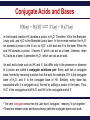
In the forward reaction HX donates a proton to H2O. Therefore, HX is the BrønstedLowry acid, and H2O is the Brønsted-Lowry base. In the reverse reaction the H3O+
ion donates a proton to the X- ion, so H3O+ is the acid and X- is the base. When the
acid HX donates a proton, it leaves X- which can act as a base. Likewise, when
H2O acts as a base, it generates H3O+, which can act as an acid.
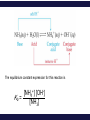
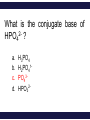
An acid and a base such as HX and X- that differ only in the presence or absence
of a proton are called a conjugate acid-base pair. Every acid has a conjugate
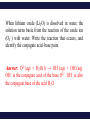
base, formed by removing a proton from the acid, for example, OH- is the conjugate
base of H2O, and X- is the conjugate base of HX. Similarly, every base has
associated with it a conjugate acid, formed by adding a proton to the base. Thus,
H3O+ is the conjugate acid of H2O, and HX is the conjugate acid of X-.
• The term conjugate comes from the Latin word “conjugare,” meaning “to join together.”
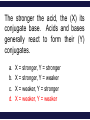
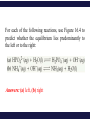
• Reactions between acids and bases always yield their conjugate bases and acids.