1
1.0 INTRODUCTION
The evaluation of triboelectric charge generation is performed either by
measuring the voltage build up on material after it has been separated
from the same or different material or by measuring the amount of
charge developed on the material. When used with a suitable Faraday
cup, the charge on a wide range of material types and sizes can
accurately be measured by the Model 230 Nanocoulombmeter.
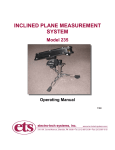
The Model 230 is a complete instrument for measuring charge directly in
nanocoulombs. The instrument is available with either a 3.125” (79mm)
diameter Faraday cup, a 12” (305mm) diameter Faraday pail, a
24”x24”x22” (610x610x559mm) Faraday Bucket; a detector probe or it
can be used alone to measure the charge on capacitors or from
capacitive discharge systems (with adequate protection).
The Nanocoulombmeter has 3 user selectable ranges of 20, 200 and
2000 nanocoulombs to cover a wide range of charge measurement
applications. The resolution of the 20 nC scale is 0.01 nC. Drift is <0.05
nC/minute. The instrument incorporates a built in precision 1.0 Volt
output along with a precision 0.10 μF, 1% capacitor for checking system
calibration.
The Model 230 meets the requirements for charge measurement as
specified in applicable ESDA, ASTM, EIA, DOD as well as many other
industry standards.
2.0 EQUIPMENT DESCRIPTION
The Model 230, shown in Figure 1.0-1, is powered by two 9-Volt alkaline
batteries that are readily accessible from the rear of the instrument. An
optional AC Power module is available to operate the unit from 95240VAC, 50/60Hz. A BAT LO indicator warns of low battery voltage (<12
Volts). The instrument is housed in a 7.5"L x 8"D x 1.75"H
(191x203x45mm) aluminum case that provides extra shielding from
external fields.
Figure 2.0-1: Model 230 Nanocoulombmeter front panel
The front panel consists of a 3½-digit LCD readout with ½ inch numerals,
a 3-position rotary RANGE selector switch, a READ/ZERO switch, a 1.0
Volt CAL output, BAT LO warning indicator, POWER ON/OFF switch,