1
A Brief Tutorial on Studio Monitors
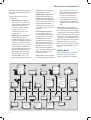
you may not have to do much. For
example, if the lowest frequency
your full-range monitors can reliably
reproduce is between 70 and 80 Hz,
you may not have to do anything but
plug in your subwoofer. If, however,
your full-range monitors are accurate
below 60 Hz, you will most likely need
to use the following instructions to
configure your crossover network.
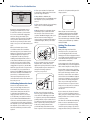
If your subwoofer provides a variable
lowpass filter:
2. Set the lowpass filter on your
subwoofer to the same frequency. For
example, if you are engaging an 80
Hz highpass filter on your full range
monitors, set the variable lowpass
filter on your subwoofer to 80 Hz.
From this point you can experiment
with the lowpass filter setting that
provides the smoothest crossover
transition while listening to your
favorite music. Again, your subwoofer
should naturally extend the lowfrequency response of your monitor
system. You should not hear any
frequency boosts or cuts.
Once your system is properly
calibrated, listen to a wide variety of
your favorite music and mixes and
make any final adjustments. At the
end of the day, your ears are the best
tools you have in the studio.
1. Set the highpass filter for your
full-range monitors using either their
onboard controls or the highpass
filter on your subwoofer.
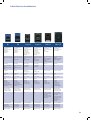
Eris E4.5
Eris E5
™
12
Eris E8
™
Eris E44
™
Eris E66
™
™
Applications
General mixing and
production
General mixing and
production
General mixing and
production
General mixing and
production,
Soundtrack,
Sound design,
Center channel,
Post-production
General mixing and
production,
Soundtrack,
Sound design,
Center channel,
Post-production
Genera
produc
High-re
Sound
Sound
Master
Unique Benefits
Compact design,
Great for small spaces,
Onboard Headphone
amp
Compact design,
Great for small spaces,
Transparent audio
Transparent audio,
Big bass sound,
Low-end punch
Ultra-wide stereo
image,
Dynamic bass
Ultra-wide stereo image,
Dynamic bass
Fast tra
Lifelike
tion
Type
2-way
2-way
2-way
2-way coaxial
2-way coaxial
2-way
HF Driver
1" silk dome
1" silk dome
1" silk dome
1.25" diaphragm
compression
1.25" diaphragm
compression
6.8-inc
AMT
Equiva
mm)
LF Driver
4.5" Kevlar
5" Kevlar
8" Kevlar
Dual 4.5” Kevlar
Dual 6.5” Kevlar
6.5” Ke
Amplifier (LF /HF)
25W per speaker
45W / 35W
75W / 65W
50W / 35W
80W / 65W
100W
Crossover Frequency
2.8 kHz
3 kHz
2.2 kHz
2.2 kHz
2.4 kHz
2.7 kH
Frequency Response
70 Hz – 20 kHz
53 Hz – 22 kHz
35 Hz – 22 kHz
42 Hz – 23 kHz
38 Hz – 23 kHz
45 Hz
Peak SPL
100 dB
102 dB
105 dB
103 dB
106 dB
104 dB
User Controls
• Volume
• MF Control
• HF Control
• Low Cut
• Acoustic Space
• Volume
• MF Control
• HF Control
• Low Cut
• Acoustic Space
• Volume
• MF Control
• HF Control
• Low Cut
• Acoustic Space
• Volume
• MF Control
• HF Control
• Low Cut
• Acoustic Space
• Volume
• MF Control
• HF Control
• Low Cut
• Acoustic Space
• Volum
• HF C
• High
• Acou
• Energ
On/Off
Inputs
1- Stereo ⅛"
2- Balanced ¼" TRS
2- Unbalanced RCA
1- Balanced XLR
1- Balanced ¼" TRS
1- Unbalanced RCA
1- Balanced XLR
1- Balanced ¼” TRS
1- Unbalanced RCA
1- Balanced XLR
1- Balanced ¼” TRS
1- Unbalanced RCA
1- Balanced XLR
1- Balanced ¼” TRS
1- Unbalanced RCA
1- Bala
1- Bala
1- Unb
Outputs
⅛" Headphone out
N/A
N/A
N/A
N/A
N/A
Cabinet
Vinyl Laminated MDF
Vinyl Laminated MDF
Vinyl Laminated MDF
Vinyl Laminated MDF
Vinyl Laminated MDF
Vinyl La
Dimensions (HxWxD)
9.45" (241 mm)
x 6.42" (163 mm)
x 7.09" 180 mm)
10.24" (260 mm)
x 7" (178 mm)
x 7.68" (195 mm)
15.12" (384 mm)
x 9.84" (250 mm)
x 11.77" (299 mm)
7” (180 mm)
x 14.3” (365 mm)
x 7” (180 mm)
9.8” (250 mm)
18.1” (460 mm)
8.5” (215 mm)
13” (32
x 8” (20
x 10.3”
Weight
6.5 lbs. (2.95 kg) ea
10.2 lbs. (4.63 kg)
22.2 lbs. (10.07 kg)
11.9 lbs. (5.4 kg)
23.4 lbs. (10.6 kg)
14.7 lb