1
1
Introduction
This document is intended to introduce the Global Address Space Programming Interface (GPI) to
the application programmer and is part of the GPI SDK.
GPI provides a partitioned global address space (PGAS) to the application which in turn has direct
and full access to a remote data location. The whole functionality includes communication primitives,
environment runtime checks, synchronization primitives such as fast barriers or global atomic counters,
all which allow the development of parallel programs for large scale.
GPI motivates and encourages an asynchronous programming model allowing for nearly perfect
overlapping of communication and computation and leveraging the strengths of the different components of a computing system that is, releasing the CPU from communication whenever possible and
letting the network interface asynchrounously do its task.
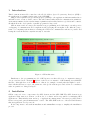
Figure 1: GPI architecture
Furthermore, the programming model of GPI promotes a threaded view of computation instead
of a process-based view. As figure 1 depicts, each node is one instance of GPI running several MCTP
threads - although there is no limitation to this as for example, normal pthreads might be used where all threads have access to all partitions of the global address space and each node contributes
with one partition to this global space.
2
Installation
GPI is composed of two components: the GPI daemon and the GPI SDK. The GPI daemon is an
application that runs as a daemon on all nodes of a cluster and is responsible for managing GPI
applications. This includes start and stop of applications, management of licenses (together with a
license server) and general infrastructure control. The GPI SDK is the set of headers and libraries
that an application developer needs.
Both components come with an installation and uninstallation script to simplify the installation
process.
2