1
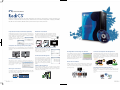
Controlling the Quality of Monitors
Managing the quality of monitors used every day
leads to the improvement of the quality
of medical care itself.
Q1
Do all monitors have same quality ?
Does quality remain unchanged over time ?
A1
Monitor quality is determined by brightness, grayscale
and brightness uniformity characteristics which vary by
monitor. Moreover, they change slowly over time.
Q3
A3
What can be done to maintain monitor quality ?
Q4
A4
What’s required to start utilizing monitor QC ?
Q5
A5
Are there any standards for monitor QC ?
Detecting changes in a monitor’s display quality
and making the proper adjustments.
Efficiently managing the huge quantity of monitors throughout the hospital.
Q2
What happens if the monitor quality differs or
changes ?
With filmless imaging spreading in the medical world,
A2
In a hospital where the images are displayed on
different monitors for diagnosis or for past and present
image comparison, differences or changes in monitor
quality may lead to deterioration in the quality of
medical care itself.
there is a growing interest in maintaining the quality
of monitors displaying medical images.
With the know-how and experience as a specialist in monitor manufacturing,
Monitor quality control (QC) is
required to detect the characteristic
difference or the gradual changes
and to take suitable steps for
maintenance.
Software that can detect changes
in monitor characteristics and
perform the appropriate calibration
when necessary.
Monitor QC assessment and judgment criteria have
been standardized and put forward by organizations
worldwide such as AAPM, DIN, JIRA, and IEC.
we offer state-of-the-art solutions for the quality control of monitors
which will lead to the improvement of the quality of medical care itself.
QC Standards
■ AAPM On-line Report No.03
“Assessment of Display Performance for Medical Imaging Systems” formulated by Task Group
(TG) 18 of American Association of Physicists in Medicine.
■ ACR “ Practice Guideline for Determinants of
This guideline was formulated collaboratively by specialists in mammography and medical
physics who represent the American College of Radiology (ACR), the American Association of
Physicists in Medicine (AAPM), and the Society for Imaging Informatics in Medicine (SIIM).
Image Quality in Digital Mammography”
■ EUREF “European Guidelines for Quality Assurance
in Breast Cancer Screening and Diagnosis Fourth
Edition”
This guideline was issued by the European Commission in cooperation with EUREF (European
Reference Organisation for Quality Assured Breast Screening and Diagnostic Services), EBCN
(European Breast Cancer Network), and EUSOMA (European Society of Mastology).
■ IEC 61223-2-5
“Evaluation and routine testing in medical imaging departments - Part 2-5: Constancy tests - Image
display devices” formulated by the International Electrotechnical Commission.
■ IPEM Report 91
“Recommended Standards for the Routine Performance Testing of Diagnostic X-ray Imaging
Systems” formulated by the Institute of Physics and Engineering in Medicine in the UK.
■ DIN V 6868-57
“Image Quality Assurance in X-ray Diagnosis - Part 57: Acceptance testing for image display devices”
formulated by the German Institute for Standardization (Deutsches Institut für Normung e.V).
■ QS-RL “Qualitätssicherungs-Richtlinie”
“Guideline for implementing quality assurance of the X-ray systems for diagnostic and medical
treatment purposes according to chapters+ C21 16 and 17 of the X-ray Ordinance”. This defines
the details of the quality assurance of general X-ray systems obliged by the X-ray Ordinance.
■ PAS 1054
“Requirements and Testing of Digital Mammographic X-ray Equipment” formulated by the German
Institute for Standardization (DIN) in cooperation with the German Radiology Society (DRG) and
others. This standard defines the details of the quality assurance obliged by the X-ray Ordinance
as well as the QS-RL for general X-ray systems and DIN V 6868-57 for image display devices.
■ JESRA X- 0093
“Quality Assurance (QA) Guideline for Medical Imaging Display Systems” formulated by Japan
Industries Association of Radiological Systems (JIRA).
■ Quality Control Manual for Digital Mammography
Quality control manual for digital mammography system written by NPO Central Committee for Quality
Control of Mammography Screening. This NPO studies and manages quality control of mammography.
03