1
Errata Sheet
Functional Deviations
CPU_TC.074 Interleaved LOOP/LOOPU instructions may cause GRWP
Trap
If a conditional loop instruction (LOOP) is executed after an unconditional loop
instruction (LOOPU) a Global Register Write Protection (GRWP) Trap may be
generated, even if the LOOP instruction does not use a global address register
as its loop counter.
In order to support zero-overhead loop execution the TriCore1 implementation
caches certain attributes pertaining to loop instructions within the CPU. The
TriCore1.3 CPU contains two loop cache buffers such that two loop (LOOP or
LOOPU) instructions may be cached. One of the attributes cached is whether
the loop instruction writes to a global address register (as its loop variable). For
LOOP instructions this attribute is updated and read as expected. For LOOPU
instructions this attribute is set but ignored by the LOOPU instruction when next
encountered.
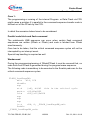
The problem occurs because there is only one global address register write flag
shared between the two loop caches. As such if LOOP and LOOPU instructions
are interleaved, with the LOOPU instruction encountered and cached after the
LOOP instruction, then the next execution of the LOOP instruction will find the
global address register write flag set and, if global register writes are disabled
(PSW.GW = 0), a GRWP trap will be incorrectly generated.
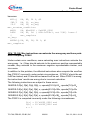
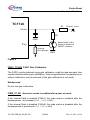
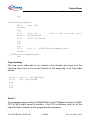
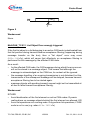
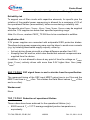
Example:
...
loopu_target_
...
loop_target_
...
LOOP
A5, loop_target_
...
LOOPU loopu_target_
...
Workaround
Enable global register write permission, PSW.GW = 1.
TC1796, EES-BC, ES-BC, BC
62/226
Rel. 2.2, 2011-10-10