1
Data Sheet
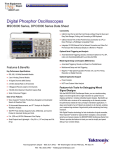
MSO/DPO4000 Series Digital Phosphor
Oscilloscopes
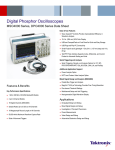
The DPO4000 Series Digital Phosphor Oscilloscopes (DPOs) are the first
oscilloscopes to offer usable deep memory on all channels, excellent
performance, serial trigger and analysis options, and all in the most compact
form factor in their class. The MSO4000 Series Mixed Signal Oscilloscopes
(MSOs) provide all the features and benefits of the DPO4000, but add
16 integrated digital channels, enabling you to visualize and correlate
analog and digital signals on a single instrument. This integration extends
triggering functionality across all 20 channels providing pattern and state
triggering ideal for debugging mixed analog and digital designs.
Designed to Make Your Work Easier
As design complexity increases, you need tools that help you find problems
quickly.
Easy to Setup and Use
The MSO/DPO4000 Series has a large 10.4 inch XGA display, a clean
front panel with familiar knobs - all in a package that is only 5.4 in.
deep and weighs only 11 lb. With USB plug-and-play operation and PC
connectivity, acquiring data and measurements from the instrument is
as simple as connecting a USB cable from the oscilloscope to the PC.
Provided applications include NI LabVIEW SignalExpress™ Tektronix
Edition LE, OpenChoice® Desktop and Microsoft Excel and Word toolbars
enabling fast and easy direct communication with your Windows PC. USB
and CompactFlash ports on the front panel enable simple transfer of
screenshots, instrument settings, and waveform data in the palm of your
hand.
When it comes to mixed signal design and debug, you want your instrument
to be intuitive so you can start solving problems quickly. The MSO4000
Series drives like an oscilloscope, the tool you already know how to use.
You do not have to relearn how to use the instrument every time you turn
it on.
Wave Inspector® Navigation
Imagine trying to efficiently use the Internet if search engines such as
Google and Yahoo didn’t exist, web browser features such as Favorites and
Links didn’t exist, or Internet Service Providers like AOL or MSN weren’t
around. Now you know how most modern oscilloscope users feel when
2
Wave Inspector® controls.
trying to actually use the long record length in their digital oscilloscope.
Record length, one of the key specifications of an oscilloscope, is the
number of samples it can digitize and store in a single acquisition. The
longer the record length, the longer the time window you can capture with
high timing resolution (high sample rate).
The first digital oscilloscopes could capture and store only 500 points,
which made it very difficult to acquire all relevant information around the
event being investigated. Over the years, oscilloscope manufacturers have
provided longer and longer record lengths to meet market demands for long
capture windows with high resolution, to the point that most mid-range
oscilloscopes either come standard with, or can be optionally upgraded
to, multi-megapoint record lengths. These megapoint record lengths often
represent thousands of screens worth of signal activity. While standard
record lengths have increased greatly over the years and can now satisfy
the vast majority of applications in the marketplace, tools for effectively and
efficiently viewing, navigating, and analyzing long record length acquisitions
have been sorely neglected until now.