1
3.
Installation guideline
3.1.
Preparatory measures
The stove should be hermetically connected to a well-functioning chimney, sufficiently enclosed to keep combustible materials (floor and walls) at a distance, and
should be installed in a room with sufficient ventilation.
Please inform about national or local norms and regulations concerning this subject.
Your distributor will give y ou the necessary advice.
You can also consult the fire department and/or an insurance company about specific demands or regulations.
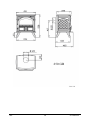
Please read the technical specifications under cover in this manual before installing
the stove.
3.1.1. The chimney
The chimney (the flue) has a double function:
•
•
It draws air, that is necessary for good combustion, into the s tove.
It functions as an exhaust pipe for combustion gases via thermal or natural
draught. Thermal draught is caused by the difference in heat between the air inand outside the flue. The heated air in the flue is lighter than the colder air outside the flue and consequently rises up, along with the combustion gases. Natural draught is caused by environmental phenomena, such as wind.
It is prohibited to connect several heaters to one chimney (for instance the central
heating boiler), unless local or national regulations allow this.
Please check which chimney is to be used for the stove you purchased and whether
your chimney is appropriate for this specific usage. You should consider an expert's
opinion on this matter.
The chimney should meet the following conditions:
•
•
•
•
•
25O
The flue should be made of fireproof material. Ceramic or stainless steel is recommended.
The chimney should be airtight and thoroughly cleaned and should guarantee a
sufficient draught (a draught or negative pressure of 15 to 20 Pa is ideal under
normal circumstances).
It should run as vertically as possible. Changes in direction or horizontal segments will disrupt the smoke flow and may cause soot to cumulate inside the
flue (and clog the flue!).
The chimney's inside dime nsions must not be too large in order to prevent the
smoke from cooling off too much. For recommended chimney dimensions, see
the technical specification under cover. Larger dimensions can be used if the flue
is well insulated.
The flue's diameter should be the same throughout its whole length. Wider, or
especially narrower segments will disrupt the smoke flow and are best avoided.
The same is true for a cover plate or exhaust hood on top of the chimney. The
exhaust hood must not narrow the chimney's outlet and should be designed in a
4
03.27934.000