1
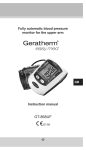
Fully Automatic Blood Pressure
Monitor for the Upper Arm
GB
INSTRUCTION MANUAL
GT-868UF
Contents
Designated use ........................................................ 26
Precautionary measures ........................................ 27
Warranty ................................................................... 29
Information you should know
before operating the unit ........................................ 30
About the unit .......................................................... 31
Explanation of displays ......................................... 32
Preparation for use
Installing/replacing batteries ................................. 32
Attaching the pressure cuff ................................... 33
Posture during measurement ................................ 34
Operations
Setting the time and date ...................................... 35
Measuring blood pressure ..................................... 35
Storing data
Recalling data ....................................................... 36
Erasing data .......................................................... 37
Disposal ................................................................... 37
GB
Care and maintenance ............................................ 38
Error messages ....................................................... 40
Specifications .......................................................... 41
Quality standard ...................................................... 42
Symbol index ........................................................... 42
Annex ....................................................................... 43
Designated use
This unit uses an oscillometric measurement method in
order to measure systolic and diastolic blood pressure, as
well as the heart rate.
The measurement is conducted on the upper arm.
All values can be read on an LCD screen.
This unit has been developed for home use and should
only be used by adults over 18 years of age with an arm
diameter of 23 to 33 cm / 9 to 13 inches.
26
Precautionary measures
• This manual and the product are not substitutes for
visiting the doctor.
Neither the information contained herein nor this product may be used to diagnose or treat health problems,
or to prescribe drugs. If you have or suspect that you
have a medical problem, please seek immediate advice from your doctor.
• Do not conduct any measurements if the temperature
is low (below +5 °C) or high (over +40 °C), or if the
relative humidity is beyond the range of 15 % to 93 %,
as this can lead to inaccurate readings.
• Wait 30 to 45 minutes, before taking a measurement if
you have just had a caffeinated drink or a cigarette.
• Relax for at least 5 to 10 minutes before taking a measurement.
• Please wait 3 to 5 minutes between measurements, so
that your blood vessels can return to the state they
were in prior to measurement. You may have to adapt
the waiting time to your personal physiology.
• It is recommended that you use the same arm for each
measurement (preferably the left) and take the measurement at about the same time every day.
• Sit down comfortably with your elbows placed on the
table and both feet on the ground. Please do not interlock your legs during the measurement.
• Wrap the cuff snug around your upper arm and lay
your arm on a flat surface at the same level as your
heart.
• Take the measurement at room temperature in a quiet
and stress-free environment.
• The unit should not be moved or shaken during the
measurement. Please do not speak during the measurement.
27
GB
Precautionary measures
• Please keep in mind that blood pressure naturally
varies depending on the time of day and is affected
by many different factors. Blood pressure is usually
highest at work and reaches its lowest level during the
sleep phase.
• Blood pressure measurements should be assessed by
a doctor or trained healthcare professional who is familiar with your medical history. If you use the unit and
regularly record the results, please keep your doctor
informed with regard to the ongoing changes in your
blood pressure.
• If you suffer from a cardiovascular disease (such as
atherosclerosis), diabetes, a liver or kidney disease,
severe hypertension or peripheral circulatory disorders, etc., please consult your doctor before using this
unit.
• This unit is not suitable for use by people with cardiac
arrhythmias or pregnant women.
GB
• The blood pressure measurements conducted with
this unit are equivalent to measurements obtained
by a trained observer in accordance with the values
achieved using the cuff/stethoscope auscultation
method and are within the specified EN 1060-4 standard limits.
• If the cuff causes any discomfort during the measurement, press the “START/STOP” button to turn off the
unit immediately.
• If the pressure is over 300 mmHg and the cuff does not
deflate automatically, pull off the Velcro strap to detach
the cuff.
• Do not use this appliance on infants, children or persons who cannot express their own intentions.
• To avoid accidental strangulation, keep the product
away from children and do not place the hose around
the neck.
28
Precautionary measures
• Measuring too frequently may result in circulatory disorders, which can cause unpleasant sensations such
as localised bleeding under the skin or temporary
numbness in your arm. These symptoms do not usually last long. However, if you have not recovered after
some time, please consult your doctor.
• Please take into consideration the electromagnetic
compatibility of the unit (e.g. disruptions to the power
supply, radio frequency interference, etc.) see annex.
Please only use the unit indoors. To avoid inaccurate
results due to electromagnetic interference between
electrical and electronic equipment, please do not use
the unit near mobile phones or microwave ovens. In
the case of devices whose maximum power exceeds
2 W, the minimum distance from your blood pressure
monitor should be 3.3 metres.
• The unit is not waterproof. Never immerse this instrument in any liquids.
• Do not use the instrument if you think it is damaged or
if you notice anything unusual.
GB
Warranty
The warranty for this blood pressure monitor is valid for
any error on the part of the manufacturer under normal
use for 3 years from the date of purchase. If your unit
does not function properly due to defective parts or assembly, we will repair it free of charge.
With the exception of the battery and cuff, all parts of the
unit are subject to this warranty. Damage caused by improper handling of your unit is not guaranteed.
We recommend that the accuracy of the unit be checked
after 2 years from manufacturing date by an authorized
laboratory.
This checking procedure is not a service provided under
the warranty.
29
Information you should know before
operating the unit
What is blood pressure?
A force is created by the heart as the ventricle forcibly
ejects blood into the blood vessels and through the vascular system. Another force is created by the arteries as
they resist the blood flow. Blood pressure is the result of
these two forces.
Is my blood pressure normal?
See the following blood pressure classification chart
released by the WHO (World Health Organization) for
evaluation of your blood pressure level.
Diastolic mmHg
Severe Hypertension (Grade 3)
Moderate Hypertension (Grade 2)
Mild Hypertension (Grade 1)
High - Normal
Normal
Optimal
GB
Systolic mmHg
Classification of
blood pressure
monitor
Systolic
mmHg
Diastolic
mmHg
Colour
indicator
Optimal
< 120
< 80
green
Normal
120 - 129
80 - 84
green
High - Normal
130 - 139
85 - 89
yellow
Grade 1
Hypertension
140 - 159
90 - 99
red
Grade 2
Hypertension
160 - 179
100 - 109
red
Grade 3
Hypertension
>= 180
>= 110
red
30
Information you should know before
operating the unit
What about low blood pressure?
In general, a lower blood pressure reading is better unless it causes unpleasant symptoms such as fainting and/
or lightheadedness.
What are systolic and diastolic pressures?
Systolic pressure is the highest pressure at the height of
the heart’s contraction. Diastolic pressure is the lowest
pressure when the heart is resting.
Fluctuation and variation in blood pressure
The following factors will influence blood pressure measurement results and cause variations.
Bathing, Breathing, Conversation, Drinking alcohol, Exercise, Moving, Mental tension, Eating, Temperature
changes, Thoughts, Smoking etc.
About the unit
ACCESS FOR POWER SUPPLY
LCD DISPLAY
SET BUTTON
RECALL MEMORY BUTTON
MODE BUTTON
START/STOP BUTTON
CUFF CONNECTION
ARM CUFF
(AA) 1,5 V x 4
ALKALINE BATTERIES
The cuff is designed to fit arm diameters between
23 and 33 cm / 9 to 13 inches.
31
GB
About the unit
Explanation of the display
Low
battery
Error
icon
Systolic
rate
WHO pressure
bar indicator
Pulse symbol
Irregular
heartbeat
detector
Icon for
users
1, 2, 3
Diastolic
rate
Hour:Minute
Puls rate
Day/Month
Number of
memory spaces
GB
Preparation for use
Installing/replacing batteries
1. Insert the batteries into the battery compartment matching correct polarities “+” and “-”.
2. Replace all batteries if the low battery indicator appears
.
3. Remove the batteries if the unit will not be used for a
long period of time.
4. REMOVE all of the BATTERIES when utilising an AC
adapter.
Note:
It is recommended that the same type of alkaline batteries
be used to avoid incompatibility.
32
Preparation for use
Keep batteries away from small children. Do not
throw batteries into fires: they could explode.
Attaching the pressure cuff
1. Wrap the cuff around the left arm. The arm should be
bare.
2. Fasten the cuff. Don’t pull it too strongly or make the
cuff too tight. The edge of the cuff should be approximately 1 inch from the crease of your elbow.
3. Attach the cuff on the right arm as shown in the figure
if it is not possible to measure on the left arm.
33
GB
Preparation for use
Posture during measurement
1. Sit upright and ensure that the measuring site is at
heart level. Relax and retain a natural posture during
measurement.
2. Measure and record blood pressure at the same time
every day to establish your blood pressure pattern.
GB
AC adapter
Use the device only with a medical approved stabilized AC adapter (input: 230 V, AC, 50 Hz; output:
6 V, DC, 1 A).
Note:
1. No batteries are required during operation using
the AC adapter.
2. If AC adapter power is interrupted during measurement, the unit must be reset by disconnecting
the AC adapter from the unit.
3. Only use medical approved adapters that comply with the specifications in this manual. Using
other adapters could cause damage your blood
pressure monitor.
34
Operations
Setting the time and date
1. Press the “SET” button to select memory store 1, 2, or 3.
2. Press the “MODE” button (“month” starts flashing).
Press the “SET” button to set the correct month.
3. Press the “MODE” button again (“date” starts flashing).
Press the “SET” button to set the correct date.
4. Press the “MODE” button again (“hour” starts flashing).
Press the “SET” button to set the correct hour in 12hour format.
5. Press the “MODE” button again (“minute” starts flashing).
Press the “SET” button to set the correct minute.
6. Press the “MODE” button again to confirm the time and
date.
Measuring blood pressure
1. Wrap the cuff around the arm (refer to “Attaching the
pressure cuff“).
2. Sit upright on a chair (refer to „Posture during measurement“).
3. Press the “SET” button to select a particular memory
store number.
4. Then press “START/STOP” to start automatic measurement.
When taking repeat measurements, be sure to select the
same memory store number before pressing “START/
STOP“.
5. The cuff is inflated. When the pulse is detected, the
PULSE symbol will start flashing.
6. After the measuring procedure has been completed,
the blood pressure values (systolic pressure and diastolic pressure) along with the pulse and WHO classification indicator will be shown on the display for 1
minute. After approx. 1 minute without being used, the
unit will automatically switch off.
To interrupt the measurement, you may press the
START/STOP buttons. The cuff will deflate immediately after a button is pressed.
35
GB
Operations
Irregular Heartbeat Detector
If the symbol
appears, it means the unit has detected
an irregular pulse during measurement. If the symbol appears regularly please consult a qualified doctor for professional advice.
Storing data
GB
After each blood pressure measurement, the blood pressure values, pulse rate, time and date will be automatically stored. Each of the three memory stores saves the
latest 30 measurements. If more than 30 measurements
are saved, the memory will automatically delete the earliest values.
Recalling data:
1. Press the “MEMORY” button. A particular memory
store will appear on the display.
2. Press the “SET” to find the correct memory store.
3. Press the “MEMORY”. The average value of the last
three measurements is shown by the following symbol:
. If no values have been stored, nothing will appear
on the display. The most recently measured value will
be displayed first.
4. By pressing the “MEMORY” button again you can
view each of the saved values in the selected memory
store.
5. After viewing the saved measurements, press “MEMORY” again to switch back to the initial display.
6. You can also switch back to the initial display by pressing the “START/STOP” button.
36
Storing data
Erasing data:
1. Press the “SET” button to select User 1 or 2 or 3.
2. Press the “MEMORY” button to enter the Memory Mode.
3. Press and hold the “MODE & SET” buttons together,
all stored date in the selected user will be erased.
4. To confirm the deletion, press the “MEMORY” button
and no date should appear.
DISPOSAL
Observe the applicable regulations when disposing of the device and batteries.
This product must not be disposed of together
with domestic waste.
All users are obliged to hand in all electrical or
electronic devices, regardless of whether or not
they contain toxic substances, at a municipal or
commercial collection point so that they can be
disposed of in an environmentally acceptable
manner.
Please remove the batteries before disposing of
the device/unit.
Do not dispose of old batteries with your household waste, but at a battery collection station at a
recycling site or in a shop.
37
GB
Care and maintenance
Do not drop the unit. It is
not shock-proof.
Do not modify or disassemble the unit or the
arm cuff.
GB
Do not twist the arm cuff.
Do not twist the arm cuff.
38
Care and maintenance
Avoid thinner, benzine,
and other harsh
cleaners.
Keep the unit in a
suitable place.
Avoid high temperature,
direct sunlight,
high moisture, and dust.
GB
Remove the batteries if
the unit will not be
used for a long time.
Do not press the
“START/STOP” button
if the cuff has not been
properly wrapped around
the arm.
39
Error messages
Replace batteries: Replace all 4 batteries
with new ones. Insert the batteries in correct
polarities.
EE
Appears when measurement error occurs or blood pressure value is displayed
excessively low or high: Measure again.
Wrap the cuff correctly and keep the arm still
during measurement.
E1
Air circuit deviation. Cuff tube may not be
plugged into monitor correctly: Check cuff
connection. Measure again.
E2
Pressure exceeds 300 mmHg: Turn the unit
off to clear, then measure again.
E3
Measurement data that result in an
error message: Measure again.
EP
Return the device to your local distributor
or to Geratherm.
GB
40
Specifications
Model No.
GT-868UF
Display System Liquid Crystal Display
Measuring
Method
Oscillometric
Power Source
4 alkaline “AA” type batteries (1.5 V)
or AC adapter (Input: 230 V, AC,
50 Hz; Output: 6 V, DC, 1A)
Measuring
Range
Pressure: 0 - 300 mmHg
Pulse: 40 - 199 beats per minute
Accuracy
Pressure: ±3 mmHg
Pulse: ±5 %
Inflation
Automatic
Deflation
Automatic exhaust valve
Memory
3 memory stores with 30 storage
spaces each = total 90 stored values
Display
LCD (date/time, pressure and pulse)
Low Battery
Indicator
yes
Automatic
switch-off
approx. 1 minute after last operation
Battery Life
around 300 operations
IP Classification
IP22 (effective against solid foreign
objects with a finger; protected
against dripping water)
Cuff Size
23 to 33 cm / 9 to 13 inches
Operating
Environment
+5 °C to +40 °C; RH 15 to 93 %
(+41 °F to +104 °F)
Storage/Transport Environment
-25 °C to +70 °C; RH ≤ 93 %
(-13 °F to +158 °F)
Dimensions
110 x 150 x 80 mm (W x D x H)
Weight
approx. 265 g (including batteries)
Specifications are subject to change without notice for
purposes of product improvement.
41
GB
Quality standard
Geratherm® is certified in accordance with Council Directive 93/42/EEC andEN ISO 13485 and is entitled to affix the CE-mark CE 0197 (Notified Body: TÜV Rheinland
LGA Products GmbH).
The blood pressure monitor conforms to
• EN 1060-1 (Non-invasive sphygmomanometers part 1:
General requirements) and
• EN 1060-3 (Non-invasive sphygmomanometers part
3: Supplementary requirements for electromechanical
blood pressure measuring systems)
• EN 1060-4 Non-invasive sphygmomanometers, Part 4:
Test procedures to determine the overall system accuracy of automated non-invasive sphygmomanometers
GB
Symbol index
Follow the instructions
for use
Type BF Equipment
Keep dry
Batch code (mm/yyyy;
month/year)
93%
Store at a max. relative
humidity of 93 %
SN
Serial number
+70°C
Store between -25 °C
and +70 °C
Manufacturer
The device must not
be disposed of with
household waste
Caution! Read the
instruction manual.
-25°C
42
Annex
Information on electromagnetic compatibility (EMC)
Electronic devices such as PCs and mobile phones can
lead to the exposure of medical devices in operation to
electromagnetic interference from other devices. This can
lead to malfunction of the medical device and create a
potentially unsafe situation.
Medical devices should also not interfere with any other
devices.
The EN 60601-1-2 standard regulates the requirements
for EMC (electromagnetic compatibility) and defines the
levels of immunity to electromagnetic interference and
the maximum electromagnetic emission levels for medical devices.
This blood pressure monitor, which is manufactured by
Geratherm Medical AG, complies with the EN 60601-1-2
standard in relation to both immunity and emissions.
However, special precautions should be observed:
please only use the device indoors and not in the vicinity
of mobile phones or microwave ovens. In the case of devices whose maximum power exceeds 2 W, the minimum
distance from your blood pressure monitor should be 3.3
metres.
43
GB
Annex
Guidance and manufacturer´s declaration – electromagnetic emissions
The device is intended for use in the electromagnetic environments listed below, and should
only beused in such environments:
Emissions test
Compliance
Electromagnetic environment - guidance
RF emissions CISPR 11
Group 1
RF energy is used only to maintain device’s
operation. Therefore, its RF emissions are so
low that it’s not likely to cause any interference
in nearby electronic equipment.
RF emissions CISPR 11
Class B
Harmonic emissions
IEC 61000-3-2
Class A
Voltage fluctuations / flicker
emissions IEC 61000-3-3
complies
The device is suitable for use in all establishments, including domesticestablishments,
and those directly connected to the public
low-voltage power supply networkthat supplies
buildings used for domestic purposes.
Guidance and manufacturer´s declaration – electromagnetic emissions
The device is intended for use in the electromagnetic environments listed below, and should
only beused in such environments:
Immunity test
IEC 60601
– test level
Compliance
level
Electromagnetic environment
- guidance
Electrostatic
discharge (ESD)
IEC 61000-4-2
± 6 kV contact
± 8 kV air
± 6 kV contact
± 8 kV air
Floors should be wood, concrete or
ceramic tile. If floors are covered with
synthetic material, the relative humidity
should be at least 30 %.
Power frequency
(50/60 Hz)
magnetic field
IEC 61000-4-8
3 A/m
3 A/m
Power frequency magnetic fields
should be at levels characteristic of a
typical location in a typicalcommercial
or hospital environment.
GB
Recommended separation distances between portable and mobile RF communication
The device is intended for use in an electromagnetic environment where radiated RF
disturbancesare under control. User can help prevent electromagnetic interference by keeping
the device at a minimum distance from portable and mobile RF communications equipment
(transmitters). Below table details the maximum output power of transmitter:
Rated maximum
output power
of transmitters
in Watt
0.01
0.1
1
10
100
Seperation distance according to frequency of transmitter / m
150 kHz to 80 MHz
d = 1.2 √P
80 MHz to 800 MHz
d = 1.2 √P
800 MHz to 2.5 GHz
d = 2.3 √P
0.12
0.38
1.2
3.8
12
0.12
0.38
1.2
3.8
12
0.23
0.73
2.3
7.3
23
For transmitters rated at a maximum output power not listed above, the recommended separation distance d in metres (m) can be estimated using the equation applicable to the frequency
of the transmitter, where P is the maximum output power rating of the transmitter in watts (W)
according to the transmitter manufacturer.
NOTE 1:
NOTE 2:
At 80 MHz and 800 MHz, the separation distance for the higher frequency
range applies.
These guidelines may not apply in all situations. Electromagnetic propagation is affected by absorption and reflection from structures, objects and
people.
44
Annex
Guidance and manufacturer´s declaration – electromagnetic immunity
The device is intended for use in the electromagnetic environments listed below, and should
only be used in such environments:
IEC 60601
Compliance
Immunity test
Electromagnetic environment - guidance
– test level
level
Portable and mobile RF communications
equipment should be used no closer to any
part of the device, including cables, than the
recommended separation distance calculated
from the equation applicable to the frequency
of the transmitter.
Recommended separation distance:
Conducted RF
IEC 61000-4-6
Radiated RF
IEC 61000-4-3
3 Vrms
150 kHz to
80 MHz
3 V/m
80 MHz to
2.5 GHz
3 Vrms
d= 1.2 √P
3 V/m
d = 1.2 √P
80 MHz to 800 MHz
d = 2.3 √P
800 MHz to 2.5 GHz
where P is the maximum output power rating
of the transmitter in watts (W) according to the
transmitter manufacturer and d is the recommended separation distance in metres (m).
Field strengths from fixed RF transmitters, as
determined by an electromagnetic site survey,a
should be less than the compliance level in
each frequency range.b
NOTE 1:
NOTE 2:
Interference may occur in the
vicinity ofequipment marked
with the following symbol:
At 80 MHz and 800 MHz, the higher frequency range applies.
These guidelines may not apply in all situations. Electromagnetic propagation is affected by absorption and reflection from structures, objects and
people.
Guidance and manufacturer´s declaration – electromagnetic immunity
a)
Field strengths from fixed transmitters, such as base stations for radio (cellular/cordless)
telephones and land mobile radios, amateur radio, AM and FM radio broadcast and TV
broadcast cannot be predicted theoretically with accuracy. To assess the electromagnetic
environment due to fixed RF transmitters, an electromagnetic site survey should be
considered. If the measured field strength in the location in which the device is used
exceeds the applicable RF compliance level above, the device should be observed to
verify normal operation. If abnormal performance is observed, additional measures may
be necessary, such as reorienting or relocating the device.
b)
Over the frequency range 150 kHz to 80 MHz, field strengths should be less than 3 V/m.
Geratherm Medical AG
Fahrenheitstrasse 1
98716 Geschwenda
Germany
45
GB