1
Inverter Motor Control Using the 8xC196MC Microcontroller Design Guide
4.4
Detailed Description of the Software Listing
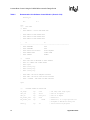
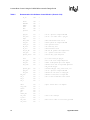
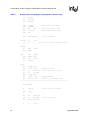
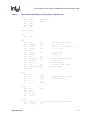
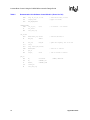
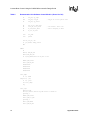
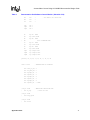
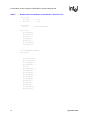
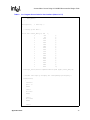
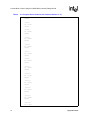
Appendix B contains the complete source listing of the Inverter Motor Control Demonstration Unit
Software module. The DEF196MC.INC defines the 80C196MC Input/Output and Special
Function registers. It also declares some items as public, for the use of other modules, and defines
all interrupt and PTS vector locations. The PTS control block and its corresponding windowed
locations are defined here too.
The following are the few associated concepts in the main program code:
• Memory location 40h through 58h contains the variables used for the serial reception and
decoding of the data from the host PC. The RECEIVE array contains the data in bytes that is
successfully received without parity or framing array. Variable R_COUNT controls the
number of bytes received in one cycle and HZ contains the decoded frequency (x 100) input.
• A sine lookup table contains 960 word entries. THETA_360 is the number of sample times in
360 degrees and THETA_60 is the number of sample times in 60 degrees. The motor control
parameters have limits and the program has many min_xxxx and max_xxxx constants. The
constants half_xxxx corresponds to half cycles.
• The program defines a a variable named VOLTZ_HZ along with its associated max/min
constants. As the frequency of the motor increases, the applied voltage must be adjusted to
compensate for the changing motor reactance. VOLTZ_HZ is the value that sets the slope of
the volts applied as frequency increases and roughly corresponds to the torque. Controlling the
rate of frequency change avoids excessive currents by ensuring the motor does neither stalls
nor becomes a generator. In inverter motor, this VOLTS_HZ ratio is usually set as a constant.
• The frequency value which corresponds to the speed of the AC compressor motor is stored in
the program in the HZ_OUT variable. The value stored is the frequency x 100, not the actual
frequency. This is to enable higher precision of speed control of the AC motor. HZ_x100
contains the frequency x 100 values inputted by the user, via hardware or software. The
restricted value, taking into account the limits of the motor, is stored in the HZ_OUT variable.
This is the frequency at which the motor is operating.
The main program starts at location 2080h, to which the processor branches following the reading
of the CCB bytes. The subsequent code contains the BEGIN software, the RESTART software and
the IDLE_TIME_LOOP software. Here, the software looks for the input from the push buttons or
the host PC, and sets flags that determine what the program will do next. The flags are set by the
interrupt routines and the software code. The remainder of the source code contains the program
subroutines and the interrupt service routines. The sine lookup table starts at location 3800h in the
program and contains 2048 bytes of data.
When the demo first is powered-up, the BEGIN software is executed. This software initializes the
LCD and clears the register RAM (location 40h to E0h). This BEGIN software needs to be
executed only once.
Next, the RESTART software initializes the system variables and operating modes. This software
is re-executed every time the restart button is pressed. First, the interrupt is disabled and the
interrupt mask registers are cleared. Then, the INITIALIZE_REG subroutine is called before the
software stops to wait for the enable switch to be turned on.
In the INITIALIZE_REG subroutine, the C8h that goes in the T0_CONTROL register enables the
timer/counter as an up counter, sets the clock source to external, and sets the resolution to the
250 ns maximum. Setting T1_CONTROL to a C1h selects an up count, internal clock source, and
500 ns resolution. The next instruction sets the PWM0 and PWM1 period to 256 states. Then a
Application Note
29