1
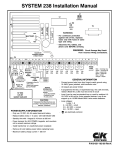
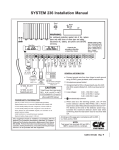
System 236E Installation Instructions Table of Contents Subject System 236E Terminal Label FCC Notice Industry Canada UL Compliance Installation Earth Ground Wiring the Panel Standby Battery AC Power Audible Output Switched Auxiliary Power Arming Stations Addressing Keypads Loop Inputs Tamper Switch Installation Telephone Interface System Start-Up Factory Default Settings Programming Options (Alphabetical List) Programming the Panel Programming with the LED Keypad Programming with the Alpha Plus Keypad Programming the Alpha Plus Keypad Keypad Message Programming Programming Options (Numerical Order) Telephone Line Problems Watchdog Indicator Limitations of your alarm system Keypad Operation Command Summary Troubleshooting Reducing False Alarms Programming Worksheets FCC Rules Part 15: The REN is useful to determine the quantity of devices you may connect to your telephone line and still have all of those devices ring when your number is called. In most, but not all areas, the sum of the REN's of all devices should not exceed five (5.0). To be certain of the number of devices you may connect to your line, as determined by the REN, you should call your local telephone company to determine the maximum REN for your calling area. Page No. Front Cover 2 2 3 3 3 3-5 3 4 4 4 4 5 5 5-6 6 6 6-7 7 7 7-8 8 8 8-9 10 - 22 23 23 23 24 25 - 26 27 29 - 30 FCC Rules Part 68 (cont.) Should you experience trouble with the telephone lines, disconnect the equipment from the line to determine the source of the trouble. If it is determined that the equipment is malfunctioning, discontinue its use until the malfunction has been corrected. Any repairs or alterations made by the user of this equipment, or equipment malfunctions, may give the telephone company cause to request the user to disconnect the equipment. Repairs to this equipment should be made by an authorized agent of C&K Systems, Inc. Contact tour local alarm installation company for service. Should this equipment cause harm to the telephone network, the telephone company may temporarily discontinue your service. If possible, they will provide you with advance notice. Otherwise they will notify you as soon as possible. The telephone company will also advise you of changes in its facilities, equipment, operations, or procedures which could affect the operation of your equipment, allowing you the opportunity to maintain uninterrupted service. You will also be advised of your right to file a complaint with the FCC. This equipment must not be used on party lines or coin operated phone lines. Industry Canada Notice: The Industry Canada label identifies certain equipment. This certification means that the equipment meets certain telecommunications network protective, operational, and safety requirements as prescribed in the appropriate Terminal Equipment Technical Requirements documents. The Department does not guarantee the equipment will operate to the user's satisfaction. Before installing this equipment, users should ensure that it is permissible to be connected to the facilities of the local telecommunications company. The equipment must be installed using an acceptable method of connection. The customer should be aware that compliance with the above conditions may not prevent the degredation of service in some situations. Repairs to certified equipment should be coordinated by a representative designated by the supplier. Any repairs or alterations made by the user of this equipment, or equipment malfunctions may give the telecommunications company cause to request the user to disconnect the equipment. FCC Notice Users should ensure for their own protection that the electrical ground connections of the power utility, telephone lines, and internal metallic water pipe system, if present, are connected together. This precaution may be particularly important in rural areas. This equipment has been tested and found to comply with Part 15 of the FCC Rules. These limits are designed to provide reasonable protection against harmful interference in a residential installation. This equipment generates, uses, and can radiate radio frequency energy and, if not installed and used in accordance with the instructions, may cause harmful interference to radio communications. However, there is no guarantee that interference will not occur in a particular installation. If this equipment does cause harmful interference to radio or television reception, which can be determined by turning the equipment off and on, the user is encouraged to try to correct the interference by one or more of the following methods: Caution: Users should not attempt to make such connections themselves, but should contact the appropriate electric inspection authority, or electrician, as appropriate. Notice: The Ringer Equivalence Number (REN) assigned to each terminal device provides an indication of the maximum number of terminals allowed to be connected to a telephone interface. The termination on an interface may consist of any combination of devices subject only to the requirement that the sum of the Ringer Equivalence Numbers of all devices does not exceed 5. Reorient or relocate the receiving antenna, Connect the AC transformer to a different outlet so that the equipment and radio/ television are on different circuits; Relocate the equipment with respect to the radio/television; Consult the dealer or an experienced radio/TV technician for help. This Class B digital apparatus meets all requirements of the Canadian InterferenceCausing Equipement Regulations. Cet appareil numérique de la classe B respecte toutes les exigences du Règlement sur le matériel brouilleur du Canada. FCC Rules Part 68: This equipment complies with FCC Rules, Part 68. On the outside of this equipment is a label that contains, among other information, the FCC Registration Number and Ringer Equivalence Number (REN) for this equipment. If requested, provide this information to your telephone company. 2