1
1. Introduction and overview.
Bluetooth is a wireless communication protocol conceived to enable high speed
data transfer through portable devices. Its physical layer can be implemented
as a light weight, small, inexpensive and low power electronic device and
therefore is being mainly used for handheld computers and phones within the
consumer electronics market. However, its applications within embedded
systems are countless and twofold: on one side, Bluetooth enabled embedded
systems may communicate with handheld devices extending its capabilities to
supervision, control and data acquisition; on other side, embedded systems
may communicate between them easily, at high data rates and at low cost up
to 100 meters in distance and even more1.
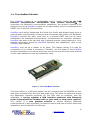
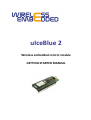
uIceBlue2 module, an evolution of mature uIceBlue, enables the integration of
Bluetooth communications within embedded systems fast, easily and
effectively. This document provides the information to start with quick hands
on practice.
1.1. The Bluetooth technology.
Bluetooth is an open specification2 to provide short-range wireless communications.
It operates in the unlicensed ISM band at 2.45 GHz using Frequency Hop Spread
Spectrum modulation to avoid interference. There are two kind of devices: Class 2
devices reach up to 10 m with a power of 0 dBm; Class 1 devices reach up to 100
m with 20 dBm1.
Bluetooth communicates a master and a slave device. Usually each device is able to
operate as either master or slave at a time. Bluetooth devices have a unique 48-bit
address (BD_ADDR) used as identification. This address defines also the way
devices negotiate and start radio communication.
The Bluetooth specification defines the implementation of profiles that run over
lower layers of the Bluetooth stack. Bluetooth Profiles define a simple way to
communicate different devices using a high level protocol. Among several Bluetooth
profiles the Serial Port Profile was created to make a simple wireless substitution to
the RS232 cable that connects many computers and embedded products. The final
goal of Bluetooth was to create a low cost alternative to the wire connection.
1
Although Class 1 Bluetooth
can be extended with the use
this area.
2
The complete Bluetooth
www.bluetooth.com.
For beginners a good starting
devices are specified to reach distances of up to 100 m, this
of directional antennas. Contact emxys for specific solutions in
(more than 1000 pages) specification cab be found at
point is http://en.wikipedia.org/wiki/Bluetooth.
6
www.emxys.com
[email protected]