1
002-150
Vacuum Bagging Techniques
A guide to the principles and practical application of vacuum bagging for
laminating composite materials with WEST SYSTEM® Brand epoxy.
Contents
1 Introduction
Understanding the theory of vacuum systems and the advantages
of vacuum bag laminating
2 Vacuum Bagging Equipment
Evaluating the equipment and materials used in vacuum bagging
3 Vacuum Bagging Molds
Examining and building the various types of molds used for
vacuum bag laminating
4 Vacuum Bagging Applications
Putting the principles of vacuum pressure to practical use in
typical vacuum bagging applications
5 Using WEST SYSTEM Epoxy
Using WEST SYSTEM products safely and effectively
Appendices Troubleshooting, selection guides and sources
1
2
3
4
5
A
Catalog number 002-150
Vacuum Bagging Techniques
A guide to the principles and practical application of vacuum bagging for
laminating composite materials with WEST SYSTEM® Brand epoxy.
6th Edition—June, 2004
The techniques described in this manual are based on the handling characteristics and physical properties of WEST SYSTEM epoxy products. Because physical properties of resin systems and epoxy brands vary, using the techniques in this publication with coatings or
adhesives other than WEST SYSTEM is not recommended. This manual is updated as products and techniques change. If the last copyright date below is more than several years old,
contact your WEST SYSTEM dealer or West System, Inc. Refer to the current WEST SYSTEM
User Manual & Product Guide for complete product information, and safety and handling
guidelines.
The information presented herein is believed to be reliable as of publication date, but we
cannot guarantee its accuracy in light of possible new discoveries. Because West System Inc.
cannot control the use of its products in customer possession, we do not make any warranty
of merchantability or any warranty of fitness for a particular use or purpose. In no event,
shall West System Inc. be liable for incidental or consequential damages.
WEST SYSTEM and Scarffer are registered trademarks, and Microlight and Episize are
trademarks of West System Inc., Bay City, MI USA.
Copyright © 1990, 1991, 1993, 1999, 2001, 2004 by West System Inc.
Published by West System Inc., Bay City, MI USA. All Rights reserved. No part of the contents of this book may be reproduced or transmitted in any form or by any means without
the written permission of the publisher.
Printed in the USA.
Table of contents
1 Introduction
1.1 What is vacuum bagging? .
.
.
.
.
.
.
.
1
1.2 Theory .
.
.
.
.
.
.
.
1
1.3 Advantages of vacuum bagging.
.
.
.
.
.
.
2
1.4 Using vacuum bagging technology .
.
.
.
.
.
2
.
.
.
.
2 Vacuum Bagging Equipment
2.1 Vacuum pumps .
.
.
.
.
.
.
.
.
.
3
2.2 Vacuum bagging materials .
.
.
.
.
.
.
.
6
2.3 Production equipment
.
.
.
.
.
.
.
9
.
3 Vacuum Bagging Molds
3.1 Flat molds .
.
.
.
.
.
.
.
.
.
.
10
3.2 Curved molds .
.
.
.
.
.
.
.
.
.
11
3.3 Building a master plug
.
.
.
.
.
.
.
.
11
3.4 Building a mold .
.
.
.
.
.
.
.
.
13
.
.
.
.
14
.
3.5 Elevated temperature post-curing in molds
4 Vacuum Bagging Applications
4.1 Basic laminating in a female mold .
.
.
.
.
.
16
4.2 Special considerations
.
.
.
.
.
.
.
.
26
4.3 Large scale vacuum bagging .
.
.
.
.
.
.
27
4.4 Repairing laminates with vacuum bagging
.
.
.
.
28
4.5 Resin infusion and VARTM .
.
.
.
.
.
.
.
29
5 Using WEST SYSTEM® Epoxy
5.1 Epoxy safety
.
.
.
.
.
.
.
.
.
.
30
5.2 Epoxy products .
.
.
.
.
.
.
.
.
.
31
5.3 Handling epoxy .
.
.
.
.
.
.
.
.
.
33
5.4 Basic techniques
.
.
.
.
.
.
.
.
.
37
.
.
Appendix A Problem solving guide
.
.
.
.
.
.
.
49
.
.
.
.
51
Appendix C Vacuum bagging equipment and material suppliers .
.
.
52
Appendix D Index
.
.
53
Appendix B Estimating guides for WEST SYSTEM products
.
.
.
.
.
.
.
.
.
.
.
Introduction 1
1 Introduction
1.1
What is vacuum bagging?
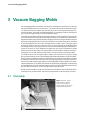
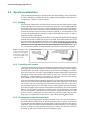
Vacuum bagging (or vacuum bag laminating) is a clamping method that uses atmospheric
pressure to hold the adhesive or resin-coated components of a lamination in place until the
adhesive cures. (When discussing composites, “resin” generally refers to the resin system—mixed or cured resin and hardener—rather than unmixed 105 epoxy resin.) Modern
room-temperature-cure adhesives have helped to make vacuum bag laminating techniques
available to the average builder by eliminating the need for much of the sophisticated and
expensive equipment required for laminating in the past. The effectiveness of vacuum bagging permits the laminating of a wide range of materials from traditional wood veneers to
synthetic fibers and core materials.
1.2
Theory
1
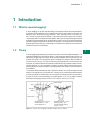
Vacuum bagging uses atmospheric pressure as a clamp to hold laminate plies together. The
laminate is sealed within an airtight envelope. The envelope may be an airtight mold on one
side and an airtight bag on the other. When the bag is sealed to the mold, pressure on the
outside and inside of this envelope is equal to atmospheric pressure: approximately 29
inches of mercury (Hg), or 14.7 psi. As a vacuum pump evacuates air from the inside of the
envelope, air pressure inside of the envelope is reduced while air pressure outside of the envelope remains at 14.7 psi. Atmospheric pressure forces the sides of the envelope and everything within the envelope together, putting equal and even pressure over the surface of
the envelope.
The pressure differential between the inside and outside of the envelope determines the
amount of clamping force on the laminate. Theoretically, the maximum possible pressure
that can be exerted on the laminate, if it were possible to achieve a perfect vacuum and remove all of the air from the envelope, is one atmosphere, or 14.7 psi. A realistic pressure
differential (clamping pressure) will be 12–25 inches of mercury (6–12.5 psi).
Vacuum envelope
Bag
Laminate
Mold
Vacuum Pump
Atmospheric pressure = 14.7 psi
Envelope pressure = 14.7 psi
Pressure differential = 0
Atmospheric pressure = 14.7 psi
Envelope pressure = 6 psi
Pressure differential (clamping
pressure) = 8.7 psi
Figure 1-1 A typical vacuum bagging lay-up before and after vacuum is applied.
2 Introduction
1.3
Advantages of vacuum bagging
Conventional clamps work well on thicker materials and narrow laminates like beams and
frames. Large projects may require a large stockpile of clamps. Staples are commonly used
to clamp thinner wooden plies when laminating wide panels for bulkheads or for applying
veneers to coldmolded hulls. Vacuum bagging offers many advantages over conventional
clamping or stapling techniques. As with other laminating methods, different materials can
be incorporated into the laminate. Materials can be selected specifically to match the structural requirements of the component rather than the limitations of the clamping method.
Even clamping pressure
Mechanical clamping or stapling applies pressure only to concentrated areas and can damage fragile core materials in one area while not providing enough pressure for a good bond
in another. When placed in a closely spaced pattern, staples exert less than 5 psi of clamping
force and then only in the immediate area of the staple. They cannot be used at all if you are
laminating to a foam or honeycomb core because of the core’s lack of holding power. In addition, extra adhesive is often required to bridge gaps that result from the uneven pressure
of clamps and staples.
Vacuum bagging, on the other hand, delivers firm, evenly distributed pressure over the entire surface regardless of the type or quantity of material being laminated. This allows a
wider range and combination of materials as well as a superior bond between the materials.
Vacuum bagging’s uniform clamping pressure across the laminate results in thinner, more
consistent glue lines and fewer voids. Because atmospheric pressure is continuous, it evenly
presses on the joint as the adhesive spreads evenly within.
Control of resin content
Vacuum bagging also gives you the means to control excess adhesive in the laminate, resulting in higher fiber-to-resin ratios. This translates into higher strength-to-weight ratios and
cost advantages for the builder. See 4.2.2.
Custom shapes
Another big advantage of vacuum bagging is in the simplicity and variety of the molds used.
Keep in mind that the atmosphere is not only pushing down on the top of the envelope, but
it is also pushing up equally on the bottom of the envelope or mold. Since atmospheric pressure provides equal and even clamping pressure to the back of the mold, the mold only has
to be strong enough to hold the laminate in its desired shape until the epoxy has cured.
Therefore, most molds can be relatively light weight and easy to build.
Efficient laminating
Because all of the materials in the laminate are wet out and laid up at the same time, vacuum
bagging allows you to complete the laminating process in one efficient operation.
1.4
Using vacuum bagging technology
This manual is designed to give you the basics of vacuum bagging. Before producing a finished composite part, you should also have an understanding of composite materials and
the engineering involved in designing composite structures. Experimenting is essential to
that understanding and a valuable part of the design process. Composite construction is the
ideal medium for experimentation, even on a small scale.
Composite construction and vacuum bag laminating are rapidly expanding technologies.
The information in this manual is sure to be surpassed by the development of new composite materials and the refinement of vacuum bagging techniques. We hope this manual gives
you the tools not only to expand your building capabilities, but also to explore the technology and improve on these techniques.
Vacuum Bagging Equipment 3
2 Vacuum Bagging Equipment
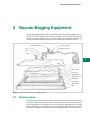
The vacuum bagging system consists of the airtight clamping envelope and a method for removing air from the envelope until the epoxy adhesive cures. This section discusses the
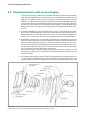
components of this system (Figure 2-1), which include both specialized equipment and
commonly available materials. Molds and mold building are discussed in Section 3.
Vacuum Throttle Valve
Trap
Vacuum Control Valve
Flexible Vacuum Hose
Port
Gauge
2
Vacuum Pump
Vacuum Bag
Breather Material
Perforated Film (opt.)
Release Fabric
Laminate Plies
Mastic Sealant
Mold
Figure 2-1 Typical components of a vacuum bagging system.
2.1
Vacuum pumps
The heart of a vacuum system is the vacuum pump. Powered vacuum pumps are mechanically similar to air compressors, but work in reverse so that air is drawn from the closed system and exhausted to the atmosphere. Vacuum pumps are designated by their vacuum
pressure potential or “Hg maximum” (Hg is the chemical symbol for mercury), their displacement in cubic feet per minute (CFM) and the horsepower required to drive the pump.
4 Vacuum Bagging Equipment
2.1.1 Vacuum pressure
The Hg maximum level is the maximum vacuum level (measured in inches of mercury) recommended for the pump. This vacuum level translates to the maximum amount of work effect or clamping pressure that can be generated. Two inches of mercury (2" Hg) equals
about one pound per square inch (1 psi) of air pressure. (Remember that 1 atmosphere =
29.92 inches Hg = 14.7 psi) If you are vacuum bagging a one square foot laminate, a 20" Hg
vacuum will yield 10 psi clamping force or a total of 1440 pounds of clamping force over
the entire laminate. If you are laminating a 4' x 8' panel, the same 20" Hg (10 psi) will yield
over 46,000 pounds of clamping force spread evenly over the entire panel.
2.1.2 Displacement
The volume of air a pump can move (rated in cubic feet per minute or CFM) is also an important consideration in the selection of a pump. If the vacuum system (the mold, bag,
plumbing and all seams and joints) were absolutely airtight, any size pump should be able to
eventually pull its rated Hg maximum vacuum regardless of the size of the system. However, creating a perfectly airtight vacuum bagging system is nearly impossible, especially as
the system gets larger or more complex. The greater the CFM rating, the closer the pump
can come to reaching its Hg maximum and maintaining an adequate clamping force against
the cumulative leaks in the system. A vacuum pump with a high CFM rating will also
achieve an effective clamping force more quickly. This is an important consideration if the
working life of the adhesive is limited or if the laminate will not hold its position until the
clamping force is applied.
2.1.3 Horsepower and performance
The horsepower requirement of the pump is an indication of how efficient the pump is and
is not in itself an indication of how well a pump is suited to vacuum bagging. When selecting
a pump, use the “Hg maximum” and CFM ratings as a guide rather than horsepower.
Smaller pumps designed for specific applications may trade off either vacuum rating or air
displacement to suit a particular job. Generally, to get both higher “Hg maximum” and
CFM ratings, more horsepower is necessary. Pumps that are useful for moderate boat yard
vacuum bagging may range from 1/4 hp to 2 hp Pumps for large production operations may
be as big as 20 hp or 30 hp.
Figure 2-2 A typical vacuum pump capacity vs vacuum rating diagram. Note that the
free air flow decreases as the vacuum pressure level increases.
Vacuum Bagging Equipment 5
2.1.4 Pump selection
The size and shape of the mold and type and quantity of the material being laminated will
determine the minimum pump requirements. If you are laminating flat panels consisting of
a few layers of glass, flat veneers or a core material, 5" or 6" Hg (2.5-3 psi) vacuum pressure
will provide enough clamping pressure for a good bond between all of the layers. If the area
of the panel is limited to a few square feet, a 1 or 2 CFM pump will be adequate to maintain
that clamping pressure. As the panel area increases, the CFM requirement increases proportionately. A displacement of 3.5 CFM may be adequate for up to a 14' panel; for larger
jobs, a pump with a displacement of 10 CFM or more may be required. Poor seals in the
plumbing system or envelope, or material which allows air leakage, will require a larger capacity pump to maintain satisfactory vacuum pressure. The more airtight the system, the
smaller the pump you’ll need.
A higher “Hg maximum” rated pump will be required if you need more clamping pressure
to force laminations to conform to a more complex mold shape. Curved or compounded
mold shapes and/or laminations of many layers of stiff veneers or core materials may require at least a 20"-28" Hg vacuum to provide an adequate clamping force. Again, if the
panel size is limited to a few square feet, a 1 or 2 CFM pump with a high “Hg rating” will
work, if the envelope is airtight. However, a large panel or hull may take a minimum of 10
CFM pump to reach and maintain enough clamping force to press all of the laminate layers
to the mold shape and produce consistent glue lines throughout the laminate. Generally,
the best pump for a specific vacuum bagging operation will have the largest air moving capacity for the vacuum/clamping pressure required while operating at a reasonable
horsepower.
2.1.5 Pump types
Vacuum pump types include piston, rotary vane, turbine, diaphragm and venturi. They
may be of a positive or non-positive displacement type.
Positive displacement vacuum pumps may be oil-lubricated or oil-less. Oil-lubricated
pumps can run at higher vacuum pressures, are more efficient and last longer than oil-less
pumps. Oil-less pumps, however, are cleaner, require less monitoring and maintenance,
and easily generate vacuums in a range useful for vacuum bagging. Of the several types of
positive displacement vacuum pumps useful for vacuum bagging, the reciprocating piston
type and the rotary vane type are most common. Piston pumps are able to generate higher
vacuums than rotary vane pumps, accompanied by higher noise levels and vibration. Rotary vane pumps may generate lower vacuums than piston pumps, but they offer several advantages over piston pumps. While their vacuum ratings are more than adequate for most
vacuum bagging, they are able to move more air for a given vacuum rating. In other words,
they can remove air from the system more quickly and can tolerate more leaks in the system
while maintaining a useful vacuum level. In addition, rotary vane pumps are generally more
compact, run more smoothly, require less power and cost less.
Figure 2-3 A Gast Model 07061-40, 1/8 hp diaphragm
pump. This pump displaces 1.2 CFM and will achieve a
maximum vacuum pressure of 24.0" Hg. It is a practical
pump for small projects.
2
6 Vacuum Bagging Equipment
Non-positive displacement vacuum pumps have high CFM ratings, but generally at vacuum pressure levels too low for most vacuum bagging. A vacuum cleaner is an example of a
non-positive displacement or turbine type pump.
Air operated vacuum generators are simple, low cost venturi devices that generate a vacuum using air pressure supplied by standard air compressors. Their portability, relatively
low cost and the accessibility of compressors in many shops and homes make them ideal for
many smaller vacuum bagging projects. Single stage generators have a high vacuum rating,
but move a low volume of air, limiting the size of the vacuum bagging operation. The
WESTSYSTEM 885-1 Venturi Vacuum Generator develops over 20" Hg (10 psi) at 1 CFM.
It is designed to run off conventional shop air compressors that deliver at least 60 psi at 2
CFM. Larger two-stage pumps are comparable to mechanical pumps for most vacuum bagging operations, but require a proportionately large compressor to run them.
Vacuum pumps have been manufactured for a wide variety of industrial applications. Used
pumps of various sizes and ratings may be found at a reasonable price. For small projects,
some builders have successfully used old milking machine pumps and even vacuum cleaner
pumps. If you find a used pump that you think will work for vacuum bagging, the vacuum
and displacement ratings will give you an idea of the range of vacuum bagging you can do
with it. If you are unsure about the pump, you can go through a dry run, following the procedures in this manual, to test the limitations of the pump. Keep in mind that the pump
should be able to hold a vacuum continuously until the adhesive reaches an effective cure,
which may take as long as 8 to 12 hours depending on the hardener used and ambient temperature. See Section 5.3 for cure time information. See Appendix C for a list of vacuum
bagging equipment and material suppliers.
2.2
Vacuum bagging materials
A variety of other materials are needed to complete the vacuum system and assist in the laminating process. The materials referred to in this manual are available from West System or
readily accessible through hardware or automotive supply stores. Alternate materials that
function the same as those listed may be used.
2.2.1 Release fabric
Release fabric is a smooth woven fabric that will not bond to epoxy. It is used to separate
the breather and the laminate. Excess epoxy can wick through the release fabric and be
peeled off the laminate after the laminate cures. It will leave a smooth textured surface that,
in most cases, can be bonded to without additional preparation.
WEST SYSTEM 879 Release Fabric is a strong, finely woven polyester fabric, specially
treated so that epoxy will not bond to it. It is not recommended for post cure temperatures
over 120°F (49°C). A variety of release materials are produced specifically for vacuum bagging operations. They may be known as release fabric, peel ply or release film. Many are designed for use at higher temperatures or to control the amount of resin that can pass
through them.
2.2.2 Perforated film
A perforated plastic film may be used in conjunction with the release fabric. This film helps
hold the resin in the laminate when high vacuum pressure is used with slow curing resin systems or thin laminates. Perforated films are available in a variety of hole sizes and patterns
depending on the clamping pressure, and the resin’s open time and viscosity.
2.2.3 Breather material
A breather (or bleeder) cloth allows air from all parts of the envelope to be drawn to a port
or manifold by providing a slight air space between the bag and the laminate.
Vacuum Bagging Equipment 7
WEST SYSTEM 881 Breather Fabric is a 45" wide lightweight polyester blanket that provides
air passage within the vacuum envelope and absorbs excess epoxy. A variety of other materials can be used such as mosquito screen, burlap, fiberglass cloth or a bubble type
swimming pool cover.
2.2.4 Vacuum bag
The vacuum bag, in most cases, forms half of the airtight envelope around the laminate. If
you plan to use vacuum pressure of less than 5 psi (10 hg) at room temperatures, 6-mil polyethylene plastic can be used for the bag. Clear plastic is preferable to an opaque material to
allow easy inspection of the laminate as it cures. For higher pressure and temperature applications, specially manufactured vacuum bag material should be used. A wrinkled type film
is available from Film Technology, Inc. Its special texture is designed to channel air and
eliminate the need for breather fabric. WEST SYSTEM 882 Vacuum Bag Film is a 60" wide,
heat stabilized nylon film that can be used at temperatures up to 350°F (176°C) and high
vacuum pressures. The vacuum bag should always be larger than the mold and allow for the
depth of the mold. When a bag wider than the standard width is needed, a larger bag can be
created by splicing two or more pieces together with mastic sealant. See Appendix C for a
list of vacuum bagging equipment and material suppliers.
2.2.5 Mastic sealant
Mastic is used to provide a continuous airtight seal between the bag and the mold around
the perimeter of the mold. The mastic may also be used to seal the point where the manifold
enters the bag and to repair leaks in the bag or plumbing.
WEST SYSTEM 883 Vacuum Bag Sealant is a 1 2 " by 3 32 " flexible adhesive strip that peels easily from the mold after use.
Generally, the better the airtight seal between the mold and bag material, the smaller the
pump you’ll need. Poor seals, or material which allows air leaks, will require a larger capacity pump to maintain satisfactory vacuum pressure.
2.2.6 The plumbing system
The plumbing system provides an airtight passage from the vacuum envelope to the vacuum pump, allowing the pump to remove air from and reduce air pressure in the envelope.
A basic system consists of flexible hose or rigid pipe, a trap, and a port that connects the
pipe to the envelope. A more versatile system includes a control valve and a vacuum throttle
valve that allow you to control the envelope vacuum pressure at the envelope. A system is
often split to provide several ports on large laminations, or may include some type of manifold within the envelope to help channel air to a single port. A variety of pipe or tubing can
be used for plumbing as long as it is airtight and resists collapsing under vacuum.
Vacuum hose is designed specifically for vacuum bagging and autoclave laminating. It is
available along with fittings, pumps, and other vacuum bagging materials from manufacturers specializing in vacuum bagging equipment. Because of its higher cost, this type of
plumbing system is most appropriate for large scale or production laminating operations.
Other types of wire reinforced hose may work, but they should be rated for crush resistance
or tested under vacuum for the appropriate length of (cure) time. Semi-rigid plastic tubing,
with adequate wall thickness, can be used for a plumbing system, but it is often awkward to
handle. If the laminate is to be post-cured during vacuum bagging, the tubing must also be
heat resistant. Plastic tubing that may be able to withstand vacuum at room temperature
may soften and collapse if heated.
Rigid ¾" PVC or CPVC pipe, elbows, T’s, and valves work well. They are low cost and
available at most local hardware or plumbing supply stores. The pieces do not need to be
cemented together and can be rearranged to suit any configuration. This type of plumbing
system, because of its low cost and versatility, is ideal for small scale or occasional laminating operations.
2
8 Vacuum Bagging Equipment
Figure 2-4 A typical large vacuum bagging operation. This 50' half hull lay-up
requires multiple vacuum lines and ports. Note the dot pattern of resin bleeding
through the perforated film.
A vacuum port connects the exhaust tubing to the vacuum bag. It can be designed specifically for the purpose or built from commonly available materials. One of the simplest ports
is a hollow suction cup that sits over a small slit in the vacuum bag. Cups designed for use
with car top carriers can be easily adapted by drilling through the center of the cup.
A control valve should be incorporated into the vacuum line to allow you to control the volume of airflow at the envelope. The control valve affects the rate of air removal, but not the
vacuum pressure. A second valve, the vacuum throttle valve, can be placed between the
control valve and the envelope. This valve, incorporated with a “T” fitting, acts as an adjustable leak in the system to control the envelope pressure. For convenience, valves should
be placed close to the envelope.
A trap should be incorporated into the line as close as possible to the envelope. The trap
collects any excess adhesive that gets sucked into the line before it reaches the valves or
pump and prevents a build up of adhesive in the line. A trap can easily be built with a small
section of pipe, a “T”, and an end cap.
A vacuum gauge is necessary to monitor the vacuum level/clamping force during the cure
time of the laminate. Most gauges read in inches of mercury from zero (one atmosphere) to
30 (inches Hg below one atmosphere). The reading of negative pressure inside the bag
equals the net pressure of the atmosphere pressing on the outside of the bag. To approximate this reading in pounds per square inch (psi), simply divide the reading by two. A vacuum gauge, available at most automotive stores, is modified by threading a hollow suction
cup (similar to the port) to the base. A 1½" PVC pipe cap, with a hole drilled and tapped to
match the gauge, will also work. The end of the cap is sealed to the vacuum bag with mastic.
A manifold can be used in some situations to assist in air removal from the envelope. It can
be a thicker section of breather material or other material that provides a channel for air
movement under the vacuum bag to a port. A ¾" PVC pipe with holes drilled along the
length of the tube was used in the applications shown later in this manual. Any hard object
(such as the manifold) placed under the vacuum bag can leave an undesirable impression in
the laminate.
The WEST SYSTEM 885 Vacuum Bagging Kit is a starter kit for room temperature repairs
and small laminating projects up to 13 sq ft The kit includes a venturi vacuum generator,
two vacuum cups (ports), 10 ft of ¼" tubing, a vacuum gauge, two T fittings, 15 sq ft of release fabric, 15 sq ft of breather fabric, 15 sq ft of vacuum bag film, 25' of mastic sealant,
and kit instructions.
For more information about WEST SYSTEM Brand products, refer to the WEST SYSTEM User
Manual & Product Guide.
Vacuum Bagging Equipment 9
2.3
Production equipment
Additional equipment is available to help large custom or production builders laminate
more efficiently. Production equipment of the types listed here can help the builder take
better advantage of the resin system’s open time, reduce the labor required to produce a
part, and laminate a part in less time.
2.3.1 Impregnators
Figure 2-5 A hand operated
impregnator. Fabric passes through
an epoxy bath and a pair of rollers.
The adjustable gap between the
rollers controls amount of epoxy in
the fabric.
An impregnator is used to wet out reinforcing fabric. Fabric is pulled through a resin puddle, and squeezed between rollers set at a specific gap. The roller gap controls the amount
of epoxy in the fabric (Figure 2-4). Hand operated impregnators are available from West
System. Air and electric powered machines are available from companies such as Venus
Gusmer. See Appendix C for a list of vacuum bagging equipment and material suppliers.
2.3.2 Permanent vacuum bags
Permanent vacuum bags, custom made to the shape of the part, can be used for a number of
vacuum cycles. They are made of cured silicone rubber sheet, polyurethane sheet, and fiber
reinforced versions of both. The bags are fastened to a rigid frame with an integral gasket
that seals to the mold. The bag can be installed and sealed in a matter of minutes even on a
very large part. These bags are rather expensive, but in the right production situation can
readily pay for themselves.
2.3.3 Metering and mixing equipment
Many types of metering pumps and mixing equipment are available to help a shop increase
production. Calibrated gear pumps and positive displacement pumps are used to dispense
the epoxy resin and hardener in the correct ratio. Static mixers on the output hoses blend
the resin and hardener together.
See Appendix C for a list of vacuum bagging material and equipment suppliers. If you are undertaking a large project and would like more information or assistance selecting or finding
production equipment for your operation, call the West System technical staff.
2
10 Vacuum Bagging Molds
3 Vacuum Bagging Molds
Vacuum bagging molds vary widely in shape, size, and method of construction. Generally
they are designed to perform two functions. They must hold the wet-out laminate in a specific shape until the resin system has cured and form half of an airtight envelope that contains the laminate. Some small molds are designed to fit completely inside an envelope and
only need to be rigid enough to hold the laminate’s shape.
The mold surface must be airtight and smooth enough to prevent bonding to the laminate.
Porous surfaces such as wood should be coated with epoxy or covered with a material such
as plastic laminate to provide the necessary airtight surface. Each part produced in the mold
will have a rough (bag) side and a smooth (mold) side. In most cases, the smooth, mold side
of the laminated part will be its outer finished surface. Greater care in finishing a mold’s
surface will result in a part with a smoother finish. A colored gelcoat can be applied before
the laminate is laid in, leaving the outer surface of the laminate completely finished when it
comes off the mold. A mold release such as paste wax will allow the laminate to release
cleanly from the surface. Plastic film can be used as a mold release in situations where surface quality is not critical and wax contamination of the part’s surface could be a problem.
The mold structure must be rigid enough to support the mold surface in its proper shape
during the laminating process. Vacuum bagging molds take advantage of the fact that atmospheric pressure is equal everywhere on the outside of the envelope. Atmospheric pressure
on the back of the mold will counteract all of the clamping pressure on the face of the mold.
A mold only needs to be strong enough to hold its shape against the springback of the material being laminated. The quantity and stiffness of the laminate, the degree of compounding
of the mold shape, the size of the mold and the precision of the finished laminate are factors
that increase the amount of reinforcing required to stiffen the mold.
Molds should be at least 6" larger than the laminate on all sides to allow excess laminate for
trimming and to provide a clean area around the perimeter to seal the bag to the mold.
3.1
Flat molds
Figure 3-1 A flat, smooth
surfaced table is a versatile
mold for a wide variety of
projects. Several lay-ups can be
completed at the same time.
Vacuum Bagging Molds 11
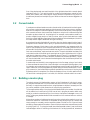
One of the simplest and most useful molds is a flat, rigid table faced with a smooth plastic
laminate (Figure 3-1). This mold is useful for producing flat laminates or panels for bulkheads, doors, beams, and a wide range of custom structural components. Any portion of
the table may be used, and multiple lay-ups of different sizes can be vacuum bagged at one
time.
3.2
Curved molds
Curved parts can be laminated over male or female molds. A female mold’s surface is generally concave, producing a laminated part with the smooth finish on the convex or outside–a
boat hull for example. A male mold generally has a convex mold surface, producing a part
with a smooth surface on the concave side–a bathtub or cockpit well. A male mold may also
be used to produce a boat hull. An existing hull, for example, can be used as a mold to reproduce a slightly larger version of itself. However, when a part is laminated over a male
mold, the rougher bag side of laminate will be the outside of the laminated part (the hull in
this case) and will require additional fairing and finishing.
A curved mold can be lofted and built in wood or other low density material, with a layer of
fiberglass cloth and several coats of epoxy to provide a smooth airtight molding surface.
Some parts, because of their shape or size, must be laminated in two separate molds. An
open or bowl shaped part, such as a small open boat hull, can be easily pulled from a one
piece mold if the opening of the mold is wider than any point on the inside. A closed object,
such as an enclosed boat, requires at least two molds. The part is divided at its widest point
so that both molds will be wider at the opening than any point inside the mold. A typical
small boat is widest at the shear. (The catamaran plug in Figure 3-2 is widest about a foot
above the waterline, which is where the deck mold and hull mold are separated). The part
will then be laminated in two halves and bonded together after the halves are pulled from
the mold and trimmed.
Curved molds are often built in a two stage process. In the first stage, a plug or form is built
to the exact dimensions and finish of the final object. In some cases an existing object, a hull
for example, can be used as the plug. In the second stage, a mold is cast from the plug. In the
case of a boat hull, a male plug (essentially a male mold) produces a female mold. To simplify construction, the female mold may be built upside down over the top of the plug, then
flipped over after it is completed. For all but the simplest of forms, it’s much easier to build,
fair and finish a male plug than it is to build, fair and finish a female mold from scratch.
3.3
Building a master plug
The plug is an exact, full sized model or pattern of the finished part. A hull plug, for example, may be lofted and built in much the same way as a one-off hull, with frames, stringers
and a skin. It may also be carved free form, using templates or calipers if necessary to transfer profiles, establish critical dimensions or keep the plug symmetrical.
The strength and durability of the plug should be determined by the number of molds that
will be made from it and how long it will have to last. A plug may be used to build many
molds for production manufacturing or from time to time replace a damaged or worn out
mold. The plug may be altered after molds are made from it to create variations or revisions
of a design.
Although any number of molds may be cast from a plug, a plug is often used only once. Any
material or method of construction is acceptable, as long as the plug is fair, smooth and
strong enough to accurately cast the required number of molds from it. Plywood frames
and easy to shape materials like cedar or foam will help to reduce the costs and time to build
the plug (Figure 3-2). The plug (and mold) should be extended at least 1" past the finished
laminate edge to allow for trimming of the laminate. A 6" wide plywood shelf, attached to
3
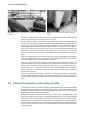
12 Vacuum Bagging Molds
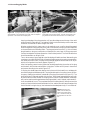
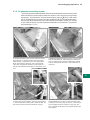
Figure 3-2 A plug can be built of any combination of easy to
shape materials. This catamaran plug’s cabin area was shaped in
Styrofoam™ and then faired with epoxy/407.
Figure 3-3 The catamaran plug was faired and finished to the
same degree as the finished product. The shelf was applied to the
plug where the mold halves divide the form at its widest point.
the plug at the edge of the plug extension, will provide a ledge around the top of the mold
when the mold is right side up. The ledge will reinforce the mold and provide a clean area
outside of the laminate to seal the bag to the mold.
Whether a plug is built for heavy use or to be used only once, no effort should be spared
when fairing and finishing the plug. Every flaw in the surface of the plug will be transferred
to the mold and to the finished product. The plug may be built to within ¼" of the finished
plug dimension, using any combination of materials. An outer layer of fairing compound
can then be shaped to the exact dimension of the finished product. The final faired surface
should be sanded to an 80-grit finish.
Two or three coats of epoxy applied to the faired plug will seal the surface. Wet sanding the
cured epoxy to a 400-600 grit finish will make the surface smooth enough to prevent adhesion when the mold is cast. The plug’s surface should appear as smooth and as fair as you
wish the final product’s surface to appear (Figure 3-3).
After final sanding, several coats of paste wax should be applied to the surface of the plug
and the shelf, with the last coat buffed to a high gloss. The wax will fill pores in the surface
and prevent bonding to the mold (Figure 3-4).
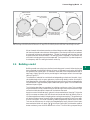
If the plug is a closed shape that requires a two piece mold, the break line or widest point
around the plug should be determined. The plug should taper in from all points on this line.
An epoxy coated, plywood shelf is attached to the plug at the break line (Figure 3-5). The
shelf should be 6" wide and parallel with the floor. Small cleats fastened temporarily with
drywall screws will hold the shelf to the plug until the mold is made. Beeswax (toilet bowl
wax) can be used to seal the gap between the plug and shelf, and, if desired, make a small fillet in the mold/shelf corner. The completed mold will include a level 6" wide lip around the
opening of the mold at the break (laminate trim) line, and the fillet will leave the edge of the
mold rounded. During the lay up, the laminates are extended past the lip, 2" onto the shelf.
Figure 3-4 A plug for a
rudder, with the shelf positioned at the rudder centerline, is waxed and ready for
the application of the mold
half.
Vacuum Bagging Molds 13
Added Framework
Top Mold Half
Plug
Temporary shelf is placed
around the plug at its widest
dimension (points tangent to
a plumb line)
Bottom Mold Half
Added Framework
Shelf is removed after
plug is inverted
Mold shelf provides area to
run out laminate beyond the
trim line and seal the bag
Figure 3-5 A closed shape like a sphere or a hull with a molded deck requires two molds separated at the widest point. A 6" wide
shelf at the edge of the mold allows the laminate to run beyond its trim line and provides a clean area to seal the bag to the mold.
When trimmed, the laminate extension provides a flange around the edge of each laminate
half that may be used to bond the two halves together. After the top half mold is completed,
the plug and mold are turned upside down. The shelf is removed, and the holes from the
drywall screws are filled and faired. The casting process is repeated for the bottom half
mold, before the plug and top mold are separated. The top mold’s 6" lip takes the place of
the temporary shelf for casting the bottom mold’s lip.
3.4
Building a mold
Building a mold over a plug is very similar to laminating a part in a mold. After the plug has
been completed, the mold shell is built up in layers, or laminated, over the plug. Hull molds
are generally built upside down. A framework is bonded to the completed mold shell to
help keep it rigid (Figure 3-6) and to provide legs for level support when it is turned right
side up (Figure 3-7).
The schedule of materials for a mold shell varies depending on the size of the mold. A typical schedule begins with an epoxy gelcoat to provide a high density surface. One layer of
light fiberglass cloth followed by multiple layers of heavier cloth will make an adequate skin
for small molds. Larger molds may require additional layers of glass, or a core material and
additional layers of glass.
The following describes one procedure for building a mold over a plug. This procedure
may be modified or other procedures may be used as long as the mold provides an airtight
surface that holds the object’s shape until the laminate has cured.
Apply two coats of thickened epoxy “gelcoat” to the waxed surface of the plug. Thicken the
epoxy to a catsup consistency with 420 Aluminum Powder and 404 High-Density Filler to
increase toughness and reduce fisheyeing when coating the waxed plug. This gelcoat layer
will be the inside surface of the mold. After the gelcoat layer reaches its initial cure, apply
the first cloth layers –4 oz cloth followed by several progressively heavier layers of cloth.
Take care to eliminate any air voids in the fiberglass/epoxy layers. When the cloth layers
have reached an initial cure, apply a 1 8"–1 4" thick layer of epoxy/407 (thickened to a peanut
butter consistency) over the cloth and allow it to cure. This thick fairing compound layer
3
14 Vacuum Bagging Molds
Figure 3-6 Framing is being added to the bottom mold after lay-up is
Figure 3-7 Legs and wheels are added to both mold
complete.
halves.
acts as an interface between the skin and the core material and helps to prevent the core
from printing through to the inner surface of the mold.
The next step is to apply 1" core material over the inside skin of the mold. Sand the fairing
mixture to knock down any ridges or high spots and provide texture for good adhesion of
the next layer. After cutting the honeycomb core material to fit the entire mold area, remove a few pieces at a time and bond them back in position. Then apply a second " layer of
epoxy/407 mixture over the cured epoxy/407 layer. Wet out the bottom contact side of the
core material with unthickened epoxy and lay it into the fresh epoxy/407 mixture. Use
weights to hold the core in position, firmly bedded in the thick epoxy/407 mixture until
cured.
After the core application has cured thoroughly and sharp or raised edges are faired, apply
the outer fiberglass skin directly over the core. The outer skin should consist of several layers of cloth, about equal to the thickness of the inner skin.
When the outer skin has cured thoroughly, bond the support framework to the skin. The
framework should support the mold shell at a convenient height and keep the mold from
flexing when it is removed and placed right side up on the floor. The mold framework may
be fixed to the floor or mounted on wheels, in which case a strongback may be needed to
keep the mold rigid. The framework should be built over the mold shell before removing
the mold from the plug.
After the mold has cured thoroughly, remove it from the plug by carefully forcing wooden
or plastic wedges between the edge of the mold and the plug. Then prepare the mold for
vacuum bagging. Inspect the mold surface for pinholes or flaws which may be repaired with
epoxy.
3.5
Elevated temperature post-curing in molds
The plug/mold construction and laminating procedures described in this manual are based
on the use of room temperature cure epoxies and materials. Plugs, molds and laminates that
will be post-cured or subjected to temperatures greater than 110°F (43°C) will require an
alternate epoxy system and building method.
High performance, low-viscosity epoxies are often used in vacuum bag laminating. These
epoxies may require curing or post-curing at elevated temperatures. If the finished laminate
is to be post-cured in the mold, special precautions must be taken when building and selecting materials for the mold as well as the laminate. Molds must be built of materials and with
techniques that enable the mold to withstand the elevated temperatures without distorting.
And, if the mold must be post-cured on the plug, the same precautions must be taken when
building the plug.
Vacuum Bagging Molds 15
When building molds that will be used with high temperature curing applications, first establish the target post-cure temperature of the part. Consider the highest and lowest temperatures at which the resin system will cure. Then consider the size of the structure to be
cured and the type of mold construction you would like to use. All of these factors affect the
post-cure schedule (the rate of temperature increase and length of cure time).
The cure temperature of the mold and plug are based on the established target temperature
of the part. The mold should be post-cured at a higher temperature than the part. The plug
should be post-cured at a higher temperature than the mold. If, for example, the part will be
cured at 140°F (60°C), the mold should be cured at 150°F (66°C), and the plug should be
post-cured at 160°F (71°C). The objective is to keep the mold below the temperature at
which it was post-cured. This way, the mold or plug can be used without exceeding the HDT
(heat deflection temperature) of their structure’s resin system.
When choosing materials for the mold, consider the fact that a cored mold will not transfer
heat as well as a solid laminate. The core in a composite sandwich mold will act as an insulator. If a core is also used in the part being laminated, the skin between the mold surface and
the part core will not warm up as well as the skin on the other side of the core. If there is a
large temperature difference between the inner skin and the outer skin, the part could
prerelease or distort during the post-cure. Verify the dimensional stability of the core material you intend to use for the intended post-cure temperature.
Call or write the West System technical staff if you have questions about mold building or
post-curing at elevated temperatures.
3
16 Vacuum Bagging Applications
4 Vacuum Bagging Applications
Boatbuilding is just one of the applications in which vacuum bag laminating can replace
conventional clamping or fastening. Vacuum bagging is a practical clamping method for
large scale and very small scale applications, from product manufacturing to backyard
building and hobby projects. Wind turbine blades, furniture, musical instruments, race car
components, and model boats are just a few of the applications of vacuum bagging.
Natural and synthetic fibers are the most common materials used in composite construction.
Wood and wood veneer represent the oldest and most widely used form of fiber in composites. Layers of wood can be laminated to make structural panels or beams. They can be used as
structural or decorative skins over other core materials or as core materials themselves. They
can be augmented with natural or synthetic fibers for cross-grain reinforcement.
Synthetic fibers such as fiberglass, carbon (graphite) and Kevlar™(aramid) in the form of
fabrics are designed for composite construction. When used alone, in combination with
other fibers or with core materials, synthetic fibers allow the builder to accurately tune the
weight, strength and shape of the finished part to its intended function.
4.1
Basic laminating in a female mold
This section describes two specific vacuum bagging procedures. These examples of small
lay-ups are intended to demonstrate the basic principles of vacuum bagging. Keep in mind
that vacuum bagging materials, molds, equipment, and laminate schedules will vary from
these procedures. In all cases, however, the same principles of vacuum bagging apply. If you
are new to epoxy or vacuum bagging, we suggest laminating a small project to familiarize
yourself with the equipment, and the sequence and timing of the procedures which are often based on the handling characteristics and open time of the epoxy.
Thorough preparation for the vacuum bagging process is essential. Be sure all equipment is
working properly and that the vacuum pump is well lubricated (if it is the oil-lubricated type).
Prepare a plastic covered work surface near the mold to wet out laminate materials. Rehearse
all of the steps with your helpers, especially if they are unfamiliar with vacuum bagging. Everyone coming in contact with the epoxy should wear the proper protective clothing. Gloves
should be worn until all of the laminates are in the mold.
Establish the maximum working time available, based on the resin/hardener you will be using and the ambient temperature. Be sure all of the steps (excluding gelcoat application) can
be completed within the working time. Refer to WEST SYSTEM product literature for cure
time information.
4.1.1 Laminating a masthead float half
The laminate in this example is half of a pivoting masthead float designed for a small catamaran. The teardrop-shaped float has a circular cross section. Both left and right halves of
the float were made from the same symmetrical mold. The laminate schedule consists of an
epoxy gelcoat, two layers of 15 oz biaxial fiberglass fabric with two layers of unidirectional
carbon fiber reinforcing the midsection axis. The adhesive is WEST SYSTEM105 Resin and
206 Slow Hardener.
Vacuum Bagging Applications 17
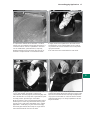
1. Prepared the materials to be laminated. Cut fabrics,
veneers and core materials to shape and place them in a
convenient area for wet-out or placement in the mold.
Cut the release fabric, perforated film (if required),
breather material and vacuum bag to size, then roll or
fold them and placed them in a convenient location.
2. Apply three coats of paste wax to the mold surface
and the shelf to act as a release agent for the cured epoxy. Buff the last coat so excess wax will not be picked
up by the laminate.
Five coats of wax are recommended on new molds.
4
3. Apply a coat of gelcoat to the mold and allow it to
cure. In this example, the gelcoat is a mixture of
resin/hardener and white pigment, thickened slightly with
406 Colloidal Silica. It will provide a good base for paint
and help prevent “print-through” of the fabric.
Wash the surface of the cured gelcoat with water and an
abrasive pad to remove any amine blush that may have
formed on the cured surface. See Section 5.4.1, Surface
preparation—cured epoxy. Dry the surface thoroughly
with clean paper towels. Sand bumps or rough areas to
assure the laminate will lie flat in the mold.
4. Apply mastic sealant to the mold perimeter. Use firm
pressure and overlap the ends so there are no gaps. Leave
space around the laminate area and keep the paper backing in place on the mastic so it will not become contaminated with wet epoxy. It is nearly impossible to seal the
bag to wet mastic.
18 Vacuum Bagging Applications
5. Place the first layer of two layers of 15 oz biaxial fiberglass fabric in position in the mold. In this example, it
is easier to wet out fabric in the mold after it is positioned and trimmed.
Once the epoxy is mixed, the time limit for the entire
process is established, based on the hardener used, ambient temperature, and the volume of laminate in the mold.
When multiple batches of epoxy are used on larger layups, apply full vacuum pressure before the first mixed
batch reaches its initial cure. Refer to product literature
for cure time information.
6. Squeegee excess epoxy from each layer of fabric after
it is wet out. There should be no puddles of epoxy or air
pockets under the fabric.
Because fabrics are compressed when vacuum bagging,
less epoxy is required. Properly wet out fabric may appear drier than for a normal wet lay-up. When properly
wet out, a puddle of epoxy will appear around the edges
of a thumb print after a few pounds of pressure are applied with a (gloved) thumb.
7. Place a layer of release fabric over the laminate. The
release fabric will peel off the cured laminate leaving a
fine-textured surface. Excess epoxy which has bled
through will be removed along with the release fabric.
8. Place breather material over the release fabric. WEST
SYSTEM 881 Breather Fabric is a polyester blanket that
allows air to pass through its fibers to the port and absorbs excess epoxy that passes through the release fabric.
Press all of the layers of material into contact with the
mold to avoid “bridging” when vacuum pressure is
applied. See Section 4.2.1
Vacuum Bagging Applications 19
9. Place the vacuum bag over the mold and seal it to the
mold’s perimeter. Starting at a corner of the mold, peel
the protective paper from the mastic. Press the edge of
the bag firmly onto the mastic while pulling the bag taut
enough to avoid wrinkles.
When cutting the bag to size, allow enough excess bag
material within the sealant perimeter to avoid stretching
the bag or bridging areas when the vacuum is applied, especially with a deep mold such as this one.
10. Because the bag perimeter is greater than the sealant
perimeter, you should create several folds or pleats of excess material as the bag is sealed around the mold.
4
Perimeter
mastic
11. Seal the pleats of excess bag with a strip of mastic
from perimeter mastic to the inside top of the pleat. then
press the bag to both sides of the strip forming a continuous airtight seal. Repeat this procedure wherever there is
a pleat around the mold.
Pleat mastic
20 Vacuum Bagging Applications
12. Connect the vacuum line to the bag with a vacuum
port. The vacuum port used here is basically a suction
cup with a hole through it, attached to the end of the
line. Puncture a small hole in the bag and attach the port
to the bag over the hole. Breather fabric provides a path
to the port inside the bag over a wide area. Place an extra layer or two of breather under the port. On smaller
molds, place the port outside of the trim line on the
mold flange or shelf. Multiple ports may be necessary on
larger parts. See Figure 2.4.
13. Turn the vacuum pump on, to begin evacuating air
from the bag. If necessary, temporarily shut off the vacuum to reposition laminate or adjust the bag. As the air is
removed from the bag, listen for leaks around the bag perimeter, especially at folds in the bag, laps in the mastic
and at the vacuum line or port connection. Where leaks
are found, push the bag into the sealant or, if necessary,
plug the leaks with pieces of mastic or tape.
Some shops use sensitive listening devices to detect leaks.
14. Attach the vacuum gauge to the vacuum bag over a
puncture in the vacuum bag. A hissing sound will indicate that enough air is leaking through the puncture to
draw a vacuum on the gauge. Place the gauge away from
the exhaust tube or port connection.
Most gauges read in inches of mercury. To approximate
the reading in psi, divide the gauge reading by two. Allow the laminate to cure thoroughly before turning off
the vacuum pump.
15. After the laminate has cured thoroughly, remove the
vacuum bag, breather and release fabric.
Separate the laminate from the mold by inserting small
wooden or plastic wedges between the edge of the
laminate and the mold. Insert wedges along one side of
the part then insert additional wedges to extend the separation around the part until it pops loose.
After the other half is laminated, trim and bond both
halves together.
Vacuum Bagging Applications 21
4.1.2 Laminating a rudder half
The laminate in this example is the right half of a rudder blade for a small catamaran. The
method demonstrated here is a variation of the previous method. This laminate incorporates core material and the mold is enclosed in a vacuum bag envelope rather than relying
on the mold as half the envelope.
The laminate schedule consists of an epoxy gelcoat, one layer of 15 oz biaxial fiberglass fabric, a layer of core materials and a second layer of 15 oz biaxial fiberglass. The adhesive is
WEST SYSTEM 105 Resin and 206 Slow Hardener. The core material varies depending on
its position in the rudder. Foam core is used in the lower blade area. Thinner material is
used in the thinner trailing edge. Thicker material is used in the center and leading edge.
Solid spruce and endgrain balsa core are used in the more highly stressed upper area and
where the pivot pin passes through the blade.
When using solid materials like wood veneers or cores, it is important to avoid air entrapment under the material. If the edges of the core contact the mold surface before the center,
when vacuum pressure is applied, a pocket of air may become trapped under the core. In
many applications, the core or veneer is perforated to allow air to escape. In the following
application, the core is carefully bedded in a layer of thickened epoxy which holds the core
in position and eliminates voids under the core. The thickened epoxy also conforms to the
uneven space between the flat cores and the curved mold surface. See Section 4.2.3.
A strong mold is required when using a vacuum bag envelope. This method of vacuum bagging can deform or collapse a weak mold. A relatively flat mold, such as the used here, is
more suited to the vacuum bag envelope.
4
1. Prepare the materials to be laminated. Cut fabrics, veneers, and core materials to shape and place them in a
convenient area for wet-out or placement in the mold.
Cut the release fabric, perforated film (if required),
breather material and vacuum bag envelope to size, then
roll or fold them and place them in a convenient location.
Apply three coats of paste wax to the mold surface and
the shelf to act as a release agent. Buff the last coat so
excess wax will not be picked up by the laminate. Apply
five coats of wax if it is a new mold.
2. Apply a coat of gelcoat to the mold and allow it to
cure. The gelcoat is a mixture of resin/hardener and
white pigment, thickened slightly with 406 Colloidal Silica.
Wash the surface of the cured gelcoat with water and an
abrasive pad to remove any amine blush that may have
formed on the cured surface. Dry the surface thoroughly
with clean paper towels. See Section 5.4.1, Surface preparation—cured epoxy. Sand bumps or rough areas to assure the laminate will lie flat in the mold.
22 Vacuum Bagging Applications
3. Place the first layer of fiberglass fabric in position in
the mold and then wet it out in the mold. This will be
the outer skin of the rudder. Squeegee the fabric to remove excess epoxy and air pockets under the fabric.
Once this first batch of epoxy is mixed, the time limit for
the entire process is established, based on the hardener
used, ambient temperature, and the volume of coated
laminate in the mold. Apply vacuum clamping pressure
before this first batch of epoxy reaches its initial cure.
4. Wet out and apply a layer of thickened epoxy to the
bottom of each piece of core material to bridge any gaps
between the core and the outer skin. Place each piece of
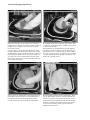
core in position in the mold.
Foam, endgrain balsa and solid spruce core materials are
used in this part. Core thickness varies depending on the
position in the mold. Denser core material is used in the
top of the rudder where loads on the part are concentrated.
5. Apply thickened epoxy to fill gaps between pieces of
core and to fillet the edges of cores. The thickened epoxy
will become part of the core.
6. Smooth the thickened epoxy to fill depressions
around core pieces. The core material and thickened epoxy should fill the mold flush with the top surface of the
mold which is the centerline of the rudder. When the
two halves of the rudder are joined they should meet
along the centerline with few voids. Remove any high
spots so the halves will meet at the centerline.
Vacuum Bagging Applications 23
7. Wet out the final layer of fabric on a plastic covered
table before placing in the mold over the core material.
8. Place the wet out fabric in the mold. Squeegee the fabric to remove any air pockets and excess epoxy.
Place a layer of release fabric over the laminate. The release fabric will peel off the cured laminate, leaving a
fine-textured surface. Excess epoxy which has bled
through will be removed along with the release fabric.
4
9. Place perforated film and breather fabric over the release fabric. Perforated film restricts the amount of epoxy
that can be drawn away from the lay-up into the breather
fabric.
10. Place the mold and lay-up inside a vacuum bag envelope. Make the envelope by folding a large sheet of plastic in two and sealing the three open sides with mastic.
Seal two sides of the envelope before beginning the layup. Peel the protective paper from the mastic and seal the
third side after the mold is placed inside.
24 Vacuum Bagging Applications
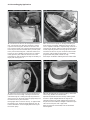
11. Turn on the vacuum pump, and place the vacuum
port and gauge over punctures in the vacuum bag. An extra layer of breather fabric under the port will help to insure that epoxy is not drawn into the vacuum line.
As the air is removed from the bag, listen for leaks
around the bag perimeter, especially at folds in the bag,
laps in the mastic and at the exhaust tube or port connection. Where leaks are found, push the bag into the sealant or, if necessary, plug the leaks with pieces of mastic
or tape.
12. Place the gauge away from the exhaust tube or port
connection. Monitor the vacuum pressure and check for
leaks throughout the cure. Allow the epoxy to cure thoroughly before turning off the vacuum.
If you plan to reuse the vacuum bag, mark the port and
gauge locations with a felt marker so the holes can be
easily found and sealed.
13. After the laminate has cured, remove the mold from
the bag and peel the breather, release fabric and perforated film from the laminate. Separate the laminate from
the mold by inserting small wooden or plastic wedges between the edge of the laminate and the mold. Insert additional wedges along one side of the part, extending the
separation around the part until it pops loose.
14. Remove the finished right half of the rudder from the
mold. Trim the laminate to the centerline of the rudder
and grind down any high spots in the center of the rudder. Laminate the left half in the same way. Sand the
bonding surface of the two halves and bond the halves
together with thickened epoxy. Drill the hole for the
pivot pin and seal the exposed core inside the hole with
epoxy. Fair the bond line around the edges of the rudder
and sand the outer surface to prepare it for paint.
Vacuum Bagging Applications 25
4.1.3 An alternate vacuum bag system
The following example demonstrates an alternative plumbing system that uses a perforated
manifold inside the vacuum bag as a method to draw air from a long lay-up using a single
vacuum port. The laminate is a structural panel using two layers of 110"-thick wood veneer
and 12 oz fiberglass cloth in a partial cylinder, female mold. With a flat base plate under it,
the manifold can be used directly over harder material like Douglas fir veneer. It is not used
on soft materials where it can leave a permanent depression in the laminate. The manifold
and plumbing are ¾" PVC.
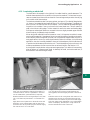
A manifold provides a rigid air path inside the vacuum
bag to the port or place where the vacuum line penetrates the bag. It is placed on top of the release fabric.
When the manifold is placed on top of the laminate,
rather than alongside the laminate, a plate under the
manifold will distribute the pressure of the narrow manifold.
A bubble-type breather material is placed over the release
fabric and the manifold. Gaps between the bubbles provide air channels to the manifold. Bubble-type material
may be reused several times, but it does not absorb excess epoxy.
4
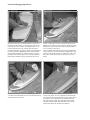
After the vacuum bag is in place, the vacuum line is connected directly to the manifold. The bag is pushed about
½" into the manifold coupling that is under the bag. The
bag is then punctured inside the manifold coupling.
The vacuum line is then shoved into the coupling, sealing
the bag between the vacuum line and the inside of the
coupling. The vacuum pump is turned on, evacuating air
from the bag through the manifold. A glue trap, seen
here, prevents excess epoxy from being drawn through
the plumbing.
26 Vacuum Bagging Applications
4.2
Special considerations
Previous examples show steps for several variations of vacuum bagging. Every combination
of molds, laminate ply schedule and vacuum bagging method presents a different set of
considerations. These are the most common.
4.2.1 Bridging
Narrow molds, deep molds or molds with sharp inside corners can create a problem called
bridging. Bridging occurs when any of the composite material or vacuum bagging materials
are too short for the mold or too stiff to drape completely into a narrow part of the mold or
into a sharp inside corner. A fabric ply or the vacuum bag may be cut too short and “bridge”
across a narrow part of the mold when the vacuum is applied; or, a wood veneer or foam
core may not bend enough to contact the inside of a small radius in a mold. The result of
bridging is a void in the laminate.
There are several ways bridging can be avoided. Cut all of the laminate and vacuum bagging
material large enough to drape into all parts of the mold. When placing laminate into the
mold, push each layer tight against the mold. Pound rigid wood veneer or core into tight inside corners with a padded block as the vacuum is applied. Place overlapping joints of the
laminate and vacuum bag material (not the vacuum bag itself) at the inside corner (Figure
4-1). This allows the ends of the material to slide into the corner as the vacuum is applied.
Figure 4-1 Bridging creates
a void in the laminate where
laminate or vacuum bag material spans the inside corner
of a mold and creates a void
under the laminate.
Voids are created when
composite or bagging
material “bridges” an
inside corner of the
mold
Plan laminate schedule with
overlapping joints at inside corners
Push each layer tight against to mold
at inside corners
4.2.2 Controlling resin content
The fibers in a laminate contribute to its strength more than the resin. Achieving the greatest strength with the lowest weight can be accomplished by reducing the ratio of resin to
structural fabric, up to a point. A typical wet lay-up (without vacuum bagging ) is limited to
about a 50% fiber/50% resin ratio. Vacuum bagging compacts the laminate so fibers can be
thoroughly wet out with as high as a 65% fiber/35% resin ratio. The fiber-to-resin ratio is
affected by 1. vacuum pressure, 2. resin viscosity, 3. resin cure time (time under vacuum,
before gelation), and 4. perforated film pattern and hole size.
High vacuum pressure results in greater compaction of the laminate, but can also draw too
much resin out of the laminate into the absorbent breather fabric, especially if you are using
low viscosity resin with a long open time. Perforated film restricts the flow of resin out of
the laminate and allows you to use higher vacuum, achieve greater laminate compaction
and lower the weight of the composite. Perforated film is available in various hole sizes and
patterns. You will need to experiment to determine the right combination of perforated
film, vacuum pressure, resin viscosity and cure time for a particular laminate. For small
project, you can try making your own perforated film by puncturing a thin layer of plastic
drop cloth or polyethylene film with holes in a grid pattern between 3 8" and 2"apart.
4.2.3 Air entrapment under laminate sheets
Solid or non-porous sheet material, such as wood veneer, foam core or pre-laminated skins,
may need to be perforated to allow air and excess resin to escape. In a flat or concave mold,
they may seal around the edges when vacuum pressure is applied, trapping air and resin beneath them. Some solid foam cores are available with small holes every 4". Air entrapment
is less of a problem in convex molds where the center of the ply will contact the mold first
and allow air and resin to bleed out around the edges of the ply.
Vacuum Bagging Applications 27
4.3
Large scale vacuum bagging
The limiting factors in the size of the lay-up include vacuum pump size, the shape and complexity of the mold, open time of the resin used, and the labor available to lay-up all of the
composite and bagging material within the resin’s open time.
This example shows the lay-up of a prototype 32' hull in the female mold shown in the photographs in Section 3. The vacuum bagging procedure used here is the same basic procedure described earlier.
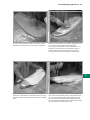
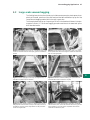
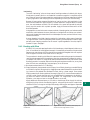
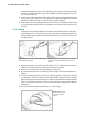
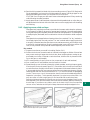
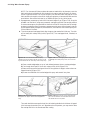
Figure 4-2 Fiberglass cloth is wet out in the bottom (hull) mold
of the 32' catamaran after the cured epoxy gelcoat is washed and
sanded.
Figure 4-3 After laying in the outer layer of cloth, core materi-
Figure 4-4 After applying an inner layer of fiberglass cloth, re-
Figure 4-5 Breather material (bubble-type) is positioned over
lease fabric is placed over the laminates.
the release fabric after a manifold is in place.
Figure 4-6 The laminate’s position is checked as the vacuum is
being applied. Note that there is plenty of extra bag to allow for
the depth of the mold. Narrow bag material can be joined with
mastic into larger sheets.
Figure 4-7 A finished laminated part (deck/cabin), suspended
over the bottom (hull) mold. The mold also serves as a jig to hold
the laminated hull in while interior components and the laminated deck are bonded in place.
als are placed. Both foam and Douglas fir veneers are used where
they are most appropriate.
4
28 Vacuum Bagging Applications
4.4
Repairing laminates with vacuum bagging
In many cases, the same procedures that are used to manufacture new panels can be used to
repair damaged fiberglass hull or deck laminate. For most fiberglass boat repairs, vacuum
bagging is not necessary to make a repair that equals or surpasses the strength of existing
laminate. For highly stressed, lightly built composites, using vacuum bagging techniques to
laminate new fabric into an excavated damaged area is an effective way to get a high fiberto-resin ratio repair that should be as strong as the existing panel. The following procedure
describes the use of the vacuum bag laminating process for fiberglass laminate repairs (Figure 4-8).
1. Prepare the damaged area. Using a buffer/polisher with an 8" foam pad and 40-grit paper,
grind out all of the damaged area. Remove any delaminated laminate, exposing solid undamaged laminate. Grind the repair area to a circular or oval shape. Bevel the edges of the
cavity to a 12 to 1 angle (up to 50 to 1 for heavily stressed areas or thin skinned laminates).
2. Seal the back of the opening to provide an airtight envelope. If it is necessary to grind completely through the laminate to remove all damage, bond a piece of plastic laminate over the
back of the opening to back up the lay-up. If a temporary backer is desired, such as in an exposed interior area, 833 Vacuum Bag Sealant may be used to hold the plastic backer in position and seal the opening. Wax the portion of the plastic backer that covers the opening so
that it can be easily removed after the lay-up has cured.
If the laminate is cored, it may be necessary to seal the core with epoxy. A scored or porous
core may make it difficult to draw a good vacuum and should be coated with epoxy to make
the surface airtight.
3. Cut an appropriate number of pieces of fabric the same shape as the excavated repair area.
The first piece should be slightly smaller than the outside of the beveled edge. Each of the
remaining pieces should be cut slightly smaller than the preceding piece with the last piece
Grind a bevel around
damaged area
Vacuum bag film
Mastic sealant
Breather fabric
Perforated film
Release fabric
Vacuum gauge
Fabric layers
Mastic or adhesive
Plastic laminate
Vacuum port
Figure 4-8 Rebuild a damaged laminate to its original thickness using multiple layers of fiberglass cloth bonded with epoxy. Back
up the opening with an airtight panel that conforms to the shape of the damaged laminate.
Vacuum Bagging Applications 29
the same size as the bottom of the cavity at the inside of the bevel. The combined thickness
of the layers when compressed should be slightly thinner than the laminate that was excavated.
4. Prepare the vacuum bagging materials. Cut release fabric, perforated film and breather
slightly larger than the repair area. Cut the vacuum bag several inches larger on all sides
than the repair area. Apply mastic sealant several inches outside the perimeter of the repair
area.
5. Wet out the repair area with a resin/hardener mixture. Apply a thin layer of thickened epoxy/404 mixture to the repair area to fill any voids or unevenness.
6. Apply the wet-out layers of cloth beginning with the largest layer and then with the progressively smaller layers centered in the repair area. Wet out each layer of cloth on a plastic
covered table, then smooth each layer in place on the repair area, removing air bubbles and
excess epoxy with an 808 Plastic Squeegee.
7. Squeegee the layer of release fabric over the layers of cloth to remove any trapped air and
excess epoxy. Place the perforated film and breather material over the lay-up and seal the
vacuum bag to the mastic. If necessary on vertical surfaces, hold the breather material in position temporarily with tape.
8. Attach the vacuum port off to the side of the repair if possible to avoid dimpling the repair
with the vacuum port.
9. Turn on the vacuum pump and attach the vacuum gauge. After the vacuum has stabilized,
moderate heat from a heat lamp or portable heater may be applied to the lay-up to speed
the cure. Allow the lay-up to cure thoroughly and remove the bag, breather, perforated film
and release fabric.
10. Grind any high spot or bumps and fill any low areas with a thick mixture of epoxy and 407
filler. Sand the repair area fair after the mixture cures thoroughly and apply two coats of epoxy to seal the repair. Apply paint or gelcoat for UV protection.
For more information about fiberglass repair, refer to 002-550 Fiberglass Boat Repair &
Maintenance published by West System, Inc.
4.5
Resin infusion and VARTM
There are several methods of laminating parts that use a vacuum bag to consolidate the
laminate and seal the mold, and use the vacuum pressure to draw resin in to the dry laminate stack. In these processes, rather than wet laminate being placed in the mold, the various fibers, and perhaps even a core, are placed in the mold dry. The vacuum bag is sealed to
the mold and vacuum drawn. Once the full vacuum pressure is applied and no leaks exist,
the resin is mixed. The resin is drawn into the laminate, much like a soft drink is sucked
through a straw, and allowed to gel.
This is a simple description of a somewhat complicated process. The details can take some
time to work out. Very good vacuum bagging skills are required for these techniques because leaks cannot be tolerated in these processes. For more information concerning these
processes, refer to Professional Boatbuilder magazine, or Composites Fabricators Association’s Composites Fabrication magazine for reprints of articles on these techniques.
4
30 Using WEST SYSTEM® Epoxy
5 Using WEST SYSTEM® Epoxy
This section is designed to help you understand and safely handle WEST SYSTEM epoxy
products and to provide the basic techniques used in most repair and building operations.
Refer to the WEST SYSTEM User Manual & Product Guide for more complete product information.
5.1
Epoxy safety
Epoxies are safe when handled properly. To use WEST SYSTEM epoxies safely, you must understand their hazards and take precautions to avoid them.
Hazards
The primary hazard associated with epoxy involves skin contact. WEST SYSTEM resin may
cause moderate skin irritation. WEST SYSTEM hardeners are corrosive and may cause severe
skin irritation. Resins and hardeners are also sensitizers and may cause an allergic reaction
similar to poison ivy. Susceptibility and the severity of a reaction varies with the individual.
Although most people are not sensitive to WEST SYSTEM resin and hardeners, the risk of becoming sensitized increases with repeated contact. For those who become sensitized, the
severity of the reaction may increase with each contact. The hazards associated with resins
and hardeners also apply to the sanding dust from epoxy that has not fully cured. These
hazards decrease as resin/hardener mixtures reach full cure. Refer to product labels or Material Safety Data Sheets for specific product warnings and safety information.
Precautions
1. Avoid contact with resin, hardeners, mixed epoxy and sanding dust from epoxy that is not
fully cured. Wear protective gloves and clothing whenever you handle WEST SYSTEM epoxies. Barrier skin creams provide additional protection. If you do get resin, hardener or
mixed epoxy on your skin, remove it as soon as possible. Resin is not water soluble—use a
waterless skin cleanser to remove resin or mixed epoxy from your skin. Hardener is water
soluble—wash with soap and warm water to remove hardener or sanding dust from your
skin. Always wash thoroughly with soap and warm water after using epoxy. Never use solvents to remove epoxy from your skin.
Stop using the product if you develop a reaction. Resume work only after the symptoms
disappear, usually after several days. When you resume work, improve your safety precautions to prevent exposure to epoxy, its vapors, and sanding dust. If problems persist, discontinue use and consult a physician.
2. Protect your eyes from contact with resin, hardeners, mixed epoxy, and sanding dust by
wearing appropriate eye protection. If contact occurs, immediately flush the eyes with water under low pressure for 15 minutes. If discomfort persists, seek medical attention.
3. Avoid breathing concentrated vapors and sanding dust. WEST SYSTEM epoxies have low
VOC content, but vapors can build up in unvented spaces. Provide ample ventilation when
working with epoxy in confined spaces, such as boat interiors. When adequate ventilation
is not possible, wear a NIOSH (National Institute for Occupational Safety and Health) ap-
Using WEST SYSTEM® Epoxy 31
proved respirator with an organic vapor cartridge. Provide ventilation and wear a dust
mask when sanding epoxy, especially uncured epoxy. Breathing uncured epoxy dust increases your risk of sensitization. Although epoxy cures quickly to a sandable solid, it may
take over two weeks at room temperature, or post-curing, to cure completely.
4. Avoid ingestion. Wash thoroughly after handling epoxy, especially before eating or smoking. If epoxy is swallowed, drink large quantities of water—DO NOT induce vomiting. Because hardeners are corrosive, they can cause additional harm if vomited. Call a physician
immediately. Refer to First Aid procedures on the Material Safety Data Sheet.
5. KEEP RESINS, HARDENERS, FILLERS AND SOLVENTS OUT OF THE REACH OF
CHILDREN.
For additional safety information or data, write to: EPOXY SAFETY, West System, Inc., PO
Box 908, Bay City, MI 48707 USA or visit www.westsystem.com.
5.1.1 Cleanup
Contain large spills with sand, clay or other inert absorbent material. Use a scraper to contain small spills and collect as much material as possible. Follow up with absorbent towels.
Uncontaminated resin or hardener may be reclaimed for use. DO NOT use saw dust or
other fine cellulose materials to absorb hardeners. DO NOT dispose of hardener in trash
containing saw dust or other fine cellulose materials—spontaneous combustion can occur.
Clean resin or mixed epoxy residue with lacquer thinner, acetone or alcohol. Follow all
safety warnings on solvent containers. Clean hardener residue with warm soapy water.
Clean 207 Hardener residue with alcohol.
Dispose of resin, hardener and empty containers safely. Puncture a corner of the can and
drain residue into the appropriate new container of resin or hardener. DO NOT dispose of
resin or hardener in a liquid state. Waste resin and hardener can be mixed and cured (in
small quantities) to a non-hazardous inert solid.
CAUTION! Pots of curing epoxy can get hot enough to ignite surrounding combustible
materials and give off hazardous fumes. Place pots of mixed epoxy in a safe and ventilated
area, away from workers and combustible materials. Dispose of the solid mass only if curing is complete and the mass has cooled. Follow federal, state or local disposal regulations.
5.2
Epoxy products
This section provides a short description of WEST SYSTEM resin, hardeners and fillers. Refer to the current User Manual & Product Guide for complete information on all WEST
SYSTEM products.
5.2.1 Resin and hardeners
Resin
105 Resin—A clear, light-amber, low-viscosity, epoxy resin that can be cured in a wide
temperature range to yield a high-strength, rigid solid which has excellent cohesive properties and is an outstanding bonding adhesive and moisture vapor barrier. WEST SYSTEM 105
Resin is formulated for use with four different WEST SYSTEM hardeners. Use the Hardener
Selection Guide (Figure 5-1) to select the hardener most suited for your application.
Hardeners
205 Hardener—Used for general bonding, barrier coating and fabric application. Formulated to cure at lower temperatures and to produce a rapid cure that develops its physical
properties quickly at room temperature. 5:1 mix ratio.
206 Slow Hardener—Used for general bonding, barrier coating and fabric application.
Formulated for a longer working and cure time or to provide adequate working time at
higher temperatures. 5:1 mix ratio.
5
32 Using WEST SYSTEM® Epoxy
Note: 205 Fast and 206 Slow Hardener may be blended for intermediate cure times. Always maintain the proper 5 part resin to 1 part hardener ratio. Do not mix 205 or 206
(5-to-1 ratio) Hardeners with 207 or 209 (3-to-1 ratio) Hardeners.
207 Special Coating Hardener—Formulated specifically for barrier coating and fabric application where clear finish is desired. 207 contains a UV stabilization additive, but still requires long term UV protection with paint or varnish. It provides good physical properties
for bonding, but it is more difficult to thicken and less cost effective for this purpose than
205 or 206 hardener. 207 is a light amber color that will tint wood slightly darker and
warmer, similar to varnish. 3:1 mix ratio.
209 Extra Slow Hardener— Used for general bonding, barrier coating and fabric application in extremely warm and/or humid conditions. Provides approximately twice the pot life
and working time as 206 Slow Hardener and adequate pot life up to 110°F (43°C). Also
used at room temperatures when a long pot life and working time are required. 3:1 mix
ratio.
Hardener Selection Guide
Figure 5-1
HARDENER TEMPERATURE RANGE (°F)*
Select a hardener for its
intended use and for
the cure speed best
suited for your job, in
the temperature range
you are working in.
HARDENER
RESIN/HARDENER USE
Room Temp.
40°
205
206
General bonding and
coating
General bonding and
coating
207
Clear coating
209
General bonding and
coating
50°
60°
70°
80°
90°
100°
CURE SPEEDS at room temperature*
TO
POT LIFE
OPEN TIME CURE
SOLID
100g cupful
thin film
thin film
9–12
60–70
6–8
minutes
minutes
hours
10–15
20–25
90–110
minutes
minutes
hours
22–27
110–130
12–18
minutes
minutes
hours
40–50
3–4
20–24
minutes
hours
hours
*Epoxy cures faster in warmer temperatures and in thicker applications—Epoxy cures slower in cooler
temperatures and in thinner applications.
5.2.2 Fillers
Throughout this manual, we will refer to epoxy or resin/hardener mixture, meaning mixed
resin and hardener without fillers added; and thickened mixture or thickened epoxy, meaning resin/hardener with one of six fillers added.
Fillers are used to thicken the epoxy for specific applications. They are categorized as either
Adhesive Fillers—used for structural bonding or gluing, and gap-filling; or Fairing Fillers—used for cosmetic surface filling. Although each filler has unique handling and cured
characteristics that make it more suitable for some jobs than others (Figure 5-2), for most
bonding applications any of the adhesive fillers can be used. And for most surface filling, either of the fairing fillers can be used. Fillers may also be blended for intermediate
characteristics.
Adhesive fillers
403 Microfibers—For general bonding and gap filling. Epoxy/403 mixtures have superior
gap-filling qualities and good strength for most bonding applications while retaining wetting/penetrating capabilities. Works especially well with porous woods. Cures to an
off-white color.
404 High-Density Filler—For hardware fastener bonding and applications that require
maximum physical properties and where high-cyclic loads are anticipated. Also used for
gap-filling where maximum strength is necessary. Cures to an off-white color.
405 Filleting Blend—For use in bonding and filleting on naturally finished wood projects.
A strong, wood-toned filler that mixes easily and spreads smoothly. Cures to a brown color
and can be used to tint other fillers.
Using WEST SYSTEM® Epoxy 33
406 Colloidal Silica—For general bonding, gap-filling, high-strength bonds and fillets. A
practical and versatile, smooth-textured filler. It can be used alone or mixed with other fillers to improve workability and smoothness. Cures to an off-white color.
Fairing fillers
407 Low-Density Filler—A blended microballoon-based filler used to make a fairing compound that is easy to sand or carve while still being reasonably strong on a
strength-to-weight basis. Cures to a reddish-brown color.
410 Microlight™—A very low-density filler for creating a light, easily-worked fairing compound. 410 spreads smoothly and sands very easily when cured. Not recommended under
dark colored paint or on other surfaces subject to high temperatures. Cures to a light tan
color.
See Appendix B for Estimating Guides for WEST SYSTEM products and additional filler selection information.
Filler Selection Guide
ADHESIVE FILLERS
USES
FAIRING FILLERS
Highest density
Resin/Hardener mixture thickened with a Filler Highest strength
Use—desired characteristics
404
406
High-Density Colloidal Silica
Lowest density
Easiest sanding
403
Microfibers
405
Filleting Blend
407
Low-Density
Bonding Hardware—Increased fastener
interface and hardware load
capability—Maximum strength
HHHH
HHH
HHH
HH
General Bonding—Join parts with epoxy
thickened to create a structural gap
filler—Strength/gap filling
HHH
HHH
HHH
HH
H
Bonding with Fillets—Increase joint bonding
area and create a structural brace between
parts—Smoothness/strength
HH
HHHH
HH
HHH
HHH
Laminating—Bond layers of wood strips,
veneers, planks, sheets and cores—Gap
filling/strength
HH
HHH
HHHH
HH
HH
Fairing—Fill low areas and voids with an
easily shaped and sanded surface filler/fairing
compound—Sandability/gap filling
HHH
410
Microlight™
HHHH
Figure 5-2 Filler suitability for various uses HHHH=excellent, HHH=very good, HH=good, H=fair, (no stars)=not recommended. This a general guide to filler selection. Any of the adhesive fillers are suitable for most bonding situations. Either fairing filler
is suitable for most fairing situations. You may develop your own preferences for general use or specific applications.
5.3
Handling epoxy
This section explains the fundamentals of epoxy curing and the steps for proper dispensing,
mixing, and adding fillers to assure that every batch of epoxy cures to a useful high-strength
solid.
5.3.1 Understanding epoxy’s cure stages
Mixing epoxy resin and hardener begins a chemical reaction that transforms the combined
liquid ingredients to a solid. The time it takes for this transformation is the cure time. As it
cures the epoxy passes from the liquid state, through a gel state, before it reaches a solid
state (Figure 5-3).
1. Liquid—Open time
Open time (also working time or wet lay-up time) is the portion of the cure time, after mixing, that the resin/hardener mixture remains a liquid and is workable and suitable for appli-
5
34 Using WEST SYSTEM® Epoxy
Figure 5-3 As it cures, mixed
epoxy passes from a liquid state,
through a gel state, to a solid
state. Cure time is shorter when
the epoxy is warmer. Cure time is
longer when the epoxy is cooler.
cation. All assembly and clamping should take place during the open time to assure a
dependable bond.
2. Gel—Initial cure
The mixture passes into an initial cure phase (also called the green stage) when it begins to
gel, or “kick off”. The epoxy is no longer workable and will no longer feel tacky. During
this stage it progresses from a soft gel consistency to the firmness of hard rubber. You will
be able to dent it with your thumb nail.
The mixture will become tack free about midway through the initial cure phase. While it is
still tacky, a new application of epoxy will still chemically link with it, so the surface may
still be bonded to or recoated without special preparation. However, this ability diminishes
as the mixture approaches the final cure phase.
3. Solid—Final cure
The epoxy mixture has cured to a solid state and can be dry sanded and shaped. You should
not be able to dent it with your thumbnail. At this point the epoxy has reached most of its
ultimate strength, so clamps can be removed. It will continue to cure over the next several
days at room temperature.
A new application of epoxy will no longer chemically link to it, so the surface of the epoxy
must be properly prepared and sanded before recoating to achieve a good mechanical, secondary bond. See Surface Preparation 5.4.1.
5.3.2 Understanding and controlling cure time
Open time and cure time govern much of the activity of building and repairing with epoxy.
Open time dictates the time available for mixing, application, smoothing, shaping, assembly
and clamping. Cure time dictates how long you must wait before removing clamps, or before
you can sand or go on to the next step in the project. Two factors determine an epoxy mixture’s open time and overall cure time—hardener cure speed and epoxy temperature.
Hardener speed
Each hardener has an ideal temperature cure range (Figure 5-1). At any given temperature,
each resin/hardener combination will go through the same cure stages, but at different
rates. Select the hardener that gives you adequate working time for the job you are doing at
the temperature and conditions you are working under. The product guide and container
labels describe hardener pot lives and cure times.
Pot life is a term used to compare the cure speeds of different hardeners. It is the amount of
time a specific mass of mixed resin and hardener remains a liquid at a specific temperature.
(A 100g-mass mixture in a standard container, at 72°F). Because pot life is a measure of the
cure speed of a specific contained mass (volume) of epoxy rather than a thin film, a hardener’s pot life is much shorter than its open time.
Epoxy temperature
The warmer the temperature of curing epoxy, the faster it cures (Figure 5-3). Curing epoxy’s temperature is determined by the ambient temperature plus the exothermic heat generated by its cure.
Using WEST SYSTEM® Epoxy 35
Ambient temperature is the temperature of the air or material in contact with the epoxy.
Air temperature is most often the ambient temperature unless the epoxy is applied to a surface with a different temperature. Generally, epoxy cures faster when the air temperature is
warmer.
Exothermic heat is produced by the chemical reaction that cures epoxy. The amount of
heat produced depends on the thickness or exposed surface area of mixed epoxy. In a
thicker mass, more heat is retained, causing a faster reaction and more heat. The mixing
container shape and mixed quantity have a great affect on this exothermic reaction. A contained mass of curing epoxy (8 fl oz or more) in a plastic mixing cup can quickly generate
enough heat to melt the cup and burn your skin. However, if the same quantity is spread
into a thin layer, exothermic heat is dissipated, and the epoxy’s cure time is determined by
the ambient temperature. The thinner the layer of curing epoxy, the less it is affected by
exothermic heat, and the slower it cures.
Controlling cure time
In warm conditions use a slower hardener, if possible. Mix smaller batches that can be used
up quickly, or quickly pour the epoxy mixture into a container with greater surface area (a
roller pan, for example), thereby allowing exothermic heat to dissipate and extending open
time. The sooner the mixture is transferred or applied (after thorough mixing), the more of
the mixture’s useful open time will be available for coating, lay-up or assembly.
In cool conditions use a faster hardener or use supplemental heat to raise the epoxy temperature above the hardeners minimum recommended application temperature. Use a hot air
gun, heat lamp or other heat source to warm the resin and hardener before mixing or after
the epoxy is applied. At room temperature, supplemental heat is useful when a quicker cure
is desired. NOTE! Unvented kerosene or propane heaters can inhibit the cure of epoxy and
contaminate epoxy surfaces with unburned hydrocarbons.
CAUTION! Heating epoxy that has not gelled will lower its viscosity, allowing the epoxy
to run or sag more easily on vertical surfaces. In addition, heating epoxy applied to a porous
substrate (soft wood or low density core material) may cause the substrate to “out-gas” and
form bubbles in the epoxy coating. To avoid outgassing, wait until the epoxy coating has
gelled before warming it. Never heat mixed epoxy in a liquid state over 120°F (49°C).
Regardless of what steps are taken to control the cure time, thorough planning of the application and assembly will allow you to make maximum use of the epoxy mixture's open time
and cure time.
5.3.3 Dispensing and mixing
stroke
Resin
Careful measuring of epoxy resin and hardener and thorough mixing are essential for a
proper cure. Whether the resin/hardener mixture is applied as a coating or modified with
fillers or additives, observing the following procedures will assure a controlled and thorough chemical transition to a high-strength epoxy solid.
Dispense the proper proportions of resin and hardener into a clean plastic, metal or wax-free
paper container. Don’t use glass or foam containers because of the potential danger from
exothermic heat buildup. DO NOT attempt to alter the cure time by altering the ratio. An accurate ratio is essential for a proper cure and full development of physical properties.
Dispensing with Mini pumps
Most problems related to curing of the epoxy can be traced to the wrong ratio of resin and
hardener. To simplify metering, we recommend using WEST SYSTEM Mini Pumps to dispense the resin and hardener. Mini Pumps are calibrated to deliver the proper working ratio of resin to hardener.
Pump one full pump stroke of resin for each one full pump stroke of hardener. Depress each
stroke
Hardener
pump head fully and allow the head to come completely back to the top before beginning
the next stroke (Figure 5-4). Partial strokes will give the wrong ratio. Read the pump instructions before using pumps.
5
36 Using WEST SYSTEM® Epoxy
Scrape corners
Figure 5-4 Dispense the proper proportions of resin
and hardener.
Figure 5-5 Stir resin and hardener together thoroughly, at least one minute—longer in cooler temperatures.
Before you use the first mixture on a project, verify the proper ratio according to the instructions that come with the pumps. Recheck the ratio anytime you experience problems
with curing.
Dispensing without Mini Pumps—Weight/volume measure
To measure 105 Resin and 205 or 206 Hardener by weight or volume, combine 5 parts
resin with 1 part hardener. To measure 105 Resin and 207 or 209 Hardener by volume,
combine 3 parts resin with 1 part hardener (by weight, 3.5 parts resin–1 part hardener).
First time users—Begin with a small test batch to get the feel for the mixing and curing
process before applying the mixture to your project. This will demonstrate the hardener's
open time for the temperature you are working in and assure you that the resin/hardener
ratio is metered properly. Mix small batches until you are confident of the mixture’s handling characteristics.
Mixing
Stir the two ingredients together thoroughly, at least one minute—longer in cooler temperatures (Figure 5-5). To assure thorough mixing, scrape the sides and bottom of the pot as
you mix. Use the flat end of the mixing stick to reach the inside corner of the pot. If you are
using a power mixer, occasionally scrape the sides and corners of the mixing pot while
mixing.
If you are going to be using the mixture for coating, quickly pour it into a roller pan to extend the open time.
WARNING! Curing epoxy generates heat. Do not fill or cast layers of epoxy thicker than
½"—thinner if enclosed by foam or other insulated material. Several inches of mixed epoxy
in a plastic mixing cup will generate enough heat to melt the cup if left to stand for its full
pot life. For this reason, do not use foam or glass mixing containers. If a pot of mixed epoxy
begins to exotherm (heat up), quickly move it outdoors. Avoid breathing the fumes. Do not
dispose of the mixture until the reaction is complete and has cooled.
5.3.4 Adding fillers and additives
Fillers
After selecting an appropriate filler for your job (Section 5.2.2), use it to thicken the epoxy
mixture to the desired consistency. The thickness of a mixture required for a particular job
is controlled by the amount of filler added. There is no strict formula or measuring involved—use your eye to judge what consistency will work best. Figure 5-6 gives you a general guide to the differences between unthickened epoxy and the three consistencies
referred to in this manual.
Always add fillers in a two-step process:
1. Mix the desired quantity of resin and hardener thoroughly before adding fillers. Begin with
a small batch—allow room for the filler.
Using WEST SYSTEM® Epoxy 37
Figure 5-6 Epoxy can
be thickened to the exact
consistency needed for a
particular job. The procedures in this manual
refer to four common
consistencies; syrup, catsup, mayonnaise and
peanut butter.
Unthickened
Slightly thickened
Moderately thickened
Maximum thickness
“SYRUP”
“CATSUP”
“MAYONNAISE”
“PEANUT BUTTER”
Drips off vertical
surfaces.
Sags down vertical
surfaces.
Clings to vertical
surfaces.
Peaks fall over.
Clings to vertical
surfaces.
Peaks stand up.
Coating, “wetting-out”
before bonding, applying
fiberglass, graphite and
other fabrics.
Laminating/bonding flat
panels with large surface
areas, injecting with a
syringe.
General bonding, filleting,
hardware bonding.
Gap filling, filleting,
fairing, bonding uneven
surfaces.
CONSISTENCY
GENERAL
APPEARANCE
CHARACTERISTICS
USES
2. Blend in small handfuls or scoops of the appropriate filler until the desired consistency is
reached (Figure 5-7).
Figure 5-7 Blend in
small handfuls or scoops
of the appropriate filler
until the desired consistency is reached.
For maximum strength, add only enough filler to completely bridge gaps between surfaces
without sagging or running out of the joint or gap. A small amount should squeeze out of
joints when clamped. For thick mixtures, don’t fill the mixing cup more than 1/3 full of epoxy before adding filler. When making fairing compounds, stir in as much 407 or 410 as
you can blend in smoothly—for easy sanding, the thicker the better. Be sure all of the filler
is thoroughly blended before the mixture is applied.
Additives
Additives are used to give epoxy additional physical properties when used as a coating. Although additives are blended with mixed epoxy in the same two-step process as fillers, they
are not designed to thicken the epoxy. Follow the mixing instructions on the individual
additive containers.
5.3.5 Removing epoxy
Removing uncured or non-curing epoxy. Removed uncured epoxy as you would spilled
resin. Scrape as much material as you can from the surface using a stiff metal or plastic
scraper—warm the epoxy to lower its viscosity. Clean the residue with lacquer thinner, acetone, or alcohol. Follow safety warnings on solvents and provide adequate ventilation. After recoating wood surfaces with epoxy, it's a good idea to brush the wet epoxy (in the
direction of the grain) with a wire brush to improve adhesion. Allow solvents to dry before
recoating.
Removing fiberglass cloth applied with epoxy. Use a heat gun to heat and soften the epoxy.
Start in a small area near a corner or an edge. Apply heat until you can slip a putty knife or
chisel under the cloth (about 200°F). Grab the edge with a pair of pliers and pull up on the
cloth while heating just ahead of the separation. On large areas, use a utility knife to score
5
38 Using WEST SYSTEM® Epoxy
the glass and remove in narrower strips. Resulting surface texture may be coated or remaining epoxy may be removed as follows.
Removing cured epoxy coating. Use a heat gun to soften the epoxy (200°F). Heat a small
area and use a paint or cabinet scraper to remove the bulk of the coating. Sand the surface to
remove the remaining material. Provide ventilation when heating epoxy.
5.4
Basic techniques
The following basic techniques are common to most repair or building projects, regardless
of the type of structure or material you are working with.
5.4.1 Surface preparation
Whether you are bonding, fairing or applying fabrics, the success of the application depends not only on the strength of the epoxy, but also on how well the epoxy adheres to the
surface to which it is being applied. Unless you are bonding to partially cured epoxy, the
strength of the bond relies on the epoxy’s ability to mechanically “key” into the surface.
That is why the following three steps of surface preparation are a critical part of any
secondary bonding operation.
For good adhesion, bonding surfaces should be:
1. Clean
Bonding surfaces must be free of any contaminants such as grease, oil, wax or mold release.
Clean contaminated surfaces with lacquer thinner, acetone or other appropriate solvent.
Wipe the surface with paper towels before the solvent dries. Clean surfaces before sanding
to avoid sanding the contaminant into the surface. Follow all safety precautions when
working with solvents.
2. Dry
All bonding surfaces must be as dry as possible for good adhesion. If necessary, accelerate
drying by warming the bonding surface with hot air guns, hair dryers or heat lamps. Use
fans to move the air in confined or enclosed spaces. Watch for condensation when working
outdoors or whenever the temperature of the work environment changes.
3. Sanded
Sand smooth non-porous surfaces—thoroughly abrade the surface. For most surfaces,
80-grit aluminum oxide paper will provide a good texture for the epoxy to “key” into. Be
sure the surface to be bonded is solid. Remove any flaking, chalking, blistering, or old coating before sanding. Remove all dust after sanding.
Special preparation for various materials
Cured epoxy—Amine blush can appear as a wax-like film on cured epoxy surfaces. It is a
byproduct of the curing process and may be more noticeable in cool, moist conditions.
Amine blush can clog sandpaper and inhibit subsequent bonding, but it can easily be removed. It’s a good idea to assume it has formed on any cured epoxy surface.
CLEAN
DRY
SANDED
Using WEST SYSTEM® Epoxy 39
To remove the blush, wash the surface with clean water (not solvent) and an abrasive pad,
such as Scotch-brite™ 7447 General Purpose Hand Pads. Dry the surface with paper towels
to remove the dissolved blush before it dries on the surface. Sand any remaining glossy areas with 80-grit sandpaper. Wet-sanding will also remove the amine blush. If a release fabric is applied over the surface of fresh epoxy, all amine blush will be removed when the
release fabric is peeled from the cured epoxy and no additional sanding is required.
Epoxy surfaces that have not fully cured may be bonded to or coated with epoxy without
washing or sanding. Before applying coatings other than epoxy (paints, bottom paints, varnishes, gelcoats, etc.), allow epoxy surfaces to cure fully, then wash and sand.
Hardwoods—Sand with 80-grit paper. (Sand white oak with 60-grit.)
Teak/oily woods—Wipe with acetone 15 minutes before coating. The solvent dries the oil
at the surface and allows epoxy to penetrate. Be sure the solvent has evaporated before
coating.
Porous woods—No special preparation needed. If surface is burnished, possibly by dull
planer blades, sand with 80-grit paper to open pores.
Steel, lead—Remove contamination, sand or grind to bright metal, coat with epoxy then
sand fresh epoxy into surface. Recoat or bond after first coat gels.
Aluminum—Sand and prepare with 860 Aluminum Etch Kit.
Polyester (fiberglass)—Clean contamination with a silicone and wax remover such as
DuPont Prep-Sol™ 3919S. Sand with 80-grit paper to a dull finish.
Plastic—Adhesion varies. If a plastic is impervious to solvents such as acetone, epoxy generally will not bond to it. Soft, flexible plastics such as polyethylene, polypropylene, nylon,
Plexiglas and polycarbonate fall into this category.
Hard, rigid plastics such as PVC, ABS and styrene provide better adhesion with good surface preparation and adequate bonding area. After sanding, flame oxidizing (by quickly
passing propane torch over the surface without melting the plastic) can improve bonding in
some plastics. Its a good idea to conduct an adhesion test on a plastic that you are uncertain
about.
5.4.2 Bonding (gluing)
This section refers to two types of structural bonding. Two-step bonding is the preferred
method for most situations because it promotes maximum epoxy penetration into the
bonding surface and prevents resin-starved joints. Single-step bonding can be used when
joints have minimal loads and excess absorption into porous surfaces is not a problem. In
both cases, epoxy bonds best when it is worked into the surface with a roller or brush
NOTE: Joint strength—the ability to adequately transfer a load from one part to another—depends on the combined effects of three factors. GLUE STRENGTH—Careful
metering and thorough mixing will assure the epoxy mixture cures to full strength. SURFACE PREPARATION—For the best adhesion and load transfer the surface must be properly prepared. JOINT AREA—The bonding area, or adhesive area, of the joint must be
adequate for the load on the joint. Increased overlap, scarf joints, fillets and reinforcing fibers across the joint can be used to increase bonding area.
Before mixing epoxy, check all parts to be bonded for proper fit and surface preparation
(Surface preparation—5.4.1), gather all the clamps and tools necessary for the operation,
and cover any areas that need protection from spills.
Two-step bonding
1. Wet-out bonding surfaces—Apply a neat resin/hardener mixture (without fillers) to the
surfaces to be joined (Figure 5-8). Wet out small or tight areas with a disposable brush. Wet
out larger areas with a foam roller or by spreading the resin/hardener mixture evenly over
the surface with a plastic spreader. You may proceed with step two immediately or any time
before the wet-out coat becomes tack free.
5
40 Using WEST SYSTEM® Epoxy
Figure 5-8 Wet out bonding surfaces with unthick-
Figure 5-9 Apply enough thickened epoxy to one of
ened epoxy for maximum penetration and greater adhesion.
the bonding surfaces so that a small amount will
squeeze out of the joint when clamped with moderate
pressure.
2. Apply thickened epoxy to one bonding surface. Modify the resin/hardener mixture by stirring in the appropriate filler until it becomes thick enough to bridge any gaps between the
mating surfaces and to prevent “resin-starved” joints. Apply enough of the mixture to one
of the surfaces, so that a small amount will squeeze out when the surfaces are joined together with a force equivalent to a firm hand grip (Figure 5-9).
Thickened epoxy can be applied immediately over the wet-out surface or any time before
the wet-out is no longer tacky. For most small bonding operations, add the filler to the
resin/hardener mixture remaining in the batch that was used for the wet-out. Mix enough
resin/hardener for both steps. Add the filler quickly after the surface is wet out and allow
for a shorter working life of the mixture.
3. Clamp components. Attach clamps as necessary to hold the components in place. Use just
enough clamping pressure to squeeze a small amount of the epoxy mixture from the joint,
indicating that the epoxy is making good contact with both mating surfaces (Figure 5-10).
Avoid using too much clamping pressure, which can squeeze all of the epoxy mixture out of
the joint.
Figure 5-10 A small amount of epoxy will squeeze
out of the joint with just the right amount of thickened
mixture and clamping pressure.
Figure 5-11 Remove excess epoxy before it begins to
gel. A sharpened mixing stick makes an excellent
cleanup tool.
4. Remove or shape excess adhesive that squeezes out of the joint as soon as the joint is secured with clamps. An 804 Reusable Mixing Stick or a wooden mixing stick with one end
sanded to a chisel edge is an ideal tool for removing the excess (Figure 5-11).
Single-step bonding
Single-step bonding is applying the thickened epoxy directly to both bonding surfaces
without first wetting out the surfaces with neat resin/hardener. We recommend that you
thicken the epoxy no more than is necessary to bridge gaps in the joint (the thinner the mixture, the more it can penetrate the surface) and that you do not use this method for
highly-loaded joints or for bonding end grain or other porous surfaces.
Using WEST SYSTEM® Epoxy 41
Laminating
The term “laminating” refers to the process of bonding numbers of relatively thin layers,
like plywood, veneers, fabrics or core material to create a composite. A composite may be
any number of layers of the same material or combinations of different materials. Methods
of epoxy application and clamping will differ depending on what you are laminating.
Because of large surface areas and limitations of wet lay-up time, roller application is the
most common method for applying epoxy. A faster method for large surfaces is to simply
pour the resin/hardener mixture onto the middle of the panel and spread the mixture
evenly over the surface with a plastic spreader. Apply thickened mixtures with an 809
Notched Spreader.
Using staples or screws is the most common method of clamping when you laminate a solid
material to a solid substrate. An even distribution of weights will work when you are laminating a solid material to a base that will not hold staples or screws, such as a foam or honeycomb core material.
Vacuum bagging is the ideal clamping method for laminating a wide range of materials.
Through the use of a vacuum pump and plastic sheeting, the atmosphere is used to apply
perfectly even clamping pressure over all areas of a panel regardless of the size, shape or
number of layers. See page 1.
5.4.3 Bonding with fillets
A fillet (fil’it) is a cove-shaped application of thickened epoxy that bridges an inside corner
joint. It is excellent for bonding parts because it increases the surface area of the bond and
serves as a structural brace. All joints that will be covered with fiberglass cloth will require a
fillet to support the cloth at the inside corner of the joint.
The procedure for bonding with fillets is the same as normal bonding except that instead of
removing the squeezed-out thickened epoxy after the components are clamped in position,
you shape it into a fillet. For larger fillets, add thickened mixture to the joint as soon as the
bonding operation is complete, before the bonding mixture becomes tack free, or any time
after the final cure and sanding of exposed epoxy in the fillet area.
1. Bond parts as described in 5.4.2 Bonding.
2. Shape and smooth the squeezed-out thick epoxy into a fillet by drawing a rounded filleting
tool (804 Mixing Stick) along the joint, dragging excess material ahead of the tool and leaving a smooth cove-shaped fillet bordered on each side by a clean margin. Some excess
filleting material will remain outside of the margin (Figure 5-12). Use the excess material to
re-fill any voids. Smooth the fillet until you are satisfied with its appearance. An 804 Mixing Stick will leave a fillet with about a 3 8" radius. For larger fillets, an 808 Flexible
Spreader, cut to shape or bent to the desired radius, works well.
Apply additional thickened epoxy to fill voids or make larger fillets. Apply the mixture
along the joint line with the rounded mixing stick, using enough mixture to create the desired size of fillet. For longer or multiple fillets, empty caulking gun cartridges or disposable
Figure 5-12 Shape and smooth the fillet with a
Figure 5-13 Clean up remaining excess epoxy out-
rounded tool.
side of the clean margin before it cures.
5
42 Using WEST SYSTEM® Epoxy
cake decorating bags can be used. Cut the plastic tip to lay a bead of thickened epoxy large
enough for the desired fillet size. Heavy duty, sealable food storage bags with one corner
cut off may also be used.
3. Clean up the remaining excess material outside of the margin by using a sharpened mixing
stick or a putty knife (Figure 5-13). Fiberglass cloth or tape may be applied over the fillet
area before the fillet has cured (or after the fillet is cured and sanded).
4. Sand smooth with 80-grit sandpaper after the fillet has fully cured. Wipe the surface clean
of any dust and apply several coats of resin/hardener over the entire fillet area before final
finishing.
5.4.4 Fairing
Fairing refers to the filling and shaping of low areas so they blend with the surrounding surfaces and appear “fair” to the eye and touch. After major structural assembly has been completed, final fairing can be easily accomplished with WEST SYSTEM epoxy and 407 or 410
low-density fillers.
Figure 5-14 Wet out porous surfaces before applying
thickened fairing compound.
Figure 5-15 Trowel the thickened epoxy fairing compound into the voids and depressions with a plastic
spreader.
1. Prepare the surface as you would for bonding (Section 5.4.1). Sand smooth any bumps or
ridges on the surface and remove all dust from the area to be faired.
2. Wet out porous surfaces with unthickened epoxy (Figure 5-14).
3. Mix resin/hardener and 407 Low-Density or 410 Microlight™ filler to a peanut butter consistency.
4. Trowel on the thickened epoxy mixture with a plastic spreader, working it into all voids
and depressions. Smooth the mixture to the desired shape, leaving the mixture slightly
higher than the surrounding area (Figure 5-15). Remove any excess thickened epoxy before
it cures. If the voids you are filling are over ½" deep, apply the mixture in several applications or use 206 Slow Hardener or 209 Extra Slow Hardener, depending on ambient
temperature.
5. Allow the final thickened epoxy application to cure thoroughly.
Figure 5-16 Sand the
fairing material to blend
with the surrounding
contour.
Using WEST SYSTEM® Epoxy 43
6. Sand the fairing material to blend with the surrounding contour (Figure 5-16). Begin with
50-grit sandpaper if you have a lot of fairing material to remove. Use 80-grit paper on the
appropriate sanding block when you are close to the final contour.
CAUTION! Don’t forget your dust mask. Remove the sanding dust and fill any remaining
voids following the same procedure.
7. Apply several coats of resin/hardener to the area with a disposable brush or roller after you
are satisfied with the fairness. Allow the final coat to cure thoroughly before final sanding
and finishing.
5.4.5 Applying woven cloth and tape
Fiberglass cloth is applied to surfaces to provide reinforcement and/or abrasion resistance,
or in the case of Douglas Fir plywood, to prevent grain checking. It is usually applied after
fairing and shaping are completed, and before the final coating operation. It is also applied
in multiple layers (laminated) and in combination with other materials to build composite
parts.
Fiberglass cloth may be applied to surfaces by either of two methods. The “dry” method refers to applying the cloth over a dry surface. The “wet” method refers to applying the cloth
to an epoxy-coated surface often after the wet-out coat becomes tacky, which helps it cling
to vertical or overhead surfaces. Since this method makes it more difficult to position the
cloth, the dry method is the preferred method especially with thinner cloth.
Dry method
1. Prepare the surface as you would for bonding (Section 5.4.1).
2. Position the cloth over the surface and cut it several inches larger on all sides. If the surface
area you are covering is larger than the cloth size, allow multiple pieces to overlap by approximately two inches. On sloped or vertical surfaces, hold the cloth in place with masking or duct tape, or with staples.
3. Mix a small quantity of epoxy (three or four pumps each of resin and hardener).
4. Pour a small pool of resin/hardener near the center of the cloth.
5. Spread the epoxy over the cloth surface with a plastic spreader, working the epoxy gently
from the pool into the dry areas (Figure 5-17). Use a foam roller or brush to wet out fabric
on vertical surfaces. Properly wet out fabric is transparent. White areas indicate dry fabric.
If you are applying the cloth over a porous surface, be sure to leave enough epoxy to be absorbed by both the cloth and the surface below it. Try to limit the amount of squeegeeing
you do. The more you “work” the wet surface, the more minute air bubbles are placed in
suspension in the epoxy. This is especially important if you plan to use a clear finish. You
may use a roller or brush to apply epoxy to horizontal as well as vertical surfaces.
Smooth wrinkles and position the cloth as you work your way to the edges. Check for dry
areas (especially over porous surfaces) and re-wet them as necessary before proceeding to
the next step. If you have to cut a pleat or notch in the cloth to lay it flat on a compound
curve or corner, make the cut with a pair of sharp scissors and overlap the edges for now.
Figure 5-17 Spread the epoxy from the center of the
fabric toward the edges with a plastic spreader.
Figure 5-18 Squeegee away excess epoxy before the
first batch begins to gel.
5
44 Using WEST SYSTEM® Epoxy
NOTE: For clear wood finishes, an alternative wet out method is to lay the epoxy onto the
fabric with a short-bristled brush. Dip the brush in the epoxy and lay the epoxy on the surface in a light even stroke. Don’t force the epoxy into the cloth,which may trap air in the
fabric and show through the clear finish. Apply enough epoxy to saturate the fabric and the
wood below. After several minutes, lay on additional epoxy to dry (white) areas.
7. Squeegee away excess epoxy before the first batch begins to gel (Figure 5-18). Drag the
spreader over the fabric, using even-pressured, overlapping strokes. Use enough pressure
to remove excess epoxy that would allow the cloth to float off the surface, but not enough
pressure to create dry spots. Excess epoxy appears as a shiny area, while a properly wet-out
surface appears evenly transparent, with a smooth, cloth texture. Later coats of epoxy will
fill the weave of the cloth.
8. Trim the excess and overlapped cloth after the epoxy has reached its initial cure. The cloth
will cut easily with a sharp utility knife (Figure 5-19). Trim overlapped cloth, if desired, as
follows:
Figure 5-19 Trim excess cloth when the epoxy
reaches its initial cure phase. The wet-out cloth will be
dry but flexible and will trim easily with a sharp utility
Figure 5-20 Trim overlapping fabric using a metal
straightedge and a sharp utility knife, for a flush butt
joint.
a) Place a metal straightedge on top of and midway between the two overlapped edges.
b) Cut through both layers of cloth with a sharp utility knife (Figure 5-20).
c) Remove the topmost trimming and then lift the opposite cut edge to remove the overlapped trimming (Figure 5-21).
d) Re-wet the underside of the raised edge with epoxy and smooth into place.
Figure 5-21 Remove the topmost trimming. Then lift
the opposite cut edge to remove the overlapped trimming.
Figure 5-22 Apply the first coat of unthickened epoxy to fill the weave of the cloth before the wet-out
coat reaches its final cure phase.
The result should be a near perfect butt joint, eliminating double cloth thickness. A lapped
joint is stronger than a butt joint, so if appearance is not important, you may want to leave
the overlap and fair in the unevenness after coating.
Using WEST SYSTEM® Epoxy 45
9. Coat the surface to fill the weave before the wet-out reaches its final cure stage (Figure
5-22). Follow the procedures for epoxy barrier coating under Section 5.5. It will take two
or three coats to completely fill the weave of the cloth and to allow for a final sanding that
will not affect the cloth.
Wet method
An alternative is to apply the fabric or tape to a surface coated with wet epoxy. As mentioned, this is not the preferred method, especially with large pieces of cloth, because of the
difficulty removing wrinkles or adjusting the position of the cloth as it is being wet out.
However, you may come across situations when this method may be useful or necessary.
1. Prepare the surface (Section 5.4.1).
2. Pre-fit and trim the cloth to size. Roll the cloth neatly so that it may be conveniently rolled
back into position later.
3. Roll a heavy coat of epoxy on the surface.
4. Unroll the glass cloth over the wet epoxy and position it. Surface tension will hold most
cloth in position. If you are applying the cloth vertically or overhead, you may want to wait
until the epoxy becomes tacky. Work out wrinkles by lifting the edge of the cloth and
smoothing from the center with your gloved hand or a spreader.
5. Apply a second coat of epoxy with a foam roller. Apply enough epoxy to thoroughly wet
out the cloth.
6. Remove the excess epoxy with a spreader, using long overlapping strokes. The cloth should
appear consistently transparent with a smooth cloth texture.
7. Follow steps 7, 8 and 9 under the dry method to finish the procedure.
Any remaining irregularities or transitions between cloth and substrate can be faired by using an epoxy/filler fairing compound if the surface is to be painted. Any additional fairing
done after the final coating should receive several additional coats over the faired area.
Note: A third alternative, a variation of both methods, is to apply the fabric after a wet out
coat has reached an initial cure. Follow the first three steps of the Wet Method, but wait until the epoxy cures dry to the touch before positioning the fabric and continuing with Step 3
of the Dry Method. Apply the fabric before the first coat reaches its final cure phase.
5.5
Epoxy barrier coating
The object of final coating is to build up an epoxy coating that provides an effective moisture barrier and a smooth base for final finishing.
Apply a minimum of two coats of WEST SYSTEM epoxy for an effective moisture barrier.
Apply three coats if sanding is to be done. Moisture protection will increase with additional
coats, up to six coats or about a 20 mil thickness. Additives or pigments should not be added
to the first coat. Mixing thinners with WEST SYSTEM epoxy is not recommended.
Disposable, thin urethane foam rollers, such as WEST SYSTEM 800 Roller Covers, allow you
greater control over film thickness, are less likely to cause the epoxy to exotherm and leave
less stipple than thicker roller covers. Cut the covers into narrower widths to reach difficult
areas or for long narrow surfaces like stringers.
Complete all fairing and cloth application before beginning the final coating. Allow the
temperature of porous surfaces to stabilize before coating. Otherwise, as the material
warms up, air within the porous material may expand and pass from the material
(outgassing) through the coating and leave bubbles in the cured coating.
1. Prepare the surface as necessary (Section 5.4.1).
2. Mix only as much resin/hardener as you can apply during the open time of the mixture.
Pour the mixture into a roller pan as soon as it is mixed thoroughly.
5
46 Using WEST SYSTEM® Epoxy
3. Load the roller with a moderate amount of the epoxy mixture. Roll the excess out on the
ramp part of the roller pan to get a uniform coating on the roller.
4. Roll lightly and randomly over an area approximately 2' × 2' to transfer the epoxy evenly
over the area (Figure 9-23).
5. As the roller dries out, increase pressure enough to spread the epoxy into a thin, even film.
Increase the coverage area, if necessary, to spread the film more thinly and evenly. The
thinner the film, the easier it is to keep it even and avoid runs or sags in each coat.
Figure 5-23 Apply the epoxy in thin even coats using
a thin foam roller.
Figure 5-24 Tip off the fresh coat of epoxy with the
grain, using a foam roller brush to remove bubbles and
roller marks.
6. Finish the area with long, light, even strokes to reduce roller marks. Overlap the previously
coated area to blend both areas together.
7. Coat as many of these small working areas as you can with each batch. If a batch begins to
thicken before it can be applied, discard it and mix a fresh, smaller batch.
8. Drag a foam roller brush lightly over the fresh epoxy in long, even, overlapping strokes after each full batch is applied. Use enough pressure to smooth the stipple, but not enough to
remove any of the coating (Figure 5-24). Alternate the direction in which each coat is tipped
off, 1st coat vertical, 2nd coat horizontal, 3rd coat vertical, etc. A WEST SYSTEM 800 Roller
Cover can be cut into segments to make a tipping bush.
Recoating Apply second and subsequent coats of epoxy following the same procedures. Make sure the
previous coat has cured firmly enough to support the weight of the next coat. To avoid
sanding between coats, apply additional coats before the previous coat has become completely tack free and apply all of the coats in the same day. See Special preparation—Cured
epoxy in Section 5.4.1. After the final coat has cured overnight, wash and sand it to prepare
for the final finish.
5.5.1 Final surface preparation
Proper finishing techniques will not only add beauty to your efforts, but will also protect
your work from ultraviolet light which will break down the epoxy over time. The most
common methods of finishing are painting or varnishing. These coating systems protect the
epoxy from ultraviolet light and require proper preparation of the surface before application.
Preparation for the final finish is just as important as it is for recoating with epoxy. The surface must first be clean, dry and sanded (Section 5.4.1).
1. Allow the final epoxy coat to cure thoroughly.
2. Wash the surface with a Scotch-brite™ pad and water. Dry with paper towels
3. Sand to a smooth finish. If there are runs or sags, begin sanding with 80-grit paper to remove the highest areas. Sand until the surface feels and looks fair. Complete sanding with
the appropriate grit for the type of coating to be applied. Generally, the thinner the coating,
Using WEST SYSTEM® Epoxy 47
the finer the grit. Paint adhesion relies on the mechanical grip of the paint keying into the
sanding scratches in the epoxy's surface. If a high-build or filling primer is to be applied,
80–100-grit is usually sufficient. For primers and high-solids coatings, 120–180-grit may
be adequate. Finishing with 220–400-grit paper is often recommended for coatings with
high-gloss finishes. Grits finer than this may not provide enough tooth for good adhesion.
Follow the coating manufacturer’s recommendation for surface preparation. Wet sanding
is preferred by many people because it reduces sanding dust and it will allow you to skip
Step 2. Wet sanding is often used for final sanding after an initial machine sanding with a
coarse grit.
4. After you are satisfied with the texture and fairness of the surface, rinse the surface with
fresh water. Rinse water should sheet evenly without beading or fish-eyeing. If rinse water
beads up (a sign of contamination), wipe the area with solvent and dry with a paper towel,
then wet sand again until beading is eliminated.
Proceed with your final coating after the surface has dried thoroughly. To reduce the possibility of contamination, it is a good idea to begin coating within 24 hours of the final sanding. Follow all of the instructions from the coating system’s manufacturer. It may be a good
idea to make a test panel to evaluate the degree of surface preparation required and the
compatibility of the finish system. n
5
48
Appendix A
Problem solving guide
PROBLEM
This guide is designed to help identify and prevent potential problems associated with epoxy use. If the prevention steps described here do not resolve the problem, call the West System technical staff.
POSSIBLE CAUSES
PREVENTION
Off ratio—too much or too little
hardener will affect the cure
time and thoroughness of the
cure
1. Remove epoxy. Do not apply additional material over
non-curing epoxy. See 5.3.5 Removing epoxy.
2. Check correct number of pump strokes-use equal
strokes of resin and hardener.
DO NOT add extra hardener for faster cure!
3. Check for correct hardener pump (5:1 or 3:1 ratio) and
be sure pumps are working properly. Look for a continuous stream of resin or hardener without spitting.
4. Check pump ratio (see pump instructions).
Low temperature- Epoxy mixtures cure slower at low temperatures
1. Allow extra curing time in cool weather.
2. Apply heat to maintain the chemical reaction and speed
the cure.
3. Use a faster hardener, designed to cure at lower temperatures. See 5.3.2 Understanding and controlling cure
time.
Insufficient mixing
1. Remove epoxy. Do not apply additional material over
non-curing epoxy. See 5.3.5 Removing epoxy.
2. Mix resin and hardener together thoroughly to avoid
resin rich and hardener rich areas.
3. Add fillers or additives after resin and hardener have
been thoroughly mixed. See 5.3.3 Dispensing and mixing.
Incorrect products
1. Remove epoxy. Do not apply additional material over
non-curing epoxy. See 5.3.5 Removing epoxy.
2. Check for proper resin and hardener. Resin will not cure
properly with other brands of hardener or with polyester
catalysts.
Insufficient cure
See above.
Resin starved joint-epoxy has
wicked into porous bonding
surfaces
Wet out bonding surfaces before applying thickened epoxy. Re-wet very porous surfaces and end grain. See 5.4.2
Bonding—Two-step bonding.
Contaminated bonding surface
1. Clean and sand the surface following the procedure in
5.4.1 Surface preparation.
2. Sand wood surfaces after planing or joining.
Bonding area too small for the
load on the joint
Increase bonding area by adding fillets, bonded fasteners
or scarf joints.
Too much clamping pressure
squeezed epoxy out of the joint
Use just enough clamping pressure to squeeze a small
amount of epoxy from the joint.
Moisture from condensation or
very humid conditions reacts
with amines in uncured hardener
1. Apply moderate heat to partially cured coating to remove moisture and complete the cure. Avoid overheating.
2. Use 207 Hardener for clear coating applications and for
bonding thin veneers that may bleed through to the surface.
Entrapped air from aggressive
roller application
1. Apply moderate heat to partially cured coating to release trapped air and complete the cure. Avoid overheating.
2. Apply coating at warmer temperature–epoxy is thinner
at warmer temperatures.
3. Apply epoxy in thin coats.
Waxy film appears on surface
of cured epoxy
Amine blush forms as a result
of the curing process
Blush formation is typical. Remove with water. See 5.4.1
Special preparation for various materials—Cured epoxy.
The hardener has turned red
after long storage
Moisture in contact with hardener and metal container
Red color will not affect epoxy performance. Avoid using
for coating or exposed areas where color is not desired.
The epoxy mixture has not
cured after the recommended
cure time has passed.
Bond failure
Clear coating turned cloudy
49
PROBLEM
POSSIBLE CAUSES
PREVENTION
Epoxy applied too thick
1. Use 800 Roller Covers and roll the coating out into a
thinner film. A thin film will flow out much smoother than
a thicker film after it is tipped off with the foam roller
brush.
2. Warm the epoxy to thin it or apply the coating at a
warmer temperature. See 5.4.6 Barrier coating.
Coating curing too slowly
1. Apply the coating at a warmer temperature.
2. Warm the resin and hardener before mixing to speed
the cure in cool weather.
3. Switch to a faster hardener if possible. See 5.3.2 Understanding and controlling cure time.
Fairing material not thick
enough
1. Add more filler to the mixture until it reaches a “peanut
butter” consistency–the more filler added, the stiffer and
easier it will be to sand.
2. Allow the wet-out coat to gel before applying the fairing
material to vertical surfaces. See 5.4.4 Fairing.
Epoxy not completely cured
Allow the final epoxy coat to cure thoroughly. Allow several days if necessary for slow hardeners at cooler temperatures. Apply moderate heat to complete the cure if
necessary. See 5.3.2 Understanding and controlling cure
time.
Paint incompatible with epoxy
1. Use a different type of paint. Some paints and varnishes
may be incompatible with some hardeners.
If unsure, test for compatibility on a coated piece of scrap
material.
2. Use 207 Hardener. It is compatible with most paints and
varnishes.
Epoxy surface not thoroughly
prepared
Remove the amine blush and sand the surface thoroughly
before applying paints or varnishes. See 5.4.7 Final surface preparation.
Batch too large
1. Mix smaller batches.
2. Transfer the mixture to a container with more surface
area, immediately after mixing. See 5.3.1 Understanding
epoxy’s cure stages.
Temperature too warm for the
hardener
Use 206 Slow or 209 Extra Slow Hardener in very warm
weather.
Application too thick
Apply thick areas of fill in several thin layers.
Bubbles formed in coating
over porous surface (bare
wood or foam)
Air trapped in pores escapes
through coating (outgassing) as
the materials temperature is rising
1. Coat the surface as the material’s temperature is dropping—after warming with heaters or during the later part
of the day.
2. Apply a thinner coat, allowing air to escape easier.
3. Tip off the coating with a roller cover brush to break
bubbles.
Pinholes appear in epoxy
coating over abraded fiberglass or epoxy
Surface tension causes epoxy
film to pull away from pinhole
before it gels
After applying epoxy with an 800 Roller Cover, force epoxy into pinholes with a stiff plastic or metal spreader held
at a low or nearly flat angle. Recoat and tip off after all pinholes are filled.
Fisheyeing in coating
1. Be sure mixing equipment is clean. Avoid waxed mixing
containers.
2. Be sure surface is properly prepared. Use proper grit
sandpaper for the coating, e.g., 80-grit for epoxy. See
paint or varnish manufacturer’s instructions for proper surface preparation.
Contamination of the coating or
After surface is prepared, avoid contamination—fingersurface, or improper abrasion
prints, exhaust fumes, rags with fabric softener (silicone).
or the undercoating
Coat within hours of preparation.
After wet sanding, rinse water should sheet without beading (beading indicates contamination). Wipe with appropriate solvent and re-rinse until water no longer beads.
Contact the West System technical staff if you have additional questions.
Runs or sags in coating
Fairing compound (epoxy/407
or 410 mixture) sags and is
difficult to sand
Paint or varnish will not set up
over epoxy
Epoxy became very hot and
cured too quickly
A
50
Appendix B
Estimating guides for WEST SYSTEM® products
Group size quantities and coating coverage
WEST SYSTEM epoxy resin and hardeners are packaged in three “Group Sizes.” For each container
size of resin, there is a corresponding sized container of hardener. When purchasing resin and hardener, be sure both containers are labeled with the same Group Size letter (A, B or C).
Group
Size
Resin
quantity
A
105-A
1 qt (.94 L)
B
105-B
.98 gal (3.74 L)
C
105-C
4.35 gal (16.47 L)
Hardener
quantity
Mixed
quantity
Saturation Coat
Porous Surfaces
Build-up Coats
Non-Porous Surfaces
205-A or 206-A
.43 pt (.20 L)
1.2 qt (1.15 L)
90–105 sq ft
(8.5–10m2)
120–135 sq ft
(11–12.5 m2)
207-A or 209-A
.66 pt (.31 L)
1.3 qt
(1.26 L)
90–105 sq ft
(9–10 m2)
120–135 sq ft
11–13 m2)
205-B or 206-B
.86 qt (.81 L)
1.2 gal (4.55 L)
350–405 sq ft
(32–37 m2)
462–520 sq ft
(43–48 m2)
207-B or 209-B
1.32 qt (1.24 L)
1.3 gal (4.98 L)
370–430 sq ft
(35–40 m2)
490–550 sq ft
(45–50 m2)
205-C or 206-C
.94 gal (3.58 L)
5.29 gal (20 L)
1530–1785 sq ft
(142–165 m2)
2040–2300 sq ft
(190–213 m2)
207-C or 209-C
1.45 gal (5.49 L)
5.8 gal (21.9 L)
1675–1955 sq ft
(155–180 m2)
2235–2520 sq ft
(207–233 m2)
Fiberglass thickness per layer
Filler/epoxy proportion guide
Approximate mixed epoxy required to produce a catsup, mayonnaise or peanut butter consistency for the
various sized filler products at 72°F. Mixtures will be
thinner at higher temperatures.
Product number
740
742
729
745
737
738
Fabric weight
4 oz
6 oz
9 oz
12 oz
15 oz
22 oz
Single layer
thickness*
.008"
.010"
.017"
.020"
.033"
.040"
*Average of multiple layers applied by hand lay-up
Shelf life
Quantity of mixed epoxy required for
Filler
Package size
403-9
403-28
403-B
6.0 oz
20.0 oz
20.0 lb
3.8 qt
3.2 gal
48.0 gal
2.5 qt
2.0 gal
32.0 gal
1.0 qt
.9 gal
15.3 gal
404-15
404-45
404-B
15.2 oz
45.6 oz
30.0 lb
1.2 qt
3.6 qt
9.4 gal
.9 qt
2.8 qt
7.4 gal
.7 qt
2.0 qt
5.3 gal
8.0 oz
.9 qt
.7 qt
.6 qt
406-2
406-7
406-B
1.9 oz
6.0 oz
10.0 lb
1.3 qt
1.1 gal
27.0 gal
.9 qt
3.0 qt
16.0 gal
.5 qt
1.7 qt
6.0 gal
407-5
407-15
407-B
4.0 oz
12.0 oz
14.0 lb
.5 qt
1.7 qt
6.0 gal
.4 qt
1.3 qt
4.8 gal
.3 qt
1.0 qt
3.7 gal
410-2
410-7
410-B
2.0 oz
5.0 oz
4.0 lb
1.2 qt
3.0 qt
8.9 gal
.9 qt
2.4 qt
7.2 gal
.7 qt
1.8 qt
5.6 gal
405
“Catsup”
consistency
“Mayonnaise”
consistency
“Peanut butter”
consistency
If the containers are kept
sealed when not in use
WEST SYSTEM resin and
hardeners should remain
usable for many years. Over
time, 105 Resin will
thicken slightly and will
therefore require extra care
when mixing. Hardeners
may darken with age, but
physical properties are not
affected by color. Mini
Pumps may be left in containers during storage. It is
a good idea, after a long
storage to verify the metering accuracy of the pumps
and mix a test batch to assure proper curing before
applying epoxy to your
project.
51
Appendix C
Vacuum bagging equipment and material suppliers
Arlon Silicone Technologies Div.
1100 Governor Lea Rd.
Bear, DE 19701
800-635-9333, 302-834-2100
Fax 302-834-2574
Silicone reusable vacuum bagging
materials for manufacturing production.
Bondline Products
15517 Seaforth Ave.
Norwalk, CA 90650
562-921-1972
[email protected]
Reusable bag materials.
Film Technology, Inc.
PO Box 230228
Houston, TX 77223
713-921-3456
Vacuum bagging films.
Gast Mfg. Inc.
A Unit of IDEX Corp.
PO Box 97
Benton Harbor, MI 49023-0097
616-926-6171
Fax 616-925-8288
www.gastmfg.com
Vacuum pumps.
Granger Industrial Supply
Call for local branch:
800-225-5994
Vacuum pumps.
Kinney Pumps
495 Turnpike St.
Canton, MA 02021
781-828-9500
Vacuum pumps.
Leybold Haraens
5700 Mellon Rd.
Export, PA 15632
724-327-5700
Fax 724-733-1217
www.leyboldvacuum.com
[email protected]
Vacuum pumps.
McMaster-Carr Supply Company
PO Box 94930
Cleveland, OH 44101-4930
330-995-5500
[email protected]
www.mcmaster.com
Vacuum pumps.
Mosities Rubber Company, Inc.
PO Box 2115
Fort Worth, TX 76113
817-335-3451
Fax 817-870-1764
[email protected]
Reusable bag materials.
Richmond Aircraft
13503 Pumice Street
Norwalk, CA 90650
562.404.2440
562.404.9011(fax)
www.richmondaircraft.com
Bagging and release films, breathers,
fabrics, tapes, valves and hoses.
Torr Technologies
1435 22nd St. NW
Auburn, WA 98001
800-845-4424
Fax 253-735-0437
sales @torrtech.com
Permanent vacuum/pressure bagging
systems and hardware. Including
vacuum pumps, frames, hoses, ports
and permanent bags.
Venus-Gusmer
1862 Ives Ave.
Kent, WA 98032
253-854-2660
Fax 253-854-1666
Epoxy metering and mixing equipment and impregnators.
West System Inc.
PO Box 908
Bay City, MI 48707-0908
866-937-8797
Fax 989-684-1374
www.westsystem.com
Hand operated impregnators, epoxy metering equipment and a
venturi vacuum bagging kit.
Zip-Vac, Danner Corp.
307 Oravetz Place SE
Auburn, WA 98092
253-939-2133
Fax 253-833-4334
[email protected]
Reusable bag materials.
Additional Reading
Composite Basis
by Andrew C. Marshall, published
by Marshall Consulting, Walnut
Creek, CA.
Technically oriented background
on composite materials and design, mold making and fabrication
techniques. 188 pages.
Fiberglass & Composite Materials
by Forbes Aird, published by The
Berkley Publishing Group, NY,
NY.
Automotive and marine oriented
topics about fiber reinforced plastics (FRP), techniques, molds, materials and structures. 148 pages.
Available from HP Books,
800-223-0510.
Handbook on vacuum and pressure systems
Gast Mfg. Inc.
A Unit of IDEX Corp.
PO Box 97
Benton Harbor, MI 49023-0097
616-926-6171
Fax 616-925-8288
www.gastmfg.com
A
52
Appendix D
Index
A
adhesive fillers 32
air entrapment 26
aluminum, bonding to 39
amine blush 38
atmospheric pressure 1
B
barrier coating 45
bonding 39
bonding with fillets 41
breather material 6
bridging 26
C
CFM rating 4
clamping pressure 1, 5
cleanup 31
controlling cure time 35
coverage, coating 51
cure stages 33
D
diaphragm pump 5
dispensing epoxy 35
displacement 4
displacement, pump 3
disposal, epoxy 31
E
envelope, vacuum bagging 1
equipment, vacuum bagging 3 - 9
estimating guides 51
exotherm 34
experimenting 2
F
fairing 42
fillers, description 32
fillets 41
G
gauge, vacuum 8
gel stage 33
H
hardeners 31
hazards 30
Hg maximum 3
horsepower, pump 3
I
impregnators 9
L
laminating 40
M
manifold 8
mercury 3
metering equipment 9
mini pumps, using 35
mixing epoxy 36
mold shelf 11
molds 10 - 15
molds, curved 11
molds, flat 10
N
pump types 5
PVC for plumbing 7
R
release fabric 6
removing epoxy 37
repairing laminates 28
resin 31
resin content, controlling 26
resin infusion 29
rotary vane pump 5
S
safety 30
sealant 7
shelf life 51
standard techniques 30 - 47
surface preparation 37
synthetic fibers 16
system, vacuum bagging 3
T
non-positive displacement pumps
6
trap, glue 8
turbine pump 5
O
V
open time 33
P
perforated film 6
permanent vacuum bags 9
piston pump 5
plastic, bonding to 39
plug, master 11
plumbing 7
port 8
positive displacement pumps 5
post-curing in molds 14
pot life 34
preparation for bonding 37
pressure differential 1
pressure potential 3
production equipment 9
pump selection 5
vacuum bag envelope 21
vacuum bag film 7
vacuum bagging, definition 1
vacuum pressure 4
vacuum pumps 3
vacuum throttle valve 8
VARTM 29
venturi generator 5
W
wood veneer laminating 25
A
Additional building and repair information available from W* EST* S* YSTEM*
Inc.
Publications
002-950 WEST SYSTEM® User Manual & Product Guide
The primary guide to safety, handling and the basic techniques of epoxy use. It
includes a complete description of WEST SYSTEM epoxy resin, hardeners, fillers,
additives, reinforcing materials, tools, supplies and publications.
002 The Gougeon Brothers on Boat Construction
This book is a must for anyone building a boat or working with wood and WEST
SYSTEM epoxy. Includes extensive chapters on composite construction techniques, materials, lofting, safety and tools, with many illustrations, diagrams and
photographs.
002-970 Wooden Boat Restoration & Repair
An illustrated guide to restore the structure, improve the appearance, reduce the
maintenance and prolong the life of wooden boats with WEST SYSTEM epoxy. Includes information on dry rot repair, structural framework repair, hull and deck
planking repair, hardware installation with epoxy and protective coating.
002-550 Fiberglass Boat Repair & Maintenance
A complete guide to repair fiberglass boats with WEST SYSTEM Epoxy. Includes
illustrated procedures for structural reinforcement, deck and hull repair, hardware installation, keel repair and teak deck installation.
002-650 Gelcoat Blisters-Diagnosis, Repair & Prevention
A guide for repairing and preventing gelcoat blisters in fiberglass boats with
WEST SYSTEM Epoxy. Includes an analysis of the factors that contribute to blister
formation and illustrated steps for preparation, drying, repairing and coating for
moisture protection.
002-740 Final Fairing & Finishing
Techniques for fairing wood, fiberglass and metal surfaces. Includes fairing
tools, materials and a general guide to finish coatings
Videos
002-892 Basic Application Techniques
A video primer on WEST SYSTEM Epoxy Products and their use. Includes safety
procedures and application tips for coating, bonding and fairing. VHS–20 min.
002-894 Fiberglass Repair with WEST SYSTEM Brand Epoxy
A guide to structural repair on fiberglass boats. Covers repairs to cored and
non-cored panels and how to apply gelcoat over epoxy repairs. VHS–20 min.
002-896 Gelcoat Blister Repair with WEST SYSTEM Brand Epoxy
002-150 Vacuum Bagging Techniques
Published by
West System Inc.
PO Box 665
Bay City, MI 48707
866-937-8797
6th Edition—June, 2004