1
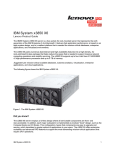
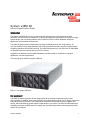
Key features The increasing demand for cloud-computing and analytics workloads by enterprises to meet social, mobile, and Big Data requirements drives innovation to find new ways to build informational systems. Clients are looking for cost-optimized fit-for-purpose IT solutions that manage large amounts of data, easily scale performance, and provide enterprise class reliability. Built on decades of innovation, Lenovo introduces its sixth generation of Enterprise X-Architecture technology, the X6 servers. Lenovo X6 servers are fast, agile, and resilient: Fast application performance means immediate access to actionable information. Agile system design helps to reduce acquisition costs and provide the ability to upgrade processor and memory technology at each refresh within the same chassis. Resilient platforms maximize application uptime and promote easy integration in virtual environments. Lenovo X6 servers continue to lead the way as the shift toward mission-critical scalable databases, business analytics, virtualization, enterprise applications, and cloud-computing applications accelerates. Fast application performance The server offer numerous features to boost performance: Supports memory-channel storage (eXFlash DIMMs), where solid-state storage devices are installed in memory DIMM sockets. These devices are directly connected to the processors and provide the lowest latency values in the industry. Based on the Intel Xeon processor E7-4800 v2 and E7-8800 v2 product family: o Supports up to four E7-4800/8800 v2 processors with 60 cores and 120 threads to maximize the concurrent running of multi-threaded applications. o Improves productivity by offering superior system performance with 15-core processors (up to 2.8 GHz core speeds), up to 37.5 MB of L3 cache, and up to three 8 GTps QPI interconnect links. Supports memory speeds up to 1600 MHz. Supports up to 96 DIMM sockets, with 24 DIMMs per processor. With eXFlash memory-channel storage, the server delivers up to 12.8 TB of ultra-low latency flash memory by using WriteNow technology, which is ideal for high-performance applications. Intelligent and adaptive system performance with Intel Turbo Boost Technology 2.0 allows processor cores to run at maximum speeds during peak workloads by temporarily going beyond processor thermal design power (TDP). Intel Hyper-Threading Technology boosts performance for multi-threaded applications by enabling simultaneous multi-threading within each processor core, up to two threads per core. Intel Virtualization Technology integrates hardware-level virtualization hooks that allow operating system vendors to better use the hardware for virtualization workloads. Intel Advanced Vector Extensions (AVX) improve floating-point performance for compute-intensive technical and scientific applications. Supports a 12 Gbps SAS RAID portfolio. The usage of solid-state drives (SSDs) instead of, or along with, traditional spinning drives (HDDs) can improve I/O performance. An SSD can support up to 100 times more I/O operations per second (IOPS) than a typical HDD. System x3850 X6 2