1
other dialogue participant. The shared eld
is divided into four subelds. One subeld is
a set of propositions which the agent assumes
for the sake of the conversation. The second
subeld is for a stack of questions under discussion (qud). These are questions that have
been raised and are currently under discussion in the dialogue. The actions eld is a
stack of (domain) actions which the user has
been instructed to perform but has not yet
performed.The lu eld contains information
about the latest utterance.
To adapt GoDiS to instructional dialogue,
we added a subeld of shared.actions to
(the shared part of) the information state.
The value of this eld is a stack of actions
which the system has instructed the user to
perform, but whose performance has not yet
been conrmed by the user.
In building the experimental IMDiS, we
have made several simplications. We have
ignored all the natural language generation
problems and all the problems related to making text or dialogue natural, e.g. problems related to the use of pronouns and other referential expressions. To handle these we would
not only have to discuss basic interactivity
but also the medium in which the interaction
takes place: speech or written text.
The monologue mode (case 1) uses only 2
moves (Instruct, and Inform). Since there
is no user to conrm that actions have been
performed, all actions are automatically conrmed using the update rule autoConrm.
autoConrm
class:
integrate
rule:
pre:
eff:
fst( shared.actions, A )
pop( shared.actions )
add( shared.bel, done(A) )
The dialogue version (cases 2 and 3)
uses 9 move types, basically the 7 used in
GoDiS (Ask, Answer, Inform, Repeat,
RequestRepeat, Greet, Quit) plus instructions (Instruct) and conrmations
(Conrm). Conrmations are integrated by
assuming that the current topmost action
in shared.actions has been performed, as
seen in the update rule below.
integrateUsrConrm
(integrate
rule:
class:
pre:
eff:
val( shared.lu.speaker, usr )
assoc( shared.lu.moves, conrm, false )
( fst( shared.actions, A )
set assoc( shared.lu.moves, conrm, true )
pop( shared.actions )
add( shared.bel, done( A ) )
This rule says that if the user performed a
Conrm move, which has not yet been in-
tegrated, and A is the \most salient" action,
then integrate the move by putting the proposition done(A) in the shared beliefs, and taking A o the action stack.
Elliptical \how"-questions from the user
are interpreted as applying to the currently
topmost action in the shared.actions stack.
5.2 Domain task, manuals and
dialogues
Let's now see how a monologue and a dialogue
version of the same task are related. Below we
have an example from the user manual for the
HomeCentre, a Xerox MFD.
Reinstalling the print head
Caution: Make sure that the green carriage lock
lever is STILL moved all the way forward before
you reinstall the print head.
1. Line up the hole in the print head with the
green post on the printer carriage.
Lower the print head down gently into position.
2. Gently push the green cartridge lock lever up
until it snaps into place.
This secures the print head.
3. Close the top cover and reattach the scanner.
4. Press and release the yellow
led
button.
The printer will prepare the cartridge for print-
ing.
Note: If the carriage does not move from the cen-
ter position after you press the cartridge change
button, remove and reinstall the print head.
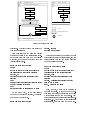
From this text, one can (re)construct a task
plan for reinstalling the print head. Such a
plan may be represented as in gure 2. Note