1
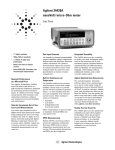
POW ER Y TO US EAS E BL E Advanced Multi-GNSS Simulator FUTURE PROOF L FU GSG-6 Series AFF O R D A Upgradable to all constellations and signals • Multi-GNSS, Multi-Frequency Simulator • GPS standard, new (L2C, L5) GLONASS, Galileo, and BeiDou • Simultaneous multi-frequency P-code (unencrypted) and C/A code • Simultaneous GNSS Constellation P-code and C/A codes • Versatile multi-channel GNSS signal generator with pre-configured test scenarios • Operates with StudioView™ for easy trajectory creation via Google Maps • SBAS simulation: WAAS (N. America), EGNOS (Europe), GAGAN (India), MSAS (Japan) • Configurable multipath simulation • White noise generator for SNR testing • Configurable interference simulation • Fully operational via front-panel, web-based remote control, or SCPI protocol • Multiple interfaces for remote control: Ethernet, USB, GPIB • Affordable, powerful, and easy-to-use Flexibility The GSG-6 Series multi-channel simulator makes it possible to simulate all the visible satellites for the receiver under test. With up to 64 channels available, these channels can be assigned to Connectivity Extends Ease of Use and Flexibility The GSG-6 Series can be controlled via an Ethernet network connection, USB or GPIB. A built-in web interface allows complete operation of the instrument through front panel controls. With the optional GSG StudioView™ PC Software, you can build, edit, and manage the most complex scenarios, including building trajectories via Google Maps, independent of the GSG unit, for later upload. FRANCE | 3 Avenue du Canada | 91974 Les Ulis, Cedex | +33 (0)1 64 53 39 80 | [email protected] UK | 6A Beechwood | Chineham Park | Basingstoke, Hants, RG24 8WA | +44 (0)1256 303630 | [email protected] BRAZIL | Rua Jose Alves dos Santos | Sao Jose dos Campos | SP – Brazil 12230-081 | +55 12 3933 2330 | [email protected] ctracomco .spe Q IS om . . . . . rp.c USA | 1565 Jefferson Road, Suite 460 | Rochester, NY 14623 | +1.585.321.5800 | [email protected] . . . quality ... The GSG-6 Series user can configure scenarios on-the-fly without the need for an external PC and pre-compilation phase. Via the front panel, the user can swiftly modify parameters such as user position, time and specify output powers in carrier-to-noise ratio instead of absolute output power. Utilizing the white noise generation extends the usability and flexibility. And using the optional StudioView™ software facilitates easily created scenarios via a Google Maps interface. GSG-6 Series is shipped with several multipath scenarios where the receivers’ response to an increased multipath environment can be analyzed. It also has a set of built-in trajectories (static, configurable circle, and rectangular as defined in 3GPP TS 25.171) or the user can upload their own trajectories in NMEA standard format. The user can upload their own ephemeris data in standard RINEX format or re-use the default data for any time periods. The GSG-Series 6 can even automatically download historical RINEX, WAAS and EGNOS data from official websites, as needed. O 9001 . Easy to Use any GNSS constellation, any particular signal. Or some of these channels can be used for SBAS simulation of EGNOS, WAAS, GAGAN, or MSAS satellites, or for simulating multipath or interference. If more channels are required, simply synchronize two or more units via the external 1PPS sync signal to generate 128, 256, or more channel simulation. Some restrictions apply. .. The GSG-6 Series family offers multiple frequency band operation, multiple GNSS constellation simulation, and expansion to many more channels. Incorporating all of the features of the popular 5 Series family, the 6 Series line expands your capability to simulate all the new, emerging GNSS signals. With a base of 32 channels, upgradable to 48, 64, or more, it provides navigational fix and position testing, for engineering and development testing. The Series 6 simulator protects your investment by being upgradeable in the future to more frequency bands and channels (plug-in hardware upgrade) and more signal formats (firmware upgrade). Technical Specifications: GSG-6 Series Suitable for Testing Timing Receivers Besides the variety of built-in navigation/positioning tests, the GSG-6 is also suited for accurate testing of timing GNSS-receivers. The GSG-6 is equipped with an ultra-highstability OCXO timebase for precision timing of the satellite data, or use external synchronization from a 10 MHz reference from e.g. a Cesium or Rubidium clock. A built-in 1-pps output, synchronized to the generated satellite data, allows comparison with the 1-pps signal from the timing receiver under test. The Affordable Test Solution •The GSG-6 is a perfect fit for a widevariety of test cases including: •Testing of military SAASM receivers and high-end survey grade civillian receivers. •Test of simulated movements (user trajectories). •Test of receivers’ sensitivity to loss of satellites, multi-path, leap seconds, and atmospheric conditions. •Fast production test of sensitivity and positioning receivers’ accuracy (conducted or over-the-air). •Test of timing receiver accuracy. •Test of receivers’ dynamic range. •Test of receivers’ susceptibility for noise •(SNR limit testing). •Test of leap second transition. Input and Output Specifications RF Signal GNSS Multi-Frequency Connector: Type N female Frequency: L1/E1/B1/SAR: 1539 – 1627 MHz; L2/L2C: 1167 – 1255 MHz; L5/E5/B2: 1146 – 1234 MHz; E6/B3:1215 – 1303 MHz Number of output channels: 32, 48 or 64; Channel configuration: Any channel can be configured to any constellation; Any channel bank of 16 channels can be configured to any of the four frequency bands Constellations: GPS, GLONASS, Galileo, BeiDou Modulations: BPSK, QPSK, BOC(all) SBAS: WAAS, EGNOS, GAGAN, MSAS, LUCH (2014) Spurious transmission: <-40 dBc Harmonics: <-40 dBc Output signal level: -65 to -160 dBm; 0.1 dB resolution down to -150 dBm; 0.3 dB down to -160 dBm Power accuracy: ±1.0 dB Pseudorange accuracy: Within any one frequency band:1mm; Across different frequency bands: 3m Inter-channel bias: Zero Inter-channel range: >54 dB Limits: Standard Extended Altitude 18,240 m (60,000 feet) 20,200,000 m (66,273,000 feet) Acceleration 4.0 g No limits Velocity 515 m/s (1000 knots) 20,000 m/s (38,874 knots) Jerk 20 m/s3 No limit www.spectracomcorp.com White noise signal level: -50 to -160 dBm 0.1 dB resolution down to -150 dBm; 0.3 dB down to -160 dBm. ±1.0 dB accuracy External Frequency Reference Input Power Connector: BNC female Frequency: 10 MHz nominal Input signal level: 0.1 to 5Vrms Input impedance: >1kΩ Line Voltage: 90-265 Vrms, 45-440 Hz Power Consumption: Model GSG-62: <25 W Model GSG-64: <40 W Frequency Reference Output Connector: BNC female Frequency: 10 MHz sine Output signal level: 1Vrms in to 50 Ω load External Trigger Input Connector: BNC female Frequency: TTL level, 1.4V nominal 1PPS Output Connector: BNC female Output signal level: approx. 0V to +2.0V in 50 Ω load Accuracy: Calibrated to ±10 nSec of RF timing mark output Built-in Timebase Internal Timebase – High Stability OCXO Ageing per 24 h: <5x10⁻¹⁰ Ageing per year: <5x10⁻⁸ Temp. variation 0…50°C: <5x10⁻⁹ Short term stability (Adev @1s): <5x10-12 Auxiliary Functions Interface GPIB (IEEE-488.2), USB 1.X or 2.X (USBTMC-488), Ethernet (100/10 Mbps) Settings Predefined scenarios: User can change date, time, position, trajectory, number of satellites, satellite power level and atmospheric model User defined scenarios: Unlimited Trajectory data: NMEA format (GGA or RMC messages, or both), convert from other formats with GSG StudioView™ (see separate datasheet) General Specifications Certifications Safety: Designed and tested for Measurement Category I, Pollution Degree 2, in accordance with EN/IEC 61010-1:2001 and CAN/ CSA-C22.2 No. 61010-1-04 (incl. approval) EMC: EN 61326-1:2006, increased test levels per EN 61000-6-3:2001 and EN 61000-6-2:2005 Dimensions WxHxD: 210 x 90 x 395 mm (8.25” x 3.6” x 15.6”) Weight: approx. 2.7 kg (approx. 5.8 lb) Ordering Information Models GSG-62: L1+Additonal Simultaneous Frequency, Multi-constellation 32-channel simulator; with standard OCXO timebase GSG-63: L1+ Two Additional Simultaneous Frequencies, Multi-constellation 48-channel simulator; with standard OCXO timebase GSG-64: L1+ Three Additional Simultaneous Frequencies, Multi-constellation 64-channel simulator; with standard OCXO timebase Included with instrument • User manual and GSG StudioView software (one license per unit) on CD • RF cable, 1.5 m • SMA to Type N adapter • USB cable • Certificate of calibration • 3-year warranty1 Optional Accessories Option 01/71: Passive GNSS Antenna Option 22/90: Rack-mount kit Option 27H: Heavy-duty hard transport case OM-54: User Manual (printed) Additional StudioView licenses are available Optional Upgrades Option GLO: GLONASS Constellation Option GAL: Galileo Constellation Option BDS: BeiDou Constellation Option L2: Frequency Option L2 Option L2C: Frequency Option L2C Option L5: Frequency Option L5 Option E6: Frequency Option E6 2 Option 48/3 : 48 channel, three-frequency upgrade (GSG-62 to GSG-63) 2 Option 64/4 : 64 channel, four-frequency upgrade (GSG-63 to GSG-64) Option RSG: Real-time Scenario Generator (requires 16 channel configuration) Option HV: High Velocity Upgrade (requires 16 channel configuration) Option RP: Record and Playback (requires 16 channel configuration) Optional Services1 Optional Antenna Frequency: 1000 - 2600MHz Impedance: 50 Ω VSWR: <2:1 (typ) Connector: SMA male Dimensions: 15 mm diameter x 36 mm length Environmental Humidity: 5-95 % @ 10 to 30°C 5-75 % @ 30 to 40°C 5-45 % @ 40 to 50°C Calibration/GSG: GSG Calibration Service Option 95/05: Extended warranty to 5 years GSG-ASP: GSG Annual Service Plan GSG-INST: User Training and Installation. The warranty period and available services may vary dependent on country. 1 Option may require the unit to be returned to factory for upgrade 2 Class: MIL-PRF-28800F, Class 3 Temperature: 0°C to +50°C (operating); -40°C to +70°C non-condensing @ <12,000 m (storage) October 15, 2013 - GSG-6Series (C) Specifications subject to change or improvement without notice. Spectracom is a business of the Orolia Group. © 2013 Orolia USA, Inc.