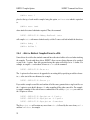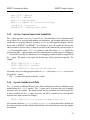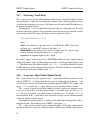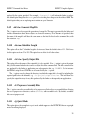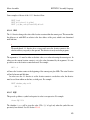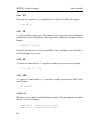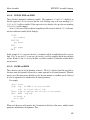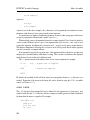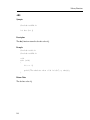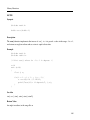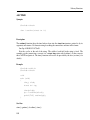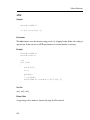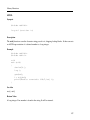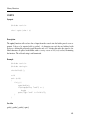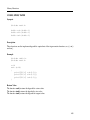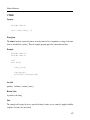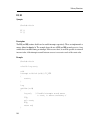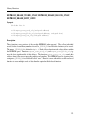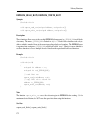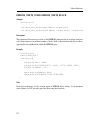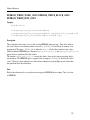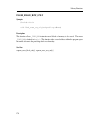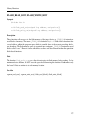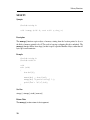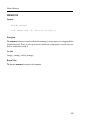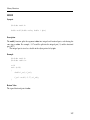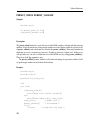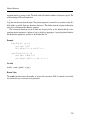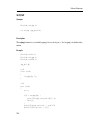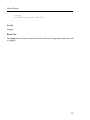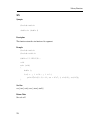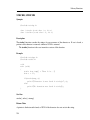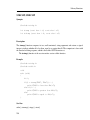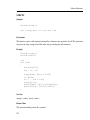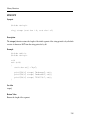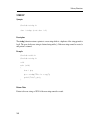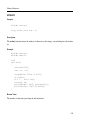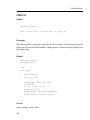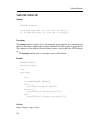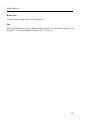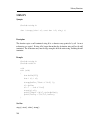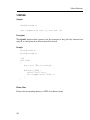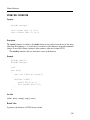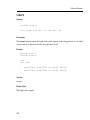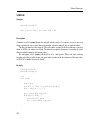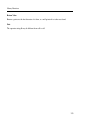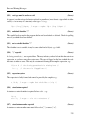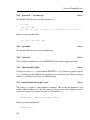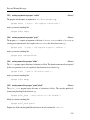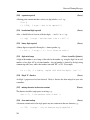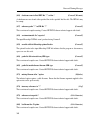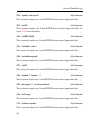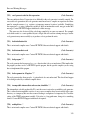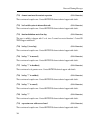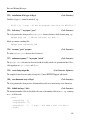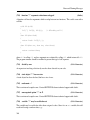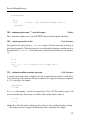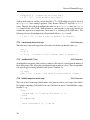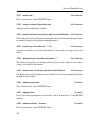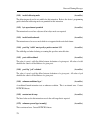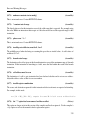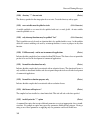
1
Manual HI-TECH for dsPIC/PIC24 Compiler HI-TECH Software. Copyright (C) 2008 HI-TECH Software. All Rights Reserved. Printed in Australia. dsPIC is a registered trademark of Microchip Technology Inc. Produced on: March 19, 2008 HI-TECH Software Pty. Ltd. ACN 002 724 549 45 Colebard Street West Acacia Ridge QLD 4110 Australia email: [email protected] web: http://microchip.htsoft.com ftp: ftp://www.htsoft.com Contents Table of Contents 3 List of Tables 13 1 Introduction 15 1.1 Typographic conventions . . . . . . . . . . . . . . . . . . . . . . . . . . . . . . . . 15 2 DSPICC Command-line Driver 2.1 Long Command Lines . . . . . . . . . . . . . . . . 2.2 Default Libraries . . . . . . . . . . . . . . . . . . . 2.3 Standard Runtime Code . . . . . . . . . . . . . . . . 2.4 DSPICC Compiler Options . . . . . . . . . . . . . . 2.4.1 -Bmodel: Select memory model . . . . . . 2.4.2 -C: Compile to Object File . . . . . . . . . . 2.4.3 -Dmacro: Define Macro . . . . . . . . . . . 2.4.4 -Efile: Redirect Compiler Errors to a File . 2.4.5 -Gfile: Generate Source-level Symbol File 2.4.6 -Ipath: Include Search Path . . . . . . . . 2.4.7 -Llibrary: Scan Library . . . . . . . . . 2.4.8 -L-option: Adjust Linker Options Directly 2.4.9 -Mfile: Generate Map File . . . . . . . . . 2.4.10 -Nsize: Identifier Length . . . . . . . . . . 2.4.11 -Ofile: Specify Output File . . . . . . . . 2.4.12 -P: Preprocess Assembly Files . . . . . . . . 2.4.13 -Q: Quiet Mode . . . . . . . . . . . . . . . . 2.4.14 -S: Compile to Assembler Code . . . . . . . 2.4.15 -Umacro: Undefine a Macro . . . . . . . . 2.4.16 -V: Verbose Compile . . . . . . . . . . . . . 3 . . . . . . . . . . . . . . . . . . . . . . . . . . . . . . . . . . . . . . . . . . . . . . . . . . . . . . . . . . . . . . . . . . . . . . . . . . . . . . . . . . . . . . . . . . . . . . . . . . . . . . . . . . . . . . . . . . . . . . . . . . . . . . . . . . . . . . . . . . . . . . . . . . . . . . . . . . . . . . . . . . . . . . . . . . . . . . . . . . . . . . . . . . . . . . . . . . . . . . . . . . . . . . . . . . . . . . . . . . . . . . . . . . . . . . . . . . . . . . . . . . . . . . . . . . . . . . . . . . . . . . . . . . . . . . . . . . . . . . . . . . . . . . . . . . . . . . . . . . . . . . . . . . . . . . . . . . . . . . . . . . . . . . . . . . . . . . . . . . . . 17 18 18 18 18 21 21 21 22 23 23 24 24 25 25 25 25 25 26 26 26 CONTENTS 2.4.17 2.4.18 2.4.19 2.4.20 2.4.21 2.4.22 2.4.23 2.4.24 2.4.25 2.4.26 2.4.27 2.4.28 2.4.29 2.4.30 2.4.31 2.4.32 2.4.33 2.4.34 2.4.35 2.4.36 2.4.37 2.4.38 2.4.39 2.4.40 2.4.41 2.4.42 2.4.43 2.4.44 2.4.45 2.4.46 2.4.47 2.4.48 2.4.49 2.4.50 2.4.51 2.4.52 4 CONTENTS -X: Strip Local Symbols . . . . . . . . . . . . . . . . . . . . . . . . . . . . --ASMLIST: Generate Assembler .LST Files . . . . . . . . . . . . . . . . . . --CHAR=type: Make Char Type Signed or Unsigned . . . . . . . . . . . . . --CHIP=processor: Define Processor . . . . . . . . . . . . . . . . . . . --CHIPINFO: Display List of Supported Processors . . . . . . . . . . . . . . --CODEOFFSET: Offset Program Code to Address . . . . . . . . . . . . . . . --CR=file: Generate Cross Reference Listing . . . . . . . . . . . . . . . . --DEBUGGER=type: Select Debugger Type . . . . . . . . . . . . . . . . . . --ERRFORMAT=format: Define Format for Compiler Messages . . . . . . . 2.4.25.1 Using the Format Options . . . . . . . . . . . . . . . . . . . . . . 2.4.25.2 Modifying the Standard Format . . . . . . . . . . . . . . . . . . . –ERRORS=number: Maximum Number of Errors . . . . . . . . . . . . . . . --FILL=opcode: Fill Unused Program Memory . . . . . . . . . . . . . . . --GETOPTION=app,file: Get Command-line Options . . . . . . . . . . . --HELP<=option>: Display Help . . . . . . . . . . . . . . . . . . . . . . --IDE=type: Specify the IDE being used . . . . . . . . . . . . . . . . . . --LANG=language: Specify the Language for Messages . . . . . . . . . . --MEMMAP=file: Display Memory Map . . . . . . . . . . . . . . . . . . . --MSGDISABLE=list: Warning messages to disable . . . . . . . . . . . . . --MSGFORMAT=format: Set Advisory Message Format . . . . . . . . . . . --NODEL: Do not remove temporary files . . . . . . . . . . . . . . . . . . . --NOEXEC: Don’t Execute Compiler . . . . . . . . . . . . . . . . . . . . . . --OPT<=type>: Invoke Compiler Optimizations . . . . . . . . . . . . . . . --OUTDIR: Specify a directory for output files . . . . . . . . . . . . . . . . . --OUTPUT=type: Specify Output File Type . . . . . . . . . . . . . . . . . . --PRE: Produce Preprocessed Source Code . . . . . . . . . . . . . . . . . . --PROTO: Generate Prototypes . . . . . . . . . . . . . . . . . . . . . . . . . --RAM=lo-hi,<lo-hi,...>: Specify Additional RAM Ranges . . . . . --ROM=lo-hi,<lo-hi,...>|tag: Specify Additional ROM Ranges . . --RUNTIME=type: Specify Runtime Environment . . . . . . . . . . . . . . --SCANDEP: Scan for Dependencies . . . . . . . . . . . . . . . . . . . . . . --SERIAL=hexcode@address: Store a Value at this Program Memory Address . . . . . . . . . . . . . . . . . . . . . . . . . . . . . . . . . . . . . --SETOPTION=app,file: Set The Command-line Options for Application --SETUP=dir: Setup the product . . . . . . . . . . . . . . . . . . . . . . . --STRICT: Strict ANSI Conformance . . . . . . . . . . . . . . . . . . . . . --SUMMARY=type: Select Memory Summary Output Type . . . . . . . . . . --TIME: Report time taken for each phase of build process . . . . . . . . . . --VER: Display The Compiler’s Version Information . . . . . . . . . . . . . 26 26 27 27 27 27 27 28 28 28 29 30 30 30 30 30 31 31 31 31 31 32 32 32 32 33 33 34 35 35 36 36 37 37 37 37 38 38 CONTENTS CONTENTS 2.4.53 --WARN=level: Set Warning Level . . . . . . . . . . . . . . . . . . . . . . 38 2.4.54 --WARNFORMAT=format: Set Warning Message Format . . . . . . . . . . . 39 3 C Language Features 3.1 ANSI Standard Issues . . . . . . . . . . . . . . . . . . . 3.1.1 Implementation-defined behaviour . . . . . . . . 3.2 Processor-related Features . . . . . . . . . . . . . . . . 3.2.1 Stack . . . . . . . . . . . . . . . . . . . . . . . 3.2.2 Configuration Fuses . . . . . . . . . . . . . . . 3.3 Files . . . . . . . . . . . . . . . . . . . . . . . . . . . . 3.3.1 Source Files . . . . . . . . . . . . . . . . . . . . 3.3.2 Symbol Files . . . . . . . . . . . . . . . . . . . 3.3.3 Library Files . . . . . . . . . . . . . . . . . . . 3.3.3.1 Standard Libraries . . . . . . . . . . . 3.3.3.2 Formatted Output Functions . . . . . . 3.3.3.3 EEPROM and Flash Functions . . . . 3.3.4 Runtime startup Modules . . . . . . . . . . . . . 3.3.4.1 Software Stack . . . . . . . . . . . . . 3.3.4.2 Initialization of Interrupt Vector Tables 3.3.4.3 Initialization of Data psects . . . . . . 3.3.4.4 Clearing the Bss Psects . . . . . . . . 3.3.4.5 Linking in the C Libraries . . . . . . . 3.3.4.6 The powerup Routine . . . . . . . . . 3.4 Supported Data Types and Variables . . . . . . . . . . . 3.4.1 Radix Specifiers and Constants . . . . . . . . . . 3.4.2 Bit Data Types and Variables . . . . . . . . . . . 3.4.3 8-Bit Integer Data Types and Variables . . . . . 3.4.4 16-Bit Integer Data Types . . . . . . . . . . . . 3.4.5 32-Bit Integer Data Types and Variables . . . . . 3.4.6 Floating Point Types and Variables . . . . . . . . 3.4.7 Structures and Unions . . . . . . . . . . . . . . 3.4.7.1 Bit-fields in Structures . . . . . . . . . 3.4.7.2 Structure and Union Qualifiers . . . . 3.4.8 Standard Type Qualifiers . . . . . . . . . . . . . 3.4.8.1 Const and Volatile Type Qualifiers . . 3.4.9 Special Type Qualifiers . . . . . . . . . . . . . . 3.4.9.1 Persistent Type Qualifier . . . . . . . 3.4.9.2 YData Type Qualifier . . . . . . . . . 3.4.9.3 Near and Far Type Qualifier . . . . . . . . . . . . . . . . . . . . . . . . . . . . . . . . . . . . . . . . . . . . . . . . . . . . . . . . . . . . . . . . . . . . . . . . . . . . . . . . . . . . . . . . . . . . . . . . . . . . . . . . . . . . . . . . . . . . . . . . . . . . . . . . . . . . . . . . . . . . . . . . . . . . . . . . . . . . . . . . . . . . . . . . . . . . . . . . . . . . . . . . . . . . . . . . . . . . . . . . . . . . . . . . . . . . . . . . . . . . . . . . . . . . . . . . . . . . . . . . . . . . . . . . . . . . . . . . . . . . . . . . . . . . . . . . . . . . . . . . . . . . . . . . . . . . . . . . . . . . . . . . . . . . . . . . . . . . . . . . . . . . . . . . . . . . . . . . . . . . . . . . . . . . . . . . . . . . . . . . . . . . . . . . . . . . . . . . . . . . . . . . . . . . . . . . . . . . . . . . . . . . . . . . . . . . . . . . . . . . . . . . . . . . . . . . . . . . . . . . . . . . . . . . . . . . . . . . . . . . . . . . . . . . . . . . . . . . . . . . . . . . . . . . . . . . . . . . . . . . . . . . . . . . . . . . . . . . . . . . . . . . . . . . . . . 41 41 41 41 41 42 42 42 42 46 46 46 47 47 48 48 49 49 50 51 51 51 53 54 54 54 55 56 56 57 58 58 58 58 59 59 5 CONTENTS CONTENTS 3.4.10 Pointer Types . . . . . . . . . . . . . . . . . . . . . . . . . . . . . . 3.4.10.1 Data Pointers . . . . . . . . . . . . . . . . . . . . . . . . 3.4.10.2 Function Pointers . . . . . . . . . . . . . . . . . . . . . . 3.4.10.3 Qualifiers and Pointers . . . . . . . . . . . . . . . . . . . 3.5 Storage Class and Object Placement . . . . . . . . . . . . . . . . . . . . . . 3.5.1 Local Variables . . . . . . . . . . . . . . . . . . . . . . . . . . . . . 3.5.1.1 Auto Variables . . . . . . . . . . . . . . . . . . . . . . . . 3.5.1.2 Static Variables . . . . . . . . . . . . . . . . . . . . . . . 3.5.2 X and Y DATA Variables . . . . . . . . . . . . . . . . . . . . . . . . 3.5.3 Absolute Variables . . . . . . . . . . . . . . . . . . . . . . . . . . . 3.5.4 Near Variables . . . . . . . . . . . . . . . . . . . . . . . . . . . . . 3.5.5 Far Variables . . . . . . . . . . . . . . . . . . . . . . . . . . . . . . 3.5.6 Objects in the Program Space . . . . . . . . . . . . . . . . . . . . . 3.6 Functions . . . . . . . . . . . . . . . . . . . . . . . . . . . . . . . . . . . . 3.6.1 Function Argument Passing . . . . . . . . . . . . . . . . . . . . . . 3.6.2 Function Return Values . . . . . . . . . . . . . . . . . . . . . . . . . 3.6.2.1 Integral Return Values . . . . . . . . . . . . . . . . . . . . 3.6.2.2 Structure Return Values . . . . . . . . . . . . . . . . . . . 3.7 Register Usage . . . . . . . . . . . . . . . . . . . . . . . . . . . . . . . . . 3.8 Operators . . . . . . . . . . . . . . . . . . . . . . . . . . . . . . . . . . . . 3.8.1 Integral Promotion . . . . . . . . . . . . . . . . . . . . . . . . . . . 3.8.2 Shifts applied to integral types . . . . . . . . . . . . . . . . . . . . . 3.8.3 Division and modulus with integral types . . . . . . . . . . . . . . . 3.9 Psects . . . . . . . . . . . . . . . . . . . . . . . . . . . . . . . . . . . . . . 3.9.1 Compiler-generated Psects . . . . . . . . . . . . . . . . . . . . . . . 3.10 Interrupt Handling in C . . . . . . . . . . . . . . . . . . . . . . . . . . . . . 3.10.1 Interrupt Functions . . . . . . . . . . . . . . . . . . . . . . . . . . . 3.10.1.1 Context Saving on Interrupts . . . . . . . . . . . . . . . . 3.10.1.2 Context Restoration . . . . . . . . . . . . . . . . . . . . . 3.10.1.3 Fast Interrupt Functions . . . . . . . . . . . . . . . . . . . 3.10.2 Enabling Interrupts . . . . . . . . . . . . . . . . . . . . . . . . . . . 3.11 Mixing C and Assembler Code . . . . . . . . . . . . . . . . . . . . . . . . . 3.11.1 External Assembly Language Functions . . . . . . . . . . . . . . . . 3.11.2 #asm, #endasm and asm() . . . . . . . . . . . . . . . . . . . . . . . 3.11.3 Accessing C objects from within Assembly Code . . . . . . . . . . . 3.11.3.1 Equivalent Assembly Symbols . . . . . . . . . . . . . . . 3.11.3.2 Accessing specifal function register names from assembler 3.12 Preprocessing . . . . . . . . . . . . . . . . . . . . . . . . . . . . . . . . . . 3.12.1 Preprocessor Directives . . . . . . . . . . . . . . . . . . . . . . . . . 6 . . . . . . . . . . . . . . . . . . . . . . . . . . . . . . . . . . . . . . . . . . . . . . . . . . . . . . . . . . . . . . . . . . . . . . . . . . . . . . . . . . . . . . . . . . . . . . . . . . . . . . . . . . . . . . . . . . . . . . . . . . . . . . . . . . . . . . . . . . . . . . . . . . . . . . . . . . . . 59 60 60 60 61 61 61 62 62 62 63 63 63 63 63 64 64 64 64 64 65 66 66 67 67 69 69 72 72 73 73 73 73 75 76 77 77 78 78 CONTENTS 4 CONTENTS 3.12.2 Predefined Macros . . . . . . . . . . . . . . . 3.12.3 Pragma Directives . . . . . . . . . . . . . . . 3.12.3.1 The #pragma inline Directive . . . . 3.12.3.2 The #pragma jis and nojis Directives 3.12.3.3 The #pragma pack Directive . . . . . 3.12.3.4 The #pragma printf_check Directive 3.12.3.5 The #pragma psect Directive . . . . 3.12.3.6 The #pragma regsused Directive . . 3.12.3.7 The #pragma switch Directive . . . . 3.13 Linking Programs . . . . . . . . . . . . . . . . . . . . 3.13.1 Replacing Library Modules . . . . . . . . . . 3.13.2 Signature Checking . . . . . . . . . . . . . . . 3.13.3 Linker-Defined Symbols . . . . . . . . . . . . 3.14 Standard I/O Functions and Serial I/O . . . . . . . . . . . . . . . . . . . . . . . . . . . . . . . . . . . . . . . . . . . . . . . . . . . . . . . . . . . . . . . . . . . . . . . . . . . . . . . . . . . . . . . . . . . . . . . . . . . . . . . . . . . . . . . . . . . . . . . . . . . . . . . . . . . . . . . . . . . . . . . . . . . . . . . . . . . . . . . . . . . . . . . . . . . . . . . . . . . . . . . . . . . . . . . . . . . . . . . . . . . . . . . . . . . . . . . . . . . . . . . . . . . . . . . . . 78 78 78 81 81 82 82 84 84 85 85 86 87 87 Macro Assembler 4.1 Assembler Usage . . . . . . . . . . . . . . . . . . 4.2 Assembler Options . . . . . . . . . . . . . . . . . 4.3 HI-TECH C Assembly Language . . . . . . . . . . 4.3.1 Statement Formats . . . . . . . . . . . . . 4.3.2 Characters . . . . . . . . . . . . . . . . . 4.3.2.1 Delimiters . . . . . . . . . . . . 4.3.2.2 Special Characters . . . . . . . . 4.3.3 Comments . . . . . . . . . . . . . . . . . 4.3.3.1 Special Comment Strings . . . . 4.3.4 Constants . . . . . . . . . . . . . . . . . . 4.3.4.1 Numeric Constants . . . . . . . 4.3.4.2 Character Constants and Strings . 4.3.5 Identifiers . . . . . . . . . . . . . . . . . . 4.3.5.1 Significance of Identifiers . . . . 4.3.5.2 Assembler-Generated Identifiers 4.3.5.3 Location Counter . . . . . . . . 4.3.5.4 Register Symbols . . . . . . . . 4.3.5.5 Symbolic Labels . . . . . . . . . 4.3.6 Expressions . . . . . . . . . . . . . . . . . 4.3.7 Program Sections . . . . . . . . . . . . . . 4.3.8 Assembler Directives . . . . . . . . . . . . 4.3.8.1 GLOBAL . . . . . . . . . . . . 4.3.8.2 END . . . . . . . . . . . . . . . . . . . . . . . . . . . . . . . . . . . . . . . . . . . . . . . . . . . . . . . . . . . . . . . . . . . . . . . . . . . . . . . . . . . . . . . . . . . . . . . . . . . . . . . . . . . . . . . . . . . . . . . . . . . . . . . . . . . . . . . . . . . . . . . . . . . . . . . . . . . . . . . . . . . . . . . . . . . . . . . . . . . . . . . . . . . . . . . . . . . . . . . . . . . . . . . . . . . . . . . . . . . . . . . . . . . . . . . . . . . . . . . . . . . . . . . . . . . . . . . . . . . . . . . . . . . . . . . . . . . . . . . . . . . . . . . . . . . . . . . . . . . . . . . . . . . . . . . . . . . . . . . . . . . . . . . . . . . . . . . . . . . . . . . . . . . . . . . . . . . . . . . . . . . . . . . . . . . . . . . . . . . . . . . 89 89 90 92 92 93 93 93 93 93 94 94 94 94 95 95 95 96 96 96 98 99 99 99 . . . . . . . . . . . . . . . . . . . . . . . . . . . . . . . . . . . . . . . . . . . . . . 7 CONTENTS 4.3.9 5 8 CONTENTS 4.3.8.3 PSECT . . . . . . . . . . . . 4.3.8.4 ORG . . . . . . . . . . . . . 4.3.8.5 EQU . . . . . . . . . . . . . 4.3.8.6 SET . . . . . . . . . . . . . 4.3.8.7 DB . . . . . . . . . . . . . . 4.3.8.8 DW . . . . . . . . . . . . . . 4.3.8.9 DDW . . . . . . . . . . . . . 4.3.8.10 DS . . . . . . . . . . . . . . 4.3.8.11 IF, ELSIF, ELSE and ENDIF 4.3.8.12 MACRO and ENDM . . . . 4.3.8.13 LOCAL . . . . . . . . . . . 4.3.8.14 ALIGN . . . . . . . . . . . . 4.3.8.15 REPT . . . . . . . . . . . . 4.3.8.16 IRP and IRPC . . . . . . . . 4.3.8.17 PROCESSOR . . . . . . . . 4.3.8.18 SIGNAT . . . . . . . . . . . Assembler Controls . . . . . . . . . . . 4.3.9.1 COND . . . . . . . . . . . . 4.3.9.2 EXPAND . . . . . . . . . . 4.3.9.3 INCLUDE . . . . . . . . . . 4.3.9.4 LIST . . . . . . . . . . . . . 4.3.9.5 NOCOND . . . . . . . . . . 4.3.9.6 NOEXPAND . . . . . . . . 4.3.9.7 NOLIST . . . . . . . . . . . 4.3.9.8 NOXREF . . . . . . . . . . 4.3.9.9 PAGE . . . . . . . . . . . . 4.3.9.10 SPACE . . . . . . . . . . . . 4.3.9.11 SUBTITLE . . . . . . . . . 4.3.9.12 TITLE . . . . . . . . . . . . 4.3.9.13 XREF . . . . . . . . . . . . Linker and Utilities 5.1 Introduction . . . . . . 5.2 Relocation and Psects . 5.3 Program Sections . . . 5.4 Local Psects . . . . . . 5.5 Global Symbols . . . . 5.6 Link and load addresses 5.7 Operation . . . . . . . . . . . . . . . . . . . . . . . . . . . . . . . . . . . . . . . . . . . . . . . . . . . . . . . . . . . . . . . . . . . . . . . . . . . . . . . . . . . . . . . . . . . . . . . . . . . . . . . . . . . . . . . . . . . . . . . . . . . . . . . . . . . . . . . . . . . . . . . . . . . . . . . . . . . . . . . . . . . . . . . . . . . . . . . . . . . . . . . . . . . . . . . . . . . . . . . . . . . . . . . . . . . . . . . . . . . . . . . . . . . . . . . . . . . . . . . . . . . . . . . . . . . . . . . . . . . . . . . . . . . . . . . . . . . . . . . . . . . . . . . . . . . . . . . . . . . . . . . . . . . . . . . . . . . . . . . . . . . . . . . . . . . . . . . . . . . . . . . . . . . . . . . . . . . . . . . . . . . . . . . . . . . . . . . . . . . . . . . . . . . . . . . . . . . . . . . . . . . . . . . . . . . . . . . . . . . . . . . . . . . . . . . . . . . . . . . . . . . . . . . . . . . . . . . . . . . . . . . . . . . . . . . . . . . . . . . . . . . . . . . . . . . . . . . . . . . . . . . . . . . . . . . . . . . . . . . . . . . . . . . . . . . . . . . . . . . . . . . . . . . . . . . . . . . . . . . . . . . . . . . . . . . . . . . . . . . . . . . . . . . . . . . . . . . . . . . . . . . . . . . . . . . . . . . . . . . . . . . . . . . . . . . . . . . . . . . . . . . . . . . . . . . . . . . . . . . . . . . . . . . . . . . . . . . . . . . . . . . . . . . . . . . . . . . . . . 99 103 103 104 104 104 104 104 105 105 106 107 107 108 109 109 109 109 109 110 110 110 111 111 111 111 111 111 112 112 . . . . . . . . . . . . . . . . . . . . . . . . . . . . . . . . . . . . . . . . . . . . . . . . . . . . . . . . . . . . . . . . . . . . . . . . . . . . . . . . . . . . . . . . . . . . . . . . . . . . . . . . . . . . . . . . . . . . . . . . . . . . . . . . . . . . . . . . . . . . 113 113 113 114 114 114 115 115 CONTENTS 5.7.1 Numbers in linker options 5.7.2 -Aclass=low-high,... . . . 5.7.3 -Cx . . . . . . . . . . . . 5.7.4 -Cpsect=class . . . . . . . 5.7.5 -Dclass=delta . . . . . . . 5.7.6 -Dsymfile . . . . . . . . . 5.7.7 -Eerrfile . . . . . . . . . . 5.7.8 -F . . . . . . . . . . . . . 5.7.9 -Gspec . . . . . . . . . . 5.7.10 -Hsymfile . . . . . . . . . 5.7.11 -H+symfile . . . . . . . . 5.7.12 -Jerrcount . . . . . . . . . 5.7.13 -K . . . . . . . . . . . . . 5.7.14 -I . . . . . . . . . . . . . 5.7.15 -L . . . . . . . . . . . . . 5.7.16 -LM . . . . . . . . . . . . 5.7.17 -Mmapfile . . . . . . . . . 5.7.18 -N, -Ns and-Nc . . . . . . 5.7.19 -Ooutfile . . . . . . . . . 5.7.20 -Pspec . . . . . . . . . . . 5.7.21 -Qprocessor . . . . . . . . 5.7.22 -S . . . . . . . . . . . . . 5.7.23 -Sclass=limit[, bound] . . 5.7.24 -Usymbol . . . . . . . . . 5.7.25 -Vavmap . . . . . . . . . 5.7.26 -Wnum . . . . . . . . . . 5.7.27 -X . . . . . . . . . . . . . 5.7.28 -Z . . . . . . . . . . . . . 5.8 Invoking the Linker . . . . . . . . 5.9 Map Files . . . . . . . . . . . . . 5.9.1 Call Graph Information . . 5.10 Librarian . . . . . . . . . . . . . 5.10.1 The Library Format . . . . 5.10.2 Using the Librarian . . . . 5.10.3 Examples . . . . . . . . . 5.10.4 Supplying Arguments . . 5.10.5 Listing Format . . . . . . 5.10.6 Ordering of Libraries . . . 5.10.7 Error Messages . . . . . . CONTENTS . . . . . . . . . . . . . . . . . . . . . . . . . . . . . . . . . . . . . . . . . . . . . . . . . . . . . . . . . . . . . . . . . . . . . . . . . . . . . . . . . . . . . . . . . . . . . . . . . . . . . . . . . . . . . . . . . . . . . . . . . . . . . . . . . . . . . . . . . . . . . . . . . . . . . . . . . . . . . . . . . . . . . . . . . . . . . . . . . . . . . . . . . . . . . . . . . . . . . . . . . . . . . . . . . . . . . . . . . . . . . . . . . . . . . . . . . . . . . . . . . . . . . . . . . . . . . . . . . . . . . . . . . . . . . . . . . . . . . . . . . . . . . . . . . . . . . . . . . . . . . . . . . . . . . . . . . . . . . . . . . . . . . . . . . . . . . . . . . . . . . . . . . . . . . . . . . . . . . . . . . . . . . . . . . . . . . . . . . . . . . . . . . . . . . . . . . . . . . . . . . . . . . . . . . . . . . . . . . . . . . . . . . . . . . . . . . . . . . . . . . . . . . . . . . . . . . . . . . . . . . . . . . . . . . . . . . . . . . . . . . . . . . . . . . . . . . . . . . . . . . . . . . . . . . . . . . . . . . . . . . . . . . . . . . . . . . . . . . . . . . . . . . . . . . . . . . . . . . . . . . . . . . . . . . . . . . . . . . . . . . . . . . . . . . . . . . . . . . . . . . . . . . . . . . . . . . . . . . . . . . . . . . . . . . . . . . . . . . . . . . . . . . . . . . . . . . . . . . . . . . . . . . . . . . . . . . . . . . . . . . . . . . . . . . . . . . . . . . . . . . . . . . . . . . . . . . . . . . . . . . . . . . . . . . . . . . . . . . . . . . . . . . . . . . . . . . . . . . . . . . . . . . . . . . . . . . . . . . . . . . . . . . . . . . . . . . . . . . . . . . . . . . . . . . . . . . . . . . . . . . . . . . . . . . . . . . . . . . . . . . . . . . . . . . . . . . . . . . . . . . . . . . . . . . . . . . . . . . . . . . . . . . . . . . . . . . . . . . . . . . . . . . . . . . . . . . . . . . . . . . . . . . . . . . . . . . . . . . . . . . . . . . . . . . . . . . . . . . . . . . . . . . . . . . . . . . . . . . . . . . . . . . . . . . . . . . . . . . . . . . . . . . . . . . . . . . . . . . . . . . . . . . . . . . . . . . . . . . . . . . . . . . . . . . . . . . 116 117 117 117 117 118 118 118 118 119 119 119 119 119 120 120 120 120 120 120 122 122 122 123 123 123 123 123 123 124 125 127 127 128 129 129 129 130 130 9 CONTENTS 5.11 Objtohex . . . . . . . . . . . . . . . . . 5.11.1 Checksum Specifications . . . . . 5.12 Cref . . . . . . . . . . . . . . . . . . . . 5.12.1 -Fprefix . . . . . . . . . . . . . . 5.12.2 -Hheading . . . . . . . . . . . . 5.12.3 -Llen . . . . . . . . . . . . . . . 5.12.4 -Ooutfile . . . . . . . . . . . . . 5.12.5 -Pwidth . . . . . . . . . . . . . . 5.12.6 -Sstoplist . . . . . . . . . . . . . 5.12.7 -Xprefix . . . . . . . . . . . . . . 5.13 Cromwell . . . . . . . . . . . . . . . . . 5.13.1 -Pname[,architecture] . . . . . . . 5.13.2 -N . . . . . . . . . . . . . . . . . 5.13.3 -D . . . . . . . . . . . . . . . . . 5.13.4 -C . . . . . . . . . . . . . . . . . 5.13.5 -F . . . . . . . . . . . . . . . . . 5.13.6 -Okey . . . . . . . . . . . . . . . 5.13.7 -Ikey . . . . . . . . . . . . . . . 5.13.8 -L . . . . . . . . . . . . . . . . . 5.13.9 -E . . . . . . . . . . . . . . . . . 5.13.10 -B . . . . . . . . . . . . . . . . . 5.13.11 -M . . . . . . . . . . . . . . . . . 5.13.12 -V . . . . . . . . . . . . . . . . . 5.14 Hexmate . . . . . . . . . . . . . . . . . . 5.14.1 Hexmate Command Line Options 5.14.1.1 + Prefix . . . . . . . . 5.14.1.2 -CK . . . . . . . . . . 5.14.1.3 -FILL . . . . . . . . . 5.14.1.4 -FIND . . . . . . . . . 5.14.1.5 -FIND...,REPLACE . . 5.14.1.6 -FORMAT . . . . . . . 5.14.1.7 -HELP . . . . . . . . . 5.14.1.8 -LOGFILE . . . . . . . 5.14.1.9 -Ofile . . . . . . . . . . 5.14.1.10 -SERIAL . . . . . . . . 5.14.1.11 -STRING . . . . . . . A Library Functions 10 CONTENTS . . . . . . . . . . . . . . . . . . . . . . . . . . . . . . . . . . . . . . . . . . . . . . . . . . . . . . . . . . . . . . . . . . . . . . . . . . . . . . . . . . . . . . . . . . . . . . . . . . . . . . . . . . . . . . . . . . . . . . . . . . . . . . . . . . . . . . . . . . . . . . . . . . . . . . . . . . . . . . . . . . . . . . . . . . . . . . . . . . . . . . . . . . . . . . . . . . . . . . . . . . . . . . . . . . . . . . . . . . . . . . . . . . . . . . . . . . . . . . . . . . . . . . . . . . . . . . . . . . . . . . . . . . . . . . . . . . . . . . . . . . . . . . . . . . . . . . . . . . . . . . . . . . . . . . . . . . . . . . . . . . . . . . . . . . . . . . . . . . . . . . . . . . . . . . . . . . . . . . . . . . . . . . . . . . . . . . . . . . . . . . . . . . . . . . . . . . . . . . . . . . . . . . . . . . . . . . . . . . . . . . . . . . . . . . . . . . . . . . . . . . . . . . . . . . . . . . . . . . . . . . . . . . . . . . . . . . . . . . . . . . . . . . . . . . . . . . . . . . . . . . . . . . . . . . . . . . . . . . . . . . . . . . . . . . . . . . . . . . . . . . . . . . . . . . . . . . . . . . . . . . . . . . . . . . . . . . . . . . . . . . . . . . . . . . . . . . . . . . . . . . . . . . . . . . . . . . . . . . . . . . . . . . . . . . . . . . . . . . . . . . . . . . . . . . . . . . . . . . . . . . . . . . . . . . . . . . . . . . . . . . . . . . . . . . . . . . . . . . . . . . . . . . . . . . . . . . . . . . . . . . . . . . . . . . . . . . . . . . . . . . . . . . . . . . . . . . . . . . . . . . . . . . . . . . . . . . . . . . . . . . . . . . . . . . . . . . . . . . . . . . . . . . . . . . . . . . . . . . . . . . . . . . . . 130 130 132 132 133 133 133 133 133 134 134 135 135 135 136 136 136 136 136 137 137 137 137 137 138 138 139 140 140 141 141 142 142 142 142 143 145 CONTENTS CONTENTS B Error and Warning Messages 263 C Chip Information 385 Index 391 11 CONTENTS 12 CONTENTS List of Tables 2.1 2.3 2.4 2.5 2.6 2.7 2.8 2.9 Driver File Types . . . . . . . . Error format specifiers . . . . . Supported IDEs . . . . . . . . . Supported languages . . . . . . Optimization Options . . . . . . Output file formats . . . . . . . Runtime environment suboptions Memory Summary Suboptions . . . . . . . . . . . . . . . . . . . . . . . . . . . . . . . . . . . . . . . . . . . . . . . . . . . . . . . . . . . . . . . . . . . . . . . . . . . . . . . . . . . . . . . . . . . . . . . . . . . . . . . . . . . . . . . . . . . . . . . . . . . . . . . . . . . . . . . . . . . . . . . . . 17 29 30 31 32 33 36 38 3.1 3.2 3.3 3.4 3.5 3.6 3.7 3.8 3.9 3.10 3.10 3.10 3.10 3.11 3.12 3.13 3.14 3.15 Configuration Bit Settings for dsPIC30F Devices . . . . . . Configuration Bit Settings for dsPIC33F & PIC24H Devices. Configuration Bit Settings for PIC24F Devices. . . . . . . . Formatted Output Functionality and Linking . . . . . . . . . Basic data types . . . . . . . . . . . . . . . . . . . . . . . . Radix formats . . . . . . . . . . . . . . . . . . . . . . . . . Floating-point formats . . . . . . . . . . . . . . . . . . . . Floating-point format example IEEE 754 . . . . . . . . . . . Integral division . . . . . . . . . . . . . . . . . . . . . . . . Interrupt Vector Address Macros . . . . . . . . . . . . . . . Interrupt Vector Address Macros . . . . . . . . . . . . . . . Interrupt Vector Address Macros . . . . . . . . . . . . . . . Interrupt Vector Address Macros . . . . . . . . . . . . . . . Predefined SFR names . . . . . . . . . . . . . . . . . . . . Preprocessor directives . . . . . . . . . . . . . . . . . . . . Predefined macros . . . . . . . . . . . . . . . . . . . . . . . Pragma directives . . . . . . . . . . . . . . . . . . . . . . . switch types . . . . . . . . . . . . . . . . . . . . . . . . . . . . . . . . . . . . . . . . . . . . . . . . . . . . . . . . . . . . . . . . . . . . . . . . . . . . . . . . . . . . . . . . . . . . . . . . . . . . . . . . . . . . . . . . . . . . . . . . . . . . . . . . . . . . . . . . . . . . . . . . . . . . . . . . . . . . . . . . . . . . . . . . . . . . . . . . . . . . . . . . . . . . . . . . . . . . . . . . . . . . . . . . . . . . . . . . . . . . . . . . . . . . . . . . . . . . . . . . . . . . . . . . . . . . . . . . . . . . 43 44 45 47 51 52 55 55 67 69 70 71 72 77 79 80 81 85 13 . . . . . . . . . . . . . . . . . . . . . . . . . . . . . . . . . . . . . . . . . . . . . . . . . . . . . . . . . . . . . . . . . . . . . . . . . . . . . . . . LIST OF TABLES LIST OF TABLES 3.16 Supported standard I/O functions . . . . . . . . . . . . . . . . . . . . . . . . . . . . 87 14 4.1 4.2 4.3 4.4 4.5 4.6 4.7 4.8 ASDSPIC command-line options Assembly statement formats . . Assembly numbers and bases . . Assembly operators . . . . . . . Assembler Directives . . . . . . PSECT flags . . . . . . . . . . . ASDSPIC assembler controls . . LIST control options . . . . . . . . . . . . . . . . . . . . . . . . . . . . . . . . . . . . . . . . . . . . . . . . . . . . . . . . . . . . . . . . . . . . . . . . . . . . . . . . . . . . . . . . . . . . . . . . . . . . . . . . . . . . . . . . . . . . . . . . . . . . . . . . . . . . . . . . . . . . . . . . . . . . . . . . . . . . . . . . . . . . . . . . . . . . . . . . . . . . . . . . . . . . . . . . . . . . . . . . . . . . . . . . . . . . . . . . . . . . . . 90 93 94 97 100 101 110 111 5.1 5.1 5.2 5.3 5.4 5.5 5.6 5.7 5.8 5.9 5.10 Linker command-line options . . . . . . . . . . . . . . Linker command-line options . . . . . . . . . . . . . . Librarian command-line options . . . . . . . . . . . . Librarian key letter commands . . . . . . . . . . . . . OBJTOHEX command-line options . . . . . . . . . . . . CREF command-line options . . . . . . . . . . . . . . CROMWELL format types . . . . . . . . . . . . . . . . . CROMWELL command-line options . . . . . . . . . . . . -P option architecture arguments for COFF file output. Hexmate command-line options . . . . . . . . . . . . INHX types used in -FORMAT option . . . . . . . . . . . . . . . . . . . . . . . . . . . . . . . . . . . . . . . . . . . . . . . . . . . . . . . . . . . . . . . . . . . . . . . . . . . . . . . . . . . . . . . . . . . . . . . . . . . . . . . . . . . . . . . . . . . . . . . . . . . . . . . . . . . . . . . . . . . . . . . . . . . . . . . . . . . . . . . . . . . . . . . . . . . . . . . . . . . . . . . . . 115 116 128 128 131 133 134 135 136 139 142 C.1 C.1 C.1 C.1 C.1 Devices supported by HI-TECH for dsPIC/PIC24 Devices supported by HI-TECH for dsPIC/PIC24 Devices supported by HI-TECH for dsPIC/PIC24 Devices supported by HI-TECH for dsPIC/PIC24 Devices supported by HI-TECH for dsPIC/PIC24 . . . . . . . . . . . . . . . . . . . . . . . . . . . . . . . . . . . . . . . . . . . . . . . . . . . . . . . . . . . . . . . . . . . . . . . . . . . . . . . . 385 386 387 388 389 . . . . . . . . . . . . . . . . . . . . . . . Chapter 1 Introduction 1.1 Typographic conventions Different fonts and styles are used throughout this manual to indicate special words or text. Computer prompts, responses and filenames will be printed in constant-spaced type. When the filename is the name of a standard header file, the name will be enclosed in angle brackets, e.g. <stdio.h>. These header files can be found in the INCLUDE directory of your distribution. Samples of code, C keywords or types, assembler instructions and labels will also be printed in a constant-space type. Assembler code is printed in a font similar to that used by C code. Particularly useful points and new terms will be emphasized using italicized type. When part of a term requires substitution, that part should be printed in the appropriate font, but in italics. For example: #include <filename.h>. 15 Typographic conventions 16 Introduction Chapter 2 DSPICC Command-line Driver DSPICC is the driver invoked from the command line to compile and/or link C programs. The driver has the following basic command format: DSPICC [options] files [libraries] It is conventional to supply the options (identified by a leading dash “-” or double dash “–”) before the filenames. The options are discussed below. The files may be a mixture of source files (C or assembler) and object files. The order of the files is not important, except that it will affect the order in which code or data appears in memory. Libraries are a list of library names, or -L options, see Section 2.4.7. Source files, object files and library files are distinguished by the driver solely by the file type or extension. Recognized file types are listed in Table 2.1. This means, for example, that an assembler file must always have a .as extension (alphabetic case is not important). The driver will check each file argument and perform appropriate actions. C files will be compiled; assembler files will be assembled. At the end, unless suppressed by one of the options discussed later, all object files resulting from compilation or assembly, or those listed explicitly on Table 2.1: Driver File Types File Type Meaning .c C source file .as Assembler source file .obj Relocatable object code file .lib Relocatable object library file 17 Long Command Lines DSPICC Command-line Driver the command line, will be linked together with the standard runtime code and libraries and any user-specified libraries. Functions in libraries will be linked into the resulting output file only if referenced in the source code. Invoking he driver with only object files specified as the file arguments (i.e. no source files) will mean only the link stage is performed. It is typical in Makefiles to use the driver with a -C option to compile several source files to object files, then to create the final program by invoking the driver again with only the generated object files and appropriate libraries (and appropriate options). 2.1 Long Command Lines The driver is capable of processing command lines exceeding any operating system limitation. To do this, the driver may be passed options via a command file. The command file is read by using the @ symbol. For example: DSPICC @xyz.cmd 2.2 Default Libraries The driver will search the appropriate standard C library by default for symbol definitions. This will always be done last, after any user-specified libraries. The particular library used will be dependent on the processor selected. 2.3 Standard Runtime Code The driver will also automatically generate standard runtime start-up code appropriate for the processor and options selected unless you have specified the to disable this via the --RUNTIME option. If you require any special powerup initialization, you should use the powerup routine feature (see Section 3.3.4.6). 2.4 DSPICC Compiler Options Most aspects of the compilation can be controlled using the command-line driver. The driver will configure and execute all required applications, such as the code generator, assembler and linker. The driver will recognize the compiler options listed in the table below. The case of the options is not important, however UNIX shells are case sensitive when it comes to names of files. 18 DSPICC Command-line Driver Option -Bmodel -C -Dmacro -E+file -Gfile -Ipath -Llibrary -L-option -Mfile -Nsize -Ofile -P -Q -S -Usymbol -V -X --ASMLIST --CHAR=type --CHIP=processor --CHIPINFO --CODEOFFSET --CR=file --DEBUGGER=type --ERRFORMAT<=format> --ERRORS=number --FILL --GETOPTION=app,file --HELP<=option> --IDE=ide --LANG=language --MEMMAP=file DSPICC Compiler Options DSPICC Driver Options Meaning Select memory model Compile to object files only Define preprocessor macro Redirect and optionally append errors to a file Generate source-level debugging information Specify a directory pathname for include files Specify a library to be scanned by the linker Specify -option to be passed directly to the linker Request generation of a MAP file Specify identifier length Output file name Preprocess assembler files Specify quiet mode Compile to assembler source files only Undefine a predefined preprocessor symbol Verbose: display compiler pass command lines Eliminate local symbols from symbol table Generate assembler .LST file for each compilation Make the default char signed or unsigned Selects which processor to compile for Displays a list of supported processors Reposition executable code to begin at this address Generate cross-reference listing Select the debugger that will be used Format error message strings to the given style Sets the maximun number of errors displayed Fill unused program memory with a specified code sequence. Get the command line options for the named application Display the compiler’s command line options Configure the compiler for use by the named IDE Specify language for compiler messages Display memory summary information for the map file continued. . . 19 DSPICC Compiler Options DSPICC Command-line Driver DSPICC Driver Options Option Meaning --MSGDISABLE Disable warning messages by their message ID number --MSGFORMAT Redefine the format of compiler messages --NODEL Do not remove temporary files generated by the compiler --NOEXEC Go through the motions of compiling without actually compiling --OUTDIR Specify output files directory --OPT<=type> Enable general compiler optimizations --OUTPUT=type Generate output file type --PRE Produce preprocessed source files --PROTO Generate function prototype information --RAM=lo-hi<,lo-hi,...> Specify and/or reserve RAM ranges --ROM=lo-hi<,lo-hi,...>|tag Specify and/or reserve ROM ranges --RUNTIME=type Configure the C runtime libraries to the specified type --SCANDEP Generate file dependency “.DEP files” --SERIAL Insert a serial number at a fixed address in program memory --SETOPTION=app,file Set the command line options for the named application --SETUP=argument Setup the product --STRICT Enable strict ANSI keyword conformance --SUMMARY=type Selects the type of memory summary output --TIME Display estimates on time taken for each phase of the build process --VER Display the compiler’s version number --WARN=level Set the compiler’s warning level --WARNFORMAT=format Format warning message strings to given style All single letter options are identified by a leading dash character, “-”, e.g. -C. Some single letter options specify an additional data field which follows the option name immediately and without any whitespace, e.g. -Ddebug. Multi-letter, or word, options have two leading dash characters, e.g. --ASMLIST. (Because of the double dash, you can determine that the option --ASMLIST, for example, is not a -A option followed by the argument SMLIST.) Some of these options define suboptions which typically appear as a 20 DSPICC Command-line Driver DSPICC Compiler Options comma-separated list following an equal character, =, e.g. --OUTPUT=hex,cof. The exact format of the options varies and are described in detail in the following sections. Some commonly used suboptions include default, which represent the default specification that would be used if this option was absent altogether; all, which indicates that all the available suboptions should be enabled as if they had each been listed; and none, which indicates that all suboptions should be disabled. Some suboptions may be prefixed with a plus character, +, to indicate that they are in addition to the other suboptions present, or a minus character “-”, to indicate that they should be excluded. In the following sections, angle brackets, < >, are used to indicate optional parts of the command. 2.4.1 -Bmodel: Select memory model The compiler implements two memory models: small and large. These are selected by either using the -Bs or -Bl options for small or large memory model respectively. In most cases small model will suffice, and is the compiler’s default setting. If the selected processor has accessible program memory at addresses above 0xFFFF and the program makes use of function pointers which may point to functions located above this address, then selecting large model will cause the compiler to generate code so that function pointers can reach these distant addresses. This is accomplished automatically through the use of a jump table so that the need for larger pointer sizes is not required. 2.4.2 -C: Compile to Object File The -C option is used to halt compilation after generating a relocatable object file. This option is frequently used when compiling multiple source files using a “make” utility. If multiple source files are specified to the compiler each will be compiled to a separate .obj file. The object files will be placed in the directory in which DSPICC was invoked, to handle situations where source files are located in read-only directories. To compile three source files main.c, module1.c and asmcode.as to object files you could use a command similar to: DSPICC --CHIP=30F6014 -C main.c module1.c asmcode.as The compiler will produce three object files main.obj, module1.obj and asmcode.obj which could then be linked to produce an Intel HEX file using the command: DSPICC --CHIP=30F6014 main.obj module1.obj asmcode.obj 2.4.3 -Dmacro: Define Macro The -D option is used to define a preprocessor macro on the command line, exactly as if it had been defined using a #define directive in the source code. This option may take one of two forms, -Dmacro which is equivalent to: 21 DSPICC Compiler Options #define macro DSPICC Command-line Driver 1 placed at the top of each module compiled using this option, or -Dmacro=text which is equivalent to: #define macro text where text is the textual substitution required. Thus, the command: DSPICC --CHIP=30F6014 -Ddebug -Dbuffers=10 test.c will compile test.c with macros defined exactly as if the C source code had included the directives: #define #define debug 1 buffers 10 2.4.4 -Efile: Redirect Compiler Errors to a File Some editors do not allow the standard command line redirection facilities to be used when invoking the compiler. To work with these editors, DSPICC allows an error listing filename to be specified as part of the -E option. Error files generated using this option will always be in -E format. For example, to compile x.c and redirect all errors to x.err, use the command: DSPICC --CHIP=30F6014 -Ex.err x.c The -E option also allows errors to be appended to an existing file by specifying an addition character, +, at the start of the error filename, for example: DSPICC --CHIP=30F6014 -E+x.err y.c If you wish to compile several files and combine all of the errors generated into a single text file, use the -E option to create the file then use -E+ when compiling all the other source files. For example, to compile a number of files with all errors combined into a file called project.err, you could use the -E option as follows: DSPICC --CHIP=30F6014 -Eproject.err -O -C main.c DSPICC --CHIP=30F6014 -E+project.err -O -C part1.c DSPICC --CHIP=30F6014 -E+project.err -C asmcode.as The file project.err will contain any errors from main.c, followed by the errors from part1.c and then asmcode.as, for example: 22 DSPICC Command-line Driver DSPICC Compiler Options main.c 11 22: ) expected main.c 63 0: ; expected part1.c 5 0: type redeclared part1.c 5 0: argument list conflicts with prototype asmcode.as 14 0: Syntax error asmcode.as 355 0: Undefined symbol _putint 2.4.5 -Gfile: Generate Source-level Symbol File The -G option generates a source-level symbol file (i.e. a file which allows tools to determine which line of source code is associated with machine code instructions, and determine which source-level variable names correspond with areas of memory, etc.) for use with supported debuggers and simR R ulators such as HI-TIDE and MPLAB . If no filename is given, the symbol file will have the same base name as the first source or object file specified on the command line, and an extension of .sym. For example the option -GTEST.SYM generates a symbol file called test.sym. Symbol files generated using the -G option include source-level information for use with source-level debuggers. Note that all source files for which source-level debugging is required should be compiled with the -G option. The option is also required at the link stage, if this is performed separately. For example: DSPICC --CHIP=30F6014 -G -C test.c DSPICC --CHIP=30F6014 -C module1.c DSPICC --CHIP=30F6014 -Gtest.sym test.obj module1.obj will include source-level debugging information for test.c only because module1.c was not compiled with the -G option. The --IDE option will typically enable the -G option. 2.4.6 -Ipath: Include Search Path Use -I to specify an additional directory to use when searching for header files which have been included using the #include directive. The -I option can be used more than once if multiple directories are to be searched. The default include directory containing all standard header files is always searched even if no -I option is present, and will be searched after any user-specified directories have been searched. For example: DSPICC --CHIP=30F6014 -C -Ic:\include -Id:\myapp\include test.c will search the directories c:\include and d:\myapp\include for any header files included into the source code, then search the default include directory (the include directory where the compiler was installed). 23 DSPICC Compiler Options DSPICC Command-line Driver 2.4.7 -Llibrary: Scan Library The -L option is used to specify additional libraries which are to be scanned by the linker. Libraries specified using the -L option are scanned before the standard C library, allowing additional versions of standard library functions to be accessed. All libraries must be located in the LIB subdirectory of the compiler installation directory. The argument to -L is not a complete library filename, rather it is a library keyword. The actual file name of the library scanned is derived from this keyword, the target device architecture and the selected memory model. The name of the library scanned is composed as follows: ARCH-MEMORYMODELkeyword.lib where ARCH is the architecture of the target device. For dsPIC30 and dsPIC33 devices this will equal dspicc and for PIC24 devices it will equal pic24. MEMORYMODEL is the memory model selected at compile time. For a small or large memory model this will equal the character s or l respectively. keyword is the argument supplied to the -L option. For example, suppose we had a project for a dsPIC30F6014 which was being compiled using the default small memory model. In addition the project requires a suitably precompiled library called foo. Then the file name of this library should be dspicc-sfoo.lib and the file should be located in the LIB subdirectory of the compiler installation directory. To instruct the linker to scan this library we need only provide the driver with the option -Lfoo. 2.4.8 -L-option: Adjust Linker Options Directly The -L option can also be used to specify an extra “-” option which will be passed directly to the linker by DSPICC. If -L is followed immediately by any text starting with a dash character “-”, the text will be passed directly to the linker without being interpreted by DSPICC. For example, if the option -L-FOO is specified, the -FOO option will be passed on to the linker when it is invoked. The -L option is especially useful when linking code which contains extra program sections (or psects), as may be the case if the program contains C code which makes use of the #pragma psect directive or assembler code which contains user-defined psects. See Section 3.12.3.5 for more information. If this -L option did not exist, it would be necessary to invoke the linker manually to link code which uses the extra psects. One commonly used linker option is -N, which sorts the symbol table in the map file by address, rather than by name. This would be passed to DSPICC as the option -L-N. The -L option can also be used to replace default linker options. If the string starting from the first character after the -L up to the = character matches a default option, then the default option is 24 DSPICC Command-line Driver DSPICC Compiler Options replaced by the option specified. For example, -L-preset=100h will inform the linker to replace the default option that places the reset psect to be one that places the psect at the address 100h. The default option that you are replacing must contain an equal character. 2.4.9 -Mfile: Generate Map File The -M option is used to request the generation of a map file. The map is generated by the linker and includes information about where objects are located in memory. If no filename is specified, then the name of the map file will have the same name as the first file listed on the command line, with the extension .map. 2.4.10 -Nsize: Identifier Length This option allows the C identifier length to be increased from the default value of 31. Valid sizes for this option are from 32 to 255. The option has no effect for all other values. 2.4.11 -Ofile: Specify Output File This option allows the name of the output file(s) to be specified. If no -O option is given, the output file(s) will be named after the first source or object file on the command line. The files controlled are any produced by the linker or applications run subsequent to that, e.g. CROMWELL. So for instance the HEX file, map file and SYM file are all controlled by the -O option. The -O option can also change the directory in which the output file is located by including the required path before the filename, e.g. -Oc:\project\output\first.hex. This will then also specify the output directory for any files produced by the linker or subsequently run applications. 2.4.12 -P: Preprocess Assembly Files The -P option causes the assembler files to be preprocessed before they are assembled thus allowing the use of preprocessor directives, such as #include, with assembler code. By default, assembler files are not preprocessed. 2.4.13 -Q: Quiet Mode This option places the compiler in a quiet mode which suppresses the HI-TECH Software copyright notice from being displayed. 25 DSPICC Compiler Options DSPICC Command-line Driver 2.4.14 -S: Compile to Assembler Code The -S option stops compilation after generating an assembler source file. An assembler file will be generated for each C source file passed on the command line. The command: DSPICC --CHIP=30F6014 -S test.c will produce an assembler file called test.as which contains the code generated from test.c. This option is particularly useful for checking function calling conventions and signature values when attempting to write external assembly language routines. The file produced by this option differs to that produced by the --ASMLIST option in that it does not contain op-codes or addresses and it may be used as a source file and subsequently passed to the assembler to be assembled. 2.4.15 -Umacro: Undefine a Macro The -U option, the inverse of the -D option, is used to undefine predefined macros. This option takes the form -Umacro. The option, -Udraft, for example, is equivalent to: #undef draft placed at the top of each module compiled using this option. 2.4.16 -V: Verbose Compile The -V is the verbose option. The compiler will display the full command lines used to invoke each of the compiler applications or compiler passes. This option may be useful for determining the exact linker options if you need to directly invoke the HLINK command. 2.4.17 -X: Strip Local Symbols The option -X strips local symbols from any files compiled, assembled or linked. Only global symbols will remain in any object files or symbol files produced. 2.4.18 --ASMLIST: Generate Assembler .LST Files The --ASMLIST option tells DSPICC to generate an assembler listing file for each module being compiled. The list file shows both the original C code, and the generated assembler code and the corresponding binary op-codes. The listing file will have the same name as the source file, and a file type (extension) of .lst. Provided the link stage has successfully concluded, the listing file will be updated by the linker so that it contains absolute addresses and symbol values. Thus you may use the assembler listing file to determine the position of, and exact op codes corresponding to, instructions. 26 DSPICC Command-line Driver DSPICC Compiler Options 2.4.19 --CHAR=type: Make Char Type Signed or Unsigned Unless this option is used, the default behaviour of the compiler is to make all undesignated character types, unsigned char, unless explicitly declared or cast to signed char. If --CHAR=signed is used, the default char type will become signed char. The range of a signed character type is -128 to +127 and the range of similar unsigned objects is 0 to 255. 2.4.20 --CHIP=processor: Define Processor This option defines the processor which is being used. To see a list of supported processors that can be used with this option, use the --CHIPINFO option. 2.4.21 --CHIPINFO: Display List of Supported Processors The --CHIPINFO option simply displays a list of processors the compiler supports. The names listed are those chips defined in the chipinfo file and which may be used with the --CHIP option. 2.4.22 --CODEOFFSET: Offset Program Code to Address In some circumstances, such as bootloaders, it is necessary to shift the program image to an alternative address. This option is used to specify a base address for the program code image. With this option, all code psects (including interrupt vectors and constant data) that the linker would ordinarily control the location of, will be adjusted. 2.4.23 --CR=file: Generate Cross Reference Listing The --CR option will produce a cross reference listing. If the file argument is omitted, the “raw” cross reference information will be left in a temporary file, leaving the user to run the CREF utility. If a filename is supplied, for example --CR=test.crf, DSPICC will invoke CREF to process the cross reference information into the listing file, in this case test.crf. If multiple source files are to be included in the cross reference listing, all must be compiled and linked with the one DSPICC command. For example, to generate a cross reference listing which includes the source modules main.c, module1.c and nvram.c, compile and link using the command: DSPICC --CHIP=30F6014 --CR=main.crf main.c module1.c nvram.c 27 DSPICC Compiler Options DSPICC Command-line Driver 2.4.24 --DEBUGGER=type: Select Debugger Type This option is intended for use for compatibility with debuggers. DSPICCsupports the Microchip ICD2 debugger and using this option will configure the compiler to conform to the requirements of the ICD2 (reserving memory addresses, etc.). For example: DSPICC --CHIP=30F6014 --DEBUGGER=icd2 main.c 2.4.25 --ERRFORMAT=format: Define Format for Compiler Messages If the --ERRFORMAT option is not used, the default behaviour of the compiler is to display any errors in a “human readable” format line with a caret “^” and error message pointing out the offending characters in the source line, for example: x.c: main() 4: _PA = xFF; ^ (192) undefined identifier: xFF This standard format is perfectly acceptable to a person reading the error output, but is not usable with environments which support compiler error handling. The following sections indicate how this option may be used in such situations. This section is also applicable to the --WARNFORMAT and --MSGFORMAT options which adjust the format of warning and advisory messages, respectively. 2.4.25.1 Using the Format Options Using the these option instructs the compiler to generate error, warning and advisory messages in a format which is acceptable to some text editors and development environments. If the same source code as used in the example above were compiled using the --ERRFORMAT option, the error output would be: x.c 4: (192) undefined identifier: xFF indicating that the error number 192 occurred in file x.c at line 4, offset 9 characters into the statement. The second numeric value - the column number - is relative to the left-most non-space character on the source line. If an extra space or tab character were inserted at the start of the source line, the compiler would still report an error at line 4, column 9. 28 DSPICC Command-line Driver DSPICC Compiler Options Table 2.3: Error format specifiers Specifier Expands To %f Filename %l Line number %c Column number %s Error string %a Application name %n Message number 2.4.25.2 Modifying the Standard Format If the message format does not meet your editor’s requirement, you can redefine its format by either using the --ERRFORMAT=format, --WARNFORMAT=format or --MSGFORMAT=format option or by setting the environment variables: HTC_ERR_FORMAT, HTC_WARN_FORMAT or HTC_MSG_FORMAT. These options are in the form of a printf-style string in which you can use the specifiers shown in Table 2.3. For example: --ERRFORMAT=”file %f; line %l; column %c; %s” The column number is relative to the left-most non-space character on the source line. To instruct the compiler to use an environment variable to determine the message format, use the option without specifying format. The environment variables can be set in a similar way, for example setting the environment variables from within DOS can be done with the following DOS commands: set HTC_WARN_FORMAT=WARNING: file %f; line %l; column %c; %s set HTC_ERR_FORMAT=ERROR: %a: file %f; line %l; column %c; %n %s Using the previous source code, the output from the compiler when using the above environment variables would be: ERROR: parser: file x.c; line 4; column 6; (192) undefined identifier: xFF Remember that if these environment variables are set in a batch file, you must prepend the specifiers with an additional percent character to stop the specifiers being interpreted immediately by DOS, e.g. the filename specifier would become %%f. 29 DSPICC Compiler Options DSPICC Command-line Driver Table 2.4: Supported IDEs Suboption IDE hitide HI-TECH Software’s HI-TIDE mplab Microchip’s MPLAB 2.4.26 –ERRORS=number: Maximum Number of Errors This option sets the maximum number of errors each component of the compiler will display before stopping. By default, up to 20 error messages will be displayed. 2.4.27 --FILL=opcode: Fill Unused Program Memory This option allows specification of a hexadecimal opcode that can be used to fill all unused program memory locations with a known code sequence. Multi-byte codes should be entered in little endian byte order. 2.4.28 --GETOPTION=app,file: Get Command-line Options This option is used to retrieve the command line options which are used for named compiler application. The options are then saved into the given file. This option is not required for most projects. 2.4.29 --HELP<=option>: Display Help The --HELP option displays information on the DSPICC compiler options. To find out more about a particular option, use the option’s name as a parameter. For example: DSPICC --help=warn This will display more detailed information about the --WARN option. 2.4.30 --IDE=type: Specify the IDE being used This option is used to automatically configure the compiler for use by the named Integrated Development Environment (IDE). The supported IDE’s are shown in Table 2.4. 30 DSPICC Command-line Driver DSPICC Compiler Options Table 2.5: Supported languages Suboption IDE en, english English fr, french,francais French de, german, deutsch German 2.4.31 --LANG=language: Specify the Language for Messages This option allows the compiler to be configured to produce error, warning and some advisory messages in languages other than English. English is the default language and some messages are only ever printed in English regardless of the language specified with this option. Table 2.5 shows those langauges currently supported. 2.4.32 --MEMMAP=file: Display Memory Map This option will display a memory map for the specified map file. This option is seldom required, but would be useful if the linker is being driven explicitly, i.e. instead of in the normal way through the driver. This command would display the memory summary which is normally produced at the end of compilation by the driver. 2.4.33 --MSGDISABLE=list: Warning messages to disable This option accepts a comma-separated list of message numbers. If a message number corresponds to a warning message, that warning will be disabled. 2.4.34 --MSGFORMAT=format: Set Advisory Message Format This option sets the format of advisory messages produced by the compiler. See Section 2.4.25 for full information. 2.4.35 --NODEL: Do not remove temporary files Specifying --NODEL when building will instruct DSPICCnot to remove the intermediate and temporary files that were created during the build process. 31 DSPICC Compiler Options Option name 1..9 asm debug all none DSPICC Command-line Driver Table 2.6: Optimization Options File format Select global optimization level (1 through 9) Select assembler optimizations Favor accurate debugging over optimization Enable all compiler optimizations Do not use any compiler optimziations 2.4.36 --NOEXEC: Don’t Execute Compiler The --NOEXEC option causes the compiler to go through all the compilation steps, but without actually performing any compilation or producing any output. This may be useful when used in conjunction with the -V (verbose) option in order to see all of the command lines the compiler uses to drive the compiler applications. 2.4.37 --OPT<=type>: Invoke Compiler Optimizations The --OPT option allows control of all the compiler optimizers. By default, without this option, all optimizations are enabled. The options --OPT or --OPT=all also enable all optimizations. Optimizations may be disabled by using --OPT=none, or individual optimizers may be controlled, e.g. --OPT=asm will only enable the assembler optimizer. Table 2.6 lists the available optimization types. The optimizations that are controlled through specifying a level 1 through 9 affect optimization during the code generation stage. The level selected is commonly referred to as the global optimization level. 2.4.38 --OUTDIR: Specify a directory for output files This option allows a directory to be nominated in for DSPICCto locate its output files. If this option is omitted, output files will be created in the current working directory. This option will not set the location of intermediate files. 2.4.39 --OUTPUT=type: Specify Output File Type This option allows the type of the output file to be specified. If no --OUTPUT option is specified, the output file’s name will be derived from the first source or object file specified on the command line. The available output file formats are shown in Table 2.7. 32 DSPICC Command-line Driver Option name lib intel tek aahex mot ubrof bin mcof cof cod elf DSPICC Compiler Options Table 2.7: Output file formats File format Library File Intel HEX Tektronic American Automation symbolic HEX file Motorola S19 HEX file UBROF format Binary file Microchip PIC COFF Common Object File Format Bytecraft COD file format ELF/DWARF file format 2.4.40 --PRE: Produce Preprocessed Source Code The --PRE option is used to generate preprocessed C source files with an extension .pre. This may be useful to ensure that preprocessor macros have expanded to what you think they should. Use of this option can also create C source files which do not require any separate header files. This is useful when sending files for technical support. 2.4.41 --PROTO: Generate Prototypes The --PROTO option is used to generate .pro files containing both ANSI and K&R style function declarations for all functions within the specified source files. Each .pro file produced will have the same base name as the corresponding source file. Prototype files contain both ANSI C-style prototypes and old-style C function declarations within conditional compilation blocks. The extern declarations from each .pro file should be edited into a global header file which is included in all the source files comprising a project. The .pro files may also contain static declarations for functions which are local to a source file. These static declarations should be edited into the start of the source file. To demonstrate the operation of the --PROTO option, enter the following source code as file test.c: #include <stdio.h> add(arg1, arg2) int * arg1; int * arg2; { 33 DSPICC Compiler Options DSPICC Command-line Driver return *arg1 + *arg2; } void printlist(int * list, int count) { while (count--) printf("%d ", *list++); putchar(’\n’); } If compiled with the command: DSPICC --CHIP=30F6014 --PROTO test.c DSPICC will produce test.pro containing the following declarations which may then be edited as necessary: /* Prototypes from test.c */ /* extern functions - include these in a header file */ #if PROTOTYPES extern int add(int *, int *); extern void printlist(int *, int); #else /* PROTOTYPES */ extern int add(); extern void printlist(); #endif /* PROTOTYPES */ 2.4.42 --RAM=lo-hi,<lo-hi,...>: Specify Additional RAM Ranges This option is used to specify memory, in addition to any RAM specified in the chipinfo file, which should be treated as available RAM space. Strictly speaking, this option specifies the areas of memory that may be used by writable (RAM-based) objects, and not necessarily those areas of memory which contain physical RAM. The output that will be placed in the ranges specified by this option are typically variables that a program defines. Some chips have an area of RAM that can be remapped in terms of its location in the memory space. This, along with any fixed RAM memory defined in the chipinfo file, are grouped an made available for RAM-based objects. For example, to specify an additional range of memory to that present on-chip, use: --RAM=default,+100-1ff 34 DSPICC Command-line Driver DSPICC Compiler Options for example. To only use an external range and ignore any on-chip memory, use: --RAM=0-ff This option may also be used to reserve memory ranges already defined as on-chip memory in the chipinfo file. To do this supply a range prefixed with a minus character, -, for example: --RAM=default,-100-103 will use all the defined on-chip memory, but not use the addresses in the range from 100h to 103h for allocation of RAM objects. 2.4.43 --ROM=lo-hi,<lo-hi,...>|tag: Specify Additional ROM Ranges This option is used to specify memory, in addition to any ROM specified in the chip configuration file, which should be treated as available ROM space. Strictly speaking, this option specifies the areas of memory that may be used by read-only (ROM-based) objects, and not necessarily those areas of memory which contain physical ROM. The output that will be placed in the ranges specified by this option are typically executable code and any data variables that are qualified as const. When producing code that may be downloaded into a system via a bootloader the destination memory may indeed be some sort of (volatile) RAM. To only use on-chip ROM memory, this option is not required. For example, to specify an additional range of memory to that on-chip, use: --ROM=default,+100-2ff for example. To only use an external range and ignore any on-chip memory, use: --ROM=100-2ff This option may also be used to reserve memory ranges already defined as on-chip memory in the chip configuration file. To do this supply a range prefixed with a minus character, -, for example: --ROM=default,-100-1ff will use all the defined on-chip memory, but not use the addresses in the range from 100h to 1ffh for allocation of ROM objects. 2.4.44 --RUNTIME=type: Specify Runtime Environment The --RUNTIME option is used to control what is included as part of the runtime environment. The runtime environment encapsulates any code that is present at runtime which has not been defined by the user, instead supplied by the compiler, typically as library code. All runtime features are enabled by default and this option is not required for normal compilation. The usable suboptions include those shown in Table 2.8. 35 DSPICC Compiler Options Sub-option init clib clear stack keep vec_func vec_reset DSPICC Command-line Driver Table 2.8: Runtime environment suboptions Controls On (+) implies The code present in the startup module The data psect’s ROM image is that copies the data psect’s ROM-image to copied into RAM. RAM. The inclusion of library files into the output Library files are linked into the code by the linker. output. The code present in the startup module that The bss psect is cleared. clears the bss psects. The code present in the startup module that The stack pointer is initialized. initializes the stack pointer. Whether the startup module source file is The startup module is not deleted. deleted after compilation. Initialization of undefined interrupt vec- Undefined interrupts will tors. vector to a function named GeneralInterrupt Initialization of unused interrupt vectors. Undefined interrupts will execute a reset instruction 2.4.45 --SCANDEP: Scan for Dependencies When this option is used, a .dep (dependency) file is generated. The dependency file lists those files on which the source file is dependant. Dependencies result when one file is #included into another. 2.4.46 --SERIAL=hexcode@address: Store a Value at this Program Memory Address This option allows a hexadecimal code to be stored at a particular address in program memory. A typical application for this option might be to position a serial number in program memory. The bytewidth of data to store is determined by the byte-width of the hexcode parameter in the option. For example to store a one byte value, zero, at program memory address 1000h, use --SERIAL=00@1000. To store the same value as a four byte quantity use --SERIAL=00000000@1000. This option is functionally identical to the corresponding hexmate option. For more detailed information and advanced controls that can be used with this option, refer to Section 5.14.1.10 of this manual. 36 DSPICC Command-line Driver DSPICC Compiler Options 2.4.47 --SETOPTION=app,file: Set The Command-line Options for Application This option is used to supply alternative command line options for the named application when compiling. The app component specifies the application that will recieve the new options. The file component specifies the name of the file that contains the additional options that will be passed to the application. This option is not required for most projects. If specifying more than one option to a component, each option must be entered on a new line in the option file. This option can also be used to remove an application from the build sequence. If the file parameter is specified as off, execution of the named application will be skipped. In most cases this is not desirable as almost all applications are critical to the success of the build process. Disabling a critical application will result in catastrophic failure. However it is permissible to skip a non-critical application such as clist or hexmate if the final results are not reliant on their function. 2.4.48 --SETUP=dir: Setup the product This option sets up the compiler after installation. Parameter, dir identifies the directory where the compiler has been installed. 2.4.49 --STRICT: Strict ANSI Conformance The --STRICT option is used to enable strict ANSI conformance of all special keywords. HITECH C supports various special keywords (for example the persistent type qualifier). If the --STRICT option is used, these keywords are changed to include two underscore characters at the beginning of the keyword (e.g. __persistent) so as to strictly conform to the ANSI standard. Be warned that use of this option may cause problems with some standard header files (e.g. <intrpt.h>). 2.4.50 --SUMMARY=type: Select Memory Summary Output Type Use this option to select the type of memory summary that is displayed after compilation. By default, or if the mem suboption is selected, a memory summary is shown. This shows the memory usage for all available linker classes. A psect summary may be shown by enabling the psect suboption. This shows individual psects, after they have been grouped by the linker, and the memory ranges they cover. Table 2.9 shows what summary types are available. 37 DSPICC Compiler Options Suboption psect mem hex file DSPICC Command-line Driver Table 2.9: Memory Summary Suboptions Controls On (+) implies Summary of psect usage. A summary of psect names and the addresses they were linked at will be shown. General summary of memory used. A general summary of memories used will be shown. Summary of address used within the hex A summary of addresses and hex file. files which make up the final output file will be shown. Whether summary information is shown Summary information will be on the screen or shown and saved to a file. shown on screen and saved to a file. 2.4.51 --TIME: Report time taken for each phase of build process Adding --TIME when building generate a summary which shows how much time each stage of the build process took to complete. 2.4.52 --VER: Display The Compiler’s Version Information The --VER option will display what version of the compiler is running. 2.4.53 --WARN=level: Set Warning Level The --WARN option is used to set the compiler warning level. Allowable warning levels range from -9 to 9. The warning level determines how pedantic the compiler is about dubious type conversions and constructs. The default warning level --WARN=0 will allow all normal warning messages. Warning level --WARN=1 will suppress the message Func() declared implicit int. --WARN=3 is recommended for compiling code originally written with other, less strict, compilers. --WARN=9 will suppress all warning messages. Negative warning levels --WARN=-1, --WARN=-2 and --WARN=-3 enable special warning messages including compile-time checking of arguments to printf() against the format string specified. Use this option with care as some warning messages indicate code that is likely to fail during execution, or compromise portability. 38 DSPICC Command-line Driver DSPICC Compiler Options 2.4.54 --WARNFORMAT=format: Set Warning Message Format This option sets the format of warning messages produced by the compiler. See Section 2.4.25 for full information. 39 DSPICC Compiler Options 40 DSPICC Command-line Driver Chapter 3 C Language Features HI-TECH for dsPIC/PIC24 supports a number of special features and extensions to the C language which are designed to ease the task of producing ROM-based applications. This chapter documents the compiler options and special language features which are specific to these devices. 3.1 3.1.1 ANSI Standard Issues Implementation-defined behaviour Certain sections of the ANSI standard have implementation-defined behaviour. This means that the exact behaviour of some C code can vary from compiler to compiler. Throughout this manual are sections describing how the HI-TECH C compiler behaves in such situations. 3.2 Processor-related Features HI-TECH C has several features which relate directly to the dsPIC and PIC24 architectures and instruction sets. These detailed in the following sections. 3.2.1 Stack The stack on dsPIC and PIC24 processors is configured by the runtime startup code. The compiler will attempt to find the largest contiguous gap available in the data memory space. In the generated startup code the stack-pointer (i.e. w15) is initialised with the lowest word-aligned address within this gap. The Stack Pointer Limit Value register (i.e. SPLIM @ 0x20) is initialised with the highest 41 Files C Language Features word-aligned address within this gap. In order to make the position and size of the stack clear to the user both of these registers are initialised using compiler generated global symbols, viz. __sp_init and __splim_init respectively. Although the processor has some support for frame pointers, the HI-TECH for dsPIC/PIC24 compiler does not use it. The compiler is able to calculate all accesses to the stack by referencing directly from the stack pointer (W15). By doing this a special frame pointer register is not required and instead can be allocated to user code. In addition, code, stack space and executation time which would ordinarily be used in manipulation of the frame pointer is not needed. 3.2.2 Configuration Fuses The dsPIC and PIC24 processors have several locations which contain the configuration bits or fuses. These bits may be set using the configuration macro. The macro has the form: __CONFIG(n, x) (there are two leading underscore characters) where n is the configuration register identifier, and x is the value that is to be in the configuration word. The macro is defined when <htc.h> is included, so be sure to include this into the module that uses this macro. The configuration macro programs one 24-bit register at a time, although only the lower 16-bits of each register are used for configuration data. Specially named quantities are defined in the header file appropriate for the processor you are using, to help you set the required features. This can be seen in Tables 3.1, 3.2 and 3.3. 3.3 3.3.1 Files Source Files The extension used with source files is important as it is used by the compiler drivers to determine their content. Source files containing C code should have the extension .c, assembler files should have extensions of .as, relocatable object files require the .obj extension, and library files should be named with a .lib extension. 3.3.2 Symbol Files The driver -G option tells the compiler to produce several symbol files which can be used by debuggers and simulators to perform symbolic and source-level debugging. Using the --IDE option may also enable symbol file generation as well. 42 C Language Features Files Table 3.1: Configuration Bit Settings for dsPIC30F Devices Description Config Register Symbols Primary oscillator types FOSC ECPLL16, ECPLL8, ECPLL4, ECIO, EC, ERC, ERCIO, XTPLL16, XTPLL8, XTPLL4, XT, HS, XTL Oscillator select FOSC POSC, LP, FRC, LPRC Oscillator system clock switch FOSC CLKSWDIS, CLKSWEN, FSCMDIS, FCSMEN FWDT WDTEN, WDTDIS Watchdog timer enable Watchdog timer pre-scale select FWDT WDTPSA512, WDTPSA64, WDTPSA8, WDTPSA1, WDTPSB1-WDTPSB16 Powerup timer enable FBORPOR PWRT64, PWRT16, PWRT4, PWRTDIS Brown-out reset enable FBORPOR BOREN, BORDIS Brown-out reset voltage FBORPOR BORV20, BORV27, BORV42, BORV45 MCLR pin function FBORPOR MCLREN, MCLRDIS Motor control PWM FBORPOR PWMBIN, HPOL, LPOL 1 Code protection FGS GCPU, GCPP, GWRU, GWRP 43 Files C Language Features Table 3.2: Configuration Bit Settings for dsPIC33F & PIC24H Devices. Description Config Register Symbols Code protection FGS GCPU, GCPP, GWRU, GWRP Oscillator two-speed startup FOSCSEL IESOEN, IESODIS Temperature protection FOSCSEL TEMPDIS, TEMPEN Initial oscillator source selection FOSCSEL FRCPS, LPRC, LP, OSCPLL, OSC, FRCPLL, FRC FCKSMDIS, CLKSWEN, Oscillator clock switching modes FOSC FCKSMEN OSC2 pin function FOSC OSC2OUT, OSC2DIO Primary oscillator modes FOSC POSCDIS, POSCHS, POSCXT, POSCEC Watchdog timer enable FWDT WDTEN, WDTDIS, WINDIS, WINEN Watchdog timer prescaler FWDT WDTPRE128, WDTPRE32 Watchdog timer postscaler FWDT WDTPS32768, WDTPS16384, WDTPS8192, WDTPS4096, WDTPS2048, WDTPS1024, WDTPS512, WDTPS256, WDTPS128, WDTPS64, WDTPS32, WDTPS16, WDTPS8, WDTPS4, WDTPS2, WDTPS1 Motor Control2 FPOR PWMPORT, PWMPWM, PWMHPAH, PWMHPAL, PWMLPAH, PWMLPAL Power-on Reset Timer FPOR PWRT128, PWRT64, PWRT32, PWRT16, PWRT8, PWRT4, PWRT2, PWRTDIS 44 C Language Features Files Table 3.3: Configuration Bit Settings for PIC24F Devices. Description Flash Config Word3 Symbols JTAG port enable bit FLSHCFGWRD1 JTAGEN, JTAGDIS Program memory code protection bit FLSHCFGWRD1 GCPU, GCPP Code flash write protection bit FLSHCFGWRD1 GWRPU, GWRPP Background debugger enable bit FLSHCFGWRD1 DEBUGDIS, DEBUGEN Set clip on emulation bit FLSHCFGWRD1 COEDIS, COEEN ICS: ICD pin placement select bit FLSHCFGWRD1 ICDEMU2, ICDEMU1 Watchdog timer enable bit FLSHCFGWRD1 WDTEN, WDTDIS Windowed WDT disable bit FLSHCFGWRD1 WINDIS, WINEN WDT prescaler ratio select bit FLSHCFGWRD1 WDTPRE128, WDTPRE32 WDT postscaler select bits FLSHCFGWRD1 WDTPS32768, WDTPS16384, WDTPS8192, WDTPS4096, WDTPS2048, WDTPS1024, WDTPS512, WDTPS256, WDTPS128, WDTPS64, WDTPS32, WDTPS16, WDTPS8, WDTPS4, WDTPS2, WDTPS1 Internal external switchover bit FLSHCFGWRD2 IESOEN, IESODIS Initial oscillator select bits FLSHCFGWRD2 FRCDIV, LPRC, SOSC, HSECPLL, XTHSEC, FRCPLL, FRC Clock switching & fail-safe clock monitor FLSHCFGWRD2 FCKSMDIS, CLKSWEN, FCKSMEN OSC2 pin configuration bit FLSHCFGWRD2 CLKO, PORTIO Primary oscillator configuration bits FLSHCFGWRD2 POSCDIS, POSCHS, POSCXT, POSCEC 45 Files C Language Features The -G option produces an absolute symbol files which contain both assembler- and C-level information. This file is produced by the linker after the linking process has ben completed. If no symbol filename is specified, a default filename of file.sym will be used, where file is the basename of the first source file specified on the command line. For example, to produce a symbol file called test.sym which includes C source-level information: DSPICC --CHIP=30F6014 -Gtest.sym test.c init.c This option will also generate other symbol files for each module compiled. These files are produced by the code generator and do not contain absolute address. These files have the extension .sdb. The base name will be the same as the base name of the module being compiled. Thus the above command line would also generate symbols files with the names test.sdb and init.sdb. 3.3.3 Library Files 3.3.3.1 Standard Libraries HI-TECH for dsPIC/PIC24 includes a number of standard libraries, each with the range of functions described in Appendix A. Library files have the extensions .lib. and reside in the in the LIB subdirectory of the compiler installation directory. Each of the library files provided conform to following naming convention: ARCH-MEMORYMODELtype.lib where ARCH is the architecture of the target device. For dsPIC30 and dsPIC33 devices this will equal dspicc and for PIC24 devices it will equal pic24. MEMORYMODEL is the memory model selected at compile time. For a small or large memory model this will equal the character s or l respectively. type refers to the type of implementation of the formatted output functions, these are denoted as c, l or f. See Section 3.3.3.2 for more details. 3.3.3.2 Formatted Output Functions The default standard libraries (i.e. those of type c) contain a compact, low-featured implementations of the formatted output functions, such as printf. These implementations provide support for processing of the simplest format types. If an application requires to process more complexed format types, libraries with enhanced routines are available. These enhanced libraries are denoted as type l or f and can be linked using the -L driver option (see Section 2.4.7). The capabilities of each of these libraries and the required driver option for linking them are given in Table 3.4. 46 C Language Features Files Table 3.4: Formatted Output Functionality and Linking Library type Supported formats Driver Option c (standard) %d, %i,%u, %o, %x, %X, %s, %c,%p N/A l (+long) c library plus %ld, %li,%lx, %lX, %lo,%lp -Ll f (+float) l library plus %f, %e,%E, %g, %G -Lf Note that it is not neccessary to nominate selection of the c (standard) library as this file will automatically included by the driver, unless explicitly excluded by the --RUNTIME option (see Section 2.4.44). Also note that increasing the functionality of these functions will increase the amount of program space consumed by them. 3.3.3.3 EEPROM and Flash Functions Included with the standard library files are a collection of EEPROM and Flash routines. These functions are also documented in Appendix A and their prototypes are declared in nvm_interface.h. The EEPROM functions only apply to those chips which have EEPROM which at present is only a subset of the dsPIC30F chips. Since these functions are included in the standard library files no special driver options are required in order to link them. 3.3.4 Runtime startup Modules A C program requires certain objects to be initialised and the processor to be in a particular state before it can begin execution of its function main(). It is the job of the runtime startup code to perform these tasks. Traditionally, runtime startup code is a generic, precompiled routine which is always linked into a user’s program. Even if a user’s program does not need all aspects of the runtime startup code, redundant code is linked in which, albeit not harmful, takes up memory and slows execution. For example, if a program does not use any uninitialized variables, then no routine is required to clear the bss psects. HI-TECH for dsPIC/PIC24 differs from other compilers by using a novel method to determine exactly what runtime startup code is required and links this into the program automatically. It does this by performing an additional link step which does not produce any usable output, but which can be used to determine the requirements of the program. From this information the driver then “writes” the assembler code which will perform the runtime startup. This code is stored into a file which can then be assembled and linked into the remainder of the program in the usual way. Since the runtime startup code is generated automatically on every compilation, the generated files associated with this process are deleted after they have been used. If required, the assembler file which contains the runtime startup code can be kept after compilation and linking by using the 47 Files C Language Features driver option --RUNTIME=default,+keep. The residual file will be called startup.as and will be located in the current working directory. If you are using an IDE to perform the compilation the destination directory is dictated by the IDE itself, however you may use the --OUTDIR option to specify an explicit output directory to the compiler. This is an automatic process which does not require any user interaction, however some aspects of the runtime code can be controlled, if required, using the --RUNTIME option. These are described in the sections below. 3.3.4.1 Software Stack As discussed earlier in section 3.2.1 the software stack is configured by the runtime startup code. This code which configures the stack is by default always emitted by the compiler in the runtime startup code. The compiler can however be forced to omit this code using the driver option --RUNTIME=-stack. 3.3.4.2 Initialization of Interrupt Vector Tables The dsPIC and PIC24 devices have two interrupt vector tables: a default (IVT) and alternate vector table (AIVT). It is the job of the runtime startup code to initialize these tables with the appropriate vectors. By default the alternate interrupt vector table (AIVT) is programmed with the same vectors as the interrupt vector table (IVT). However any interrupt service routines linked to the AIVT will of course take precedence over this behaviour. Any undefined interrupts in both tables are set to the reset vector (i.e. 0x0). Some aspects of the initialization of vector tables can be influenced using the following driver options. --RUNTIME=+vec_reset This option will initialise any unused interrupts with a vector to a RESET instruction. The location of the instruction will be labelled with the compiler generated global symbol __DefaultInterrupt. --RUNTIME=+vec_func This option will initialise any unused interrupts with a vector to a user provided interrupt function called GeneralInterrupt. By creating such a function and using this option, all undefined interrupts will vector to this shared interrupt function. Please not that the sub-options vec_reset and vec_func are considered mutually exclusive. Using both will generate a warning from the compiler and the vec_reset option will take precendence. 48 C Language Features 3.3.4.3 Files Initialization of Data psects One job of the runtime startup code is ensure that any initialized variables contain their initial value before the program begins execution. Initialized variables are those which are not auto objects and which are assigned an initial value in their definition, for example input in the following example. int input = 88; void main(void) { ... • Since auto objects are dynamically created, they require code to be positioned in the function in which they are defined to perform their initialization. It is also possible that their initial value changes on each instance of the function. As a result, initialized auto objects do not use the data psects. Such initialized objects have two components and are placed within the data psects. The actual initial values are placed in a psect called idata. The other component is where the variables will reside, and be accessed, at runtime. Space is reserved for the runtime location of initialized variables in a psect called data. This psect does not contribute to the output file. The runtime startup code performs a block copy of the values from the idata to the data psect so that the RAM variables will contain their initial values before main() is executed. Each location in the idata psect is copied to appropriate placed in the data psect. The block copy of the data psects may be omitted by disabling the init suboption of --RUNTIME. For example: --RUNTIME=default,-init With this part of the runtime startup code absent, the contents of initialized variables will be unpredictable when the program begins execution. Code relying on variables containing their initial value will fail. Variables whose contents should be preserved over a reset, or even power off, should be qualified with persistent, see Section 3.4.9.1. Such variables are linked at a different area of memory and are not altered by the runtime startup code in any way. 3.3.4.4 Clearing the Bss Psects The ANSI standard dictates that those non-auto objects which are not initialized must be cleared before execution of the program begins. The compiler does this by grouping all such uninitialized objects into a bss psect. This psect is then cleared as a block by the runtime startup code. 49 Files C Language Features • The abbreviation "bss" stands for Block Started by Symbol and was an assembler pseudoop used in IBM systems back in the days when computers were coal-fired. The continued usage of this term is still appropriate. The name of the bss psect is rbss. The block clear of the bss psect may be omitted by disabling the clear suboption of --RUNTIME. For example: --RUNTIME=default,-clear With this part of the runtime startup code absent, the contents of uninitialized variables will be unpredictable when the program begins execution. Variables whose contents should be preserved over a reset, or even power off, should be qualified with persistent, see Section 3.4.9.1. Such variables are linked at a different area of memory and are not altered by the runtime startup code in anyway. 3.3.4.5 Linking in the C Libraries By default, a set of libraries are automatically passed to the linker to be linked in with user’s program. The libraries can be omitted by disabling the clib suboption of --RUNTIME. For example: --RUNTIME=default,-clib With this part of the runtime startup code absent, the user must provide alternative library or source files to allow calls to library routines. This suboption may be useful if alternative library or source files are available and you wish to ensure that no HI-TECH C library routines are present in the final output. • Some C statements produce assembler code that call library routines even though no library function was called by the C code. These calls perform such operations as division or floating-point arithmetic. If the C libraries have been excluded from the code output, these implicit library calls will also require substitutes. 50 C Language Features Supported Data Types and Variables Table 3.5: Basic data types Size (bits) Arithmetic Type 1 unsigned integer 8 signed or unsigned integer4 char 8 unsigned integer 16 signed integer short 16 unsigned integer 16 signed integer int 16 unsigned integer 32 signed integer long 32 unsigned integer 32 real 32 real Type bit char unsigned short unsigned int unsigned long unsigned float double 3.3.4.6 The powerup Routine Some hardware configurations require special initialisation, often within the first few cycles of execution after reset. To achieve this there is a hook to the reset vector provided via the powerup routine. This is a user-supplied assembler module that will be executed immediately on reset. Often this can be embedded in a C module as embedded assembler code. A “dummy” powerup routine is included in the file powerup.as. The file can be copied, modified and included into your project to replace the default powerup routine that is present in the standard libraries. If you use a powerup routine, you will need to add a jump to start after your initializations. Refer to comments in the powerup source file for details about this. 3.4 Supported Data Types and Variables The HI-TECH for dsPIC/PIC24 compiler supports basic data types with 1, 2 and 4 byte sizes. Table 3.5 shows the data types and their corresponding size and arithmetic type. 3.4.1 Radix Specifiers and Constants The format of integral constants specifies their radix. HI-TECH C supports the ANSI standard radix specifiers as well as ones which enables binary constants to specified in C code. The format used to specify the radices are given in Table 3.6. The letters used to specify binary or hexadecimal radices are case insensitive, as are the letters used to specify the hexadecimal digits. 51 Supported Data Types and Variables Radix binary octal decimal hexadecimal C Language Features Table 3.6: Radix formats Format 0bnumber or 0Bnumber 0number number 0xnumber or 0Xnumber Example 0b10011010 0763 129 0x2F Any integral constant will have a type which is the smallest type that can hold the value without overflow. The suffix l or L may be used with the constant to indicate that it must be assigned either a signed long or unsigned long type, and the suffix u or U may be used with the constant to indicate that it must be assigned an unsigned type, and both l or L and u or U may be used to indicate unsigned long int type. Floating-point constants have double type unless suffixed by f or F, in which case it is a float constant. The suffixes l or L specify a long double type which is considered an identical type to double by HI-TECH C. Character constants are enclosed by single quote characters ’, for example ’a’. A character constant has char type. Multi-byte character constants are not supported. String constants or string literals are enclosed by double quote characters ", for example "hello world". The type of string constants is const char * and the strings are stored in the program memory. Assigning a string constant to a non-const char pointer will generate a warning from the compiler. For example: char * cp= "one"; const char * ccp= "two"; // "one" in ROM, produces warning // "two" in ROM, correct Defining and initializing a non-const array (i.e. not a pointer definition) with a string, for example: char ca[]= "two"; // "two" different to the above produces an array in data space which is initialised at startup with the string "two" (copied from program space), whereas a constant string used in other contexts represents an unnamed constqualified array, accessed directly in program space. HI-TECH C will use the same storage location and label for strings that have identical character sequences, except where the strings are used to initialise an array residing in the data space as shown in the last statement in the previous example. Two adjacent string constants (i.e. two strings separated only by white space) are concatenated by the compiler. Thus: const char * cp = "hello " "world"; assigned the pointer with the string "hello world". 52 C Language Features 3.4.2 Supported Data Types and Variables Bit Data Types and Variables HI-TECH for dsPIC/PIC24supports bit integral types which can hold the values 0 or 1. Single bit variables may be declared using the keyword bit. bit objects declared within a function, for example: static bit init_flag; will be allocated in the bit-addressable psect bitbss, and will be visible only in that function. When the following declaration is used outside any function: bit init_flag; init_flag will be globally visible, but located within the same psect. Bit variables cannot be auto or parameters to a function. A function may return a bit object by using the bit keyword in the functions prototype in the usual way. The bit return value will be returning in the carry flag in the status register. Bit variables behave in most respects like normal unsigned char variables, but they may only contain the values 0 and 1, and therefore provide a convenient and efficient method of storing boolean flags without consuming large amounts of internal RAM. It is, however, not possible to declared pointers to bit variables or statically initialise bit variables. Operations on bit objects are performed using the single bit instructions (SET and CLR) wherever possible, thus the generated code to access bit objects is very efficient. Note that when assigning a larger integral type to a bit variable, only the least-significant bit is used. For example, if the bit variable bitvar was assigned as in the following: int data = 0x54; bit bitvar; bitvar = data; it will be cleared by the assignment since the least significant bit of data is zero. If you want to set a bit variable to be 0 or 1 depending on whether the larger integral type is zero (false) or non-zero (true), use the form: bitvar = data != 0; The psects in which bit objects are allocated storage are declared using the bit PSECT directive flag. Eight bit objects will take up one byte of storage space which is indicated by the psect’s scale value of 8 in the map file. The length given in the map file for bit psects is in units of bits, not bytes. All addresses specified for bit objects are also bit addresses. The bit psects are cleared on startup, but are not initialised. To create a bit object which has a non-zero initial value, explicitly initialise it at the beginning of your code. If the driver option --STRICT is used, the bit keyword becomes unavailable. 53 Supported Data Types and Variables 3.4.3 C Language Features 8-Bit Integer Data Types and Variables HI-TECH for dsPIC/PIC24 supports both signed char and unsigned char 8-bit integral types. If the signed or unsigned keyword is absent from the variable’s definition, the default type is unsigned char unless the driver --CHAR=signed option is used, in which case the default type is signed char. The signed char type is an 8-bit two’s complement signed integer type, representing integral values from -128 to +127 inclusive. The unsigned char is an 8-bit unsigned integer type, representing integral values from 0 to 255 inclusive. It is a common misconception that the C char types are intended purely for ASCII character manipulation. This is not true, indeed the C language makes no guarantee that the default character representation is even ASCII. The char types are simply the smallest of up to four possible integer sizes, and behave in all respects like integers. The reason for the name “char” is historical and does not mean that char can only be used to represent characters. It is possible to freely mix char values with short, int and long values in C expressions. With HI-TECH C the char types will commonly be used for a number of purposes, as 8-bit integers, as storage for ASCII characters, and for access to I/O locations. Variables may be declared using the signed char and unsigned char keywords, respectively, to hold values of these types. Where only char is used in the declaration, the type will be signed char unless the option, mentioned above, to specify unsigned char as default is used. Since the processor’s register are 16-bit wide, it can often be more efficient to use 16-bit integrer variables over 8-bit variables. 3.4.4 16-Bit Integer Data Types HI-TECH for dsPIC/PIC24 supports four 16-bit integer types. short and int are 16-bit two’s complement signed integer types, representing integral values from -32,768 to +32,767 inclusive. Unsigned short and unsigned int are 16-bit unsigned integer types, representing integral values from 0 to 65,535 inclusive. All 16-bit integer values are represented in little endian format with the least significant byte at the lower address. Variables may be declared using the signed short int and unsigned short int keyword sequences, respectively, to hold values of these types. When specifying a short int type, the keyword int may be omitted. Thus a variable declared as short will contain a signed short int and a variable declared as unsigned short will contain an unsigned short int. Since the processor’s register are 16-bit wide, it can often be more efficient to use 16-bit integrer variables over 8-bit variables. 3.4.5 32-Bit Integer Data Types and Variables HI-TECH for dsPIC/PIC24supports two 32-bit integer types. Long is a 32-bit two’s complement signed integer type, representing integral values from -2,147,483,648 to +2,147,483,647 inclusive. 54 C Language Features Format IEEE 754 32-bit Supported Data Types and Variables Table 3.7: Floating-point formats Sign biased exponent mantissa x xxxx xxxx xxx xxxx xxxx xxxx xxxx xxxx Table 3.8: Floating-point format example IEEE 754 biased expo1.mantissa decimal nent 7DA6B69Bh 11111011b 1.01001101011011010011011b 2.77000e+37 (251) (1.302447676659) Number Unsigned long is a 32-bit unsigned integer type, representing integral values from 0 to 4,294,967,295 inclusive. All 32-bit integer values are represented in little endian format with the least significant word and least significant byte at the lowest address. Long and unsigned long occupy 32 bits as this is the smallest long integer size allowed by the ANSI standard for C. Variables may be declared using the signed long int and unsigned long int keyword sequences, respectively, to hold values of these types. Where only long int is used in the declaration, the type will be signed long. When specifying this type, the keyword int may be omitted. Thus a variable declared as long will contain a signed long int and a variable declared as unsigned long will contain an unsigned long int. 3.4.6 Floating Point Types and Variables Floating point is implemented using the IEEE 754 32-bit format. The 32-bit format is used for all float and double values. This format is described in Table 3.7, where: • sign is the sign bit • The exponent is 8-bits which is stored as excess 127 (i.e. an exponent of 0 is stored as 127). • mantissa is the mantissa, which is to the right of the radix point. There is an implied bit to the left of the radix point which is always 1 except for a zero value, where the implied bit is zero. A zero value is indicated by a zero exponent. The value of this number is (-1)sign x 2(exponent−127) x 1.mantissa. Here are some examples of the IEEE 754 32-bit formats: Note that the most significant bit of the mantissa column in Table 3.8 (that is the bit to the left of the radix point) is the implied bit, which is assumed to be 1 unless the exponent is zero (in which case the float is zero). 55 Supported Data Types and Variables C Language Features The 32-bit example in Table 3.8 can be calculated manually as follows. The sign bit is zero; the biased exponent is 251, so the exponent is 251-127=124. Take the binary number to the right of the decimal point in the mantissa. Convert this to decimal and divide it by 223 where 23 is the number of bits taken up by the mantissa, to give 0.302447676659. Add one to this fraction. The floating-point number is then given by: −10 × 2124 × 1.302447676659 = 1×2.126764793256e + 37 × 1.302447676659≈ 2.77000e + 37 Variables may be declared using the float and double keywords, respectively, to hold values of these types. Floating point types are always signed and the unsigned keyword is illegal when specifying a floating point type. Types declared as long double will use the same format as types declared as double. 3.4.7 Structures and Unions HI-TECH for dsPIC/PIC24 supports struct and union types of any size from one byte upwards. Structures and unions only differ in the memory offset applied for each member. The members of structures and unions may not be objects of type bit, but bit-fields are fully supported. Structures and unions may be passed freely as function arguments and return values. Pointers to structures and unions are fully supported. 3.4.7.1 Bit-fields in Structures HI-TECH for dsPIC/PIC24 fully supports bit-fields in structures. Bit-fields are always allocated within 16-bit words. The first bit defined will be the least significant bit of the word in which it will be stored. When a bit-field is declared, it is allocated within the current 16-bit unit if it will fit, otherwise a new word is allocated within the structure. bit-fields can never cross the boundary between 16-bit allocation units. For example, the declaration: struct { unsigned unsigned unsigned } foo; lo : 1; dummy : 14; hi : 1; will produce a structure occupying 2 bytes. If foo was ultimately linked at address 10H, the field lo will be bit 0 of address 10H, hi will be bit 7 of address 11H. The least significant bit of dummy will be bit 1 of address 10H and the most significant bit of dummy will be bit 6 of address 11h. Unnamed bit-fields may be declared to pad out unused space between active bits in control registers. For example, if dummy is never used the structure above could have been declared as: struct { 56 C Language Features unsigned unsigned unsigned Supported Data Types and Variables lo : 1; : 14; hi : 1; } foo; If a bit-field is declared in a structure that is assigned an absolute address, no storage will be allocated for the structure. Absolute structures would be used when mapping a structure over a register to allow a portable method of accessing individual bits within the register. A structure with bit-fields may be initialised by supplying a comma-separated list of initial values for each field. For example: struct { unsigned unsigned unsigned } foo = {1, 8, 0}; 3.4.7.2 lo : 1; mid : 14; hi : 1; Structure and Union Qualifiers HI-TECH C supports the use of type qualifiers on structures. When a qualifier is applied to a structure, all of its members will inherit this qualification. In the following example the structure is qualified const. const struct { int number; int *ptr; } record = { 0x55, &i}; In this case, the structure will be placed into the program space and each member will, obviously, be read-only. Remember that all members must be initialized if a structure is const as they cannot be initialized at runtime. If the members of the structure were individually qualified const but the structure was not, then the structure would be positioned into RAM, but each member would be read-only. Compare the following structure with the above. struct { const int number; int * const ptr; } record = { 0x55, &i}; 57 Supported Data Types and Variables 3.4.8 C Language Features Standard Type Qualifiers Type qualifiers provide information regarding how an object may be used, in addition to its type which defines it storage size and format. HI-TECH C supports both ANSI qualifiers and additional special qualifiers which are useful for embedded applications and which take advantage of the dsPIC and PIC24 architecture. 3.4.8.1 Const and Volatile Type Qualifiers HI-TECH C supports the use of the ANSI type qualifiers const and volatile. The const type qualifier is used to tell the compiler that an object is read only and will not be modified. If any attempt is made to modify an object declared const, the compiler will issue a warning. User-defined objects declared const are placed in a special psects in the program space. Obviously, a const object must be initialised when it is declared as it cannot be assigned a value at any point at runtime. For example: const int version = 3; The volatile type qualifier is used to tell the compiler that an object cannot be guaranteed to retain its value between successive accesses. This prevents the optimizer from eliminating apparently redundant references to objects declared volatile because it may alter the behaviour of the program to do so. All Input/Output ports and any variables which may be modified by interrupt routines should be declared volatile, for example: volatile static unsigned int TACTL @ 0x160; Volatile objects may be accessed using different generated code to non-volatile objects. 3.4.9 Special Type Qualifiers HI-TECH for dsPIC/PIC24supports the special type qualifiers to allow the user to control placement of static and extern class variables into particular address spaces. 3.4.9.1 Persistent Type Qualifier By default, any C variables that are not explicitly initialised are cleared to zero on startup. This is consistent with the definition of the C language. However, there are occasions where it is desired for some data to be preserved across resets or even power cycles (on-off-on). The persistent type qualifier is used to qualify variables that should not be cleared on startup. In addition, any persistent variables will be stored in a different area of memory to other variables. persistent objects are placed within the psect nvram. 58 C Language Features Supported Data Types and Variables This type qualifier may not be used on variables of class auto; if used on variables local to a function they must be combined with the static keyword. For example, you may not write: void test(void) { persistent int intvar; .. other code .. } /* WRONG! */ because intvar is of class auto. To declare intvar as a persistent variable local to function test(), write: static persistent int intvar; If the driver option, --STRICT is used, this type qualifier is changed to __persistent. There are some library routines provided to check and initialise persistent data - see A for more information, and for an example of using persistent data. 3.4.9.2 YData Type Qualifier The dsPIC memory map for RAM is divided into two parts: x-data and y-data. Some dsPIC instruction can only operate will addresses to object in the y-data range. Qualifying an object as ydata cause the object to be placed into the ranges of memory designated for ydata. 3.4.9.3 Near and Far Type Qualifier Global or static objects qualified as near will be located below address 0x2000 and can be access directly. Objects defined as far may be located anywhere in the data space and will be accessed indirectly. By default (i.e. with no qualifier) objects are near. 3.4.10 Pointer Types There are two basic pointer types supported by HI-TECH C: data pointers and function pointers. Data pointers hold the address of data objects which can be indirectly read and possibly written by the program using the pointer. Function pointers hold the address of an executable routine which can be called indirectly via the pointer. 59 Supported Data Types and Variables 3.4.10.1 C Language Features Data Pointers A data pointer that is not a pointer to const references objects in the data space, or RAM. Such pointers are 16 bits wide and can access any object resident in the data space. A data pointer to a const-qualified object is used when the object is read-only and will not be modified. If any attempt is made to indirectly modify an object declared as const, the compiler will issue a warning. 3.4.10.2 Function Pointers Pointers to functions can be defined to indirectly call functions or routines in the program space. The size of function pointers is always 16 bits. Although only being 16 bits, this will still work correctly if the selected processor has more memory than can be addressed by a 16-bit pointer. This is achieved though the use of a jump table which will automatically be generated by the compiler when large model is selected. 3.4.10.3 Qualifiers and Pointers Pointers can be qualified like any other C objects, but care must be taken when doing so as there are two quantities associated with pointers. The first is the actual pointer itself, which is treated like any ordinary C variable and has memory reserved for it. The second is the object that the pointer references, or to which the pointer points. The general form of an initialized pointer definition looks like the following. object’s_type_&_qualifiers * pointer’s_qualifiers pointer’s_name = value; The rule is as follows: if the modifier is to the left of the * in the pointer declaration, it applies to the object which the pointer references. If the modifier is to the right of the *( next to the pointer’s name), it applies to the pointer variable itself. Any data variable qualifier may be applied to pointers in the above manner. T UT•RIAL Here are three examples of pointers, initialized with the address of the variables: const int ci = 0x55aa; int i; in which the definition fields are highlighted with spacing: const int * cip = &ci ; int * const icp = &i ; const int * const cicp = &ci ; 60 C Language Features Storage Class and Object Placement The first example is a pointer called cip. It contains the address of an int object (in this case ci) that is qualified const, however the pointer itself is not qualified. The pointer may be used to read, but not write, the object to which it references. The contents of the pointer may be read and written by the program. The second example is a pointer called icp which contains the address of an int object (in this case i). Since this object is not qualified, it is a data space object which is referenced by the pointer and this object can be both read and written using the pointer. However, the pointer is qualifed const and so can only be read by the program — it cannot be made to point to any other object other than the object whose address initializes the pointer (in this case i). The last example is of a pointer called cicp which is itself qualified const and which also holds the address of an object that is also qualified const. Thus the pointer can only be used to read the object to which it references and the pointer itself cannot be modified so it will always reference the same object during the program (in this case ci). 3.5 Storage Class and Object Placement Objects are positioned in different memory areas dependant on their storage class and declaration. This is discussed in the following sections. 3.5.1 Local Variables A local variable is one which only has scope within the block in which it was defined. That is, it may only be referenced within that block. C supports two classes of local variables in functions: auto variables which are normally allocated in the function’s stack frame, and static variables which are always given a fixed memory location and have permanent duration. 3.5.1.1 Auto Variables Auto (short for automatic) variables are the default type of local variable. Unless explicitly declared to be static a local variable will be made auto, however the auto keyword may be used if desired. auto variables are allocated either to spare registers, or onto the stack. The variables will not necessarily be allocated in the order declared - in contrast to parameters which are always in lexical order. Note that most type qualifiers cannot be used with auto variables, since there is no control over the storage location. The exceptions are const and volatile. 61 Storage Class and Object Placement 3.5.1.2 C Language Features Static Variables Uninitialized static variables are by default allocated in the bss psect (located in XDATA memory) unless they have also been qualified as ydata which will instead use the ybss psect (located in YDATA memory). static variables are local in scope to the function in which they are declared, but may be accessed by other functions via pointers since they have permanent duration. static variables are guaranteed to retain their value between calls to a function, unless explicitly modified via a pointer. static variables which are initialised are only done so once during the program’s execution. Thus, they may be preferable over initialised auto objects which are assigned a value every time the block in which the definition is placed is executed. 3.5.2 X and Y DATA Variables The memory map of the dsPIC devices are divided into X and Y data areas. Some dsp instructions can only operate on objects stored in ydata. For this reason the ydata qualifier is provided to position an object into ydata memory. Only static and global variables may use this qualifier. If no qualifier is given, a location in xdata memory will be assumed. 3.5.3 Absolute Variables A global or static variable can be located at an absolute address by following its declaration with the construct @ address, for example: volatile unsigned char Portvar @ 0x06; will declare a variable called Portvar located at 06h. Note that the compiler does not reserve any storage, but merely equates the variable to that address, the compiler-generated assembler will include a line of the form: _Portvar EQU 06h This construct is primarily intended for equating the address of a C identifier with a microprocessor special funciton register. To place a user-defined variable at an absolute address, define it in a separate psect and instruct the linker to place this psect at the required address as specified in Section 3.12.3.5. • Absolute variables are accessed using the address specified with their definition, thus there are no symbols associated with them. Because the linker never sees any symbols 62 C Language Features Functions for these objects it is not aware that they have been allocated space and it cannot make any checks for overlap of absolute variables with other objects. It is entirely the programmer’s responsibility to ensure that absolute variables are allocated memory that is not already in use. 3.5.4 Near Variables Global or static objects qualified as near will be located below address 0x2000 and can be access directly. By default (i.e. with no qualifier) objects are near. 3.5.5 Far Variables Global or static objects objects defined as far may be located anywhere in the data space and will be accessed indirectly. 3.5.6 Objects in the Program Space const-qualified objects are placed in the program space along with code. The program space visibility (PSV) feature of the dsPIC is use to map the const-qualified objects into the x-data space. The PSV is configured automatically at startup by the runtime code. 3.6 3.6.1 Functions Function Argument Passing The first parameter, if it is no larger than 2 bytes in size, is loaded into W0. If it is three or four bytes in size, the high order word is loaded into W1. If present, the second, third and fourth parameters are loaded into W2/W3, W4/W5 and W6/W7, respectively. Additional arguments, or those larger than 4 bytes in size are placed on the stack. Once one parameter has been loaded onto the stack, all following parameters will also be placed on the stack. In the case of a variable argument list, which is defined by the ellipsis symbol ..., the calling function places all but the last prototype parameter in registers, if possible. The last prototyped parameter and all parameters matching the ellipsis are placed on the stack. Take, for example, the following ANSI-style function: void test(char a, int b, long c) { 63 Register Usage C Language Features } The function test() will receive the parameter a in low order byte of register W0, parameter b in register W2, and the low and high order words of parameter c in registers W4 and W5, respectively. If you need to determine, for assembler code for example, the exact entry or exit code within a function or the code used to call a function, it is often helpful to write a dummy C function with the same argument types as your assembler function, and compile to assembler code with the driver -S option, allowing you to examine the assembler code. 3.6.2 Function Return Values Function return values are passed to the calling function as follows: 3.6.2.1 Integral Return Values All integral return values no larger than 2 bytes in size are returned from a function in W0. Integral return values of 4 bytes in size are returned in W0/W1, with the low order word in W0. 3.6.2.2 Structure Return Values Composite return values (struct and union) of size 4 bytes or smaller are returned in W0/W1 as with integral return values. For larger types, the structure or union is copied into a space allocated by the calling function, a pointer to which is passed in W14 when the function is called. 3.7 Register Usage The dsPIC and PIC24 devices use register W15 for the system stack pointer. Registers W0 through W7 may be used for function parameters, and function return values may be returned in W0/W1. The compiler assumes that registers W8 through W13 will not be altered over function calls. Any assembler routines that are called from C code should preserve these registers. 3.8 Operators HI-TECH C supports all the ANSI operators. The exact results of some of these are implementation defined. The following sections illustrate code produced by the compiler. 64 C Language Features 3.8.1 Operators Integral Promotion When there is more than one operand to an operator, they typically must be of exactly the same type. The compiler will automatically convert the operands, if necessary, so they have the same type. The conversion is to a “larger” type so there is no loss of information. Even if the operands have the same type, in some situations they are converted to a different type before the operation. This conversion is called integral promotion. HI-TECH C performs these integral promotions where required. If you are not aware that these changes of type have taken place, the results of some expressions are not what would normally be expected. Integral promotion is the implicit conversion of enumerated types, signed or unsigned varieties of char, short int or bit-field types to either signed int or unsigned int. If the result of the conversion can be represented by an signed int, then that is the destination type, otherwise the conversion is to unsigned int. Consider the following example. unsigned char count, a=0, b=50; if(a - b < 10) count++; The unsigned char result of a - b is 206 (which is not less than 10), but both a and b are converted to signed int via integral promotion before the subtraction takes place. The result of the subtraction with these data types is -50 (which is less than 10) and hence the body of the if() statement is executed. If the result of the subtraction is to be an unsigned quantity, then apply a cast. For example: if((unsigned int)(a - b) < 10) count++; The comparison is then done using unsigned int, in this case, and the body of the if() would not be executed. Another problem that frequently occurs is with the bitwise compliment operator, “~”. This operator toggles each bit within a value. Consider the following code. unsigned char count, c; c = 0x55; if( ~c == 0xAA) count++; If c contains the value 55h, it often assumed that ~c will produce AAh, however the result is FFAAh and so the comparison in the above example would fail. The compiler may be able to issue a 65 Operators C Language Features mismatched comparison error to this effect in some circumstances. Again, a cast could be used to change this behaviour. The consequence of integral promotion as illustrated above is that operations are not performed with char-type operands, but with int-type operands. However there are circumstances when the result of an operation is identical regardless of whether the operands are of type char or int. In these cases, HI-TECH C will not perform the integral promotion so as to increase the code efficiency. Consider the following example. unsigned char a, b, c; a = b + c; Strictly speaking, this statement requires that the values of b and c should be promoted to unsigned int, the addition performed, the result of the addition cast to the type of a, and then the assignment can take place. Even if the result of the unsigned int addition of the promoted values of b and c was different to the result of the unsigned char addition of these values without promotion, after the unsigned int result was converted back to unsigned char, the final result would be the same. If an 8-bit addition is more efficient than an a 32-bit addition, the compiler will encode the former. If, in the above example, the type of a was unsigned int, then integral promotion would have to be performed to comply with the ANSI standard. 3.8.2 Shifts applied to integral types The ANSI standard states that the result of right shifting (> > operator) signed integral types is implementation defined when the operand is negative. Typically, the possible actions that can be taken are that when an object is shifted right by one bit, the bit value shifted into the most significant bit of the result can either be zero, or a copy of the most significant bit before the shift took place. The latter case amounts to a sign extension of the number. HI-TECH for dsPIC/PIC24 performs a sign extension of any signed integral type (for example signed char, signed int or signed long). Thus an object with the signed int value 0x0124 shifted right one bit will yield the value 0x0092 and the value 0x8024 shifted right one bit will yield the value 0xC012. Right shifts of unsigned integral values always clear the most significant bit of the result. Left shifts (< < operator), signed or unsigned, always clear the least significant bit of the result. 3.8.3 Division and modulus with integral types The sign of the result of division with integers when either operand is negative is implementation specific. Table 3.9 shows the expected sign of the result of the division of operand 1 with operand 2 when compiled with HI-TECH C. In the case where the second operand is zero (division by zero), the result will always be zero. 66 C Language Features Psects Operand 1 + + - 3.9 Table 3.9: Integral division Operand 2 Quotient Remainder + + + + + + - Psects The compiler splits code and data objects into a number of standard program sections referred to as psects. The HI-TECH assembler allows an arbitrary number of named psects to be included in assembler code. The linker will group all data for a particular psect into a single segment. • If you are using the driver to invoke the linker, you don’t need to worry about the information documented here, except as background knowledge. If you want to run the linker manually (this is not recommended), or write your own assembly language subroutines, you should read this section carefully. A psect can be created in assembler code by using the PSECT assembler directive (see Section 4.3.8.3). In C, user-defined psects can be created by using the #pragma psect preprocessor directive, see Section 3.12.3.5. 3.9.1 Compiler-generated Psects The code generator places code and data into psects with standard names which are subsequent positioned by the default linker options. These psects are described below. The compiler-generated psects which are placed in the program space are: powerup This contains executable code for the standard or user-supplied power-up routine. init This contains executable code associated with the RAM clear and copy portion of the runtime startup module. end_init This contains executable code associated with the runtime startup module which transfer control to the funciton main(). text This contains all executable code compiled from C source modules. It also contains all code from library modules. 67 Psects C Language Features ctext This contains function entry code used when large model is selected. const This psects holds objects that are declared const and string literals which are not modifiable. vectors Is the psect which contains the interrupt code linked directly at the default interrupt vectors. altvectors Is the psect which contains the alternative interrupt code linked directly at the alternative interrupt vectors. reset_vec Is the psect which contains the reset interrupt vector code. config This psects holds user-programmed processors configuration bits. idata This psects initialization data for xdata objects that require initialization. yidata This psects initialization data for ydata objects that require initialization. The compiler-generated psects which are placed in the data space are: bss These psects contain global or static local variables which are uninitialized. ybss These psects contain global or static local ydata variables which are uninitialized. mconst This is the RAM version of the const psect, when after mapping. data These psects contain any initialised global or static local variables, ydata These psects contain any initialised global or static local ydata variables, nvram This psect is used to store persistent qualified variables. It is not cleared or otherwise modified by the runtime startup code. ynvram This psect is used to store ydata persistent qualified variables. It is not cleared or otherwise modified by the runtime startup code. bitbss This psect is used to store all bit variables, except those qualified persistent. ybitbss This psect is used to store all ydata bit variables, except those qualified persistent. nvbit This psect is used to store all bit variables qualified persistent. ynvbit This psect is used to store all ydata bit variables qualified persistent. temp This psect is used for temporary storage. 68 C Language Features 3.10 Interrupt Handling in C Interrupt Handling in C The compiler incorporates features allowing interrupts to be handled from C code. Interrupt functions are often called interrupt service routines (ISR). Interrupts are also known as exceptions. 3.10.1 Interrupt Functions The function qualifier interrupt may be applied to any number of C function definitions to allow them to be called directly from the hardware interrupts. The compiler will process the interrupt function differently to any other functions, generating code to save and restore any registers used and exit using the appropriate instruction. If the driver option --STRICT is used, the interrupt keyword becomes __interrupt. An interrupt function must be declared as type void interrupt and may not have parameters. This is the only function prototype that makes sense for an interrupt function. interrupt functions may not be called directly from C code (due to the different return instruction that is used), but they may call other functions itself. As there is more than one vector location usable with dsPIC and PIC24s, an indicator is required with the function definition to specify the interrupt vector to which the function should associated. This takes the form of a @ symbol followed by the vector address at the end of the function prototype. The address can either be a literal, or a symbolic name defined after including <htc.h>. An example of an interrupt function linked to the Timer 1 vector (0x0C) is shown here. int tick_count; void interrupt tc_int(void) @ T1_VCTR { ++tick_count; } A table of all available vector address macros for all supported devices is shown in Table 3.10, however not all these macros and vectors are available on all devices. Table 3.10: Interrupt Vector Address Macros Macro name INT0_VCTR IC1_VCTR OC1_VCTR continued. . . dsPIC30F Vector Addresses 0x14 0x16 0x18 Other Devices6 Vector Addresses 0x14 0x16 0x18 Description External Interrupt 0 Input Capture 1 Output Compare 1 69 Interrupt Handling in C C Language Features Table 3.10: Interrupt Vector Address Macros Macro name T1_VCTR DMA0_VCTR IC2_VCTR OC2_VCTR T2_VCTR T3_VCTR SPI1_VCTR SPI1E_VCTR SPI1D_VCTR U1RX_VCTR U1TX_VCTR ADC1_VCTR DMA1_VCTR ADC_VCTR NVM_VCTR SI2C_VCTR MI2C_VCTR SI2C1_VCTR MI2C1_VCTR CM_VCTR INCH_VCTR INT1_VCTR ADC2_VCTR IC7_VCTR IC8_VCTR DMA2_VCTR OC3_VCTR OC4_VCTR T4_VCTR T5_VCTR INT2_VCTR U2RX_VCTR U2TX_VCTR continued. . . 70 dsPIC30F Vector Addresses 0x1A 0x1C 0x1E 0x20 0x22 0x24 0x26 0x28 Other Devices5 Vector Addresses 0x1A 0x1C 0x1E 0x20 0x22 0x24 0x26 0x28 0x2A 0x2C 0x2E 0x30 0x2A 0x2C 0x2E 0x30 0x32 0x34 0x36 0x38 0x3A 0x3C 0x3E 0x40 0x42 0x44 0x46 0x34 0x36 0x38 0x3A 0x3C 0x3E 0x40 0x42 0x44 0x46 0x48 0x4A 0x4C 0x4E 0x50 0x52 Description Timer 1 DMA Channel 0 Input Capture 2 Output Compare 2 Timer 2 Timer 3 Serial Comms 1 Serial Comms 1 Error Serial Comms 1 Transfer Done UART1 Receiver UART1 Transmitter A/D Converter 1 DMA Channel 1 ADC Convert Done NVM Write Complete I2C Slave Interrupt I2C Master Interrupt I2C1 Slave Interrupt I2C1 Master Interrupt Comparator Event Input Change Interrupt External Interrupt 1 A/D Converter 2 Input Capture 7 Input Capture 8 DMA Channel 2 Output Compare 3 Output Compate 4 Timer 4 Timer 5 External Interrupt 2 UART2 Receiver UART2 Transmitter C Language Features Interrupt Handling in C Table 3.10: Interrupt Vector Address Macros Macro name SPI2E_VCTR SPI2D_VCTR C1RX_VCTR C1E_VCTR SPI2_VCTR C1_VCTR DMA3_VCTR IC3_VCTR IC4_VCTR IC5_VCTR IC6_VCTR OC5_VCTR OC6_VCTR OC7_VCTR OC8_VCTR PMP_VCTR DMA4_VCTR T6_VCTR T7_VCTR SI2C2_VCTR MI2C2_VCTR INT3_VCTR INT4_VCTR C1RX_VCTR C1E_VCTR C2_VCTR PWM_VCTR QEI_VCTR DCIE_VCTR DCID_VCTR DMA5_VCTR RTCC_VCTR DCI_VCTR continued. . . dsPIC30F Vector Addresses 0x48 0x4A 0x4C 0x4E 0x50 0x52 0x54 0x56 0x58 0x5A 0x5C 0x5E 0x60 0x62 0x64 0x66 Other Devices5 Vector Addresses 0x54 0x56 0x58 0x58 0x5A 0x5C 0x5E 0x60 0x62 0x64 0x66 0x68 0x6A 0x6C 0x6E 0x70 0x72 0x74 0x76 0x78 0x7E 0x80 0x82 0x82 0x84 0x86 0x88 0x8A 0x8C 0x8E 0x90 Description Serial Comms 2 Error Serial Comms 2 Transfer Done ECAN1 Receive Data Ready CAN1 Error on PS Devices Serial Comms 2 Combined IRQ for CAN1 or ECAN1 DMA Channel 3 Input Capture 3 Input Capture 4 Input Capture 5 Input Capture 6 Output Compare 5 Output Compare 6 Output Compare 7 Output Compare 8 Parallel Port Master DMA Channel 4 Timer 6 Timer 7 I2C2 Slave Interrupt I2C2 Master Interrupt External Interrupt 3 External Interrupt 4 ECAN2 Receive Data Ready CAN2 Error on PS Devices Combined IRQ for CAN2 or ECAN2 PWM Period Match QEI Interrupt DCI Error DCI Transfer Done DMA Channel 5 Real-time Clock/Calendar Codec Transfer Done 71 Interrupt Handling in C C Language Features Table 3.10: Interrupt Vector Address Macros Macro name LVD_VCTR FLTA_VCTR FLTB_VCTR U1E_VCTR U2E_VCTR DMA6_VCTR DMA7_VCTR C1TX_VCTR C2TX_VCTR 3.10.1.1 dsPIC30F Vector Addresses 0x68 0x6A 0x6C Other Devices5 Vector Addresses 0x92 0x94 0x96 0x98 0x9C 0x9E 0xA0 0xA2 Description Low Voltage Detect PWM Fault A PWM Fault B UART1 Error UART2 Error DMA Channel 6 DMA Channel 7 ECAN1 Transmit Data Request ECAN2 Transmit Data Request Context Saving on Interrupts HI-TECH for dsPIC/PIC24 automatically generates code to save context when an interrupt occurs. This code will be executed before the code generated from the C interrupt function is entered. Only those registers which are used by the interrupt function are saved. If called functions have not been “seen” by the compiler, a worst case scenario is assumed and all registers not preserved by function calls will be saved. HI-TECH C does not scan assembly code which is placed in-line within the interrupt function for register usage. Thus, if you include in-line assembly code into an interrupt function, you may have to add extra assembly code to save and restore any registers or locations used if they are not already saved by the interrupt entry routine. 3.10.1.2 Context Restoration Any objects saved by the compiler are automatically restored before the interrupt function returns. A retfie instruction placed at the end of the interrupt code which will reload the program counter and re-enable the master interrupt bit. The program will return to the location at which it was when the interrupt occurred. Microchip have reported in Silicon Errata for PIC24 and dsPIC devices that under certain conditions it is possible to generate an address trap error when using interrupt nesting. In order to minimise the window of opportunity for this to occur during context-restoration the compiler will disable interrupts immediately before the context-restoration code by temporarily raising the CPU interrupt priority level to 7. Furthermore the code generator will also place ”DISI #4” before the retfie instruction. 72 C Language Features 3.10.1.3 Mixing C and Assembler Code Fast Interrupt Functions Interrupt functions qualified as fast, will utilise a fast interrupt save/restore technique. Such functions will save and restore working resgisters W0 to W3 and the C, Z, OV, N and DC status register flags to and from the devices’ internal shadow registers. This technique reduces the context save and restore code size and cycles. However the device shadow registers are usually not accessable and are also one level deep. Hence the use of fast interrupts in conjunction with interrupt nesting could be problematic. 3.10.2 Enabling Interrupts Hardware interrupt sources can be enabled and disabled using macros defined in <dspic.h>. The macros are called DI(), and EI() which enable and disable interrupts respectively. Also provided is DISI(n)which will disable interrupts for the given number of cycles plus one. Its parameter must be a literal constant. 3.11 Mixing C and Assembler Code Assembly language code can be mixed with C code using two different techniques: writing assembly coe and placing it into a separate assembler module, or including it as in-line assembler in a C module. For the latter, there are two formats in which this can be done. 3.11.1 External Assembly Language Functions Entire functions may be coded in assembly language as separate .as source files, assembled and combined into the output image using the linker. This technique allows arguments and return values to be passed between C and assembler code. The following are guidelines that must be adhered to when writing a routine in assembly code that is callable from C code. • select, or define, a suitable psect for the executable assembly code • select a name (label) for the routine so that its corresponding C identifier is valid • ensure that the routine’s label is globally accessable from other modules • select an appropriate equivalent C prototype for the routine on which argument passing can be modelled • ensure any symbol used to hold arguments to the routine is globally accessable 73 Mixing C and Assembler Code C Language Features • ensure any symbol used to hold a return value is globally accessable • optionally, use a signature value to enable type checking when the function is called • write the routine ensuring arguments are read from the correct location, the return value is loaded to the correct storage location before returning • ensure any local variables required by the routine have space reserved by the appropriate directive A mapping is performed on the names of all C functions and non-static global variables. See Section 3.11.3.1 for a complete description of mappings between C and assembly identifiers. T UT•RIAL A assembly routine is required which can add two 16-bit values together. The routine must be callable from C code. Both the values are passed in as arguments when the routine is called from the C code. The assembly routine should return the result of the addition as a 16-bit quanity. Most compiler-generated executable code is placed in a psect called text (see Section 3.9.1). As we do not need to have this assembly routine linked at any particular location, we can use this psect so the code is bundled with other executbale code and stored somewhere in the program space. This way we do not need to use any additional linker options. So we use an ordinary looking psect that you would see in assembly code produced by the compiler. The psect’s name is text, will be linked in the CODE class, which will reside in a memory space that has 2 bytes per addressable location and must start on a word boundary: PSECT text,reloc=4,local,class=CODE,delta=2 Now we would like to call this routine add. However in assembly we must choose the name _add as this then maps to the C identifier add since the compiler prepends an underscore to all C identifiers when it creates assembly labels. If the name add was chosen for the assembler routine the it could never be called from C code. The name of the assembly routine is the label that we will assocaite with the assembly code: _add: We need to be able to call this from other modules, som make this label globally accessable: GLOBAL _add Arguments, or parameters, to this routine will passed via W0 and W2 registers and the result returned in W0. 74 C Language Features Mixing C and Assembler Code By compiling a dummy C function with a similar prototype to how we will be calling this assembly routine, we can determine the signature value. We add a assembler directive to make this signature value known: SIGNAT _add,8250 Now to actually writing the function, remembering that the first byte parameter is already in the accumulator and the second paramater is already in this routine’s paramters area – placed there by the calling function elsewhere. The result is placed back in to the paramater area ready to be returned add w0,w2,w0 return ;add W0 to W2 and put the result in W0 To call an assembly routine from C code, a declaration for the routine must be provided. This ensures that the compiler knows how to encode the function call in terms of paramters and return values, however no other code is necessary. If a signature value is present in the assembly code routine, its value will be checked by the linker when the calling and called routines’ signatures can be compared. T UT•RIAL To continue the previous example, here is a code snippet that declares the operation of the assembler routine, then calls the routine. extern unsigned int add(unsigned a, unsigned b); void main(void) { int a, result; a = read_port(); result = add(5, a); } 3.11.2 #asm, #endasm and asm() dsPIC and PIC24 instructions may also be directly embedded “in-line” into C code using the directives #asm, #endasm or the statement asm(). The #asm and #endasm directives are used to start and end a block of assembly instructions which are to be embedded into the assembly output of the code generator. The #asm and #endasm construct 75 Mixing C and Assembler Code C Language Features is not syntactically part of the C program, and thus it does not obey normal C flow-of-control rules, however you can easily include multiple instructions with this form of in-line assembly. The asm() statement is used to embed a single assembler instruction. This form looks and behaves like a C statement, however each instruction must be encapsulated within an asm() statement. • You should not use a #asm block within any C constructs such as if, while, do etc. In these cases, use only the asm("") form, which is a C statement and will correctly interact with all C flow-of-control structures. The following example shows both methods used: unsigned int var; void main(void) { var = 1; #asm // like this... mov.w _var,w0 sl.w w0,w0 mov.w w0,_var #endasm // or like this asm("mov.w _var,w0"); asm("sl.w w0,w0"); asm("mov.w w0,_var"); } When using in-line assembler code, great care must be taken to avoid interacting with compilergenerated code. The code generator cannot scan the assembler code for register usage and so will remain unaware if registers are clobberred or used by the code. If in doubt, compile your program with the driver -S option and examine the assembler code generated by the compiler. 3.11.3 Accessing C objects from within Assembly Code The following applies regardless of whether the assembly is part of a separate assembly module, or in-line with C code. For any non-local assembly symbol, the GLOBAL directive must be used to link in with the symbol if it was defined elsewhere. If it is a local symbol, then it may be used immediately. 76 C Language Features Mixing C and Assembler Code Table 3.11: Predefined SFR names Register Address pcl 0x2E pch 0x30 sr 0x42 3.11.3.1 Equivalent Assembly Symbols The assembler equivalent identifier to an identifier in C code follows a form that is dependent on the scope and type of the C identifier. The different forms are discussed below. Accessing the C identifier in C code and its assembly equivalent in assembly code implies accessing the same object. Here, “global” implies defined outside a function; “local” defined within a function. C identifiers are assigned different symbols in the output assembly code so that an assembly identifier cannot conflict with an identifier defined in C code. If assembly programmers choose identifier names that do not begin with an underscore, these identifiers will never conflict with C identifiers. Importantly, this implies that the assembly identifier, i, and the C identifier i relate to different objects at different memory locations. 3.11.3.2 Accessing specifal function register names from assembler When the code generator compiles a C module, it includes a list of EQU directives for some of the more commonly used SFRs. These registers are listed in Table 3.11. Any assembly code that is placed in-line into a C module can use these register names. If writing separate assembly modules, these SFR definitions will not be present since the code generator does not process assembler files in any way. Another way of using the SFRs in in-line assembly code is refer to the symbols defined by the chip-specific C header files. Whenever you include <htc.h> into a C module, all the available SFRs are defined as absolute C variables. As the contents of this file is C code, it cannot be included into an assembler module, but assembler code can uses these definitions. To use a SFR in in-line assembler code from within the same C module that includes <htc.h>, simply use the symbol with an underscore character prepended to the name. For example: #include <htc.h> void main(void) { PORTA = 0x55; asm("mov #0xAA,w0"); asm("mov w0, _PORTA); 77 Preprocessing 3.12 C Language Features Preprocessing All C source files are preprocessed before compilation. Assembler files can also be preprocessed if the -P command-line option is issued. 3.12.1 Preprocessor Directives HI-TECH for dsPIC/PIC24 accepts several specialised preprocessor directives in addition to the standard directives. All of these are listed in Table 3.12. Macro expansion using arguments can use the # character to convert an argument to a string, and the ## sequence to concatenate tokens. 3.12.2 Predefined Macros The compiler drivers define certain symbols to the preprocessor (CPP), allowing conditional compilation based on chip type etc. The symbols listed in Table 3.13 show the more common symbols defined by the drivers. Each symbol, if defined, is equated to 1 unless otherwise stated. 3.12.3 Pragma Directives There are certain compile-time directives that can be used to modify the behaviour of the compiler. These are implemented through the use of the ANSI standard #pragma facility. The format of a pragma is: #pragma keyword options where keyword is one of a set of keywords, some of which are followed by certain options. A list of the keywords is given in Table 3.14. Those keywords not discussed elsewhere are detailed below. 3.12.3.1 The #pragma inline Directive Some of the standard C library functions only contain a small amount of code. Because the code is small, often it would be more efficient to directly include (inline) the library function’s code rather than calling it and linking in the function. The #pragma inline directive provides a mechanism for doing this. The compiler can only do this for library routines which it recognizes and currently HI-TECH for dsPIC/PIC24 only supports inlining of the fabs() library routine. 78 C Language Features Directive # #assert #asm #define #elif #else #endasm #endif #error #if #ifdef #ifndef #include #line #nn #pragma #undef #warning Preprocessing Table 3.12: Preprocessor directives Meaning Example preprocessor null directive, do # nothing generate error if condition false #assert SIZE > 10 signifies the beginning of in-line #asm assembly mov r0, r1h #endasm define preprocessor macro #define SIZE 5 #define FLAG #define add(a,b) ((a)+(b)) short for #else #if see #ifdef conditionally include source lines see #if terminate in-line assembly see #asm terminate conditional source see #if inclusion generate an error message #error Size too big include source lines if constant #if SIZE < 10 expression true c = process(10) #else skip(); #endif include source lines if preprocessor #ifdef FLAG symbol defined do_loop(); #elif SIZE == 5 skip_loop(); #endif include source lines if preprocessor #ifndef FLAG symbol not defined jump(); #endif include text file into source #include <stdio.h> #include "project.h" specify line number and filename #line 3 final for listing (where nn is a number) short for #20 #line nn compiler specific options 3.12.3 undefines preprocessor symbol #undef FLAG generate a warning message #warning Length not set 79 Preprocessing Symbol HI_TECH_C _HTC_VER_MAJOR_ _HTC_VER_MINOR_ _HTC_VER_PATCH_ _HTC_EDITION_ __DSPICC__ _MPC_ __dsPIC__ __PIC24__ __dsPIC30F__ __dsPIC33F__ __PIC24FJ__ __PIC24HJ__ __chipname__ __EEPROM_SIZE__ __FILE__ __LINE__ __DATE__ __TIME__ 80 C Language Features Table 3.13: Predefined macros When set Usage Always To indicate that the compiler in use is HITECH C. Always To indicate the integer component of the compiler’s version number. Always To indicate the decimal component of the compiler’s version number. Always To indicate the patch level of the compiler’s version number. Always To indicate which of PRO, STD or Lite compiler is in use. Values of 2, 1 or 0 are assigned respectively. Always To indicate the use of the dsPIC and PIC24 C compiler. Always To indicate the target device is a Microchip device. If dsPIC device To indicate the target device is a dsPIC device. If PIC24 device To indicate the target device is a PIC24 device. If dsPIC30F device To indicate the target device is a dsPIC30F device. If dsPIC33F device To indicate the target device is a dsPIC33F device. If PIC24FJ device To indicate the target device is a PIC24FJ device. If PIC24HJ device To indicate the target device is a PIC24HJ device. When chip selected To indicate the specific chip target selected. Always To indicate if EEPROM memory is available and how many bytes are available. Always To indicate this source file being preprocessed. Always To indicate this source line number. Always To indicate the current date, e.g. May 21 2004 Always To indicate the current time, e.g. 08:06:31. C Language Features Directive inline jis nojis pack printf_check psect regsused switch 3.12.3.2 Preprocessing Table 3.14: Pragma directives Meaning Example Specify function as inline #pragma inline(fabs) Enable JIS character handling in #pragma jis strings Disable JIS character handling (de- #pragma nojis fault) Specify structure packing #pragma pack 1 Enable printf-style format string #pragma checking printf_check(printf) const Rename compiler-defined psect #pragma psect text=mytext Specify registers which are used in #pragma regsused w10 an interrupt Specify code generation for switch #pragma switch direct statements The #pragma jis and nojis Directives If your code includes strings with two-byte characters in the JIS encoding for Japanese and other national characters, the #pragma jis directive will enable proper handling of these characters, specifically not interpreting a backslash, \, character when it appears as the second half of a two byte character. The nojis directive disables this special handling. JIS character handling is disabled by default. 3.12.3.3 The #pragma pack Directive Some MCUs requires word accesses to be aligned on word boundaries. Consequently the compiler will align all word or larger quantities onto a word boundary, including structure members. This can lead to “holes” in structures, where a member has been aligned onto the next word boundary. This behaviour can be altered with this directive. Use of the directive #pragma pack 1 will prevent any padding or alignment within structures. Use this directive with caution - in general if you must access data that is not aligned on a word boundary you should do so by extracting individual bytes and re-assembling the data. This will result in portable code. Note that this directive must not appear before any system header file, as these must be consistent with the libraries supplied. • dsPIC and PIC24s can only perform byte accesses to memory and so do not require any alignment of memory objects. This pragma will have no effect when used. 81 Preprocessing 3.12.3.4 C Language Features The #pragma printf_check Directive Certain library functions accept a format string followed by a variable number of arguments in the manner of printf(). Although the format string is interpreted at runtime, it can be compile-time checked for consistency with the remaining arguments. This directive enables this checking for the named function, e.g. the system header file <stdio.h> includes the directive #pragma printf_check(printf) const to enable this checking for printf(). You may also use this for any user-defined function that accepts printf-style format strings. The qualifier following the function name is to allow automatic conversion of pointers in variable argument lists. The above example would cast any pointers to strings in RAM to be pointers of the type (const char *) • Note that the warning level must be set to -1 or below for this option to have any visible effect. See Section 2.4.53. 3.12.3.5 The #pragma psect Directive Normally the object code generated by the compiler is broken into the standard psects as described in Section 3.9.1. This is fine for most applications, but sometimes it is necessary to redirect variables or code into different psects when a special memory configuration is desired. Code and data for any of the standard C psects may be redirected using a #pragma psect directive. The general form of this pragma looks like: #pragma psect default_psect=new_psect and instructs the code generator that anything that would normally appear in the compiler-generated psect default_psect, will now appear in a new psect called new_psect. This psect will be identical to default_psect in terms of its options, however will have a different name. Thus, this new psect can be explicitly positioned by the linker without affect the original psect’s location. If the name of the default psect that is being redirected contains a counter, e.g. text0, text1, text2, then the placeholder %%u should be used in the name of the psect at the position of the counter, e.g. text%%u. Any default psect, regadless of the counter value, will match such a psect name. This pragma remains in force until the end of the module and any given psect should only be redirected once in a particular module. All psect redirections for a particular module should be placed at the top of the source file, below any #include statements and above any other declarations. 82 C Language Features Preprocessing T UT•RIAL A particular function, called read_port(), needs to be located at the absolute address 0x400 in a program. Using the #pragma psect directive in the source code, and adding a new linker option can do this. First write the function in the usual way. Place the function definition in a separate module. There is obvioulsy something special about this function so a module all to itself is probably a good idea anyway. unsigned char read_port(void) { return PORTA; } Now, how do we know in which psect the code associated with the function will be placed? Compile you program, inlcuding this new module and generate an assembly list file, see Section 2.4.18. Look for the definition of the function. A function starts with an assembly label which is the name of the function prepended with an underscore. In this example, the label appears on line 37. 36 psect text 37 0002 _read_port: Look above this to see the first PSECT directive you encounter. This will indicate the name of the psect in which the code is located. In this case it is the psect called text. So let us redirect this psect into one with a unique and more meaningful name. In the C module that contains the definition for read_port() place the following pragma: #pragma psect text=readport at the top of the module, before the function definition. With this, the read_port() function will be placed in the psect called readport. Confirm this in the new assembly list file. Now we can tell the linker where we would like this psect positioned. Issue an additional option to the command-line driver to place this psect at address 0x400. -L-preadport=0400h The generate an check the map file, see Section 2.4.9. You should see the additional linker command (minus the leading -L part of the option) present in the section after Linker command line:. You should also see the remapped psect name appear in the source file list of psects, e.g.: 83 Preprocessing Name /tmp/cgt9e31jr.obj main.obj maintext portread C Language Features Link Load Length Selector Space Scale 0 400 0 400 2 2 0 800 0 0 Check the link address to ensure it is that requested, inthis case, 0x400. 3.12.3.6 The #pragma regsused Directive HI-TECH C will automatically save context when an interrupt occurs. The compiler will determine only those registers and objects which need to be saved for the particular interrupt function defined. The #pragma regsused directive allows the programmer to indicate register usage for functions that will not be “seen” by the code generator, for example if they were written in assembly code. The general form of the pragma is: #pragma regsused register_list where register_list is a space or comma-separated list of registers names (W0..W15). Those registers not listed are assumed to be unused by the function or routine. The code generator may use the unlisted registers to hold values across a function call. Hence, if the routine does in fact use these registers, unreliable program execution may eventuate. The list of registers to be saved will apply to the first interrupt qualified function defined after the pragma’s usage. The register names are not case sensitive and a warning will be produced if the register name is not recognised. A blank list indicates that the specified function or routine uses no registers. 3.12.3.7 The #pragma switch Directive Normally the compiler decides the code generation method for switch statements which results in the smallest possible code size. The #pragma switch directive can be used to force the compiler to use one particular method. The general form of the switch pragma is: #pragma switch switch_type where switch_type is one of the available switch methods listed in Table . Specifying the direct option to the #pragma switch directive forces the compiler to generate the table look-up style switch method. This is mostly useful where timing is an issue for switch statements (i.e.: state machines). This pragma affects all code generated onward. The auto option may be used to revert to the default behaviour. 84 C Language Features Linking Programs switch type auto direct 3.13 Table 3.15: switch types description use smallest code size method (default) table lookup (fixed delay) Linking Programs The compiler will automatically invoke the linker unless requested to stop after producing assembler code (driver -S option) or object code (driver -C option). HI-TECH C, by default, generates intel HEX. Use the --OUTPUT= option to specify a different output format. After linking, the compiler will automatically generate a memory usage map which shows the address used by, and the total sizes of, all the psects which are used by the compiled code. The program statistics shown after the summary provides more concise information based on each memory area of the device. This can be used as a guide to the available space left in the device. More detailed memory usage information, listed in ascending order of individual psects, may be obtained by using the driver --SUMMARY=psect option. Generate a map file for the complete memory specification of the program. 3.13.1 Replacing Library Modules Although HI-TECH C comes with a librarian (LIBR) which allows you to unpack a library files and replace modules with your own modified versions, you can easily replace a library module that is linked into your program without having to do this. If you add the source file which contains the library routine you wish to replace on the command-line list of source files then the routine will replace the routine in the library file with the same name. • This method works due to the way the linker scans source and library file. When trying to resolve a symbol (in this instance a function name) the linker first scans all source modules for the definition. Only if it cannot resolve the symbol in these files does it then search the library files. Even though the symbol may be defined in a source file and a library file, the linker will not search the libraries and no multiply defined symbol error will result. This is not true if a symbol is defined twice in source files. For example, if you wished to make changes to the library function max() which resides in the file max.c in the SOURCES directory, you could make a copy of this source file, make the appropriate 85 Linking Programs C Language Features changes and then compile and use it as follows. DSPICC --chip=30F6014 main.c init.c max.c The code for max() in max.c will be linked into the program rather than the max() function contained in the standard libraries. Note, that if you replace an assembler module, you may need the -P option to preprocess assembler files as the library assembler files often contain C preprocessor directives. 3.13.2 Signature Checking The compiler automatically produces signatures for all functions. A signature is a 16-bit value computed from a combination of the function’s return data type, the number of its parameters and other information affecting the calling sequence for the function. This signature is output in the object code of any function referencing or defining the function. At link time the linker will report any mismatch of signatures. HI-TECH for dsPIC/PIC24 is only likely to issue a mismatch error from the linker when the routine is either a precompiled object file or an assembly routine. Other function mismatches are reported by the code generator. T UT•RIAL It is sometimes necessary to write assembly language routines which are called from C using an extern declaration. Such assembly language functions should include a signature which is compatible with the C prototype used to call them. The simplest method of determining the correct signature for a function is to write a dummy C function with the same prototype and compile it to assembly language using the driver -S option. For example, suppose you have an assembly language routine called _widget which takes two int arguments and returns a char value. The prototype used to call this function from C would be: extern char widget(int, int); Where a call to _widget is made in the C code, the signature for a function with two int arguments and a char return value would be generated. In order to match the correct signature the source code for widget needs to contain an assembler SIGNAT pseudo-op which defines the same signature value. To determine the correct value, you would write the following code: char widget(int arg1, int arg2) { } and compile it to assembler code using 86 C Language Features Standard I/O Functions and Serial I/O Table 3.16: Supported standard I/O functions Function name Purpose printf(const char * s, ...) Formatted printing to stdout sprintf(char * buf, const char * s, ...) Writes formatted text to buf DSPICC -S x.c The resultant assembler code includes the following line: SIGNAT _widget,8249 The SIGNAT pseudo-op tells the assembler to include a record in the .obj file which associates the value 8249 with symbol _widget. The value 8249 is the correct signature for a function with two int arguments and a char return value. If this line is copied into the .as file where _widget is defined, it will associate the correct signature with the function and the linker will be able to check for correct argument passing. For example, if another .c file contains the declaration: extern char widget(long); then a different signature will be generated and the linker will report a signature mismatch which will alert you to the possible existence of incompatible calling conventions. 3.13.3 Linker-Defined Symbols The link address of a psect can be obtained from the value of a global symbol with name __Lname where name is the name of the psect. For example, __Lbss is the low bound of the bss psect. The highest address of a psect (i.e. the link address plus the size) is symbol __Hname. If the psect has different load and link addresses the load start address is specified as __Bname. 3.14 Standard I/O Functions and Serial I/O A number of the standard I/O functions are provided in the C library with the compiler, specifically those functions intended to read and write formatted text on standard output and input. A list of the available functions is in Table 3.16. More details of these functions can be found in Appendix A. Before any characters can be written or read using these functions, the putch() and getch() functions must be written. Other routines which may be required include getche() and kbhit(). 87 Standard I/O Functions and Serial I/O 88 C Language Features Chapter 4 Macro Assembler The Macro Assembler included with HI-TECH for dsPIC/PIC24 assembles source files for dsPIC and PIC24 MCUs. This chapter describes the usage of the assembler and the directives (assembler pseudo-ops and controls) accepted by the assembler in the source files. The HI-TECH C Macro Assembler package includes a linker, librarian, cross reference generator and an object code converter. • Athough the term “assembler” is almost universally used to decribe the tool which converts human-readable mnemonics into machine code, both “assembler” and “assembly” are used to describe the source code which such a tool reads. The latter is more common and is used in this manual to describe the language. Thus you will see the terms assembly language (or just assembly), assembly listing and etc, but assembler options, assembler directive and assembler optimizer. 4.1 Assembler Usage The assembler is called ASDSPIC and is available to run on Windows, Linux and Mac OS systems. Note that the assembler will not produce any messages unless there are errors or warnings — there are no “assembly completed” messages. Typically the command-line driver, DSPICC, is used to envoke the assembler as it can be passed assembler source files as input, however the options for the assembler are supplied here for instances 89 Assembler Options Macro Assembler where the assembler is being called directly, or when they are specified using the command-line driver option --SETOPTION, see Section 2.4.47. The usage of the assembler is similar under all of available operating systems. All command-line options are recognised in either upper or lower case. The basic command format is shown: ASDSPIC [ options ] files files is a space-separated list of one or more assembler source files. Where more than one source file is specified the assembler treats them as a single module, i.e. a single assembly will be performed on the concatenation of all the source files specified. The files must be specified in full, no default extensions or suffixes are assumed. options is an optional space-separated list of assembler options, each with a minus sign - as the first character. A full list of possible options is given in Table 4.1, and a full description of each option follows. Table 4.1: ASDSPIC command-line options Meaning Default -A Produce assembler output Produce object code -C Produce cross-reference file No cross reference -Cchipinfo Define the chipinfo file dat\dspicc.ini -E[file|digit] Set error destination/format -Flength Specify listing form length 66 -H Output hex values for constants Decimal values -I List macro expansions Don’t list macros -L[listfile] Produce listing No listing -O Perform optimization No optimization -Ooutfile Specify object name srcfile.obj -Pprocessor Define the processor -R Specify non-standard ROM -Twidth Specify listing page width 80 -V Produce line number info No line numbers -Wlevel Set warning level threshold 0 -X No local symbols in OBJ file Option 4.2 Assembler Options The command line options recognised by the assembler are as follows: 90 Macro Assembler Assembler Options -A An assembler file with an extension .opt will be produced if this option is used. This is useful when checking the optimized assembler produced using the -O option. -C A cross reference file will be produced when this option is used. This file, called srcfile.crf, where srcfile is the base portion of the first source file name, will contain raw cross reference information. The cross reference utility CREF must then be run to produce the formatted cross reference listing. See Section 4.7 for more information. -Cchipinfo Specify the chipinfo file to use. The chipinfo file is called dspicc.ini and can be found in the DAT directory of the compiler distribution. -E[file|digit] The default format for an error message is in the form: filename: line: message where the error of type message occurred on line line of the file filename. The -E option with no argument will make the assembler use an alternate format for error and warning messages. Specifying a digit as argument has a similar effect, only it allows selection of any of the available message formats. Specifying a filename as argument will force the assembler to direct error and warning messages to a file with the name specified. -Flength By default the listing format is pageless, i.e. the assembler listing output is continuous. The output may be formatted into pages of varying lengths. Each page will begin with a header and title, if specified. The -F option allows a page length to be specified. A zero value of length implies pageless output. The length is specified in a number of lines. -H Particularly useful in conjunction with the -A or -L assembler options, this option specifies that output constants should be shown as hexadecimal values rather than decimal values. -I This option forces listing of macro expansions and unassembled conditionals which would otherwise be suppressed by a NOLIST assembler control. The -L option is still necessary to produce a listing. -Llistfile This option requests the generation of an assembly listing file. If listfile is specified then the listing will be written to that file, otherwise it will be written to the standard output. -O This requests the assembler to perform optimization on the assembly code. Note that the use of this option slows the assembly process down, as the assembler must make an additional pass over the input code. Debug information for assembler code generated from C source code may become unreliable. 91 HI-TECH C Assembly Language Macro Assembler -Ooutfile By default the assembler determines the name of the object file to be created by stripping any suffix or extension (i.e. the portion after the last dot) from the first source filename and appending .obj. The -O option allows the user to override the default filename and specify a new name for the object file. -Pprocessor This option defines the processor which is being used. The processor type can also be indicated by use of the PROCESSOR directive in the assembler source file, see Section 4.3.8.17. You can also add your own processors to the compiler via the compiler’s chipinfo file. -V This option will include line number and filename information in the object file produced by the assembler. Such information may be used by debuggers. Note that the line numbers will correspond with assembler code lines in the assembler file. This option should not be used when assembling an assembler file produced by the code generator from a C source file. -Twidth This option allows specification of the listfile paper width, in characters. width should be a decimal number greater than 41. The default width is 80 characters. -X The object file created by the assembler contains symbol information, including local symbols, i.e. symbols that are neither public or external. The -X option will prevent the local symbols from being included in the object file, thereby reducing the file size. 4.3 HI-TECH C Assembly Language The source language accepted by the macro assembler, is described below. All opcode mnemonics and operand syntax are strictly dsPIC and PIC24 assembly language. Additional mnemonics and assembler directives are documented in this section. 4.3.1 Statement Formats Legal statement formats are shown in Table 4.2. The label field is optional and, if present, should contain one identifier. A label may appear on a line of its own, or precede a mnemonic as shown in the second format. The third format is only legal with certain assembler directives, such as MACRO, SET and EQU. The name field is mandatory and should also contain one identifier. If the assembly file is first processed by the C preprocessor, see Section 2.4.12, then it may also contain lines that form valid preprocessor directives. See Section 3.12.1 for more information on the format for these directives. There is no limitation on what column or part of the line in which any part of the statement should appear. 92 Macro Assembler Format 1 Format 2 Format 3 Format 4 Format 5 4.3.2 HI-TECH C Assembly Language Table 4.2: Assembly statement formats label: label: mnemonic operands name pseudo-op operands ; comment only <empty line> ; comment ; comment Characters The character set used is standard 7 bit ASCII. Alphabetic case is significant for identifiers, but not mnemonics and reserved words. Tabs are treated as equivalent to spaces. 4.3.2.1 Delimiters All numbers and identifiers must be delimited by white space, non-alphanumeric characters or the end of a line. 4.3.2.2 Special Characters There are a few characters that are special in certain contexts. Within a macro body, the character & is used for token concatenation. To use the bitwise & operator within a macro body, escape it by using && instead. In a macro argument list, the angle brackets < and > are used to quote macro arguments. 4.3.3 Comments An assembly comment is initiated with a semicolon that is not part of a string or character constant. If the assembly file is first processed by the C preprocessor, see Section 2.4.12, then it may also contain C or C++ style comments using the standard /* ... */ and // syntax. 4.3.3.1 Special Comment Strings Several comment strings are appended to assembler instructions by the code generator. These are typically used by the assembler optimizer. The comment string ;volatile is used to indicate that the memory location being accessed in the commented instruction is associated with a variable that was declared as volatile in the C source code. Accesses to this location which appear to be redundant will not be removed by the assembler optimizer if this string is present. This comment string may also be used in assembler source to achive the same effect for locations defined and accessed in assembly code. 93 HI-TECH C Assembly Language Radix Binary Octal Decimal Hexadecimal Macro Assembler Table 4.3: Assembly numbers and bases Format digits 0 and 1 followed by B digits 0 to 7 followed by O, Q, o or q digits 0 to 9 followed by D, d or nothing digits 0 to 9, A to F preceded by Ox or followed by H or h 4.3.4 Constants 4.3.4.1 Numeric Constants The assembler performs all arithmetic with signed 32-bit precision. The default radix for all numbers is 10. Other radices may be specified by a trailing base specifier as given in Table 4.3. Hexadecimal numbers must have a leading digit (e.g. 0ffffh) to differentiate them from identifiers. Hexadecimal digits are accepted in either upper or lower case. Note that a binary constant must have an upper case B following it, as a lower case b is used for temporary (numeric) label backward references. In expressions, real numbers are accepted in the usual format, and are interpreted as IEEE 32-bit format. 4.3.4.2 Character Constants and Strings A character constant is a single character enclosed in single quotes ’. Multi-character constants, or strings, are a sequence of characters, not including carriage return or newline characters, enclosed within matching quotes. Either single quotes ’ or double quotes " maybe used, but the opening and closing quotes must be the same. 4.3.5 Identifiers Assembly identifiers are user-defined symbols representing memory locations or numbers. A symbol may contain any number of characters drawn from the alphabetics, numerics and the special characters dollar, $, question mark, ? and underscore, _. The first character of an identifier may not be numeric. The case of alphabetics is significant, e.g. Fred is not the same symbol as fred. Some examples of identifiers are shown here: An_identifier an_identifier an_identifier1 94 Macro Assembler HI-TECH C Assembly Language $ ?$_12345 4.3.5.1 Significance of Identifiers Users of other assemblers that attempt to implement forms of data typing for identifiers should note that this assembler attaches no significance to any symbol, and places no restrictions or expectations on the usage of a symbol. The names of psects (program sections) and ordinary symbols occupy separate, overlapping name spaces, but other than this, the assembler does not care whether a symbol is used to represent bytes, words or sports cars. No special syntax is needed or provided to define the addresses of bits or any other data type, nor will the assembler issue any warnings if a symbol is used in more than one context. The instruction and addressing mode syntax provide all the information necessary for the assembler to generate correct code. 4.3.5.2 Assembler-Generated Identifiers Where a LOCAL directive is used in a macro block, the assembler will generate a unique symbol to replace each specified identifier in each expansion of that macro. These unique symbols will have the form ??nnnn where nnnn is a 4 digit number. The user should avoid defining symbols with the same form. 4.3.5.3 Location Counter The current location within the active program section is accessible via the symbol $. This symbol expands to the address of the currently executing instruction. Thus: goto $ will represent code that will jump to itself and form an endless loop. By using this symbol and an offset, a relative jump destination to be specified. The address represented by $ is a word address and thus any offset to this symbol represents a number of instructions. For example: goto $+1 mov #8, w8 mov w8, _foo will skip one instruction. 95 HI-TECH C Assembly Language 4.3.5.4 Macro Assembler Register Symbols Code in assembly modules may gain access to the special function registers by including pre-defined assembly header files. The appropriate file can be included by add the line: #include <asdspic.h> to the assembler source file. Note that the file must be included using a C pre-processor directive and hence the option to pre-process assembly files must be enabled when compiling, see Section 2.4.12. This header file contains appropriate commands to ensure that the header file specific for the target device is included into the souce file. These header files contain EQU declarations for all byte or multi-byte sized registers and #define macros for named bits within byte registers. 4.3.5.5 Symbolic Labels A label is symbolic alias which is assigned a value equal to its offset within the current psect. A label definition consists of any valid assembly identifier followed by a colon, :. The definition may appear on a line by itself or be positioned before a statement. Here are two examples of legitimate labels interspersed with assembly code. frank: simon44: mov #1, w0 goto fin clrf _input Here, the label frank will ultimately be assigned the address of the mov instruction, and simon44 the address of the clrf instruction. Regardless of how they are defined, the assembler list file produced by the assembler will always show labels on a line by themselves. Labels may be used (and are prefered) in assembly code rather than using an absolute address. Thus they can be used as the target location for jump-type instructions or to load an address into a register. Like variables, labels have scope. By default, they may be used anywhere in the module in which they are defined. They may be used by code above their definition. To make a label accessable in other modules, use the GLOBAL directive. See Section 4.3.8.1 for more information. 4.3.6 Expressions The operands to instructions and directives are comprised of expressions. Expressions can be made up of numbers, identifiers, strings and operators. 96 Macro Assembler Operator * + / = or eq > or gt >= or ge < or lt <= or le <> or ne low high highword mod & ^ | not < < or shl > > or shr rol ror float24 nul HI-TECH C Assembly Language Table 4.4: Assembly operators Purpose Example Multiplication mov #4*33,W0 Addition bra $+1 Subtraction DB 5-2 Division mov #100/4,W5 Equality IF inp eq 66 Signed greater than IF inp > 40 Signed greater than or equal to IF inp ge 66 Signed less than IF inp < 40 Signed less than or equal to IF inp le 66 Signed not equal to IF inp <> 40 Low byte of operand mov #low(inp),W2 High byte of operand mov #high(1008h),W3 High 16 bits of operand DW highword(inp) Modulus mov #77mod4,W10 Bitwise AND clrf inp&0ffh Bitwise XOR (exclusive or) mov #inp^80,W4 Bitwise OR mov #inp!1,W1 Bitwise complement mov #not 055h,W6 Shift left DB inp> >8 Shift right mov #inp shr 2,W3 Rotate left DB inp rol 1 Rotate right DB inp ror 1 24-bit version of real operand DW float24(3.3) Tests if macro argument is null 97 HI-TECH C Assembly Language Macro Assembler Operators can be unary (one operand, e.g. not) or binary (two operands, e.g. +). The operators allowable in expressions are listed in Table 4.4. The usual rules governing the syntax of expressions apply. The operators listed may all be freely combined in both constant and relocatable expressions. The HI-TECH linker permits relocation of complex expressions, so the results of expressions involving relocatable identifiers may not be resolved until link time. 4.3.7 Program Sections Program sections, or psects, are simply a section of code or data. They are a way of grouping together parts of a program (via the psect’s name) even though the source code may not be physically adjacent in the source file, or even where spread over several source files. • The concept of a program section is not a HI-TECH-only feature. Often referred to as blocks or segments in other compilers, these grouping of code and data have long used the names text, bss and data. A psect is identified by a name and has several attributes. The PSECT assembler directive is used to define a psect. It takes as arguments a name and an optional comma-separated list of flags. See Section 4.3.8.3 for full information on psect definitions. Chapter 5 has more information on the operation of the linker and on optins that can be used to control psect placement in memory. The assembler associates no significance to the name of a psect and the linker is also not aware of which are compiler-generated or user-defined psects. Unless defined as abs (absolute), psects are relocatable. The following is an example showing some executable instructions being placed in the text psect, and some data being placed in the bss psect. PSECT text,class=CODE,delta=2 adjust: goto clear_fred increment: inc _fred PSECT bss,class=RAM,space=1 fred: DS 2 PSECT text,class=CODE,delta=2 clear_fred: 98 Macro Assembler HI-TECH C Assembly Language clrf _fred return Note that even though the two blocks of code in the text psect are separated by a block in the bss psect, the two text psect blocks will be contiguous when loaded by the linker. In other words, the inc _fred instruction will be followed by the clrf instruction in the final ouptut. The actual location in memory of the text and bss psects will be determined by the linker. Code or data that is not explicitly placed into a psect will become part of the default (unnamed) psect. 4.3.8 Assembler Directives Assembler directives, or pseudo-ops, are used in a similar way to instruction mnemonicss, but either do not generate code, or generate non-executable code, i.e. data bytes. The directives are listed in Table 4.5, and are detailed below. 4.3.8.1 GLOBAL GLOBAL declares a list of symbols which, if defined within the current module, are made public. If the symbols are not defined in the current module, it is a reference to symbols in external modules. Example: GLOBAL 4.3.8.2 lab1,lab2,lab3 END END is optional, but if present should be at the very end of the program. It will terminate the assembly and not even blank lines should follow this directive. If an expression is supplied as an argument, that expression will be used to define the start address of the program. Whether this is of any use will depend on the linker. Example: END 4.3.8.3 start_label PSECT The PSECT directive declares or resumes a program section. It takes as arguments a name and, optionally, a comma-separated list of flags. The allowed flags are listed in Table 4.6, below. Once a psect has been declared it may be resumed later by another PSECT directive, however the flags need not be repeated. 99 HI-TECH C Assembly Language Directive GLOBAL END PSECT ORG EQU SET DB DW DDW DS IF ELSIF ELSE ENDIF MACRO ENDM LOCAL ALIGN PAGESEL PROCESSOR REPT IRP IRPC SIGNAT 100 Macro Assembler Table 4.5: Assembler Directives Purpose Make symbols accessible to other modules or allow reference to other modules’ symbols End assembly Declare or resume program section Set location counter Define symbol value Define or re-define symbol value Define constant byte(s) Define constant word(s) Define constant double word(s) Reserve storage Conditional assembly Alternate conditional assembly Alternate conditional assembly End conditional assembly Macro definition End macro definition Define local tabs Align output to the specified boundary Generate set/reset instruction to set PCLATH for this page Define the particular chip for which this file is to be assembled. Repeat a block of code n times Repeat a block of code with a list Repeat a block of code with a character list Define function signature Macro Assembler HI-TECH C Assembly Language Flag abs bit class=name delta=size global limit=address local ovrld pure pad=amount reloc=boundary size=max space=area width=size with=psect Table 4.6: PSECT flags Meaning Psect is absolute Psect holds bit objects Specify class name for psect Size of an addressing unit Psect is global (default) Upper address limit of psect Psect is not global Psect will overlap same psect in other modules Psect is to be read-only Zero pads psect up to specified alignment Start psect on specified boundary Maximum size of psect Represents area in which psect will reside Sets maximum number of bytes used per address Place psect in the same page as specified psect • abs defines the current psect as being absolute, i.e. it is to start at location 0. This does not mean that this module’s contribution to the psect will start at 0, since other modules may contribute to the same psect. • The bit flag specifies that a psect hold objects that are 1 bit long. Such psects have a scale value of 8 to indicate that there are 8 addressable units to each byte of storage. • The class flag specifies a class name for this psect. Class names are used to allow local psects to be referred to by a class name at link time, since they cannot be referred to by their own name. Class names are also useful where psects need only be positioned anywhere within a range of addresses rather than at one specific address. • The delta flag defines the size of an addressing unit. In other words, the number of bytes covered for an increment in the address. • A psect defined as global will be combined with other global psects of the same name from other modules at link time. This is the default behaviour for psects, unless the local flag is used. • The limit flag specifies a limit on the highest address to which a psect may extend. 101 HI-TECH C Assembly Language Macro Assembler • A psect defined as local will not be combined with other local psects at link time, even if there are others with the same name. Where there are two local psects in the one module, they reference the same psect. A local psect may not have the same name as any global psect, even one in another module. • A psect defined as ovrld will have the contribution from each module overlaid, rather than concatenated at runtime. ovrld in combination with abs defines a truly absolute psect, i.e. a psect within which any symbols defined are absolute. • The pure flag instructs the linker that this psect will not be modified at runtime and may therefore, for example, be placed in ROM. This flag is of limited usefulness since it depends on the linker and target system enforcing it. • The pad flag instructs the linker that at the end of this psect, it should zero pad it to the next address which is a multiple of the given value. This is useful when mulitple psects are linked one after each other as it ensures that the start of each psect will begin on the selected address boundary. • The reloc flag allows specification of a requirement for alignment of the psect on a particular boundary, e.g. reloc=100h would specify that this psect must start on an address that is a multiple of 100h. • The size flag allows a maximum size to be specified for the psect, e.g. size=100h. This will be checked by the linker after psects have been combined from all modules. • The space flag is used to differentiate areas of memory which have overlapping addresses, but which are distinct. Psects which are positioned in program memory and data memory may have a different space value to indicate that the program space address zero, for example, is a different location to the data memory address zero. Devices which use banked RAM data memory typically have the same space value as their full addresses (including bank information) are unique. • The with flag allows a psect to be placed in the same page with a specified psect. For example with=text will specify that this psect should be placed in the same page as the text psect. • The width flag is used to control the maximum number of bytes placed at each address. For example, even if each address can take a four byte (32-bit) instruction, this flag could be used to restrict this to a smaller value. On the dsPIC, this is used on data constants to limit only two bytes of constants per address. This is needed because constants are mapped into data memory where each addressable location is two bytes (16-bits) wide. This flag is useful only when used in conjunction with the DB, DW and DDW assembler directives. 102 Macro Assembler HI-TECH C Assembly Language Some examples of the use of the PSECT directive follow: PSECT fred PSECT bill,size=100h,global PSECT joh,abs,ovrld,class=CODE,delta=2 4.3.8.4 ORG The ORG directive changes the value of the location counter within the current psect. This means that the addresses set with ORG are relative to the base address of the psect, which is not determined until link time. • The much-abused ORG directive does not necessarily move the location counter to the absolute address you specify as the operand. This directive is rarely needed in programs. The argument to ORG must be either an absolute value, or a value referencing the current psect. In either case the current location counter is set to the value determined by the argument. It is not possible to move the location counter backward. For example: ORG 100h will move the location counter to the beginning of the current psect plus 100h. The actual location will not be known until link time. In order to use the ORG directive to set the location counter to an absolute value, the directive must be used from within an absolute, overlaid psect. For example: PSECT absdata,abs,ovrld ORG 50h 4.3.8.5 EQU This pseudo-op defines a symbol and equates its value to an expression. For example thomas EQU 123h The identifier thomas will be given the value 123h. EQU is legal only when the symbol has not previously been defined. See also Section 4.3.8.6. 103 HI-TECH C Assembly Language 4.3.8.6 Macro Assembler SET This pseudo-op is equivalent to EQU except that allows a symbol to be re-defined. For example thomas SET 0h 4.3.8.7 DB DB is used to initialize storage as bytes. The argument is a list of expressions, each of which will be assembled into one byte. Each character of the string will be assembled into one memory location. Examples: alabel: DB ’X’,1,2,3,4, Note that because the size of an address unit in ROM is 2 bytes, the DB pseudo-op will initialise a word with the upper byte set to zero. 4.3.8.8 DW DW operates in a similar fashion to DB, except that it assembles expressions into words. Example: DW -1, 3664h, ‘A’, 3777Q 4.3.8.9 DDW DDW operates in a similar fashion to DW, except that it assembles expressions into double (32-bit) words. Example: DDW 12345678h 4.3.8.10 DS This directive reserves, but does not initialize, memory locations. The single argument is the number of bytes to be reserved. Examples: alabel: DS 23 xlabel: DS 2+3 104 ;Reserve 23 bytes of memory ;Reserve 5 bytes of memory Macro Assembler 4.3.8.11 HI-TECH C Assembly Language IF, ELSIF, ELSE and ENDIF These directives implement conditional assembly. The argument to IF and ELSIF should be an absolute expression. If it is non-zero, then the code following it up to the next matching ELSE, ELSIF or ENDIF will be assembled. If the expression is zero then the code up to the next matching ELSE or ENDIF will be skipped. At an ELSE the sense of the conditional compilation will be inverted, while an ENDIF will terminate the conditional assembly block. Example: IF ABC goto aardvark ELSIF DEF goto denver ELSE goto grapes ENDIF In this example, if ABC is non-zero, the first jmp instruction will be assembled but not the second or third. If ABC is zero and DEF is non-zero, the second jmp will be assembled but the first and third will not. If both ABC and DEF are zero, the third jmp will be assembled. Conditional assembly blocks may be nested. 4.3.8.12 MACRO and ENDM These directives provide for the definition of macros. The MACRO directive should be preceded by the macro name and optionally followed by a comma-separated list of formal parameters. When the macro is used, the macro name should be used in the same manner as a machine opcode, followed by a list of arguments to be substituted for the formal parameters. For example: ;macro: storem ;args: arg1 - the NAME of the source variable ; arg2 - the literal value to load ;descr: Loads two registers with the value in the variable: ldtwo MACRO arg1,arg2 mov #&arg2, w0 mov w0,&arg1 ENDM When used, this macro will expand to the 2 instructions in the body of the macro, with the formal parameters substituted by the arguments. Thus: 105 HI-TECH C Assembly Language Macro Assembler storem tempvar,2 expands to: mov #2,w0 mov w0,tempvar A point to note in the above example: the & character is used to permit the concatenation of macro parameters with other text, but is removed in the actual expansion. A comment may be suppressed within the expansion of a macro (thus saving space in the macro storage) by opening the comment with a double semicolon, ;;. When invoking a macro, the argument list must be comma-separated. If it is desired to include a comma (or other delimiter such as a space) in an argument then angle brackets < and > may be used to quote the argument. In addition the exclamation mark, ! may be used to quote a single character. The character immediately following the exclamation mark will be passed into the macro argument even if it is normally a comment indicator. If an argument is preceded by a percent sign %, that argument will be evaluated as an expression and passed as a decimal number, rather than as a string. This is useful if evaluation of the argument inside the macro body would yield a different result. The nul operator may be used within a macro to test a macro argument, for example: IF nul ... ELSE ... ENDIF arg3 ; argument was not supplied. ; argument was supplied By default, the assembly list file will show macro in an unexpanded format, i.e. as the macro was invoked. Expansion of the macro in the listing file can be shown by using the EXPAND assembler control, see Section 4.3.9.2, 4.3.8.13 LOCAL The LOCAL directive allows unique labels to be defined for each expansion of a given macro. Any symbols listed after the LOCAL directive will have a unique assembler generated symbol substituted for them when the macro is expanded. For example: down MACRO count LOCAL more more: dec count cp0 count 106 Macro Assembler HI-TECH C Assembly Language bra nz, more ENDM when expanded will include a unique assembler generated label in place of more. For example: down foobar expands to: ??0001 dec foobar cp0 foobar bra nz, ??0001 if invoked a second time, the label more would expand to ??0002. 4.3.8.14 ALIGN The ALIGN directive aligns whatever is following, data storage or code etc., to the specified boundary in the psect in which the directive is found. The boundary is specified by a number following the directive and it specifies a number of bytes. For example, to align output to a 2 byte (even) address within a psect, the following could be used. ALIGN 2 Note, however, that what follows will only begin on an even absolute address if the psect begins on an even address. The ALIGN directive can also be used to ensure that a psect’s length is a multiple of a certain number. For example, if the above ALIGN directive was placed at the end of a psect, the psect would have a length that was always an even number of bytes long. 4.3.8.15 REPT The REPT directive temporarily defines an unnamed macro, then expands it a number of times as determined by its argument. For example: REPT 3 sl w0 ENDM will expand to sl w0 sl w0 sl w0 107 HI-TECH C Assembly Language 4.3.8.16 Macro Assembler IRP and IRPC The IRP and IRPC directives operate similarly to REPT, however instead of repeating the block a fixed number of times, it is repeated once for each member of an argument list. In the case of IRP the list is a conventional macro argument list, in the case or IRPC it is each character in one argument. For each repetition the argument is substituted for one formal parameter. For example: PSECT romdata,class=CODE,reloc=4,delta=2 IRP number,4865h,6C6Ch,6F00h DW number ENDM PSECT text would expand to: PSECT romdata,class=CODE,reloc=4,delta=2 DW 4865h DW 6C6Ch DW 6F00h PSECT text Note that you can use local labels and angle brackets in the same manner as with conventional macros. The IRPC directive is similar, except it substitutes one character at a time from a string of nonspace characters. For example: PSECT romdata,class=CODE,reloc=4,delta=2 IRPC char,ABC DB ’char’ ENDM PSECT text will expand to: PSECT romdata,class=CODE,reloc=4,delta=2 DB ’A’ DB ’B’ DB ’C’ PSECT text 108 Macro Assembler 4.3.8.17 HI-TECH C Assembly Language PROCESSOR The output of the assembler may vary depending on the target device. The device name is typically set using the --CHIP option to the command-line driver, see Section 2.4.20, or using the assembler -P option, see Table 4.1, but can also be set with this directive, e.g. PROCESSOR 30F6014 4.3.8.18 SIGNAT This directive is used to associate a 16-bit signature value with a label. At link time the linker checks that all signatures defined for a particular label are the same and produces an error if they are not. The SIGNAT directive is used by the HI-TECH C compiler to enforce link time checking of C function prototypes and calling conventions. Use the SIGNAT directive if you want to write assembly language routines which are called from C. For example: SIGNAT _fred,8192 will associate the signature value 8192 with the symbol _fred. If a different signature value for _fred is present in any object file, the linker will report an error. 4.3.9 Assembler Controls Assembler controls may be included in the assembler source to control assembler operation such as listing format. These keywords have no significance anywhere else in the program. The control is invoked by the directive OPT followed by the control name. Some keywords are followed by one or more parameters. For example: OPT EXPAND A list of keywords is given in Table 4.7, and each is described further below. 4.3.9.1 COND Any conditional code will be included in the listing output. See also the NOCOND control in Section 4.3.9.5. 4.3.9.2 EXPAND When EXPAND is in effect, the code generated by macro expansions will appear in the listing output. See also the NOEXPAND control in Section 4.3.9.6. 109 HI-TECH C Assembly Language Control1 COND* EXPAND INCLUDE LIST* NOCOND NOEXPAND* NOLIST PAGE SUBTITLE TITLE 4.3.9.3 Macro Assembler Table 4.7: ASDSPIC assembler controls Meaning Format Include conditional code in the listing COND Expand macros in the listing output EXPAND Textually include another source file INCLUDE <pathname> Define options for listing output LIST [<listopt>, ..., <listopt>] Leave conditional code out of the listing NOCOND Disable macro expansion NOEXPAND Disable listing output NOLIST Start a new page in the listing output PAGE Specify the subtitle of the program SUBTITLE “<subtitle>” Specify the title of the program TITLE “<title>” INCLUDE This control causes the file specified by pathname to be textually included at that point in the assembly file. The INCLUDE control must be the last control keyword on the line, for example: OPT INCLUDE "options.h" The driver does not pass any search paths to the assembler, so if the include file is not located in the working directory, the pathname must specify the exact location. See also the driver option -P in Section 2.4.12 which forces the C preprocessor to preprocess assembly file, thus allowing use of preprocessor directives, such as #include (see Section 3.12.1). 4.3.9.4 LIST If the listing was previously turned off using the NOLIST control, the LIST control on its own will turn the listing on. Alternatively, the LIST control may includes options to control the assembly and the listing. The options are listed in Table 4.8. See also the NOLIST control in Section 4.3.9.7. 4.3.9.5 NOCOND Using this control will prevent conditional code from being included in the listing output. See also the COND control in Section 4.3.9.1. 110 Macro Assembler List Option c=nnn n=nnn t=ON|OFF p=<processor> r=<radix> x=ON|OFF 4.3.9.6 HI-TECH C Assembly Language Table 4.8: LIST control options Default Description 80 Set the page (i.e. column) width. 59 Set the page length. OFF Truncate listing output lines. The default wraps lines. n/a Set the processor type. hex Set the default radix to hex, dec or oct. OFF Turn macro expansion on or off. NOEXPAND NOEXPAND disables macro expansion in the listing file. The macro call will be listed instead. See also the EXPAND control in Section 4.3.9.2. Assembly macro are discussed in Section 4.3.8.12. 4.3.9.7 NOLIST This control turns the listing output off from this point onward. See also the LIST control in Section 4.3.9.4. 4.3.9.8 NOXREF NOXREF will disable generation of the raw cross reference file. See also the XREF control in Section 4.3.9.13. 4.3.9.9 PAGE PAGE causes a new page to be started in the listing output. A Control-L (form feed) character will also cause a new page when encountered in the source. 4.3.9.10 SPACE The SPACE control will place a number of blank lines in the listing output as specified by its parameter. 4.3.9.11 SUBTITLE SUBTITLE defines a subtitle to appear at the top of every listing page, but under the title. The string should be enclosed in single or double quotes. See also the TITLE control in Section 4.3.9.12. 111 HI-TECH C Assembly Language 4.3.9.12 Macro Assembler TITLE This control keyword defines a title to appear at the top of every listing page. The string should be enclosed in single or double quotes. See also the SUBTITLE control in Section 4.3.9.11. 4.3.9.13 XREF XREF is equivalent to the driver command line option --CR (see Section 2.4.23). It causes the assembler to produce a raw cross reference file. The utility CREF should be used to actually generate the formatted cross-reference listing. 112 Chapter 5 Linker and Utilities 5.1 Introduction HI-TECH C incorporates a relocating assembler and linker to permit separate compilation of C source files. This means that a program may be divided into several source files, each of which may be kept to a manageable size for ease of editing and compilation, then each source file may be compiled separately and finally all the object files linked together into a single executable program. This chapter describes the theory behind and the usage of the linker. Note however that in most instances it will not be necessary to use the linker directly, as the compiler driver will automatically invoke the linker with all necessary arguments. Using the linker directly is not simple, and should be attempted only by those with a sound knowledge of the compiler and linking in general. If it is absolutely necessary to use the linker directly, the best way to start is to copy the linker arguments constructed by the compiler driver, and modify them as appropriate. This will ensure that the necessary startup module and arguments are present. Note also that the linker supplied with HI-TECH C is generic to a wide variety of compilers for several different processors. Not all features described in this chapter are applicable to all compilers. 5.2 Relocation and Psects The fundamental task of the linker is to combine several relocatable object files into one. The object files are said to be relocatable since the files have sufficient information in them so that any references to program or data addresses (e.g. the address of a function) within the file may be adjusted according to where the file is ultimately located in memory after the linkage process. Thus the file is said to be relocatable. Relocation may take two basic forms; relocation by name, i.e. 113 Program Sections Linker and Utilities relocation by the ultimate value of a global symbol, or relocation by psect, i.e. relocation by the base address of a particular section of code, for example the section of code containing the actual executable instructions. 5.3 Program Sections Any object file may contain bytes to be stored in memory in one or more program sections, which will be referred to as psects. These psects represent logical groupings of certain types of code bytes in the program. In general the compiler will produce code in three basic types of psects, although there will be several different types of each. The three basic kinds are text psects, containing executable code, data psects, containing initialised data, and bss psects, containing uninitialised but reserved data. The difference between the data and bss psects may be illustrated by considering two external variables; one is initialised to the value 1, and the other is not initialised. The first will be placed into the data psect, and the second in the bss psect. The bss psect is always cleared to zeros on startup of the program, thus the second variable will be initialised at run time to zero. The first will however occupy space in the program file, and will maintain its initialised value of 1 at startup. It is quite possible to modify the value of a variable in the data psect during execution, however it is better practice not to do so, since this leads to more consistent use of variables, and allows for restartable and ROMable programs. For more information on the particular psects used in a specific compiler, refer to the appropriate machine-specific chapter. 5.4 Local Psects Most psects are global, i.e. they are referred to by the same name in all modules, and any reference in any module to a global psect will refer to the same psect as any other reference. Some psects are local, which means that they are local to only one module, and will be considered as separate from any other psect even of the same name in another module. Local psects can only be referred to at link time by a class name, which is a name associated with one or more psects via the PSECT directive class= in assembler code. See Section 4.3.8.3 for more information on PSECT options. 5.5 Global Symbols The linker handles only symbols which have been declared as GLOBAL to the assembler. The code generator generates these assembler directives whenever it encounters global C objects. At the C source level, this means all names which have storage class external and which are not declared 114 Linker and Utilities Link and load addresses as static. These symbols may be referred to by modules other than the one in which they are defined. It is the linker’s job to match up the definition of a global symbol with the references to it. Other symbols (local symbols) are passed through the linker to the symbol file, but are not otherwise processed by the linker. 5.6 Link and load addresses The linker deals with two kinds of addresses; link and load addresses. Generally speaking the link address of a psect is the address by which it will be accessed at run time. The load address, which may or may not be the same as the link address, is the address at which the psect will start within the output file (HEX or binary file etc.). In the case of the 8086 processor, the link address roughly corresponds to the offset within a segment, while the load address corresponds to the physical address of a segment. The segment address is the load address divided by 16. Other examples of link and load addresses being different are; an initialised data psect that is copied from ROM to RAM at startup, so that it may be modified at run time; a banked text psect that is mapped from a physical (== load) address to a virtual (== link) address at run time. The exact manner in which link and load addresses are used depends very much on the particular compiler and memory model being used. 5.7 Operation A command to the linker takes the following form: hlink1 options files ... Options is zero or more linker options, each of which modifies the behaviour of the linker in some way. Files is one or more object files, and zero or more library names. The options recognised by the linker are listed in Table 5.1 and discussed in the following paragraphs. Table 5.1: Linker command-line options Option -8 -Aclass=low-high,... -Cx continued. . . 1 In Effect Use 8086 style segment:offset address form Specify address ranges for a class Call graph options earlier versions of HI-TECH C the linker was called LINK.EXE 115 Operation Linker and Utilities Table 5.1: Linker command-line options Option -Cpsect=class -Cbaseaddr -Dclass=delta -Dsymfile -Eerrfile -F -Gspec -Hsymfile -H+symfile -I -Jnum -K -L -LM -N -Nc -Ns -Mmapfile -Ooutfile -Pspec -Qprocessor -S -Sclass=limit[,bound] -Usymbol -Vavmap -Wwarnlev -Wwidth -X -Z 5.7.1 Effect Specify a class name for a global psect Produce binary output file based at baseaddr Specify a class delta value Produce old-style symbol file Write error messages to errfile Produce .obj file with only symbol records Specify calculation for segment selectors Generate symbol file Generate enhanced symbol file Ignore undefined symbols Set maximum number of errors before aborting Prevent overlaying function parameter and auto areas Preserve relocation items in .obj file Preserve segment relocation items in .obj file Sort symbol table in map file by address order Sort symbol table in map file by class address order Sort symbol table in map file by space address order Generate a link map in the named file Specify name of output file Specify psect addresses and ordering Specify the processor type (for cosmetic reasons only) Inhibit listing of symbols in symbol file Specify address limit, and start boundary for a class of psects Pre-enter symbol in table as undefined Use file avmap to generate an Avocet format symbol file Set warning level (-9 to 9) Set map file width (>=10) Remove any local symbols from the symbol file Remove trivial local symbols from the symbol file Numbers in linker options Several linker options require memory addresses or sizes to be specified. The syntax for all these is similar. By default, the number will be interpreted as a decimal value. To force interpretation as a hex number, a trailing H should be added, e.g. 765FH will be treated as a hex number. 116 Linker and Utilities 5.7.2 Operation -Aclass=low-high,... Normally psects are linked according to the information given to a -P option (see below) but sometimes it is desired to have a class of psects linked into more than one non-contiguous address range. This option allows a number of address ranges to be specified for a class. For example: -ACODE=1020h-7FFEh,8000h-BFFEh specifies that the class CODE is to be linked into the given address ranges. Note that a contribution to a psect from one module cannot be split, but the linker will attempt to pack each block from each module into the address ranges, starting with the first specified. Where there are a number of identical, contiguous address ranges, they may be specified with a repeat count, e.g. -ACODE=0-FFFFhx16 specifies that there are 16 contiguous ranges each 64k bytes in size, starting from zero. Even though the ranges are contiguous, no code will straddle a 64k boundary. The repeat count is specified as the character x or * after a range, followed by a count. 5.7.3 -Cx These options allow control over the call graph information which may be included in the map file produced by the linker. The -CN option removes the call graph information from the map file. The -CC option only include the critical paths of the call graph. A function call that is marked with a * in a full call graph is on a critical path and only these calls are included when the -CC option is used. A call graph is only produced for processors and memory models that use a compiled stack. 5.7.4 -Cpsect=class This option will allow a psect to be associated with a specific class. Normally this is not required on the command line since classes are specified in object files. 5.7.5 -Dclass=delta This option allows the delta value for psects that are members of the specified class to be defined. The delta value should be a number and represents the number of bytes per addressable unit of objects within the psects. Most psects do not need this option as they are defined with a delta value. 117 Operation 5.7.6 Linker and Utilities -Dsymfile Use this option to produce an old-style symbol file. An old-style symbol file is an ASCII file, where each line has the link address of the symbol followed by the symbol name. 5.7.7 -Eerrfile Error messages from the linker are written to standard error (file handle 2). Under DOS there is no convenient way to redirect this to a file (the compiler drivers will redirect standard error if standard output is redirected). This option will make the linker write all error messages to the specified file instead of the screen, which is the default standard error destination. 5.7.8 -F Normally the linker will produce an object file that contains both program code and data bytes, and symbol information. Sometimes it is desired to produce a symbol-only object file that can be used again in a subsequent linker run to supply symbol values. The -F option will suppress data and code bytes from the output file, leaving only the symbol records. This option can be used when producing more than one hex file for situations where the program is contained in different memory devices located at different addresses. The files for one device are compiled using this linker option to produce a symbol-only object file; this is then linked with the files for the other device. The process can then be repeated for the other files and device. 5.7.9 -Gspec When linking programs using segmented, or bank-switched psects, there are two ways the linker can assign segment addresses, or selectors, to each segment. A segment is defined as a contiguous group of psects where each psect in sequence has both its link and load address concatenated with the previous psect in the group. The segment address or selector for the segment is the value derived when a segment type relocation is processed by the linker. By default the segment selector will be generated by dividing the base load address of the segment by the relocation quantum of the segment, which is based on the reloc= flag value given to psects at the assembler level. This is appropriate for 8086 real mode code, but not for protected mode or some bank-switched arrangements. In this instance the -G option is used to specify a method for calculating the segment selector. The argument to -G is a string similar to: A/10h-4h where A represents the load address of the segment and / represents division. This means "Take the load address of the psect, divide by 10 hex, then subtract 4". This form can be modified by substituting N for A, * for / (to represent multiplication), and adding rather than subtracting a constant. 118 Linker and Utilities Operation The token N is replaced by the ordinal number of the segment, which is allocated by the linker. For example: N*8+4 means "take the segment number, multiply by 8 then add 4". The result is the segment selector. This particular example would allocate segment selectors in the sequence 4, 12, 20, ... for the number of segments defined. This would be appropriate when compiling for 80286 protected mode, where these selectors would represent LDT entries. 5.7.10 -Hsymfile This option will instruct the linker to generate a symbol file. The optional argument symfile specifies a file to receive the symbol file. The default file name is l.sym. 5.7.11 -H+symfile This option will instruct the linker to generate an enhanced symbol file, which provides, in addition to the standard symbol file, class names associated with each symbol and a segments section which lists each class name and the range of memory it occupies. This format is recommended if the code is to be run in conjunction with a debugger. The optional argument symfile specifies a file to receive the symbol file. The default file name is l.sym. 5.7.12 -Jerrcount The linker will stop processing object files after a certain number of errors (other than warnings). The default number is 10, but the -J option allows this to be altered. 5.7.13 -K For compilers that use a compiled stack, the linker will try and overlay function auto and parameter areas in an attempt to reduce the total amount of RAM required. For debugging purposes, this feature can be disabled with this option. 5.7.14 -I Usually failure to resolve a reference to an undefined symbol is a fatal error. Use of this option will cause undefined symbols to be treated as warnings instead. 119 Operation 5.7.15 Linker and Utilities -L When the linker produces an output file it does not usually preserve any relocation information, since the file is now absolute. In some circumstances a further "relocation" of the program will be done at load time, e.g. when running a .exe file under DOS or a .prg file under TOS. This requires that some information about what addresses require relocation is preserved in the object (and subsequently the executable) file. The -L option will generate in the output file one null relocation record for each relocation record in the input. 5.7.16 -LM Similar to the above option, this preserves relocation records in the output file, but only segment relocations. This is used particularly for generating .exe files to run under DOS. 5.7.17 -Mmapfile This option causes the linker to generate a link map in the named file, or on the standard output if the file name is omitted. The format of the map file is illustrated in Section 5.9. 5.7.18 -N, -Ns and-Nc By default the symbol table in the link map will be sorted by name. The -N option will cause it to be sorted numerically, based on the value of the symbol. The -Ns and -Nc options work similarly except that the symbols are grouped by either their space value, or class. 5.7.19 -Ooutfile This option allows specification of an output file name for the linker. The default output file name is l.obj. Use of this option will override the default. 5.7.20 -Pspec Psects are linked together and assigned addresses based on information supplied to the linker via -P options. The argument to the -P option consists basically of comma-separated sequences thus: -Ppsect=lnkaddr+min/ldaddr+min,psect=lnkaddr/ldaddr, ... There are several variations, but essentially each psect is listed with its desired link and load addresses, and a minimum value. All values may be omitted, in which case a default will apply, depending on previous values. 120 Linker and Utilities Operation The minimum value, min, is preceded by a + sign, if present. It sets a minimum value for the link or load address. The address will be calculated as described below, but if it is less than the minimum then it will be set equal to the minimum. The link and load addresses are either numbers as described above, or the names of other psects or classes, or special tokens. If the link address is a negative number, the psect is linked in reverse order with the top of the psect appearing at the specified address minus one. Psects following a negative address will be placed before the first psect in memory. If a link address is omitted, the psect’s link address will be derived from the top of the previous psect, e.g. -Ptext=100h,data,bss In this example the text psect is linked at 100 hex (its load address defaults to the same). The data psect will be linked (and loaded) at an address which is 100 hex plus the length of the text psect, rounded up as necessary if the data psect has a reloc= value associated with it. Similarly, the bss psect will concatenate with the data psect. Again: -Ptext=-100h,data,bss will link in ascending order bss, data then text with the top of text appearing at address 0ffh. If the load address is omitted entirely, it defaults to the same as the link address. If the slash / character is supplied, but no address is supplied after it, the load address will concatenate with the previous psect, e.g. -Ptext=0,data=0/,bss will cause both text and data to have a link address of zero, text will have a load address of 0, and data will have a load address starting after the end of text. The bss psect will concatenate with data for both link and load addresses. The load address may be replaced with a dot . character. This tells the linker to set the load address of this psect to the same as its link address. The link or load address may also be the name of another (already linked) psect. This will explicitly concatenate the current psect with the previously specified psect, e.g. -Ptext=0,data=8000h/,bss/. -Pnvram=bss,heap This example shows text at zero, data linked at 8000h but loaded after text, bss is linked and loaded at 8000h plus the size of data, and nvram and heap are concatenated with bss. Note here the use of two -P options. Multiple -P options are processed in order. If -A options have been used to specify address ranges for a class then this class name may be used in place of a link or load address, and space will be found in one of the address ranges. For example: 121 Operation Linker and Utilities -ACODE=8000h-BFFEh,E000h-FFFEh -Pdata=C000h/CODE This will link data at C000h, but find space to load it in the address ranges associated with CODE. If no sufficiently large space is available, an error will result. Note that in this case the data psect will still be assembled into one contiguous block, whereas other psects in the class CODE will be distributed into the address ranges wherever they will fit. This means that if there are two or more psects in class CODE, they may be intermixed in the address ranges. Any psects allocated by a -P option will have their load address range subtracted from any address ranges specified with the -A option. This allows a range to be specified with the -A option without knowing in advance how much of the lower part of the range, for example, will be required for other psects. 5.7.21 -Qprocessor This option allows a processor type to be specified. This is purely for information placed in the map file. The argument to this option is a string describing the processor. 5.7.22 -S This option prevents symbol information relating from being included in the symbol file produced by the linker. Segment information is still included. 5.7.23 -Sclass=limit[, bound] A class of psects may have an upper address limit associated with it. The following example places a limit on the maximum address of the CODE class of psects to one less than 400h. -SCODE=400h Note that to set an upper limit to a psect, this must be set in assembler code (with a limit= flag on a PSECT directive). If the bound (boundary) argument is used, the class of psects will start on a multiple of the bound address. This example places the FARCODE class of psects at a multiple of 1000h, but with an upper address limit of 6000h: -SFARCODE=6000h,1000h 122 Linker and Utilities 5.7.24 Invoking the Linker -Usymbol This option will enter the specified symbol into the linker’s symbol table as an undefined symbol. This is useful for linking entirely from libraries, or for linking a module from a library where the ordering has been arranged so that by default a later module will be linked. 5.7.25 -Vavmap To produce an Avocet format symbol file, the linker needs to be given a map file to allow it to map psect names to Avocet memory identifiers. The avmap file will normally be supplied with the compiler, or created automatically by the compiler driver as required. 5.7.26 -Wnum The -W option can be used to set the warning level, in the range -9 to 9, or the width of the map file, for values of num >= 10. -W9 will suppress all warning messages. -W0 is the default. Setting the warning level to -9 (-W-9) will give the most comprehensive warning messages. 5.7.27 -X Local symbols can be suppressed from a symbol file with this option. Global symbols will always appear in the symbol file. 5.7.28 -Z Some local symbols are compiler generated and not of interest in debugging. This option will suppress from the symbol file all local symbols that have the form of a single alphabetic character, followed by a digit string. The set of letters that can start a trivial symbol is currently "klfLSu". The -Z option will strip any local symbols starting with one of these letters, and followed by a digit string. 5.8 Invoking the Linker The linker is called HLINK, and normally resides in the BIN subdirectory of the compiler installation directory. It may be invoked with no arguments, in which case it will prompt for input from standard input. If the standard input is a file, no prompts will be printed. This manner of invocation is generally useful if the number of arguments to HLINK is large. Even if the list of files is too long to fit on one line, continuation lines may be included by leaving a backslash \ at the end of the 123 Map Files Linker and Utilities preceding line. In this fashion, HLINK commands of almost unlimited length may be issued. For example a link command file called x.lnk and containing the following text: -Z -OX.OBJ -MX.MAP \ -Ptext=0,data=0/,bss,nvram=bss/. \ X.OBJ Y.OBJ Z.OBJ C:\HT-Z80\LIB\Z80-SC.LIB may be passed to the linker by one of the following: hlink @x.lnk hlink < x.lnk 5.9 Map Files The map file contains information relating to the relocation of psects and the addresses assigned to symbols within those psects. The sections in the map file are as follows; first is a copy of the command line used to invoke the linker. This is followed by the version number of the object code in the first file linked, and the machine type. This is optionally followed by call graph information, depended on the processor and memory model selected. Then are listed all object files that were linked, along with their psect information. Libraries are listed, with each module within the library. The TOTALS section summarises the psects from the object files. The SEGMENTS section summarises major memory groupings. This will typically show RAM and ROM usage. The segment names are derived from the name of the first psect in the segment. Lastly (not shown in the example) is a symbol table, where each global symbol is listed with its associated psect and link address. Linker command line: -z -Mmap -pvectors=00h,text,strings,const,im2vecs \ -pbaseram=00h -pramstart=08000h,data/im2vecs,bss/.,stack=09000h \ -pnvram=bss,heap \ -oC:\TEMP\l.obj C:\HT-Z80\LIB\rtz80-s.obj hello.obj \ C:\HT-Z80\LIB\z80-sc.lib Object code version is 2.4 Machine type is Z80 Name Link Load Length Selector C:\HT-Z80\LIB\rtz80-s.obj vectors 0 0 71 bss 8000 8000 24 const FB FB 1 0 124 Linker and Utilities text hello.obj text C:\HT-Z80\LIB\z80-sc.lib powerup.obj vectors TOTAL Name CLASS CODE vectors const text CLASS DATA bss SEGMENTS Name vectors bss 5.9.1 Map Files 72 F4 72 F4 82 7 71 Link 71 Load 1 Length 0 FB 72 0 FB 72 72 1 89 8000 8000 Load Length 000000 0000FC 008000 000024 24 Top 0000FC 008024 Selector 0 8000 Call Graph Information A call graph is produced for chip types and memory models that use a compiled stack, rather than a hardware stack, to facilitate parameter passing between functions and auto variables defined within a function. When a compiled stack is used, functions are not re-entrant since the function will use a fixed area of memory for its local objects (parameters/auto variables). A function called foo(), for example, will use symbols like ?_foo for parameters and ?a_foo for auto variables. Compilers such as the PIC, 6805 and V8 use compiled stacks. The 8051 compiler uses a compiled stack in small and medium memory models. The call graph shows information relating to the placement of function parameters and auto variables by the linker. A typical call graph may look something like: Call graph: *_main size 0,0 offset 0 _init size 2,3 offset 0 _ports size 2,2 offset 5 * _sprintf size 5,10 offset 0 * _putch INDIRECT 4194 INDIRECT 4194 _function_2 size 2,2 offset 0 _function size 2,2 offset 5 *_isr->_incr size 2,0 offset 15 The graph shows the functions called and the memory usage (RAM) of the functions for their own local objects. In the example above, the symbol _main is associated with the function main(). It is 125 Map Files Linker and Utilities shown at the far left of the call graph. This indicates that it is the root of a call tree. The run-time code has the FNROOT assembler directive that specifies this. The size field after the name indicates the number of parameters and auto variables, respectively. Here, main() takes no parameters and defines no auto variables. The offset field is the offset at which the function’s parameters and auto variables have been placed from the beginning of the area of memory used for this purpose. The run-time code contains a FNCONF directive which tells the compiler in which psect parameters and auto variables should reside. This memory will be shown in the map file under the name COMMON. Main() calls a function called init(). This function uses a total of two bytes of parameters (it may be two objects of type char or one int; that is not important) and has three bytes of auto variables. These figures are the total of bytes of memory consumed by the function. If the function was passed a two-byte int, but that was done via a register, then the two bytes would not be included in this total. Since main() did not use any of the local object memory, the offset of init()’s memory is still at 0. The function init() itself calls another function called ports(). This function uses two bytes of parameters and another two bytes of auto variables. Since ports() is called by init(), its local variables cannot be overlapped with those of init()’s, so the offset is 5, which means that ports()’s local objects were placed immediately after those of init()’s. The function main also calls sprintf(). Since the function sprintf() is not active at the same time as init() or ports(), their local objects can be overlapped and the offset is hence set to 0. Sprintf() calls a function putch(), but this function uses no memory for parameters (the char passed as argument is apparently done so via a register) or locals, so the size and offset are zero and are not printed. Main() also calls another function indirectly using a function pointer. This is indicated by the two INDIRECT entries in the graph. The number following is the signature value of functions that could potentially be called by the indirect call. This number is calculated from the parameters and return type of the functions the pointer can indirectly call. The names of any functions that have this signature value are listed underneath the INDIRECT entries. Their inclusion does not mean that they were called (there is no way to determine that), but that they could potentially be called. The last line shows another function whose name is at the far left of the call graph. This implies that this is the root of another call graph tree. This is an interrupt function which is not called by any code, but which is automatically invoked when an enabled interrupt occurs. This interrupt routine calls the function incr(), which is shown shorthand in the graph by the -> symbol followed by the called function’s name instead of having that function shown indented on the following line. This is done whenever the calling function does not takes parameters, nor defines any variables. Those lines in the graph which are starred with * are those functions which are on a critical path in terms of RAM usage. For example, in the above, (main() is a trivial example) consider the function sprintf(). This uses a large amount of local memory and if you could somehow rewrite it so that it used less local memory, it would reduce the entire program’s RAM usage. The functions init() and ports() have had their local memory overlapped with that of sprintf(), so 126 Linker and Utilities Librarian reducing the size of these functions’ local memory will have no affect on the program’s RAM usage. Their memory usage could be increased, as long as the total size of the memory used by these two functions did not exceed that of sprintf(), with no additional memory used by the program. So if you have to reduce the amount of RAM used by the program, look at those functions that are starred. If, when searching a call graph, you notice that a function’s parameter and auto areas have been overlapped (i.e. ?a_foo was placed at the same address as ?_foo, for example), then check to make sure that you have actually called the function in your program. If the linker has not seen a function actually called, then it overlaps these areas of memory since that are not needed. This is a consequence of the linker’s ability to overlap the local memory areas of functions which are not active at the same time. Once the function is called, unique addresses will be assigned to both the parameters and auto objects. If you are writing a routine that calls C code from assembler, you will need to include the appropriate assembler directives to ensure that the linker sees the C function being called. 5.10 Librarian The librarian program, LIBR, has the function of combining several object files into a single file known as a library. The purposes of combining several such object modules are several. • fewer files to link • faster access • uses less disk space In order to make the library concept useful, it is necessary for the linker to treat modules in a library differently from object files. If an object file is specified to the linker, it will be linked into the final linked module. A module in a library, however, will only be linked in if it defines one or more symbols previously known, but not defined, to the linker. Thus modules in a library will be linked only if required. Since the choice of modules to link is made on the first pass of the linker, and the library is searched in a linear fashion, it is possible to order the modules in a library to produce special effects when linking. More will be said about this later. 5.10.1 The Library Format The modules in a library are basically just concatenated, but at the beginning of a library is maintained a directory of the modules and symbols in the library. Since this directory is smaller than the sum of the modules, the linker is speeded up when searching a library since it need read only the directory and not all the modules on the first pass. On the second pass it need read only those modules which are required, seeking over the others. This all minimises disk I/O when linking. 127 Librarian Linker and Utilities Table 5.2: Librarian command-line options Option Effect -Pwidth specify page width -W Suppress non-fatal errors Table 5.3: Key r d x m s Librarian key letter commands Meaning Replace modules Delete modules Extract modules List modules List modules with symbols It should be noted that the library format is geared exclusively toward object modules, and is not a general purpose archiving mechanism as is used by some other compiler systems. This has the advantage that the format may be optimized toward speeding up the linkage process. 5.10.2 Using the Librarian The librarian program is called LIBR, and the format of commands to it is as follows: LIBR options k file.lib file.obj ... Interpreting this, LIBR is the name of the program, options is zero or more librarian options which affect the output of the program. k is a key letter denoting the function requested of the librarian (replacing, extracting or deleting modules, listing modules or symbols), file.lib is the name of the library file to be operated on, and file.obj is zero or more object file names. The librarian options are listed in Table 5.2. The key letters are listed in Table 5.3. When replacing or extracting modules, the file.obj arguments are the names of the modules to be replaced or extracted. If no such arguments are supplied, all the modules in the library will be replaced or extracted respectively. Adding a file to a library is performed by requesting the librarian to replace it in the library. Since it is not present, the module will be appended to the library. If the r key is used and the library does not exist, it will be created. Under the d key letter, the named object files will be deleted from the library. In this instance, it is an error not to give any object file names. 128 Linker and Utilities Librarian The m and s key letters will list the named modules and, in the case of the s keyletter, the symbols defined or referenced within (global symbols only are handled by the librarian). As with the r and x key letters, an empty list of modules means all the modules in the library. 5.10.3 Examples Here are some examples of usage of the librarian. The following lists the global symbols in the modules a.obj, b.obj and c.obj: LIBR s file.lib a.obj b.obj c.obj This command deletes the object modules a.obj, b.obj and c.obj from the library file.lib: LIBR d file.lib a.obj b.obj c.obj 5.10.4 Supplying Arguments Since it is often necessary to supply many object file arguments to LIBR, and command lines are restricted to 127 characters by CP/M and MS-DOS, LIBR will accept commands from standard input if no command line arguments are given. If the standard input is attached to the console, LIBR will prompt for input. Multiple line input may be given by using a backslash as a continuation character on the end of a line. If standard input is redirected from a file, LIBR will take input from the file, without prompting. For example: libr libr> r file.lib 1.obj 2.obj 3.obj \ libr> 4.obj 5.obj 6.obj will perform much the same as if the object files had been typed on the command line. The libr> prompts were printed by LIBR itself, the remainder of the text was typed as input. libr <lib.cmd LIBR will read input from lib.cmd, and execute the command found therein. This allows a virtually unlimited length command to be given to LIBR. 5.10.5 Listing Format A request to LIBR to list module names will simply produce a list of names, one per line, on standard output. The s keyletter will produce the same, with a list of symbols after each module name. Each symbol will be preceded by the letter D or U, representing a definition or reference to the symbol respectively. The -P option may be used to determine the width of the paper for this operation. For example: 129 Objtohex Linker and Utilities LIBR -P80 s file.lib will list all modules in file.lib with their global symbols, with the output formatted for an 80 column printer or display. 5.10.6 Ordering of Libraries The librarian creates libraries with the modules in the order in which they were given on the command line. When updating a library the order of the modules is preserved. Any new modules added to a library after it has been created will be appended to the end. The ordering of the modules in a library is significant to the linker. If a library contains a module which references a symbol defined in another module in the same library, the module defining the symbol should come after the module referencing the symbol. 5.10.7 Error Messages LIBR issues various error messages, most of which represent a fatal error, while some represent a harmless occurrence which will nonetheless be reported unless the -W option was used. In this case all warning messages will be suppressed. 5.11 Objtohex The HI-TECH linker is capable of producing simple binary files, or object files as output. Any other format required must be produced by running the utility program OBJTOHEX. This allows conversion of object files as produced by the linker into a variety of different formats, including various hex formats. The program is invoked thus: OBJTOHEX options inputfile outputfile All of the arguments are optional. If outputfile is omitted it defaults to l.hex or l.bin depending on whether the -b option is used. The inputfile defaults to l.obj. The options for OBJTOHEX are listed in Table 5.4. Where an address is required, the format is the same as for HLINK. 5.11.1 Checksum Specifications If you are generating a HEX file output, please refer to the hexmate section 5.14 for calculating checksums. For OBJTOHEX, the checksum specification allows automated checksum calculation and takes the form of several lines, each line describing one checksum. The syntax of a checksum line is: 130 Linker and Utilities Option -8 -A -Bbase -Cckfile -D -E -Ffill -I -L -M -N -Pstk -R -Sfile -T -TE -U -UB -V -n,m Objtohex Table 5.4: OBJTOHEX command-line options Meaning Produce a CP/M-86 output file Produce an ATDOS .atx output file Produce a binary file with offset of base. Default file name is l.obj Read a list of checksum specifications from ckfile or standard input Produce a COD file Produce an MS-DOS .exe file Fill unused memory with words of value fill - default value is 0FFh Produce an Intel HEX file with linear addressed extended records. Pass relocation information into the output file (used with .exe files) Produce a Motorola HEX file (S19, S28 or S37 format) Produce an output file for Minix Produce an output file for an Atari ST, with optional stack size Include relocation information in the output file Write a symbol file into file Produce a Tektronix HEX file. Produce an extended TekHEX file. Produce a COFF output file Produce a UBROF format file Reverse the order of words and long words in the output file Format either Motorola or Intel HEX file, where n is the maximum number of bytes per record and m specifies the record size rounding. Non-rounded records are zero padded to a multiple of m. m itself must be a multiple of 2. 131 Cref Linker and Utilities addr1-addr2 where1-where2 +offset All of addr1, addr2, where1, where2 and offset are hex numbers, without the usual H suffix. Such a specification says that the bytes at addr1 through to addr2 inclusive should be summed and the sum placed in the locations where1 through where2 inclusive. For an 8 bit checksum these two addresses should be the same. For a checksum stored low byte first, where1 should be less than where2, and vice versa. The +offset is optional, but if supplied, the value offset will be used to initialise the checksum. Otherwise it is initialised to zero. For example: 0005-1FFF 3-4 +1FFF This will sum the bytes in 5 through 1FFFH inclusive, then add 1FFFH to the sum. The 16 bit checksum will be placed in locations 3 and 4, low byte in 3. The checksum is initialised with 1FFFH to provide protection against an all zero ROM, or a ROM misplaced in memory. A run time check of this checksum would add the last address of the ROM being checksummed into the checksum. For the ROM in question, this should be 1FFFH. The initialization value may, however, be used in any desired fashion. 5.12 Cref The cross reference list utility CREF is used to format raw cross-reference information produced by the compiler or the assembler into a sorted listing. A raw cross-reference file is produced with the --CR option to the compiler. The assembler will generate a raw cross-reference file with a -C option (most assemblers) or by using an OPT CRE directive (6800 series assemblers) or a XREF control line (PIC assembler). The general form of the CREF command is: cref options files where options is zero or more options as described below and files is one or more raw crossreference files. CREF takes the options listed in Table 5.5. Each option is described in more detail in the following paragraphs. 5.12.1 -Fprefix It is often desired to exclude from the cross-reference listing any symbols defined in a system header file, e.g. <stdio.h>. The -F option allows specification of a path name prefix that will be used to exclude any symbols defined in a file whose path name begins with that prefix. For example, -F\ will exclude any symbols from all files with a path name starting with \. 132 Linker and Utilities Cref Table 5.5: CREF command-line options Meaning Exclude symbols from files with a pathname or filename starting with prefix -Hheading Specify a heading for the listing file -Llen Specify the page length for the listing file -Ooutfile Specify the name of the listing file -Pwidth Set the listing width -Sstoplist Read file stoplist and ignore any symbols listed. -Xprefix Exclude and symbols starting with prefix Option -Fprefix 5.12.2 -Hheading The -H option takes a string as an argument which will be used as a header in the listing. The default heading is the name of the first raw cross-ref information file specified. 5.12.3 -Llen Specify the length of the paper on which the listing is to be produced, e.g. if the listing is to be printed on 55 line paper you would use a -L55 option. The default is 66 lines. 5.12.4 -Ooutfile Allows specification of the output file name. By default the listing will be written to the standard output and may be redirected in the usual manner. Alternatively outfile may be specified as the output file name. 5.12.5 -Pwidth This option allows the specification of the width to which the listing is to be formatted, e.g. -P132 will format the listing for a 132 column printer. The default is 80 columns. 5.12.6 -Sstoplist The -S option should have as its argument the name of a file containing a list of symbols not to be listed in the cross-reference. Multiple stoplists may be supplied with multiple -S options. 133 Cromwell Linker and Utilities Table 5.6: CROMWELL format types Key Format cod Bytecraft COD file coff COFF file format elf ELF/DWARF file eomf51 Extended OMF-51 format hitech HI-TECH Software format icoff ICOFF file format ihex Intel HEX file format mcoff Microchip COFF file format omf51 OMF-51 file format pe P&E file format s19 Motorola HEX file format 5.12.7 -Xprefix The -X option allows the exclusion of symbols from the listing, based on a prefix given as argument to -X. For example if it was desired to exclude all symbols starting with the character sequence xyz then the option -Xxyz would be used. If a digit appears in the character sequence then this will match any digit in the symbol, e.g. -XX0 would exclude any symbols starting with the letter X followed by a digit. CREF will accept wildcard filenames and I/O redirection. Long command lines may be supplied by invoking CREF with no arguments and typing the command line in response to the cref> prompt. A backslash at the end of the line will be interpreted to mean that more command lines follow. 5.13 Cromwell The CROMWELL utility converts code and symbol files into different formats. The formats available are shown in Table 5.6. The general form of the CROMWELL command is: CROMWELL options input_files -okey output_file where options can be any of the options shown in Table 5.7. Output_file (optional) is the name of the output file. The input_files are typically the HEX and SYM file. CROMWELL automatically searches for the SDB files and reads those if they are found. The options are further described in the following paragraphs. 134 Linker and Utilities Cromwell Table 5.7: CROMWELL command-line options Option Description -Pname[,architecture] Processor name and architecture -N Identify code classes -D Dump input file -C Identify input files only -F Fake local symbols as global -Okey Set the output format -Ikey Set the input format -L List the available formats -E Strip file extensions -B Specify big-endian byte ordering -M Strip underscore character -V Verbose mode 5.13.1 -Pname[,architecture] The -P options takes a string which is the name of the processor used. CROMWELL may use this in the generation of the output format selected. Note that to produce output in COFF format an additional argument to this option which also specifies the processor architecture is required. Hence for this format the usage of this option must take the form: -Pname,architecture. Table 5.8 enumerates the architectures supported for producing COFF files. 5.13.2 -N To produce some output file formats (e.g. COFF), Cromwell requires that the names of the program memory space psect classes be provided. The names of the classes are given as a comma separated list. For example, in the DSPIC C compiler these classes are typically “CODE” and “NEARCODE”, i.e. -NCODE,NEARCODE. 5.13.3 -D The -D option is used to display to the screen details about the named input file in a readable format. The input file can be one of the file types as shown in Table 5.6. 135 Cromwell Linker and Utilities Table 5.8: -P option architecture arguments for COFF file output. Architecture Description 68K Motorola 68000 series chips H8/300 Hitachi 8 bit H8/300 chips H8/300H Hitachi 16 bit H8/300H chips SH Hitachi 32 bit SuperH RISC chips PIC12 Microchip base-line PIC chips PIC14 Microchip mid-range PIC chips PIC16 Microchip high-end (17Cxxx) PIC chips PIC18 Microchip PIC18 chips PIC24 Microchip PIC24F and PIC24H chips PIC30 Microchip dsPIC30 and dsPIC33 chips 5.13.4 -C This option will attempt to identify if the specified input files are one of the formats as shown in Table 5.6. If the file is recognised, a confirmation of its type will be displayed. 5.13.5 -F When generating a COD file, this option can be used to force all local symbols to be represented as global symbols. The may be useful where an emulator cannot read local symbol information from the COD file. 5.13.6 -Okey This option specifies the format of the output file. The key can be any of the types listed in Table 5.6. 5.13.7 -Ikey This option can be used to specify the default input file format. The key can be any of the types listed in Table 5.6. 5.13.8 -L Use this option to show what file format types are supported. A list similar to that given in Table 5.6 will be shown. 136 Linker and Utilities 5.13.9 Hexmate -E Use this option to tell CROMWELL to ignore any filename extensions that were given. The default extension will be used instead. 5.13.10 -B In formats that support different endian types, use this option to specify big-endian byte ordering. 5.13.11 -M When generating COD files this option will remove the preceding underscore character from symbols. 5.13.12 -V Turns on verbose mode which will display information about operations CROMWELL is performing. 5.14 Hexmate The Hexmate utility is a program designed to manipulate Intel HEX files. Hexmate is a post-link stage utility that provides the facility to: • Calculate and store variable-length checksum values • Fill unused memory locations with known data sequences • Merge multiple Intel hex files into one output file • Convert INHX32 files to other INHX formats (eg. INHX8M) • Detect specific or partial opcode sequences within a hex file • Find/replace specific or partial opcode sequences • Provide a map of addresses used in a hex file • Change or fix the length of data records in a hex file. • Validate checksums within Intel hex files. Typical applications for hexmate might include: 137 Hexmate Linker and Utilities • Merging a bootloader or debug module into a main application at build time • Calculating a checksum over a range of program memory and storing its value in program memory or EEPROM • Filling unused memory locations with an instruction to send the PC to a known location if it gets lost. • Storage of a serial number at a fixed address. • Storage of a string (eg. time stamp) at a fixed address. • Store initial values at a particular memory address (eg. initialise EEPROM) • Detecting usage of a buggy/restricted instruction • Adjusting hex records to a fixed length as required by some bootloaders 5.14.1 Hexmate Command Line Options Some of these hexmate operations may be possible from the compiler’s command line driver. However, if hexmate is to be run directly, its usage is: hexmate <file1.hex ... fileN.hex> <options> Where file1.hex through to fileN.hex are a list of input Intel hex files to merge using hexmate. Additional options can be provided to further customize this process. Table 5.9 lists the command line options that hexmate accepts. The input parameters to hexmate are now discussed in greater detail. filename.hex A list of INHX32 or INHX8M input files to feed to hexmate. A range restriction can be applied by appending ,startAddress-endAddress. The data can be stored at an offset address by appending +offset. For example, myfile.hex,0-1FF+1E00 will read in code from myfile.hex which falls within address range 0h - 1FFh (inclusive), but write this code to addresses 1E00h - 1FFFh. Be careful when shifting sections of executable code. Program code shouldn’t be shifted unless it can be guaranteed that no part of the program relies upon the absolute location of this code segment. 5.14.1.1 + Prefix When the + operator precedes a parameter or input file, the data obtained from that parameter will be forced into the output file and will overwrite other data existing within its address range. For example, +input.hex +-STRING@1000="My string". Ordinarily, hexmate will issue an error if two sources try to store differing data at the same location. Using the + operator informs hexmate 138 Linker and Utilities Option -CK -FILL -FIND -FIND...,REPLACE -FORMAT -HELP -LOGFILE -Ofile -SERIAL -STRING -W + Hexmate Table 5.9: Hexmate command-line options Effect Calculate and store a checksum value Program unused locations with a known value Search and notify if a particular code sequence is detected Replace the code sequence with a new code sequence Specify maximum data record length or select INHX variant Show all options or display help message for specific option Save hexmate analysis of output and various results to a file Specify the name of the output file Store a serial number or code sequence at a fixed address Store an ASCII string at a fixed address Adjust warning sensitivity Prefix to any option to overwrite other data in its address range if necessary that if more than one data source tries to store data to the same address, the one specified with a ’+’ will take priority. 5.14.1.2 -CK -CK is for calculating a checksum. The usage of this option is: -CK=start-end@destination[+offset][wWidth][tCode] where: Start and End specify the address range that the checksum will be calculated over. Destination is the address where to store the checksum result. This value cannot be within the range of calculation. Offset is an optional initial value to add to the checksum result. Width is optional and specifies the byte-width of the checksum result. Results can be calculated for byte-widths of 1 to 4 bytes. If a positive width is requested, the result will be stored in big-endian byte order. A negative width will cause the result to be stored in little-endian byte order. If the width is left unspecified, the result will be 2 bytes wide and stored in little-endian byte order. Code is a hexadecimal code that will trail each byte in the checksum result. This can allow each byte of the checksum result to be embedded within an instruction. For example, -CK=0-1FFF@2FFE+2100w2 will calculate a checksum over the range 0-1FFFh and program the checksum result at address 2FFEh, checksum value will apply an initial offset of 2100h. The result will be two bytes wide. 139 Hexmate 5.14.1.3 Linker and Utilities -FILL -FILL is used for filling unused memory locations with a known value. The usage of this option is: -FILL=Code@Start-End where: Code is the opcode that will be programmed to unused locations in memory. Multi-byte codes should be entered in little endian order. Start and End specify the address range that this fill will apply to. For example, -FILL=3412@0-1FFF will program opcode 1234h in all unused addresses from program memory address 0 to 1FFFh (Note the endianism). -FILL accepts whole bytes of hexadecimal data from 1 to 8 bytes in length. 5.14.1.4 -FIND This option is used to detect and log occurrences of an opcode or partial code sequence. The usage of this option is: -FIND=Findcode[mMask]@Start-End[/Align][w][t”Title”] where: Findcode is the hexadecimal code sequence to search for and is entered in little endian byte order. Mask is optional. It allows a bitmask over the Findcode value and is entered in little endian byte order. Start and End limit the address range to search through. Align is optional. It specifies that a code sequence can only match if it begins on an address which is a multiple of this value. w, if present will cause hexmate to issue a warning whenever the code sequence is detected. Title is optional. It allows a title to be given to this code sequence. Defining a title will make logreports and messages more descriptive and more readable. A title will not affect the actual search results. T UT•RIAL Let’s look at some examples. The option -FIND=3412@0-7FFF/2w will detect the code sequence 1234h when aligned on a 2 (two) byte address boundary, between 0h and 7FFFh. w indicates that a warning will be issued each time this sequence is found. Another example, -FIND=3412M0F00@0-7FFF/2wt"ADDXY" is same as last example but the code sequence being matched is masked with 000Fh, so hexmate will search for 123xh. If a byte-mask is used, is must be of equal byte-width to the opcode it is applied to. Any messaging or reports generated by hexmate will refer to this opcode by the name, ADDXY as this was the title defined for this search. If hexmate is generating a logfile, it will contain the results of all searches. -FIND accepts whole bytes of hex data from 1 to 8 bytes in length. Optionally, -FIND can be used in conjunction with 140 Linker and Utilities Hexmate ,REPLACE (described below). 5.14.1.5 -FIND...,REPLACE REPLACE Can only be used in conjunction with a -FIND option. Code sequences that matched the -FIND criteria can be replaced or partially replaced with new codes. The usage for this sub-option is: -FIND...,REPLACE=Code[mMask] where: Code is a little endian hexadecimal code to replace the sequences that match the -FIND criteria. Mask is an optional bitmask to specify which bits within Code will replace the code sequence that has been matched. This may be useful if, for example, it is only necessary to modify 4 bits within a 16-bit instruction. The remaining 12 bits can masked and be left unchanged. 5.14.1.6 -FORMAT -FORMAT can be used to specify a particular variant of INHX format or adjust maximum record length. The usage of this option is: -FORMAT=Type[,Length] where: Type specifies a particular INHX format to generate. Length is optional and sets the maximum number of bytes per data record. A valid length is between 1 and 16, with 16 being the default. T UT•RIAL Consider this case. A bootloader trying to download an INHX32 file fails succeed because it cannot process the extended address records which are part of the INHX32 standard. You know that this bootloader can only program data addressed within the range 0 to 64k, and that any data in the hex file outside of this range can be safely disregarded. In this case, by generating the hex file in INHX8M format the operation might succeed. The hexmate option to do this would be -FORMAT=INHX8M. Now consider this. What if the same bootloader also required every data record to contain eight bytes of data, no more, no less? This is possible by combining -FORMAT with -FILL. Appropriate use of -FILL can ensure that there are no gaps in the data for the address range being programmed. This will satisfy the minimum data length requirement. To set the maximum length of data records to eight bytes, just modify the previous option to become -FORMAT=INHX8M,8. The possible types that are supported by this option are listed in Table 5.10. Note that INHX032 is not an actual INHX format. Selection of this type generates an INHX32 file but will also initialize the upper address information to zero. This is a requirement of some device programmers. 141 Hexmate Type INHX8M INHX32 INHX032 Linker and Utilities Table 5.10: INHX types used in -FORMAT option Description Cannot program addresses beyond 64K. Can program addresses beyond 64K with extended linear address records. INHX32 with initialization of upper address to zero. 5.14.1.7 -HELP Using -HELP will list all hexmate options. By entering another hexmate option as a parameter of -HELP will show a detailed help message for the given option. For example, -HELP=string will show additional help for the -STRING hexmate option. 5.14.1.8 -LOGFILE -LOGFILE saves hexfile statistics to the named file. For example, -LOGFILE=output.log will analyse the hex file that hexmate is generating and save a report to a file named output.log. 5.14.1.9 -Ofile The generated Intel hex output will be created in this file. For example, -Oprogram.hex will save the resultant output to program.hex. The output file can take the same name as one of its input files, but by doing so, it will replace the input file entirely. 5.14.1.10 -SERIAL Store a particular hex value at a fixed address. The usage of this option is: -SERIAL=Code[+/-Increment]@Address[+/-Interval][rRepetitions] where: Code is a hexadecimal value to store and is entered in little endian byte order. Increment is optional and allows the value of Code to change by this value with each repetition (if requested). Address is the location to store this code, or the first repetition thereof. Interval is optional and specifies the address shift per repetition of this code. Repetitions is optional and specifies the number of times to repeat this code. For example, -SERIAL=000001@EFFE will store hex code 00001h to address EFFEh. Another example, -SERIAL=0000+2@1000+10r5 will store 5 codes, beginning with value 0000 at address 1000h. Subsequent codes will appear at address intervals of +10h and the code value will change in increments of +2h. 142 Linker and Utilities 5.14.1.11 Hexmate -STRING The -STRING option will embed an ASCII string at a fixed address. The usage of this option is: -STRING@Address[tCode]=”Text” where: Address is the location to store this string. Code is optional and allows a byte sequence to trail each byte in the string. This can allow the bytes of the string to be encoded within an instruction. Text is the string to convert to ASCII and embed. For example -STRING@1000="My favourite string" will store the ASCII data for the string, My favourite string (including null terminator) at address 1000h. Another example, -STRING@1000t34="My favourite string" will store the same string with every byte in the string being trailed with the hexcode 34h. 143 Hexmate 144 Linker and Utilities Appendix A Library Functions The functions within the standard compiler library are listed in this chapter. Each entry begins with the name of the function. This is followed by information decomposed into the following categories. Synopsis the C declaration of the function, and the header file in which it is declared. Description a narrative description of the function and its purpose. Example an example of the use of the function. It is usually a complete small program that illustrates the function. Data types any special data types (structures etc.) defined for use with the function. These data types will be defined in the header file named under Synopsis. See also any allied functions. Return value the type and nature of the return value of the function, if any. Information on error returns is also included Only those categories which are relevant to each function are used. 145 Library Functions __CONFIG Synopsis #include <htc.h> __CONFIG(n, data); Description This macro is used to program the configuration fuses that set the device into various modes of operation. The macro accepts a number corresponding to the configuration register it is to program, then the value it is to update it with. Macros have been defined to give a more readable name to the configuration register, also masks have been created to describe each programmable attribute available on each device. These attribute masks can be found tabulated in this manual in the Features and Runtime Environment section. Multiple attributes can be selected by ANDing them together. Example #include <htc.h> __CONFIG(FOSC, XTPLL4); __CONFIG(FWDT, WDTDIS); __CONFIG(FBORPOR, MCLREN & BORDIS); void main (void) { } 146 Library Functions __EEPROM_DATA Synopsis #include <htc.h> __EEPROM_DATA(a,b,c,d,e,f,g,h) Description This macro is used to store initial values into the device’s EEPROM registers at the time of programming. The macro must be given blocks of 8 bytes to write each time it is called, and can be called repeatedly to store multiple blocks. __EEPROM_DATA() will begin writing to EEPROM address zero, and will auto-increment the address written to by 8, each time it is used. Example #include <htc.h> __EEPROM_DATA(0x00,0x01,0x02,0x03,0x04,0x05,0x06,0x07) __EEPROM_DATA(0x08,0x09,0x0A,0x0B,0x0C,0x0D,0x0E,0x0F) void main (void) { } 147 Library Functions ABS Synopsis #include <stdlib.h> int abs (int j) Description The abs() function returns the absolute value of j. Example #include <stdio.h> #include <stdlib.h> void main (void) { int a = -5; printf("The absolute value of %d is %d\n", a, abs(a)); } Return Value The absolute value of j. 148 Library Functions ACOS Synopsis #include <math.h> double acos (double f) Description The acos() function implements the inverse of cos(), i.e. it is passed a value in the range -1 to +1, and returns an angle in radians whose cosine is equal to that value. Example #include <math.h> #include <stdio.h> /* Print acos() values for -1 to 1 in degrees. */ void main (void) { float i, a; for(i = -1.0; i < 1.0 ; i += 0.1) { a = acos(i)*180.0/3.141592; printf("acos(%f) = %f degrees\n", i, a); } } See Also sin(), cos(), tan(), asin(), atan(), atan2() Return Value An angle in radians, in the range 0 to π 149 Library Functions ASCTIME Synopsis #include <time.h> char * asctime (struct tm * t) Description The asctime() function takes the time broken down into the struct tm structure, pointed to by its argument, and returns a 26 character string describing the current date and time in the format: Sun Sep 16 01:03:52 1973\n\0 Note the newline at the end of the string. The width of each field in the string is fixed. The example gets the current time, converts it to a struct tm pointer with localtime(), it then converts this to ASCII and prints it. The time() function will need to be provided by the user (see time() for details). Example #include <stdio.h> #include <time.h> void main (void) { time_t clock; struct tm * tp; time(&clock); tp = localtime(&clock); printf("%s", asctime(tp)); } See Also ctime(), gmtime(), localtime(), time() 150 Library Functions Return Value A pointer to the string. Note The example will require the user to provide the time() routine as it cannot be supplied with the compiler. See time() for more details. 151 Library Functions ASIN Synopsis #include <math.h> double asin (double f) Description The asin() function implements the converse of sin(), i.e. it is passed a value in the range -1 to +1, and returns an angle in radians whose sine is equal to that value. Example #include <math.h> #include <stdio.h> void main (void) { float i, a; for(i = -1.0; i < 1.0 ; i += 0.1) { a = asin(i)*180.0/3.141592; printf("asin(%f) = %f degrees\n", i, a); } } See Also sin(), cos(), tan(), acos(), atan(), atan2() Return Value An angle in radians, in the range - π 152 Library Functions ASSERT Synopsis #include <assert.h> void assert (int e) Description This macro is used for debugging purposes; the basic method of usage is to place assertions liberally throughout your code at points where correct operation of the code depends upon certain conditions being true initially. An assert() routine may be used to ensure at run time that an assumption holds true. For example, the following statement asserts that the pointer tp is not equal to NULL: assert(tp); If at run time the expression evaluates to false, the program will abort with a message identifying the source file and line number of the assertion, and the expression used as an argument to it. A fuller discussion of the uses of assert() is impossible in limited space, but it is closely linked to methods of proving program correctness. Example void ptrfunc (struct xyz * tp) { assert(tp != 0); } Note When required for ROM based systems, the underlying routine _fassert(...) will need to be implemented by the user. 153 Library Functions ATAN Synopsis #include <math.h> double atan (double x) Description This function returns the arc tangent of its argument, i.e. it returns an angle e in the range - π Example #include <stdio.h> #include <math.h> void main (void) { printf("%f\n", atan(1.5)); } See Also sin(), cos(), tan(), asin(), acos(), atan2() Return Value The arc tangent of its argument. 154 Library Functions ATOF Synopsis #include <stdlib.h> double atof (const char * s) Description The atof() function scans the character string passed to it, skipping leading blanks. It then converts an ASCII representation of a number to a double. The number may be in decimal, normal floating point or scientific notation. Example #include <stdlib.h> #include <stdio.h> void main (void) { char buf[80]; double i; gets(buf); i = atof(buf); printf("Read %s: converted to %f\n", buf, i); } See Also atoi(), atol() Return Value A double precision floating point number. If no number is found in the string, 0.0 will be returned. 155 Library Functions ATOI Synopsis #include <stdlib.h> int atoi (const char * s) Description The atoi() function scans the character string passed to it, skipping leading blanks and reading an optional sign. It then converts an ASCII representation of a decimal number to an integer. Example #include <stdlib.h> #include <stdio.h> void main (void) { char buf[80]; int i; gets(buf); i = atoi(buf); printf("Read %s: converted to %d\n", buf, i); } See Also xtoi(), atof(), atol() Return Value A signed integer. If no number is found in the string, 0 will be returned. 156 Library Functions ATOL Synopsis #include <stdlib.h> long atol (const char * s) Description The atol() function scans the character string passed to it, skipping leading blanks. It then converts an ASCII representation of a decimal number to a long integer. Example #include <stdlib.h> #include <stdio.h> void main (void) { char buf[80]; long i; gets(buf); i = atol(buf); printf("Read %s: converted to %ld\n", buf, i); } See Also atoi(), atof() Return Value A long integer. If no number is found in the string, 0 will be returned. 157 Library Functions BSEARCH Synopsis #include <stdlib.h> void * bsearch (const void * key, void * base, size_t n_memb, size_t size, int (*compar)(const void *, const void *)) Description The bsearch() function searches a sorted array for an element matching a particular key. It uses a binary search algorithm, calling the function pointed to by compar to compare elements in the array. Example #include <stdlib.h> #include <stdio.h> #include <string.h> struct value { char name[40]; int value; } values[100]; int val_cmp (const void * p1, const void * p2) { return strcmp(((const struct value *)p1)->name, ((const struct value *)p2)->name); } void main (void) { char inbuf[80]; int i; struct value * vp; 158 Library Functions i = 0; while(gets(inbuf)) { sscanf(inbuf,"%s %d", values[i].name, &values[i].value); i++; } qsort(values, i, sizeof values[0], val_cmp); vp = bsearch("fred", values, i, sizeof values[0], val_cmp); if(!vp) printf("Item ’fred’ was not found\n"); else printf("Item ’fred’ has value %d\n", vp->value); } See Also qsort() Return Value A pointer to the matched array element (if there is more than one matching element, any of these may be returned). If no match is found, a null pointer is returned. Note The comparison function must have the correct prototype. 159 Library Functions CEIL Synopsis #include <math.h> double ceil (double f) Description This routine returns the smallest whole number not less than f. Example #include <stdio.h> #include <math.h> void main (void) { double j; scanf("%lf", &j); printf("The ceiling of %lf is %lf\n", j, ceil(j)); } 160 Library Functions CGETS Synopsis #include <conio.h> char * cgets (char * s) Description The cgets() function will read one line of input from the console into the buffer passed as an argument. It does so by repeated calls to getche(). As characters are read, they are buffered, with backspace deleting the previously typed character, and ctrl-U deleting the entire line typed so far. Other characters are placed in the buffer, with a carriage return or line feed (newline) terminating the function. The collected string is null terminated. Example #include <conio.h> #include <string.h> char buffer[80]; void main (void) { for(;;) { cgets(buffer); if(strcmp(buffer, "exit") == 0) break; cputs("Type ’exit’ to finish\n"); } } See Also getch(), getche(), putch(), cputs() 161 Library Functions Return Value The return value is the character pointer passed as the sole argument. 162 Library Functions CLRWDT Synopsis #include <htc.h> CLRWDT(); Description This macro is used to clear the device’s internal watchdog timer. Example #include <htc.h> void main (void) { WDTCON=1; /* enable the WDT */ CLRWDT(); } 163 Library Functions COS Synopsis #include <math.h> double cos (double f) Description This function yields the cosine of its argument, which is an angle in radians. The cosine is calculated by expansion of a polynomial series approximation. Example #include <math.h> #include <stdio.h> #define C 3.141592/180.0 void main (void) { double i; for(i = 0 ; i <= 180.0 ; i += 10) printf("sin(%3.0f) = %f, cos = %f\n", i, sin(i*C), cos(i*C)); } See Also sin(), tan(), asin(), acos(), atan(), atan2() Return Value A double in the range -1 to +1. 164 Library Functions COSH, SINH, TANH Synopsis #include <math.h> double cosh (double f) double sinh (double f) double tanh (double f) Description These functions are the implement hyperbolic equivalents of the trigonometric functions; cos(), sin() and tan(). Example #include <stdio.h> #include <math.h> void main (void) { printf("%f\n", cosh(1.5)); printf("%f\n", sinh(1.5)); printf("%f\n", tanh(1.5)); } Return Value The function cosh() returns the hyperbolic cosine value. The function sinh() returns the hyperbolic sine value. The function tanh() returns the hyperbolic tangent value. 165 Library Functions CPUTS Synopsis #include <conio.h> void cputs (const char * s) Description The cputs() function writes its argument string to the console, outputting carriage returns before each newline in the string. It calls putch() repeatedly. On a hosted system cputs() differs from puts() in that it writes to the console directly, rather than using file I/O. In an embedded system cputs() and puts() are equivalent. Example #include <conio.h> #include <string.h> char buffer[80]; void main (void) { for(;;) { cgets(buffer); if(strcmp(buffer, "exit") == 0) break; cputs("Type ’exit’ to finish\n"); } } See Also cputs(), puts(), putch() 166 Library Functions CTIME Synopsis #include <time.h> char * ctime (time_t * t) Description The ctime() function converts the time in seconds pointed to by its argument to a string of the same form as described for asctime(). Thus the example program prints the current time and date. Example #include <stdio.h> #include <time.h> void main (void) { time_t clock; time(&clock); printf("%s", ctime(&clock)); } See Also gmtime(), localtime(), asctime(), time() Return Value A pointer to the string. Note The example will require the user to provide the time() routine as one cannot be supplied with the compiler. See time() for more detail. 167 Library Functions DI, EI Synopsis #include <htc.h> EI () DI () Description The DI() and EI() routines disable and re-enable interrupts respectively. These are implemented as macros defined in dspic.h. The example shows the use of DI() and EI() around access to a long variable that is modified during an interrupt. If this was not done, it would be possible to return an incorrect value, if the interrupt occurred between accesses to successive words of the count value. Example #include <htc.h> volatile long count; void interrupt void tick (void) @ T1_VCTR { count++; } long getticks (void) { long val; DI(); val = count; EI(); return val; } 168 /* Disable interrupts around access to count, to ensure consistency.*/ Library Functions Notes In the above example the variable count must be qualified volatile because it is modified by the interrupt service routine and is read by code outside that routine. This is a separate issue from that of accessing a multi-byte variable both within and outside an interrupt service routine. 169 Library Functions DIV Synopsis #include <stdlib.h> div_t div (int numer, int demon) Description The div() function computes the quotient and remainder of the numerator divided by the denominator. Example #include <stdlib.h> #include <stdio.h> void main (void) { div_t x; x = div(12345, 66); printf("quotient = %d, remainder = %d\n", x.quot, x.rem); } Return Value Returns the quotient and remainder into the div_t structure. 170 Library Functions EEPROM_ERASE_WORD_ONLY, EEPROM_ERASE_BLOCK_ONLY, EEPROM_ERASE_ROW_ONLY Synopsis #include <htc.h> void eeprom_erase_word_only(unsigned address) void eeprom_erase_block_only(unsigned address, unsigned size) void eeprom_erase_row_only(unsigned address) Description These functions erase portions of the on-chip EEPROM (when present). They allow individual words, blocks of an arbitrary number of words or _EEPROM_ROW word blocks of memory to be erased. The macro _EEPROM_ROW is defined in dspic.h. Each of these functions take a byte-address within the EEPROM space. Functions eeprom_erase_word_only and eeprom_erase_block_only ignore the least-significant bit of this address. The function eeprom_erase_row_only rounds this address down to the nearest preceding whole-row boundary. The EEPROM space is organized into contiguous _EEPROM_ROW word blocks called “rows”. Hence it is more efficient to use the row-based function to erase multiple words of data than the equivalent block-based function. 171 Library Functions EEPROM_READ_ROW, EEPROM_WRITE_ROW Synopsis #include <htc.h> void eeprom_read_row(unsigned address, unsigned row[]) void eeprom_write_row(unsigned address, unsigned row[]) Description These functions allow access to the on-chip EEPROM (when present) as _EEPROM_ROW word blocks of memory. The macro _EEPROM_ROW is defined in dspic.h. Each of these functions take a byteaddress which is rounded down to the nearest preceding whole-row boundary. The EEPROM space is organized into contiguous _EEPROM_ROW word blocks called “rows”. Hence it is more efficient to use these functions to access multiple words of data than the equivalent block-based functions. Example #include <htc.h> void main(void) { unsigned int address = 0x0; unsigned int row[_EEPROM_ROW]; // read first row eeprom_read_row(address, row); // copy first row to second row address += _EEPROM_ROW; eeprom_write_row(address, row); } Note The function eeprom_write_row erases the relevant region in EEPROM before writing. So for maximum device lifetime, do NOT erase the space first when using this functions. See Also eeprom_read_block(), eeprom_write_block() 172 Library Functions EEPROM_READ_WORD, EEPROM_READ_BLOCK Synopsis #include <htc.h> unsigned eeprom_read_word(unsigned address) void eeprom_read_block(unsigned address, unsigned block[], unsigned size) Description These functions allow read access to the on-chip EEPROM (when present) on a word per word basis or by blocks memory of an arbitrary number of words. Each of these functions take a byte-address (ignoring the least-significant bit) within the EEPROM space. Example #include <htc.h> #define BLOCK_SIZE 10 void main(void) { unsigned int data; unsigned int block[BLOCK_SIZE]; unsigned int address = 0x10; data = eeprom_read_word(address); eeprom_read_block(address, block, BLOCK_SIZE); } 173 Library Functions EEPROM_WRITE_WORD, EEPROM_WRITE_BLOCK Synopsis #include <htc.h> void eeprom_write_word(unsigned address, unsigned value) void eeprom_write_block(unsigned address, unsigned block[], unsigned size) Description These functions allow write access to the on-chip EEPROM (when present) on a word per word basis or by blocks memory of an arbitrary number of words. Each of these functions take a byte-address (ignoring the least-significant bit) within the EEPROM space. Example #include <htc.h> #define BLOCK_SIZE 4 void main(void) { unsigned int data = 0xABCD; unsigned int block[BLOCK_SIZE] = {0x1234, 0x5678, 0x9ABC, 0xDEF0}; unsigned int address = 0x10; eeprom_write_word(address, data); eeprom_write_block(address, block, BLOCK_SIZE); } Note Each of these functions erase the relevant region in EEPROM before writing. So for maximum device lifetime, do NOT erase the space first when using these functions. 174 Library Functions EEPROM_WRITE_WORD_ONLY, EEPROM_WRITE_BLOCK_ONLY, EEPROM_WRITE_ROW_ONLY Synopsis #include <htc.h> void eeprom_write_word_only(unsigned address) void eeprom_write_block_only(unsigned address, unsigned block[], unsigned size) void eeprom_write_row_only(unsigned address, unsigned row[]) Description These functions allow write access to the on-chip EEPROM (when present). They allow individual words, blocks of an arbitrary number of words or _EEPROM_ROW word blocks of memory to be programmed. The macro _EEPROM_ROW is defined in dspic.h. Each of these functions take a byteaddress within the EEPROM space. Functions eeprom_write_word_only and eeprom_write_block_only ignore the least-significant bit of this address. The function eeprom_write_row_only rounds this address down to the nearest preceding wholerow boundary. The EEPROM space is organized into contiguous _EEPROM_ROW word blocks called “rows”. Hence it is more efficient to use the row-based function to write multiple words of data than the equivalent block-based function. Note Each of these functions do not erase the relevant region in EEPROM before writing. They only write to EEPROM. 175 Library Functions FLASH_ERASE_ROW_ONLY Synopsis #include <htc.h> void flash_erase_row_only(unsigned long address) Description This function allows _FLASH_ROW instruction-word blocks of memory to be erased. The macro _FLASH_ROW is defined in dspic.h. This function takes a word-address within the program space but rounds it down to the preceding whole-row boundary. See Also eeprom_erase_block_only(), eeprom_erase_row_only() 176 Library Functions FLASH_READ_ROW, FLASH_WRITE_ROW Synopsis #include <htc.h> void flash_read_row(unsigned long address, unsigned row[]) void flash_write_row(unsigned long address, unsigned row[]) Description These functions allow access to the flash memory of the target device as _FLASH_ROW instructionword blocks of memory. The macro _FLASH_ROW is defined in dspic.h. Each of these functions take a word-address within the program space which is rounded down to the nearest preceding wholerow boundary. The flash memory space is organized into contiguous _FLASH_ROW instruction-word blocks called “rows”. Hence it is more efficient to use these row-based functions than the equivalent block-based functions. Note The function flash_write_row erases the relevant region in flash memory before writing. So for maximum device lifetime, do NOT erase the space first when using this function. Furthermore only the lower 24 bits are written to at each memory location. See Also eeprom_read_row(), eeprom_write_row(), flash_read_block(), flash_write_block() 177 Library Functions FLASH_READ_WORD, FLASH_READ_BLOCK Synopsis #include <htc.h> unsigned long flash_read_word(unsigned address) void flash_read_block(unsigned address, unsigned block[], unsigned size) Description These functions allow read access to the flash memory of the target device. They can be used to read a word at a time or a block of words of an arbitrary size. Each of these functions take a word-address in the program space ignoring the least-significant bit. See Also eeprom_read_word(), eeprom_read_block(), flash_read_row() 178 Library Functions FLASH_WRITE_ROW_ONLY Synopsis #include <htc.h> void eeprom_write_row_only(unsigned long address) Description This function allows write access to the to the flash memory of the target device in _FLASH_ROW instruction-word blocks of memory. The macro _FLASH_ROW is defined in dspic.h. The function takes a word-address within the program space which is rounded down to the nearest preceding whole-row boundary. Note This function does not erase the relevant region in flash memory before writing. It only writes to flash memory. Furthermore only the lower 24 bits are written to at each memory location. See Also eeprom_write_row_only(), flash_write_block() 179 Library Functions EVAL_POLY Synopsis #include <math.h> double eval_poly (double x, const double * d, int n) Description The eval_poly() function evaluates a polynomial, whose coefficients are contained in the array d, at x, for example: y = x*x*d2 + x*d1 + d0. The order of the polynomial is passed in n. Example #include <stdio.h> #include <math.h> void main (void) { double x, y; double d[3] = {1.1, 3.5, 2.7}; x = 2.2; y = eval_poly(x, d, 2); printf("The polynomial evaluated at %f is %f\n", x, y); } Return Value A double value, being the polynomial evaluated at x. 180 Library Functions EXP Synopsis #include <math.h> double exp (double f) Description The exp() routine returns the exponential function of its argument, i.e. e to the power of f. Example #include <math.h> #include <stdio.h> void main (void) { double f; for(f = 0.0 ; f <= 5 ; f += 1.0) printf("e to %1.0f = %f\n", f, exp(f)); } See Also log(), log10(), pow() 181 Library Functions FABS Synopsis #include <math.h> double fabs (double f) Description This routine returns the absolute value of its double argument. Example #include <stdio.h> #include <math.h> void main (void) { printf("%f %f\n", fabs(1.5), fabs(-1.5)); } See Also abs() 182 Library Functions FLOOR Synopsis #include <math.h> double floor (double f) Description This routine returns the largest whole number not greater than f. Example #include <stdio.h> #include <math.h> void main (void) { printf("%f\n", floor( 1.5 )); printf("%f\n", floor( -1.5)); } 183 Library Functions FREXP Synopsis #include <math.h> double frexp (double f, int * p) Description The frexp() function breaks a floating point number into a normalized fraction and an integral power of 2. The integer is stored into the int object pointed to by p. Its return value x is in the interval (0.5, 1.0) or zero, and f equals x times 2 raised to the power stored in *p. If f is zero, both parts of the result are zero. Example #include <math.h> #include <stdio.h> void main (void) { double f; int i; f = frexp(23456.34, &i); printf("23456.34 = %f * 2^%d\n", f, i); } See Also ldexp() 184 Library Functions GETCH, GETCHE Synopsis #include <conio.h> char getch (void) char getche (void) Description The getch() function reads a single character from the console keyboard and returns it without echoing. The getche() function is similar but does echo the character typed. In an embedded system, the source of characters is defined by the particular routines supplied. By default, the library contains a version of getch() that will interface to the Lucifer Debugger. The user should supply an appropriate routine if another source is desired, e.g. a serial port. The module getch.c in the SOURCES directory contains model versions of all the console I/O routines. Other modules may also be supplied, e.g. ser180.c has routines for the serial port in a Z180. Example #include <conio.h> void main (void) { char c; while((c = getche()) != ’\n’) continue; } See Also cgets(), cputs(), ungetch() 185 Library Functions GETCHAR Synopsis #include <stdio.h> int getchar (void) Description The getchar() routine is a getc(stdin) operation. It is a macro defined in stdio.h. Note that under normal circumstances getchar() will NOT return unless a carriage return has been typed on the console. To get a single character immediately from the console, use the function getch(). Example #include <stdio.h> void main (void) { int c; while((c = getchar()) != EOF) putchar(c); } See Also getc(), fgetc(), freopen(), fclose() Note This routine is not usable in a ROM based system. 186 Library Functions GETS Synopsis #include <stdio.h> char * gets (char * s) Description The gets() function reads a line from standard input into the buffer at s, deleting the newline (cf. fgets()). The buffer is null terminated. In an embedded system, gets() is equivalent to cgets(), and results in getche() being called repeatedly to get characters. Editing (with backspace) is available. Example #include <stdio.h> void main (void) { char buf[80]; printf("Type a line: "); if(gets(buf)) puts(buf); } See Also fgets(), freopen(), puts() Return Value It returns its argument, or NULL on end-of-file. 187 Library Functions GMTIME Synopsis #include <time.h> struct tm * gmtime (time_t * t) Description This function converts the time pointed to by t which is in seconds since 00:00:00 on Jan 1, 1970, into a broken down time stored in a structure as defined in time.h. The structure is defined in the ’Data Types’ section. Example #include <stdio.h> #include <time.h> void main (void) { time_t clock; struct tm * tp; time(&clock); tp = gmtime(&clock); printf("It’s %d in London\n", tp->tm_year+1900); } See Also ctime(), asctime(), time(), localtime() 188 Library Functions Return Value Returns a structure of type tm. Note The example will require the user to provide the time() routine as one cannot be supplied with the compiler. See time() for more detail. 189 Library Functions ISALNUM, ISALPHA, ISDIGIT, ISLOWER et. al. Synopsis #include <ctype.h> int int int int int int int int int int int int isalnum (char isalpha (char isascii (char iscntrl (char isdigit (char islower (char isprint (char isgraph (char ispunct (char isspace (char isupper (char isxdigit(char c) c) c) c) c) c) c) c) c) c) c) c) Description These macros, defined in ctype.h, test the supplied character for membership in one of several overlapping groups of characters. Note that all except isascii() are defined for c, if isascii(c) is true or if c = EOF. isalnum(c) isalpha(c) isascii(c) iscntrl(c) isdigit(c) islower(c) isprint(c) isgraph(c) ispunct(c) isspace(c) isupper(c) isxdigit(c) 190 c is in 0-9 or a-z or A-Z c is in A-Z or a-z c is a 7 bit ascii character c is a control character c is a decimal digit c is in a-z c is a printing char c is a non-space printable character c is not alphanumeric c is a space, tab or newline c is in A-Z c is in 0-9 or a-f or A-F Library Functions Example #include <ctype.h> #include <stdio.h> void main (void) { char buf[80]; int i; gets(buf); i = 0; while(isalnum(buf[i])) i++; buf[i] = 0; printf("’%s’ is the word\n", buf); } See Also toupper(), tolower(), toascii() 191 Library Functions KBHIT Synopsis #include <conio.h> int kbhit (void) Description This function returns 1 if a character has been pressed on the console keyboard, 0 otherwise. Normally the character would then be read via getch(). Example #include <conio.h> void main (void) { int i; while(!kbhit()) { cputs("I’m waiting.."); for(i = 0 ; i != 1000 ; i++) continue; } } See Also getch(), getche() Return Value Returns one if a character has been pressed on the console keyboard, zero otherwise. 192 Library Functions LDEXP Synopsis #include <math.h> double ldexp (double f, int i) Description The ldexp() function performs the inverse of frexp() operation; the integer i is added to the exponent of the floating point f and the resultant returned. Example #include <math.h> #include <stdio.h> void main (void) { double f; f = ldexp(1.0, 10); printf("1.0 * 2^10 = %f\n", f); } See Also frexp() Return Value The return value is the integer i added to the exponent of the floating point value f. 193 Library Functions LDIV Synopsis #include <stdlib.h> ldiv_t ldiv (long number, long denom) Description The ldiv() routine divides the numerator by the denominator, computing the quotient and the remainder. The sign of the quotient is the same as that of the mathematical quotient. Its absolute value is the largest integer which is less than the absolute value of the mathematical quotient. The ldiv() function is similar to the div() function, the difference being that the arguments and the members of the returned structure are all of type long int. Example #include <stdlib.h> #include <stdio.h> void main (void) { ldiv_t lt; lt = ldiv(1234567, 12345); printf("Quotient = %ld, remainder = %ld\n", lt.quot, lt.rem); } See Also div() Return Value Returns a structure of type ldiv_t 194 Library Functions LOCALTIME Synopsis #include <time.h> struct tm * localtime (time_t * t) Description The localtime() function converts the time pointed to by t which is in seconds since 00:00:00 on Jan 1, 1970, into a broken down time stored in a structure as defined in time.h. The routine localtime() takes into account the contents of the global integer time_zone. This should contain the number of minutes that the local time zone is westward of Greenwich. On systems where it is not possible to predetermine this value, localtime() will return the same result as gmtime(). Example #include <stdio.h> #include <time.h> char * wday[] = { "Sunday", "Monday", "Tuesday", "Wednesday", "Thursday", "Friday", "Saturday" }; void main (void) { time_t clock; struct tm * tp; time(&clock); tp = localtime(&clock); printf("Today is %s\n", wday[tp->tm_wday]); } 195 Library Functions See Also ctime(), asctime(), time() Return Value Returns a structure of type tm. Note The example will require the user to provide the time() routine as one cannot be supplied with the compiler. See time() for more detail. 196 Library Functions LOG, LOG10 Synopsis #include <math.h> double log (double f) double log10 (double f) Description The log() function returns the natural logarithm of f. The function log10() returns the logarithm to base 10 of f. Example #include <math.h> #include <stdio.h> void main (void) { double f; for(f = 1.0 ; f <= 10.0 ; f += 1.0) printf("log(%1.0f) = %f\n", f, log(f)); } See Also exp(), pow() Return Value Zero if the argument is negative. 197 Library Functions LONGJMP Synopsis #include <setjmp.h> void longjmp (jmp_buf buf, int val) Description The longjmp() function, in conjunction with setjmp(), provides a mechanism for non-local goto’s. To use this facility, setjmp() should be called with a jmp_buf argument in some outer level function. The call from setjmp() will return 0. To return to this level of execution, longjmp() may be called with the same jmp_buf argument from an inner level of execution. Note however that the function which called setjmp() must still be active when longjmp() is called. Breach of this rule will cause disaster, due to the use of a stack containing invalid data. The val argument to longjmp() will be the value apparently returned from the setjmp(). This should normally be non-zero, to distinguish it from the genuine setjmp() call. Example #include <stdio.h> #include <setjmp.h> #include <stdlib.h> jmp_buf jb; void inner (void) { longjmp(jb, 5); } void main (void) { int i; 198 Library Functions if(i = setjmp(jb)) { printf("setjmp returned %d\n", i); exit(0); } printf("setjmp returned 0 - good\n"); printf("calling inner...\n"); inner(); printf("inner returned - bad!\n"); } See Also setjmp() Return Value The longjmp() routine never returns. Note The function which called setjmp() must still be active when longjmp() is called. Breach of this rule will cause disaster, due to the use of a stack containing invalid data. 199 Library Functions MEMCHR Synopsis #include <string.h> void * memchr (const void * block, int val, size_t length) Description The memchr() function is similar to strchr() except that instead of searching null terminated strings, it searches a block of memory specified by length for a particular byte. Its arguments are a pointer to the memory to be searched, the value of the byte to be searched for, and the length of the block. A pointer to the first occurrence of that byte in the block is returned. Example #include <string.h> #include <stdio.h> unsigned int ary[] = {1, 5, 0x6789, 0x23}; void main (void) { char * cp; cp = memchr(ary, 0x89, sizeof ary); if(!cp) printf("not found\n"); else printf("Found at offset %u\n", cp - (char *)ary); } See Also strchr() 200 Library Functions Return Value A pointer to the first byte matching the argument if one exists; NULL otherwise. 201 Library Functions MEMCMP Synopsis #include <string.h> int memcmp (const void * s1, const void * s2, size_t n) Description The memcmp() function compares two blocks of memory, of length n, and returns a signed value similar to strncmp(). Unlike strncmp() the comparison does not stop on a null character. Example #include <stdio.h> #include <string.h> void main (void) { int buf[10], cow[10], i; buf[0] = 1; buf[2] = 4; cow[0] = 1; cow[2] = 5; buf[1] = 3; cow[1] = 3; i = memcmp(buf, cow, 3*sizeof(int)); if(i < 0) printf("less than\n"); else if(i > 0) printf("Greater than\n"); else printf("Equal\n"); } 202 Library Functions See Also strncpy(), strncmp(), strchr(), memset(), memchr() Return Value Returns negative one, zero or one, depending on whether s1 points to string which is less than, equal to or greater than the string pointed to by s2 in the collating sequence. 203 Library Functions MEMCPY Synopsis #include <string.h> void * memcpy (void * d, const void * s, size_t n) Description The memcpy() function copies n bytes of memory starting from the location pointed to by s to the block of memory pointed to by d. The result of copying overlapping blocks is undefined. The memcpy() function differs from strcpy() in that it copies a specified number of bytes, rather than all bytes up to a null terminator. Example #include <string.h> #include <stdio.h> void main (void) { char buf[80]; memset(buf, 0, sizeof buf); memcpy(buf, "a partial string", 10); printf("buf = ’%s’\n", buf); } See Also strncpy(), strncmp(), strchr(), memset() Return Value The memcpy() routine returns its first argument. 204 Library Functions MEMMOVE Synopsis #include <string.h> void * memmove (void * s1, const void * s2, size_t n) Description The memmove() function is similar to the function memcpy() except copying of overlapping blocks is handled correctly. That is, it will copy forwards or backwards as appropriate to correctly copy one block to another that overlaps it. See Also strncpy(), strncmp(), strchr(), memcpy() Return Value The function memmove() returns its first argument. 205 Library Functions MEMSET Synopsis #include <string.h> void * memset (void * s, int c, size_t n) Description The memset() function fills n bytes of memory starting at the location pointed to by s with the byte c. Example #include <string.h> #include <stdio.h> void main (void) { char abuf[20]; strcpy(abuf, "This is a string"); memset(abuf, ’x’, 5); printf("buf = ’%s’\n", abuf); } See Also strncpy(), strncmp(), strchr(), memcpy(), memchr() 206 Library Functions MODF Synopsis #include <math.h> double modf (double value, double * iptr) Description The modf() function splits the argument value into integral and fractional parts, each having the same sign as value. For example, -3.17 would be split into the integral part (-3) and the fractional part (-0.17). The integral part is stored as a double in the object pointed to by iptr. Example #include <math.h> #include <stdio.h> void main (void) { double i_val, f_val; f_val = modf( -3.17, &i_val); } Return Value The signed fractional part of value. 207 Library Functions PERSIST_CHECK, PERSIST_VALIDATE Synopsis #include <sys.h> int persist_check (int flag) void persist_validate (void) Description The persist_check() function is used with non-volatile RAM variables, declared with the persistent qualifier. It tests the nvram area, using a magic number stored in a hidden variable by a previous call to persist_validate() and a checksum also calculated by persist_validate(). If the magic number and checksum are correct, it returns true (non-zero). If either are incorrect, it returns zero. In this case it will optionally zero out and re-validate the non-volatile RAM area (by calling persist_validate()). This is done if the flag argument is true. The persist_validate() routine should be called after each change to a persistent variable. It will set up the magic number and recalculate the checksum. Example #include <sys.h> #include <stdio.h> persistent long reset_count; void main (void) { if(!persist_check(1)) printf("Reset count invalid - zeroed\n"); else printf("Reset number %ld\n", reset_count); reset_count++; /* update count */ persist_validate(); /* and checksum */ for(;;) continue; /* sleep until next reset */ 208 Library Functions } Return Value FALSE (zero) if the NVRAM area is invalid; TRUE (non-zero) if the NVRAM area is valid. 209 Library Functions POW Synopsis #include <math.h> double pow (double f, double p) Description The pow() function raises its first argument, f, to the power p. Example #include <math.h> #include <stdio.h> void main (void) { double f; for(f = 1.0 ; f <= 10.0 ; f += 1.0) printf("pow(2, %1.0f) = %f\n", f, pow(2, f)); } See Also log(), log10(), exp() Return Value f to the power of p. 210 Library Functions PRINTF, VPRINTF Synopsis #include <stdio.h> int printf (const char * fmt, ...) #include <stdio.h> #include <stdarg.h> int vprintf (const char * fmt, va_list va_arg) Description The printf() function is a formatted output routine, operating on stdout. There are corresponding routines operating on a given stream (fprintf()) or into a string buffer (sprintf()). The printf() routine is passed a format string, followed by a list of zero or more arguments. In the format string are conversion specifications, each of which is used to print out one of the argument list values. Each conversion specification is of the form %m.nc where the percent symbol % introduces a conversion, followed by an optional width specification m. The n specification is an optional precision specification (introduced by the dot) and c is a letter specifying the type of the conversion. A minus sign (’-’) preceding m indicates left rather than right adjustment of the converted value in the field. Where the field width is larger than required for the conversion, blank padding is performed at the left or right as specified. Where right adjustment of a numeric conversion is specified, and the first digit of m is 0, then padding will be performed with zeroes rather than blanks. For integer formats, the precision indicates a minimum number of digits to be output, with leading zeros inserted to make up this number if required. A hash character (#) preceding the width indicates that an alternate format is to be used. The nature of the alternate format is discussed below. Not all formats have alternates. In those cases, the presence of the hash character has no effect. The floating point formats require that the appropriate floating point library is linked. From within HPD this can be forced by selecting the "Float formats in printf" selection in the options menu. From the command line driver, use the option -LF. If the character * is used in place of a decimal constant, e.g. in the format %*d, then one integer argument will be taken from the list to provide that value. The types of conversion are: f Floating point - m is the total width and n is the number of digits after the decimal point. If n is 211 Library Functions omitted it defaults to 6. If the precision is zero, the decimal point will be omitted unless the alternate format is specified. e Print the corresponding argument in scientific notation. Otherwise similar to f. g Use e or f format, whichever gives maximum precision in minimum width. Any trailing zeros after the decimal point will be removed, and if no digits remain after the decimal point, it will also be removed. oxXud Integer conversion - in radices 8, 16, 16, 10 and 10 respectively. The conversion is signed in the case of d, unsigned otherwise. The precision value is the total number of digits to print, and may be used to force leading zeroes. E.g. %8.4x will print at least 4 hex digits in an 8 wide field. Preceding the key letter with an l indicates that the value argument is a long integer. The letter X prints out hexadecimal numbers using the upper case letters A-F rather than a-f as would be printed when using x. When the alternate format is specified, a leading zero will be supplied for the octal format, and a leading 0x or 0X for the hex format. s Print a string - the value argument is assumed to be a character pointer. At most n characters from the string will be printed, in a field m characters wide. c The argument is assumed to be a single character and is printed literally. Any other characters used as conversion specifications will be printed. Thus % will produce a single percent sign. The vprintf() function is similar to printf() but takes a variable argument list pointer rather than a list of arguments. See the description of va_start() for more information on variable argument lists. An example of using vprintf() is given below. Example printf("Total = %4d%", 23) yields ’Total = 23%’ printf("Size is %lx" , size) where size is a long, prints size as hexadecimal. printf("Name = %.8s", "a1234567890") yields ’Name = a1234567’ 212 Library Functions printf("xx%*d", 3, 4) yields ’xx 4’ /* vprintf example */ #include <stdio.h> int error (char * s, ...) { va_list ap; va_start(ap, s); printf("Error: "); vprintf(s, ap); putchar(’\n’); va_end(ap); } void main (void) { int i; i = 3; error("testing 1 2 %d", i); } See Also fprintf(), sprintf() Return Value The printf() and vprintf() functions return the number of characters written to stdout. 213 Library Functions PUTCH Synopsis #include <conio.h> void putch (char c) Description The putch() function outputs the character c to the console screen, prepending a carriage return if the character is a newline. In a CP/M or MS-DOS system this will use one of the system I/O calls. In an embedded system this routine, and associated others, will be defined in a hardware dependent way. The standard putch() routines in the embedded library interface either to a serial port or to the Lucifer Debugger. Example #include <conio.h> char * x = "This is a string"; void main (void) { char * cp; cp = x; while(*x) putch(*x++); putch(’\n’); } See Also cgets(), cputs(), getch(), getche() 214 Library Functions PUTCHAR Synopsis #include <stdio.h> int putchar (int c) Description The putchar() function is a putc() operation on stdout, defined in stdio.h. Example #include <stdio.h> char * x = "This is a string"; void main (void) { char * cp; cp = x; while(*x) putchar(*x++); putchar(’\n’); } See Also putc(), getc(), freopen(), fclose() Return Value The character passed as argument, or EOF if an error occurred. 215 Library Functions Note This routine is not usable in a ROM based system. 216 Library Functions PUTS Synopsis #include <stdio.h> int puts (const char * s) Description The puts() function writes the string s to the stdout stream, appending a newline. The null character terminating the string is not copied. Example #include <stdio.h> void main (void) { puts("Hello, world!"); } See Also fputs(), gets(), freopen(), fclose() Return Value EOF is returned on error; zero otherwise. 217 Library Functions QSORT Synopsis #include <stdlib.h> void qsort (void * base, size_t nel, size_t width, int (*func)(const void *, const void *)) Description The qsort() function is an implementation of the quicksort algorithm. It sorts an array of nel items, each of length width bytes, located contiguously in memory at base. The argument func is a pointer to a function used by qsort() to compare items. It calls func with pointers to two items to be compared. If the first item is considered to be greater than, equal to or less than the second then func should return a value greater than zero, equal to zero or less than zero respectively. Example #include <stdio.h> #include <stdlib.h> int aray[] = { 567, 23, 456, 1024, 17, 567, 66 }; int sortem (const void * p1, const void * p2) { return *(int *)p1 - *(int *)p2; } void main (void) { register int i; 218 Library Functions qsort(aray, sizeof aray/sizeof aray[0], sizeof aray[0], sortem); for(i = 0 ; i != sizeof aray/sizeof aray[0] ; i++) printf("%d\t", aray[i]); putchar(’\n’); } Note The function parameter must be a pointer to a function of type similar to: int func (const void *, const void *) i.e. it must accept two const void * parameters, and must be prototyped. 219 Library Functions RAND Synopsis #include <stdlib.h> int rand (void) Description The rand() function is a pseudo-random number generator. It returns an integer in the range 0 to 32767, which changes in a pseudo-random fashion on each call. The algorithm will produce a deterministic sequence if started from the same point. The starting point is set using the srand() call. The example shows use of the time() function to generate a different starting point for the sequence each time. Example #include <stdlib.h> #include <stdio.h> #include <time.h> void main (void) { time_t toc; int i; time(&toc); srand((int)toc); for(i = 0 ; i != 10 ; i++) printf("%d\t", rand()); putchar(’\n’); } See Also srand() 220 Library Functions Note The example will require the user to provide the time() routine as one cannot be supplied with the compiler. See time() for more detail. 221 Library Functions REALLOC Synopsis #include <stdlib.h> void * realloc (void * ptr, size_t cnt) Description The realloc() function frees the block of memory at ptr, which should have been obtained by a previous call to malloc(), calloc() or realloc(), then attempts to allocate cnt bytes of dynamic memory, and if successful copies the contents of the block of memory located at ptr into the new block. At most, realloc() will copy the number of bytes which were in the old block, but if the new block is smaller, will only copy cnt bytes. Example #include <stdlib.h> #include <stdio.h> #include <string.h> void main (void) { char * cp; cp = malloc(255); if(gets(cp)) cp = realloc(cp, strlen(cp)+1); printf("buffer now %d bytes long\n", strlen(cp)+1); } See Also malloc(), calloc() 222 Library Functions Return Value A pointer to the new (or resized) block. NULL if the block could not be expanded. A request to shrink a block will never fail. 223 Library Functions SCANF, VSCANF Synopsis #include <stdio.h> int scanf (const char * fmt, ...) #include <stdio.h> #include <stdarg.h> int vscanf (const char *, va_list ap) Description The scanf() function performs formatted input ("de-editing") from the stdin stream. Similar functions are available for streams in general, and for strings. The function vscanf() is similar, but takes a pointer to an argument list rather than a series of additional arguments. This pointer should have been initialised with va_start(). The input conversions are performed according to the fmt string; in general a character in the format string must match a character in the input; however a space character in the format string will match zero or more "white space" characters in the input, i.e. spaces, tabs or newlines. A conversion specification takes the form of the character %, optionally followed by an assignment suppression character (’*’), optionally followed by a numerical maximum field width, followed by a conversion specification character. Each conversion specification, unless it incorporates the assignment suppression character, will assign a value to the variable pointed at by the next argument. Thus if there are two conversion specifications in the fmt string, there should be two additional pointer arguments. The conversion characters are as follows: oxd Skip white space, then convert a number in base 8, 16 or 10 radix respectively. If a field width was supplied, take at most that many characters from the input. A leading minus sign will be recognized. f Skip white space, then convert a floating number in either conventional or scientific notation. The field width applies as above. s Skip white space, then copy a maximal length sequence of non-white-space characters. The pointer 224 Library Functions argument must be a pointer to char. The field width will limit the number of characters copied. The resultant string will be null terminated. c Copy the next character from the input. The pointer argument is assumed to be a pointer to char. If a field width is specified, then copy that many characters. This differs from the s format in that white space does not terminate the character sequence. The conversion characters o, x, u, d and f may be preceded by an l to indicate that the corresponding pointer argument is a pointer to long or double as appropriate. A preceding h will indicate that the pointer argument is a pointer to short rather than int. Example scanf("%d %s", &a, &c) with input " 12s" will assign 12 to a, and "s" to s. scanf("%3cd %lf", &c, &f) with input " abcd -3.5" will assign " abc" to c, and -3.5 to f. See Also fscanf(), sscanf(), printf(), va_arg() Return Value The scanf() function returns the number of successful conversions; EOF is returned if end-of-file was seen before any conversions were performed. 225 Library Functions SETJMP Synopsis #include <setjmp.h> int setjmp (jmp_buf buf) Description The setjmp() function is used with longjmp() for non-local goto’s. See longjmp() for further information. Example #include <stdio.h> #include <setjmp.h> #include <stdlib.h> jmp_buf jb; void inner (void) { longjmp(jb, 5); } void main (void) { int i; if(i = setjmp(jb)) { printf("setjmp returned %d\n", i); exit(0); } printf("setjmp returned 0 - good\n"); printf("calling inner...\n"); 226 Library Functions inner(); printf("inner returned - bad!\n"); } See Also longjmp() Return Value The setjmp() function returns zero after the real call, and non-zero if it apparently returns after a call to longjmp(). 227 Library Functions SIN Synopsis #include <math.h> double sin (double f) Description This function returns the sine function of its argument. Example #include <math.h> #include <stdio.h> #define C 3.141592/180.0 void main (void) { double i; for(i = 0 ; i <= 180.0 ; i += 10) printf("sin(%3.0f) = %f, cos = %f\n", i, sin(i*C), cos(i*C)); } See Also cos(), tan(), asin(), acos(), atan(), atan2() Return Value Sine vale of f. 228 Library Functions SPRINTF, VSPRINTF Synopsis #include <stdio.h> int sprintf (char * buf, const char * fmt, ...) #include <stdio.h> #include <stdarg.h> int vsprintf (char * buf, const char * fmt, va_list ap) Description The sprintf() function operates in a similar fashion to printf(), except that instead of placing the converted output on the stdout stream, the characters are placed in the buffer at buf. The resultant string will be null terminated, and the number of characters in the buffer will be returned. The vsprintf() function is similar to sprintf() but takes a variable argument list pointer rather than a list of arguments. See the description of va_start() for more information on variable argument lists. See Also printf(), fprintf(), sscanf() Return Value Both these routines return the number of characters placed into the buffer. 229 Library Functions SQRT Synopsis #include <math.h> double sqrt (double f) Description The function sqrt(), implements a square root routine using Newton’s approximation. Example #include <math.h> #include <stdio.h> void main (void) { double i; for(i = 0 ; i <= 20.0 ; i += 1.0) printf("square root of %.1f = %f\n", i, sqrt(i)); } See Also exp() Return Value Returns the value of the square root. Note A domain error occurs if the argument is negative. 230 Library Functions SRAND Synopsis #include <stdlib.h> void srand (unsigned int seed) Description The srand() function initializes the random number generator accessed by rand() with the given seed. This provides a mechanism for varying the starting point of the pseudo-random sequence yielded by rand(). On the Z80, a good place to get a truly random seed is from the refresh register. Otherwise timing a response from the console will do, or just using the system time. Example #include <stdlib.h> #include <stdio.h> #include <time.h> void main (void) { time_t toc; int i; time(&toc); srand((int)toc); for(i = 0 ; i != 10 ; i++) printf("%d\t", rand()); putchar(’\n’); } See Also rand() 231 Library Functions SSCANF, VSSCANF Synopsis #include <stdio.h> int sscanf (const char * buf, const char * fmt, ...) #include <stdio.h> #include <stdarg.h> int vsscanf (const char * buf, const char * fmt, va_list ap) Description The sscanf() function operates in a similar manner to scanf(), except that instead of the conversions being taken from stdin, they are taken from the string at buf. The vsscanf() function takes an argument pointer rather than a list of arguments. See the description of va_start() for more information on variable argument lists. See Also scanf(), fscanf(), sprintf() Return Value Returns the value of EOF if an input failure occurs, else returns the number of input items. 232 Library Functions STRCAT Synopsis #include <string.h> char * strcat (char * s1, const char * s2) Description This function appends (concatenates) string s2 to the end of string s1. The result will be null terminated. The argument s1 must point to a character array big enough to hold the resultant string. Example #include <string.h> #include <stdio.h> void main (void) { char buffer[256]; char * s1, * s2; strcpy(buffer, "Start of line"); s1 = buffer; s2 = " ... end of line"; strcat(s1, s2); printf("Length = %d\n", strlen(buffer)); printf("string = \"%s\"\n", buffer); } See Also strcpy(), strcmp(), strncat(), strlen() Return Value The value of s1 is returned. 233 Library Functions STRCHR, STRICHR Synopsis #include <string.h> char * strchr (const char * s, int c) char * strichr (const char * s, int c) Description The strchr() function searches the string s for an occurrence of the character c. If one is found, a pointer to that character is returned, otherwise NULL is returned. The strichr() function is the case-insensitive version of this function. Example #include <strings.h> #include <stdio.h> void main (void) { static char temp[] = "Here it is..."; char c = ’s’; if(strchr(temp, c)) printf("Character %c was found in string\n", c); else printf("No character was found in string"); } See Also strrchr(), strlen(), strcmp() Return Value A pointer to the first match found, or NULL if the character does not exist in the string. 234 Library Functions Note Although the function takes an integer argument for the character, only the lower 8 bits of the value are used. 235 Library Functions STRCMP, STRICMP Synopsis #include <string.h> int strcmp (const char * s1, const char * s2) int stricmp (const char * s1, const char * s2) Description The strcmp() function compares its two, null terminated, string arguments and returns a signed integer to indicate whether s1 is less than, equal to or greater than s2. The comparison is done with the standard collating sequence, which is that of the ASCII character set. The stricmp() function is the case-insensitive version of this function. Example #include <string.h> #include <stdio.h> void main (void) { int i; if((i = strcmp("ABC", "ABc")) < 0) printf("ABC is less than ABc\n"); else if(i > 0) printf("ABC is greater than ABc\n"); else printf("ABC is equal to ABc\n"); } See Also strlen(), strncmp(), strcpy(), strcat() 236 Library Functions Return Value A signed integer less than, equal to or greater than zero. Note Other C implementations may use a different collating sequence; the return value is negative, zero or positive, i.e. do not test explicitly for negative one (-1) or one (1). 237 Library Functions STRCPY Synopsis #include <string.h> char * strcpy (char * s1, const char * s2) Description This function copies a null terminated string s2 to a character array pointed to by s1. The destination array must be large enough to hold the entire string, including the null terminator. Example #include <string.h> #include <stdio.h> void main (void) { char buffer[256]; char * s1, * s2; strcpy(buffer, "Start of line"); s1 = buffer; s2 = " ... end of line"; strcat(s1, s2); printf("Length = %d\n", strlen(buffer)); printf("string = \"%s\"\n", buffer); } See Also strncpy(), strlen(), strcat(), strlen() Return Value The destination buffer pointer s1 is returned. 238 Library Functions STRCSPN Synopsis #include <string.h> size_t strcspn (const char * s1, const char * s2) Description The strcspn() function returns the length of the initial segment of the string pointed to by s1 which consists of characters NOT from the string pointed to by s2. Example #include <stdio.h> #include <string.h> void main (void) { static char set[] = "xyz"; printf("%d\n", strcspn( "abcdevwxyz", set)); printf("%d\n", strcspn( "xxxbcadefs", set)); printf("%d\n", strcspn( "1234567890", set)); } See Also strspn() Return Value Returns the length of the segment. 239 Library Functions STRDUP Synopsis #include <string.h> char * strdup (const char * s1) Description The strdup() function returns a pointer to a new string which is a duplicate of the string pointed to by s1. The space for the new string is obtained using malloc(). If the new string cannot be created, a null pointer is returned. Example #include <stdio.h> #include <string.h> void main (void) { char * ptr; ptr = strdup("This is a copy"); printf("%s\n", ptr); } Return Value Pointer to the new string, or NULL if the new string cannot be created. 240 Library Functions STRLEN Synopsis #include <string.h> size_t strlen (const char * s) Description The strlen() function returns the number of characters in the string s, not including the null terminator. Example #include <string.h> #include <stdio.h> void main (void) { char buffer[256]; char * s1, * s2; strcpy(buffer, "Start of line"); s1 = buffer; s2 = " ... end of line"; strcat(s1, s2); printf("Length = %d\n", strlen(buffer)); printf("string = \"%s\"\n", buffer); } Return Value The number of characters preceding the null terminator. 241 Library Functions STRNCAT Synopsis #include <string.h> char * strncat (char * s1, const char * s2, size_t n) Description This function appends (concatenates) string s2 to the end of string s1. At most n characters will be copied, and the result will be null terminated. s1 must point to a character array big enough to hold the resultant string. Example #include <string.h> #include <stdio.h> void main (void) { char buffer[256]; char * s1, * s2; strcpy(buffer, "Start of line"); s1 = buffer; s2 = " ... end of line"; strncat(s1, s2, 5); printf("Length = %d\n", strlen(buffer)); printf("string = \"%s\"\n", buffer); } See Also strcpy(), strcmp(), strcat(), strlen() 242 Library Functions Return Value The value of s1 is returned. 243 Library Functions STRNCMP, STRNICMP Synopsis #include <string.h> int strncmp (const char * s1, const char * s2, size_t n) int strnicmp (const char * s1, const char * s2, size_t n) Description The strncmp() function compares its two, null terminated, string arguments, up to a maximum of n characters, and returns a signed integer to indicate whether s1 is less than, equal to or greater than s2. The comparison is done with the standard collating sequence, which is that of the ASCII character set. The strnicmp() function is the case-insensitive version of this function. Example #include <stdio.h> #include <string.h> void main (void) { int i; i = strcmp("abcxyz", "abcxyz"); if(i == 0) printf("Both strings are equal\n"); else if(i > 0) printf("String 2 less than string 1\n"); else printf("String 2 is greater than string 1\n"); } See Also strlen(), strcmp(), strcpy(), strcat() 244 Library Functions Return Value A signed integer less than, equal to or greater than zero. Note Other C implementations may use a different collating sequence; the return value is negative, zero or positive, i.e. do not test explicitly for negative one (-1) or one (1). 245 Library Functions STRNCPY Synopsis #include <string.h> char * strncpy (char * s1, const char * s2, size_t n) Description This function copies a null terminated string s2 to a character array pointed to by s1. At most n characters are copied. If string s2 is longer than n then the destination string will not be null terminated. The destination array must be large enough to hold the entire string, including the null terminator. Example #include <string.h> #include <stdio.h> void main (void) { char buffer[256]; char * s1, * s2; strncpy(buffer, "Start of line", 6); s1 = buffer; s2 = " ... end of line"; strcat(s1, s2); printf("Length = %d\n", strlen(buffer)); printf("string = \"%s\"\n", buffer); } See Also strcpy(), strcat(), strlen(), strcmp() 246 Library Functions Return Value The destination buffer pointer s1 is returned. 247 Library Functions STRPBRK Synopsis #include <string.h> char * strpbrk (const char * s1, const char * s2) Description The strpbrk() function returns a pointer to the first occurrence in string s1 of any character from string s2, or a null pointer if no character from s2 exists in s1. Example #include <stdio.h> #include <string.h> void main (void) { char * str = "This is a string."; while(str != NULL) { printf( "%s\n", str ); str = strpbrk( str+1, "aeiou" ); } } Return Value Pointer to the first matching character, or NULL if no character found. 248 Library Functions STRRCHR, STRRICHR Synopsis #include <string.h> char * strrchr (char * s, int c) char * strrichr (char * s, int c) Description The strrchr() function is similar to the strchr() function, but searches from the end of the string rather than the beginning, i.e. it locates the last occurrence of the character c in the null terminated string s. If successful it returns a pointer to that occurrence, otherwise it returns NULL. The strrichr() function is the case-insensitive version of this function. Example #include <stdio.h> #include <string.h> void main (void) { char * str = "This is a string."; while(str != NULL) { printf( "%s\n", str ); str = strrchr( str+1, ’s’); } } See Also strchr(), strlen(), strcmp(), strcpy(), strcat() Return Value A pointer to the character, or NULL if none is found. 249 Library Functions STRSPN Synopsis #include <string.h> size_t strspn (const char * s1, const char * s2) Description The strspn() function returns the length of the initial segment of the string pointed to by s1 which consists entirely of characters from the string pointed to by s2. Example #include <stdio.h> #include <string.h> void main (void) { printf("%d\n", strspn("This is a string", "This")); printf("%d\n", strspn("This is a string", "this")); } See Also strcspn() Return Value The length of the segment. 250 Library Functions STRSTR, STRISTR Synopsis #include <string.h> char * strstr (const char * s1, const char * s2) char * stristr (const char * s1, const char * s2) Description The strstr() function locates the first occurrence of the sequence of characters in the string pointed to by s2 in the string pointed to by s1. The stristr() routine is the case-insensitive version of this function. Example #include <stdio.h> #include <string.h> void main (void) { printf("%d\n", strstr("This is a string", "str")); } Return Value Pointer to the located string or a null pointer if the string was not found. 251 Library Functions STRTOK Synopsis #include <string.h> char * strtok (char * s1, const char * s2) Description A number of calls to strtok() breaks the string s1 (which consists of a sequence of zero or more text tokens separated by one or more characters from the separator string s2) into its separate tokens. The first call must have the string s1. This call returns a pointer to the first character of the first token, or NULL if no tokens were found. The inter-token separator character is overwritten by a null character, which terminates the current token. For subsequent calls to strtok(), s1 should be set to a null pointer. These calls start searching from the end of the last token found, and again return a pointer to the first character of the next token, or NULL if no further tokens were found. Example #include <stdio.h> #include <string.h> void main (void) { char * ptr; char buf[] = "This is a string of words."; char * sep_tok = ".,?! "; ptr = strtok(buf, sep_tok); while(ptr != NULL) { printf("%s\n", ptr); ptr = strtok(NULL, sep_tok); } } 252 Library Functions Return Value Returns a pointer to the first character of a token, or a null pointer if no token was found. Note The separator string s2 may be different from call to call. 253 Library Functions TAN Synopsis #include <math.h> double tan (double f) Description The tan() function calculates the tangent of f. Example #include <math.h> #include <stdio.h> #define C 3.141592/180.0 void main (void) { double i; for(i = 0 ; i <= 180.0 ; i += 10) printf("tan(%3.0f) = %f\n", i, tan(i*C)); } See Also sin(), cos(), asin(), acos(), atan(), atan2() Return Value The tangent of f. 254 Library Functions TIME Synopsis #include <time.h> time_t time (time_t * t) Description This function is not provided as it is dependant on the target system supplying the current time. This function will be user implemented. When implemented, this function should return the current time in seconds since 00:00:00 on Jan 1, 1970. If the argument t is not equal to NULL, the same value is stored into the object pointed to by t. Example #include <stdio.h> #include <time.h> void main (void) { time_t clock; time(&clock); printf("%s", ctime(&clock)); } See Also ctime(), gmtime(), localtime(), asctime() Return Value This routine when implemented will return the current time in seconds since 00:00:00 on Jan 1, 1970. 255 Library Functions Note The time() routine is not supplied, if required the user will have to implement this routine to the specifications outlined above. 256 Library Functions TOLOWER, TOUPPER, TOASCII Synopsis #include <ctype.h> char toupper (int c) char tolower (int c) char toascii (int c) Description The toupper() function converts its lower case alphabetic argument to upper case, the tolower() routine performs the reverse conversion and the toascii() macro returns a result that is guaranteed in the range 0-0177. The functions toupper() and tolower() return their arguments if it is not an alphabetic character. Example #include <stdio.h> #include <ctype.h> #include <string.h> void main (void) { char * array1 = "aBcDE"; int i; for(i=0;i < strlen(array1); ++i) { printf("%c", tolower(array1[i])); } printf("\n"); } See Also islower(), isupper(), isascii(), et. al. 257 Library Functions UNGETCH Synopsis #include <conio.h> void ungetch (char c) Description The ungetch() function will push back the character c onto the console stream, such that a subsequent getch() operation will return the character. At most one level of push back will be allowed. See Also getch(), getche() 258 Library Functions VA_START, VA_ARG, VA_END Synopsis #include <stdarg.h> void va_start (va_list ap, parmN ) type va_arg (ap, type) void va_end (va_list ap) Description These macros are provided to give access in a portable way to parameters to a function represented in a prototype by the ellipsis symbol (...), where type and number of arguments supplied to the function are not known at compile time. The rightmost parameter to the function (shown as parmN) plays an important role in these macros, as it is the starting point for access to further parameters. In a function taking variable numbers of arguments, a variable of type va_list should be declared, then the macro va_start() invoked with that variable and the name of parmN. This will initialize the variable to allow subsequent calls of the macro va_arg() to access successive parameters. Each call to va_arg() requires two arguments; the variable previously defined and a type name which is the type that the next parameter is expected to be. Note that any arguments thus accessed will have been widened by the default conventions to int, unsigned int or double. For example if a character argument has been passed, it should be accessed by va_arg(ap, int) since the char will have been widened to int. An example is given below of a function taking one integer parameter, followed by a number of other parameters. In this example the function expects the subsequent parameters to be pointers to char, but note that the compiler is not aware of this, and it is the programmers responsibility to ensure that correct arguments are supplied. Example #include <stdio.h> #include <stdarg.h> void pf (int a, ...) { 259 Library Functions va_list ap; va_start(ap, a); while(a--) puts(va_arg(ap, char *)); va_end(ap); } void main (void) { pf(3, "Line 1", "line 2", "line 3"); } 260 Library Functions XTOI Synopsis #include <stdlib.h> unsigned xtoi (const char * s) Description The xtoi() function scans the character string passed to it, skipping leading blanks reading an optional sign, and converts an ASCII representation of a hexadecimal number to an integer. Example #include <stdlib.h> #include <stdio.h> void main (void) { char buf[80]; int i; gets(buf); i = xtoi(buf); printf("Read %s: converted to %x\n", buf, i); } See Also atoi() Return Value A signed integer. If no number is found in the string, zero will be returned. 261 Library Functions 262 Appendix B Error and Warning Messages This chapter lists most error, warning and advisory messages from all HI-TECH C compilers, with an explanation of each message. Most messages have been assigned a unique number which appears in brackets before each message in this chapter, and which is also printed by the compiler when the message is issued. The messages shown here are sorted by their number. Un-numbered messages appear toward the end and are sorted alphabetically. The name of the application(s) that could have produced the messages are listed in brackets opposite the error message. In some cases examples of code or options that could trigger the error are given. The use of * in the error message is used to represent a string that the compiler will substitute that is specific to that particular error. Note that one problem in your C or assembler source code may trigger more than one error message. (100) unterminated #if[n][def] block from line * A #if or similar block was not terminated with a matching #endif, e.g.: #if INPUT void main(void) { run(); } /* error flagged here */ /* no #endif was found in this module */ 263 (Preprocessor) Error and Warning Messages (101) #* may not follow #else (Preprocessor) A #else or #elif has been used in the same conditional block as a #else. These can only follow a #if, e.g.: #ifdef FOO result = foo; #else result = bar; #elif defined(NEXT) result = next(0); #endif (102) /* the #else above terminated the #if */ #* must be in an #if (Preprocessor) The #elif, #else or #endif directive must be preceded by a matching #if line. If there is an apparently corresponding #if line, check for things like extra #endif’s, or improperly terminated comments, e.g.: #ifdef FOO result = foo; #endif result = bar; #elif defined(NEXT) result = next(0); #endif (103) /* the #endif above terminated the #if */ #error: * (Preprocessor) This is a programmer generated error; there is a directive causing a deliberate error. This is normally used to check compile time defines etc. Remove the directive to remove the error, but first check as to why the directive is there. (104) preprocessor #assert failure (Preprocessor) The argument to a preprocessor #assert directive has evaluated to zero. This is a programmer induced error. #assert SIZE == 4 264 /* size should never be 4 */ Error and Warning Messages (105) no #asm before #endasm (Preprocessor) A #endasm operator has been encountered, but there was no previous matching #asm, e.g.: void cleardog(void) { clrwdt #endasm /* this ends the in-line assembler, only where did it begin? */ } (106) nested #asm directives (Preprocessor) It is not legal to nest #asm directives. Check for a missing or misspelt #endasm directive, e.g.: #asm move r0, #0aah #asm sleep #endasm (107) ; the previous #asm must be closed before opening another illegal # directive "*" (Preprocessor, Parser) The compiler does not understand the # directive. It is probably a misspelling of a pre-processor # directive, e.g.: #indef DEBUG (108) /* woops -- that should be #undef DEBUG */ #if[n][def] without an argument (Preprocessor) The preprocessor directives #if, #ifdef and #ifndef must have an argument. The argument to #if should be an expression, while the argument to #ifdef or #ifndef should be a single name, e.g.: #if /* woops -- no argument to check */ output = 10; #else output = 20; #endif 265 Error and Warning Messages (109) #include syntax error (Preprocessor) The syntax of the filename argument to #include is invalid. The argument to #include must be a valid file name, either enclosed in double quotes "" or angle brackets < >. Spaces should not be included, and the closing quote or bracket must be present. There should be nothing else on the line other than comments, e.g.: #include stdio.h (110) /* woops -- should be: #include <stdio.h> */ too many file arguments; usage: cpp [input [output]] (Preprocessor) CPP should be invoked with at most two file arguments. Contact HI-TECH Support if the preprocessor is being executed by a compiler driver. (111) redefining preprocessor macro "*" (Preprocessor) The macro specified is being redefined, to something different to the original definition. If you want to deliberately redefine a macro, use #undef first to remove the original definition, e.g.: #define ONE 1 /* elsewhere: */ #define ONE one /* Is this correct? It will overwrite the first definition. */ (112) #define syntax error (Preprocessor) A macro definition has a syntax error. This could be due to a macro or formal parameter name that does not start with a letter or a missing closing parenthesis , ), e.g.: #define FOO(a, 2b) (113) bar(a, 2b) /* 2b is not to be! */ unterminated string in preprocessor macro body (Preprocessor, Assembler) A macro definition contains a string that lacks a closing quote. (114) illegal #undef argument The argument to #undef must be a valid name. It must start with a letter, e.g.: #undef 6YYY 266 /* this isn’t a valid symbol name */ (Preprocessor) Error and Warning Messages (115) recursive preprocessor macro definition of "*" defined by "*" (Preprocessor) The named macro has been defined in such a manner that expanding it causes a recursive expansion of itself! (116) end of file within preprocessor macro argument from line * (Preprocessor) A macro argument has not been terminated. This probably means the closing parenthesis has been omitted from a macro invocation. The line number given is the line where the macro argument started, e.g.: #define FUNC(a, b) func(a+b) FUNC(5, 6; /* woops -- where is the closing bracket? */ (117) misplaced constant in #if (Preprocessor) A constant in a #if expression should only occur in syntactically correct places. This error is most probably caused by omission of an operator, e.g.: #if FOO BAR (118) /* woops -- did you mean: #if FOO == BAR ? */ stack overflow processing #if expression (Preprocessor) The preprocessor filled up its expression evaluation stack in a #if expression. Simplify the expression — it probably contains too many parenthesized subexpressions. (119) invalid expression in #if line (Preprocessor) This is an internal compiler error. Contact HI-TECH Software technical support with details. (120) operator "*" in incorrect context (Preprocessor) An operator has been encountered in a #if expression that is incorrectly placed, e.g. two binary operators are not separated by a value, e.g.: #if FOO * % BAR == 4 #define BIG #endif /* what is “* %” ? */ 267 Error and Warning Messages (121) expression stack overflow at operator "*" (Preprocessor) Expressions in #if lines are evaluated using a stack with a size of 128. It is possible for very complex expressions to overflow this. Simplify the expression. (122) unbalanced parenthesis at operator "*" (Preprocessor) The evaluation of a #if expression found mismatched parentheses. Check the expression for correct parenthesisation, e.g.: #if ((A) + (B) /* woops -- a missing ), I think */ #define ADDED #endif (123) misplaced "?" or ":"; previous operator is "*" (Preprocessor) A colon operator has been encountered in a #if expression that does not match up with a corresponding ? operator, e.g.: #if XXX : YYY (124) /* did you mean: #if COND ? XXX : YYY */ illegal character "*" in #if (Preprocessor) There is a character in a #if expression that has no business being there. Valid characters are the letters, digits and those comprising the acceptable operators, e.g.: #if ‘YYY‘ int m; #endif (125) /* what are these characters doing here? */ illegal character (* decimal) in #if (Preprocessor) There is a non-printable character in a #if expression that has no business being there. Valid characters are the letters, digits and those comprising the acceptable operators, e.g.: #if ^SYYY int m; #endif 268 /* what is this control characters doing here? */ Error and Warning Messages (126) strings can’t be used in #if (Preprocessor) The preprocessor does not allow the use of strings in #if expressions, e.g.: #if MESSAGE > “hello” #define DEBUG #endif (127) /* no string operations allowed by the preprocessor */ bad syntax for defined() in #[el]if (Preprocessor) The defined() pseudo-function in a preprocessor expression requires its argument to be a single name. The name must start with a letter and should be enclosed in parentheses, e.g.: #if defined(a&b) input = read(); #endif (128) /* woops -- defined expects a name, not an expression */ illegal operator in #if (Preprocessor) A #if expression has an illegal operator. Check for correct syntax, e.g.: #if FOO = 6 (129) /* woops -- should that be: #if FOO == 5 ? */ unexpected "\" in #if (Preprocessor) The backslash is incorrect in the #if statement, e.g.: #if FOO == \34 #define BIG #endif (130) unknown type "*" in #[el]if sizeof() (Preprocessor) An unknown type was used in a preprocessor sizeof(). The preprocessor can only evaluate sizeof() with basic types, or pointers to basic types, e.g.: #if sizeof(unt) == 2 i = 0xFFFF; #endif /* woops -- should be: #if sizeof(int) == 2 */ 269 Error and Warning Messages (131) illegal type combination in #[el]if sizeof() (Preprocessor) The preprocessor found an illegal type combination in the argument to sizeof() in a #if expression, e.g. #if sizeof(short long int) == 2 i = 0xFFFF; #endif (132) /* short or long? make up your mind */ no type specified in #[el]if sizeof() (Preprocessor) Sizeof() was used in a preprocessor #if expression, but no type was specified. The argument to sizeof() in a preprocessor expression must be a valid simple type, or pointer to a simple type, e.g.: #if sizeof() i = 0; #endif (133) /* woops -- size of what? */ unknown type code (0x*) in #[el]if sizeof() (Preprocessor) The preprocessor has made an internal error in evaluating a sizeof() expression. Check for a malformed type specifier. This is an internal error. Contact HI-TECH Software technical support with details. (134) syntax error in #[el]if sizeof() (Preprocessor) The preprocessor found a syntax error in the argument to sizeof, in a #if expression. Probable causes are mismatched parentheses and similar things, e.g.: #if sizeof(int == 2) i = 0xFFFF; #endif (135) /* woops -- should be: #if sizeof(int) == 2 */ unknown operator (*) in #if (Preprocessor) The preprocessor has tried to evaluate an expression with an operator it does not understand. This is an internal error. Contact HI-TECH Software technical support with details. 270 Error and Warning Messages (137) strange character "*" after ## (Preprocessor) A character has been seen after the token catenation operator ## that is neither a letter nor a digit. Since the result of this operator must be a legal token, the operands must be tokens containing only letters and digits, e.g.: #define cc(a, b) a ## ’b (138) strange character (*) after ## /* the ’ character will not lead to a valid token */ (Preprocessor) An unprintable character has been seen after the token catenation operator ## that is neither a letter nor a digit. Since the result of this operator must be a legal token, the operands must be tokens containing only letters and digits, e.g.: #define cc(a, b) a ## ’b (139) end of file in comment /* the ’ character will not lead to a valid token */ (Preprocessor) End of file was encountered inside a comment. Check for a missing closing comment flag, e.g.: /* Here is the start of a comment. I’m not sure where I end, though } (140) can’t open * file "*": * (Driver, Preprocessor, Code Generator, Assembler) The command file specified could not be opened for reading. Confirm the spelling and path of the file specified on the command line, e.g.: picc @communds should that be: picc @commands (141) can’t open * file "*": * (Any) An output file could not be created. Confirm the spelling and path of the file specified on the command line. 271 Error and Warning Messages (144) too many nested #if blocks (Preprocessor) #if, #ifdef etc. blocks may only be nested to a maximum of 32. (146) #include filename too long (Preprocessor) A filename constructed while looking for an include file has exceeded the length of an internal buffer. Since this buffer is 4096 bytes long, this is unlikely to happen. (147) too many #include directories specified (Preprocessor) A maximum of 7 directories may be specified for the preprocessor to search for include files. The number of directories specified with the driver is too great. (148) too many arguments for preprocessor macro (Preprocessor) A macro may only have up to 31 parameters, as per the C Standard. (149) preprocessor macro work area overflow (Preprocessor) The total length of a macro expansion has exceeded the size of an internal table. This table is normally 8192 bytes long. Thus any macro expansion must not expand into a total of more than 8K bytes. (150) illegal "__" preprocessor macro "*" (Preprocessor) This is an internal compiler error. Contact HI-TECH Software technical support with details. (151) too many arguments in preprocessor macro expansion (Preprocessor) There were too many arguments supplied in a macro invocation. The maximum number allowed is 31. (152) bad dp/nargs in openpar(): c = * (Preprocessor) This is an internal compiler error. Contact HI-TECH Software technical support with details. (153) out of space in preprocessor macro "*" argument expansion (Preprocessor) A macro argument has exceeded the length of an internal buffer. This buffer is normally 4096 bytes long. 272 Error and Warning Messages (155) work buffer overflow concatenating "*" (Preprocessor) This is an internal compiler error. Contact HI-TECH Software technical support with details. (156) work buffer "*" overflow (Preprocessor) This is an internal compiler error. Contact HI-TECH Software technical support with details. (157) can’t allocate * bytes of memory (Code Generator, Assembler, Optimiser) This is an internal compiler error. Contact HI-TECH Software technical support with details. (158) invalid disable in preprocessor macro "*" (Preprocessor) This is an internal compiler error. Contact HI-TECH Software technical support with details. (159) too many calls to unget() (Preprocessor) This is an internal compiler error. Contact HI-TECH Software technical support with details. (160) too many errors (Preprocessor, Parser, Code Generator, Assembler, Linker) There were so many errors that the compiler has given up. Correct the first few errors and many of the later ones will probably go away. (161) control line "*" within preprocessor macro expansion (Preprocessor) A preprocessor control line (one starting with a #) has been encountered while expanding a macro. This should not happen. (162) #warning: * (Preprocessor, Driver) This warning is either the result of user-defined #warning preprocessor directive or the driver encountered a problem reading the the map file. If the latter then please HI-TECH Software technical support with details (163) unexpected text in control line ignored (Preprocessor) This warning occurs when extra characters appear on the end of a control line, e.g. The extra text will be ignored, but a warning is issued. It is preferable (and in accordance with Standard C) to enclose the text as a comment, e.g.: 273 Error and Warning Messages #if defined(END) #define NEXT #endif END /* END would be better in a comment here */ (164) #include filename "*" was converted to lower case (Preprocessor) The #include file name had to be converted to lowercase before it could be opened, e.g.: #include <STDIO.H> /* woops -- should be: #include <stdio.h> */ (165) #include filename "*" does not match actual name (check upper/lower case) (Preprocessor) In Windows versions this means the file to be included actually exists and is spelt the same way as the #include filename, however the case of each does not exactly match. For example, specifying #include “code.c” will include Code.c if it is found. In Linux versions this warning could occur if the file wasn’t found. (166) too few values specified with option "*" (Preprocessor) The list of values to the preprocessor (CPP) -S option is incomplete. This should not happen if the preprocessor is being invoked by the compiler driver. The values passes to this option represent the sizes of char, short, int, long, float and double types. (167) too many values specified with -S option; "*" unused (Preprocessor) There were too many values supplied to the -S preprocessor option. See the Error Message -s, too few values specified in * on page ??. (168) unknown option "*" (Any) This option given to the component which caused the error is not recognized. (169) strange character (*) after ## There is an unexpected character after #. 274 (Preprocessor) Error and Warning Messages (170) symbol "*" in undef was never defined (Preprocessor) The symbol supplied as argument to #undef was not already defined. This warning may be disabled with some compilers. This warning can be avoided with code like: #ifdef SYM #undef SYM #endif (171) /* only undefine if defined */ wrong number of preprocessor macro arguments for "*" (* instead of *)(Preprocessor) A macro has been invoked with the wrong number of arguments, e.g.: #define ADD(a, b) (a+b) ADD(1, 2, 3) /* woops -- only two arguments required */ (172) formal parameter expected after # (Preprocessor) The stringization operator # (not to be confused with the leading # used for preprocessor control lines) must be followed by a formal macro parameter, e.g.: #define str(x) #y /* woops -- did you mean x instead of y? */ If you need to stringize a token, you will need to define a special macro to do it, e.g. #define __mkstr__(x) #x then use __mkstr__(token) wherever you need to convert a token into a string. (173) undefined symbol "*" in #if, 0 used (Preprocessor) A symbol on a #if expression was not a defined preprocessor macro. For the purposes of this expression, its value has been taken as zero. This warning may be disabled with some compilers. Example: #if FOO+BAR /* e.g. FOO was never #defined */ #define GOOD #endif 275 Error and Warning Messages (174) multi-byte constant "*" isn’t portable (Preprocessor) Multi-byte constants are not portable, and in fact will be rejected by later passes of the compiler, e.g.: #if CHAR == ’ab’ #define MULTI #endif (175) division by zero in #if; zero result assumed (Preprocessor) Inside a #if expression, there is a division by zero which has been treated as yielding zero, e.g.: #if foo/0 int a; #endif (176) /* divide by 0: was this what you were intending? */ missing newline (Preprocessor) A new line is missing at the end of the line. Each line, including the last line, must have a new line at the end. This problem is normally introduced by editors. (177) symbol "*" in -U option was never defined (Preprocessor) A macro name specified in a -U option to the preprocessor was not initially defined, and thus cannot be undefined. (179) nested comments (Preprocessor) This warning is issued when nested comments are found. A nested comment may indicate that a previous closing comment marker is missing or malformed, e.g.: output = 0; /* a comment that was left unterminated flag = TRUE; /* another comment: hey, where did this line go? */ (180) unterminated comment in included file Comments begun inside an included file must end inside the included file. 276 (Preprocessor) Error and Warning Messages (181) non-scalar types can’t be converted to other types (Parser) You can’t convert a structure, union or array to another type, e.g.: struct TEST test; struct TEST * sp; sp = test; /* woops -- did you mean: sp = &test; ? */ (182) illegal conversion between types (Parser) This expression implies a conversion between incompatible types, e.g. a conversion of a structure type into an integer, e.g.: struct LAYOUT layout; int i; layout = i; /* an int cannot be converted into a struct */ Note that even if a structure only contains an int, for example, it cannot be assigned to an int variable, and vice versa. (183) function or function pointer required (Parser) Only a function or function pointer can be the subject of a function call, e.g.: int a, b, c, d; a = b(c+d); /* b is not a function -- did you mean a = b*(c+d) ? */ (184) calling an interrupt function is illegal (Parser) A function qualified interrupt can’t be called from other functions. It can only be called by a hardware (or software) interrupt. This is because an interrupt function has special function entry and exit code that is appropriate only for calling from an interrupt. An interrupt function can call other non-interrupt functions. (185) function does not take arguments (Parser, Code Generator) This function has no parameters, but it is called here with one or more arguments, e.g.: int get_value(void); void main(void) { 277 Error and Warning Messages int input; input = get_value(6); /* woops -- the parameter should not be here */ } (186) too many function arguments (Parser) This function does not accept as many arguments as there are here. void add(int a, int b); add(5, 7, input); (187) /* this call has too many arguments */ too few function arguments (Parser) This function requires more arguments than are provided in this call, e.g.: void add(int a, int b); add(5); (188) /* this call needs more arguments */ constant expression required (Parser) In this context an expression is required that can be evaluated to a constant at compile time, e.g.: int a; switch(input) { case a: /* woops -- you cannot use a variable as part of a case label */ input++; } (189) illegal type for array dimension (Parser) An array dimension must be either an integral type or an enumerated value. int array[12.5]; (190) /* woops -- twelve and a half elements, eh? */ illegal type for index expression (Parser) An index expression must be either integral or an enumerated value, e.g.: int i, array[10]; i = array[3.5]; /* woops -- exactly which element do you mean? */ 278 Error and Warning Messages (191) cast type must be scalar or void (Parser) A typecast (an abstract type declarator enclosed in parentheses) must denote a type which is either scalar (i.e. not an array or a structure) or the type void, e.g.: lip = (long [])input; (192) /* woops -- maybe: lip = (long *)input */ undefined identifier "*" (Parser) This symbol has been used in the program, but has not been defined or declared. Check for spelling errors if you think it has been defined. (193) not a variable identifier "*" (Parser) This identifier is not a variable; it may be some other kind of object, e.g. a label. (194) ")" expected (Parser) A closing parenthesis, ), was expected here. This may indicate you have left out this character in an expression, or you have some other syntax error. The error is flagged on the line at which the code first starts to make no sense. This may be a statement following the incomplete expression, e.g.: if(a == b b = 0; (195) /* the closing parenthesis is missing here */ /* the error is flagged here */ expression syntax (Parser) This expression is badly formed and cannot be parsed by the compiler, e.g.: a /=% b; (196) /* woops -- maybe that should be: a /= b; */ struct/union required (Parser) A structure or union identifier is required before a dot ., e.g.: int a; a.b = 9; (197) /* woops -- a is not a structure */ struct/union member expected (Parser) A structure or union member name must follow a dot (".") or arrow ("->"). 279 Error and Warning Messages (198) undefined struct/union "*" (Parser) The specified structure or union tag is undefined, e.g. struct WHAT what; (199) /* a definition for WHAT was never seen */ logical type required (Parser) The expression used as an operand to if, while statements or to boolean operators like ! and && must be a scalar integral type, e.g.: struct FORMAT format; if(format) /* this operand must be a scaler type */ format.a = 0; (200) taking the address of a register variable is illegal (Parser) A variable declared register may not have storage allocated for it in memory, and thus it is illegal to attempt to take the address of it by applying the & operator, e.g.: int * proc(register int in) { int * ip = ∈ /* woops -- in may not have an address to take */ return ip; } (201) taking the address of this object is illegal (Parser) The expression which was the operand of the & operator is not one that denotes memory storage ("an lvalue") and therefore its address can not be defined, e.g.: ip = &8; (202) /* woops -- you can’t take the address of a literal */ only lvalues may be assigned to or modified (Parser) Only an lvalue (i.e. an identifier or expression directly denoting addressable storage) can be assigned to or otherwise modified, e.g.: int array[10]; int * ip; char c; array = ip; /* array is not a variable, it cannot be written to */ 280 Error and Warning Messages A typecast does not yield an lvalue, e.g.: (int)c = 1; /* the contents of c cast to int is only a intermediate value */ However you can write this using pointers: *(int *)&c = 1 (203) illegal operation on bit variable (Parser) Not all operations on bit variables are supported. This operation is one of those, e.g.: bit b; int * ip; ip = &b; /* woops -- cannot take the address of a bit object */ (204) void function can’t return a value (Parser) A void function cannot return a value. Any return statement should not be followed by an expression, e.g.: void run(void) { step(); return 1; } (205) /* either run should not be void, or remove the 1 */ integral type required (Parser) This operator requires operands that are of integral type only. (206) illegal use of void expression (Parser) A void expression has no value and therefore you can’t use it anywhere an expression with a value is required, e.g. as an operand to an arithmetic operator. (207) simple type required for "*" (Parser) A simple type (i.e. not an array or structure) is required as an operand to this operator. 281 Error and Warning Messages (208) operands of "*" not same type (Parser) The operands of this operator are of different pointer, e.g.: int * ip; char * cp, * cp2; cp = flag ? ip : cp2; /* result of ? : will either be int * or char * */ Maybe you meant something like: cp = flag ? (char *)ip : cp2; (209) type conflict (Parser) The operands of this operator are of incompatible types. (210) bad size list (Parser) This is an internal compiler error. Contact HI-TECH Software technical support with details. (211) taking sizeof bit is illegal (Parser) It is illegal to use the sizeof operator with the HI-TECH C bit type. When used against a type the sizeof operator gives the number of bytes required to store an object that type. Therefore its usage with the bit type make no sense and is an illegal operation. (212) missing number after pragma "pack" (Parser) The pragma pack requires a decimal number as argument. This specifies the alignment of each member within the structure. Use this with caution as some processors enforce alignment and will not operate correctly if word fetches are made on odd boundaries, e.g.: #pragma pack /* what is the alignment value */ Maybe you meant something like: #pragma pack 2 282 Error and Warning Messages (215) missing argument to pragma "switch" (Parser) The pragma switch requires an argument of auto, direct or simple, e.g.: #pragma switch /* woops -- this requires a switch mode */ maybe you meant something like: #pragma switch simple (216) missing argument to pragma "psect" (Parser) The pragma psect requires an argument of the form oldname=newname where oldname is an existing psect name known to the compiler, and newname is the desired new name, e.g.: #pragma psect /* woops -- this requires an psect to redirect */ maybe you meant something like: #pragma psect text=specialtext (218) missing name after pragma "inline" (Parser) The inline pragma expects the name of a function to follow. The function name must be recognized by the code generator for it to be expanded; other functions are not altered, e.g.: #pragma inline /* what is the function name? */ maybe you meant something like: #pragma inline memcpy (219) missing name after pragma "printf_check" (Parser) The printf_check pragma expects the name of a function to follow. This specifies printf-style format string checking for the function, e.g. #pragma printf_check /* what function is to be checked? */ Maybe you meant something like: #pragma printf_check sprintf Pragmas for all the standard printf-like function are already contained in <stdio.h>. 283 Error and Warning Messages (220) exponent expected (Parser) A floating point constant must have at least one digit after the e or E., e.g.: float f; f = 1.234e; (221) /* woops -- what is the exponent? */ hexadecimal digit expected (Parser) After 0x should follow at least one of the hex digits 0-9 and A-F or a-f, e.g.: a = 0xg6; (222) /* woops -- was that meant to be a = 0xf6 ? */ binary digit expected (Parser) A binary digit was expected following the 0b format specifier, e.g. i = 0bf000; (223) /* wooops -- f000 is not a base two value */ digit out of range (Parser, Assembler, Optimiser) A digit in this number is out of range of the radix for the number, e.g. using the digit 8 in an octal number, or hex digits A-F in a decimal number. An octal number is denoted by the digit string commencing with a zero, while a hex number starts with "0X" or "0x". For example: int a = 058; (224) /* a leading 0 implies octal which has digits 0 thru 7 */ illegal "#" directive (Parser) An illegal # preprocessor has been detected. Likely a directive has been misspelt in your code somewhere. (225) missing character in character constant (Parser) The character inside the single quotes is missing, e.g.: char c = ”; (226) /* the character value of what? */ char const too long (Parser) A character constant enclosed in single quotes may not contain more than one character, e.g.: c = ’12’; 284 /* woops -- only one character may be specified */ Error and Warning Messages (227) "." expected after ".." (Parser) The only context in which two successive dots may appear is as part of the ellipsis symbol, which must have 3 dots. (An ellipsis is used in function prototypes to indicate a variable number of parameters.) Either .. was meant to be an ellipsis symbol which would require you to add an extra dot, or it was meant to be a structure member operator which would require you remove one dot. (228) illegal character (*) (Parser) This character is illegal in the C code. Valid characters are the letters, digits and those comprising the acceptable operators, e.g.: c = ‘a‘; (229) /* woops -- did you mean c = ’a’; ? */ unknown qualifier "*" given to -A (Parser) This is an internal compiler error. Contact HI-TECH Software technical support with details. (230) missing argument to -A (Parser) This is an internal compiler error. Contact HI-TECH Software technical support with details. (231) unknown qualifier "*" given to -I (Parser) This is an internal compiler error. Contact HI-TECH Software technical support with details. (232) missing argument to -I (Parser) This is an internal compiler error. Contact HI-TECH Software technical support with details. (233) bad -Q option "*" (Parser) This is an internal compiler error. Contact HI-TECH Software technical support with details. (234) close error (Parser) This is an internal compiler error. Contact HI-TECH Software technical support with details. 285 Error and Warning Messages (236) simple integer expression required (Parser) A simple integral expression is required after the operator @, used to associate an absolute address with a variable, e.g.: int address; char LOCK @ address; (237) function "*" redefined (Parser) More than one definition for a function has been encountered in this module. Function overloading is illegal, e.g.: int twice(int a) { return a*2; } long twice(long a) { return a*2; } (238) /* only one prototype & definition of rv can exist */ illegal initialisation (Parser) You can’t initialise a typedef declaration, because it does not reserve any storage that can be initialised, e.g.: typedef unsigned int uint = 99; (239) /* woops -- uint is a type, not a variable */ identifier "*" redefined (from line *) (Parser) This identifier has already been defined in the same scope. It cannot be defined again, e.g.: int a; int a; /* a filescope variable called “a” */ /* this attempts to define another with the same name */ Note that variables with the same name, but defined with different scopes are legal, but not recommended. 286 Error and Warning Messages (240) too many initializers (Parser) There are too many initializers for this object. Check the number of initializers against the object definition (array or structure), e.g.: int ivals[3] = { 2, 4, 6, 8}; (241) /* three elements, but four initializers */ initialization syntax (Parser) The initialisation of this object is syntactically incorrect. Check for the correct placement and number of braces and commas, e.g.: int iarray[10] = {{’a’, ’b’, ’c’}; (242) /* woops -- one two many {s */ illegal type for switch expression (Parser) A switch operation must have an expression that is either an integral type or an enumerated value, e.g: double d; switch(d) { /* woops -- this must be integral */ case ’1.0’: d = 0; } (243) inappropriate break/continue (Parser) A break or continue statement has been found that is not enclosed in an appropriate control structure. A continue can only be used inside a while, for or do while loop, while break can only be used inside those loops or a switch statement, e.g.: switch(input) { case 0: if(output == 0) input = 0xff; } /* woops -- this shouldn’t be here and closed the switch */ break; /* this should be inside the switch */ 287 Error and Warning Messages (244) "default" case redefined (Parser) There is only allowed to be one default label in a switch statement. You have more than one, e.g.: switch(a) { default: b = 9; break; default: b = 10; break; (245) /* if this is the default case... */ /* then what is this? */ "default" case not in switch (Parser) A label has been encountered called default but it is not enclosed by a switch statement. A default label is only legal inside the body of a switch statement. If there is a switch statement before this default label, there may be one too many closing braces in the switch code which would prematurely terminate the switch statement. See example for Error Message ’case’ not in switch on page ??. (246) case label not in switch (Parser) A case label has been encountered, but there is no enclosing switch statement. A case label may only appear inside the body of a switch statement. If there is a switch statement before this case label, there may be one too many closing braces in the switch code which would prematurely terminate the switch statement, e.g.: switch(input) { case ’0’: count++; break; case ’1’: if(count>MAX) count= 0; } /* woops -- this shouldn’t be here */ break; case ’2’: /* error flagged here */ 288 Error and Warning Messages (247) duplicate label "*" (Parser) The same name is used for a label more than once in this function. Note that the scope of labels is the entire function, not just the block that encloses a label, e.g.: start: if(a > 256) goto end; start: if(a == 0) goto start; (248) /* error flagged here */ /* which start label do I jump to? */ inappropriate "else" (Parser) An else keyword has been encountered that cannot be associated with an if statement. This may mean there is a missing brace or other syntactic error, e.g.: /* here is a comment which I have forgotten to close... if(a > b) { c = 0; /* ... that will be closed here, thus removing the “if” */ else /* my “if” has been lost */ c = 0xff; (249) probable missing "}" in previous block (Parser) The compiler has encountered what looks like a function or other declaration, but the preceding function has not been ended with a closing brace. This probably means that a closing brace has been omitted from somewhere in the previous function, although it may well not be the last one, e.g.: void set(char a) { PORTA = a; void clear(void) { PORTA = 0; } /* the closing brace was left out here */ /* error flagged here */ 289 Error and Warning Messages (251) array dimension redeclared (Parser) An array dimension has been declared as a different non-zero value from its previous declaration. It is acceptable to redeclare the size of an array that was previously declared with a zero dimension, but not otherwise, e.g.: extern int array[5]; int array[10]; (252) /* woops -- has it 5 or 10 elements? */ argument * conflicts with prototype (Parser) The argument specified (argument 0 is the left most argument) of this function definition does not agree with a previous prototype for this function, e.g.: extern int calc(int, int); int calc(int a, long int b) { return sin(b/a); } (253) /* this is supposedly calc’s prototype */ /* hmmm -- which is right? */ /* error flagged here */ argument list conflicts with prototype (Parser) The argument list in a function definition is not the same as a previous prototype for that function. Check that the number and types of the arguments are all the same. extern int calc(int); int calc(int a, int b) { return a + b; } (254) /* this is supposedly calc’s prototype */ /* hmmm -- which is right? */ /* error flagged here */ undefined *: "*" (Parser) This is an internal compiler error. Contact HI-TECH Software technical support with details. (255) not a member of the struct/union "*" This identifier is not a member of the structure or union type with which it used here, e.g.: 290 (Parser) Error and Warning Messages struct { int a, b, c; } data; if(data.d) /* woops -- there is no member d in this structure */ return; (256) too much indirection (Parser) A pointer declaration may only have 16 levels of indirection. (257) only "register" storage class allowed (Parser) The only storage class allowed for a function parameter is register, e.g.: void process(static int input) (258) duplicate qualifier (Parser) There are two occurrences of the same qualifier in this type specification. This can occur either directly or through the use of a typedef. Remove the redundant qualifier. For example: typedef volatile int vint; volatile vint very_vol; /* woops -- this results in two volatile qualifiers */ (259) can’t be qualified both far and near (Parser) It is illegal to qualify a type as both far and near, e.g.: far near int spooky; (260) /* woops -- choose either far or near, not both */ undefined enum tag "*" (Parser) This enum tag has not been defined, e.g.: enum WHAT what; /* a definition for WHAT was never seen */ 291 Error and Warning Messages (261) struct/union member "*" redefined (Parser) This name of this member of the struct or union has already been used in this struct or union, e.g.: struct { int a; int b; int a; } input; (262) /* woops -- a different name is required here */ struct/union "*" redefined (Parser) A structure or union has been defined more than once, e.g.: struct { int a; } ms; struct { int a; } ms; /* was this meant to be the same name as above? */ (263) members can’t be functions (Parser) A member of a structure or a union may not be a function. It may be a pointer to a function, e.g.: struct { int a; int get(int); } object; (264) /* this should be a pointer: int (*get)(int); */ bad bitfield type (Parser) A bitfield may only have a type of int (signed or unsigned), e.g.: struct FREG { char b0:1; char :6; char b7:1; } freg; 292 /* woops -- these must be part of an int, not char */ Error and Warning Messages (265) integer constant expected (Parser) A colon appearing after a member name in a structure declaration indicates that the member is a bitfield. An integral constant must appear after the colon to define the number of bits in the bitfield, e.g.: struct { unsigned first: /* woops -- should be: unsigned first; */ unsigned second; } my_struct; If this was meant to be a structure with bitfields, then the following illustrates an example: struct { unsigned first : 4; unsigned second: 4; } my_struct; (266) /* 4 bits wide */ /* another 4 bits */ storage class illegal (Parser) A structure or union member may not be given a storage class. Its storage class is determined by the storage class of the structure, e.g.: struct { static int first; } ; (267) /* no additional qualifiers may be present with members */ bad storage class (Code Generator) The code generator has encountered a variable definition whose storage class is invalid, e.g.: auto int foo; int power(static int a) { return foo * a; } (268) /* auto not permitted with global variables */ /* parameters may not be static */ inconsistent storage class (Parser) A declaration has conflicting storage classes. Only one storage class should appear in a declaration, e.g.: extern static int where; /* so is it static or extern? */ 293 Error and Warning Messages (269) inconsistent type (Parser) Only one basic type may appear in a declaration, e.g.: int float if; (270) /* is it int or float? */ variable can’t have storage class "register" (Parser) Only function parameters or auto variables may be declared using the register qualifier, e.g.: register int gi; int process(register int input) { return input + gi; } (271) /* this cannot be qualified register */ /* this is okay */ type can’t be long (Parser) Only int and float can be qualified with long. long char lc; (272) /* what? */ type can’t be short (Parser) Only int can be modified with short, e.g.: short float sf; (273) /* what? */ type can’t be both signed and unsigned (Parser) The type modifiers signed and unsigned cannot be used together in the same declaration, as they have opposite meaning, e.g.: signed unsigned int confused; (274) /* which is it? signed or unsigned? */ type can’t be unsigned A floating point type cannot be made unsigned, e.g.: unsigned float uf; 294 /* what? */ (Parser) Error and Warning Messages (275) "..." illegal in non-prototype argument list (Parser) The ellipsis symbol may only appear as the last item in a prototyped argument list. It may not appear on its own, nor may it appear after argument names that do not have types, i.e. K&R-style non-prototype function definitions. For example: int kandr(a, b, ...) int a, b; { (276) /* K&R-style non-prototyped function definition */ type specifier required for prototyped argument (Parser) A type specifier is required for a prototyped argument. It is not acceptable to just have an identifier. (277) can’t mix prototyped and non-prototyped arguments (Parser) A function declaration can only have all prototyped arguments (i.e. with types inside the parentheses) or all K&R style args (i.e. only names inside the parentheses and the argument types in a declaration list before the start of the function body), e.g.: int plus(int a, b) int b; { return a + b; } (278) /* woops -- a is prototyped, b is not */ argument "*" redeclared (Parser) The specified argument is declared more than once in the same argument list, e.g. int calc(int a, int a) (279) /* you cannot have two parameters called “a” */ initialization of function arguments is illegal (Parser) A function argument can’t have an initialiser in a declaration. The initialisation of the argument happens when the function is called and a value is provided for the argument by the calling function, e.g.: extern int proc(int a = 9); /* woops -- a is initialized when proc is called */ 295 Error and Warning Messages (280) arrays of functions are illegal (Parser) You can’t define an array of functions. You can however define an array of pointers to functions, e.g.: int * farray[](); (281) /* woops -- should be: int (* farray[])(); */ functions can’t return functions (Parser) A function cannot return a function. It can return a function pointer. A function returning a pointer to a function could be declared like this: int (* (name()))(). Note the many parentheses that are necessary to make the parts of the declaration bind correctly. (282) functions can’t return arrays (Parser) A function can return only a scalar (simple) type or a structure. It cannot return an array. (283) dimension required (Parser) Only the most significant (i.e. the first) dimension in a multi-dimension array may not be assigned a value. All succeeding dimensions must be present as a constant expression, e.g.: enum { one = 1, two }; int get_element(int array[two][]) { return array[1][6]; } (284) /* should be, e.g.: int array[][7] */ invalid dimension (Parser) This is an internal compiler error. Contact HI-TECH Software technical support with details. (285) no identifier in declaration (Parser) The identifier is missing in this declaration. This error can also occur where the compiler has been confused by such things as missing closing braces, e.g.: void interrupt(void) { } 296 /* what is the name of this function? */ Error and Warning Messages (286) declarator too complex (Parser) This declarator is too complex for the compiler to handle. Examine the declaration and find a way to simplify it. If the compiler finds it too complex, so will anybody maintaining the code. (287) arrays of bits or pointers to bit are illegal (Parser) It is not legal to have an array of bits, or a pointer to bit variable, e.g.: bit barray[10]; bit * bp; (288) /* wrong -- no bit arrays */ /* wrong -- no pointers to bit variables */ only functions may be void (Parser) A variable may not be void. Only a function can be void, e.g.: int a; void b; (289) /* this makes no sense */ only functions may be qualified "interrupt" (Parser) The qualifier interrupt may not be applied to anything except a function, e.g.: interrupt int input; (290) /* variables cannot be qualified interrupt */ illegal function qualifier(s) (Parser) A qualifier has been applied to a function which makes no sense in this context. Some qualifier only make sense when used with an lvalue, e.g. const or volatile. This may indicate that you have forgotten out a star * indicating that the function should return a pointer to a qualified object, e.g. const char ccrv(void) { return ccip; } /* woops -- did you mean const * char ccrv(void) ? */ /* error flagged here */ 297 Error and Warning Messages (291) K&R identifier "*" not an argument (Parser) This identifier that has appeared in a K&R style argument declarator is not listed inside the parentheses after the function name, e.g.: int process(input) int unput; /* woops -- that should be int input; */ { } (292) function parameter may not be a function (Parser) A function parameter may not be a function. It may be a pointer to a function, so perhaps a "*" has been omitted from the declaration. (293) bad size in index_type() (Parser) This is an internal compiler error. Contact HI-TECH Software technical support with details. (294) can’t allocate * bytes of memory (Code Generator, Hexmate) This is an internal compiler error. Contact HI-TECH Software technical support with details. (295) expression too complex (Parser) This expression has caused overflow of the compiler’s internal stack and should be re-arranged or split into two expressions. (296) out of memory (Objtohex) This could be an internal compiler error. Contact HI-TECH Software technical support with details. (297) bad argument (*) to tysize() (Parser) This is an internal compiler error. Contact HI-TECH Software technical support with details. (298) end of file in #asm (Preprocessor) An end of file has been encountered inside a #asm block. This probably means the #endasm is missing or misspelt, e.g.: 298 Error and Warning Messages #asm mov mov } (300) r0, #55 [r1], r0 /* woops -- where is the #endasm */ unexpected end of file (Parser) An end-of-file in a C module was encountered unexpectedly, e.g.: void main(void) { init(); run(); /* is that it? What about the close brace */ (301) end of file on string file (Parser) This is an internal compiler error. Contact HI-TECH Software technical support with details. (302) can’t reopen "*": * (Parser) This is an internal compiler error. Contact HI-TECH Software technical support with details. (303) can’t allocate * bytes of memory (line *) (Parser) The parser was unable to allocate memory for the longest string encountered, as it attempts to sort and merge strings. Try reducing the number or length of strings in this module. (306) can’t allocate * bytes of memory for * (Code Generator) This is an internal compiler error. Contact HI-TECH Software technical support with details. (307) too many qualifier names (Parser) This is an internal compiler error. Contact HI-TECH Software technical support with details. (308) too many case labels in switch (Code Generator) There are too many case labels in this switch statement. The maximum allowable number of case labels in any one switch statement is 511. 299 Error and Warning Messages (309) too many symbols (Assembler) There are too many symbols for the assembler’s symbol table. Reduce the number of symbols in your program. (310) "]" expected (Parser) A closing square bracket was expected in an array declaration or an expression using an array index, e.g. process(carray[idx); (311) /* woops -- should be: process(carray[idx]); */ closing quote expected (Parser) A closing quote was expected for the indicated string. (312) "*" expected (Parser) The indicated token was expected by the parser. (313) function body expected (Parser) Where a function declaration is encountered with K&R style arguments (i.e. argument names but no types inside the parentheses) a function body is expected to follow, e.g.: int get_value(a, b); (314) /* the function block must follow, not a semicolon */ ";" expected (Parser) A semicolon is missing from a statement. A close brace or keyword was found following a statement with no terminating semicolon, e.g.: while(a) { b = a-- /* woops -- where is the semicolon? */ } /* error is flagged here */ Note: Omitting a semicolon from statements not preceding a close brace or keyword typically results in some other error being issued for the following code which the parser assumes to be part of the original statement. 300 Error and Warning Messages (315) "{" expected (Parser) An opening brace was expected here. This error may be the result of a function definition missing the opening brace, e.g.: void process(char c) return max(c, 10) * 2; } (316) /* woops -- no opening brace after the prototype */ /* error flagged here */ "}" expected (Parser) A closing brace was expected here. This error may be the result of a initialized array missing the closing brace, e.g.: char carray[4] = { 1, 2, 3, 4; (317) /* woops -- no closing brace */ "(" expected (Parser) An opening parenthesis, (, was expected here. This must be the first token after a while, for, if, do or asm keyword, e.g.: if a == b b = 0; (318) /* should be: if(a == b) */ string expected (Parser) The operand to an asm statement must be a string enclosed in parentheses, e.g.: asm(nop); (319) /* that should be asm(“nop”); while expected (Parser) The keyword while is expected at the end of a do statement, e.g.: do { func(i++); } if(i > 5) end(); /* do the block while what condition is true? */ /* error flagged here */ 301 Error and Warning Messages (320) ":" expected (Parser) A colon is missing after a case label, or after the keyword default. This often occurs when a semicolon is accidentally typed instead of a colon, e.g.: switch(input) { case 0; state = NEW; (321) /* woops -- that should have been: case 0: */ label identifier expected (Parser) An identifier denoting a label must appear after goto, e.g.: if(a) goto 20; (322) /* this is not BASIC -- a valid C label must follow a goto */ enum tag or "{" expected (Parser) After the keyword enum must come either an identifier that is or will be defined as an enum tag, or an opening brace, e.g.: enum 1, 2; (323) /* should be, e.g.: enum {one=1, two }; */ struct/union tag or "{" expected (Parser) An identifier denoting a structure or union or an opening brace must follow a struct or union keyword, e.g.: struct int a; /* this is not how you define a structure */ You might mean something like: struct { int a; } my_struct; (324) too many arguments for printf-style format string (Parser) There are too many arguments for this format string. This is harmless, but may represent an incorrect format string, e.g.: printf(“%d - %d”, low, high, median); 302 /* woops -- missed a placeholder? */ Error and Warning Messages (325) error in printf-style format string (Parser) There is an error in the format string here. The string has been interpreted as a printf() style format string, and it is not syntactically correct. If not corrected, this will cause unexpected behaviour at run time, e.g.: printf(“%l”, lll); (326) /* woops -- maybe: printf(“%ld”, lll); */ long int argument required in printf-style format string (Parser) A long argument is required for this format specifier. Check the number and order of format specifiers and corresponding arguments, e.g.: printf(“%lx”, 2); (327) /* woops -- maybe you meant: printf(“%lx”, 2L); long long int argument required in printf-style format string (Parser) A long long argument is required for this format specifier. Check the number and order of format specifiers and corresponding arguments, e.g.: printf(“%llx”, 2); /* woops -- maybe you meant: printf(“%llx”, 2LL); Note that not all HI-TECH C compilers provide support for a long long integer type. (328) int argument required in printf-style format string (Parser) An integral argument is required for this printf-style format specifier. Check the number and order of format specifiers and corresponding arguments, e.g.: printf(“%d”, 1.23); (329) /* woops -- either wrong number or wrong placeholder */ double argument required in printf-style format string (Parser) The printf format specifier corresponding to this argument is %f or similar, and requires a floating point expression. Check for missing or extra format specifiers or arguments to printf. printf(“%f”, 44); /* should be: printf(“%f”, 44.0); */ 303 Error and Warning Messages (330) pointer to * argument required in printf-style format string (Parser) A pointer argument is required for this format specifier. Check the number and order of format specifiers and corresponding arguments. (331) too few arguments for printf-style format string (Parser) There are too few arguments for this format string. This would result in a garbage value being printed or converted at run time, e.g.: printf(“%d - %d”, low); (332) /* woops -- where is the other value to print? */ "interrupt_level" should be 0 to 7 (Parser) The pragma interrupt_level must have an argument from 0 to 7, e.g.: #pragma interrupt_level /* woops -- what is the level */ void interrupt isr(void) { /* isr code goes here */ } (333) unrecognized qualifier name after "strings" (Parser) The pragma strings was passed a qualifier that was not identified, e.g.: #pragma strings cinst (334) /* woops -- should that be #pragma strings const ? */ unrecognized qualifier name after "printf_check" (Parser) The #pragma printf_check was passed a qualifier that could not be identified, e.g.: #pragma printf_check(printf) cinst /* woops -- should that be const not cinst? */ (335) unknown pragma "*" (Parser) An unknown pragma directive was encountered, e.g.: #pragma rugsused w 304 /* I think you meant regsused */ Error and Warning Messages (336) string concatenation across lines (Parser) Strings on two lines will be concatenated. Check that this is the desired result, e.g.: char * cp = “hi” “there”; (337) /* this is okay, but is it what you had intended? */ line does not have a newline on the end (Parser) The last line in the file is missing the newline (operating system dependent character) from the end. Some editors will create such files, which can cause problems for include files. The ANSI C standard requires all source files to consist of complete lines only. (338) can’t create * file "*" (Any) The application tried to create or open the named file, but it could not be created. Check that all file pathnames are correct. (339) initializer in extern declaration (Parser) A declaration containing the keyword extern has an initialiser. This overrides the extern storage class, since to initialise an object it is necessary to define (i.e. allocate storage for ) it, e.g.: extern int other = 99; (340) /* if it’s extern and not allocated storage, how can it be initialized? */ string not terminated by null character. (Parser) A char array is being initialized with a string literal larger than the array. Hence there is insufficient space in the array to safely append a null terminating character, e.g.: char foo[5] = “12345”; /* the string stored in foo won’t have a null terminating, i.e. foo = [’1’, ’2’, ’3’, ’4’, ’5’] */ (343) implicit return at end of non-void function (Parser) A function which has been declared to return a value has an execution path that will allow it to reach the end of the function body, thus returning without a value. Either insert a return statement with a value, or if the function is not to return a value, declare it void, e.g.: 305 Error and Warning Messages int mydiv(double a, int b) { if(b != 0) return a/b; /* what about when b is 0? */ } /* warning flagged here */ (344) non-void function returns no value (Parser) A function that is declared as returning a value has a return statement that does not specify a return value, e.g.: int get_value(void) { if(flag) return val++; return; /* what is the return value in this instance? */ } (345) unreachable code (Parser) This section of code will never be executed, because there is no execution path by which it could be reached, e.g.: while(1) process(); flag = FINISHED; (346) /* how does this loop finish? */ /* how do we get here? */ declaration of "*" hides outer declaration (Parser) An object has been declared that has the same name as an outer declaration (i.e. one outside and preceding the current function or block). This is legal, but can lead to accidental use of one variable when the outer one was intended, e.g.: int input; void process(int a) { int input; a = input; 306 /* input has filescope */ /* local blockscope input */ /* this will use the local variable. Is this right? */ Error and Warning Messages (347) external declaration inside function (Parser) A function contains an extern declaration. This is legal but is invariably not desirable as it restricts the scope of the function declaration to the function body. This means that if the compiler encounters another declaration, use or definition of the extern object later in the same file, it will no longer have the earlier declaration and thus will be unable to check that the declarations are consistent. This can lead to strange behaviour of your program or signature errors at link time. It will also hide any previous declarations of the same thing, again subverting the compiler’s type checking. As a general rule, always declare extern variables and functions outside any other functions. For example: int process(int a) { extern int away; return away + a; } (348) /* this would be better outside the function */ auto variable "*" should not be qualified (Parser) An auto variable should not have qualifiers such as near or far associated with it. Its storage class is implicitly defined by the stack organization. An auto variable may be qualified with static, but it is then no longer auto. (349) non-prototyped function declaration for "*" (Parser) A function has been declared using old-style (K&R) arguments. It is preferable to use prototype declarations for all functions, e.g.: int process(input) int input; /* warning flagged here */ { } This would be better written: int process(int input) { } (350) unused * "*" (from line *) (Parser) The indicated object was never used in the function or module being compiled. Either this object is redundant, or the code that was meant to use it was excluded from compilation or misspelt the name of the object. Note that the symbols rcsid and sccsid are never reported as being unused. 307 Error and Warning Messages (352) float parameter coerced to double (Parser) Where a non-prototyped function has a parameter declared as float, the compiler converts this into a double float. This is because the default C type conversion conventions provide that when a floating point number is passed to a non-prototyped function, it will be converted to double. It is important that the function declaration be consistent with this convention, e.g.: double inc_flt(f) float f; { return f * 2; } (353) /* the parameter f will be converted to double type */ /* warning flagged here */ sizeof external array "*" is zero (Parser) The size of an external array evaluates to zero. This is probably due to the array not having an explicit dimension in the extern declaration. (354) possible pointer truncation (Parser) A pointer qualified far has been assigned to a default pointer or a pointer qualified near, or a default pointer has been assigned to a pointer qualified near. This may result in truncation of the pointer and loss of information, depending on the memory model in use. (355) implicit signed to unsigned conversion (Parser) A signed number is being assigned or otherwise converted to a larger unsigned type. Under the ANSI "value preserving" rules, this will result in the signed value being first sign-extended to a signed number the size of the target type, then converted to unsigned (which involves no change in bit pattern). Thus an unexpected sign extension can occur. To ensure this does not happen, first convert the signed value to an unsigned equivalent, e.g.: signed char sc; unsigned int ui; ui = sc; /* if sc contains 0xff, ui will contain 0xffff for example */ will perform a sign extension of the char variable to the longer type. If you do not want this to take place, use a cast, e.g.: ui = (unsigned char)sc; 308 Error and Warning Messages (356) implicit conversion of float to integer (Parser) A floating point value has been assigned or otherwise converted to an integral type. This could result in truncation of the floating point value. A typecast will make this warning go away. double dd; int i; i = dd; /* is this really what you meant? */ If you do intend to use an expression like this, then indicate that this is so by a cast: i = (int)dd; (357) illegal conversion of integer to pointer (Parser) An integer has been assigned to or otherwise converted to a pointer type. This will usually mean you have used the wrong variable, but if this is genuinely what you want to do, use a typecast to inform the compiler that you want the conversion and the warning will be suppressed. This may also mean you have forgotten the & address operator, e.g.: int * ip; int i; ip = i; /* woops -- did you mean ip = &i ? */ If you do intend to use an expression like this, then indicate that this is so by a cast: ip = (int *)i; (358) illegal conversion of pointer to integer (Parser) A pointer has been assigned to or otherwise converted to a integral type. This will usually mean you have used the wrong variable, but if this is genuinely what you want to do, use a typecast to inform the compiler that you want the conversion and the warning will be suppressed. This may also mean you have forgotten the * dereference operator, e.g.: int * ip; int i; i = ip; /* woops -- did you mean i = *ip ? */ If you do intend to use an expression like this, then indicate that this is so by a cast: i = (int)ip; 309 Error and Warning Messages (359) illegal conversion between pointer types (Parser) A pointer of one type (i.e. pointing to a particular kind of object) has been converted into a pointer of a different type. This will usually mean you have used the wrong variable, but if this is genuinely what you want to do, use a typecast to inform the compiler that you want the conversion and the warning will be suppressed, e.g.: long input; char * cp; cp = &input; /* is this correct? */ This is common way of accessing bytes within a multi-byte variable. To indicate that this is the intended operation of the program, use a cast: cp = (char *)&input; /* that’s better */ This warning may also occur when converting between pointers to objects which have the same type, but which have different qualifiers, e.g.: char * cp; cp = “I am a string of characters”; /* yes, but what sort of characters? */ If the default type for string literals is const char *, then this warning is quite valid. This should be written: const char * cp; cp = “I am a string of characters”; /* that’s better */ Omitting a qualifier from a pointer type is often disastrous, but almost certainly not what you intend. (360) array index out of bounds (Parser) An array is being indexed with a constant value that is less than zero, or greater than or equal to the number of elements in the array. This warning will not be issued when accessing an array element via a pointer variable, e.g.: int i, * ip, input[10]; i = input[-2]; ip = &input[5]; i = ip[-2]; 310 /* woops -- this element doesn’t exist */ /* this is okay */ Error and Warning Messages (361) function declared implicit int (Parser) Where the compiler encounters a function call of a function whose name is presently undefined, the compiler will automatically declare the function to be of type int, with unspecified (K&R style) parameters. If a definition of the function is subsequently encountered, it is possible that its type and arguments will be different from the earlier implicit declaration, causing a compiler error. The solution is to ensure that all functions are defined or at least declared before use, preferably with prototyped parameters. If it is necessary to make a forward declaration of a function, it should be preceded with the keywords extern or static as appropriate. For example: void set(long a, int b); /* I may prevent an error arising from calls below */ void main(void) { set(10L, 6); /* by here a prototype for set should have seen */ } (362) redundant "&" applied to array (Parser) The address operator & has been applied to an array. Since using the name of an array gives its address anyway, this is unnecessary and has been ignored, e.g.: int array[5]; int * ip; ip = &array; /* array is a constant, not a variable; the & is redundant. */ (363) redundant "&" applied to function (Parser) The address operator "&" has been applied to a function. Since using the name of a function gives its address anyway, this is unnecessary and has been ignored, e.g.: extern void foo(void); void main(void) { void(*bar)(void); /* both assignments are equivalent */ bar = &foo; bar = foo; /* the & is redundant */ } 311 Error and Warning Messages (364) attempt to modify object qualified * (Parser) Objects declared const or code may not be assigned to or modified in any other way by your program. The effect of attempting to modify such an object is compiler-specific. const int out = 1234; out = 0; (365) /* “out” is read only */ /* woops -- writing to a read-only object */ pointer to non-static object returned (Parser) This function returns a pointer to a non-static (e.g. auto) variable. This is likely to be an error, since the storage associated with automatic variables becomes invalid when the function returns, e.g.: char * get_addr(void) { char c; return &c; /* returning this is dangerous; the pointer could be dereferenced */ } (366) operands of "*" not same pointer type (Parser) The operands of this operator are of different pointer types. This probably means you have used the wrong pointer, but if the code is actually what you intended, use a typecast to suppress the error message. (367) identifier is already extern; can’t be static (Parser) This function was already declared extern, possibly through an implicit declaration. It has now been redeclared static, but this redeclaration is invalid. void main(void) { set(10L, 6); /* at this point the compiler assumes set is extern... */ } static void set(long a, int b) /* now it finds out otherwise */ { PORTA = a + b; } 312 Error and Warning Messages (368) array dimension on "*[]" ignored (Preprocessor) An array dimension on a function parameter has been ignored because the argument is actually converted to a pointer when passed. Thus arrays of any size may be passed. Either remove the dimension from the parameter, or define the parameter using pointer syntax, e.g.: int get_first(int array[10]) { return array[0]; } (369) /* param should be: “int array[]” or “int *” */ /* warning flagged here */ signed bitfields not supported (Parser) Only unsigned bitfields are supported. If a bitfield is declared to be type int, the compiler still treats it as unsigned, e.g.: struct { signed int sign: 1; signed int value: 15; } ; (370) /* this must be unsigned */ illegal basic type; int assumed (Parser) The basic type of a cast to a qualified basic type couldn’t not be recognised and the basic type was assumed to be int, e.g.: unsigned char bar = (unsigned ling) ’a’; /* here ling is assumed to be int */ (371) missing basic type; int assumed (Parser) This declaration does not include a basic type, so int has been assumed. This declaration is not illegal, but it is preferable to include a basic type to make it clear what is intended, e.g.: char c; i; /* don’t let the compiler make assumptions, use : int i */ func(); /* ditto, use: extern int func(int); */ 313 Error and Warning Messages (372) "," expected (Parser) A comma was expected here. This could mean you have left out the comma between two identifiers in a declaration list. It may also mean that the immediately preceding type name is misspelled, and has thus been interpreted as an identifier, e.g.: unsigned char a; unsigned chat b; /* thinks: chat & b are unsigned, but where is the comma? */ (373) implicit signed to unsigned conversion (Parser) An unsigned type was expected where a signed type was given and was implicitly cast to unsigned, e.g.: unsigned int foo = -1; /* the above initialization is implicitly treated as: unsigned int foo = (unsigned) -1; */ (374) missing basic type; int assumed (Parser) The basic type of a cast to a qualified basic type was missing and assumed to be int., e.g.: int foo = (signed) 2; /* here (signed) is assumed to be (signed int) */ (375) unknown FNREC type "*" (Linker) This is an internal compiler error. Contact HI-TECH Software technical support with details. (376) bad non-zero node in call graph (Linker) The linker has encountered a top level node in the call graph that is referenced from lower down in the call graph. This probably means the program has indirect recursion, which is not allowed when using a compiled stack. (378) can’t create * file "*" This type of file could not be created. Is the file or a file by this name already in use? 314 (Hexmate) Error and Warning Messages (379) bad record type "*" (Linker) This is an internal compiler error. Ensure the object file is a valid HI-TECH object file. Contact HI-TECH Software technical support with details. (380) unknown record type (*) (Linker) This is an internal compiler error. Contact HI-TECH Software technical support with details. (381) record "*" too long (*) (Linker) This is an internal compiler error. Contact HI-TECH Software technical support with details. (382) incomplete record: type = *, length = * (Dump, Xstrip) This message is produced by the DUMP or XSTRIP utilities and indicates that the object file is not a valid HI-TECH object file, or that it has been truncated. Contact HI-TECH Support with details. (383) text record has length (*) too small (Linker) This is an internal compiler error. Contact HI-TECH Software technical support with details. (384) assertion failed: file *, line *, expression * (Linker, Parser) This is an internal compiler error. Contact HI-TECH Software technical support with details. (387) illegal or too many -G options (Linker) There has been more than one linker -g option, or the -g option did not have any arguments following. The arguments specify how the segment addresses are calculated. (388) duplicate -M option (Linker) The map file name has been specified to the linker for a second time. This should not occur if you are using a compiler driver. If invoking the linker manually, ensure that only one instance of this option is present on the command line. See Section 5.7.9 for information on the correct syntax for this option. (389) illegal or too many -O options (Linker) This linker -o flag is illegal, or another -o option has been encountered. A -o option to the linker must be immediately followed by a filename with no intervening space. 315 Error and Warning Messages (390) missing argument to -P (Linker) There have been too many -p options passed to the linker, or a -p option was not followed by any arguments. The arguments of separate -p options may be combined and separated by commas. (391) missing argument to -Q (Linker) The -Q linker option requires the machine type for an argument. (392) missing argument to -U (Linker) The -U (undefine) option needs an argument. (393) missing argument to -W (Linker) The -W option (listing width) needs a numeric argument. (394) duplicate -D or -H option (Linker) The symbol file name has been specified to the linker for a second time. This should not occur if you are using a compiler driver. If invoking the linker manually, ensure that only one instance of either of these options is present on the command line. (395) missing argument to -J (Linker) The maximum number of errors before aborting must be specified following the -j linker option. (397) usage: hlink [-options] files.obj files.lib (Linker) Improper usage of the command-line linker. If you are invoking the linker directly then please refer to Section 5.7 for more details. Otherwise this may be an internal compiler error and you should contact HI-TECH Software technical support with details. (398) output file can’t be also an input file (Linker) The linker has detected an attempt to write its output file over one of its input files. This cannot be done, because it needs to simultaneously read and write input and output files. (400) bad object code format (Linker) This is an internal compiler error. The object code format of an object file is invalid. Ensure it is a valid HI-TECH object file. Contact HI-TECH Software technical support with details. 316 Error and Warning Messages (402) bad argument to -F (Objtohex) The -F option for objtohex has been supplied an invalid argument. If you are invoking this command-line tool directly then please refer to Section 5.11 for more details. Otherwise this may be an internal compiler error and you should contact HI-TECH Software technical support with details. (403) bad -E option: "*" (Objtohex) This is an internal compiler error. Contact HI-TECH Software technical support with details. (404) bad maximum length value to -<digits> (Objtohex) The first value to the OBJTOHEX -n,m hex length/rounding option is invalid. (405) bad record size rounding value to -<digits> (Objtohex) The second value to the OBJTOHEX -n,m hex length/rounding option is invalid. (406) bad argument to -A (Objtohex) This is an internal compiler error. Contact HI-TECH Software technical support with details. (407) bad argument to -U (Objtohex) This is an internal compiler error. Contact HI-TECH Software technical support with details. (408) bad argument to -B (Objtohex) This option requires an integer argument in either base 8, 10 or 16. If you are invoking objtohex directly then see Section 5.11 for more details. Otherwise this may be an internal compiler error and you should contact HI-TECH Software technical support with details. (409) bad argument to -P (Objtohex) This option requires an integer argument in either base 8, 10 or 16. If you are invoking objtohex directly then see Section 5.11 for more details. Otherwise this may be an internal compiler error and you should contact HI-TECH Software technical support with details. (410) bad combination of options (Objtohex) The combination of options supplied to OBJTOHEX is invalid. 317 Error and Warning Messages (412) text does not start at 0 (Objtohex) Code in some things must start at zero. Here it doesn’t. (413) write error on "*" (Assembler, Linker, Cromwell) A write error occurred on the named file. This probably means you have run out of disk space. (414) read error on "*" (Linker) The linker encountered an error trying to read this file. (415) text offset too low in COFF file (Objtohex) This is an internal compiler error. Contact HI-TECH Software technical support with details. (416) bad character (*) in extended TEKHEX line (Objtohex) This is an internal compiler error. Contact HI-TECH Software technical support with details. (417) seek error in "*" (Linker) This is an internal compiler error. Contact HI-TECH Software technical support with details. (418) image too big (Objtohex) This is an internal compiler error. Contact HI-TECH Software technical support with details. (419) object file is not absolute (Objtohex) The object file passed to OBJTOHEX has relocation items in it. This may indicate it is the wrong object file, or that the linker or OBJTOHEX have been given invalid options. The object output files from the assembler are relocatable, not absolute. The object file output of the linker is absolute. (420) too many relocation items (Objtohex) This is an internal compiler error. Contact HI-TECH Software technical support with details. (421) too many segments (Objtohex) This is an internal compiler error. Contact HI-TECH Software technical support with details. 318 Error and Warning Messages (422) no end record (Linker) This object file has no end record. This probably means it is not an object file. Contact HI-TECH Support if the object file was generated by the compiler. (423) illegal record type (Linker) There is an error in an object file. This is either an invalid object file, or an internal error in the linker. Contact HI-TECH Support with details if the object file was created by the compiler. (424) record too long (Objtohex) This is an internal compiler error. Contact HI-TECH Software technical support with details. (425) incomplete record (Objtohex, Libr) The object file passed to OBJTOHEX or the librarian is corrupted. Contact HI-TECH Support with details. (427) syntax error in checksum list (Objtohex) There is a syntax error in a checksum list read by OBJTOHEX. The checksum list is read from standard input in response to an option. (428) too many segment fixups (Objtohex) This is an internal compiler error. Contact HI-TECH Software technical support with details. (429) bad segment fixups (Objtohex) This is an internal compiler error. Contact HI-TECH Software technical support with details. (430) bad checksum specification (Objtohex) A checksum list supplied to OBJTOHEX is syntactically incorrect. (431) bad argument to -E (Objtoexe) This option requires an integer argument in either base 8, 10 or 16. If you are invoking objtoexe directly then check this argument. Otherwise this may be an internal compiler error and you should contact HI-TECH Software technical support with details. 319 Error and Warning Messages (432) usage: objtohex [-ssymfile] [object-file [exe-file]] (Objtohex) Improper usage of the command-line tool objtohex. If you are invoking objtohex directly then please refer to Section 5.11 for more details. Otherwise this may be an internal compiler error and you should contact HI-TECH Software technical support with details. (434) too many symbols (*) (Linker) There are too many symbols in the symbol table, which has a limit of * symbols. Change some global symbols to local symbols to reduce the number of symbols. (435) bad segment selector "*" (Linker) The segment specification option (-G) to the linker is invalid, e.g.: -GA/f0+10 Did you forget the radix? -GA/f0h+10 (436) psect "*" re-orged (Linker) This psect has had its start address specified more than once. (437) missing "=" in class spec (Linker) A class spec needs an = sign, e.g. -Ctext=ROM See Section 5.7.9 for more information. (438) bad size in -S option (Linker) The address given in a -S specification is invalid: it should be a valid number, in decimal, octal or hexadecimal radix. The radix is specified by a trailing O, for octal, or H for hex. A leading 0x may also be used for hexadecimal. Case in not important for any number or radix. Decimal is the default, e.g.: -SCODE=f000 Did you forget the radix? -SCODE=f000h 320 Error and Warning Messages (439) bad -D spec: "*" (Linker) The format of a -D specification, giving a delta value to a class, is invalid, e.g.: -DCODE What is the delta value for this class? Maybe you meant something like: -DCODE=2 (440) bad delta value in -D spec (Linker) The delta value supplied to a -D specification is invalid. This value should an integer of base 8, 10 or 16. (441) bad -A spec: "*" (Linker) The format of a -A specification, giving address ranges to the linker, is invalid, e.g.: -ACODE What is the range for this class? Maybe you meant: -ACODE=0h-1fffh (442) missing address in -A spec (Linker) The format of a -A specification, giving address ranges to the linker, is invalid, e.g.: -ACODE= What is the range for this class? Maybe you meant: -ACODE=0h-1fffh (443) bad low address "*" in -A spec (Linker) The low address given in a -A specification is invalid: it should be a valid number, in decimal, octal or hexadecimal radix. The radix is specified by a trailing O (for octal) or H for hex. A leading 0x may also be used for hexadecimal. Case in not important for any number or radix. Decimal is default, e.g.: -ACODE=1fff-3fffh Did you forget the radix? -ACODE=1fffh-3fffh 321 Error and Warning Messages (444) expected "-" in -A spec (Linker) There should be a minus sign, -, between the high and low addresses in a -A linker option, e.g. -AROM=1000h maybe you meant: -AROM=1000h-1fffh (445) bad high address "*" in -A spec (Linker) The high address given in a -A specification is invalid: it should be a valid number, in decimal, octal or hexadecimal radix. The radix is specified by a trailing O, for octal, or H for hex. A leading 0x may also be used for hexadecimal. Case in not important for any number or radix. Decimal is the default, e.g.: -ACODE=0h-ffff Did you forget the radix? -ACODE=0h-ffffh See Section 5.7.20 for more information. (446) bad overrun address "*" in -A spec (Linker) The overrun address given in a -A specification is invalid: it should be a valid number, in decimal, octal or hexadecimal radix. The radix is specified by a trailing O (for octal) or H for hex. A leading 0x may also be used for hexadecimal. Case in not important for any number or radix. Decimal is default, e.g.: -AENTRY=0-0FFh-1FF Did you forget the radix? -AENTRY=0-0FFh-1FFh 322 Error and Warning Messages (447) bad load address "*" in -A spec (Linker) The load address given in a -A specification is invalid: it should be a valid number, in decimal, octal or hexadecimal radix. The radix is specified by a trailing O (for octal) or H for hex. A leading 0x may also be used for hexadecimal. Case in not important for any number or radix. Decimal is default, e.g.: -ACODE=0h-3fffh/a000 Did you forget the radix? -ACODE=0h-3fffh/a000h (448) bad repeat count "*" in -A spec (Linker) The repeat count given in a -A specification is invalid, e.g.: -AENTRY=0-0FFhxf Did you forget the radix? -AENTRY=0-0FFhxfh (449) syntax error in -A spec: * (Linker) The -A spec is invalid. A valid -A spec should be something like: -AROM=1000h-1FFFh (450) psect "*" was never defined (Linker, Optimiser) This psect has been listed in a -P option, but is not defined in any module within the program. (451) bad psect origin format in -P option (Linker) The origin format in a -p option is not a validly formed decimal, octal or hex number, nor is it the name of an existing psect. A hex number must have a trailing H, e.g.: -pbss=f000 Did you forget the radix? -pbss=f000h 323 Error and Warning Messages (452) bad "+" (minimum address) format in -P option (Linker) The minimum address specification in the linker’s -p option is badly formatted, e.g.: -pbss=data+f000 Did you forget the radix? -pbss=data+f000h (453) missing number after "%" in -P option (Linker) The % operator in a -p option (for rounding boundaries) must have a number after it. (454) link and load address can’t both be set to "." in -P option (Linker) The link and load address of a psect have both been specified with a dot character. Only one of these addresses may be specified in this manner, e.g.: -Pmypsect=1000h/. -Pmypsect=./1000h Both of these options are valid and equivalent, however the following usage is ambiguous: -Pmypsect=./. What is the link or load address of this psect? (455) psect "*" not relocated on 0x* byte boundary (Linker) This psect is not relocated on the required boundary. Check the relocatability of the psect and correct the -p option. if necessary. (456) psect "*" not loaded on 0x* boundary (Linker) This psect has a relocatability requirement that is not met by the load address given in a -p option. For example if a psect must be on a 4K byte boundary, you could not start it at 100H. (461) can’t create * file "*" (Assembler or Code Generator) This is an internal compiler error. Contact HI-TECH Software technical support with details. 324 Error and Warning Messages (464) missing key in avmap file (Linker) This is an internal compiler error. Contact HI-TECH Software technical support with details. (465) undefined symbol "*" in FNBREAK record (Linker) The linker has found an undefined symbol in the FNBREAK record for a non-reentrant function. Contact HI-TECH Support if this is not handwritten assembler code. (466) undefined symbol "*" in FNINDIR record (Linker) The linker has found an undefined symbol in the FNINDIR record for a non-reentrant function. Contact HI-TECH Support if this is not handwritten assembler code. (467) undefined symbol "*" in FNADDR record (Linker) The linker has found an undefined symbol in the FNADDR record for a non-reentrant function. Contact HI-TECH Support if this is not handwritten assembler code. (468) undefined symbol "*" in FNCALL record (Linker) The linker has found an undefined symbol in the FNCALL record for a non-reentrant function. Contact HI-TECH Support if this is not handwritten assembler code. (469) undefined symbol "*" in FNROOT record (Linker) The linker has found an undefined symbol in the FNROOT record for a non-reentrant function. Contact HI-TECH Support if this is not handwritten assembler code. (470) undefined symbol "*" in FNSIZE record (Linker) The linker has found an undefined symbol in the FNSIZE record for a non-reentrant function. Contact HI-TECH Support if this is not handwritten assembler code. (471) recursive function calls: (Linker) These functions (or function) call each other recursively. One or more of these functions has statically allocated local variables (compiled stack). Either use the reentrant keyword (if supported with this compiler) or recode to avoid recursion, e.g.: 325 Error and Warning Messages int test(int a) { if(a == 5) return test(a++); return 0; } /* recursion may not be supported by some compilers */ (472) non-reentrant function "*" appears in multiple call graphs: rooted at "*" and "*" (Linker) This function can be called from both main-line code and interrupt code. Use the reentrant keyword, if this compiler supports it, or recode to avoid using local variables or parameters, or duplicate the function, e.g.: void interrupt my_isr(void) { scan(6); /* scan is called from an interrupt function */ } void process(int a) { scan(a); /* scan is also called from main-line code */ } (474) no psect specified for function variable/argument allocation (Linker) The FNCONF assembler directive which specifies to the linker information regarding the auto/parameter block was never seen. This is supplied in the standard runtime files if necessary. This error may imply that the correct run-time startup module was not linked. Ensure you have used the FNCONF directive if the runtime startup module is hand-written. (475) conflicting FNCONF records (Linker) The linker has seen two conflicting FNCONF directives. This directive should only be specified once and is included in the standard runtime startup code which is normally linked into every program. (476) fixup overflow referencing * * (location 0x* (0x*+*), size *, value 0x*) (Linker) The linker was asked to relocate (fixup) an item that would not fit back into the space after relocation. See the following error message (477) for more information.. 326 Error and Warning Messages (477) fixup overflow in expression (location 0x* (0x*+*), size *, value 0x*) (Linker) Fixup is the process conducted by the linker of replacing symbolic references to variables etc, in an assembler instruction with an absolute value. This takes place after positioning the psects (program sections or blocks) into the available memory on the target device. Fixup overflow is when the value determined for a symbol is too large to fit within the allocated space within the assembler instruction. For example, if an assembler instruction has an 8-bit field to hold an address and the linker determines that the symbol that has been used to represent this address has the value 0x110, then clearly this value cannot be inserted into the instruction. The causes for this can be many, but hand-written assembler code is always the first suspect. Badly written C code can also generate assembler that ultimately generates fixup overflow errors. Consider the following error message. main.obj: 8: Fixup overflow in expression (loc 0x1FD (0x1FC+1), size 1, value 0x7FC) This indicates that the file causing the problem was main.obj. This would be typically be the output of compiling main.c or main.as. This tells you the file in which you should be looking. The next number (8 in this example) is the record number in the object file that was causing the problem. If you use the DUMP utility to examine the object file, you can identify the record, however you do not normally need to do this. The location (loc) of the instruction (0x1FD), the size (in bytes) of the field in the instruction for the value (1) , and the value which is the actual value the symbol represents, is typically the only information needed to track down the cause of this error. Note that a size which is not a multiple of 8 bits will be rounded up to the nearest byte size, i.e. a 7 bit space in an instruction will be shown as 1 byte. Generate an assembler list file for the appropriate module. Look for the address specified in the error message. 7 8 9 07FC 07FD 07FE 0E21 movlw 33 6FFC movwf _foo 0012 return and to confirm, look for the symbol referenced in the assembler instruction at this address in the symbol table at the bottom of the same file. Symbol Table _foo 01FC _main 07FF Fri Aug 12 13:17:37 2004 In this example, the instruction causing the problem takes an 8-bit offset into a bank of memory, but clearly the address 0x1FC exceeds this size. Maybe the instruction should have been written as: 327 Error and Warning Messages movwf (_foo&0ffh) which masks out the top bits of the address containing the bank information. If the assembler instruction that caused this error was generated by the compiler, in the assembler list file look back up the file from the instruction at fault to determine which C statement has generated this instruction. You will then need to examine the C code for possible errors. incorrectly qualified pointers are an common trigger. (478) * range check failed (location 0x* (0x*+*), value 0x* > limit 0x*) (Linker) This is an internal compiler error. Contact HI-TECH Software technical support with details. (479) circular indirect definition of symbol "*" (Linker) The specified symbol has been equated to an external symbol which, in turn, has been equated to the first symbol. (480) function signatures do not match: * (*): 0x*/0x* (Linker) The specified function has different signatures in different modules. This means it has been declared differently, e.g. it may have been prototyped in one module and not another. Check what declarations for the function are visible in the two modules specified and make sure they are compatible, e.g.: extern int get_value(int in); /* and in another module: */ int get_value(int in, char type) { (481) /* this is different to the declaration */ common symbol "*" psect conflict (Linker) A common symbol has been defined to be in more than one psect. (482) symbol "*" multiply defined in "*" (Assembler) This symbol has been defined in more than one place. The assembler will issue this error if a symbol is defined more than once in the same module, e.g.: _next: move r0, #55 move [r1], r0 _next: 328 ; woops -- choose a different name Error and Warning Messages The linker will issue this warning if the symbol (C or assembler) was defined multiple times in different modules. The names of the modules are given in the error message. Note that C identifiers often have an underscore prepended to their name after compilation. (483) symbol "*" can’t be global (Linker) This is an internal compiler error. Contact HI-TECH Software technical support with details. (484) psect "*" can’t be in classes "*" and "*" (Linker) A psect cannot be in more than one class. This is either due to assembler modules with conflicting class= options to the PSECT directive, or use of the -C option to the linker, e.g.: psect final,class=CODE finish: /* elsewhere: */ psect final,class=ENTRY (485) unknown "with" psect referenced by psect "*" (Linker) The specified psect has been placed with a psect using the psect with flag. The psect it has been placed with does not exist, e.g.: psect starttext,class=CODE,with=rext ; was that meant to be with text? (486) psect "*" selector value redefined (Linker) The selector value for this psect has been defined more than once. (487) psect "*" type redefined: */* (Linker) This psect has had its type defined differently by different modules. This probably means you are trying to link incompatible object modules, e.g. linking 386 flat model code with 8086 real mode code. (488) psect "*" memory space redefined: */* (Linker) A global psect has been defined in two different memory spaces. Either rename one of the psects or, if they are the same psect, place them in the same memory space using the space psect flag, e.g.: 329 Error and Warning Messages psect spdata,class=RAM,space=0 ds 6 ; elsewhere: psect spdata,class=RAM,space=1 (489) psect "*" memory delta redefined: */* (Linker) A global psect has been defined with two different delta values, e.g.: psect final,class=CODE,delta=2 finish: ; elsewhere: psect final,class=CODE,delta=1 (490) class "*" memory space redefined: */* (Linker) A class has been defined in two different memory spaces. Either rename one of the classes or, if they are the same class, place them in the same memory space. (491) can’t find 0x* words for psect "*" in segment "*" (Linker) One of the main tasks the linker performs is positioning the blocks (or psects) of code and data that is generated from the program into the memory available for the target device. This error indicates that the linker was unable to find an area of free memory large enough to accommodate one of the psects. The error message indicates the name of the psect that the linker was attempting to position and the segment name which is typically the name of a class which is defined with a linker -A option. Section 3.9.1 lists each compiler-generated psect and what it contains. Typically psect names which are, or include, text relate to program code. Names such as bss or data refer to variable blocks. This error can be due to two reasons. First, the size of the program or the program’s data has exceeded the total amount of space on the selected device. In other words, some part of your device’s memory has completely filled. If this is the case, then the size of the specified psect must be reduced. The second cause of this message is when the total amount of memory needed by the psect being positioned is sufficient, but that this memory is fragmented in such a way that the largest contiguous block is too small to accommodate the psect. The linker is unable to split psects in this situation. That is, the linker cannot place part of a psect at one location and part somewhere else. Thus, the linker must be able to find a contiguous block of memory large enough for every psect. If this is the cause of the error, then the psect must be split into smaller psects if possible. To find out what memory is still available, generate and look in the map file, see Section 2.4.9 for information on how to generate a map file. Search for the string UNUSED ADDRESS RANGES. Under 330 Error and Warning Messages this heading, look for the name of the segment specified in the error message. If the name is not present, then all the memory available for this psect has been allocated. If it is present, there will be one address range specified under this segment for each free block of memory. Determine the size of each block and compare this with the number of words specified in the error message. Psects containing code can be reduced by using all the compiler’s optimizations, or restructuring the program. If a code psect must be split into two or more small psects, this requires splitting a function into two or more smaller functions (which may call each other). These functions may need to be placed in new modules. Psects containing data may be reduced when invoking the compiler optimizations, but the effect is less dramatic. The program may need to be rewritten so that it needs less variables. Section 5.9.1 has information on interpreting the map file’s call graph if the compiler you are using uses a compiled stack. (If the string Call graph: is not present in the map file, then the compiled code uses a hardware stack.) If a data psect needs to be split into smaller psects, the definitions for variables will need to be moved to new modules or more evenly spread in the existing modules. Memory allocation for auto variables is entirely handled by the compiler. Other than reducing the number of these variables used, the programmer has little control over their operation. This applies whether the compiled code uses a hardware or compiled stack. For example, after receiving the message: Can’t find 0x34 words (0x34 withtotal) for psect text in segment CODE (error) look in the map file for the ranges of unused memory. UNUSED ADDRESS RANGES CODE RAM 00000244-0000025F 00001000-0000102f 00300014-00301FFB In the CODE segment, there is 0x1c (0x25f-0x244+1) bytes of space available in one block and 0x30 available in another block. Neither of these are large enough to accommodate the psect text which is 0x34 bytes long. Notice, however, that the total amount of memory available is larger than 0x34 bytes. (492) attempt to position absolute psect "*" is illegal (Linker) This psect is absolute and should not have an address specified in a -P option. Either remove the abs psect flag, or remove the -P linker option. 331 Error and Warning Messages (493) origin of psect "*" multiply defined (Linker) The origin of this psect is defined more than once. There is most likely more than one -p linker option specifying this psect. (494) bad -P format "*/*" (Linker) The -P option given to the linker is malformed. This option specifies placement of a psect, e.g.: -Ptext=10g0h Maybe you meant: -Ptext=10f0h (497) psect "*" exceeds max size: *h > *h (Linker) The psect has more bytes in it than the maximum allowed as specified using the size psect flag. (498) psect "*" exceeds address limit: *h > *h (Linker) The maximum address of the psect exceeds the limit placed on it using the limit psect flag. Either the psect needs to be linked at a different location or there is too much code/data in the psect. (499) undefined symbol: (Assembler, Linker) The symbol following is undefined at link time. This could be due to spelling error, or failure to link an appropriate module. (500) undefined symbols: (Linker) A list of symbols follows that were undefined at link time. These errors could be due to spelling error, or failure to link an appropriate module. (501) program entry point multiply defined (Linker) There is more than one entry point defined in the object files given the linker. End entry point is specified after the END directive. The runtime startup code defines the entry point, e.g.: powerup: goto start END powerup ; end of file and define entry point ; other files that use END should not define another entry point 332 Error and Warning Messages (502) incomplete * record body: length = * (Linker) An object file contained a record with an illegal size. This probably means the file is truncated or not an object file. Contact HI-TECH Support with details. (503) ident records do not match (Linker) The object files passed to the linker do not have matching ident records. This means they are for different processor types. (504) object code version is greater than *.* (Linker) The object code version of an object module is higher than the highest version the linker is known to work with. Check that you are using the correct linker. Contact HI-TECH Support if the object file if you have not patched the linker. (505) no end record found in object file (Linker) An object file did not contain an end record. This probably means the file is corrupted or not an object file. Contact HI-TECH Support if the object file was generated by the compiler. (506) object file record too long: *+* (Linker) This is an internal compiler error. Contact HI-TECH Software technical support with details. (507) unexpected end of file in object file (Linker) This is an internal compiler error. Contact HI-TECH Software technical support with details. (508) relocation offset (*) out of range 0..*-*-1 (Linker) This is an internal compiler error. Contact HI-TECH Software technical support with details. (509) illegal relocation size: * (Linker) There is an error in the object code format read by the linker. This either means you are using a linker that is out of date, or that there is an internal error in the assembler or linker. Contact HI-TECH Support with details if the object file was created by the compiler. 333 Error and Warning Messages (510) complex relocation not supported for -R or -L options (Linker) The linker was given a -R or -L option with file that contain complex relocation. (511) bad complex range check (Linker) This is an internal compiler error. Contact HI-TECH Software technical support with details. (512) unknown complex operator 0x* (Linker) This is an internal compiler error. Contact HI-TECH Software technical support with details. (513) bad complex relocation (Linker) The linker has been asked to perform complex relocation that is not syntactically correct. Probably means an object file is corrupted. (514) illegal relocation type: * (Linker) An object file contained a relocation record with an illegal relocation type. This probably means the file is corrupted or not an object file. Contact HI-TECH Support with details if the object file was created by the compiler. (515) unknown symbol type * (Linker) This is an internal compiler error. Contact HI-TECH Software technical support with details. (516) text record has bad length: *-*-(*+1) < 0 (Linker) This is an internal compiler error. Contact HI-TECH Software technical support with details. (520) function "*" is never called (Linker) This function is never called. This may not represent a problem, but space could be saved by removing it. If you believe this function should be called, check your source code. Some assembler library routines are never called, although they are actually execute. In this case, the routines are linked in a special sequence so that program execution falls through from one routine to the next. (521) call depth exceeded by function "*" The call graph shows that functions are nested to a depth greater than specified. 334 (Linker) Error and Warning Messages (522) library "*" is badly ordered (Linker) This library is badly ordered. It will still link correctly, but it will link faster if better ordered. (523) argument to -W option (*) illegal and ignored (Linker) The argument to the linker option -w is out of range. This option controls two features. For warning levels, the range is -9 to 9. For the map file width, the range is greater than or equal to 10. (524) unable to open list file "*": * (Linker) The named list file could not be opened. The linker would be trying to fixup the list file so that it will contain absolute addresses. Ensure that an assembler list file was generated during the compilation stage. Alternatively, remove the assembler list file generation option from the link step. (525) too many address (memory) spaces; space (*) ignored (Linker) The limit to the number of address spaces (specified with the PSECT assembler directive) is currently 16. (526) psect "*" not specified in -P option (first appears in "*") (Linker) This psect was not specified in a -P or -A option to the linker. It has been linked at the end of the program, which is probably not where you wanted it. (528) no start record; entry point defaults to zero (Linker) None of the object files passed to the linker contained a start record. The start address of the program has been set to zero. This may be harmless, but it is recommended that you define a start address in your startup module by using the END directive. (529) usage: objtohex [-Ssymfile] [object-file [hex-file]] (Objtohex) Improper usage of the command-line tool objtohex. If you are invoking objtohex directly then please refer to Section 5.11 for more details. Otherwise this may be an internal compiler error and you should contact HI-TECH Software technical support with details. (593) can’t find 0x* words (0x* withtotal) for psect "*" in segment "*" (Linker) See error (491) in Appendix ??. 335 Error and Warning Messages (594) undefined symbol: (Linker) The symbol following is undefined at link time. This could be due to spelling error, or failure to link an appropriate module. (595) undefined symbols: (Linker) A list of symbols follows that were undefined at link time. These errors could be due to spelling error, or failure to link an appropriate module. (596) segment "*" (*-*) overlaps segment "*" (*-*) (Linker) The named segments have overlapping code or data. Check the addresses being assigned by the -P linker option. (599) No psect classes given for COFF write (Cromwell) Cromwell requires that the program memory psect classes be specified to produce a COFF file. Ensure that you are using the -N option as per Section 5.13.2. (600) No chip arch given for COFF write (Cromwell) Cromwell requires that the chip architecture be specified to produce a COFF file. Ensure that you are using the -P option as per Section 5.13.1. (601) Unknown chip arch "*" for COFF write (Cromwell) The chip architecture specified for producing a COFF file isn’t recognised by Cromwell. Ensure that you are using the -P option as per Section 5.13.1 and that the architecture specified matches one of those in Table 5.8. (602) null file format name (Cromwell) The -I or -O option to Cromwell must specify a file format. (603) ambiguous file format name "*" (Cromwell) The input or output format specified to Cromwell is ambiguous. These formats are specified with the -ikey and -okey options respectively. 336 Error and Warning Messages (604) unknown file format name "*" (Cromwell) The output format specified to CROMWELL is unknown, e.g.: cromwell -m -P16F877 main.hex main.sym -ocot and output file type of cot, did you mean cof? (605) did not recognize format of input file (Cromwell) The input file to Cromwell is required to be COD, Intel HEX, Motorola HEX, COFF, OMF51, P&E or HI-TECH. (606) inconsistent symbol tables (Cromwell) This is an internal compiler error. Contact HI-TECH Software technical support with details. (607) inconsistent line number tables (Cromwell) This is an internal compiler error. Contact HI-TECH Software technical support with details. (608) bad path specification (Cromwell) This is an internal compiler error. Contact HI-TECH Software technical support with details. (609) missing processor spec after -P (Cromwell) The -p option to cromwell must specify a processor name. (610) missing psect classes after -N (Cromwell) Cromwell requires that the -N option be given a list of the names of psect classes. (611) too many input files (Cromwell) To many input files have been specified to be converted by CROMWELL. (612) too many output files (Cromwell) To many output file formats have been specified to CROMWELL. 337 Error and Warning Messages (613) no output file format specified (Cromwell) The output format must be specified to CROMWELL. (614) no input files specified (Cromwell) CROMWELL must have an input file to convert. (616) option -C is illegal with options -R or -L (Linker) The linker option -Cbaseaddr cannot be used in conjunction with either the -R or -L linker options. (618) error reading COD file data (Cromwell) An error occurred reading the input COD file. Confirm the spelling and path of the file specified on the command line. (619) I/O error reading symbol table (Cromwell) The COD file has an invalid format in the specified record. (620) filename index out of range in line number record (Cromwell) The COD file has an invalid value in the specified record. (621) error writing ELF/DWARF section "*" on "*" (Cromwell) An error occurred writing the indicated section to the given file. Confirm the spelling and path of the file specified on the command line. (622) too many type entries (Cromwell) This is an internal compiler error. Contact HI-TECH Software technical support with details. (623) bad class in type hashing (Cromwell) This is an internal compiler error. Contact HI-TECH Software technical support with details. (624) bad class in type compare (Cromwell) This is an internal compiler error. Contact HI-TECH Software technical support with details. 338 Error and Warning Messages (625) too many files in COFF file (Cromwell) This is an internal compiler error. Contact HI-TECH Software technical support with details. (626) string lookup failed in COFF: get_string() (Cromwell) This is an internal compiler error. Contact HI-TECH Software technical support with details. (627) missing "*" in SDB file "*" line * column * (Cromwell) This is an internal compiler error. Contact HI-TECH Software technical support with details. (629) bad storage class "*" in SDB file "*" line * column * (Cromwell) This is an internal compiler error. Contact HI-TECH Software technical support with details. (630) invalid syntax for prefix list in SDB file "*" (Cromwell) This is an internal compiler error. Contact HI-TECH Software technical support with details. (631) syntax error at token "*" in SDB file "*" line * column * (Cromwell) This is an internal compiler error. Contact HI-TECH Software technical support with details. (632) can’t handle address size (*) (Cromwell) This is an internal compiler error. Contact HI-TECH Software technical support with details. (633) unknown symbol class (*) (Cromwell) Cromwell has encountered a symbol class in the symbol table of a COFF, Microchip COFF, or ICOFF file which it can’t identify. (634) error dumping "*" (Cromwell) Either the input file to CROMWELL is of an unsupported type or that file cannot be dumped to the screen. (635) invalid HEX file "*" on line * (Cromwell) The specified HEX file contains an invalid line. Contact HI-TECH Support if the HEX file was generated by the compiler. 339 Error and Warning Messages (636) checksum error in Intel HEX file "*" on line * (Cromwell, Hexmate) A checksum error was found at the specified line in the specified Intel hex file. The HEX file may be corrupt. (637) unknown prefix "*" in SDB file "*" (Cromwell) This is an internal compiler warning. Contact HI-TECH Software technical support with details. (638) version mismatch: 0x* expected (Cromwell) The input Microchip COFF file wasn’t produced using Cromwell. (639) zero bit width in Microchip optional header (Cromwell) The optional header in the input Microchip COFF file indicates that the program or data memory spaces are zero bits wide. (668) prefix list did not match any SDB types (Cromwell) This is an internal compiler error. Contact HI-TECH Software technical support with details. (669) prefix list matched more than one SDB type (Cromwell) This is an internal compiler error. Contact HI-TECH Software technical support with details. (673) missing filename after * option (Objtohex) The indicated option requires a valid file name. Ensure that the filename argument supplied to this option exists and is spelt correctly. (674) too many references to "*" (Cref) This is an internal compiler error. Contact HI-TECH Software technical support with details. (679) unknown extraspecial: * (Code Generator) This is an internal compiler error. Contact HI-TECH Software technical support with details. (680) bad format for -P option (Code Generator) This is an internal compiler error. Contact HI-TECH Software technical support with details. 340 Error and Warning Messages (686) bad switch size (*) (Code Generator) This is an internal compiler error. Contact HI-TECH Software technical support with details. (689) unknown predicate "*" (Code Generator) This is an internal compiler error. Contact HI-TECH Software technical support with details. (695) duplicate case label (*) (Code Generator) There are two case labels with the same value in this switch statement, e.g.: switch(in) { case ’0’: /* if this is case ’0’... */ b++; break; case ’0’: /* then what is this case? */ b--; break; } (696) out-of-range case label (*) (Code Generator) This case label is not a value that the controlling expression can yield, and thus this label will never be selected. (697) non-constant case label (Code Generator) A case label in this switch statement has a value which is not a constant. (699) no case labels in switch (Code Generator) There are no case labels in this switch statement, e.g.: switch(input) { } /* there is nothing to match the value of input */ (701) unreasonable matching depth (Code Generator) This is an internal compiler error. Contact HI-TECH Software technical support with details. 341 Error and Warning Messages (702) regused(): bad arg to G (Code Generator) This is an internal compiler error. Contact HI-TECH Software technical support with details. (703) bad GN (Code Generator) This is an internal compiler error. Contact HI-TECH Software technical support with details. See Section 5.7.2 for more information. (704) bad RET_MASK (Code Generator) This is an internal compiler error. Contact HI-TECH Software technical support with details. (705) bad which (*) after I (Code Generator) This is an internal compiler error. Contact HI-TECH Software technical support with details. (706) bad which in expand() (Code Generator) This is an internal compiler error. Contact HI-TECH Software technical support with details. (707) bad SX (Code Generator) This is an internal compiler error. Contact HI-TECH Software technical support with details. (708) bad mod "+" for how = "*" (Code Generator) This is an internal compiler error. Contact HI-TECH Software technical support with details. (709) metaregister "*" can’t be used directly (Code Generator) This is an internal compiler error. Contact HI-TECH Software technical support with details. (710) bad U usage (Code Generator) This is an internal compiler error. Contact HI-TECH Software technical support with details. (711) bad how in expand() (Code Generator) This is an internal compiler error. Contact HI-TECH Software technical support with details. 342 Error and Warning Messages (712) can’t generate code for this expression (Code Generator) This error indicates that a C expression is too difficult for the code generator to actually compile. For successful code generation, the code generator must know how to compile an expression and there must be enough resources (e.g. registers or temporary memory locations) available. Simplifying the expression, e.g. using a temporary variable to hold an intermediate result, may get around this message. Contact HI-TECH Support with details of this message. This error may also be issued if the code being compiled is in some way unusual. For example code which writes to a const-qualified object is illegal and will result in warning messages, but the code generator may unsuccessfully try to produce code to perform the write. (713) bad initialization list (Code Generator) This is an internal compiler error. Contact HI-TECH Software technical support with details. (714) bad intermediate code (Code Generator) This is an internal compiler error. Contact HI-TECH Software technical support with details. (715) bad pragma "*" (Code Generator) The code generator has been passed a pragma directive that it does not understand. This implies that the pragma you have used is a HI-TECH specific pragma, but the specific compiler you are using has not implemented this pragma. (716) bad argument to -M option "*" (Code Generator) The code generator has been passed a -M option that it does not understand. This should not happen if it is being invoked by a standard compiler driver. (718) incompatible intermediate code version; should be *.* (Code Generator) The intermediate code file produced by P1 is not the correct version for use with this code generator. This is either that incompatible versions of one or more compilers have been installed in the same directory, or a temporary file error has occurred leading to corruption of a temporary file. Check the setting of the TEMP environment variable. If it refers to a long path name, change it to something shorter. Contact HI-TECH Support with details if required. (720) multiple free: * (Code Generator) This is an internal compiler error. Contact HI-TECH Software technical support with details. 343 Error and Warning Messages (721) element count must be constant expression (Code Generator) This is an internal compiler error. Contact HI-TECH Software technical support with details. (722) bad variable syntax in intermediate code (Code Generator) This is an internal compiler error. Contact HI-TECH Software technical support with details. (723) function definitions nested too deep (Code Generator) This error is unlikely to happen with C code, since C cannot have nested functions! Contact HITECH Support with details. (724) bad op (*) in revlog() (Code Generator) This is an internal compiler error. Contact HI-TECH Software technical support with details. (726) bad op "*" in uconval() (Code Generator) This is an internal compiler error. Contact HI-TECH Software technical support with details. (727) bad op "*" in bconfloat() (Code Generator) This is an internal code generator error. Contact HI-TECH technical support with details. (728) bad op "*" in confloat() (Code Generator) This is an internal compiler error. Contact HI-TECH Software technical support with details. (729) bad op "*" in conval() (Code Generator) This is an internal compiler error. Contact HI-TECH Software technical support with details. (730) bad op "*" (Code Generator) This is an internal compiler error. Contact HI-TECH Software technical support with details. (731) expression error with reserved word (Code Generator) This is an internal compiler error. Contact HI-TECH Software technical support with details. 344 Error and Warning Messages (732) initialization of bit types is illegal (Code Generator) Variables of type bit cannot be initialised, e.g.: bit b1 = 1; (733) /* woops -- b1 must be assigned a value after its definition */ bad string "*" in pragma "psect" (Code Generator) The code generator has been passed a pragma psect directive that has a badly formed string, e.g.: #pragma psect text /* redirect text psect into what? */ Maybe you meant something like: #pragma psect text=special_text (734) too many "psect" pragmas (Code Generator) Too many #pragma psect directives have been used. (737) unknown argument "*" to pragma "switch" (Code Generator) The #pragma switch directive has been used with an invalid switch code generation method. Possible arguments are: auto, simple and direct. (739) error closing output file (Code Generator, Optimiser) The compiler detected an error when closing a file. Contact HI-TECH Support with details. (740) zero dimension array is illegal (Code Generator) The code generator has been passed a declaration that results in an array having a zero dimension. (741) bitfield too large (* bits) (Code Generator) The maximum number of bits in a bit field is the same as the number of bits in an int, e.g. assuming an int is 16 bits wide: struct { unsigned flag : 1; unsigned value : 12; unsigned cont : 6; } object; /* woops -- that makes a total of 19 bits */ 345 Error and Warning Messages (742) function "*" argument evaluation overlapped (Linker) A function call involves arguments which overlap between two functions. This could occur with a call like: void fn1(void) { fn3( 7, fn2(3), fn2(9)); /* Offending call */ } char fn2(char fred) { return fred + fn3(5,1,0); } char fn3(char one, char two, char three) { return one+two+three; } where fn1 is calling fn3, and two arguments are evaluated by calling fn2, which in turn calls fn3. The program structure should be modified to prevent this type of call sequence. (743) divide by zero (Code Generator) An expression involving a division by zero has been detected in your code. (744) static object "*" has zero size (Code Generator) A static object has been declared, but has a size of zero. (745) nodecount = * (Code Generator) This is an internal compiler error. Contact HI-TECH Software technical support with details. (747) unrecognized option "*" to -Z (Code Generator) This is an internal compiler error. Contact HI-TECH Software technical support with details. (748) variable "*" may be used before set (Code Generator) This variable may be used before it has been assigned a value. Since it is an auto variable, this will result in it having a random value, e.g.: 346 Error and Warning Messages void main(void) { int a; if(a) /* woops -- a has never been assigned a value */ process(); } (749) unknown register name "*" used with pragma (Linker) This is an internal compiler error. Contact HI-TECH Software technical support with details. (750) constant operand to || or && (Code Generator) One operand to the logical operators || or && is a constant. Check the expression for missing or badly placed parentheses. This message may also occur if the global optimizer is enabled and one of the operands is an auto or static local variable whose value has been tracked by the code generator, e.g.: { int a; a = 6; if(a || b) b++; (751) /* a is 6, therefore this is always true */ arithmetic overflow in constant expression (Code Generator) A constant expression has been evaluated by the code generator that has resulted in a value that is too big for the type of the expression. The most common code to trigger this warning is assignments to signed data types. For example: signed char c; c = 0xFF; As a signed 8-bit quantity, c can only be assigned values -128 to 127. The constant is equal to 255 and is outside this range. If you mean to set all bits in this variable, then use either of: c = ~0x0; c = -1; which will set all the bits in the variable regardless of the size of the variable and without warning. This warning can also be triggered by intermediate values overflowing. For example: 347 Error and Warning Messages unsigned int i; i = 240 * 137; /* assume ints are 16 bits wide */ /* this should be okay, right? */ A quick check with your calculator reveals that 240 * 137 is 32880 which can easily be stored in an unsigned int, but a warning is produced. Why? Because 240 and 137 and both signed int values. Therefore the result of the multiplication must also be a signed int value, but a signed int cannot hold the value 32880. (Both operands are constant values so the code generator can evaluate this expression at compile time, but it must do so following all the ANSI rules.) The following code forces the multiplication to be performed with an unsigned result: i = 240u * 137; (752) /* force at least one operand to be unsigned */ conversion to shorter data type (Code Generator) Truncation may occur in this expression as the lvalue is of shorter type than the rvalue, e.g.: char a; int b, c; a = b + c; (753) /* conversion of int to char may result in truncation */ undefined shift (* bits) (Code Generator) An attempt has been made to shift a value by a number of bits equal to or greater than the number of bits in the data type. This will produce an undefined result on many processors. This is non-portable code and is flagged as having undefined results by the C Standard, e.g.: int input; input < <= 33; (754) /* woops -- that shifts the entire value out of input */ bitfield comparison out of range (Code Generator) This is the result of comparing a bitfield with a value when the value is out of range of the bitfield. For example, comparing a 2-bit bitfield to the value 5 will never be true as a 2-bit bitfield has a range from 0 to 3, e.g.: struct { unsigned mask : 2; /* mask can hold values 0 to 3 */ } value; int compare(void) { return (value.mask == 6); /* test can } 348 Error and Warning Messages (755) divide by zero (Code Generator) A constant expression that was being evaluated involved a division by zero, e.g.: a /= 0; (757) /* divide by 0: was this what you were intending */ constant conditional branch (Code Generator) A conditional branch (generated by an if, for, while statement etc.) always follows the same path. This will be some sort of comparison involving a variable and a constant expression. For the code generator to issue this message, the variable must have local scope (either auto or static local) and the global optimizer must be enabled, possibly at higher level than 1, and the warning level threshold may need to be lower than the default level of 0. The global optimizer keeps track of the contents of local variables for as long as is possible during a function. For C code that compares these variables to constants, the result of the comparison can be deduced at compile time and the output code hard coded to avoid the comparison, e.g.: { int a, b; a = 5; if(a == 4) b = 6; /* this can never be false; always perform the true statement */ will produce code that sets a to 5, then immediately sets b to 6. No code will be produced for the comparison if(a == 4). If a was a global variable, it may be that other functions (particularly interrupt functions) may modify it and so tracking the variable cannot be performed. This warning may indicate more than an optimization made by the compiler. It may indicate an expression with missing or badly placed parentheses, causing the evaluation to yield a value different to what you expected. This warning may also be issued because you have written something like while(1). To produce an infinite loop, use for(;;). A similar situation arises with for loops, e.g.: { int a, b; for(a=0; a!=10; a++) b = func(a); /* this loop must iterate at least once */ In this case the code generator can again pick up that a is assigned the value 0, then immediately checked to see if it is equal to 10. Because a is modified during the for loop, the comparison code cannot be removed, but the code generator will adjust the code so that the comparison is not 349 Error and Warning Messages performed on the first pass of the loop; only on the subsequent passes. This may not reduce code size, but it will speed program execution. (758) constant conditional branch: possible use of "=" instead of "==" (Code Generator) There is an expression inside an if or other conditional construct, where a constant is being assigned to a variable. This may mean you have inadvertently used an assignment = instead of a compare ==, e.g.: int a, b; if(a = 4) b = 6; /* this can never be false; always perform the true statement */ will assign the value 4 to a, then , as the value of the assignment is always true, the comparison can be omitted and the assignment to b always made. Did you mean: if(a == 4) b = 6; /* this can never be false; always perform the true statement */ which checks to see if a is equal to 4. (759) expression generates no code (Code Generator) This expression generates no output code. Check for things like leaving off the parentheses in a function call, e.g.: int fred; fred; /* this is valid, but has no effect at all */ Some devices require that special function register need to be read to clear hardware flags. To accommodate this, in some instances the code generator does produce code for a statement which only consists of a variable ID. This may happen for variables which are qualified as volatile. Typically the output code will read the variable, but not do anything with the value read. (760) portion of expression has no effect (Code Generator) Part of this expression has no side effects, and no effect on the value of the expression, e.g.: int a, b, c; a = b,c; /* “b” has no effect, was that meant to be a comma? */ 350 Error and Warning Messages (761) sizeof yields 0 (Code Generator) The code generator has taken the size of an object and found it to be zero. This almost certainly indicates an error in your declaration of a pointer, e.g. you may have declared a pointer to a zero length array. In general, pointers to arrays are of little use. If you require a pointer to an array of objects of unknown length, you only need a pointer to a single object that can then be indexed or incremented. (763) constant left operand to "? :" operator (Code Generator) The left operand to a conditional operator ? is constant, thus the result of the tertiary operator ?: will always be the same, e.g.: a = 8 ? b : c; (764) /* this is the same as saying a = b; */ mismatched comparison (Code Generator) A comparison is being made between a variable or expression and a constant value which is not in the range of possible values for that expression, e.g.: unsigned char c; if(c > 300) /* woops -- how can this be true? */ close(); (765) degenerate unsigned comparison (Code Generator) There is a comparison of an unsigned value with zero, which will always be true or false, e.g.: unsigned char c; if(c >= 0) will always be true, because an unsigned value can never be less than zero. (766) degenerate signed comparison (Code Generator) There is a comparison of a signed value with the most negative value possible for this type, such that the comparison will always be true or false, e.g.: char c; if(c >= -128) will always be true, because an 8 bit signed char has a maximum negative value of -128. 351 Error and Warning Messages (768) constant relational expression (Code Generator) There is a relational expression that will always be true or false. This may be because e.g. you are comparing an unsigned number with a negative value, or comparing a variable with a value greater than the largest number it can represent, e.g.: unsigned int a; if(a == -10) /* if a is unsigned, how can it be -10? */ b = 9; (769) no space for macro definition (Assembler) The assembler has run out of memory. (772) include files nested too deep (Assembler) Macro expansions and include file handling have filled up the assembler’s internal stack. The maximum number of open macros and include files is 30. (773) macro expansions nested too deep (Assembler) Macro expansions in the assembler are nested too deep. The limit is 30 macros and include files nested at one time. (774) too many macro parameters (Assembler) There are too many macro parameters on this macro definition. (776) can’t allocate space for object "*" (offs: *) (Assembler) The assembler has run out of memory. (777) can’t allocate space for opnd structure within object "*", (offs: *) (Assembler) The assembler has run out of memory. (780) too many psects defined There are too many psects defined! Boy, what a program! 352 (Assembler) Error and Warning Messages (781) can’t enter abs psect (Assembler) This is an internal compiler error. Contact HI-TECH Software technical support with details. (782) REMSYM error (Assembler) This is an internal compiler error. Contact HI-TECH Software technical support with details. (783) "with" psects are cyclic (Assembler) If Psect A is to be placed “with” Psect B, and Psect B is to be placed “with” Psect A, there is no hierarchy. The with flag is an attribute of a psect and indicates that this psect must be placed in the same memory page as the specified psect. Remove a with flag from one of the psect declarations. Such an assembler declaration may look like: psect my_text,local,class=CODE,with=basecode which will define a psect called my_text and place this in the same page as the psect basecode. (784) overfreed (Assembler) This is an internal compiler error. Contact HI-TECH Software technical support with details. (785) too many temporary labels (Assembler) There are too many temporary labels in this assembler file. The assembler allows a maximum of 2000 temporary labels. (787) can’t handle "v_rtype" of * in copyexpr (Assembler) This is an internal compiler error. Contact HI-TECH Software technical support with details. (788) invalid character "*" in number (Assembler) A number contained a character that was not part of the range 0-9 or 0-F. (790) end of file inside conditional (Assembler) END-of-FILE was encountered while scanning for an "endif" to match a previous "if". 353 Error and Warning Messages (793) unterminated macro argument (Assembler) An argument to a macro is not terminated. Note that angle brackets ("< >") are used to quote macro arguments. (794) invalid number syntax (Assembler, Optimiser) The syntax of a number is invalid. This can be, e.g. use of 8 or 9 in an octal number, or other malformed numbers. (796) use of LOCAL outside macros is illegal (Assembler) The LOCAL directive is only legal inside macros. It defines local labels that will be unique for each invocation of the macro. (797) syntax error in LOCAL argument (Assembler) A symbol defined using the LOCAL assembler directive in an assembler macro is syntactically incorrect. Ensure that all symbols and all other assembler identifiers conform with the assembly language of the target device. (798) macro argument may not appear after LOCAL (Assembler) The list of labels after the directive LOCAL may not include any of the formal parameters to the macro, e.g.: mmm macro a1 move r0, #a1 LOCAL a1 ENDM (799) ; woops -- the macro parameter cannot be used with local REPT argument must be >= 0 (Assembler) The argument to a REPT directive must be greater than zero, e.g.: rept -2 move r0, [r1]++ endm (800) ; -2 copies of this code? */ undefined symbol "*" The named symbol is not defined in this module, and has not been specified GLOBAL. 354 (Assembler) Error and Warning Messages (801) range check too complex (Assembler) This is an internal compiler error. Contact HI-TECH Software technical support with details. (802) invalid address after END directive (Assembler) The start address of the program which is specified after the assembler END directive must be a label in the current file. (803) undefined temporary label (Assembler) A temporary label has been referenced that is not defined. Note that a temporary label must have a number >= 0. (804) write error on object file (Assembler) The assembler failed to write to an object file. This may be an internal compiler error. Contact HI-TECH Software technical support with details. (806) attempted to get an undefined object (*) (Assembler) This is an internal compiler error. Contact HI-TECH Software technical support with details. (807) attempted to set an undefined object (*) (Assembler) This is an internal compiler error. Contact HI-TECH Software technical support with details. (808) bad size in add_reloc() (Assembler) This is an internal compiler error. Contact HI-TECH Software technical support with details. (809) unknown addressing mode (*) (Assembler, Optimiser) An unknown addressing mode was used in the assembly file. (815) syntax error in chipinfo file at line * (Assembler) The chipinfo file contains non-standard syntax at the specified line. 355 Error and Warning Messages (816) duplicate ARCH specification in chipinfo file "*" at line * (Assembler, Driver) The chipinfo file has a processor section with multiple ARCH values. Only one ARCH value is allowed. If you have not manually edited the chip info file, contact HI-TECH Support with details. (817) unknown architecture in chipinfo file at line * (Assembler, Driver) An chip architecture (family) that is unknown was encountered when reading the chip INI file. (819) duplicate ZEROREG for "*" in chipinfo file at line * (Assembler) The chipinfo file has a processor section with multiple ZEROREG values. Only one ZEROREG value is allowed. If you have not manually edited the chip info file, contact HI-TECH Support with details. (820) duplicate SPAREBIT for "*" in chipinfo file at line * (Assembler) The chipinfo file has a processor section with multiple SPAREBIT values. Only one SPAREBIT value is allowed. If you have not manually edited the chip info file, contact HI-TECH Support with details. (822) duplicate ROMSIZE for "*" in chipinfo file at line * (Assembler) The chipinfo file has a processor section with multiple ROMSIZE values. Only one ROMSIZE value is allowed. If you have not manually edited the chip info file, contact HI-TECH Support with details. (824) duplicate LIB for "*" in chipinfo file at line * (Assembler) The chipinfo file has a processor section with multiple LIB values. Only one LIB value is allowed. If you have not manually edited the chip info file, contact HI-TECH Support with details. (829) unrecognized line in chipinfo file at line * (Assembler) The chipinfo file contains a processor section with an unrecognised line. Contact HI-TECH Support if the INI has not been edited. (830) missing ARCH specification for "*" in chipinfo file (Assembler) The chipinfo file has a processor section without an ARCH values. The architecture of the processor must be specified. Contact HI-TECH Support if the chipinfo file has not been modified. 356 Error and Warning Messages (832) empty chip info file "*" (Assembler) The chipinfo file contains no data. If you have not manually edited the chip info file, contact HITECH Support with details. (834) page width must be >= 60 (Assembler) The listing page width must be at least 60 characters. Any less will not allow a properly formatted listing to be produced, e.g.: LIST C=10 (835) ; the page width will need to be wider than this form length must be >= 15 (Assembler) The form length specified using the -Flength option must be at least 15 lines. Setting this length to zero is allowed and turns off paging altogether. The default value is zero (pageless). (836) no file arguments (Assembler) The assembler has been invoked without any file arguments. It cannot assemble anything. (839) relocation too complex (Assembler) The complex relocation in this expression is too big to be inserted into the object file. (840) phase error (Assembler) The assembler has calculated a different value for a symbol on two different passes. This is probably due to bizarre use of macros or conditional assembly. (844) lexical error (Assembler, Optimiser) An unrecognized character or token has been seen in the input. (845) multiply defined symbol "*" (Assembler) This symbol has been defined in more than one place. The assembler will issue this error if a symbol is defined more than once in the same module, e.g.: 357 Error and Warning Messages _next: move r0, #55 move [r1], r0 _next: ; woops -- choose a different name The linker will issue this warning if the symbol (C or assembler) was defined multiple times in different modules. The names of the modules are given in the error message. Note that C identifiers often have an underscore prepended to their name after compilation. (846) relocation error (Assembler, Optimiser) It is not possible to add together two relocatable quantities. A constant may be added to a relocatable value, and two relocatable addresses in the same psect may be subtracted. An absolute value must be used in various places where the assembler must know a value at assembly time. (847) operand error (Assembler, Optimiser) The operand to this opcode is invalid. Check your assembler reference manual for the proper form of operands for this instruction. (852) radix must be from 2 - 16 (Assembler) The radix specified using the RADIX assembler directive must be in the range from 2 (binary) to 16 (hexadecimal). (855) ORG argument must be a positive constant (Assembler) An argument to the ORG assembler directive must be a positive constant or a symbol which has been equated to a positive constant, e.g.: ORG -10 (856) /* this must a positive offset to the current psect */ ALIGN argument must be a positive constant (Assembler) The align assembler directive requires a non-zero positive integer argument. (857) psect may not be local and global A local psect may not have the same name as a global psect, e.g.: 358 (Linker) Error and Warning Messages psect text,class=CODE ; text is implicitly global move r0, r1 ; elsewhere: psect text,local,class=CODE move r2, r4 The global flag is the default for a psect if its scope is not explicitly stated. (859) argument to C option must specify a positive constant (Assembler) The parameter to the LIST assembler control’s C= option (which sets the column width of the listing output) must be a positive decimal constant number, e.g.: LIST C=a0h (861) ; constant must be decimal and positive, try: LIST C=80 argument to N option must specify a positive constant (Assembler) The parameter to the LIST assembler control’s N option (which sets the page length for the listing output) must be a positive constant number, e.g.: LIST N=-3 (862) ; page length must be positive symbol is not external (Assembler) A symbol has been declared as EXTRN but is also defined in the current module. (863) symbol can’t be both extern and public (Assembler) If the symbol is declared as extern, it is to be imported. If it is declared as public, it is to be exported from the current module. It is not possible for a symbol to be both. (864) argument to "size" psect flag must specify a positive constant (Assembler) The parameter to the PSECT assembler directive’s size option must be a positive constant number, e.g.: PSECT text,class=CODE,size=-200 ; a negative size? 359 Error and Warning Messages (865) psect flag "size" redefined (Assembler) The size flag to the PSECT assembler directive is different from a previous PSECT directive, e.g.: psect spdata,class=RAM,size=400 ; elsewhere: psect spdata,class=RAM,size=500 (866) argument to "reloc" psect flag must specify a positive constant (Assembler) The parameter to the PSECT assembler directive’s reloc option must be a positive constant number, e.g.: psect test,class=CODE,reloc=-4 (867) ; the reloc must be positive psect flag "reloc" redefined (Assembler) The reloc flag to the PSECT assembler directive is different from a previous PSECT directive, e.g.: psect spdata,class=RAM,reloc=4 ; elsewhere: psect spdata,class=RAM,reloc=8 (868) argument to "delta" psect flag must specify a positive constant (Assembler) The parameter to the PSECT assembler directive’s DELTA option must be a positive constant number, e.g.: PSECT text,class=CODE,delta=-2 (869) ; a negative delta value does not make sense psect flag "delta" redefined (Assembler) The ’DELTA’ option of a psect has been redefined more than once in the same module. (870) argument to "pad" psect flag must specify a positive constant (Assembler) The parameter to the PSECT assembler directive’s ’PAD’ option must be a non-zero positive integer. 360 Error and Warning Messages (871) argument to "space" psect flag must specify a positive constant (Assembler) The parameter to the PSECT assembler directive’s space option must be a positive constant number, e.g.: PSECT text,class=CODE,space=-1 (872) ; space values start at zero psect flag "space" redefined (Assembler) The space flag to the PSECT assembler directive is different from a previous PSECT directive, e.g.: psect spdata,class=RAM,space=0 ; elsewhere: psect spdata,class=RAM,space=1 (875) bad character constant in expression (Assembler,Optimizer) The character constant was expected to consist of only one character, but was found to be greater than one character or none at all. An assembler specific example: mov (876) r0, #’12’ ; ’12’ specifies two characters syntax error (Assembler, Optimiser) A syntax error has been detected. This could be caused a number of things. (877) yacc stack overflow (Assembler) This is an internal compiler error. Contact HI-TECH Software technical support with details. (878) -S option used: "*" ignored (Driver) The indicated assembly file has been supplied to the driver in conjunction with the -S option. The driver really has nothing to do since the file is already an assembly file. (880) invalid number of parameters. Use "* –HELP" for help (Driver) Improper command-line usage of the of the compiler’s driver. (881) setup succeeded (Driver) The compiler has been successfully setup using the --setup driver option. 361 Error and Warning Messages (883) setup failed (Driver) The compiler was not successfully setup using the --setup driver option. Ensure that the directory argument to this option is spelt correctly, is syntactically correct for your host operating system and it exists. (884) please ensure you have write permissions to the configuration file (Driver) The compiler was not successfully setup using the --setup driver option because the driver was unable to access the XML configuration file. Ensure that you have write permission to this file. The driver will search the following configuration files in order: • the file specified by the environment variable HTC_XML • the file /etc/htsoft.xml if the directory ’/etc’ is writable and there is no .htsoft.xml file in your home directory • the file .htsoft.xml file in your home directory If none of the files can be located then the above error will occur. (890) contact HI-TECH Software to purchase and re-activate this compiler (Driver) The evaluation period of this demo installation of the compiler has expired. You will need to purchase the compiler to re-activate it. If however you sincerely believe the evaluation period has ended prematurely please contact HI-TECH technical support. (891) can’t open psect usage map file "*": * (Driver) The driver was unable to open the indicated file. The psect usage map file is generated by the driver when the driver option --summary=file is used. Ensure that the file is not open in another application. (892) can’t open memory usage map file "*": * (Driver) The driver was unable to open the indicated file. The memory usage map file is generated by the driver when the driver option --summary=file is used. Ensure that the file is not open in another application. 362 Error and Warning Messages (893) can’t open HEX usage map file "*": * (Driver) The driver was unable to open the indicated file. The HEX usage map file is generated by the driver when the driver option --summary=file is used. Ensure that the file is not open in another application. (894) unknown source file type "*" (Driver) The extension of the indicated input file could not be determined. Only files with the extensions as, c, obj, usb, p1, lib or hex are identified by the driver. (895) can’t request and specify options in the one command (Driver) The usage of the driver options --getoption and --setoption is mutually exclusive. (899) can’t open option file "*" for application "*": * (Driver) An option file specified by a --getoption or --setoption driver option could not be opened. If you are using the --setoption option ensure that the name of the file is spelt correctly and that it exists. If you are using the --getoption option ensure that this file can be created at the given location or that it is not in use by any other application. (900) exec failed: * (Driver) The subcomponent listed failed to execute. Does the file exist? Try re-installing the compiler. (902) no chip name specified; use "* –CHIPINFO" to see available chip names (Driver) The driver was invoked without selecting what chip to build for. Running the driver with the – CHIPINFO option will display a list of all chips that could be selected to build for. (904) illegal format specified in "*" option (Driver) The usage of this option was incorrect. Confirm correct usage with –HELP or refer to the part of the manual that discusses this option. (905) illegal application specified in "*" option (Driver) The application given to this option is not understood or does not belong to the compiler. 363 Error and Warning Messages (907) unknown memory space tag "*" in "*" option specification (Driver) A parameter to this memory option was a string but did not match any valid tags. Refer to the section of this manual that describes this option to see what tags (if any) are valid for this device. (908) exit status = * (Driver) One of the subcomponents being executed encountered a problem and returned an error code. Other messages should have been reported by the subcomponent to explain the problem that was encountered. (913) "*" option may cause compiler errors in some standard header files (Driver) Using this option will invalidate some of the qualifiers used in the standard header files resulting in errors. This issue and its solution are detailed in the section of this manual that specifically discusses this option. (915) no room for arguments (Preprocessor, Parser, Code Generator, Linker, Objtohex) The code generator could not allocate any more memory. (917) argument too long (Preprocessor, Parser) This is an internal compiler error. Contact HI-TECH Software technical support with details. (918) *: no match (Preprocessor, Parser) This is an internal compiler error. Contact HI-TECH Software technical support with details. (920) empty chipinfo file (Driver, Assembler) The chip configuration file was able to be opened but it was empty. Try re-installing the compiler. (922) chip "*" not present in chipinfo file "*" (Driver) The chip selected does not appear in the compiler’s chip configuration file. You may need to contact HI-TECH Software to see if support for this device is available or upgrade the version of your compiler. 364 Error and Warning Messages (923) unknown suboption "*" (Driver) This option can take suboptions, but this suboption is not understood. This may just be a simple spelling error. If not, –HELP to look up what suboptions are permitted here. (924) missing argument to "*" option (Driver) This option expects more data but none was given. Check the usage of this option. (925) extraneous argument to "*" option (Driver) This option does not accept additional data, yet additional data was given. Check the usage of this option. (926) duplicate "*" option (Driver) This option can only appear once, but appeared more than once. (928) bad "*" option value (Driver, Assembler) The indicated option was expecting a valid hexadecimal integer argument. (929) bad "*" option ranges (Driver) This option was expecting a parameter in a range format (start_of_range-end_of_range), but the parameter did not conform to this syntax. (930) bad "*" option specification (Driver) The parameters to this option were not specified correctly. Run the driver with –HELP or refer to the driver’s chapter in this manual to verify the correct usage of this option. (931) command file not specified (Driver) Command file to this application, expected to be found after ’@’ or ’<’ on the command line was not found. (939) no file arguments (Driver) The driver has been invoked with no input files listed on its command line. If you are getting this message while building through a third party IDE, perhaps the IDE could not verify the source files to compile or object files to link and withheld them from the command line. 365 Error and Warning Messages (940) *-bit checksum * placed at * (Objtohex) Presenting the result of the requested checksum calculation. (941) bad "*" assignment; USAGE: ** (Hexmate) An option to Hexmate was incorrectly used or incomplete. Follow the usage supplied by the message and ensure that that the option has been formed correctly and completely. (942) unexpected character on line * of file "*" (Hexmate) File contains a character that was not valid for this type of file, the file may be corrupt. For example, an Intel hex file is expected to contain only ASCII representations of hexadecimal digits, colons (:) and line formatting. The presence of any other characters will result in this error. (944) data conflict at address *h between * and * (Hexmate) Sources to Hexmate request differing data to be stored to the same address. To force one data source to override the other, use the ’+’ specifier. If the two named sources of conflict are the same source, then the source may contain an error. (945) checksum range (*h to *h) contained an indeterminate value (Hexmate) The range for this checksum calculation contained a value that could not be resolved. This can happen if the checksum result was to be stored within the address range of the checksum calculation. (948) checksum result width must be between 1 and 4 bytes (Hexmate) The requested checksum byte size is illegal. Checksum results must be within 1 to 4 bytes wide. Check the parameters to the -CKSUM option. (949) start of checksum range must be less than end of range (Hexmate) The -CKSUM option has been given a range where the start is greater than the end. The parameters may be incomplete or entered in the wrong order. (951) start of fill range must be less than end of range (Hexmate) The -FILL option has been given a range where the start is greater than the end. The parameters may be incomplete or entered in the wrong order. 366 Error and Warning Messages (953) unknown -HELP sub-option: * (Hexmate) Invalid sub-option passed to -HELP. Check the spelling of the sub-option or use -HELP with no sub-option to list all options. (956) -SERIAL value must be between 1 and * bytes long (Hexmate) The serial number being stored was out of range. Ensure that the serial number can be stored in the number of bytes permissible by this option. (958) too many input files specified; * file maximum (Hexmate) Too many file arguments have been used. Try merging these files in several stages rather than in one command. (960) unexpected record type (*) on line * of "*" (Hexmate) Intel hex file contained an invalid record type. Consult the Intel hex format specification for valid record types. (962) forced data conflict at address *h between * and * (Hexmate) Sources to Hexmate force differing data to be stored to the same address. More than one source using the ’+’ specifier store data at the same address. The actual data stored there may not be what you expect. (963) checksum range includes voids or unspecified memory locations (Hexmate) Checksum range had gaps in data content. The runtime calculated checksum is likely to differ from the compile-time checksum due to gaps/unused byes within the address range that the checksum is calculated over. Filling unused locations with a known value will correct this. (964) unpaired nibble in -FILL value will be truncated (Hexmate) The hexadecimal code given to the FILL option contained an incomplete byte. The incomplete byte (nibble) will be disregarded. (965) -STRPACK option not yet implemented, option will be ignored (Hexmate) This option currently is not available and will be ignored. 367 Error and Warning Messages (966) no END record for HEX file "*" (Hexmate) Intel hex file did not contain a record of type END. The hex file may be incomplete. (967) unused function definition "*" (from line *) (Parser) The indicated static function was never called in the module being compiled. Being static, the function cannot be called from other modules so this warning implies the function is never used. Either the function is redundant, or the code that was meant to call it was excluded from compilation or misspelt the name of the function. (968) unterminated string (Assembler, Optimiser) A string constant appears not to have a closing quote missing. (969) end of string in format specifier (Parser) The format specifier for the printf() style function is malformed. (970) character not valid at this point in format specifier (Parser) The printf() style format specifier has an illegal character. (971) type modifiers not valid with this format (Parser) Type modifiers may not be used with this format. (972) only modifiers "h" and "l" valid with this format (Parser) Only modifiers h (short) and l (long) are legal with this printf format specifier. (973) only modifier "l" valid with this format (Parser) The only modifier that is legal with this format is l (for long). (974) type modifier already specified (Parser) This type modifier has already be specified in this type. (975) invalid format specifier or type modifier (Parser) The format specifier or modifier in the printf-style string is illegal for this particular format. 368 Error and Warning Messages (976) field width not valid at this point (Parser) A field width may not appear at this point in a printf() type format specifier. (978) this identifier is already an enum tag (Parser) This identifier following a struct or union keyword is already the tag for an enumerated type, and thus should only follow the keyword enum, e.g.: enum IN {ONE=1, TWO}; struct IN { int a, b; }; (979) /* woops -- IN is already defined */ this identifier is already a struct tag (Parser) This identifier following a union or enum keyword is already the tag for a structure, and thus should only follow the keyword struct, e.g.: struct IN { int a, b; }; enum IN {ONE=1, TWO}; (980) /* woops -- IN is already defined */ this identifier is already a union tag (Parser) This identifier following a struct or enum keyword is already the tag for a union, and thus should only follow the keyword union, e.g.: union IN { int a, b; }; enum IN {ONE=1, TWO}; (981) pointer required /* woops -- IN is already defined */ (Parser) A pointer is required here, e.g.: struct DATA data; data->a = 9; /* data is a structure, not a pointer to a structure */ 369 Error and Warning Messages (982) unknown op "*" in nxtuse() (Optimiser,Assembler) This is an internal compiler error. Contact HI-TECH Software technical support with details. (983) storage class redeclared (Parser) A variable previously declared as being static, has now be redeclared as extern. (984) type redeclared (Parser) The type of this function or object has been redeclared. This can occur because of two incompatible declarations, or because an implicit declaration is followed by an incompatible declaration, e.g.: int a; char a; (985) /* woops -- what is the correct type? */ qualifiers redeclared (Parser) This function or variable has different qualifiers in different declarations. (986) enum member redeclared (Parser) A member of an enumeration is defined twice or more with differing values. Does the member appear twice in the same list or does the name of the member appear in more than one enum list? (987) arguments redeclared (Parser) The data types of the parameters passed to this function do not match its prototype. (988) number of arguments redeclared (Parser) The number of arguments in this function declaration does not agree with a previous declaration of the same function. (989) module has code below file base of *h (Linker) This module has code below the address given, but the -C option has been used to specify that a binary output file is to be created that is mapped to this address. This would mean code from this module would have to be placed before the beginning of the file! Check for missing psect directives in assembler files. 370 Error and Warning Messages (990) modulus by zero in #if; zero result assumed (Preprocessor) A modulus operation in a #if expression has a zero divisor. The result has been assumed to be zero, e.g.: #define ZERO 0 #if FOO%ZERO /* this will have an assumed result of 0 */ #define INTERESTING #endif (991) integer expression required (Parser) In an enum declaration, values may be assigned to the members, but the expression must evaluate to a constant of type int, e.g.: enum { one = 1, two, about_three = 3.12 }; (992) /* no non-int values allowed */ can’t find op (Assembler, Optimiser) This is an internal compiler error. Contact HI-TECH Software technical support with details. (1005) a macro name can’t also be a label (Assembler) The name of an assembler macro has also been used as an assembler label. (1015) missing "*" specification in chipinfo file "*" at line * (Driver) This attribute was expected to appear at least once but was not defined for this chip. (1016) missing argument* to "*" specification in chipinfo file "*" at line * (Driver) This value of this attribute is blank in the chip configuration file. (1018) illegal number of "*" specification* (* found; * expected) in chipinfo file "*" at line * (Driver) This attribute was expected to appear a certain number of times but it did not for this chip. (1019) duplicate "*" specification in chipinfo file "*" at line * (Driver) This attribute can only be defined once but has been defined more than once for this chip. 371 Error and Warning Messages (1020) unknown attribute "*" in chipinfo file "*" at line * (Driver) The chip configuration file contains an attribute that is not understood by this version of the compiler. Has the chip configuration file or the driver been replaced with an equivalent component from another version of this compiler? (1021) syntax error reading "*" value in chipinfo file "*" at line * (Driver) The chip configuration file incorrectly defines the specified value for this device. If you are modifying this file yourself, take care and refer to the comments at the beginning of this file for a description on what type of values are expected here. (1022) syntax error reading "*" range in chipinfo file "*" at line * (Driver) The chip configuration file incorrectly defines the specified range for this device. If you are modifying this file yourself, take care and refer to the comments at the beginning of this file for a description on what type of values are expected here. (1024) syntax error in chipinfo file "*" at line * (Driver) The chip configuration file contains a syntax error at the line specified. (1025) unknown architecture in chipinfo file "*" at line * (Driver) The attribute at the line indicated defines an architecture that is unknown to this compiler. (1026) missing architecture in chipinfo file "*" at line * (Assembler) The chipinfo file has a processor section without an ARCH values. The architecture of the processor must be specified. Contact HI-TECH Support if the chipinfo file has not been modified. (1029) compiler not installed correctly - error code (*) (Driver) This compiler has failed to find any activation information and cannot proceed to execute. The compiler may have been installed incorrectly or incompletely. The error code quoted can help diagnose the reason for this failure. You may be asked for this failure code if contacting HI-TECH Software for assistance with this problem. (1030) HEXMATE - Intel hex editing utility (Build 1.%i) Indicating the version number of the Hexmate being executed. 372 (Hexmate) Error and Warning Messages (1031) USAGE: * [input1.hex] [input2.hex]... [inputN.hex] [options] (Hexmate) The suggested usage of Hexmate. (1032) use –HELP=<option> for usage of these command line options (Hexmate) More detailed information is available for a specific option by passing that option to the HELP option. (1033) available command-line options: (Hexmate) This is a simple heading that appears before the list of available options for this application. (1034) type "*" for available options (Hexmate) It looks like you need help. This advisory suggests how to get more information about the options available to this application or the usage of these options. (1036) bad "*" optional header length (0x* expected) (Cromwell) The length of the optional header in this COFF file was of an incorrect length. (1037) short read on * (Cromwell) When reading the type of data indicated in this message, it terminated before reaching its specified length. (1038) string table length too short (Cromwell) The specified length of the COFF string table is less than the minimum. (1039) inconsistent symbol count (Cromwell) The number of symbols in the symbol table has exceeded the number indicated in the COFF header. (1040) bad checksum: record 0x*, checksum 0x* (Cromwell) A record of the type specified failed to match its own checksum value. (1041) short record (Cromwell) While reading a file, one of the file’s records ended short of its specified length. 373 Error and Warning Messages (1042) unknown * record type 0x* (Cromwell) The type indicator of this record did not match any valid types for this file format. (1043) unknown optional header (Cromwell) When reading this Microchip COFF file, the optional header within the file header was of an incorrect length. (1044) end of file encountered (Cromwell, Linker) The end of the file was found while more data was expected. Has this input file been truncated? (1045) short read on block of * bytes (Cromwell) A while reading a block of byte data from a UBROF record, the block ended before the expected length. (1046) short string read (Cromwell) A while reading a string from a UBROF record, the string ended before the specified length. (1047) bad type byte for UBROF file (Cromwell) This UBROF file did not begin with the correct record. (1048) bad time/date stamp (Cromwell) This UBROF file has a bad time/date stamp. (1049) wrong CRC on 0x* bytes; should be * (Cromwell) An end record has a mismatching CRC value in this UBROF file. (1050) bad date in 0x52 record (Cromwell) A debug record has a bad date component in this UBROF file. (1051) bad date in 0x01 record (Cromwell) A start of program record or segment record has a bad date component in this UBROF file. 374 Error and Warning Messages (1052) unknown record type (Cromwell) A record type could not be determined when reading this UBROF file. (1058) assertion (Code Generator) This is an internal error. Contact HI-TECH Software. (1059) rewrite loop (Code Generator) This is an internal error. Contact HI-TECH Software. (1060) unknown memory model type "*"; using small. (Driver) The memory model selected is invalid. The build will default to small memory model and continue. Check your usage of the -B option. (1081) static initialization of persistent variable "*" (Parser, Code Generator) A persistent variable has been assigned an initial value. This is somewhat contradictory as the initial value will be assigned to the variable during execution of the compiler’s startup code, however the persistent qualifier requests that this variable shall be unchanged by the compiler’s startup code. (1090) variable "*" is not used (Code Generator) This variable is declared but has not been used by the program. Consider removing it from the program. (1091) main function "*" not defined (Code Generator) The main function has not been defined. Every C program must have a function called main. (1118) bad string "*" in getexpr(J) (Code Generator) This is an internal error. Contact HI-TECH Software. (1119) bad string "*" in getexpr(LRN) (Code Generator) This is an internal error. Contact HI-TECH Software. 375 Error and Warning Messages (1137) match() error: * (Code Generator) This is an internal error. Contact HI-TECH Software. (1138) attempt to return bit object on the stack (Code Generator) A bit type cannot be returned from a function. (1139) function’s parameter area too large; must be less than 1024 bytes (Code Generator) The amount of data used by this function for parameters has exceeded its maximum limit. Reduce the amount of data passed to this function through parameters. (1141) bad interrupt vector address for "*": 0x* (Code Generator) An invalid vector address was assigned to this function. It was possibly out of range or not an even address. (1142) missing interrupt vector address for function "*" (Code Generator) This function was qualified as an interrupt function but has not been assigned a vector address. Assign a vector address to this function. (1143) function’s auto area too large, must be less than 65536 bytes (Code Generator) The amount of data used by this function for auto variables has exceeded its maximum limit. Reduce the number of auto variables. (1146) unknown register index (Assembler) This is an internal error. Contact HI-TECH Software. (1147) unknown opbase (Assembler) The op-code for this instruction has not been defined. This is an internal error. Contact HI-TECH Software. (1148) unknown status bit (*) in nxtuse() This is an internal error. Contact HI-TECH Software. 376 (Assembler) Error and Warning Messages (1150) constant operand must be one of: -6, -4, -2, 2, 4, 6 (Assembler) An illegal value was used in this increment/decrement of this instruction. Only values of -6, -4, -2, 2, 4 and 6 are permitted. (1151) write back register must be W13 (Assembler) The working register W13 must be selected as the write back destination. (1152) increment must be a constant (Assembler) An invalid increment value was used in this instruction. Negative values are not permitted. (1153) increment must be 2 (Assembler) An invalid increment value was used in this instruction. The value 2 was expected. (1154) prefetch W register must be W8 or W9 (Assembler) An illegal working register was selected as a prefetch destination register. For this prefetch, valid destinations are W8 or W9. (1155) prefetch W register must be W10 or W11 (Assembler) An illegal working register was selected as a prefetch destination register. For this prefetch, valid destinations are W10 or W11. (1156) prefetch destination register must be one of: W4, W5, W6, W7 (Assembler) An illegal working register was selected as a prefetch destination register. For this prefetch, valid destinations are W4, W5, W6 or W7. (1158) W register must be W12 (Assembler) The working register required here has to be W12, but an other working register was selected. (1160) invalid W register (Assembler) An incorrect working register was selected for this instruction. Some instructions have restrictions on which working registers they can use in certain modes. Refer to the device’s programming guide to learn more about what working registers can be used here. 377 Error and Warning Messages (1161) invalid addressing mode (Assembler) The addressing mode used is not suitable for this instruction. Refer to the device’s programming guide to find what addressing modes are permitted for this instruction. (1162) byte operation not permitted (Assembler) This instruction does not have a byte mode but a byte mode was requested. (1163) invalid writeback mode (Assembler) This instruction used an access mode which is not supported in the write back feature. (1164) psect flag "width" must specify a positive constant 1,2,3 (Assembler) The width flag used when declaring or resuming this psect has an invalid value. (1165) psect width redefined (Assembler) The value of a psect’s width flag differs between declarations of a given psect. All values of width should be the same for all declarations of a given psect. (1166) psect flag "pad" redefined (Assembler) The value of a psect’s pad flag differs between declarations of a given psect. All values of pad should be the same for all declarations of a given psect. (1168) unknown conditional type * (Assembler) A conditional branch instruction tests an unknown condition. This is an internal error. Contact HI-TECH Software. (1169) constant out of range (Assembler) The literal value used in this instruction exceeds the valid range that is expected. (1170) unknown operand type in emobj() This is an internal error. Contact HI-TECH Software. 378 (Assembler) Error and Warning Messages (1171) unknown constant size in emobj() (Assembler) This is an internal error. Contact HI-TECH Software. (1172) * constant out of range (Assembler) The literal value used in this instruction exceeds the valid range that is expected. For example using the value 300h in an instruction that accepts an 8 bit value would exceed the expected range for this instruction. (1173) phase error * != * (Assembler) This is an internal error. Contact HI-TECH Software. (1174) invalid psect width size, must be 0, 1 or 2 (Assembler) The width flag used when declaring or resuming this psect has an invalid value. A valid values of width are 0, 1 or 2. (1175) branch out of range (Assembler) The destination or the offset given to this branch instruction exceeds the maximum range of a branch instruction. If this instruction is branching to a label, move the label within the reach of the branch instruction. (1176) call address must be even (Assembler) The destination of a call or goto instruction has been declared absolute and is not an even address. Adjust the address value so that it is an even number. (1177) invalid register combination (Assembler) The source and destination operands for this instruction did not conform to an expected relationship. For example, in this mode: mov [Ws + Wb],[Wd + Wb] ; expects the same Wb in both source and destination (1178) the "*" option has been removed and has no effect (Driver) This option no longer exists in this version of the compiler and has been ignored. Use the compiler’s –help option or refer to the manual to find a replacement option. 379 Error and Warning Messages (1180) directory "*" does not exist (Driver) The directory specified in the setup option does not exist. Create the directory and try again. (1182) near variables must be global or static (Code Generator) A variable qualified as near must also be qualified with static or made global. An auto variable cannot be qualified as near. (1189) only interrupt functions may be qualified "fast" (Code Generator) The fast qualifier can only be used on a function that is also qualified with interrupt. As this qualifier affects the context switching code used by an interrupt function, it serves no purpose in any other function. (1190) FAE license only - not for use in commercial applications (Driver) Indicates that this compiler has been activated with an FAE licence. This licence does not permit the product to be used for the development of commercial applications. (1191) licensed for educational use only (Driver) Indicates that this compiler has been activated with an education licence. The educational licence is only available to educational facilities and does not permit the product to be used for the development of commercial applications. (1192) licensed for evaluation purposes only (Driver) Indicates that this compiler has been activated with an evaluation licence. (1193) this licence will expire on * (Driver) The compiler has been installed as a time-limited trial. This trial will end on the date specified. (1195) invalid syntax for "*" option (Driver) A command line option that accepts additional parameters was given inappropriate data or insufficient data. For example an option may expect two parameters with both being integers. Passing a string as one of these parameters or supplying only one parameter could result in this error. 380 Error and Warning Messages (1198) too many "*" specifications; * maximum (Hexmate) This option has been specified too many times. If possible, try performing these operations over several command lines. (1199) compiler has not been activated (Driver) The trial period for this compiler has expired. The compiler is now inoperable until activated with a valid serial number. Contact HI-TECH Software to purchase this software and obtain a serial number. (1200) Found %0*lXh at address *h (Hexmate) The code sequence specified in a -FIND option has been found at this address. (1201) all FIND/REPLACE code specifications must be of equal width (Hexmate) All find, replace and mask attributes in this option must be of the same byte width. Check the parameters supplied to this option. For example finding 1234h (2 bytes) masked with FFh (1 byte) will result in an error, but masking with 00FFh (2 bytes) will be Ok. (1202) unknown format requested in -FORMAT: * (Hexmate) An unknown or unsupported INHX format has been requested. Refer to documentation for supported INHX formats. (1203) unpaired nibble in * value will be truncated (Hexmate) Data to this option was not entered as whole bytes. Perhaps the data was incomplete or a leading zero was omitted. For example the value Fh contains only four bits of significant data and is not a whole byte. The value 0Fh contains eight bits of significant data and is a whole byte. (1204) * value must be between 1 and * bytes long (Hexmate) An illegal length of data was given to this option. The value provided to this option exceeds the maximum or minimum bounds required by this option. 381 Error and Warning Messages (1205) using the configuration file *; you may override this with the environment variable HTC_XML (Driver) This is the compiler configuration file selected during compiler setup. This can be changed via the HTC_XML environment variable. This file is used to determine where the compiler has been installed. (1207) some of the command line options you are using are now obsolete (Driver) Some of the command line options passed to the driver have now been discontinued in this version of the compiler, however during a grace period these old options will still be processed by the driver. (1208) use –help option or refer to the user manual for option details (Driver) An obsolete option was detected. Use –help or refer to the manual to find a replacement option that will not result in this advisory message. (1210) Visit the HI-TECH Software website (www.htsoft.com) for a possible update (Driver) Visit our website to see if an update is available to address the issue(s) listed in the previous compiler message. Please refer to the on-line self-help facilities such as the Frequently asked Questions or search the On-line forums. In the event of no details being found here, contact HI-TECH Software for further information. (1212) Found * (%0*lXh) at address *h (Hexmate) The code sequence specified in a -FIND option has been found at this address. (1213) duplicate ARCH for * in chipinfo file at line * (Assembler, Driver) The chipinfo file has a processor section with multiple ARCH values. Only one ARCH value is allowed. If you have not manually edited the chip info file, contact HI-TECH Support with details. (1218) can’t create cross reference file * (Assembler) The assembler attempted to create a cross reference file, but it could not be created. Check that the file’s pathname is correct. 382 Error and Warning Messages (1226) invalid instruction or instruction mode for this architecture: "*" (Assembler) An instruction or instruction mode has been used that is not implemented in this particular device. This may be because code has been ported to a lesser device that does not implement all of the features of the original device. Rewrite the section of code that is affected to avoid the use of this instruction or select another device. (1227) support for device * in this compiler version is * (Driver) The chip selected may have a limited or preliminary level of support. Contact HI-TECH Software for specific details of the limitations to the compiler’s support of this device. (1228) unable to locate installation directory (Driver) The compiler cannot determine the directory where it has been installed. (1229) only vec_reset or vec_func may be selected (Driver) The --RUNTIME sub-options vec_reset and vec_func are considered mutually exclusive and cannot be used simultaneously. (1230) dereferencing uninitialized pointer "*" (Code Generator) A pointer that has not yet been assigned a value has been dereferenced. This can result in erroneous behaviour at runtime. (1236) invalid argument to *: * (Driver) An option that can take additional parameters was given an invalid parameter value. Check the usage of the option or the syntax or range of the expected parameter. (1240) can’t create error file "*" (Driver) The error file specified after the -Efile or -E+file options could not be opened. Check to ensure that the file or directory is valid and that has read only access. delete what ? (Libr) The librarian requires one or more modules to be listed for deletion when using the d key, e.g.: libr d c:\ht-pic\lib\pic704-c.lib 383 Error and Warning Messages does not indicate which modules to delete. try something like: libr d c:\ht-pic\lib\pic704-c.lib wdiv.obj incomplete ident record (Libr) The IDENT record in the object file was incomplete. Contact HI-TECH Support with details. incomplete symbol record (Libr) The SYM record in the object file was incomplete. Contact HI-TECH Support with details. library file names should have .lib extension: * (Libr) Use the .lib extension when specifying a library filename. module * defines no symbols (Libr) No symbols were found in the module’s object file. This may be what was intended, or it may mean that part of the code was inadvertently removed or commented. replace what ? (Libr) The librarian requires one or more modules to be listed for replacement when using the r key, e.g.: libr r lcd.lib This command needs the name of a module (.obj file) after the library name. 384 Appendix C Chip Information The following table lists all devices currently supported by HI-TECH for dsPIC/PIC24. Table C.1: Devices supported by HI-TECH for dsPIC/PIC24 DEVICE 24HJ256GP610 24HJ64GP506 24HJ64GP510 24HJ128GP206 24HJ128GP210 24HJ128GP306 24HJ128GP506 24HJ128GP510 24HJ128GP310 24FJ128GA006 24FJ128GA008 24FJ128GA010 24FJ128GA010PS 24FJ64GA002 24FJ64GA004 24FJ64GA006 24FJ64GA008 24FJ64GA010 24FJ96GA006 24FJ96GA008 24FJ96GA010 24FJ32GA002 24FJ32GA004 24FJ48GA002 continued. . . ARCH PIC24 PIC24 PIC24 PIC24 PIC24 PIC24 PIC24 PIC24 PIC24 PIC24 PIC24 PIC24 PIC24 PIC24 PIC24 PIC24 PIC24 PIC24 PIC24 PIC24 PIC24 PIC24 PIC24 PIC24 FLASH 0-2ABFF 0-ABFF 0-ABFF 0-157FF 0-157FF 0-157FF 0-157FF 0-157FF 0-157FF 0-157FB 0-157FB 0-157FB 0-157FB 0-ABFB 0-ABFB 0-ABFB 0-ABFB 0-ABFB 0-FFFB 0-FFFB 0-FFFB 0-57FB 0-57FB 0-83FB 385 XDATA 800-47FF 800-27FF 800-27FF 800-27FF 800-27FF 800-47FF 800-27FF 800-27FF 800-27FF 800-27FF 800-27FF 800-27FF 800-27FF 800-27FF 800-27FF 800-27FF 800-27FF 800-27FF 800-27FF 800-27FF 800-27FF 800-27FF 800-27FF 800-27FF EEPROM Chip Information Table C.1: Devices supported by HI-TECH for dsPIC/PIC24 DEVICE 24FJ48GA004 24FJ16GA002 24FJ16GA004 24HJ256GP206 24HJ256GP210 24HJ64GP206 24HJ64GP210 30F1010 30F2010 30F2010A 30F2010e 30F2011 30F2011e 30F2012 30F2012e 30F2020 30F2021 30F2022 30F2023 30F2020PS 30F3010 30F3010e 30F3011 30F3011e 30F3012 30F3012e 30F3013 30F3013e 30F3014 30F3014e 30F4011 30F4011e 30F4012 30F4012e 30F4013 30F4013e 30F5011 30F5011e 30F5013 30F5013e 30F5015 30F5015e 30F5016 30F6010 30F6010A continued. . . 386 ARCH PIC24 PIC24 PIC24 PIC24 PIC24 PIC24 PIC24 PIC30 PIC30 PIC30 PIC30 PIC30 PIC30 PIC30 PIC30 PIC30 PIC30 PIC30 PIC30 PIC30 PIC30 PIC30 PIC30 PIC30 PIC30 PIC30 PIC30 PIC30 PIC30 PIC30 PIC30 PIC30 PIC30 PIC30 PIC30 PIC30 PIC30 PIC30 PIC30 PIC30 PIC30 PIC30 PIC30 PIC30 PIC30 FLASH 0-83FB 0-2BFB 0-2BFB 0-2ABFE 0-2ABFE 0-ABFE 0-ABFE 0-FFF 0-1FFF 0-1FFF 0-1FFF 0-1FFF 0-1FFF 0-1FFF 0-1FFF 0-1FFF 0-1FFF 0-1FFF 0-1FFF 0-1FFF 0-3FFF 0-3FFF 0-3FFF 0-3FFF 0-3FFF 0-3FFF 0-3FFF 0-3FFF 0-3FFF 0-3FFF 0-7FFF 0-7FFF 0-7FFF 0-7FFF 0-7FFF 0-7FFF 0-AFFF 0-AFFF 0-AFFF 0-AFFF 0-AFFF 0-AFFF 0-AFFF 0-17FFF 0-17FFF XDATA 800-27FF 800-17FF 800-17FF 800-47FF 800-47FF 800-27FF 800-27FF 800-8FF 800-9FF 800-9FF 1700-18FF 800-BFF 1600-19FF 800-BFF 1600-19FF 800-9FF 800-9FF 800-9FF 800-9FF 800-9FF 800-BFF 1600-19FF 800-BFF 1600-19FF 800-FFF 1400-1BFF 800-FFF 1400-1BFF 800-FFF 1400-1BFF 800-FFF 1400-1BFF 800-FFF 1400-1BFF 800-FFF 1400-1BFF 800-17FF 1000-1FFF 800-17FF 1000-1FFF 800-FFF 1400-1BFF 800-FFF 800-27FF 800-27FF EEPROM 7FFC00-7FFFFE 7FFC00-7FFFFE 7FFC00-7FFFFE 7FFC00-7FFFFE 7FFC00-7FFFFE 7FFC00-7FFFFE 7FFC00-7FFFFE 7FFC00-7FFFFE 7FFC00-7FFFFE 7FFC00-7FFFFE 7FFC00-7FFFFE 7FFC00-7FFFFE 7FFC00-7FFFFE 7FFC00-7FFFFE 7FFC00-7FFFFE 7FFC00-7FFFFE 7FFC00-7FFFFE 7FFC00-7FFFFE 7FFC00-7FFFFE 7FFC00-7FFFFE 7FFC00-7FFFFE 7FFC00-7FFFFE 7FFC00-7FFFFE 7FFC00-7FFFFE 7FFC00-7FFFFE 7FFC00-7FFFFE 7FF000-7FFFFE 7FF000-7FFFFE Chip Information Table C.1: Devices supported by HI-TECH for dsPIC/PIC24 DEVICE 30F6011 30F6011A 30F6012 30F6012A 30F6013 30F6013A 30F6014 30F6014A 30F6015 33FJ128GP206 33FJ128GP306 33FJ128GP310 33FJ128GP706 33FJ128GP706PS 33FJ128GP708 33FJ128GP708PS 33FJ128MC510 33FJ128MC706 33FJ128MC706PS 33FJ128MC708 33FJ128MC708PS 33FJ256GP510 33FJ256GP710 33FJ256GP710PS 33FJ256MC510 33FJ256MC710 33FJ256MC710PS 33FJ64GP506 33FJ128GP710 33FJ128MC506 33FJ128MC710 33FJ256GP506 33FJ64GP206 33FJ64GP306 33FJ64GP310 33FJ64GP706 33FJ64GP708 33FJ64GP710 33FJ64MC506 33FJ64MC508 33FJ64MC510 33FJ64MC706 33FJ64MC708 33FJ64MC710 24FJ128GA106 continued. . . ARCH PIC30 PIC30 PIC30 PIC30 PIC30 PIC30 PIC30 PIC30 PIC30 PIC30 PIC30 PIC30 PIC30 PIC30 PIC30 PIC30 PIC30 PIC30 PIC30 PIC30 PIC30 PIC30 PIC30 PIC30 PIC30 PIC30 PIC30 PIC30 PIC30 PIC30 PIC30 PIC30 PIC30 PIC30 PIC30 PIC30 PIC30 PIC30 PIC30 PIC30 PIC30 PIC30 PIC30 PIC30 PIC24 FLASH 0-15FFF 0-15FFF 0-17FFF 0-17FFF 0-15FFF 0-15FFF 0-17FFF 0-17FFF 0-17FFF 0-157FF 0-157FF 0-157FF 0-157FF 0-157FF 0-157FF 0-157FF 0-157FF 0-157FF 0-157FF 0-157FF 0-157FF 0-2ABFF 0-2ABFF 0-2ABFF 0-2ABFF 0-2ABFF 0-2ABFF 0-ABFF 0-157FF 0-157FF 0-157FF 0-2ABFF 0-ABFF 0-ABFF 0-ABFF 0-157FF 0-ABFF 0-ABFF 0-ABFF 0-ABFF 0-ABFF 0-ABFF 0-ABFF 0-ABFF 0-157F7 XDATA 800-1FFF 800-1FFF 800-27FF 800-27FF 800-1FFF 800-1FFF 800-27FF 800-27FF 800-27FF 800-27FF 800-47FF 800-47FF 800-47FF 800-47FF 800-47FF 800-47FF 800-27FF 800-47FF 800-47FF 800-47FF 800-47FF 800-47FF 800-7FFF 800-7FFF 800-47FF 800-47FF 800-7FFF 800-47FF 800-47FF 800-27FF 800-47FF 800-47FF 800-27FF 800-47FF 800-47FF 800-47FF 800-47FF 800-47FF 800-27FF 800-27FF 800-27FF 800-47FF 800-47FF 800-47FF 800-47FF EEPROM 7FF800-7FFFFE 7FF800-7FFFFE 7FF000-7FFFFE 7FF000-7FFFFE 7FF800-7FFFFE 7FF800-7FFFFE 7FF000-7FFFFE 7FF000-7FFFFE 7FF000-7FFFFE 387 Chip Information Table C.1: Devices supported by HI-TECH for dsPIC/PIC24 DEVICE 24FJ128GA108 24FJ128GA110 24FJ128GB106 24FJ128GB108 24FJ128GB110 24FJ192GA106 24FJ192GA108 24FJ192GA110 24FJ192GB106 24FJ192GB108 24FJ192GB110 24FJ256GA106 24FJ256GA108 24FJ256GA110 24FJ256GB106 24FJ256GB108 24FJ256GB110 24FJ64GB106 24FJ64GB108 24FJ64GB110 24HJ128GP202 24HJ128GP204 24HJ128GP302 24HJ128GP304 24HJ128GP502 24HJ128GP504 24HJ128GP802 24HJ12GP201 24HJ12GP202 24HJ12MC201 24HJ12MC202 24HJ16GP304 24HJ16MC302 24HJ16MC304 24HJ32GP202 24HJ32GP204 24HJ32GP302 24HJ32GP304 24HJ32MC202 24HJ32MC204 24HJ64GP202 24HJ64GP204 24HJ64GP502 24HJ64GP504 30F2005 continued. . . 388 ARCH PIC24 PIC24 PIC24 PIC24 PIC24 PIC24 PIC24 PIC24 PIC24 PIC24 PIC24 PIC24 PIC24 PIC24 PIC24 PIC24 PIC24 PIC24 PIC24 PIC24 PIC24 PIC24 PIC24 PIC24 PIC24 PIC24 PIC24 PIC24 PIC24 PIC24 PIC24 PIC24 PIC24 PIC24 PIC24 PIC24 PIC24 PIC24 PIC24 PIC24 PIC24 PIC24 PIC24 PIC24 PIC30 FLASH 0-157F7 0-157F7 0-157F7 0-20BF7 0-20BF7 0-20BF7 0-20BF7 0-20BF7 0-20BF7 0-20BF7 0-20BF7 0-2ABF7 0-2ABF7 0-2ABF7 0-2ABF7 0-2ABF7 0-2ABF7 0-ABF7 0-ABF7 0-ABF7 0-157FF 0-157FF 0-157FF 0-157FF 0-157FF 0-157FF 0-157FF 0-157FF 0-157FF 0-157FF 0-157FF 0-2BFF 0-2BFF 0-2BFF 0-57FF 0-57FF 0-57FF 0-57FF 0-57FF 0-57FF 0-ABFF 0-ABFF 0-ABFF 0-ABFF 0-15FF XDATA 800-47FF 800-47FF 800-47FF 800-47FF 800-47FF 800-47FF 800-47FF 800-47FF 800-47FF 800-47FF 800-47FF 800-47FF 800-47FF 800-47FF 800-47FF 800-47FF 800-47FF 800-47FF 800-47FF 800-47FF 800-27FF 800-27FF 800-27FF 800-27FF 800-27FF 800-27FF 800-47FF 800-BFF 800-BFF 800-BFF 800-BFF 800-FFF 800-FFF 800-FFF 800-FFF 800-FFF 800-1800 800-1800 800-FFF 800-FFF 800-27FF 800-27FF 800-27FF 800-27FF 800-8FF EEPROM Chip Information Table C.1: Devices supported by HI-TECH for dsPIC/PIC24 DEVICE 33FJ06GS101 33FJ06GS102 33FJ06GS202 33FJ128GP202 33FJ128GP204 33FJ128GP802 33FJ128GP804 33FJ128MC202 33FJ128MC204 33FJ128MC802 33FJ128MC804 33FJ12GP201 33FJ12GP202 33FJ12MC201 33FJ12MC202 33FJ16GP304 33FJ16GS402 33FJ16GS404 33FJ16GS502 33FJ16GS504 33FJ16MC304 33FJ256MC510 33FJ256MC710 33FJ32GP202 33FJ32GP204 33FJ32GP302 33FJ32GP304 33FJ32MC202 33FJ32MC204 33FJ32MC302 33FJ32MC304 33FJ64GP202 33FJ64GP204 33FJ64GP802 33FJ64GP804 33FJ64MC202 33FJ64MC204 33FJ64MC802 33FJ64MC804 ARCH PIC30 PIC30 PIC30 PIC30 PIC30 PIC30 PIC30 PIC30 PIC30 PIC30 PIC30 PIC30 PIC30 PIC30 PIC30 PIC30 PIC30 PIC30 PIC30 PIC30 PIC30 PIC30 PIC30 PIC30 PIC30 PIC30 PIC30 PIC30 PIC30 PIC30 PIC30 PIC30 PIC30 PIC30 PIC30 PIC30 PIC30 PIC30 PIC30 FLASH 0-1FFF 0-1FFF 0-1FFF 0-157FF 0-157FF 0-157FF 0-157FF 0-157FF 0-157FF 0-157FF 0-157FF 0-1FFF 0-1FFF 0-1FFF 0-1FFF 0-2BFF 0-2BFF 0-2BFF 0-2BFF 0-2BFF 0-2BFF 0-2ABFF 0-2ABFF 0-57FF 0-57FF 0-57FF 0-57FF 0-57FF 0-57FF 0-57FF 0-57FF 0-ABFF 0-ABFF 0-157FF 0-ABFF 0-ABFF 0-ABFF 0-157FF 0-ABFF XDATA 800-8FF 800-8FF 800-BFF 800-27FF 800-27FF 800-47FF 800-47FF 800-27FF 800-27FF 800-47FF 800-47FF 800-BFF 800-BFF 800-BFF 800-BFF 800-FFF 800-FFF 800-FFF 800-FFF 800-FFF 800-FFF 800-47FF 800-77FFF 800-FFF 800-FFF 800-1800 800-1800 800-FFF 800-FFF 800-1800 800-1800 800-27FF 800-27FF 800-47FF 800-47FF 800-27FF 800-27FF 800-47FF 800-47FF EEPROM 389 Chip Information 390 Index ! macro quote character, 106 . psect address symbol, 120 ... symbol, 63 .as files, 42 .c files, 42 .cmd files, 129 .crf files, 27, 91 .lib files, 42, 46, 127, 129 .lnk files, 124 .lst files, 26 .obj files, 42, 120, 129 .opt files, 91 .pro files, 33 .sdb files, 46 .sym files, 46, 119, 122 / psect address symbol, 120 ;; comment suppression characters, 106 <> macro quote characters, 106 ? character in assembler labels, 94 ??nnnn type symbols, 95, 107 ?_xxxx type symbols, 125 ?a_xxxx type symbols, 125 #asm directive, 75 #define, 21 #endasm directive, 75 #pragma directives, 78 #undef, 26 $ character in assembler labels, 94 $ location counter symbol, 95 % macro argument prefix, 106 & assembly macro concatenation character, 106 _ character in assembler labels, 94 __Bxxxx type symbols, 87 __CONFIG, 42 __CONFIG macro, 146 __EEPROM_DATA macro, 147 __Hxxxx type symbols, 87 __Lxxxx type symbols, 87 abs function, 148 abs PSECT flag, 101 absolute object files, 120 absolute psects, 101, 102 absolute variables, 62, 82 acos function, 149 additional memory ranges, 34, 35 addresses link, 115, 120 load, 115, 120 addressing unit, 101 ALIGN directive, 107 alignment within psects, 107 ANSI standard conformance, 37 implementation-defined behaviour, 41 argument passing, 63 391 INDEX ASCII characters, 54 asctime function, 150 ASDSPIC, see assembler asin function, 152 asm() C directive, 75 assembler, 89 accessing C objects, 76 comments, 92 controls, 109 directives, 99 expressions, 96 generating from C, 26 label field, 92 line numbers, 92 mixing with C, 73 pseudo-ops, 99 special characters, 93 assembler code called by C, 73 assembler controls, 109 COND, 109 EXPAND, 109 INCLUDE, 110 LIST, 110 NOCOND, 110 NOEXPAND, 111 NOLIST, 111 NOXREF, 111 PAGE, 111 SPACE, 111 SUBTITLE, 111 TITLE, 112 XREF, 112 assembler directives ALIGN, 107 DB, 104 DDW, 104 DS, 104 DW, 104 392 INDEX ELSE, 105 ELSIF, 105 END, 99 ENDIF, 105 ENDM, 105 EQU, 77, 103 GLOBAL, 96, 99 IF, 105 IRP, 108 IRPC, 108 LOCAL, 95, 106 MACRO, 105 org, 103 PROCESSOR, 109 PSECT, 98, 99 REPT, 107 SET, 104 SIGNAT, 109 SIGNAT directive, 86 assembler files preprocessing, 33 assembler listings, 26 expanding macros, 91 generating, 91 hexadecimal constants, 91 page length, 91 page width, 92 assembler operators, 98 assembler optimizer enabling, 91 assembler options, 90 -A, 91 -C, 91 -Cchipinfo, 91 -E, 91 -Flength, 91 -H, 91 -I, 91 -Llistfile, 91 INDEX -O, 91 -Ooutfile, 92 -Twidth, 92 -V, 92 -X, 92 -processor, 92 assembler-generated symbols, 95 assembly, 89 character constants, 94 character set, 93 conditional, 105 constants, 94 default radix, 94 delimiters, 93 expressions, 96 identifiers, 94 data typing, 95 include files, 110 initializing bytes, 104 double words, 104 words, 104 location counter, 95 multi-character constants, 94 radix specifiers, 94 relative jumps, 95 relocatable expression, 98 repeating macros, 107 reserving locations, 104 special characters, 93 special comment strings, 93 strings, 94 volatile locations, 93 assembly labels, 96 scope, 96, 99 assembly listings blank lines, 111 disabling macro expansion, 111 INDEX enabling, 110 excluding conditional code, 110 expanding macros, 109 including conditional code, 109 new page, 111 subtitles, 111 titles, 112 assembly macros, 105 ! character, 106 % character, 106 & symbol, 106 concatenation of arguments, 106 quoting characters, 106 suppressing comments, 106 assembly statements format of, 92 assert function, 153 atan function, 154 atof function, 155 atoi function, 156 atol function, 157 auto variables, 61 Avocet symbol file, 123 base specifier, see radix specifier bases C source, 51 batch files, 29 biased exponent, 56 big endian format, 139 binary constants assembly, 94 C, 51 bit PSECT flag, 101 bit types in assembly, 101 bit-fields, 56 initializing, 57 393 INDEX unamed, 56 bitbss psect, 68 bitwise complement operator, 65 blocks, see psects bootloader, 35, 138, 141 bsearch function, 158 bss psect, 36, 49, 62, 68, 114 clearing, 114 call graph, 125 ceil function, 160 cgets function, 161 char types, 27, 54 char variables, 27 character constants, 52 assembly, 94 checksum endianism, 139 checksum specifications, 130 checksums, 137, 139 chipinfo files, 91 class PSECT flag, 101 classes, 117 address ranges, 117 boundary argument, 122 upper address limit, 122 CLRWDT macro, 163 COD file, 32 command line driver, 17 command lines HLINK, long command lines, 124 long, 18, 129 verbose option, 26 compiled stack, 125 compiler options, 18 compiler errors format, 29 compiler generated psects, 67 compiling 394 INDEX to assembler file, 26 to object file, 21 COND assembler control, 109 conditional assembly, 105 configuration fuses, 42 configuration words, 42 console I/O functions, 87 const psect, 68 const qualifier, 58 constants assembly, 94 C specifiers, 51 character, 52 string, see string literals context retrieval, 72 context saving, 72 in-line assembly, 84 copyright notice, 25 cos function, 164 cosh function, 165 cputs function, 166 creating libraries, 128 creating new, 67 CREF, 91 CREF application, 132 CREF option -Fprefix, 132 -Hheading, 133 -Llen, 133 -Ooutfile, 133 -Pwidth, 133 -Sstoplist, 133 -Xprefix, 134 CREF options, 132 cromwell application, 134 cromwell option -B, 137 -C, 136 INDEX -D, 135 -E, 137 -F, 136 -Ikey, 136 -L, 136 -M, 137 -N, 135 -Okey, 136 -P, 135 -V, 137 cromwell options, 134 cross reference disabling, 111 generating, 132 list utility, 132 cross reference file, 91 generation, 91 cross reference listings, 27 excluding header symbols, 132 excluding symbols, 133, 134 headers, 133 output name, 133 page length, 133 page width, 133 cross referencing enabling, 112 ctext psect, 68 ctime function, 167 data psect, 36, 68, 114 copying, 115 data psects, 49 data types, 51 16-bit integer, 54 8-bit integer, 54 assembly, 95 char, 54 floating point, 55 int, 54 INDEX short, 54 DB directive, 104 DDW directive, 104 debug information, 23, 42 assembler, 92 optimizers and, 91 default libraries, 18 default psect, 99 default radix assembly, 94 delta PSECT flag, 101 delta psect flag, 117 dependencies, 36 device selection, 27 DI macro, 168 directives asm, C, 75 assembler, 99 EQU, 96 div function, 170 divide by zero result of, 66 driver command format, 17 file types, 17 long command lines, 18 options, 18 predefined macros, 78 supported data types, 51 version number, 38 driver options –ASMLIST, 26 –CHAR, 26 –CHAR=type, 54 –CHIP=processor, 27 –CHIPINFO, 27 –CODEOFFSET, 27 –CR=file, 27 –DEBUGGER, 27 395 INDEX –ERRFORMAT=format, 28 –ERRORS, 29 –FILL, 30 –GETOPTION, 30 –HELP, 30 –IDE, 30 –LANG, 30 –MEMMAP, 31 –MSGDISABLE, 31 –MSGFORMAT, 31 –NODEL, 31 –NOEXEC, 31 –OPT, 32 –OUTDIR, 32 –OUTPUT, 32 –PRE, 32 –PROTO, 33 –RAM, 34 –ROM, 35 –RUNTIME=type, 35, 48 clear, 36, 50 clib, 36, 50 init, 36, 49 keep, 36, 48 stack, 36, 48 vec_func, 36, 48 vec_reset, 36, 48 –SCANDEP, 35 –SERIAL, 36 –SETOPTION=app,file, 36 –SETUP, 37 –STRICT, 37 –SUMMARY, 37 –SUMMARY=type, 85 –TIME, 37 –VER, 38 –WARN=level, 38 –WARNFORMAT, 38 –WARNFORMAT=format, 28 396 INDEX -C, 21, 85 -D, 21 -E, 22 -G, 23, 42 -I, 23 -L, 24 -M, 25 -N, 25 -O, 25 -P, 25 -Q, 25 -S, 25, 85 -U, 26 -V, 26 -X, 26 DS directive, 104 dsPIC and PIC24 assembly language functions, 73 dsPIC and PIC24 MCU assembly language, 92 DSPICC, see driver DW directive, 104 eeprom_erase_block_only function, 171 eeprom_erase_row_only function, 171 eeprom_erase_word_only function, 171 eeprom_read_block function, 173 eeprom_read_row function, 172 eeprom_read_word function, 173 eeprom_write_block function, 174 eeprom_write_block_only function, 175 eeprom_write_row function, 172 eeprom_write_row_only function, 175 eeprom_write_word function, 174 eeprom_write_word_only function, 175 EI macro, 168 ellipsis symbol, 63 ELSE directive, 105 ELSIF directive, 105 embedding serial numbers, 142 INDEX END directive, 99 ENDIF directive, 105 ENDM directive, 105 enhanced symbol files, 119 environment variable HTC_ERR_FORMAT, 29 HTC_WARN_FORMAT, 29 EQU directive, 77, 96, 103 equ directive, 92 equating assembly symbols, 103 error files creating, 118 error messages, 22 formatting, 29 LIBR, 130 eval_poly function, 180 exceptions, 69 exp function, 181 EXPAND assembler control, 109 exponent, 55 expressions assembly, 96 relocatable, 98 fabs function, 182 far keyword, 59 far qualifier, 59 fast interrupt functions, 73 fast keyword, 73 file formats assembler listing, 26 Avocet symbol, 123 command, 129 creating with cromwell, 134 cross reference, 91, 132 cross reference listings, 27 dependency, 36 DOS executable, 120 enhanced symbol, 119 INDEX library, 127, 129 link, 124 object, 21, 120, 129 preprocessor, 33 prototype, 33 specifying, 32 symbol, 119 symbol files, 42 TOS executable, 120 files intermediate, 31, 32 output, 32 source, 42 temporary, 31 fill memory, 137 filling unused memory, 30, 140 flash_erase_block_only function, 176 flash_erase_row_only function, 176 flash_read_block function, 178 flash_read_row function, 177 flash_read_word function, 178 flash_write_row function, 177 flash_write_row_only function, 179 floating point data types, 55 biased exponent, 56 exponent, 56 format, 55 mantissa, 55 floating suffix, 52 floor function, 183 fnconf directive, 126 fnroot directive, 126 frexp function, 184 function return values, 64 function prototypes, 86, 109 ellipsis, 63 function return values, 64 function signatures, 109 397 INDEX functions argument passing, 63 getch, 87 interrupt, 69 interrupt qualifier, 69 kbhit, 87 putch, 87 return values, 64 signatures, 86 written in assembler, 73 getch function, 87, 185 getchar function, 186 getche function, 185 gets function, 187 GLOBAL directive, 96, 99 global optimization, 32 global PSECT flag, 101 global symbols, 114 gmtime function, 188 INDEX assembly, 94 hexmate application, 137 hexmate option +prefix, 138 -CK, 139 -FILL, 140, 141 -FIND, 140 -FIND...,REPLACE, 141 -FORMAT, 141 -HELP, 142 -LOGFILE, 142 -O, 142 -SERIAL, 36, 142 -STRING, 143 hexmate options, 138 HI-TIDE, 30 HLINK, see linker HTC_ERR_FORMAT, 29 HTC_WARN_FORMAT, 29 I/O hardware initialization, 51 header files problems in, 37 HEX file format, 141 HEX file map, 142 hex files address map, 137 calculating check sums, 137 converting to other Intel formats, 137 detecting instruction sequences, 137 embedding serial numbers, 138 filling unused memory, 30, 137 find and replacing instructions, 137 merging multiple, 137 multiple, 118 record length, 137, 141 hexadecimal constants 398 console I/O functions, 87 serial, 87 STDIO, 87 identifier length, 25 identifiers assembly, 94 IEEE floating point format, 55 IF directive, 105 Implementation-defined behaviour division and modulus, 66 shifts, 66 implementation-defined behaviour, 41 in-line assembly, 72 INCLUDE assembler control, 110 include files assembly, 110 INHX32, 137, 141 INHX8M, 137, 141 INDEX init psect, 67 inline pragma directive, 78 int data types, 54 integer suffix long, 52 unsigned, 52 integral constants, 52 integral promotion, 65 interrupt functions, 69 context retrieval, 72 context saving, 72, 84 fast, 73 interrupt keyword, 69 interrupt qualifier, 69 interrupt service routines, 69 interrupts handling in C, 69 IRP directive, 108 IRPC directive, 108 isalnum function, 190 isalpha function, 190 isdigit function, 190 islower function, 190 Japanese character handling, 81 JIS character handling, 81 jis pragma directive, 81 kbhit function, 87, 192 keywords auto, 61 disabling non-ANSI, 37 far, 59 fast, 73 interrupt, 69 near, 59 persistent, 58 ydata, 59 label field, 92 INDEX labels assembly, 96 local, 106 ldexp function, 193 ldiv function, 194 LIBR, 127, 128 command line arguments, 128 error messages, 130 listing format, 129 long command lines, 129 module order, 130 librarian, 127 command files, 129 command line arguments, 128, 129 error messages, 130 listing format, 129 long command lines, 129 module order, 130 Libraries, 50 libraries adding files to, 128 creating, 128 default, 18 deleting files from, 128 excluding, 36 format of, 127 linking, 123 listing modules in, 129 module order, 130 scanning additional, 24 used in executable, 120 library difference between object file, 127 manager, 127 library function __CONFIG, 146 __EEPROM_DATA, 147 abs, 148 acos, 149 399 INDEX asctime, 150 asin, 152 assert, 153 atan, 154 atof, 155 atoi, 156 atol, 157 bsearch, 158 ceil, 160 cgets, 161 cos, 164 cosh, 165 cputs, 166 ctime, 167 div, 170 eeprom_erase_block_only, 171 eeprom_erase_row_only, 171 eeprom_erase_word_only, 171 eeprom_read_block, 173 eeprom_read_row, 172 eeprom_read_word, 173 eeprom_write_block, 174 eeprom_write_block_only, 175 eeprom_write_row, 172 eeprom_write_row_only, 175 eeprom_write_word, 174 eeprom_write_word_only, 175 eval_poly, 180 exp, 181 fabs, 182 flash_erase_block_only, 176 flash_erase_row_only, 176 flash_read_block, 178 flash_read_row, 177 flash_read_word, 178 flash_write_row, 177 flash_write_row_only, 179 floor, 183 frexp, 184 400 INDEX getch, 185 getchar, 186 getche, 185 gets, 187 gmtime, 188 isalnum, 190 isalpha, 190 isdigit, 190 islower, 190 kbhit, 192 ldexp, 193 ldiv, 194 localtime, 195 log, 197 log10, 197 longjmp, 198 memchr, 200 memcmp, 202 memcpy, 204 memmove, 205 memset, 206 modf, 207 persist_check, 208 persist_validate, 208 pow, 210 printf, 211 putch, 214 putchar, 215 puts, 217 qsort, 218 rand, 220 realloc, 222 scanf, 224 setjmp, 226 sin, 228 sinh, 165 sprintf, 229 sqrt, 230 srand, 231 INDEX sscanf, 232 strcat, 233 strchr, 234 strcmp, 236 strcpy, 238 strcspn, 239 strdup, 240 strichr, 234 stricmp, 236 stristr, 251 strlen, 241 strncat, 242 strncmp, 244 strncpy, 246 strnicmp, 244 strpbrk, 248 strrchr, 249 strrichr, 249 strspn, 250 strstr, 251 strtok, 252 tan, 254 tanh, 165 time, 255 toascii, 257 tolower, 257 toupper, 257 ungetch, 258 va_arg, 259 va_end, 259 va_start, 259 vprintf, 211 vscanf, 224 vsprintf, 229 vsscanf, 232 xtoi, 261 library macro CLRWDT, 163 DI, 168 INDEX EI, 168 limit PSECT flag, 101 link addresses, 115, 120 linker, 113 command files, 123 command line arguments, 115, 123 invoking, 123 long command lines, 123 options from DSPICC, 24 passes, 127 symbols handled, 114 linker defined symbols, 87 linker errors aborting, 119 undefined symbols, 119 linker options, 115 -Aclass=low-high, 117, 121 -Cpsect=class, 117 -Dsymfile, 118 -Eerrfile, 118 -F, 118 -Gspec, 118 -H+symfile, 119 -Hsymfile, 119 -I, 119 -Jerrcount, 119 -K, 119 -L, 120 -LM, 120 -Mmapfile, 120 -N, 120 -Nc, 120 -Ns, 120 -Ooutfile, 120 -Pspec, 120 -Qprocessor, 122 -Sclass=limit[,bound], 122 -Usymbol, 123 -Vavmap, 123 401 INDEX -Wnum, 123 -X, 123 -Z, 123 from DSPICC, 24 numbers in, 116 linking programs, 85 LIST assembler control, 110 list files, see assembler listings assembler, 26 little endian format, 54, 55, 139 load addresses, 115, 120 LOCAL directive, 95, 106 local PSECT flag, 102 local psects, 114 local symbols, 26 suppressing, 92, 123 local variables, 61 auto, 61 static, 62 localtime function, 195 location counter, 95, 103 log function, 197 LOG10 function, 197 long data types, 54 long integer suffix, 52 longjmp function, 198 MACRO directive, 105 macro directive, 92 macros disabling in listing, 111 expanding in listings, 91, 109 nul operator, 106 predefined, 78 repeat with argument, 108 undefining, 26 unnamed, 107 mantissa, 55 map files, 120 402 INDEX call graphs, 125 generating, 25 processor selection, 122 segments, 124 symbol tables in, 120 width of, 123 mconst psect, 68 memchr function, 200 memcmp function, 202 memcpy function, 204 memmove function, 205 memory reserving, 34, 35 specifying, 34, 35 specifying ranges, 117 unused, 30, 120 memory pages, 102 memory summary, 37 memset function, 206 merging hex files, 138 messages disabling, 31 warning, 31 Microchip COF file, 32 modf function, 207 modules in library, 127 list format, 129 order in library, 130 used in executable, 120 moving code, 27 MPLAB, 30 multi-character constants assembly, 94 multiple hex files, 118 near keyword, 59 near qualifier, 59 NOCOND assembler control, 110 INDEX NOEXPAND assembler control, 111 nojis pragma directive, 81 NOLIST assembler control, 111 non-volatile memory, 68 non-volatile RAM, 58 NOXREF assembler control, 111 numbers C source, 51 in linker options, 116 nvbit psect, 68 nvram psect, 58, 68 object code, version number, 120 object files, 21 absolute, 120 relocatable, 113 specifying name of, 92 suppressing local symbols, 92 symbol only, 118 OBJTOHEX, 130 command line arguments, 130 offsetting code, 27 Optimizations assembler, 32 code generator, 32 debugging, 32 global, 32 optimizations assembler, see assembler optimizer options assembler, 90 ORG directive, 103 output specifying name of, 25 output file, 25 Output file formats American Automation HEX, 32 Binary, 32 Bytecraft COD, 32 INDEX COFF, 32 ELF, 32 Intel HEX, 32 library, 32 Microchip COFF, 32 Motorola S19 HEX, 32 Tektronic, 32 UBROF, 32 output file formats, 120 specifying, 32, 130 overlaid memory areas, 119 overlaid psects, 102 ovrld PSECT flag, 102 pack pragma directive, 81 pad PSECT flag, 102 PAGE assembler control, 111 parameter passing, 63, 73 persist_check function, 208 persist_validate function, 208 persistent keyword, 58 persistent qualifier, 58 persistent variables, 68 pointer qualifiers, 59 pointers, 59 16bit, 59 32 bit, 59 to functions, 59 pow function, 210 powerup psect, 67 powerup routine, 18, 51 pragma directives, 78 inline, 78 jis, 81 nojis, 81 pack, 81 printf_check, 82 psect, 82 403 INDEX regsused, 84 switch, 84 predefined symbols preprocessor, 78 preprocessing, 25 assembler files, 25 preprocessor macros, 21 path, 23 preprocessor directives, 78 #asm, 75 #endasm, 75 in assembly files, 92 preprocessor symbols predefined, 78 printf format checking, 82 printf function, 211 printf_check pragma directive, 82 processor selection, 27, 109, 122 program sections, 98 psect bitbss, 68 bss, 36, 49, 68, 114 const, 68 ctext, 68 data, 36, 68, 114 init, 67 mconst, 68 nvbit, 68 nvram, 58, 68 powerup, 67 ramdata, 49 romdata, 49 temp, 68 text, 67 vectors, 68 PSECT directive, 98, 99 PSECT directive flag 404 INDEX limit, 122 PSECT flags abs, 101 bit, 101 class, 101 delta, 101 global, 101 limit, 101 local, 102 ovrld, 102 pad, 102 pure, 102 reloc, 102 size, 102 space, 102 width, 102 with, 102 psect flags, 99 psect pragma directive, 82 psects, 67, 98, 114 absolute, 101, 102 aligning within, 107 alignment of, 102 basic kinds, 114 class, 117, 122 compiler generated, 67 default, 99 delta value of, 117 differentiating ROM and RAM, 102 linking, 113 listing, 37 local, 114 maximum size of, 102 page boundaries and, 102 renaming, 82 specifying address ranges, 121 specifying addresses, 117, 120 user defined, 82 pseudo-ops INDEX assembler, 99 pure PSECT flag, 102 putch function, 87, 214 putchar function, 215 puts function, 217 qsort function, 218 qualifiers, 58 and auto variables, 61 auto, 61 const, 58 far, 59 interrupt, 69 near, 59 persistent, 58 pointer, 59 special, 58 volatile, 58, 93 ydata, 59 quiet mode, 25 radix specifiers assembly, 94 C source, 51 ramdata psect, 49 rand function, 220 read-only variables, 58 realloc function, 222 redirecting errors, 22 Reference, 116, 124 registers special function, see special function registers regsused pragma directive, 84 relative jump, 95 RELOC, 118, 120 reloc PSECT flag, 102 relocatable object files, 113 INDEX relocation, 113 relocation information preserving, 120 renaming psects, 82 REPT directive, 107 reserving memory, 34, 35 reset, 51 code executed after, 51 return values, 64 romdata psect, 49 runtime environment, 35 runtime module, 18 runtime startup variable initialization, 49 vector table initialization, 48 runtime startup code, 47 runtime startup module, 36 scale value, 101 scanf function, 224 search path header files, 23 segment selector, 118 segments, see psects, 118, 124 serial I/O, 87 serial numbers, 36, 142 SET directive, 104 set directive, 92 setjmp function, 226 SFRs using in assembler code, 77 shift operations result of, 66 shifting code, 27 sign extension when shifting, 66 SIGNAT directive, 109 signat directive, 86 signature checking, 86 signatures, 109 405 INDEX sin function, 228 sinh function, 165 size PSECT flag, 102 skipping applications, 37 source file extensions, 42 source files, 42 SPACE assembler control, 111 space PSECT flag, 102 special characters, 93 special function registers in assembly code, 96 predefined, 77 special type qualifiers, 58 sports cars, 95 sprintf function, 229 sqrt function, 230 srand function, 231 sscanf function, 232 stack, 41, 48 stack pointer, 36, 41 standard type qualifiers, 58 startup module, 18, 36 clearing bss, 114 data copying, 115 static variables, 62 STDIO, 87 storage class, 61 strcat function, 233 strchr function, 234 strcmp function, 236 strcpy function, 238 strcspn function, 239 strdup function, 240 strichr function, 234 stricmp function, 236 string literals, 52, 143 concatenation, 52 strings 406 INDEX assembly, 94 storage location, 52, 143 type of, 52 stristr function, 251 strlen function, 241 strncat function, 242 strncmp function, 244 strncpy function, 246 strnicmp function, 244 strpbrk function, 248 strrchr function, 249 strrichr function, 249 strspn function, 250 strstr function, 251 strtok function, 252 structures alignment,padding, 81 bit-fields, 56 qualifiers, 57 SUBTITLE assembler control, 111 SUMMARY option file, 38 hex, 38 mem, 38 psect, 38 switch pragma directive, 84 Symbol files Avocet format, 123 symbol files, 23, 42 enhanced, 119 generating, 119 local symbols in, 123 old style, 118 removing local symbols from, 26 removing symbols from, 122 source level, 23 symbol tables, 120, 123 sorting, 120 symbols INDEX assembler-generated, 95 global, 114, 129 linker defined, 87 undefined, 123 tan function, 254 tanh function, 165 temp psect, 68 text psect, 67 time function, 255 TITLE assembler control, 112 toascii function, 257 tolower function, 257 toupper function, 257 type qualifiers, 58 typographic conventions, 15 unamed structure members, 56 ungetch function, 258 unnamed psect, 99 unsigned integer suffix, 52 unused memory filling, 137 utilities, 113 va_arg function, 259 va_end function, 259 va_start function, 259 variable argument list, 63 variable initialization, 49 variables absolute, 62 accessing from assembler, 76, 77 auto, 61 char types, 54 floating point types, 55 int types, 54 local, 61 persistent, 68 static, 62 INDEX unique length of, 25 vector table initialization, 48 vectors psect, 68 verbose, 26 version number, 38 volatile qualifier, 58, 93 vprintf function, 211 vscanf function, 224 vsprintf function, 229 vsscanf function, 232 warning level, 38 setting, 123 warning message format, 39 warnings level displayed, 38 suppressing, 123 width PSECT flag, 102 with PSECT flag, 102 word boundaries, 102 XREF assembler control, 112 xtoi function, 261 ydata keyword, 59 ydata qualifier, 59 407 INDEX 408 INDEX Option -Bmodel -C -Dmacro -E+file -Gfile -Ipath -Llibrary -L-option -Mfile -Nsize -Ofile -P -Q -S -Usymbol -V -X --ASMLIST --CHAR=type --CHIP=processor --CHIPINFO --CODEOFFSET --CR=file --DEBUGGER=type --ERRFORMAT<=format> --ERRORS=number --FILL --GETOPTION=app,file --HELP<=option> --IDE=ide --LANG=language --MEMMAP=file continued. . . DSPICC Driver Options Meaning Select memory model Compile to object files only Define preprocessor macro Redirect and optionally append errors to a file Generate source-level debugging information Specify a directory pathname for include files Specify a library to be scanned by the linker Specify -option to be passed directly to the linker Request generation of a MAP file Specify identifier length Output file name Preprocess assembler files Specify quiet mode Compile to assembler source files only Undefine a predefined preprocessor symbol Verbose: display compiler pass command lines Eliminate local symbols from symbol table Generate assembler .LST file for each compilation Make the default char signed or unsigned Selects which processor to compile for Displays a list of supported processors Reposition executable code to begin at this address Generate cross-reference listing Select the debugger that will be used Format error message strings to the given style Sets the maximun number of errors displayed Fill unused program memory with a specified code sequence. Get the command line options for the named application Display the compiler’s command line options Configure the compiler for use by the named IDE Specify language for compiler messages Display memory summary information for the map file DSPICC Driver Options Option Meaning --MSGDISABLE Disable warning messages by their message ID number --MSGFORMAT Redefine the format of compiler messages --NODEL Do not remove temporary files generated by the compiler --NOEXEC Go through the motions of compiling without actually compiling --OUTDIR Specify output files directory --OPT<=type> Enable general compiler optimizations --OUTPUT=type Generate output file type --PRE Produce preprocessed source files --PROTO Generate function prototype information --RAM=lo-hi<,lo-hi,...> Specify and/or reserve RAM ranges --ROM=lo-hi<,lo-hi,...>|tag Specify and/or reserve ROM ranges --RUNTIME=type Configure the C runtime libraries to the specified type --SCANDEP Generate file dependency “.DEP files” --SERIAL Insert a serial number at a fixed address in program memory --SETOPTION=app,file Set the command line options for the named application --SETUP=argument Setup the product --STRICT Enable strict ANSI keyword conformance --SUMMARY=type Selects the type of memory summary output --TIME Display estimates on time taken for each phase of the build process --VER Display the compiler’s version number --WARN=level Set the compiler’s warning level --WARNFORMAT=format Format warning message strings to given style