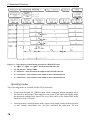
1
6. Streaming I/O Versions
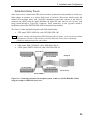
When the card reads the digital words, it sends the results continually into the 1k-sample FIFO
buffer in the DSP. Every time the buffer is half full (512 samples), the DSP sends the values to
host memory or a disk file using bus mastering or DMA transfers.
When the card outputs digital words, it obtains data from one of two sources depending on the
mode.
• In Regenerate mode, it continuously cycles through digital words stored in an onboard
buffer (64k words).
• In Buffered mode, you continuously download the words into the onboard memory in
response to interrupt requests from the board. When generating digital outputs, the perchannel rate is the aggregate rate from system RAM or the disk file divided by the
number of digital output channels.
When not being used in this special counting mode, the card functions similar to the standard
DIO-64/128 card. And when the digital I/O lines are working in this streaming fashion, the
counter/timers are available to the user (TMR1 is used by the input stream and TMR2 by the
output stream operation).
Functional Details
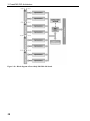
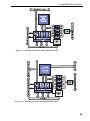
Operation of the PowerDAQ -ST digital I/O boards is based on the pacer clock provided by one of
the integrated DSP counter/timers. Counter/timer 1 (TMR1) is used to pace the input stream, while
counter/timer 2 (TMR2) paces the output stream. At the beginning of a sequence, the counter is
loaded with 0, and at every clock it increments this internal value. When this value equals the
value in the compare register, the counter reloads itself with a Zero and initiates one DSP DMA
transfer (in DMA mode) or invokes a special interrupt service routine (ISR) that transfers data to
or from the DIO port. Thus for every clock, it can process only one port. Every time the DSP input
FIFO is half full (512 samples) or the output FIFO is half empty (32k samples), the DSP processes
collected data or requests more data from the PowerDAQ driver with a PCI interrupt. In the inputstream mode the card supports PCI bus mastering (if enabled from the PowerDAQ Control Panel
applet), thus allowing as many as ten boards to stream data from their DIO ports into PC memory
at 1.6M samples/sec each.
72