1
7
Setup and Wiring
For detailed information on installing and wiring, refer to the product manuals
listed in the Additional Resources.
System Overview
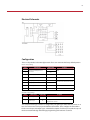
The 1734-IB8S input module monitors OSSD1 and OSSD2 from the 440L light curtain.
If the Light Curtain is blocked, OSSD1 and OSSD2 go LO, and the controller will react by
dropping out the safety contactors.
The 440L has onboard diagnostics to dynamically test the signal wiring for shorts to 24Vdc and
channel to channel shorts. If a fault occurs, either or both OSSD1 and OSSD2 will be set LO,
and the controller will react by dropping out the safety contactors.
Shorts to 0V DC (and wire off) will be seen as an open circuit by the 1734-IB8S input module and the
controller will react by dropping out the safety contactors. If the inputs remain discrepant for longer
than the discrepancy time, then the function block (DCS) in the controller will declare a fault.
Only after the fault is cleared and the light curtain is cycled (blocked, then unblocked) will the
function block reset.
The final control device in this case is a pair of 100S safety contactors, K1 and K2. The contactors
are controlled by a 1734-OBS safety output module. The contactors are wired in a redundant series
configuration. A feedback circuit is wired through the N/O contacts and back to an input on the
1734-IB8S module to monitor the contactors for proper operation. The contactors cannot restart if
the feedback circuit is not in the correct state.
The system has individual reset buttons for resetting faults and safety outputs.
Note that the reset buttons and the contactor feedback circuit are all wired to the 1734-IB8S module
in this example. This is not required for functional safety. These three (3) inputs could be wired to a
standard input module.
Safe Distance Calculation
The user will need to perform a calculation using this formula to determine the distance between
the light curtain and the hazard. The user will need to use values based on their application; rather
than the example calculation shown here:
S = (K * T) + C
K = 63 inches per second (constant from B11.19-1990)
T = stopping time
C = Depth Penetration Factor = 1 inch (for 14mm resolution; from documentation)