1
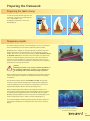
Basal rest mould on the gums
We recommend not veneering the basal application of the bridge pontics
on the gingiva of the alveolar ridge with composite veneers. This area must
be designed from BioHPP in order to ensure the greatest possible strength
in the vertical extension. In the transitions from the composite veneer
to the BioHPP framework material, an undercutting retentive end strip
must be modelled using a wraparound technique (Fig. 3). The BioHPP has
extremely good polishing properties, making direct contact to the gingiva
possible.
3
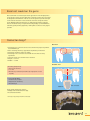
Connector design*
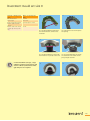
Oral view
• Veneering resin in the buccal basal area should not project beyond the
basal BioHPP layer
• Even veneering thickness, supported everywhere by framework
• Veneering should not taper off sharply
• Veneering in the connector area should not have wide or sharp
separations
• The basal pontic area should not be veneered
• Height: > 3.7 mm
• Width: > 3.5 mm
Veneering (composite):
• Even layer thickness
• 1–2 mm
• Round cusp formation (anatomically shaped, but not too
angled)
4
Palatinal view
5
Framework (BioHPP):
• Anatomically shaped
• Supports the veneering
• Round design
Section
Tooth stump preparation options:
• Wedge with rounded interior edge
• Accentuated chamfer
Not veneered
5
* University of Regensburg UKR, Dr. Rosentritt (DE)
Image: Schwindt Dentallabor, Landau/Pfalz (DE)
7/28