1
4.3.1
A sample session
We present a sample Scilab session, where the randvar class is used to generate samples from the
Normale law.
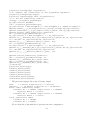
In the following Scilab session, we create a Normale random variable and compute samples
from this law. The nisp_initseed function is used to initialize the seed for the uniform random
variable generator. Then we use the randvar_new function to create a new random variable from
the Normale law with mean 1. and standard deviation 0.5. The main loop allows to compute
1000 samples from this law, based on calls to the randvar_getvalue function. Once the samples
are computed, we use the Scilab function mean to check that the mean is close to 1 (which is
the expected value of the Normale law, when the number of samples is infinite). Finally, we use
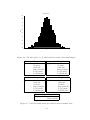
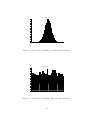
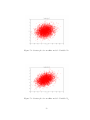
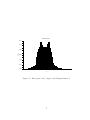
the randvar_destroy function to destroy our random variable. Once done, we plot the empirical
distribution function of this sample, with 50 classes.
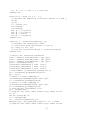
nisp_initseed ( 0 );
mu = 1.0;
sigma = 0.5;
rv = randvar_new ( " Normale " , mu , sigma );
nbshots = 1000;
values = zeros ( nbshots );
for i =1: nbshots
values ( i ) = randvar_getvalue ( rv );
end
mymean = mean ( values );
mysigma = st_deviation ( values );
myvariance = variance ( values );
mprintf ( " Mean is : %f ( expected = %f )\ n " , mymean , mu );
mprintf ( " Standard deviation is : %f ( expected = %f )\ n " , mysigma , sigma );
mprintf ( " Variance is : %f ( expected = %f )\ n " , myvariance , sigma ^2);
randvar_destroy ( rv );
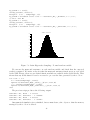
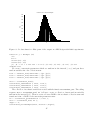
histplot (50 , values )
xtitle ( " Histogram of X " ," X " ," P ( x ) " )
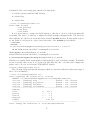
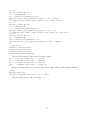
The previous script produces the following output.
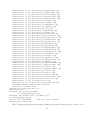
Mean is : 0.988194 ( expected = 1.000000)
Standard deviation is : 0.505186 ( expected = 0.500000)
Variance is : 0.255213 ( expected = 0.250000)
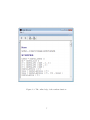
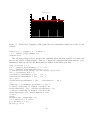
The previous script also produces the figure 4.4.
4.3.2
Variable transformations
In this section, we present the transformation of uniform random variables into other types of
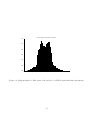
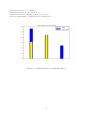
variables. The transformations which are available in the randvar class are presented in figure
4.5. We begin the analysis by a presentation of the theory required to perform transformations.
Then we present some of the many the transformations which are provided by the library.
We now present some additionnal details for the function randvar_getvalue ( rv , rv2 ,
value2 ). This method allows to transform a random variable sample from one law to another.
The statement
22