1
SSB GENERATION - THE PHASING
METHOD
PREPARATION .................................................................................84
the filter method .......................................................................................84
the phasing method...................................................................................84
Weaver’s method......................................................................................85
the SSB signal............................................................................85
the envelope .............................................................................................85
generator characteristics ............................................................86
a phasing generator...................................................................................86
performance criteria .................................................................................88
EXPERIMENT ...................................................................................89
the QPS ......................................................................................89
phasing generator model............................................................90
performance measurement.........................................................91
degree of modulation - PEP.......................................................93
determining rated PEP..............................................................................94
practical observation..................................................................94
TUTORIAL QUESTIONS..................................................................95
SSB generation - the phasing method
Vol A1, ch 7, rev 1.1
- 83
SSB GENERATION - THE
PHASING METHOD
ACHIEVEMENTS: introduction to the QUADRATURE PHASE SPLITTER
module (QPS); modelling the phasing method of SSB generation;
estimation of sideband suppression; definition of PEP.
PREREQUISITES: an acquaintance with DSBSC generation, as in the
experiment entitled DSBSC generation, would be an advantage.
PREPARATION
There are three well known methods of SSB generation using analog techniques,
namely the filter method, the phasing method, and Weaver’s method. This
experiment will study the phasing method.
the filter method
You have already modelled a DSBSC signal.
An SSB signal may be derived from this by the use of a suitable bandpass filter commonly called, in this application, an SSB sideband filter. This, the filter
method, is probably the most common method of SSB generation. Mass
production has given rise to low cost, yet high performance, filters. But these
filters are generally only available at ‘standard’ frequencies (for example 455 kHz,
10.7 MHz) and SSB generation by the filter method at other frequencies can be
expensive. For this reason TIMS no longer has a 100 kHz SSB filter module,
although a decade ago these were in mass production and relatively inexpensive 1.
the phasing method
The phasing method of SSB generation, which is the subject of this experiment,
does not require an expensive filter, but instead an accurate phasing network, or
quadrature phase splitter (QPS). It is capable of acceptable performance in many
applications.
1 analog frequency division multiplex, where these filters were used, has been superseded by time
division multiplex
84 - A1
SSB generation - the phasing method
The QPS operates at baseband, no matter what the carrier frequency (either
intermediate or final), in contrast to the filter of the filter method.
Weaver’s method
In 1956 Weaver published a paper on what has become known either as ‘the third
method’, or ‘Weaver`s method’, of SSB generation 2.
Weaver’s method can be modelled with TIMS - refer to the experiment entitled
Weaver`s SSB generator (within Volume A2 - Further & Advanced Analog
Experiments).
the SSB signal
Recall that, for a single tone message cosµt, a DSBSC signal is defined by:
DSBSC = A.cosµt.cosωt
......... 1
= A/2.cos(ω - µ)t + A/2.cos(ω + µ)t
......... 2
= lower sideband + upper sideband
......... 3
When, say, the lower sideband (LSB) is removed, by what ever method, then the
upper sideband (USB) remains.
......... 4
USB = A/2.cos(ω + µ)t
This is a single frequency component at frequency (ω + µ)/(2.π) Hz. It is a
(co)sine wave. Viewed on an oscilloscope, with the time base set to a few periods
of ω, it looks like any other sinewave.
What is its envelope ?
the envelope
The USB signal of eqn. (4) can be written in the form introduced in the
experiment on Envelopes in this Volume. Thus:
........ 5
USB = a(t).cos[(ω + µ)t + ϕ(t)]
The envelope has been defined as:
........ 6
envelope = | a(t) |
= A/2
[from eqn. (4)]
........ 7
Thus the envelope is a constant (ie., a straight line) and the oscilloscope, correctly
set up, will show a rectangular band of colour across the screen.
This result may seem at first confusing. One tends to ask: ‘where is the message
information’ ?
2 Weaver, D.K., “A third method of generation and detection of single sideband signals”, Proc. IRE,
Dec. 1956, pp. 1703-1705
SSB generation - the phasing method
A1
- 85
answer: the message amplitude information is contained in the
amplitude of the SSB, and the message frequency information is
contained in the frequency offset, from ω, of the SSB.
An SSB derived from a single tone message is a very simple example. When the
message contains more components the SSB envelope is no longer a straight line.
Here is an important finding !
An ideal SSB generator, with a single tone message,
should have a straight line for an envelope.
Any deviation from this suggests extra components in the SSB itself. If there is
only one extra component, say some ‘leaking’ carrier, or an unwanted sideband
not completely suppressed, then the amplitude and frequency of the envelope will
identify the amplitude and frequency of the unwanted component.
generator characteristics
A most important characteristic of any SSB generator is the amount of out-of-band
energy it produces, relative to the wanted output. In most cases this is determined
by the degree to which the unwanted sideband is suppressed 3. A ratio of wantedto-unwanted output power of 40 dB was once considered acceptable commercial
performance; but current practice is likely to call for a suppression of 60 dB or
more, which is not a trivial result to achieve.
a phasing generator.
The phasing method of SSB generation is based on the addition of two DSBSC
signals, so phased that their upper sidebands (say) are identical in phase and
amplitude, whilst their lower sidebands are of similar amplitude but opposite
phase.
The two out-of-phase sidebands will cancel if added; alternatively the in-phase
sidebands will cancel if subtracted.
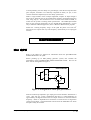
The principle of the SSB phasing generator in illustrated in Figure 1.
Notice that there are two 90o phase changers. One operates at carrier frequency,
the other at message frequencies.
The carrier phase changer operates at a single, fixed frequency, ω rad/s.
The message is shown as a single tone at frequency µ rad/s. But this can lie
anywhere within the frequency range of speech, which covers several octaves. A
network providing a constant 90o phase shift over this frequency range is very
difficult to design. This would be a wideband phase shifter, or Hilbert
transformer.
3 but this is not the case for Weaver's method
86 - A1
SSB generation - the phasing method
DSB
I
π/2
I
π/2
Σ
SSB
cos ω t
cos µ t
(message)
Q
DSB
Q
Figure 1: principle of the SSB Phasing Generator
In practice a wideband phase splitter is used. This is shown in the arrangement of
Figure 2.
DSB
I
I
I
π/2
Σ
QPS
cos µ t
(message)
Q
Q
SSB
cos ω t
DSB
Q
Figure 2: practical realization of the SSB phasing generator
The wideband phase splitter consists of two complementary networks - say I
(inphase) and Q (quadrature). When each network is fed from the same input
signal the phase difference between the two outputs is maintained at 90o. Note
that the phase difference between the common input and either of the outputs is
not specified; it is not independent of frequency.
Study Figures 1 and 2 to ensure that you appreciate the difference.
At the single frequency µ rad/s the arrangements of Figure 1 and Figure 2 will
generate two DSBSC. These are of such relative phases as to achieve the
cancellation of one sideband, and the reinforcement of the other, at the summing
output.
You should be able to confirm this. You could use graphical methods (phasors) or
trigonometrical analysis.
The QPS may be realized as either an active or passive circuit, and depends for its
performance on the accuracy of the components used. Over a wide band of audio
frequencies, and for a common input, it maintains a phase difference between the
SSB generation - the phasing method
A1
- 87
two outputs of 90 degrees, with a small frequency-dependant error (typically
equiripple).
performance criteria
As stated earlier, one of the most important measures of performance of an SSB
generator is its ability to eliminate (suppress) the unwanted sideband. To measure
the ratio of wanted-to-unwanted sideband suppression directly requires a
SPECTRUM ANALYSER. In commercial practice these instruments are very
expensive, and their purchase cannot always be justified merely to measure an
SSB generator performance.
As always, there are indirect methods of measurement. One such method depends
upon a measurement of the SSB envelope, as already hinted.
Suppose that the output of an SSB generator, when the message is a single tone of
frequency µ rad/s, consists only of the wanted sideband W and a small amount of
the unwanted sideband U.
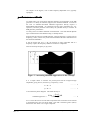
It may be shown that, for U << W, the envelope is nearly sinusoidal and of a
frequency equal to the frequency difference of the two components.
Thus the envelope frequency is (2µ) rad/s.
Figure 3 : measuring sideband suppression via the envelope
It is a simple matter to measure the peak-to-peak and the trough-to-trough
amplitudes, giving twice P, and twice Q, respectively. Then:
................ 6
P=W+U
................ 7
Q= W-U
as seen from the phasor diagram. This leads directly to:
P+Q
20
log
[
] dB
10
sideband suppression =
P−Q
........ 8
If U is in fact the sum of several small components then an estimate of the wanted
to unwanted power ratio can still be made. Note that it would be greater (better)
than for the case where U is a single component.
88 - A1
SSB generation - the phasing method
A third possibility, the most likely in a good design, is that the envelope becomes
quite complex, with little or no stationary component at either µ or µ/2; in this
case the unwanted component(s) are most likely system noise.
Make a rough estimate of the envelope magnitude, complex in shape though it
may well be, and from this can be estimated the wanted to unwanted suppression
ratio, using eqn.(8). This should turn out to be better than 26 dB in TIMS, in
which case the system is working within specification. The TIMS QPS module
does not use precision components, nor is it aligned during manufacture. It gives
only a moderate sideband suppression, but it is ideal for demonstration purposes.
Within the ‘working frequency range’ of the QPS the phase error from 900
between the two outputs will vary with frequency (theoretically in an equi-ripple
manner).
EXPERIMENT
the QPS
Refer to the TIMS User Manual for information about the QUADRATURE
PHASE SPLITTER - the ‘QPS’.
Before patching up an SSB phasing generator system, first examine the
performance of the QUADRATURE PHASE SPLITTER module. This can be
done with the arrangement of Figure 4.
I
in
OSCILLOSCOPE
QPS
Q
Figure 4: arrangement to check QPS performance
With the oscilloscope adjusted to give equal gain in each channel it should show a
circle. This will give a quick confirmation that there is a phase difference of
approximately 90 degrees between the two output sinewaves at the measurement
frequency. Phase or amplitude errors should be too small for this to degenerate
visibly into an ellipse. The measurement will also show the bandwidth over which
the QPS is likely to be useful.
SSB generation - the phasing method
A1
- 89
T1 set up the arrangement of Figure 4. The oscilloscope should be in X-Y
mode, with equal sensitivity in each channel. For the input signal
source use an AUDIO OSCILLATOR module. For correct QPS
operation the display should be an approximate circle. We will not
attempt to measure phase error from this display.
T2 vary the frequency of the AUDIO OSCILLATOR, and check that the
approximate circle is maintained over at least the speech range of
frequencies.
phasing generator model
When satisfied that the QPS is operating satisfactorily, you are now ready to
model the SSB generator. Once patched up, it will be necessary to adjust
amplitudes and phases to achieve the desired result. A hit-and-miss method can be
used, but a systematic method is recommended, and will be described now.
CH1-A
ext. trig
CH2-A
CH1-B
various
Figure 5: the SSB phasing generator model
T3 patch up a model of the phasing SSB generator, following the arrangement
illustrated in Figure 5. Remember to set the on-board switch of the
PHASE SHIFTER to the ‘HI’ (100 kHz) range before plugging it in.
T4 set the AUDIO OSCILLATOR to about 1 kHz
T5 switch the oscilloscope sweep to ‘auto’ mode, and connect the ‘ext trig’ to
an output from the AUDIO OSCILLATOR. It is now synchronized
to the message.
90 - A1
SSB generation - the phasing method
T6 display one or two periods of the message on the upper channel CH1-A of
the oscilloscope for reference purposes. Note that this signal is
used for external triggering of the oscilloscope. This will maintain
a stationary envelope while balancing takes place. Make sure you
appreciate the convenience of this mode of triggering.
Separate DSBSC signals should already exist at the output of each MULTIPLIER.
These need to be of equal amplitudes at the output of the ADDER. You will set
this up, at first approximately and independently, then jointly and with precision,
to achieve the required output result.
T7 check that out of each MULTIPLIER there is a DSBSC signal.
T8 turn the ADDER gain ‘G’ fully anti-clockwise. Adjust the magnitude of the
other DSBSC, ‘g’, of Figure 5, viewed at the ADDER output on
CH2-A, to about 4 volts peak-to-peak. Line it up to be coincident
with two convenient horizontal lines on the oscilloscope graticule
(say 4 cm apart).
T9 remove the ‘g’ input patch cord from the ADDER. Adjust the ‘G’ input to
give approximately 4 volts peak-to-peak at the ADDER output, using
the same two graticule lines as for the previous adjustment.
T10 replace the ‘g’ input patch cord to the ADDER.
The two DSBSC are now appearing simultaneously at the ADDER output.
Now use the same techniques as were used for balancing in the experiment entitled
Modelling an equation in this Volume. Choose one of the ADDER gain controls
(‘g’ or ‘G’) for the amplitude adjustment, and the PHASE SHIFTER for the
carrier phase adjustment.
The aim of the balancing procedure is to
produce an SSB at the ADDER output.
The amplitude and phase adjustments are non-interactive.
performance measurement
Since the message is a sine wave, the SSB will also be a sine wave when the
system is correctly adjusted. Make sure you agree with this statement before
proceeding.
The oscilloscope sweep speed should be such as to display a few periods of the
message across the full screen. This is so that, when looking at the SSB, a
stationary envelope will be displayed.
SSB generation - the phasing method
A1
- 91
Until the system is adjusted the display will look more like a DSBSC, or even an
AM, than an SSB.
Remote from balance the envelope should be stationary, but perhaps not
sinusoidal. As the balance condition is approached the envelope will become
roughly sinusoidal, and its amplitude will reduce. Remember that the pure SSB is
going to be a sinewave 4. As discussed earlier, if viewed with an appropriate time
scale, which you have already set up, this should have a constant (‘flat’) envelope.
This is what the balancing procedure is aiming to achieve.
T11 balance the SSB generator so as to minimize the envelope amplitude.
During the process it may be necessary to increase the oscilloscope
sensitivity as appropriate, and to shift the display vertically so that
the envelope remains on the screen.
T12 when the best balance has been achieved, record results, using Figure 3 as
a guide. Although you need the magnitudes P and Q, it is more
accurate to measure
a)
b)
2P directly, which is the peak-to-peak of the SSB
Q indirectly, by measuring (P-Q), which is the peak-to-peak
of the envelope.
As already stated, the TIMS QPS is not a precision device, and a
sideband suppression of better than 26 dB is unlikely.
You will not achieve a perfectly flat envelope. But its amplitude may be small or
comparable with respect to the noise floor of the TIMS system.
The presence of a residual envelope can be due to any one or more of:
•
•
•
•
leakage of a component at carrier frequency (a fault of one or other
MULTIPLIER 5)
incomplete cancellation of the unwanted sideband due to imperfections of
the QPS 6.
distortion components generated by the MULTIPLIER modules.
other factors; can you suggest any ?
Any of the above will give an envelope ripple period comparable with the period
of the message, rather than that of the carrier. Do you agree with this statement ?
If the envelope shape is sinusoidal, and the frequency is:
• twice that of the message, then the largest unwanted component is due to
incomplete cancellation of the unwanted sideband.
• the same as the message, then the largest unwanted component is at carrier
frequency (‘carrier leak’).
4 for the case of a single-tone message, as you have
5 the TIMS user is not able to make adjustments to a MULTIPLIER balance
6 there is no provision for adjustments to the QPS
92 - A1
SSB generation - the phasing method
If it is difficult to identify the shape of the envelope, then it is probably a
combination of these two; or just the inevitable system noise. An engineering
estimate must then be made of the wanted-to-unwanted power ratio (which could
be a statement of the form ‘better than 45 dB’), and an attempt made to describe
the nature of these residual signals.
T13 if not already done so, use the FREQUENCY COUNTER to identify your
sideband as either upper (USSB) or lower (LSSB). Record also the
exact frequency of the message sine wave from the AUDIO
OSCILLATOR. From a knowledge of carrier and message
frequencies, confirm your sideband is on one or other of the
expected frequencies.
To enable the sideband identification to be confirmed analytically
(see Question below) you will need to make a careful note of the
model configuration, and in particular the sign and magnitude of
the phase shift introduced by the PHASE SHIFTER, and the sign of
the phase difference between the I and Q outputs of the QPS.
Without these you cannot check results against theory.
degree of modulation - PEP
The SSB generator, like a DSBSC generator, has no ‘depth of modulation’, as
does, for example, an AM generator 7. Instead, the output of an SSB transmitter
may be increased until some part of the circuitry overloads, giving rise to
unwanted distortion components. In a good practical design it is the output
amplifier which should overload first 8. When operating just below the point of
overload the transmitter output amplifier is said to be producing its maximum
peak output power - commonly referred to as the ‘PEP’ - an abbreviation for ‘peak
envelope power’.
Depending upon the nature of the message, the amplifier may already have
exceeded its maximum average power output capability. This is generally so with
tones, or messages with low peak-to-average power waveform, but not so with
speech, which has a relatively high peak-to-average power ratio of approximately
14 dB.
When setting up an SSB transmitter, the message amplitude must be so adjusted
that the rated PEP is not exceeded. This is not a trivial exercise, and is difficult to
perform without the appropriate equipment.
7 which has a fixed amplitude carrier term for reference.
8 why ?
SSB generation - the phasing method
A1
- 93
determining rated PEP
The setting up procedure for an SSB transmitter assumes a knowledge of the
transmitter rated PEP. But how is this determined in the first place ? This
question is discussed further in the experiment Amplifier overload.
practical observation
You might be interested to look at both an SSB and a DSBSC signal when derived
from speech. Use a SPEECH module. You can view these signals simultaneously
since the DSBSC is available within the SSB generator.
Q can you detect any difference, in the time domain, between an SSB and a
DSBSC, each derived from (the same) speech ? If so, could you
decide which was which if you could only see one of them ?
94 - A1
SSB generation - the phasing method
TUTORIAL QUESTIONS
Q1 what simple modification(s) to your model would change the output from
the current to the opposite sideband ?
Q2 with a knowledge of the model configuration, and the individual module
properties, determine analytically which sideband (USSB or LSSB)
the model should generate. Check this against the measured result.
Q3 why are mass produced (and, consequently, affordable) 100 kHz SSB filters
not available in the 1990s ?
Q4 what sort of phase error could the arrangement of Figure 4 detect ?
Q5 is the QPS an approximation to the Hilbert transformer ? Explain.
Q6 suggest a simple test circuit for checking QPS modules on the production
line.
Q7 the phasing generator adds two DSBSC signals so phased that one pair of
sidebands adds and the other subtracts.
Show that, if the only
error is one of phasing, due to the QPS, the worst-case ratio of
wanted to unwanted sideband, is given by:
α
SSR = 20 log10 [cot( )]dB
2
where α is the phase error of the QPS.
Typically the phase error would vary over the frequency range in an
equi-ripple manner, so α would be the peak phase error.
Evaluate the SSR for the case α = 1 degree.
Q8 obtain an expression for the envelope of an SSB signal (derived from a
single tone message) when the only imperfection is a small amount
of carrier ‘leaking’ through. HINT: refer to the definition of
envelopes in the experiment entitled Envelopes in this Volume. At
what ratio of sideband to carrier leak would you say the envelope
was roughly sinusoidal ? note: expressions for the envelope of an
SSB signal, for the general message m(t), involve the Hilbert
transform, and the analytic signal.
Q9 sketch the output of an SSB transmitter, as seen in the time domain, when
the message is two audio tones of equal amplitude. Discuss.
Q10 devise an application for the QPS not connected with SSB.
SSB generation - the phasing method
A1
- 95
96 - A1
SSB generation - the phasing method