1
http://www.bio-protocol.org/e1484
Vol 6, Iss 11, Jun 05, 2015
8. Shutdown solution (Beckman Coulter, catalog number: 629968)
9. Stock solutions (see Recipes)
10. Otto 1 solution 0.01% (see Recipes)
11. Otto 1 solution 1% (see Recipes)
12. Otto 1 solution 0.5% (see Recipes)
13. Otto 2 solution (see Recipes)
Equipment
1. 1.2 ml Cluster tube and rack (sterile) (Thermo Fisher Scientific, catalog number:
07-200-320)
2. Storage plate cap strips (Thermo Fisher Scientific, catalog number: AB-0981)
3. 3 mm stainless steel beads (Schieritz & Hauenstein, catalog number: 22.455.0011)
4. Nunc Fritted deep well plates (Thermo Fisher Scientific, catalog number: 278011)
5. 96-well V-bottom plates (SARSTEDT AG, catalog number: 82.1583.001)
6. 200 μl tips (SARSTEDT AG, catalog number: 70.760.002)
7. 1 ml tips (Rainin/Mettler Toledo, catalog number: RC-1000/10)
8. Single channel pipettes (Gilson, catalog number: P10, P1000)
9. Multichannel pipette 10-100 µl (Thermo Fisher Scientific, catalog number 4661130)
10. Multichannel pipette 30-300 µl (Thermo Fisher Scientific, catalog number 4661140)
11. Mixer mill (Retsch, model: MM300)
12. Centrifuge (Eppendorf, model: 5810R)
12. UV lamp ((part of 13. flow cytometer))
13. Flow cytometer (Beckman Coulter, Cell Lab Quanta SC, serial number: AN020010)
14. Flow cytometer robotics (Beckman Coulter, MPL, Cell Lab Quanta SC, serial number:
AN90022)
Procedure
A. Isolation of nuclei by bead-beating (3-4 h)
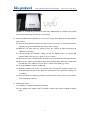
1. Place a single 3 mm stainless steal bead into each cluster tube (Figure 1A).
2. Place cluster tubes into 96-wellrack (Figure 1B).
3. Label the tubes and mark positions of samples (as schematic drawing in the lab book).
4. Fix the silique on a sticky tape and slit it open with a dissection or hypodermic needle
(Figure 1C-D). Add a single mature but still green seed (Figure 1C-D) into each cluster
tube. In Boechera spp. endosperm degrades upon seed maturation. If a fully mature
seed of the species under investigation contains endosperm, the mature seed can be
used. This can be checked by microscopic analyses of cleared seeds at various stages.
The method of clearing depends on the species and should be chosen and adapted
based on published protocols.
2