1
IRIS 2.0 User Manual
10
end while
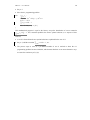
3. W(ai) ← h
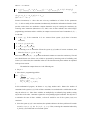
• To find B(ai), the best assignment for an action ai compatible with the constraints:
4. h ← t-1
5. While max{s(ai,bh)-λ: Zx(λ,k1,...,kn)T≥0, k1+...+kn=1} < 0 (variables are λ, k1, ..., kn)
do h ← h - 1
end while
3. W(ai) ← h+1
Except a few rare cases (see Section 3.4.1), an action ai may be assigned to the range of categories
that goes from W(ai) to B(ai) without violating any constraint. The following robust conclusions
(valid for all the acceptable combinations of parameter values) may be drawn for every ai∈A:
• ai is not worse than W(ai);
• ai is not better than B(ai).
Sometimes, W(ai) = B(ai), which means that a precise robust assignment has been found for that
action despite the lack of precise values for the parameter values.
3.4.1. IMPOSSIBLE ASSIGNMENTS WITHIN A RANGE
It may occur that some actions ai∈A cannot be assigned to categories which lay between W(ai) and
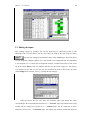
B(ai). As an illustration, let us consider the assignment of an action ai according to four criteria:
C1
b0
C2
ai b1
C3
b2
...
b3
g1(.)
g2(.)
g3(.)
g4(.)
Action ai has performances that are between b2 and b3 according to criteria g1(.) and g2(.). According
to these criteria, it would belong to C3. On the other hand, according to criteria g3(.) and g4(.) it has
performances that are between b0 and b1, hence should belong to C1. If k1 + k2 ≥ λ, then the first two
criteria are important enough to make ai fall into C3; otherwise, a1 falls into C1: there is no
intermediate possibility, i.e. whatever the values for k1, k2, k3, k4, and λ, it is not possible for ai to be
assigned to C2.
In the version of ELECTRE TRI presented in sections 3.1 - 3.2, such impossible
assignments may appear only when an action compares identically with two consecutive profiles,
when discordance does not intervene:
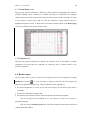
cj(ai,bh-1) = cj(ai,bh), ∀j∈{1,...,n}
1
⇔
ai cannot be assigned to Ch, ∀λ,k1,...,kn.
A very small positive constant ε=0.0001 is added by IRIS to this right-hand-side value to ensure that the
inequality becomes strict. We did not add it here to simplify the presentation.