1
4-8
Analog I/O Ports
Compact Gauges
Compact Gauges are becoming increasingly popular in vacuum applications and share some standard
characteristics: (1) the measurement and control electronics are integrated into a small package (mounted
directly on the gauge head), (2) a modest DC power supply is required to operate the gauge and its
electronics, and (3) pressure data is directly read via an output voltage proportional to the pressure. In its
most popular implementation, the voltage output is related to the log of the pressure and the typical
scaling factor is 1V/decade of pressure (Torr).
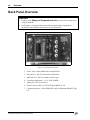
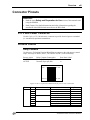
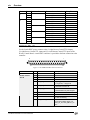
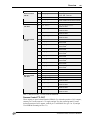
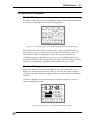
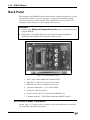
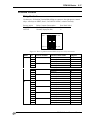
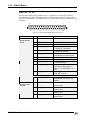
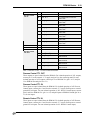
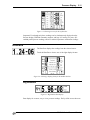
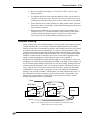
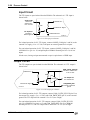
Most compact gauges can be connected directly to the ANALOG I/O ports of the PPM100. The controller
includes a logarithmic scaling mode for the CM pressure calculations which makes it possible to display
compact gauge pressures directly on its front panel. A 1V/decade relationship between voltage output and
pressure is the only requirement for compatibility. To implement this pressure display mode: (1) program
Pmax to the pressure corresponding to a 10V gauge output signal, (2) set CM display=Log. The pressure
readings are displayed in the CM Data box (or Data Bar) associated to the analog port connected to the
gauge.
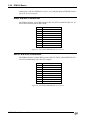
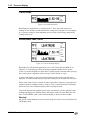
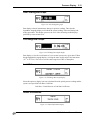
It is also common for Compact Gauges to bracket their useful pressure related output between 2 and
10Vdc. Voltages below 1V indicate a Gauge Off Condition and voltages greater than 10V indicate a Fault
condition. These conditions are detected (by Default) by the PPM 100 when CM Display=Log is selected.
Consult the manufacturer’s power requirements for the compact gauge. It is often possible to use the +/15Vdc auxiliary output provided by the PPM100 to power compact gauges as well as capacitance
manometers.
PPM100 Partial Pressure Monitor