1
D. PERSONAL FALL ARREST SYSTEM: PFASs used with this roof anchor must meet applicable OSHA,
state, federal and ANSI requirements. PFASs incorporating a full body harness must be capable of
arresting a worker’s fall with a maximum arresting force of no greater than 900 lbs. (4 kN) and limit the
free fall distance to 6 ft. (1.8 m) or less. The deceleration distance for a PFAS must be 42 inches (1.1 m)
or less [47 inches (1.2 m) in Canada]. Reference ANSI Z359.1, OSHA and CSA Z259.11 requirements.
The system must be rigged in a way that limits free fall to 6 ft. or less. Contact DBI‑SALA if you have
questions or concerns regarding free fall limits.
e. Surface Structure: The surface on which the Perimeter Limiter is installed must be capable of
supporting the weight of the Perimeter Limiter and any additional loading as a result of fall arrest forces.
Do not install the system on an uneven surface or a slope of greater than 5°.
f. ENVIRONMENTAL HAZARDS: Use of this equipment in areas where environmental hazards exist may
require additional precautions be taken to reduce the possibility of injury to the user or damage to the
equipment. Hazards may include, but are not limited to: high heat, extreme cold, caustic chemicals,
corrosive environments, high voltage power lines, explosive or toxic gases, moving machinery, or
sharp edges. Contact DBI‑SALA if you have questions about using this equipment where environmental
hazards exist.
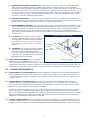
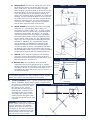
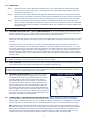
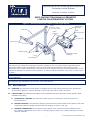
Figure 2 -System Location
g. Location: The Perimeter Limiter must be
located a sufficient distance from the edge of a
working surface. Minimum distance allowable
from the front of the unit is 2 ft. (.6 m) and
from the side of the unit is 3 ft. (.9 m) See
Figure 2.
2 ft Min.
H. TRAINING: This equipment must be installed
and used by persons who have been properly
trained in its correct application and use.
Installation and use of this equipment must be
supervised by a qualified person, as defined by
OSHA fall protection standards.
(.6 m Min.)
Front
Leading Edge
3 ft Min.
(.9 m Min)
Side Leading Edge
1.3 Applicable standards: Refer to national
Standards including ANSI Z359 (.0, .1, .2, .3,
and .4) family of standards on fall protection, ANSI A10.32, and applicable local, state and federal (OSHA)
requirements governing occupational safety for more information about work positioning systems. Refer to
CSA Z259.13 in Canada for more information on personal fall arrest systems and associated components.
2.0SYSTEM REQUIREMENTS
2.1 COMPATIBILITY OF COMPONENTS: DBI‑SALA equipment is designed for use with DBI‑SALA approved
components and subsystems only. Substitutions or replacements made with non-approved components
or subsystems may jeopardize compatibility of equipment and may effect the safety and reliability of the
complete system.
2.2 COMPATIBILITY OF CONNECTORS: Connectors are considered to be compatible with connecting
elements when they have been designed to work together in such a way that their sizes and shapes do
not cause their gate mechanisms to inadvertently open regardless of how they become oriented. Contact
DBI‑SALA if you have any questions about compatibility.
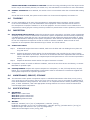
Connectors (hooks, carabiners, and D‑rings) must be capable of supporting at least 5,000 lbs. (22.2 kN).
Connectors must be compatible with the anchorage or other system components. Do not use equipment
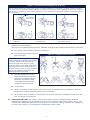
that is not compatible. Non-compatible connectors may unintentionally disengage. See Figure 3. Connectors
must be compatible in size, shape, and strength. Self locking snap hooks and carabiners are required by
ANSI Z359.1 and OSHA and CSA Z259.12 in Canada.
2.3 MAKING CONNECTIONS: Only use self-locking snap hooks and carabiners with this equipment. Only use
connectors that are suitable to each application. Ensure all connections are compatible in size, shape and
strength. Do not use equipment that is not compatible. Ensure all connectors are fully closed and locked.