1
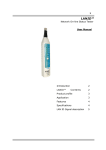
LANID
A comprehensive TOOL for LAN
installation and troubleshooting
User's Manual
Patent Pending
Introduction
Congratulations on your purchase of the LANID Network Device
Identifier! The LANID is the quintessential diagnostic tool for
network installers and troubleshooters working with small LANs.
Using the LANID, network administrators can quickly confirm
features of LAN devices and diagnose problems during LAN
installation. With a push of a button, the LANID will determine
whether the device you are testing whether it supports the
following topologies and capabilities:
Auto negotiation
100BASE-Tx full duplex
100BASE-Tx half duplex
10BASE-T full duplex
10BASE-T half duplex
100BASE-T4
Moreover, the LAN ID can also act as a network device,
negotiating with other LAN devices to determine faults. The
"auto-negotiation" function provides automatic speed matching
for multi-speed devices, allowing devices to configure to the best
possible mode of operation over a link. When linked up with
another LAN device, the LAN ID will provide the following
information about that device:
Whether the link is up or not
Whether the device is transmitting a packet or not
Whether the device is working in full duplex mode or half
duplex mode
Whether the device is operating in 100BASE-Tx, 10BASE-T or
100BASE-T4 mode
Whether a data transmission error has occurred
The compact "pen style" design provides the user with optimum
convenience and portability.
1
6. The tested device is a 10/100 BASE-TX capable of autonegotiation, but is configured at 10Mbps.
LANID Contents
LANID
Users manual
Soft vinyl carrying pouch
One 15cm Twisted pairs RJ45 cable
One RJ45 to RJ45 coupler
(green) AUTO
LINK
100 F
TX
FULL (green)
HALF
100
10 (red)
100 H
10 F
10 H
Product Profile
ERROR
POWER
1
1
PLUG TO HUB`S JACK
2
AUTO NEGOTIATION LED
(10/100 BASE-T GREEN LED
100 BASE-T4 RED LED )
3
100Mbps WITH FULL-DUPLEX LED
4
100Mbps WITH HALF-DUPLEX LED
5
10Mbps WITH FULL-DUPLEX LED
6
10Mbps WITH HALF-DUPLEX LED
7
LINK LED
8
TX LED
7
12
8
9
10
11
2
14
3
4
5
17
6
LINK
STATUS
15
DEVICE
CAPABILITY
13
16
9
FULL-DUPLEX OR HALF-DUPLEX LED
10
100 Mbps OR 10Mbps LED
11
ERROR STATUS LED
12
FOR NIC( Network Interface Card ) JACK
13
POWER LED
14
POWER ON/OFF SWITCH
15
TEST KEY
16
LEFT SIDE FOR DEVICE CAPABILITY
INDICATOR
17
RIGHT SIDE FOR LINK STATUS INDICATOR
NOTE: If you configure a NIC as 10Mbps/full-duplex mode, the device
capability display will be different from the above diagram,
depending on the NIC device driver.
This means your card is capable of 10 or 100 Mbps, but you are
running the card at only 10 Mbps. You should then reconfigure
your card to the maximize speed.
7. The tested device is a 10 BASE-T device, but the battery power
is too low to display reliable results. At this time, you must
replace the battery with a new one.
AUTO
LINK
100 F
TX
100 H
FULL
HALF (red)
100
10 (red)
10 F
10 H
ERROR
(Flashing)
POWER
2
7
4. The tested device is a 10 BASE-T, half-duplex device, linked at
10Mbps in half-duplex mode and is communicating bad
packets.
AUTO
LINK
100 F
TX
100 H
FULL
HALF (red)
100
10 (red)
10 F
10 H
ERROR
POWER
5. The tested device is a 100 BASE-T4 device capable of autonegotiation.
(red) AUTO
LINK
100 F
TX
100 H
FULL
HALF
100
10
ERROR
10 F
10 H
Application
1. HUB Testing
Turn the power switch on and plug the LANID marked "Hub"
into a hub port, wall plate or patch panel that you wish to test.
Push the "TEST" button and read the results
The LANID will determine the status of the port and display the
capabilities of the device connected (left-hand side) as well as
the link status (right-hand side).
2. NIC (Network Interface Card) Testing
Plug the provided patch cable into the "NIC" port on the righthand side ofthe LANID
Push the "TEST" button and read the results
The LANID will display the capabilities of the NIC connected
(left-hand side) as well as the link status (right-hand side).
If you are not sure whether a HUB or NIC is connected on the
other end, you can push the "TEST" button to see if the green
"LINK" LED lights up.
This will tell you that the cable is connected to an NIC or a Hub
uplink port.
Features
IEEE 802.3 compliant Fast Ethernet PHY negotiation
Power down mode significantly reduces power consumption
LED indicators test and monitor line connection status and
determine features of the device being tested
RJ45 connector allows quick and easy connections to most
network devices
Small, handheld pen-style casing allows for convenient
application and portability
POWER
NOTE: LANID does not Link with 100BASE-T4 but it can
advertise in the Auto-Negotiation 100BASE-T4 operation
6
3
2. The tested device is a 10 BASE-T NIC without auto-negotiation
and link at a speed of 10Mbps in half duplex mode.
Specifications
Model number
256655
Connector type
RJ-45
Recommended operation temperature
0 ~ 70
AUTO
LINK
Power supply
DC3V , 2*AAA battery
100 F
TX
Power consumption
350 mW typical
100 W in Power Down Mode
100 H
Display
LED indicator
FULL
HALF (red)
100
10 (red)
Enclosure
Durable plastic housing
Dimensions
215 34 34mm
10 F
10 H
ERROR
POWER
LANID Signal Description
LED is off
LED is on
1. The tested device is a 10/100 BASE-TX half/full duplex device
capable of auto-negotiation and link at a speed of 100Mbps in
full-duplex mode.
(green) AUTO
LINK
100 F
TX
FULL (green)
HALF
100 (green)
10
ERROR
100 H
10 F
10 H
3. The tested device is a 100 BASE-TX full-duplex device
capable linked at 100Mbps in full-duplex mode. It is also
transmitting an auto-negotiation packet.
AUTO
LINK
100 F
TX
FULL (green)
HALF
100 (green)
10
ERROR
100 H
10 F
10 H
POWER
POWER
4
5
2. The tested device is a 10 BASE-T NIC without auto-negotiation
and link at a speed of 10Mbps in half duplex mode.
Specifications
Model number
256655
Connector type
RJ-45
Recommended operation temperature
0 ~ 70
AUTO
LINK
Power supply
DC3V , 2*AAA battery
100 F
TX
Power consumption
350 mW typical
100 W in Power Down Mode
100 H
Display
LED indicator
FULL
HALF (red)
100
10 (red)
Enclosure
Durable plastic housing
Dimensions
215 34 34mm
10 F
10 H
ERROR
POWER
LANID Signal Description
LED is off
LED is on
1. The tested device is a 10/100 BASE-TX half/full duplex device
capable of auto-negotiation and link at a speed of 100Mbps in
full-duplex mode.
(green) AUTO
LINK
100 F
TX
FULL (green)
HALF
100 (green)
10
ERROR
100 H
10 F
10 H
3. The tested device is a 100 BASE-TX full-duplex device
capable linked at 100Mbps in full-duplex mode. It is also
transmitting an auto-negotiation packet.
AUTO
LINK
100 F
TX
FULL (green)
HALF
100 (green)
10
ERROR
100 H
10 F
10 H
POWER
POWER
4
5
4. The tested device is a 10 BASE-T, half-duplex device, linked at
10Mbps in half-duplex mode and is communicating bad
packets.
AUTO
LINK
100 F
TX
100 H
FULL
HALF (red)
100
10 (red)
10 F
10 H
ERROR
POWER
5. The tested device is a 100 BASE-T4 device capable of autonegotiation.
(red) AUTO
LINK
100 F
TX
100 H
FULL
HALF
100
10
ERROR
10 F
10 H
Application
1. HUB Testing
Turn the power switch on and plug the LANID marked "Hub"
into a hub port, wall plate or patch panel that you wish to test.
Push the "TEST" button and read the results
The LANID will determine the status of the port and display the
capabilities of the device connected (left-hand side) as well as
the link status (right-hand side).
2. NIC (Network Interface Card) Testing
Plug the provided patch cable into the "NIC" port on the righthand side ofthe LANID
Push the "TEST" button and read the results
The LANID will display the capabilities of the NIC connected
(left-hand side) as well as the link status (right-hand side).
If you are not sure whether a HUB or NIC is connected on the
other end, you can push the "TEST" button to see if the green
"LINK" LED lights up.
This will tell you that the cable is connected to an NIC or a Hub
uplink port.
Features
IEEE 802.3 compliant Fast Ethernet PHY negotiation
Power down mode significantly reduces power consumption
LED indicators test and monitor line connection status and
determine features of the device being tested
RJ45 connector allows quick and easy connections to most
network devices
Small, handheld pen-style casing allows for convenient
application and portability
POWER
NOTE: LANID does not Link with 100BASE-T4 but it can
advertise in the Auto-Negotiation 100BASE-T4 operation
6
3
6. The tested device is a 10/100 BASE-TX capable of autonegotiation, but is configured at 10Mbps.
LANID Contents
LANID
Users manual
Soft vinyl carrying pouch
One 15cm Twisted pairs RJ45 cable
One RJ45 to RJ45 coupler
(green) AUTO
LINK
100 F
TX
FULL (green)
HALF
100
10 (red)
100 H
10 F
10 H
Product Profile
ERROR
POWER
1
1
PLUG TO HUB`S JACK
2
AUTO NEGOTIATION LED
(10/100 BASE-T GREEN LED
100 BASE-T4 RED LED )
3
100Mbps WITH FULL-DUPLEX LED
4
100Mbps WITH HALF-DUPLEX LED
5
10Mbps WITH FULL-DUPLEX LED
6
10Mbps WITH HALF-DUPLEX LED
7
LINK LED
8
TX LED
7
12
8
9
10
11
2
14
3
4
5
17
6
LINK
STATUS
15
DEVICE
CAPABILITY
13
16
9
FULL-DUPLEX OR HALF-DUPLEX LED
10
100 Mbps OR 10Mbps LED
11
ERROR STATUS LED
12
FOR NIC( Network Interface Card ) JACK
13
POWER LED
14
POWER ON/OFF SWITCH
15
TEST KEY
16
LEFT SIDE FOR DEVICE CAPABILITY
INDICATOR
17
RIGHT SIDE FOR LINK STATUS INDICATOR
NOTE: If you configure a NIC as 10Mbps/full-duplex mode, the device
capability display will be different from the above diagram,
depending on the NIC device driver.
This means your card is capable of 10 or 100 Mbps, but you are
running the card at only 10 Mbps. You should then reconfigure
your card to the maximize speed.
7. The tested device is a 10 BASE-T device, but the battery power
is too low to display reliable results. At this time, you must
replace the battery with a new one.
AUTO
LINK
100 F
TX
100 H
FULL
HALF (red)
100
10 (red)
10 F
10 H
ERROR
(Flashing)
POWER
2
7